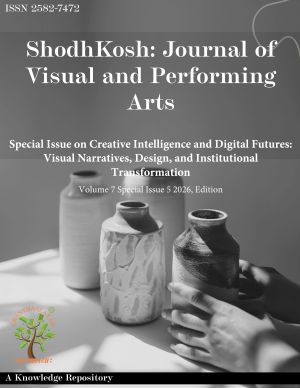
SPECIAL ISSUE ON CREATIVE INTELLIGENCE AND DIGITAL FUTURES: VISUAL NARRATIVES, DESIGN, AND INSTITUTIONAL TRANSFORMATION
DOI:
https://doi.org/10.29121/shodhkosh.v7.i5s.2026.7679Abstract [English]
ShodhKosh: Journal of Visual and Performing Arts invites submissions for the Special Issue, “Creative Intelligence and Digital Futures: Visual Narratives, Design, and Institutional Transformation.” The issue explores how visual culture, digital technologies, and intelligent design are reshaping creativity, communication, and institutions. It welcomes interdisciplinary contributions on illustration, advertising, visual storytelling, AI-assisted design, music and creative genius, digital governance, e-courts, and institutional reform. Scholars, designers, media practitioners, and policy thinkers are encouraged to submit original research, review articles, case studies, and creative-critical works that examine creativity, technology, and systemic transformation in contemporary digital society.
Issue Editor:
Dr. Baliram N. Gaikwad
Lifelong Learning and Extension, University of Mumbai, Maharashtra, India
Email: gaikwadbn@gmail.com
Dr. Swati Vitthal Khidse
Associate Professor, Department of Computer Science and Engineering, CSMSS CHH. SHAHU COLLEGE OF ENGINEERING , Chhatrapati Sambhajinagar, Maharashtra, India
Email: swatikhidse@gmail.com
Dr. Deepa Dixit
Director of SIES School of Business Studies, India
Email: deepasd@sies.edu.in
Nilay Özsavaş Uluçay
Associate Professor, Interior Architecture and Environmental Designer, Muğla Sıtkı Koçman University, Mugla, Turkey
Email: nozsavas@gmail.com
Stephen Olatunde Olabiyisi
Professor, Department of Computer Science Ladoke Akintola University of Technology Ogbomoso, Nigeria
Email: soolabiyisi@lautech.edu.ng / tundeolabiyisi@gmail.com

Published
How to Cite
Issue
Section
License
Copyright (c) 2026 Baliram N. Gaikwad, Dr. Swati Vitthal Khidse, Dr. Deepa Dixit, Nilay Özsavaş Uluçay, Stephen Olatunde Olabiyisi

This work is licensed under a Creative Commons Attribution 4.0 International License.
With the licence CC-BY, authors retain the copyright, allowing anyone to download, reuse, re-print, modify, distribute, and/or copy their contribution. The work must be properly attributed to its author.
It is not necessary to ask for further permission from the author or journal board.
This journal provides immediate open access to its content on the principle that making research freely available to the public supports a greater global exchange of knowledge.





























