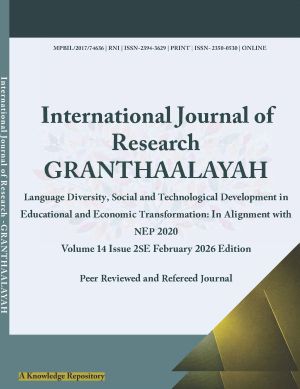
SECOND LANGUAGE ACQUISITION OF AN ASYLUM SEEKER IN SHARON BALA’S THE BOAT PEOPLE
DOI:
https://doi.org/10.29121/granthaalayah.v14.i2SE.2026.6600Keywords:
Second Language Acquisition, Asylum Seeker, The Boat People, Albert Bandura, Social Efficacy TheoryAbstract [English]
Second language acquisition is a critical yet challenging process for asylum seekers. It is often complicated by factors such as trauma, stress, and interrupted education. The study focuses on Mahindan, an asylum seeker who recognised language proficiency as essential for his survival and sustained life in the host country. This paper analyses the second language acquisition journey of Mahindan through Self-efficacy theory by Albert Bandura. The theory posits that an individual’s belief in their capacity to succeed in specific situations serves as a significant determinant of motivation and behaviour. This examination outlines the four elements of Self-efficacy theory. They are performance accomplishments, vicarious experiences, verbal persuasion and emotional arousal. Mahindan in The Boat People formed a rigorous self-regulation to transform his own habits and learning. The paper further discusses the language barriers Mahindan faced, the challenges he overcame, and the efforts he made to achieve his language acquisition goal.
Downloads
References
Al Masri, H., and Abu-Ayyash, E. A. S. (2020). Second Language Acquisition From Syrian Refugees’ Perspectives: Difficulties and Solutions. Open Linguistics, 6(1), 372–385. https://doi.org/10.1515/opli-2020-0025 DOI: https://doi.org/10.1515/opli-2020-0025
Bala, S. (2018). The Boat People. Penguin Random House.
Bandura, A. (1977). Self-Efficacy: Toward a Unifying Theory of Behavioral Change. Psychological Review, 84(2), 191–215. https://doi.org/10.1037/0033-295X.84.2.191 DOI: https://doi.org/10.1037/0033-295X.84.2.191
Dinakaran, S., and Mukherjee, S. (2024). The Trauma of the Civil Conflict on the Masses: An Analysis of Sharon Bala’s The Boat People. World Journal of English Language, 14(3), 521–521. https://doi.org/10.5430/wjel.v14n3p521 DOI: https://doi.org/10.5430/wjel.v14n3p521
Graham, S. (2022). Self-Efficacy and Language Learning—What It Is and What It Isn’t. The Language Learning Journal, 50(2), 186–207. https://doi.org/10.1080/09571736.2022.2045679 DOI: https://doi.org/10.1080/09571736.2022.2045679
Haggbloom, S. J., Warnick, R., Warnick, J. E., Jones, V. K., Yarbrough, G. L., Russell, T. M., Borecky, C. M., McGahhey, R., Powell, J. L., Beavers, J., and Monte, E. (2002). The 100 Most Eminent Psychologists of the 20th Century. Review of General Psychology, 6(2), 139–152. https://doi.org/10.1037/1089-2680.6.2.139 DOI: https://doi.org/10.1037//1089-2680.6.2.139
Shultz, C., Rahtz, D., Sirgy, M. J., and Lee, D.-J. (2020). The Global Refugee Crisis: Pathway for a More Humanitarian Solution. Journal of Macromarketing, 40(1), 128–143. https://doi.org/10.1177/0276146719896390 DOI: https://doi.org/10.1177/0276146719896390
United Nations High Commissioner for Refugees. (2020). Global Trends: Forced Displacement in 2019. United Nations Publications. https://doi.org/10.18356/9789211066012 DOI: https://doi.org/10.18356/9789211066012

Published
How to Cite
Issue
Section
License
Copyright (c) 2026 Gokila S, Dr. S. Boopathi

This work is licensed under a Creative Commons Attribution 4.0 International License.
With the licence CC-BY, authors retain the copyright, allowing anyone to download, reuse, re-print, modify, distribute, and/or copy their contribution. The work must be properly attributed to its author.
It is not necessary to ask for further permission from the author or journal board.
This journal provides immediate open access to its content on the principle that making research freely available to the public supports a greater global exchange of knowledge.