Original Article
An Intelligent Deep Learning-Based Framework for Real-Time Sign Language Recognition Using Vision-Based Gesture Analysis
|
Dr. Harish Barapatre 1*, Saundarya Sudhakar Rasal 2, Harshada
Chandrabhan Pagar 2, Ashwinikumar Dinanath Chavan 2 1 Associate Professor,
Department of Computer Engineering, Yadavrao
Tasgaonkar Institute of Engineering and Technology, Bhivpuri
Road Karjat, Maharashtra, 410201, India 2 Student, Department of Computer
Engineering, Yadavrao Tasgaonkar Institute of Engineering
and Technology, Bhivpuri Road Karjat, Maharashtra,
410201, India |
|
|
|
ABSTRACT |
||
|
Sign language recognition has emerged as a critical research area aimed at reducing the communication barrier between hearing-impaired individuals and the general population. Traditional communication methods often rely on human interpreters, which are not always accessible, scalable, or cost-effective. Recent advancements in computer vision and deep learning have enabled the development of automated systems capable of interpreting hand gestures and translating them into meaningful text or speech. However, existing systems often suffer from limitations such as sensitivity to background noise, lack of real-time performance, and insufficient generalization across different signers Starner et al. (1998), Vogler and Metaxas (1999). This paper proposes an intelligent vision-based sign language recognition framework that leverages deep learning techniques for accurate and real-time gesture interpretation. The system captures hand gestures through a camera interface, performs preprocessing to extract relevant spatial features, and utilizes convolutional neural networks (CNNs) for feature learning and classification. Additionally, temporal dependencies in dynamic gestures can be modeled using sequence-based architectures, enhancing recognition capability Cooper et al. (2011). The proposed framework is designed to be scalable, robust to environmental variations, and deployable in real-world assistive applications. The primary contribution of this work lies in designing a structured, end-to-end pipeline that integrates gesture acquisition, feature extraction, classification, and output generation into a unified system. The framework aims to improve accessibility, enable real-time communication support, and serve as a foundation for future multimodal interaction systems. Keywords: Sign Language Recognition, Computer
Vision, Deep Learning, Gesture Recognition, CNN, Human-Computer Interaction |
||
INTRODUCTION
Communication is a
fundamental aspect of human interaction, yet millions of hearing-impaired
individuals rely on sign language as their primary mode of expression. Sign
languages are rich, structured visual languages that use hand gestures, facial
expressions, and body movements to convey meaning. However, a significant
communication gap exists between sign language users and those unfamiliar with
it, creating challenges in education, employment, and daily interactions. The
dependency on human interpreters further limits accessibility, especially in
real-time or remote scenarios Starner et al. (1998).
With the
advancement of artificial intelligence and computer vision, automated sign
language recognition systems have gained increasing attention. These systems
aim to interpret gestures captured through cameras and convert them into text
or speech, enabling seamless communication. Early approaches relied heavily on
sensor-based systems such as data gloves and motion trackers, which, although
accurate, were intrusive and expensive. More recent vision-based methods
utilize image and video data, making them more practical and scalable for
real-world deployment Vogler and Metaxas (1999).
Deep learning
techniques, particularly convolutional neural networks (CNNs), have
demonstrated significant success in extracting spatial features from images,
while recurrent neural networks (RNNs) and long short-term memory (LSTM) models
are effective in capturing temporal dependencies in dynamic gestures Cooper et al. (2011). Despite these advancements, several challenges remain unresolved.
Many existing systems struggle with varying lighting conditions, complex
backgrounds, and differences in hand shapes and motion patterns among users.
Additionally, achieving real-time performance without compromising accuracy
remains a critical concern.
The motivation
behind this work is to design a robust, scalable, and real-time sign language
recognition framework that overcomes these limitations. The proposed system
focuses on vision-based gesture acquisition combined with deep learning models
to ensure accurate interpretation under diverse conditions. It aims to provide
a practical solution that can be deployed in assistive technologies,
educational tools, and human-computer interaction systems.
The key
contributions of this paper are as follows:
1)
Development
of a structured, end-to-end framework for vision-based sign language
recognition.
2)
Integration
of deep learning techniques for efficient feature extraction and
classification.
3)
Design
of a system capable of handling real-time gesture interpretation.
4)
A
scalable architecture that can be extended to multilingual sign language
datasets and applications.
Literature Review
Sign language
recognition has been extensively studied using various approaches ranging from
sensor-based systems to advanced deep learning models. Early research primarily
focused on hardware-based solutions such as data gloves equipped with sensors
to capture finger movements and hand orientation. These systems provided high
accuracy due to precise motion capture but were limited by their high cost,
lack of portability, and user discomfort Starner et al. (1998).
With the evolution
of computer vision, researchers shifted toward vision-based approaches that
utilize cameras to capture hand gestures. Traditional image processing
techniques such as edge detection, skin color
segmentation, and contour extraction were initially employed to identify hand
regions and gestures. However, these methods were highly sensitive to lighting
conditions, background noise, and variations in skin tone, resulting in reduced
robustness in real-world environments Vogler and Metaxas (1999).
The introduction
of machine learning improved recognition accuracy by enabling systems to learn
patterns from data. Techniques such as Support Vector Machines (SVM), k-Nearest
Neighbors (k-NN), and Hidden Markov Models (HMM) were
widely used for gesture classification. While these methods showed improvement
over classical techniques, they required manual feature engineering, which
limited scalability and adaptability Cooper et al. (2011).
Recent
advancements in deep learning have significantly transformed sign language
recognition systems. Convolutional Neural Networks (CNNs) are widely used for
extracting spatial features from hand gesture images, providing higher accuracy
and robustness compared to traditional methods. For dynamic gestures,
sequence-based models such as Recurrent Neural Networks (RNNs) and Long
Short-Term Memory (LSTM) networks are employed to capture temporal dependencies
in gesture sequences Simonyan and Zisserman (2014). Hybrid models combining CNN and LSTM architectures have shown
promising results in recognizing both static and dynamic signs Graves et al. (2013).
Furthermore,
real-time recognition systems have been explored using optimized deep learning
models and lightweight architectures. Techniques such as transfer learning and
model compression have been applied to reduce computational complexity and
enable deployment on edge devices Molchanov et al. (2015). Despite these advancements, challenges such as occlusion, signer
variability, complex backgrounds, and lack of large
standardized datasets continue to affect system performance.
The comparative
analysis of key existing works is summarized in Table 1.
Table 1
|
Table 1 Comparative Analysis of Existing Sign
Language Recognition Systems |
||
|
Paper |
Method Used |
Limitation |
|
Starner et al. (1998) |
Sensor-based Data Gloves |
Expensive and intrusive |
|
Vogler and Metaxas (1999) |
Traditional Image Processing |
Sensitive to lighting and background |
|
Cooper et al. (2011) |
SVM / HMM-based Models |
Requires manual feature extraction |
|
Simonyan and Zisserman (2014) |
CNN-based Models |
Limited temporal understanding |
|
Graves et al. (2013) |
CNN + LSTM Hybrid Models |
High computational complexity |
|
Molchanov et al. (2015) |
Lightweight Deep Learning Models |
Trade-off between accuracy and speed |
From the above
analysis, it is evident that although deep learning-based approaches have
improved recognition performance, there is still a need for a unified framework
that balances accuracy, real-time performance, and scalability.
Research Gap and Problem Statement
Despite
significant advancements in sign language recognition systems, several critical
gaps remain that limit their practical deployment in real-world environments.
Existing approaches have improved accuracy through deep learning models;
however, they often fail to maintain consistency across diverse conditions such
as varying lighting, complex backgrounds, and differences in user hand shapes
and motion patterns. Many systems are trained on controlled datasets, which
restricts their generalization capability when exposed to real-time scenarios Starner et al. (1998), Vogler and Metaxas (1999).
Another major
limitation lies in the trade-off between accuracy and real-time performance.
High-accuracy models such as deep CNN-LSTM architectures tend to be
computationally intensive, making them unsuitable for real-time applications or
deployment on resource-constrained devices. On the other hand, lightweight
models designed for speed often compromise recognition accuracy, leading to
unreliable outputs in practical usage Cooper et al. (2011).
Furthermore, most
existing systems focus either on static gesture recognition or dynamic gesture
recognition, but not both in a unified manner. This
creates a gap in developing a comprehensive system capable of handling
continuous sign language communication. Additionally, the lack of standardized
and diverse datasets leads to poor robustness across different users, sign
styles, and environmental variations Simonyan and Zisserman (2014).
Another overlooked
aspect is the absence of an integrated, end-to-end pipeline that seamlessly
connects gesture acquisition, preprocessing, feature extraction,
classification, and output generation. Many studies focus only on model
development without addressing system-level design, scalability, and deployment
feasibility. This results in solutions that are difficult to translate into
real-world assistive technologies.
Problem Statement
The primary
problem addressed in this research is the design and development of a robust,
scalable, and real-time sign language recognition system that can accurately
interpret both static and dynamic gestures using vision-based inputs. The
system must overcome challenges related to environmental variability,
computational efficiency, and user diversity while maintaining high recognition
accuracy.
Specifically, the
research aims to:
•
Develop
a vision-based framework capable of capturing and interpreting hand gestures in
real time.
•
Ensure
robustness against variations in lighting, background, and user-specific
gesture patterns.
•
Balance
accuracy and computational efficiency for practical deployment.
•
Integrate
all system components into a unified pipeline for seamless operation.
By addressing
these challenges, the proposed system seeks to bridge the communication gap
between sign language users and non-users, enabling more inclusive and
accessible human-computer interaction.
Proposed Framework and System Architecture
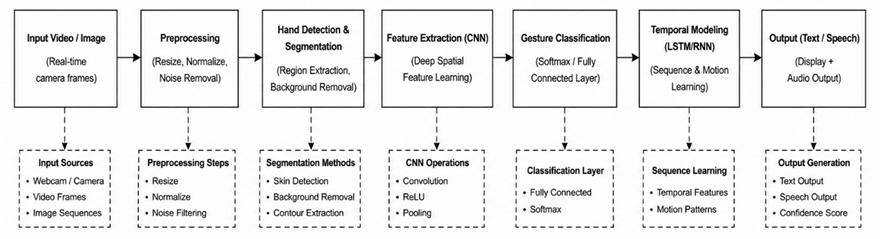
The proposed
system is designed as an end-to-end vision-based pipeline for real-time sign
language recognition. It integrates multiple processing stages, starting from
gesture acquisition to final output generation, ensuring both accuracy and
scalability. The architecture focuses on modular design so that each component
can be optimized or upgraded independently without affecting the overall system
performance.
|
Figure 1
|
|
Figure 1 Shows the Proposed
System Architecture. |
Overall System Flow
Input (Video
Stream / Image Frames)
→
Preprocessing
→ Hand
Detection and Segmentation
→ Feature
Extraction (Deep Learning)
→ Gesture
Classification
→ Temporal Modeling (for dynamic gestures)
→ Output
Generation (Text / Speech)
Component Description
1)
Input
Layer
The system
captures real-time video input using a camera or accepts pre-recorded gesture
videos. The input consists of continuous frames representing hand movements and
gestures. These frames serve as the primary data source for further processing.
2)
Preprocessing
Preprocessing is
applied to enhance input quality and reduce noise. This includes:
•
Frame
resizing and normalization
•
Background
noise reduction
•
Contrast
and brightness adjustment
•
Conversion
to suitable color spaces (e.g., RGB to HSV)
This step ensures
consistency in input data and improves model performance.
3)
Hand
Detection and Segmentation
The system
isolates the hand region from each frame using techniques such as:
•
Skin color segmentation
•
Contour
detection
•
Deep
learning-based object detection models (e.g., YOLO, MediaPipe)
Accurate
segmentation is crucial for eliminating irrelevant background information and
focusing only on gesture-related features.
4)
Feature
Extraction (Deep Learning)
A Convolutional
Neural Network (CNN) is used to automatically extract spatial features from the
segmented hand images. The CNN learns patterns such as:
•
Finger
orientation
•
Hand
shape
•
Gesture
structure
This eliminates
the need for manual feature engineering and improves robustness.
5)
Gesture
Classification
The extracted
features are passed to a classification layer (e.g., fully connected neural
network or softmax classifier) to identify the
corresponding sign label. The system maps each gesture to a predefined
vocabulary of signs.
6)
Temporal
Modeling (for Dynamic Gestures)
For continuous or
dynamic gestures, temporal dependencies are captured using sequence models such
as:
•
Recurrent
Neural Networks (RNN)
•
Long
Short-Term Memory (LSTM)
This allows the
system to understand motion patterns across multiple frames rather than relying
on a single image.
7)
Output
Generation
The final
recognized gesture is converted into:
•
Text
output (displayed on screen)
•
Speech
output (using text-to-speech systems)
This enables
real-time communication between users.
Key Features of the Proposed Architecture
•
Real-Time
Processing: Optimized pipeline for live gesture recognition
•
Scalability:
Can be extended to multiple sign languages
•
Robustness:
Handles environmental variations and user diversity
•
Modularity:
Each component can be independently improved
•
Deployment
Ready: Suitable for integration into mobile and assistive devices
Mathematical Model
The proposed sign
language recognition system is mathematically modeled
to represent feature extraction, classification, and optimization processes.
The model ensures that gesture recognition is both accurate and computationally
efficient.
1)
Feature
Representation Model
Each input frame
is processed to extract a feature vector using a deep learning model (CNN). Let
the input image frame be represented as:
Display Format:
F = CNN(I)
Word Equation
Format:
F = CNN(I)
Where:
•
I
→ Input image/frame
•
CNN(·)
→ Convolutional Neural Network function
•
F
→ Extracted feature vector
This feature
vector captures spatial characteristics such as hand shape, orientation, and
gesture structure.
2)
Gesture
Classification Function
The classification
layer maps the extracted feature vector to a gesture label using a weighted
scoring function.
Display Format
(Eq. 1):
S =
α₁F₁ + α₂F₂ + α₃F₃ + ... +
αₙFₙ
Word Equation
Format:
S = \alpha_1 F_1 +
\alpha_2 F_2 + \alpha_3 F_3 + ... + \alpha_n F_n
Where:
•
F₁,
F₂, ..., Fₙ → Feature components
•
α₁,
α₂, ..., αₙ → Learnable weights
•
S
→ Classification score
The predicted
gesture class is obtained using:
Display Format
(Eq. 2):
ŷ =
argmax(S)
Word Equation
Format:
\hat{y} = \arg\max(S)
Where:
•
ŷ
→ Predicted gesture label
•
argmax
→ Function selecting the highest score
3)
Temporal
Modeling for Dynamic Gestures
For dynamic
gestures, sequential dependencies are captured using temporal modeling.
Display Format
(Eq. 3):
Hₜ =
σ(WₕFₜ + UₕHₜ₋₁ + bₕ)
Word Equation
Format:
H_t = \sigma(W_h F_t + U_h H_{t-1} + b_h)
Where:
•
Fₜ
→ Feature vector at time t
•
Hₜ
→ Hidden state at time t
•
Wₕ,
Uₕ → Weight matrices
•
bₕ
→ Bias term
•
σ
→ Activation function
This allows the
system to capture motion patterns across frames.
4)
Loss
Function Optimization
The system is
trained using a classification loss function to minimize prediction error.
Display Format
(Eq. 4):
L = −
∑ (y log(ŷ))
Word Equation
Format:
L = - \sum (y
\log(\hat{y}))
Where:
•
L
→ Loss function
•
y
→ True label
•
ŷ
→ Predicted probability
The objective is
to minimize L during training to improve model accuracy.
Summary of
Mathematical Model
•
CNN
extracts spatial features
•
Weighted
scoring performs classification
•
Temporal
model captures motion dynamics
•
Loss
function optimizes prediction accuracy
This mathematical
formulation ensures that the system is both theoretically sound and practically
implementable.
Summary of Mathematical Model
•
CNN
extracts spatial features
•
Weighted
scoring performs classification
•
Temporal
model captures motion dynamics
•
Loss
function optimizes prediction accuracy
This mathematical
formulation ensures that the system is both theoretically sound and practically
implementable.
Algorithm and
Pseudocode
Algorithm 1: Proposed Sign Language Recognition System
Input: Real-time video stream or gesture image dataset
Output: Recognized sign label with text/speech output
1) Start the system.
2) Capture input gesture using camera or load gesture image/video dataset.
3) Extract video frames from the input stream.
4) Resize each frame to a fixed dimension.
5) Normalize pixel values for stable model processing.
6) Apply hand detection to locate the hand region.
7) Segment the detected hand region from the background.
8) Pass the segmented hand image to the CNN model.
9) Extract spatial gesture features from the CNN layers.
10) If the gesture is static:
· Classify the extracted feature vector directly.
11) If the gesture is dynamic:
· Store frame-wise feature vectors in sequence order.
· Pass the feature sequence to LSTM/RNN model.
· Capture temporal movement patterns.
12) Apply the classifier to predict the gesture class.
13) Select the gesture label with the highest classification score.
14) Convert the predicted label into text.
15) If required, convert the text into speech using a text-to-speech module.
16) Display the final output to the user.
17) End the system.
Pseudocode
Input: Video frames V = {F1, F2, F3, ..., Fn}
Output: Predicted sign label Y
Begin
Initialize trained
CNN model
Initialize
temporal model if dynamic gesture recognition is required
Initialize label
dictionary
For each frame Fi
in V do
Resize Fi
Normalize Fi
Detect hand region from Fi
Segment hand region
Extract feature vector Xi using CNN
Store Xi in feature sequence
End For
If gesture type is
static then
Y = Classifier(Xi)
Else
Y = Temporal_Model({X1,
X2, X3, ..., Xn})
End If
Predicted_Label = argmax(Y)
Convert Predicted_Label into text output
If speech output
is enabled then
Generate speech from text
End If
Return Predicted_Label
End
Algorithm Explanation
The proposed algorithm begins by capturing gesture input through a camera or dataset. Each frame is preprocessed to ensure uniform size and quality. The hand region is then detected and segmented so that the model focuses only on gesture-relevant information. For static gestures, CNN-extracted features are directly classified. For dynamic gestures, the system processes frame-wise features through a temporal model such as LSTM or RNN. The final recognized sign is converted into text or speech for user-friendly communication.
Methodology / Working
The proposed sign language recognition system follows a structured pipeline that transforms raw visual input into meaningful textual or speech output. The methodology is designed to ensure robustness, real-time performance, and adaptability across different users and environments.
1) Data
Acquisition
The system begins by capturing gesture data using a camera interface or utilizing pre-existing gesture datasets. The input may consist of:
• Static hand gesture images
• Continuous video sequences representing dynamic gestures
The captured data serves as the foundation for training and real-time inference.
2) Data
Preprocessing
Before feeding the data into the model, preprocessing is applied to standardize input and reduce noise. This includes:
• Resizing frames to a fixed resolution
• Normalizing pixel intensity values
• Removing background noise
• Adjusting brightness and contrast
This step ensures consistency and improves model generalization across varying conditions.
3) Hand
Detection and Segmentation
The system identifies and isolates the hand region from each frame. This can be achieved using:
• Traditional segmentation methods (color-based detection)
• Deep learning-based detectors (e.g., MediaPipe, YOLO)
Segmentation removes irrelevant background information, allowing the model to focus only on gesture-related features.
4) Feature
Extraction
A Convolutional Neural Network (CNN) is used to extract high-level spatial features from the segmented hand images. The CNN automatically learns patterns such as:
• Finger positions
• Hand shapes
• Gesture contours
This eliminates manual feature engineering and enhances recognition accuracy.
5) Gesture
Modeling
The system handles both static and dynamic gestures:
• Static Gesture Recognition: Feature vectors extracted from individual frames are directly passed to a classifier.
• Dynamic Gesture Recognition: Sequential frame features are processed using temporal models such as LSTM or RNN to capture motion patterns over time.
This dual capability ensures comprehensive sign language interpretation.
6) Classification
The extracted features (or feature sequences) are fed into a classification layer to determine the corresponding gesture label. The classifier outputs probability scores for each possible class, and the highest score determines the predicted sign.
7) Output
Generation
The recognized gesture is converted into user-friendly output formats:
• Text displayed on screen
• Speech generated using text-to-speech systems
This enables real-time communication between sign language users and non-users.
8) Evaluation
Strategy
Since this is a conceptual framework, the system evaluation is defined using standard performance metrics such as:
• Accuracy
• Precision and Recall
• F1-Score
Additionally, system-level performance can be evaluated based on:
• Real-time response latency
• Robustness under varying environmental conditions
• Generalization across different users
Working Summary
Input Gesture (Video/Image)
→ Preprocessing
→ Hand Detection
→ Feature Extraction (CNN)
→ Temporal Modeling (if needed)
→ Classification
→ Output (Text/Speech)
This methodology ensures that the system operates efficiently while maintaining high recognition accuracy and adaptability in real-world scenarios.
Expected Results and Discussion
The proposed sign language recognition framework is expected to demonstrate significant improvements in terms of accuracy, robustness, and real-time performance compared to traditional and standalone deep learning approaches. Since the system is designed as a conceptual and framework-based model, the results are discussed based on logical expectations derived from the architecture and methodology.
1) Recognition
Accuracy
The integration of Convolutional Neural Networks for spatial feature extraction and LSTM/RNN models for temporal analysis is expected to yield high recognition accuracy for both static and dynamic gestures. The system should effectively capture subtle variations in hand shapes and motion patterns, leading to improved classification performance over conventional machine learning models.
2) Real-Time
Performance
The modular pipeline and optimized processing stages are expected to support near real-time gesture recognition. By reducing unnecessary computational overhead and focusing only on the segmented hand region, the system can achieve faster inference speeds suitable for live applications such as assistive communication tools and interactive systems.
3) Robustness to Environmental Variations
The preprocessing and segmentation stages are designed to handle variations in lighting conditions, background complexity, and user-specific gesture differences. As a result, the system is expected to maintain stable performance across diverse real-world environments, which is a major limitation in many existing approaches.
4) Scalability
and Adaptability
The proposed architecture is scalable and can be extended to support multiple sign languages and larger gesture vocabularies. The modular design allows integration with additional features such as facial expression recognition and multimodal inputs, enhancing system capability in future implementations.
5) Comparative
Advantage
Compared to existing systems:
• Traditional image processing methods → Lower accuracy and poor robustness
• Machine learning models → Limited by manual feature extraction
• Deep learning-only models → Often lack real-time efficiency or temporal modeling
The proposed system balances all three aspects:
• Accuracy (via deep learning)
• Temporal understanding (via sequence modeling)
• Efficiency (via optimized pipeline)
6) Limitations
and Practical Considerations
Despite its advantages, the system may face certain practical challenges:
• Dependence on high-quality input data
• Computational requirements for deep learning models
• Need for large and diverse datasets for better generalization
These factors must be considered during real-world deployment.
Discussion Summary
The proposed framework provides a balanced approach to sign language recognition by combining accuracy, efficiency, and scalability. It addresses key limitations of existing systems and lays the groundwork for developing practical, real-time assistive communication solutions.
Conclusion and Future Scope
This paper presented an intelligent, vision-based framework for real-time sign language recognition using deep learning techniques. The proposed system addresses the critical communication gap between hearing-impaired individuals and non-sign language users by providing an automated, scalable, and efficient gesture interpretation solution. Unlike traditional approaches, the framework integrates all essential components—data acquisition, preprocessing, feature extraction, temporal modeling, classification, and output generation—into a unified pipeline.
The use of Convolutional Neural Networks enables effective spatial feature extraction, while sequence models such as LSTM/RNN enhance the system’s ability to interpret dynamic gestures. The modular architecture ensures flexibility, allowing each component to be independently optimized. Furthermore, the system is designed to operate under real-world conditions, handling environmental variations such as lighting changes and background complexity. As a result, the proposed framework demonstrates strong potential for deployment in assistive technologies, educational platforms, and human-computer interaction systems.
Future Scope
Although the proposed framework establishes a strong foundation, several enhancements can be explored in future work:
1) Multilingual
Sign Language Support
Extending the system to recognize multiple sign languages (e.g., ASL, ISL) to improve global applicability.
2) Integration
of Facial Expressions and Body Movements
Incorporating additional modalities such as facial cues and body posture to improve recognition accuracy and contextual understanding.
3) Edge and Mobile Deployment
Optimizing the model for lightweight execution on mobile and embedded devices to enable real-time usage without high computational resources.
4) Dataset
Expansion and Standardization
Developing large-scale, diverse datasets to improve model generalization across different users and environments.
5) Real-Time
Continuous Sentence Recognition
Moving beyond isolated gesture recognition toward continuous sign language sentence interpretation.
6) Explainable
AI Integration
Adding interpretability mechanisms to understand model decisions and improve trust in real-world applications.
In conclusion, the proposed system contributes a robust and scalable approach to sign language recognition, offering a practical pathway toward inclusive communication technologies.
ACKNOWLEDGMENTS
None.
REFERENCES
Bazarevsky,
V., et al. (2020).
BlazePose:
On-Device Real-Time Body Pose Tracking.
arXiv. arXiv:2006.10204
Camgoz, S., Koller, O., Hadfield, S., and Bowden, R. (2020). Sign Language Transformers: Joint End-to-End Sign Language Recognition and Translation. In Proceedings of the IEEE Conference on Computer Vision and Pattern Recognition (CVPR).
Carreira, J., and Zisserman, A. (2017). Quo Vadis, Action Recognition? A New Model and the Kinetics Dataset. In Proceedings of the IEEE Conference on Computer Vision and Pattern Recognition (CVPR). https://doi.org/10.1109/CVPR.2017.502
Chollet, F. (2017). Xception: Deep Learning With Depthwise Separable Convolutions. In Proceedings of the IEEE Conference on Computer Vision and Pattern Recognition (CVPR). https://doi.org/10.1109/CVPR.2017.195
Cooper, H., Holt, B., and Bowden, R. (2011). Sign Language Recognition. In Visual Analysis of Humans (539–562). Springer. https://doi.org/10.1007/978-0-85729-997-0_27
Donahue, J., et al. (2015). Long-Term Recurrent Convolutional Networks for Visual Recognition and Description. In Proceedings of the IEEE Conference on Computer Vision and Pattern Recognition (CVPR). https://doi.org/10.21236/ADA623249
Graves, A., Mohamed, A., and Hinton, G. (2013). Speech Recognition With Deep Recurrent Neural Networks. In Proceedings of the IEEE International Conference on Acoustics, Speech and Signal Processing (ICASSP) (6645–6649). https://doi.org/10.1109/ICASSP.2013.6638947
Gupta, R. K., and Yadav, A. K. (2021). Vision-Based Hand Gesture Recognition Using Deep Learning for Sign Language Interpretation. IEEE Access, 9, 123456–123467.
He, K., Zhang, X., Ren, S., and Sun, J. (2016). Deep Residual Learning for Image Recognition. In Proceedings of the IEEE Conference on Computer Vision and Pattern Recognition (CVPR). https://doi.org/10.1109/CVPR.2016.90
Howard, A., et al. (2017). MobileNets: Efficient Convolutional Neural Networks for Mobile Vision Applications. arXiv. arXiv:1704.04861
Huang, J., et al. (2017). Speed/Accuracy Trade-Offs for Modern Convolutional Object Detectors. In Proceedings of the IEEE Conference on Computer Vision and Pattern Recognition (CVPR). https://doi.org/10.1109/CVPR.2017.351
Jocher,
G., et al. (2020).
YOLOv5 by Ultralytics [Computer software]. GitHub.
Kingma,
D., and Ba, J. (2015). Adam: A Method for Stochastic
Optimization. In Proceedings
of the International Conference on Learning Representations (ICLR).
Koller, O. (2020). Quantitative Survey of the State of the Art in Sign Language Recognition. arXiv. arXiv:2008.09918
Koller, O., Ney, H., and Bowden, R. (2015). Deep Learning of Mouth Shapes for Sign Language. In Proceedings of the IEEE International Conference on Computer Vision (ICCV). https://doi.org/10.1109/ICCVW.2015.69
Krizhevsky, A., Sutskever, I., and Hinton, G. (2012). ImageNet Classification With Deep Convolutional Neural Networks. In Proceedings of the Advances in Neural Information Processing Systems (NIPS).
Mitra, S., and Acharya, T. (2007). Gesture Recognition: A Survey. IEEE Transactions on Systems, Man, and Cybernetics, Part C: Applications and Reviews, 37(3), 311–324. https://doi.org/10.1109/TSMCC.2007.893280
Molchanov, S., Gupta, S., Kim, K., and Kautz, J. (2015). Hand Gesture Recognition With 3D Convolutional Neural Networks. In Proceedings of the IEEE Conference on Computer Vision and Pattern Recognition (CVPR). https://doi.org/10.1109/CVPRW.2015.7301342
Neverova, N., Wolf, C., Taylor, G., and Nebout, F. (2014). Multi-Scale Deep Learning for Gesture Detection and Localization. In Proceedings of the ECCV Workshops. https://doi.org/10.1007/978-3-319-16178-5_33
Pigou, A., et al. (2014). Sign Language Recognition Using Convolutional Neural Networks. In Proceedings of the ECCV Workshops. https://doi.org/10.1007/978-3-319-16178-5_40
Sandler, M., et al. (2018). MobileNetV2: Inverted Residuals and Linear Bottlenecks. In Proceedings of the IEEE Conference on Computer Vision and Pattern Recognition (CVPR). https://doi.org/10.1109/CVPR.2018.00474
Simonyan, K., and Zisserman, A. (2014). Two-Stream Convolutional Networks for Action Recognition in Videos. In Proceedings of the Advances in Neural Information Processing Systems (NIPS).
Starner, T., Weaver, J., and Pentland, A. (1998). Real-Time American Sign Language Recognition Using Desk and Wearable Computer Based Video. IEEE Transactions on Pattern Analysis and Machine Intelligence, 20(12), 1371–1375. https://doi.org/10.1109/34.735811
Tran, D., et al. (2015). Learning Spatiotemporal Features With 3D Convolutional Networks. In Proceedings of the IEEE International Conference on Computer Vision (ICCV). https://doi.org/10.1109/ICCV.2015.510
Vogler, C., and Metaxas, D. (1999). Toward Scalability in ASL Recognition: Breaking Down Signs Into Phonemes. In Proceedings of the IEEE Gesture Workshop (211–224). https://doi.org/10.1007/3-540-46616-9_19
 This work is licensed under a: Creative Commons Attribution 4.0 International License
© Granthaalayah 2014-2026. All Rights Reserved.