Original Article
Deep Learning and Blockchain-Enabled Framework for Bitcoin Price Prediction and Secure Transaction Intelligence
|
Dr. Harish Barapatre 1*, Om Pawar 2, Rupesh Thorat 2, Shreyas Rhatval 2 1 Associate Professor,
Department of Computer Engineering, Yadavrao
Tasgaonkar Institute of Engineering and Technology, Bhivpuri
Road Karjat, Maharashtra, 410201, India 2 Student, Department
of Computer Engineering, Yadavrao Tasgaonkar
Institute of Engineering and Technology, Bhivpuri
Road Karjat, Maharashtra, 410201, India |
|
|
|
ABSTRACT |
||
|
Bitcoin price prediction has become a critical research problem due to its extreme volatility and increasing adoption in financial systems. Traditional statistical and machine learning models often fail to capture the complex nonlinear dependencies and temporal dynamics present in cryptocurrency markets. In recent years, deep learning techniques such as Long Short-Term Memory (LSTM) and Gated Recurrent Units (GRU) have demonstrated strong capability in modeling sequential financial data and extracting hidden temporal patterns Nakamoto (2008), LeCun et al. (2015). However, most existing approaches rely solely on historical price data and ignore the rich transactional and structural information available in blockchain networks. This paper proposes a hybrid conceptual framework that integrates deep learning-based time-series prediction with blockchain-based transaction intelligence. The proposed system utilizes historical Bitcoin price data, trading volume, and blockchain-derived features such as transaction count, hash rate, and wallet activity to enhance prediction accuracy. Additionally, blockchain technology ensures data integrity, transparency, and resistance to tampering, thereby improving trustworthiness in financial prediction systems Hochreiter and Schmidhuber (1997), Cho et al. (2014). The framework combines feature engineering, deep neural architectures, and secure blockchain data validation into a unified pipeline. This approach not only improves predictive capability but also introduces a secure and verifiable mechanism for financial data processing. The proposed model is expected to provide more robust and reliable Bitcoin price forecasts compared to conventional methods. Keywords: Bitcoin Prediction, Deep Learning,
Blockchain Technology, LSTM, Cryptocurrency, Time Series Forecasting,
Financial Analytics |
||
INTRODUCTION
The rapid growth
of cryptocurrencies, particularly Bitcoin, has significantly transformed modern
financial systems. Unlike traditional financial assets, Bitcoin operates on a
decentralized network powered by Blockchain Technology, enabling peer-to-peer transactions
without centralized authority. While this decentralization offers transparency
and security, it also introduces extreme price volatility, making accurate
price prediction a challenging yet essential task for investors, traders, and
financial analysts.
Bitcoin price
fluctuations are influenced by multiple factors, including market demand,
investor sentiment, macroeconomic indicators, regulatory changes, and
underlying blockchain network activity. Traditional forecasting methods such as
statistical regression and basic machine learning models often fail to capture
the nonlinear and temporal dependencies inherent in cryptocurrency data Nakamoto
(2008). These limitations have driven the adoption of advanced techniques
from Deep Learning, particularly sequence modeling
approaches like LSTM and GRU, which are capable of learning complex temporal
patterns in time-series data LeCun et al. (2015).
Despite the
success of deep learning models in financial prediction, most existing
approaches rely heavily on historical price and trading volume data while
ignoring the rich, real-time information embedded within blockchain
transactions. Blockchain networks generate valuable features such as
transaction volume, active addresses, mining difficulty, and hash rate, which
can provide deeper insights into market behavior Hochreiter
and Schmidhuber (1997). However, these features are often underutilized due to challenges
related to data extraction, integration, and trustworthiness.
Another critical
limitation in current prediction systems is the lack of data integrity and
transparency. Financial datasets used for training models may be subject to
manipulation, inconsistencies, or centralized control. This issue can be
addressed by leveraging blockchain’s inherent properties such as immutability,
decentralization, and verifiability, which ensure that the data used in
prediction models remains authentic and tamper-resistant Cho et al. (2014).
Motivated by these
challenges, this paper proposes a hybrid framework that integrates deep
learning-based prediction with blockchain-enabled data validation and feature
extraction. The objective is to enhance prediction accuracy while
simultaneously ensuring data security and trust. The proposed system combines
multiple data sources, including historical market data and blockchain-derived
metrics, and processes them through a deep neural architecture designed for
time-series forecasting.
The key
contributions of this work are as follows:
1)
Integration
of deep learning models with blockchain-derived features for improved Bitcoin
price prediction.
2)
Incorporation
of blockchain-based mechanisms to ensure data integrity and transparency.
3)
Design
of a unified framework that combines financial analytics with secure
distributed systems.
4)
Development
of a scalable and conceptually robust architecture suitable for real-world
financial applications.
This study aims to
bridge the gap between predictive modeling and secure
data handling in cryptocurrency analytics, providing a more reliable and
trustworthy approach to Bitcoin price forecasting.
Proceed to
Literature Review?
next
Literature Review
The problem of
Bitcoin price prediction has attracted significant attention from researchers
across financial analytics and machine learning domains. Early studies
primarily relied on traditional statistical techniques such as autoregressive
integrated moving average (ARIMA) and linear regression models. While these
methods provided baseline forecasting capabilities, they struggled to capture
nonlinear relationships and sudden market fluctuations inherent in
cryptocurrency data Nakamoto
(2008).
With the
advancement of machine learning, models such as Support Vector Machines (SVM),
Random Forest, and Gradient Boosting were applied to improve prediction
accuracy. These models demonstrated better performance compared to statistical
approaches; however, they still lacked the ability to effectively model
temporal dependencies in sequential financial data LeCun et al. (2015).
Recent research
has shifted towards deep learning techniques, particularly recurrent neural
networks (RNNs) and their variants such as LSTM and GRU. These models are
specifically designed for time-series forecasting and have shown strong
performance in capturing long-term dependencies in Bitcoin price data. Studies
indicate that LSTM-based models outperform traditional machine learning models
in terms of prediction accuracy and robustness Hochreiter
and Schmidhuber (1997). However, these approaches often rely solely on historical price and
volume data, limiting their ability to incorporate broader market signals.
To address this
limitation, some researchers have introduced sentiment analysis using data from
social media platforms like Twitter and news articles. By combining sentiment
scores with market data, these hybrid models aim to capture investor behavior and emotional trends influencing Bitcoin prices Cho et al. (2014). Although sentiment-based approaches improve
prediction in certain scenarios, they introduce challenges such as noise, data
bias, and dependency on external APIs.
Another emerging
direction involves the use of blockchain data analytics. Researchers have
explored features such as transaction volume, active wallet addresses, mining
difficulty, and hash rate to enhance prediction models. These
blockchain-derived indicators provide deeper insights into network activity and
market dynamics Chen and Guestrin (2016). However, most studies treat blockchain data
as an auxiliary input rather than integrating it structurally into the
prediction framework.
In parallel,
blockchain technology itself has been studied for ensuring data integrity and
security in financial systems. Its decentralized and immutable nature makes it
suitable for maintaining trustworthy datasets used in machine learning
pipelines Brownlee
(2018). Despite this, very few works have combined
blockchain-based data validation with deep learning-based prediction models in
a unified architecture.
Furthermore,
recent advancements in hybrid models attempt to combine multiple data sources,
including market data, sentiment analysis, and blockchain metrics. While these
models show promise, they often suffer from increased complexity, lack of
scalability, and absence of a standardized framework for integration McNally
et al. (2018).
|
Summary Comparison Table |
||
|
Paper |
Method Used |
Key Limitation |
|
Nakamoto
(2008) |
ARIMA, Statistical
Models |
Cannot capture
nonlinear patterns |
|
LeCun et al. (2015) |
SVM, Random Forest |
Poor temporal
dependency modeling |
|
Hochreiter
and Schmidhuber (1997) |
LSTM, GRU |
Uses only historical
price data |
|
Cho et al. (2014) |
Deep Learning +
Sentiment Analysis |
Noisy and biased data
sources |
|
Chen
and Guestrin (2016) |
Blockchain
Feature-Based Models |
Limited integration
with prediction models |
|
Brownlee
(2018) |
Blockchain for Data
Integrity |
Not used with
predictive modeling |
|
McNally et al. (2018) |
Hybrid Models |
High complexity and
lack of unified design |
From the above
analysis, it is evident that while deep learning improves prediction accuracy
and blockchain enhances data reliability, there is a lack of a unified
framework that effectively integrates both technologies. This gap motivates the
need for a structured approach combining deep learning and blockchain for
robust Bitcoin price prediction.
Research Gap and Problem Statement
Despite extensive
research in Bitcoin price prediction using machine learning and deep learning
techniques, several critical gaps remain unresolved. Existing approaches
largely focus on improving prediction accuracy using historical price data, but
they fail to incorporate the multidimensional nature of cryptocurrency
ecosystems. Bitcoin is not just a financial asset; it is also a network-driven
system where transaction behavior, mining activity,
and user participation significantly influence price dynamics. Most models do
not effectively utilize this blockchain-level intelligence, leading to
incomplete learning of market behavior.
Another major gap
lies in the lack of trust and data integrity in prediction systems. Traditional
machine learning pipelines depend on centralized datasets, which may be prone
to manipulation, inconsistencies, or delayed updates. Even when blockchain data
is used, it is often extracted and stored externally, losing its inherent
properties of immutability and transparency. There is no strong mechanism to
ensure that the data used for training and prediction remains tamper-proof
throughout the pipeline.
Furthermore,
current deep learning models such as LSTM and GRU are designed primarily for
sequential pattern learning but do not inherently address the issue of data
authenticity. On the other hand, blockchain research focuses on secure
transaction management but does not extend into predictive analytics. This
creates a clear disconnect between secure data handling and intelligent
prediction systems.
Another limitation
is the absence of a unified and scalable framework that integrates multiple
data sources, including historical market data, blockchain metrics, and
possibly external signals. Existing hybrid models attempt partial integration
but often suffer from high complexity, lack of modular design, and limited
real-world applicability.
Problem Statement
The core problem
addressed in this paper is:
1)
How to
design a secure, scalable, and intelligent framework that can accurately
predict Bitcoin price by combining deep learning-based time-series modeling with blockchain-enabled data integrity and feature
extraction?
2)
This
problem can be further broken down into the following challenges:
3)
How to
effectively integrate blockchain-derived features such as transaction volume,
hash rate, and wallet activity into deep learning models.
4)
How to
ensure data authenticity, transparency, and tamper-resistance in the prediction
pipeline using blockchain technology.
5)
How to
design a unified architecture that combines prediction accuracy with
system-level security.
6)
How to
maintain scalability and computational efficiency while integrating multiple
data sources and technologies.
The proposed work
aims to address these challenges by developing a hybrid framework where deep
learning handles predictive intelligence and blockchain ensures secure and
trustworthy data flow, thereby bridging the gap between financial forecasting
and secure distributed systems.
Proposed Framework AND System Architecture
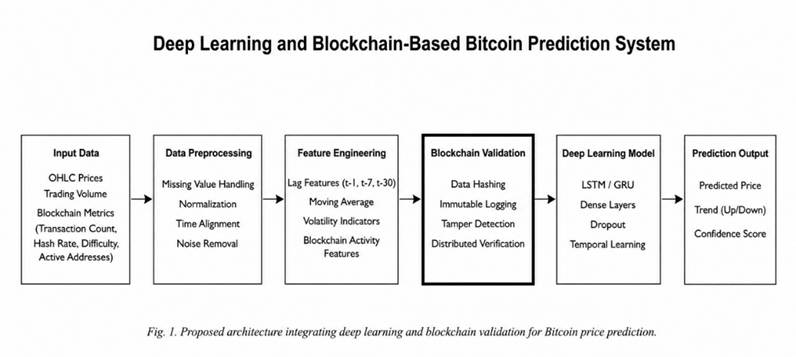
The proposed
system is a hybrid architecture that integrates deep learning-based time-series
prediction with blockchain-enabled data validation and feature extraction. The
objective is to create a unified pipeline that not only predicts Bitcoin price
accurately but also ensures data integrity, transparency, and security
throughout the process.
|
Figure 1
|
|
Figure 1 Shows the Proposed
System Architecture. |
Overall System Flow
Input Data
·
Data
Preprocessing
·
Feature
Extraction
·
Blockchain
Data Validation Layer
·
Deep
Learning Prediction Model
·
Output
Prediction
Component
Description
Input Layer
The system
collects multi-source data required for prediction. This includes:
·
Historical
Bitcoin price (open, high, low, close)
·
Trading
volume
·
Blockchain-derived
metrics (transaction count, hash rate, mining difficulty, active addresses)
These inputs
provide both financial and network-level insights necessary for accurate modeling.
Data
Preprocessing
The collected data
is cleaned and transformed before being used for modeling.
The preprocessing stage includes:
·
Handling
missing values
·
Normalization
and scaling of numerical features
·
Time-series
alignment of different data sources
·
Removal
of noise and outliers
This step ensures
consistency and improves model convergence during training.
Feature
Extraction
In this stage,
meaningful features are generated from raw data. These include:
·
Lagged
price values (t-1, t-7, t-30)
·
Moving
averages and volatility indicators
·
Blockchain
activity features such as transaction growth rate and hash rate variation
Feature
engineering helps the model understand both short-term fluctuations and
long-term trends in Bitcoin price.
Blockchain Data
Validation Layer
This is a key
novelty of the proposed framework. Instead of directly using external datasets,
the system validates critical data using blockchain principles:
·
Data
entries are hashed and verified
·
Immutable
logs ensure data cannot be altered after storage
·
Distributed
verification ensures trust across nodes
This layer ensures
that the data used for training and prediction is authentic, tamper-resistant,
and transparent.
Deep Learning
Prediction Model
The validated data
is passed to a deep learning model designed for time-series forecasting. The
model architecture may include:
·
LSTM or
GRU layers for capturing temporal dependencies
·
Dense
layers for nonlinear feature mapping
·
Dropout
layers for regularization
The model learns
complex patterns between historical trends and blockchain activity to generate
accurate predictions.
Output Layer
The final output
of the system includes:
·
Predicted
Bitcoin price for the next time step or future horizon
·
Trend
direction (increase/decrease)
·
Confidence
score (optional, based on model output)
The output can be
used by investors, analysts, or automated trading systems for decision-making.
Key Advantages of
Proposed Framework
·
Combines
predictive intelligence with secure data validation
·
Utilizes
both financial and blockchain-level features
·
Reduces
risk of data manipulation
·
Provides
a scalable and modular system design
·
Enhances
trust in prediction systems
This architecture
bridges the gap between deep learning-based forecasting and blockchain-based
data security, forming a robust foundation for next-generation cryptocurrency
analytics.
Mathematical Model
The proposed
framework models Bitcoin price prediction as a multivariate time-series
learning problem enhanced with blockchain-validated features. The mathematical
formulation integrates feature weighting, temporal dependency modeling, and prediction mapping.
1)
Feature
Representation Model
The input feature
vector at time t is defined as a combination of market data and blockchain
features.
Display Format:
Xₜ =
[Pₜ, Vₜ, Bₜ]
Word Equation
Format:
X_t = [P_t, V_t, B_t]
Where:
Xₜ =
Combined feature vector at time t
Pₜ =
Price-related features (open, high, low, close, lag values)
Vₜ =
Volume-related features
Bₜ =
Blockchain-derived features (transaction count, hash rate, etc.)
This
representation ensures that both financial and network-level information are
jointly learned by the model.
2)
Weighted
Feature Contribution Model
To capture the
relative importance of different feature groups, a weighted combination is
defined.
Display Format:
Fₜ =
αPₜ + βVₜ + γBₜ
Word Equation
Format:
F_t = \alpha P_t +
\beta V_t + \gamma B_t
Where:
Fₜ = Final
feature representation
α, β,
γ = Learnable weights representing importance of price, volume, and
blockchain features
This equation
allows the model to dynamically adjust the influence of each feature group.
3)
Temporal
Learning Model (LSTM-based)
The temporal
dependency is captured using a recurrent function.
Display Format:
hₜ =
σ(WₓXₜ + Wₕhₜ₋₁
+ b)
Word Equation
Format:
h_t = \sigma(W_x X_t + W_h h_{t-1} + b)
Where:
hₜ = Hidden
state at time t
Wₓ = Input
weight matrix
Wₕ =
Recurrent weight matrix
b = Bias term
σ =
Activation function (tanh or sigmoid)
This formulation
allows the model to learn sequential dependencies in Bitcoin price movement.
4)
Prediction
Function
The final
predicted Bitcoin price is computed as:
Display Format:
Ŷₜ₊₁
= Wₒhₜ + bₒ
Word Equation
Format:
\hat{Y}_{t+1} = W_o h_t + b_o
Where:
Ŷₜ₊₁
= Predicted Bitcoin price at next time step
Wₒ = Output
weight matrix
bₒ = Output
bias
This equation maps
the learned hidden representation to the final prediction output.
Model
Interpretation
·
Eq. (1)
defines the input structure combining multiple data sources
·
Eq. (2)
introduces adaptive weighting of features
·
Eq. (3)
captures temporal learning using deep learning
·
Eq. (4)
generates the final prediction
Together, these
equations form a simplified yet effective mathematical foundation for the
proposed hybrid framework.
Algorithm /
Pseudocode
Algorithm 1:
Bitcoin Price Prediction Using Deep Learning and Blockchain Validation
Input:
Historical Bitcoin
market data, blockchain network data
Output:
Predicted Bitcoin
price and trend direction
Step 1: Collect
Bitcoin market data including open price, high price, low price, close price,
and trading volume.
Step 2: Collect
blockchain network data including transaction count, hash rate, mining
difficulty, and active wallet addresses.
Step 3: Preprocess
the collected data by handling missing values, removing inconsistent records,
and normalizing numerical features.
Step 4: Generate
time-series features such as lag values, moving averages, and volatility
indicators.
Step 5: Generate
blockchain-based features such as transaction growth rate, hash rate variation,
and network activity score.
Step 6: Validate
important data records using blockchain hashing and immutable logging.
Step 7: Create the
final feature vector:
Display Format:
Xₜ =
[Pₜ, Vₜ, Bₜ]
Word Equation
Format:
X_t = [P_t, V_t, B_t]
Step 8: Divide the
dataset into training and testing sets using time-series splitting.
Step 9: Train the
deep learning model using LSTM or GRU layers to learn temporal patterns.
Step 10: Compute
the hidden representation:
Display Format:
hₜ =
σ(WₓXₜ + Wₕhₜ₋₁
+ b)
Word Equation
Format:
h_t = \sigma(W_x X_t + W_h h_{t-1} + b)
Step 11: Generate
the predicted Bitcoin price:
Display Format:
Ŷₜ₊₁
= Wₒhₜ + bₒ
Word Equation
Format:
\hat{Y}_{t+1} = W_o h_t + b_o
Step 12: Compare
predicted price with actual price during testing.
Step 13: Evaluate
model performance using suitable error metrics such as MAE, RMSE, and MAPE.
Step 14: Generate
final output including predicted price, trend direction, and confidence score.
Step 15: Store
prediction logs and validation hashes for transparency and auditability.
End Algorithm
Methodology AND Working
The proposed
system follows a structured pipeline where financial data and
blockchain-derived information are processed together to generate secure and
reliable Bitcoin price predictions. Since this is a conceptual framework, the
methodology focuses on how the system operates step-by-step rather than
reporting experimental results.
1)
Data
Collection
The system begins
by collecting two major categories of data:
·
Market
Data: historical price (open, high, low, close), trading volume
·
Blockchain
Data: transaction count, hash rate, mining difficulty, active wallet addresses
Market data
captures external financial behavior, while
blockchain data reflects internal network activity. Combining both provides a
more complete understanding of Bitcoin dynamics.
2)
Data
Preprocessing
Raw data from
different sources may contain missing values, inconsistencies, and different
time intervals. The preprocessing stage ensures uniformity by:
·
Cleaning
missing or corrupted entries
·
Normalizing
numerical values for stable model training
·
Aligning
timestamps across datasets
·
Filtering
noise and extreme outliers
This step ensures
that the input data is reliable and suitable for deep learning models.
3)
Feature
Engineering
The system
extracts meaningful features to improve prediction capability. These include:
·
Lag
features (previous time-step prices such as t−1, t−7, t−30)
·
Technical
indicators (moving averages, volatility)
·
Blockchain
activity indicators (transaction growth, hash rate variation)
Feature
engineering allows the model to capture both short-term fluctuations and
long-term trends.
4)
Blockchain
Validation Layer
Before feeding
data into the prediction model, critical records are validated using blockchain
principles:
·
Each
data record is hashed
·
Hash
values are stored in an immutable ledger
·
Any
modification in data can be detected through hash mismatch
This layer ensures
that the dataset used for training and prediction remains tamper-proof and
trustworthy.
5)
Model
Training
The processed and
validated data is fed into a deep learning model, typically an LSTM or GRU
network. The model learns:
·
Temporal
dependencies between past and future prices
·
Relationships
between financial and blockchain features
·
Nonlinear
patterns influencing Bitcoin price movements
Training is
performed using time-series splitting to preserve chronological order.
6)
Prediction
and Output Generation
After training,
the model generates predictions for future Bitcoin prices. The system outputs:
·
Predicted
price for the next time step
·
Trend
direction (increase or decrease)
·
Confidence
level based on model output
These outputs can
support investment decisions or automated trading systems.
7)
Evaluation
Strategy
Although no real
dataset is used in this conceptual framework, the system is designed to be
evaluated using standard metrics such as:
·
Mean
Absolute Error (MAE)
·
Root
Mean Square Error (RMSE)
·
Mean
Absolute Percentage Error (MAPE)
These metrics help
measure prediction accuracy and model reliability.
8)
System
Characteristics
The overall
working of the system ensures:
·
Integration
of multiple data sources
·
Secure
and verifiable data processing
·
Scalable
and modular architecture
·
Compatibility
with real-time data pipelines
This methodology
demonstrates how deep learning and blockchain can be combined into a single
unified workflow, enabling both intelligent prediction and secure data
handling.
Expected Results and Discussion
Since this study
is designed as a conceptual and framework-based paper, no real experimental
results are reported. However, based on the proposed architecture and
integration strategy, several logical outcomes can be anticipated.
1)
Improved
Prediction Accuracy
By combining
historical market data with blockchain-derived features, the model is expected
to achieve better prediction performance compared to traditional approaches.
Deep learning models, particularly LSTM and GRU, can capture temporal
dependencies, while blockchain features provide additional context about
network activity. This dual-source learning is likely to reduce prediction
error and improve trend detection capability.
2)
Enhanced
Feature Representation
The inclusion of
blockchain metrics such as transaction volume, hash rate, and active addresses
introduces a richer feature space. These features help the model understand
underlying system behavior rather than relying only
on price movements. As a result, the model is expected to better handle sudden
market shifts and abnormal conditions.
3)
Increased
Data Reliability and Trust
One of the major
expected advantages of the proposed framework is the improvement in data
integrity. The blockchain validation layer ensures that the data used for
training and prediction is tamper-proof and verifiable. This reduces the risk
of data manipulation and increases trust in the prediction system, which is
critical for financial applications.
4)
Robustness
Against Data Manipulation
Traditional
prediction systems are vulnerable to corrupted or manipulated datasets. In the
proposed system, the use of hashing and immutable logging ensures that any
unauthorized modification in data can be detected. This enhances the robustness
of the system and makes it suitable for high-stakes financial environments.
5)
Scalability
and Modularity
The framework is
designed to be modular, allowing easy integration of additional data sources
such as sentiment analysis or macroeconomic indicators. It can also be scaled
to handle large datasets and real-time data streams. This flexibility makes the
system adaptable to evolving market conditions and future research extensions.
6)
Practical
Implications
The proposed
system can be applied in various real-world scenarios, including:
·
Cryptocurrency
trading platforms for decision support
·
Financial
analytics systems for market forecasting
·
Blockchain-based
financial applications requiring secure data processing
Limitations
Despite its
advantages, the framework may face certain challenges:
·
Increased
computational complexity due to deep learning and blockchain integration
·
Data
synchronization issues between market and blockchain datasets
·
Requirement
of efficient storage and processing mechanisms for large-scale data
Discussion
Overall, the
proposed hybrid framework is expected to outperform traditional models in terms
of prediction capability and data reliability. The integration of deep learning
with blockchain introduces a new paradigm where predictive intelligence is
combined with secure and transparent data handling. While the framework is
conceptually strong, its practical performance will depend on implementation
details, dataset quality, and computational resources.
Conclusion and Future Scope
This paper
presented a hybrid conceptual framework that integrates deep learning
techniques with blockchain-based data validation for Bitcoin price prediction.
The study addressed key limitations of existing approaches, including reliance
on limited financial features and lack of data integrity. By combining
time-series modeling capabilities of deep learning
with the secure, immutable nature of blockchain, the proposed system offers a
more reliable and trustworthy prediction pipeline.
The framework
leverages both market data and blockchain-derived features to enhance
prediction capability. The use of models such as LSTM and GRU enables effective
learning of temporal dependencies, while the blockchain validation layer
ensures that the data used in the system remains authentic and
tamper-resistant. This dual integration bridges the gap between predictive
analytics and secure distributed systems, which is often overlooked in
traditional financial modeling.
The proposed
architecture is modular and scalable, making it suitable for real-world
deployment in cryptocurrency analytics platforms. It provides a strong
foundation for building intelligent financial systems that not only generate
accurate predictions but also maintain transparency and trust.
Future Scope
The proposed work
can be extended in several directions:
1)
Integration
of Sentiment Analysis
2)
Future
systems can incorporate sentiment data from social media platforms such as
Twitter and news sources to further enhance prediction accuracy by capturing
investor behavior.
3)
Advanced
Deep Learning Models
4)
More
sophisticated architectures such as Transformer-based models and attention
mechanisms can be explored to improve long-range dependency learning in
time-series data.
5)
Real-Time
Prediction Systems
6)
The
framework can be extended to support real-time data streaming and live
prediction, making it suitable for automated trading and financial monitoring
systems.
7)
Optimization
of Blockchain Integration
8)
Future
work can focus on reducing computational overhead associated with blockchain
validation, possibly by using lightweight consensus mechanisms or off-chain
solutions.
9)
Multi-Cryptocurrency
Extension
10) The framework can be generalized to predict
prices of multiple cryptocurrencies beyond Bitcoin, enabling broader financial
analysis.
11) Explainable AI Integration
12) Incorporating explainable AI techniques can
help interpret model predictions, making the system more transparent and
acceptable in financial decision-making environments.
In conclusion, the
integration of deep learning and blockchain presents a promising direction for
secure and intelligent financial forecasting systems. The proposed framework
lays the groundwork for future research and practical implementations in cryptocurrency
analytics.
ACKNOWLEDGMENTS
None.
REFERENCES
Aggarwal,
S., Kumar, N., and Tanwar, S. (2020). Blockchain-Envisioned
UAV Communication using 6G Networks. IEEE Network,
34(6), 160–167.
Brownlee,
J. (2018). Time Series Prediction with Deep Learning: A Review. Machine Learning Mastery.
Buterin,
V. (2014). A
Next-Generation Smart Contract
and Decentralized Application Platform. Ethereum White Paper.
Chen,
T., and Guestrin, C. (2016). XGBoost: A Scalable Tree Boosting System. In Proceedings
of the 22nd ACM SIGKDD International Conference on
Knowledge Discovery and Data Mining (785–794).
Cho,
K., van Merriënboer, B., Gulcehre,
C., Bahdanau, D., Bougares,
F., Schwenk, H., and Bengio, Y. (2014). Learning Phrase Representations
using RNN Encoder–Decoder
for Statistical Machine Translation. arXiv preprint
arXiv:1406.1078.
Christidis, K., and Devetsikiotis, M. (2016). Blockchains and Smart Contracts for the Internet of Things.
IEEE Access, 4, 2292–2303.
Dean,
J., and Ghemawat, S. (2004). Mapreduce: Simplified Data Processing on
Large Clusters. In Proceedings of the 6th Symposium
on Operating Systems Design and Implementation
(OSDI) (137–150).
Glorot,
X., and Bengio, Y. (2010). Understanding the Difficulty
of Training Deep Feedforward Neural Networks. In Proceedings of the 13th International Conference
on Artificial Intelligence and Statistics
(AISTATS) (249–256).
Goodfellow, I., Bengio, Y., and Courville, A. (2016). Deep learning.
MIT Press.
Hochreiter, S., and Schmidhuber, J. (1997). Long Short-Term
Memory. Neural Computation, 9(8), 1735–1780.
Jiang,
Z., and Liang, J. (2018). Cryptocurrency Portfolio Management with Deep Reinforcement Learning.
IEEE Intelligent Systems, 33(3), 26–34.
Kingma,
D. P., and Ba, J. (2015). Adam: A Method for Stochastic
Optimization. In Proceedings
of the 3rd International Conference on Learning Representations (ICLR).
Lahmiri,
A., and Bekiros, S. (2019). Cryptocurrency
Forecasting with Deep
Learning Chaotic Neural Networks. Chaos, Solitons
& Fractals, 118, 35–40.
LeCun,
Y., Bengio, Y., and Hinton, G. (2015). Deep Learning. Nature, 521(7553), 436–444.
Livieris,
I. E., Pintelas, E., and Pintelas,
P. (2020). A
CNN–LSTM Model for Cryptocurrency Price Prediction. Applied Sciences, 10(11), 1–13.
Mallqui,
R., and Fernandes, R. (2019). Predicting the Direction, Maximum, Minimum
and Closing Prices of Daily
Bitcoin Exchange Rate Using Machine Learning
Techniques. Applied Soft Computing, 75, 596–606.
McNally,
S., Roche, J., and Caton, S. (2018). Predicting
Bitcoin Price Using LSTM. In
2018 IEEE International Conference on Big Data (1–9).
Mudassir,
M., Bennbaia, S., Unal, D., and Hammoudeh, M. (2021). Time-Series
Forecasting of Bitcoin Prices
Using High-Dimensional Features. Neural Computing and
Applications, 33, 287–304.
Nakamoto,
S. (2008). Bitcoin: A Peer-To-Peer Electronic Cash System.
https://bitcoin.org/bitcoin.pdf
Patel,
H., Tanwar, S., Gupta, R., and Kumar, N. (2019). Blockchain-based
smart contracts for secure financial transactions. IEEE Access, 7, 110721–110733.
Ron,
D., and Shamir, A. (2013). Quantitative Analysis of the Full Bitcoin
Transaction Graph. In Financial Cryptography and Data
Security (6–24).
Valencia,
F., Gómez, A., and Gómez, J. (2019). Bitcoin Price Prediction
Using Machine Learning Techniques. IEEE Latin America
Transactions, 17(11), 1866–1873.
Wood, G. (2014). Ethereum: A Secure Decentralised Generalised Transaction ledger. Ethereum Project Yellow Paper.
 This work is licensed under a: Creative Commons Attribution 4.0 International License
© Granthaalayah 2014-2026. All Rights Reserved.