A Critical Review of Fuzzy Inference Systems for Decision Support Applications with Special Reference to the Mamdani Model
Ankit Kumar 1, Dr. Sanjay Bhadoriya 2
1 Student,
Department of Computer Technology Application, Dr. A.P.J. Abdul Kalam
University, Indore, India
2 Professor,
Department of Computer Technology Application, Dr. A.P.J. Abdul Kalam
University, Indore, India
|
|
|
ABSTRACT |
|
|
Fuzzy inference systems (FIS) have been found to be very useful tools for decision making in uncertain and complex environments. One major type of FIS, which have earned wide attention, is the Mamdani fuzzy inference system (MFIS), which tries to capture and implement expert knowledge in terms of linguistic variables as well fuzzy rules. This review processes to presents a detailed study on the use of MFIS for decision making. The review starts with an introduction to the basic concepts of fuzzy logic and an MFIS structure involving linguistic variables, different types of membership functions, fuzzy rule bases and defuzzification methods. It examines
the fundamental ideas and methods of operation of the MFIS, emphasizing its
capacity to manage imprecise and ambiguous data and simulate human-like
thinking. Additionally, the paper looks at the many ways that MFIS is used in
decision-making in a variety of fields, including engineering, healthcare,
finance, and environmental management. It talks about how MFIS is used to
create intelligent decision support systems by modeling and reasoning with
ambiguous and subjective data. The review addresses the benefits and
drawbacks of MFIS in decision making, along with application examples. It
highlights how the MFIS's linguistic variables and fuzzy rules can be
interpreted, making the decision-making process more transparent and
intelligible. Nonetheless, issues with model interpretability, computational
complexity, and rule base design are also covered. |
|||
|
Received 15 October 2022 Accepted 21 November 2022 Published 31 December 2022 DOI 10.29121/IJOEST.v6.i6.2022.754 Funding: This research
received no specific grant from any funding agency in the public, commercial,
or not-for-profit sectors. Copyright: © 2022 The
Author(s). This work is licensed under a Creative Commons
Attribution 4.0 International License. With the
license CC-BY, authors retain the copyright, allowing anyone to download,
reuse, re-print, modify, distribute, and/or copy their contribution. The work
must be properly attributed to its author.
|
|||
|
Keywords: MFIS, Fuzzy
logic, Linguistic Variables, Defuzzification, Fuzzification |
|||
1. INTRODUCTION
A fuzzy inference system (FIS) is a type of artificial intelligence algorithm that uses fuzzy logic to reason about data. Fuzzy logic is a mathematical framework that deals with uncertainty and imprecision, making it well-suited to handling complex, real-world problems. The input variables in a fuzzy inference system are represented as fuzzy sets, which are defined by membership functions that give each value in the set a degree of membership. Fuzzy logic is used to express the rules governing how the input variables influence the output variables, and the output variables themselves are also represented as fuzzy sets. The process of inference in a fuzzy inference system involves three main steps: fuzzification, rule evaluation, and defuzzification. Fuzzification converts the crisp input values into fuzzy sets using the membership functions. Rule evaluation applies the fuzzy rules to the fuzzy inputs to determine the degree of membership of the output variables. Finally, defuzzification converts the fuzzy output sets back into crisp values for use in decision making. Control systems frequently make use of fuzzy inference systems, which can be used to model and control complex systems with uncertain or imprecise data. Additionally, they are utilized in applications for pattern recognition and data analysis, where they can aid in the identification of intricate relationships in large data sets.
The act of creating a mapping from a given input to an output using fuzzy logic operators and fuzzy rules is known as a fuzzy inference system (FIS). The mapping then offers a foundation for decision-making or the identification of patterns. One of the most well-known uses of fuzzy logic and fuzzy set theory is FIS. A linguistic variable is a variable with a value in fuzzy set theory. The fuzzy logic operators "or" and "and," if-then rules, and membership functions of input and output linguistic variables are the primary characteristics of the system.
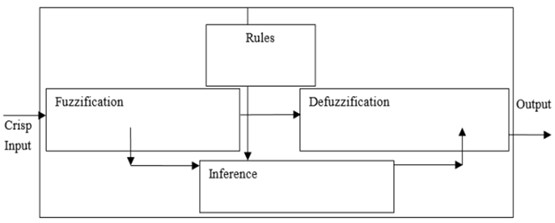
The kinds of fuzzy sets used to define input variables and the arrangement of fuzzy rules determine how optimum the output variables are. The ability of FIS to handle linguistic notions is predicated on its dual identity of input and output variables. FIS have developed into universal approximators that can carry out non-linear mappings between inputs and outputs as a result of this strength. The Mamdani-type and Sugeno-type FIS have been created using these two FIS strengths. The fuzzification interface, inference engine, and defuzzification are the system's primary parts.
Figure 1
|
Figure 1 Fuzzy Interference System |
The Mamdani-type and Sugeno-type inferences are essentially carried out in accordance with the architecture shown in Figure 1, where the two primary processes are fuzzification and deffuzification. The inference procedure is the third step. A single polynomial with regard to the input variables explains the output in the Sugeno inference process, while the Mamdani inference process defines the output as a membership function. With distinct rule bases for input and output, the Mamdani inference shares a common structure.
2. LITERATURE REVIEW
Samavat et al. (2023) The two classes for Mamdani and Sugeno are reviewed in order to present the best controller for increasing the output of a solar system by employing both types and learning about their distinctions. Investigated is also how the quantity of input membership functions affects the effectiveness of the controller. Each fuzzy system model is therefore given one of two alternative input membership functions. As a subset of artificial intelligence, it is important to mention that fuzzy system setup was carried out by genetic algorithms in response to a mortal desire to automate various operations. Four separate fuzzy systems have therefore been created and put into use on a solar system. In MATLAB Simulink, the findings were evaluated and compiled for various radiations Samavat et al. (2023).
Sonia et al. (2023) etaluses a multi-layer neural network no-prop method to provide a brand-new system for categorising diabetes mellitus' three types. The algorithm uses the development phase or the testing phase, which are the two main information system phases. Beginning with normal, type 1 diabetes, followed by normal & type 2 diabetes, and healthy women with pregnant diabetes come last in each phase. After selecting the pertinent qualities, a multi-layer neural network is trained individually utilising the attributes selected in the attribute-selection process. The multi-layer neural network's architecture increases the effectiveness of classification. An experiment is conducted to analyse the sensitivity, specificity, and accuracy of diabetes diagnoses, and a confusion matrix is created. Achieved are maximum sensitivity as well as specificity values of 0.95 and 0.97. Sonia et al. (2023)
Shwetha et al. (2023) In addition, 14 attributes are gathered from preprocessed photos. Techniques for the early detection and treatment of diabetic retinopathy, a condition that is frequently observed, can help with the identification of retinal lesions.
offer a novel criterion for determining the location of the optical disc in which we first determine the important blood vessels and then make use of their intersection to determine the optic disc's location. using colour features to localise in the future. Also show that a set of characteristics, such as blood vessels, mucus, micro aneurysms, and haemorrhages, may be accurately identified by using several morphological techniques when used appropriately. Shwetha et al. (2023)
Sadat Asl et al. (2022) The COVID-19 patients' ICU admission is predicted using the interval type-2 fuzzy expert system. A system for adaptive neuro-fuzzy inference (ANFIS) was further created for this prediction task. Not to mention, the outcomes of these fuzzy systems are compared to a number of well-known classification techniques, such as Naive Bayes (NB), Case-Based Reasoning (CBR), Decision Tree (DT), and K Nearest Neighbour (KNN). When compared to other system modelling methodologies, the results demonstrate that both the ANFIS and type-2 fuzzy expert system models compete favourably in terms of accuracy and F-measure. Sadat Asl et al. (2022)
Sangeetha Devi, A. (2022) offer a fresh A Sugeno-Type Fuzzy Graph of Groups is discovered using a number of fuzzy graph operations, such as cycle, union, join, and products. The minimal number of shared edges selected by the ones vertices in the formations that comprise all paths with those vertices as their starts and ends to compare with other paths is a figure that is representative depending on those vertices in all paths with those vertices as their starts and ends. All sets of shared edges have a least Sugeno shared edge, which is the Sugeno dominating path-colouring number, which enables a variety of approaches. Several recently made chromatic number graphs are examined using these new findings. Sangeetha Devi, A. (2022)
Kotiyal et al. (2022) Big Data is related to this issue since a significant portion of the population is impacted. Big Data faces a number of challenges, but Deep Learning is able to address these problems. Academics are therefore very interested in big data and deep learning. In order to achieve binary classification of diabetic retinopathy, we aimed to use efficient preprocessing and Deep Learning techniques in this study. A dataset from Kaggle that was gathered in India is used in the experiment. The peculiarity of the research is that the work is executed on the Spark platform, and the effectiveness of three models—InceptionV3, Xception, and VGG19—with the Logistic Regression classifier is contrasted. The models' accuracy is used as a metric for comparison. According to the trial's findings, InceptionV3 is 95 percent accurate, Xception is 92.50 percent accurate, and VGG19 is 89.94 percent accurate. As a result, InceptionV3 performs better than the other two models. Otiyal and Pathak (2022)
Lin et al. (2022) According to the eGFR grading, Grade 1 corresponds to 42.50 percent of the 54 DKD cases, while Grades 2, 3a, 3b, and 4 correspond to 18.52 percent, 11.1 percent, 9.2 percent, 18.52 percent, and 18.52 percent, respectively. Blood urea and creatinine levels were significantly positively linked with the progression of DKD, despite blood Hb levels having a negative relationship. In contrast to healthy cases, ultrasonography revealed that the major renal artery (MRA), segment renal artery (SRA), and interlobular renal artery (IRA) all had significantly lower Vsmax and Vdmin values. The alterations in the aforementioned data were likewise more noticeable than those in the lower extremities, and the IR of the aforementioned arteries was noticeably increased. RI and DKD grades were favourably connected, however Vdmin of MRA, SRA, and IRA grades were negatively correlated. We discovered that the level of Hb is positively correlated with kidney health, although RI of the arteries is adversely correlated with it. This is because RI and Hb level are convergent. Conclusions. The haemoglobin (Hb) level and the intrarenal artery resistance index (RI), as determined by ultrasonography, are indicators of the progression of DKD. Lin et al. (2022)
Srivastava et al. (2014) concentrates on classifying the common types of arrhythmia in people in Southeast Asia. How medical information is used in practise to improve professional arrhythmia diagnosis has been carefully investigated. With the help of a satisfied factor, this system is put to the test to see how well the inputs and outputs match. Srivastava et al. (2014)
Pati et al. (2022) The Pima Indians Diabetes Dataset (PIDD) and the Hospital Frankfurt Germany Diabetes Dataset (HFGDD) are the two diabetes mellitus disease datasets (DMDDs) used in the integrated dataset on which the system is trained using EDL approaches. These datasets were taken from the UCI-ML and Kaggle repositories, respectively. The proposed system has been used to show a variety of properties, including precision, recall, accuracy, F-measure, latency, arbitrator time, jitter, processing time, throughput, consumption of energy, bandwidth utilisation, networking utilisation, scalability, and more. In order to diagnose diabetic patients remotely and immediately, the IoT-cloud link is useful. The results show the advantages of applying FC concepts and the extent to which they can be applied to rapidly diagnose diabetes patients remotely. The key's description is found in the text PACS-key. Textual description of the PACS-key. Pati et al. (2022)
Tian et al. (2022) looked at the connection between CHD and the serum Sestrin2 levels of type 2 diabetes individuals. The study's participants were 69 T2DM individuals who did not have coronary heart disease. Clinical traits as well as metabolic markers were found. ELISA was used to measure the concentration of serum Sestrin2. Results: Serum levels of sestrin2 were substantially lower in the T2DM-CHD groups than in the T2DM group (11.17 (9.79, 13.14) ng/mL vs. 9.46 (8.34, 10.91) ng/mL). Bivariate correlation analysis revealed a negative relationship between serum Sestrin2 levels and age (r = 0.256, P = 0.002), BMI (r = 0.206, P = 0.015), FBG (r = 0.261, P = 0.002), and Tyg index (r = 0.207, P 0.014). Lower blood Sestrin2 levels and a higher risk of T2DM-CHD were revealed to be significantly correlated (P 0.05) by binary logistic regression. Sestrin2 was used to predict T2DM-CHD patients, and its area under the curve (95% CI 0.641-0.808, P 0.001) also reached 0.724 (95% CI 0.641-0.808, P 0.001). In diabetic patients, Sestrin2 levels had a strong correlation with CHD. On the prevalence and development of diabetic heart disease, serum sestrin2 may have an effect. Tian et al. (2022)
Zhang and Zhang (2022) a vehicle's suspension can be controlled effectively, more reliably, and with less energy use. Based on bionic nonlinear dynamics, a fuzzy SMC technique for active suspension systems is developed. In contrast to earlier findings, the proposed control strategy effectively makes use of the beneficial nonlinear stiffness or damping of the biomimetic reference model, resulting in performance that is energy-saving. Furthermore, a number of real-world concerns are carefully considered, such as input saturation, dead zones, unknown/uncertain dynamics, and outside interference. According to theoretical analysis and simulation results, the suggested fuzzy SMC approach based on bionic dynamics may successfully reduce energy consumption, improve ride comfort, and efficiently reduce the vibration of the active suspension system. Zhang and Zhang (2022)
Afrash et al. (2022) In an effort to develop a system for decision support (DSS) based on the use of machine learning (ML) for DN diagnosis, it was tried to identify the variables that were relevant in predicting DN. Methods: Retrospective analysis was performed on the medical records of 327 people who had diabetes (types 1 and 2). The predicted variables affecting DN following data processing were identified using the genetic algorithm's (GA) feature choice method. Then, in addition to other ML methods, the support vector machine (SVM), decision tree (DT), K-nearest neighbour (KNN), and artificial neural networks (ANN) were used to train prediction models based on the selected features. The performance of the developed models was then evaluated using the accuracy, specificity, and sensitivity criteria over the course of ten independent runs. Afrash et al. (2022)
Galo et al. (2022) This article suggests the application of computational tools for decision-making using fuzzy inference systems as a way to potentially improve the triage procedures in Brazil. We contend that the use of natural language to describe the patient's symptoms makes it simpler for medical personnel to understand the problem and that fuzzy set theory is applicable. We used a pilot test after simulating the issue in a fuzzy system. The model takes into account the symptoms that doctors now utilise to evaluate COVID-19 cases. The findings point to the model's possible use in aiding triage for the classification of the seriousness of COVID-19 cases by showing convergence with the sample data. One advantage of the suggested model . We place particular emphasis on the contributions that reduce the amount of time and personnel needed for triage and the exposure of medical personnel and other patients who may be carrying the virus. In this sense, this study offers a chance to acquire social contributions for the enhancement of services in public hospitals. Galo et al. (2022)
Chakraborty et al. (2022) Applying a fuzzy inference system & machine learning techniques, a COVID-19 risk prediction model for diabetes patients is suggested. This study sought to determine the COVID-19 risk level in diabetes individuals without seeking medical advice in order to take prompt action and reduce the multifold COVID-19 mortality rate amongst diabetic patients. Eight factors that were identified as having the greatest influence on diabetic patients' symptoms serve as inputs for the suggested model. Fifteen models were built utilising a range of cutting-edge machine learning techniques, with the rule base serving as the framework. The CatBoost classifier delivers the highest kappa, F1, recall, accuracy, and other measures. The CatBoost classifier achieved 76% accuracy after hyper-parameter optimisation, along with improvements in recall, precision, F1 score, and kappa score. Then, with 75.1% accuracy, came logistic regression and XGBoost. Chakraborty et al. (2022).
Liu et al. (2021) This study used bioinformatics approaches to look into how to treat diabetic coronary heart disease. Methods. From the GeneCard database, the associated genes for diabetic CHD and the target genes for the chemical components of Qiweitangping were obtained. The active chemical elements of Qiweitangping were gathered using the TCMSP database. The junction between the drug's target gene and the gene linked to the disease was also found in order to discover possible genes. Next, utilising the STRING and DAVID databases, KEGG enrichment analysis & protein interaction analysis were performed on the candidate genes. The docking of molecules was also used as an additional verification method. By using the Cytoscape tool, a network of "drug component-gene target-pathway" genes was eventually created. Results. In Qiweitangping, 62 active substances, comprising naringin, diosgenin, formogenin, isorolin, and isocryptanshinone, as well as 59 potential target genes, including AKT1, CASP3, and VEGF-A, were discovered. Additionally, the outcomes of two molecular docking tests (CASP-naringenin and STAT3-cryptotanshinone) demonstrated high affinity (-5.00 kcal/mol). Conclusion. Qiweitangping uses the study's findings in a variety of chemical treatments for diabetic CHD. Its operation may be influenced by the signalling pathways PI3K-Akt, ErbB, and HIF-1. The molecular docking method has demonstrated that the Qiweitangping, STAT3, and CASP genes interact well. More experimental studies on the Qiweitangping therapeutic mechanism for diabetic CHD will be theoretically underpinned by the findings of this study.
Isa (2021) The framework's input
as well as output language variables were both chosen to use the triangle
membership function. Using the methodology's fuzzy aggregation approach, which
enables the gathering of professional opinion, a suitable control action can be
selected. With the use of a total of 23 rules, including the logical OR
operator, the truncation implication, and the Mean of Maxima (MoM)
defuzzification method, an effective fuzzy model for forming judgements was
created. The framework determines the link between the input and output
parameters used in if-then statements or mathematical functions by employing a
potent fuzzy arithmetic operator. A Mamdani-style decision framework and an
example from a medium-sized project in Malaysia's construction industry are
used to discuss the underlying issues with different expert perspectives in the
study. We confirm the logic and dependability of the suggested method by
comparing it with the outcomes of other experiments. Isa (2021)
3. SCOPE OF THE RESEARCH
The scope of the research on Fuzzy Inference Systems (FIS) for decision making, focusing on the Mamdani Fuzzy Inference System (MFIS), encompasses several key areas that contribute to a comprehensive understanding and advancement of the topic. The scope includes:
Theoretical foundations: The research will delve into the fundamental concepts and principles of fuzzy logic, fuzzy sets, and fuzzy reasoning. It will explore the underlying theory behind FIS and the MFIS, providing a solid theoretical foundation for the study.
MFIS architecture and components: The research will cover the architecture and components of the MFIS, including linguistic variables, membership functions, fuzzy rule bases, and defuzzification methods. It will analyze the roles and interactions of these components in decision making.
Design and optimization of the MFIS: The research will address the challenges and methods associated with the design and optimization of the MFIS, focusing on rule base construction, linguistic term selection, and membership function design. It will explore techniques to improve the accuracy and reliability of the MFIS in decision-making tasks.
Computational efficiency: The research will investigate methods to enhance the computational efficiency of the MFIS, particularly in handling large and complex rule bases. It will explore algorithms and optimization techniques to reduce computation time while maintaining accuracy and real-time applicability.
Interpretability and explainability: The research will examine techniques to improve the interpretability and explainability of the MFIS outputs in decision making. It will explore methods for enhancing the transparency of the reasoning process and facilitating user understanding of the decision outcomes.
Integration with other techniques: The research will explore the integration of the MFIS with other techniques, such as machine learning, optimization algorithms, or expert systems. It will investigate fusion and integration methods to leverage the strengths of different methodologies and enhance the performance and robustness of MFIS-based decision support systems.
Applications in various domains: The research will explore the application of MFIS in diverse domains, such as finance, healthcare, engineering, and environmental management. It will analyze case studies and real-world examples to showcase the effectiveness and practicality of the MFIS in decision-making contexts.
The scope of the research is to provide a comprehensive understanding of FIS for decision making, with a specific focus on the MFIS. It aims to address key challenges, propose innovative solutions, and explore practical applications of the MFIS in diverse domains. The research will contribute to advancing the field of fuzzy inference systems and improving the effectiveness and usability of MFIS-based decision support systems.
Problem Statement
Fuzzy Inference Systems (FIS) have gained significant
attention as effective tools for decision making in complex and uncertain
environments. Among the different types of FIS, the Mamdani Fuzzy Inference
System (MFIS) is widely used and recognized for its ability to capture and
utilize expert knowledge through linguistic variables and fuzzy rules. However,
despite its popularity, there are still several challenges and issues
associated with the application of the MFIS in decision making that need to be addressed.
One of the key problems is the design and optimization of the fuzzy rule base
in the MFIS. The process of constructing an appropriate rule base, which
includes determining the number of rules, setting linguistic terms, and
defining membership functions, requires expert knowledge and experience.
However, the subjective nature of this process can lead to ambiguity and
inconsistency in the rule base, affecting the accuracy and reliability of the
decision-making outcomes. Another challenge is the computational complexity of
the MFIS, especially when dealing with large and complex rule bases. The
evaluation of fuzzy rules and the subsequent defuzzification process can be
computationally demanding, potentially limiting the real-time applicability of
the MFIS in decision-making systems. Finding efficient algorithms and
optimization techniques to reduce the computational burden without sacrificing
accuracy is a crucial problem to be addressed.
4. Conclusion
Fuzzy Inference Systems (FIS) have become effective tools for making decisions in uncertain and complex situations. The Mamdani Fuzzy Inference System (MFIS) has drawn a lot of interest among the different kinds of FIS because of its capacity to handle linguistic variables, fuzzy rules, and expert knowledge. The goal of this review was to offer a thorough examination of how the MFIS is used in decision-making. During the review, we looked at the basic ideas of fuzzy logic as well as the elements of an MFIS, such as membership functions, linguistic variables, fuzzy rule bases, and defuzzification techniques.
We examined the fundamental ideas and methods of the MFIS, emphasizing its ability to manage imprecise and ambiguous data and simulate human-like thinking. We also looked at a variety of fields, including banking, healthcare, engineering, and environmental management, where the MFIS has been effectively used for decision-making. These examples demonstrated how the MFIS can efficiently represent and reason with ambiguous and subjective data, facilitating the creation of intelligent decision support systems. We discussed the drawbacks and difficulties of using the MFIS in decision-making while highlighting the interpretability of fuzzy rules and linguistic variables. These difficulties included things like model interpretability, computational complexity, and rule base design. When using the MFIS in decision-making situations, researchers and practitioners must carefully take these elements into account.
CONFLICT OF INTERESTS
None.
ACKNOWLEDGMENTS
None.
REFERENCES
Abiyev, R. H., and Altiparmak, H. (2021). Type-2 Fuzzy Neural System for Diagnosis of Diabetes. Mathematical Problems in Engineering, 2021. https://doi.org/10.1155/2021/5854966
Afrash, M. R., Rahimi, F., Kazemi-Arpanahi, H., Shanbezadeh, M., Amraei, M., and Asadi, F. (2022). Development of an Intelligent Clinical Decision Support System for the Early Prediction of Diabetic Nephropathy. Informatics in Medicine Unlocked, 35, 101135. https://doi.org/10.1016/j.imu.2022.101135
Chakraborty, G. S., Singh, D., Rakhra, M., Batra, S., and Singh, A. (2022). Covid-19 and Diabetes Risk Prediction for Diabetic Patient Using Advance Machine Learning Techniques and Fuzzy Inference System. In Proceedings of the 5th International Conference on Contemporary Computing and Informatics (IC3I 2022) (1212–1219). https://doi.org/10.1109/IC3I56241.2022.10073256
Galo, N. R., Roriz Junior, M. P., and Tóffano Pereira, R. P. (2022). A Fuzzy Approach to Support Decision-Making in the Triage Process for Suspected COVID-19 Patients in Brazil. Applied Soft Computing, 129, 109626. https://doi.org/10.1016/j.asoc.2022.109626
Isa, Z. (2021). Experts’ Judgment-Based Mamdani-Type Decision System For. 2021. https://doi.org/10.1155/2021/6652419
Khedher, A., Elleuch, I., and Benothman, K. (2021). Adaptive Proportional Integral Observer Design for Interval Type 2 Takagi-Sugeno Fuzzy Systems. Mathematical Problems in Engineering, 2021. https://doi.org/10.1155/2021/5317391
Lin, J., Liu, G., Lin, Y., Wei, C., Liu, S., and Xu, Y. (2022). Ultrasonography Combined with Blood Biochemistry on the Early Diagnosis of Diabetic Kidney Disease. Disease Markers, 2022. https://doi.org/10.1155/2022/4231535
Otiyal, Bk., and Pathak, H. (2022). Diabetic Retinopathy Binary Image Classification Using Pyspark. International Journal of Mathematical, Engineering and Management Sciences, 7(5), 624–642. https://doi.org/10.33889/IJMEMS.2022.7.5.041
Pati et al. (2022). Diagnose Diabetic Mellitus Illness Based on IoT Smart Architecture. Wireless Communications and Mobile Computing, 2022. https://doi.org/10.1155/2022/7268571
Sadat Asl, A. A., Ershadi, M. M., Sotudian, S., Li, X., and Dick, S. (2022). Fuzzy Expert Systems for Prediction of ICU Admission in Patients with COVID-19. Intelligent Decision Technologies, 16(1), 159–168. https://doi.org/10.3233/IDT-200220
Samavat et al. (2023). Research Article A Comparative Analysis of the Mamdani and Sugeno Fuzzy Inference Systems for MPPT of an Islanded PV System. 2023. https://doi.org/10.1155/2023/7676113
Sangeetha Devi, A. (2022). An Extensive Study on Graph Colourings and Dominator Chromatic Number of Sugeno-Type Fuzzy Graphs. Mathematical Problems in Engineering, 2022. https://doi.org/10.1155/2022/3135201
Shwetha, G. K., R. K., U. K. R. K., Rathod, J. A., and Sathyaprakash, B. P. (2023). Diabetic Retinopathy Prediction Using Modified Inception V3 Model Structure. Intelligent Systems and Applications, 11(1), 261–268.
Sonia, J. J., Jayachandran, P., Md, A. Q., Mohan, S., Sivaraman, A. K., and Tee, K. F. (2023). Machine-Learning-Based Diabetes Mellitus Risk Prediction Using Multi-Layer Neural Network No-Prop Algorithm. Diagnostics, 13(4), 1–16. https://doi.org/10.3390/diagnostics13040723
Srivastava, P., Sharma, N., and Aparna, C. S. (2014). Fuzzy Soft System and Arrhythmia Classification. Chinese Journal of Mathematics, 2014, 1–12. https://doi.org/10.1155/2014/164781
Tian, X., et al. (2022). The Association Between Serum Sestrin2 and the Risk of Coronary Heart Disease in Patients with Type 2 Diabetes Mellitus. BMC Cardiovascular Disorders, 22(1). https://doi.org/10.1186/s12872-022-02727-1
Zhang, M., and Zhang, J. (2022). Fuzzy SMC Method for Active Suspension Systems with Non-Ideal Inputs Based on a Bioinspired Reference Model. IFAC-PapersOnLine, 55(27), 404–409. https://doi.org/10.1016/j.ifacol.2022.10.547
 This work is licensed under a: Creative Commons Attribution 4.0 International License
© Granthaalayah 2014-2022. All Rights Reserved.