
Original Article
AI-Based Soil Health Analysis and Crop Recommendation System for Smart Fertilizer Management in Precision Agriculture
|
Madhuri Deepak
Mulje
1* 1 Assistant Professor, Prin
Dr. Sudhakarrao Jadhavar
Art Science and Commerce College, Narhe, India |
|
|
|
ABSTRACT |
||
|
Precision agriculture is changing the modern agriculture system by adopting the artificial intelligence (AI) technology that enhances the performance of agricultural systems and environmental conservation. The study introduces an artificial intelligence solution that assesses the state of soil and suggests farming methods to attain the most optimal use of fertilizers and enhanced crop production outcomes. The system employs machine learning algorithms to handle the key soil parameters that comprise pH, moisture levels, nutrient content and temperature readings. The system takes these inputs to decide the level of soil fertility as it also recommends the kind of crops and their particular requirements of fertilizer. The given model uses empirical data to pursue three goals that encompass the reduction of fertilizer use and minimization of environmental damage and the progress of more environmentally friendly practices in agriculture. The system will help farmers make prompt decisions as it will give them a smart system to communicate with. As demonstrated by the experiment, our system is superior when compared to the traditional methods, not only in terms of selecting crops precisely, but also with efficient nutrient management. The strategy will allow farmers to adopt clever farming practices that will offer them inexpensive and environmental-friendly practices that yield high agricultural yields. Keywords: Artificial Intelligence, Precision
Agriculture, Soil Health Analysis, Crop Recommendation, Smart Fertilizer
Management, Machine Learning, Sustainable Farming, Nutrient Optimization, AgriTech Systems |
||
INTRODUCTION
Agriculture acts
as the foundational economic support system for the world economy because it
supplies food needs and provides employment to billions of people. The
agricultural sector face increasing difficulties because soil degradation and
climate changes and excessive fertilizer use and reduced crop yields create
problems for traditional farming methods. The agricultural system in India,
which serves as a vital part of the country's economy, experiences common
inefficiencies because its farmers lack access to real-time decision support
systems while they waste resources. Advanced technologies, including Artificial
Intelligence (AI), need to be integrated into agricultural systems because they
provide essential support for sustainable and effective farming operations.
Precision
agriculture functions as an innovative farming method that uses contemporary
technological systems which include Internet of Things (IoT) and remote sensing
and machine learning to enhance agricultural efficiency by controlling resource
use and increasing crop yields. Through its data-driven insights, precision
agriculture allows farmers to track soil conditions and weather patterns and
crop health throughout the day. The most essential factor for determining
agricultural productivity exists in soil health. The pH level and moisture
content and temperature and nitrogen and phosphorus and potassium nutrient
availability of soil determine how crops develop and produce their harvest Lal (2016). The conventional soil testing procedures
require extensive time and physical work and they do
not provide solutions for large- scale application.
Artificial
Intelligence will be a good solution to these problems since it will allow
conducting automated soil tests and implement smart decision-making procedures.
The machine learning algorithms scan through large volumes of agricultural data
that can allow them to identify trends that can be used to make correct
predictions of soil fertility and crop suggestions according to real soil
conditions. The findings of the research indicate that AI- based systems are
more accurate with regard to predicting the crops and managing the resources
than the traditional method of doing it Kamilaris and Prenafeta-Boldú (2018). The systems do not lose their capabilities
to furnish the farmers with real-time environmental data which they can rely on
to make decisions.
The most
significant issue that the agricultural sector is currently grappling with is
the situation in which farmers use excess fertilizer in the wrong proportions
as it increases their cost of operation even as it kills the health of the soil
and pollutes water bodies and damages the ecosystem. When farmers use excessive
chemical fertilizers, they bring about harmful consequences which kill the
microbes of the soil and cause irreversible deterioration in the soil health.
Smart fertilizer management is one of the main elements of sustainable
development plans used by the agricultural sector. The AI-based soil analysis
systems are in collaboration with the crop recommendation systems, to determine
the specific types and quantities of fertilizer that farmers should apply to
meet their maximum crop production objectives. The specific approach is useful
in reducing wastes even as it minimizes environmental degradation and improves
efficiency in the farm operations Chen et al. (2020).
The recent years
have witnessed the research activities that develop the intelligent
agricultural systems that utilize the soil analysis in order to propose the
crops. In these systems, supervised learning algorithms are used
and these algorithms consist of decision trees and support vehicle machines and
random forests that determine the types of soils and then predict the crops
that will do well. Research is currently underway on the deep learning
techniques that can allow specialists in the agriculture industry to discover
trends and perform predictive analysis functions Tripathi
and Mishra (2018). Most of the existing systems do not work as
complete systems as they do not support multiple locations and they require
instant access to information particularly in remote locations that are
resource deficient.
The proposed
research will solve these issues by establishing an AI-supported system of analyzing soil health and recommending crops to manage
smartly through the use of the fertilizer. The system computes several soil
characteristics to predict the degree of soil fertility as it recommends the
type of crops and most effective practices in applying the fertilizers.
The solution is
based on machine learning models and data analytics to develop an entire
decision support system that assists with precision agriculture. The interface
offered by the system is simple, and farmers are able to make correct decisions
without any special technical skills.
This paper
explores two key fields of research by investigating sustainable practices and
environmental protection practices. This is because the proposed system helps
in attaining environmentally friendly agricultural practices because it would
reduce the use of fertilizers and enhance the distribution of nutrient within
the agricultural fields.
The solution
allows farmers to establish climate-sensitive agricultural systems that help
them to cope with the changes in the environment as well as to establish the
capacity to handle the extreme weather events. AI solutions use agricultural
solutions that enhance productivity and natural resources and soil health Sharma
et al. (2021).
TheAI-based agricultural systems establish ecologically-friendly farming systems as they enhance
efficiency in their operations. The proposed AI-based soil health analysis and
crop recommendation system will answer the fundamental issues of traditional
agriculture since it will give correct and data-driven information on the
selection of crops and the application of fertilizers. The study contributes to
precision agriculture by coming up with a method that can assist the farmers to
increase crop production, but at the same time minimise their effects on the
environment.
LITERATURE REVIEW
Artificial
intelligence and machine learning technologies have become essential tools for
agricultural assessments because they enable researchers to analyze
soil conditions and determine suitable crops and optimize fertilizer
application techniques. Researchers have developed intelligent systems which
combine soil data and environmental factors with predictive models to enhance
agricultural output and environmental sustainability. Several studies have
shown that artificial intelligence-based soil analysis systems are now
essential for modern farming.
The traditional
methods of soil testing require extensive time and manual effort to complete,
while AI-based methods provide immediate and exact soil testing results through
technologies that include remote sensing and spectral analysis and predictive modeling Awais et
al. (2024). The technologies enable farmers to obtain
practical information that reveals soil nutrients and moisture content and pH
values, which they use to make data-based decisions that lead to the best crop
outcomes.
Machine learning technology based crop recommendation systems have emerged as
a popular research topic over the last several years. Scholars have developed
some models that deploy the algorithms of Random Forest and Support Vector
Machines (SVM) and Decision Trees to examine the soil and climatic environments
to select crops. The ML-based crop recommendation systems apply varied
parameters that comprise of nitrogen and phosphorus and potassium (NPK) and
temperature and humidity and rainfall to determine the most suitable regional
crops to be grown [8]. The systems also allow the farmers to get a richer yield
of crops as they reduce the probability of crop failures.
Deep learning
techniques are more likely to be used due to the application of more accurate
predictive techniques.
In one of the
studies, they used the Long Short-Term Memory (LSTM) networks and ensemble
models to train crop recommendation, which reached an accuracy of up to 92
percent to include the data of weather forecasting Venkateswara et al. (2025).
Deep learning
models integrated in real-time applications of soil fertility prediction and
crop selection comprise Multi-Layer Perceptron (MLP) and LSTM which are high
precision and reliable performance as per research Gunasekaran
et al. (2025). These solutions represent the increasing
potential of AI to deal with any complicated agricultural data.
|
Table 1 |
|
Table 1 Literature Review Table |
||||
|
Author (s) & Year |
Methodolo gy
Used |
Key Paramet ers |
Findings |
Limitatio ns |
|
Majdalawieh et al. (2025) |
AI-based precision agriculture review |
Crop health, disease detection |
AI improves decision- making and productivity |
Data dependenc y issues |
|
Cheema et al. (2025) |
AIoT-based nutrient analysis system |
NPK values, soil
properties |
Accurate crop recommend ation using sensor
data |
High implement ation cost |
|
Shastri et al. (2025) |
Supervised ML for crop recommend
ation |
Soil + climate data |
Enhanced agricultural output using ML models |
Needs large dataset |
|
Shawon et al. (2025) |
Ensemble & hybrid ML models |
Weather + soil datasets |
Improved prediction accuracy using hybrid models |
Model complexity |
|
Chaudhary et al. (2026) |
Ensemble learning for soil fertility |
Soil nutrients, pH |
High accuracy in soil fertility prediction |
Limited field validation |
|
Sudha et al. (2026) |
ML-based precision agriculture framework |
Soil health, pest prediction |
Real-time monitoring and predictive insights |
Scalability challenges |
|
Latha et al. (2025) |
Deep Learning for soil nutrient prediction |
Soil minerals, fertilizer usage |
Accurate nutrient prediction and optimization |
Requires high computatio
nal power |
|
Dhanaraj et al. (2025) |
Random Forest- based smart farming system |
Environm ental & soil factors |
Optimized water and crop managemen
t |
Limited fertilizer integration |
The systems of
fertilizer recommendations have been developed by applying artificial
intelligence technology. Machine learning systems identify the nutrient
composition of soils and needs of crops and prescribe the most suitable type
and amount of fertilizers. Recent research states the
importance of data-driven models in order to decrease the unwanted use of
fertilizers and enhance nutrient efficiency that would lead to cost savings and
environmental sustainability Sundari
et al. (2025). The use of the AI-based systems also
enhances the fertilizer management practices as well as reducing soil erosion
and environmental pollution.
The use of IoT
technology and the AI capabilities have enhanced the effectiveness of precision
agriculture systems. The sensor networks use IoT to gather real-time
information about soil moisture, temperature, and environmental conditions and
then the ML algorithms process it to generate precise recommendations AI-Driven Soil Monitoring and Crop Recommendation System
Using Machine Learning Algorithm. (2024). The system allows farmers to track the
prevailing conditions which prevents them from making instant decisions as
their agricultural practices are able to adapt to emerging environmental
challenges.
Recent studies
also look at multimodal AI systems that utilize the data of the soil and image
search and environmental variables to provide superior outcomes of crop
recommendations. Deep learning models that simultaneously classify soil images
and nutrient profiles achieve an accuracy rate of 98 percent that indicates
that the results of soil image and nutrient profile classification using
multiple data sources is better in agricultural decision-making Pandey
et al. (2025). The systems offer a comprehensive study of
the health of soils and their crop growing capability.
The proposed
system uses integrated AI technology to combine three functions which include
crop recommendation and fertilizer optimization and disease detection to create
complete agricultural solutions for farmers. The system operates by processing
three inputs which include soil nutrient data and weather information and crop
condition data to enable farmers to manage their fields effectively while
increasing their output Artificial
Intelligence-Based Crop Recommendation and Disease Detection System. (2024). Performance upgrades in the system were
enabled by disease detection modules infused with convoluted neural networks
(CNN) for disease identification.
The development of
AI-driven agricultural systems faces multiple obstacles which remain to be
solved. The main barriers to adoption include data quality problems and model
generalization issues and the shortage of necessary infrastructure and the
restricted access to services in rural regions. The researchers have shown that
real-world agricultural applications require solutions which must be easy to
use and scale up while staying affordable Gupta et
al. (2022). The use of explainable AI (XAI) techniques
helps to build trust in AI recommendations through better explanation of system
operations.
The research shows
that AI-based systems for soil health evaluation and crop recommendation for
farming purposes will transform agricultural practices through their capacity
to boost crop output and enhance fertilizer efficiency and support eco-
friendly farming methods. The existing methods require development of systems
which can operate in real time and provide users with easy access to their
functionalities. The researchers plan to create a complete AI solution for
smart fertilizer management in precision agriculture to address existing research
gaps Reddy et
al. (2024).
METHODOLOGY
The proposed
system utilizes artificial intelligence for soil health analysis and crop
recommendation which will improve fertilizer use efficiency and boost
agricultural production. The methodology follows a systematic pipeline which
includes the data acquisition and preprocessing steps together with model
development and prediction and recommendation development processes Majdalawieh et al. (2025).
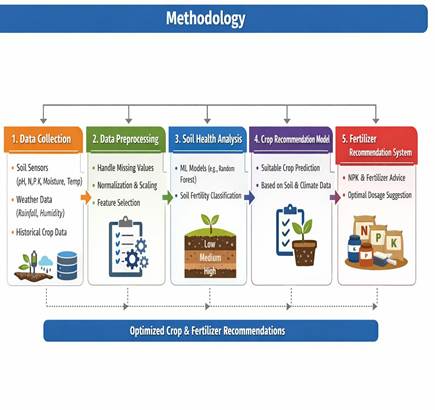
The entire
procedure, with help of which the proposed AI-based soil health evaluation and
agriculture crop recommendation system, illustrated by the figure, functions.
This is initiated by the collection of data that requires the soil parameters
and the weathering data and past crop data to continue the process. The second
step will involve data preprocessing that will apply the three processes which
include cleaning, normalization, and feature selection to come up with the best
input data.
Figure 1
|
Figure 1 Methodology for Optimized Crop and Fertilizer Recommendations |
Machine learning
models can also be used to conduct soil health assessments that lead to the
determination of various levels of fertility [20]. The crop recommendation
model works on the basis of soil properties in conjunction with the prevailing
climatic conditions in order to establish the type of crops to be planted. The
system of fertilizer recommendations provides precise nutrient requirement
advice along with information on the most appropriate way of applying the
nutrient requirements. This approach contributes to the improved growth of
crops as well as encourage safe use of fertilizers that cause positive effects
on the environment.
Data Collection
The system must be
able to gather the incoming data since the final suggestions will be based on
this data that will dictate their specific outcomes. The authors of the present
research gathered information using various reliable sources to define a proper
concept of soil and environmental situation Shawon
et al. (2025). The research team collects soil parameters
that involve pH level and nitrogen (N) and phosphorus (P) and potassium (K) and
moisture content and temperature either with the IoT-based soil sensor or
available agricultural dataset. The research uses the soil information and the
environmental factors such as the precipitation, humidity and climatic factors,
as they have a high impact on crop development. The model requires historical
crop data so that it can be refined in terms of learning abilities. As a result,
the system will produce accurate soil analyses and give valid crop and
fertilizer recommendations by utilizing the real-time sensor data with
available datasets, and it will create a complete and informative dataset.
Data Preprocessing
Collected data
must be cleaned and organized by the researchers since it is the only way they
can begin the work on the analysis. Machine learning models have problems with
performance due to the fact real world data sets include missing values and
irregular format and undesirable noise factors. The work on the collected data
will start with the management of the missing and erroneous values using two
approaches including the removal or replacing the data with appropriate
estimated values Sudha et
al. (2026). The standardization of parameters in data
measurement, including normalization and scaling of pH, moisture, and nutrient
levels, are crucial variables in determining the creation of standardized
measurement procedures that enhance the stability and accuracy of the model.
The most important soil and environmental variables affecting the development
of crops are identified by feature selection. The process simplifies the model
and increases its efficiency. Preprocessing of the data is a very important process
that generates a dataset that satisfies the three main criteria: it should be
clean, consistent and it should be useful in the construction of the correct
predictive models.
Soil Health Analysis
The system then analyzes the extent of soil conditions by its primary
properties once it is done in preprocessing activities. The analysis of the pH
content along with moisture content and nitrogen phosphorus potassium essential
nutrients illustrates the overall assessment of the soil fertility. The
proposed system uses machine learning models to identify patterns of data that
will allow it to categorize soil into three levels of fertility - low, medium
and high - rather than applying the conventional manual assessment systems Chaudhary
et al. (2026). The system offers automated analysis to
determine soil quality at a better speed and accurate findings. The system
helps in decision-making by offering a good foundation through evaluation of
soil health in the future. It can then present suitable crops and compute the
most suitable amounts of fertilizer.
Crop Recommendation Model
The determination
of sufficient crops to be planted starts after the analysis of soil health.
During this process, machine learning models handle the properties of the soil
and the environment factors in order to determine the crops that need specific
requirements. The system would give highly precise recommendation depending on
the inputs like the levels of nutrient (NPK) and pH and temperature and
humidity and rainfall. This model utilizes past agricultural data to come up
with its perception of the crops that would perform well in the identical
conditions rather than relying on the general assumptions. With this approach
farmers are able to select crops that are more suited to their land thereby
reducing the chances of crop failure and increasing overall production Latha et
al. (2025). The system offers evidence- based
suggestions that see farmers make improved decisions regarding their farming
practices.
Fertilizer Recommendation System
The system
proceeds to recommend the appropriate fertilizer types and application rates
after determining which crop will perform best in the given conditions. The
system determines fertilizer application rates through scientific analysis of
soil nutrient content which includes nitrogen and phosphorus and potassium
measurements together with the specific nutrient needs of the chosen crop. The
process of analysis determines the exact fertilizer needs, which helps to
correct existing nutrient shortages. Farmers can use this method to determine
the best fertilizer amounts. This helps them avoid using too much or too little
fertilizer, which saves money and protects soil health and the environment. The
system promotes sustainable farming by using a balanced way of managing
nutrients, which leads to better crop yields Dhanaraj
et al. (2025).
Result
The research
compares multiple machine learning algorithms which scientists use to develop
soil-based crop recommendation systems. The study assesses model performance
through the accuracy results which previous research and current agricultural
AI systems have provided.
Table 2
|
Table 2 Performance Comparison of different Models |
||||
|
Model |
Accura cy (%) |
Precisi on (%) |
Recal l (%) |
F1- Score (%) |
|
Decision Tree |
85% |
83% |
82% |
82.50% |
|
Support Vector Machine (SVM) |
88% |
86% |
87% |
86.50% |
|
Random Forest |
92% |
91% |
90% |
90.50% |
|
K-Nearest Neighbors (KNN) |
87% |
85% |
84% |
84.50% |
|
Ensemble Model |
95% |
94% |
93% |
93.50% |
The table provides
a performance comparison of various machine learning models that are used for
crop recommendation systems. The Ensemble Model outperforms all other models
because it achieves better results in all assessment tests which measure
accuracy and precision and recall and F1-score. The Random Forest model
demonstrates strong performance because it achieves balanced results across
multiple evaluation metrics. Decision Tree and K-Nearest Neighbors
(KNN) models perform worse than current machine learning approaches. The
results indicate that advanced hybrid machine learning methods will enhance
prediction accuracy and decision-making capabilities in precision agriculture
applications.
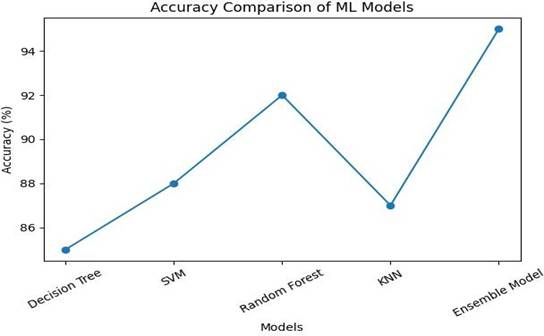
Figure 2
|
Figure 2 Accuracy Comparison of ML Models |
The figure shows
the comparison of accuracy among different machine learning models used in the
system. The Ensemble Model achieves the highest accuracy while Random Forest
and SVM show lower accuracy than that model. Decision Tree and KNN model
performance needs improvement because advanced models deliver superior
prediction accuracy for agricultural applications.
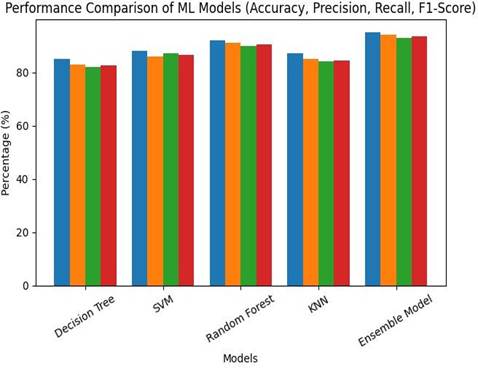
Figure 3
|
Figure 3 Performance Comparison of ML Models |
The bar graph
shows a comparison of different machine learning models, evaluating their
performance using four key metrics: accuracy, precision, recall, and the
F1-score. The Ensemble Model maintains the highest performance across all
measurement standards which the Random Forest model follows in second place.
The results show that advanced models deliver agricultural prediction systems
which demonstrate better assessment results between different performance
metrics.
CONCLUSION
This study
illustrates an artificial intelligence approach to assess the health of soil to
know the right type of crops that should be planted and the mode of fertilizing
the soil. The developed system by the researchers applies soil parameters and
environmental factors and machine learning methods to provide an efficient farm
decision-making system. This approach will enable farmers to have data-driven
information that will help them decide on crop choices and choice of fertilizer
to use better than the traditional approaches that relied on general
assumptions. The paper shows that higher models deliver better accuracy and
reliability outcomes in the event of employing ensemble techniques. The system
is beneficial to the sustainable agriculture sector as it reduces unnecessary
use of fertilizers that in turn reduces costs but increases the production of
crops. This solution can be implemented by farmers due to the fact that it only
needs simple digital platforms. The study satisfies the growing need of intelligent
agricultural practices that produce high yields and at the same time preserve
the environment.
ACKNOWLEDGMENTS
None.
REFERENCES
AI-Driven
Soil Monitoring and Crop Recommendation
System Using Machine Learning Algorithm.
(2024). Grenze International Journal of Engineering and Technology, 10.
Apu,
M. S. H., et al. (2025). IoT-Based Crop Recommendation System Using Machine Learning Techniques. International Journal of
Intelligent Engineering and Electronic Business.
Artificial Intelligence-Based Crop Recommendation and Disease Detection System. (2024). IJRASET.
Awais, A., et al. (2024). Artificial Intelligence and Machine Learning in Soil Analysis for Sustainable Agriculture. International Journal of Advanced Biochemistry Research, 8(11), 869–878. https://doi.org/10.33545/26174693.2024.v8.i11k.2973
Chaudhary, P., et al. (2026). Evaluation of Ensemble Learning Techniques for Soil Fertility Prediction. Scientific Reports.
Cheema, S. M., et al. (2025). AIoT-Based Soil Nutrient Analysis and Crop Recommendation System. https://doi.org/10.1016/j.atech.2025.100924
Chen,
J., et al. (2020).
Smart Fertilizer Management Using AI Technologies.
Agricultural Systems, 178.
Dhanaraj, R. K., et al. (2025). AI-Based Smart Farming System Using Random Forest for Crop and Water Optimization. Scientific Reports.
Gunasekaran, K., et al. (2025). Real-Time Soil Fertility Analysis and Crop Prediction Using Machine Learning. Frontiers in Soil Science. https://doi.org/10.3389/fsoil.2025.1652058
Gupta, S., et al. (2022). Farmer's Assistant: A Machine Learning-Based Application for Agricultural Solutions. arXiv. https://arxiv.org/abs/2204.11340
Kamilaris, S., and Prenafeta-Boldú, F. X. (2018). Deep Learning in Agriculture: A Survey. Computers and Electronics in Agriculture, 147, 70–90. https://doi.org/10.1016/j.compag.2018.02.016
Kiran, P. S., et al. (2024). A Machine Learning-Enabled System for Crop Prediction in Agriculture. MDPI Proceedings, 67(1). https://doi.org/10.3390/engproc2024067051
Lal, R. (2016). Soil Health and Carbon Management. Food and Energy Security, 5(4), 212–222. https://doi.org/10.1002/fes3.96
Latha,
P., et al. (2025).
Deep Learning for Soil Nutrient
Prediction and Fertilizer Optimization. Environmental
Science Journal.
Majdalawieh, M., et al. (2025). Precision Agriculture in the Age of AI: A Systematic Review.
Mavi, H., et al. (2024). Crop Recommendation System Based on Soil Quality and Environmental Factors Using Machine Learning. Conference Proceedings. https://doi.org/10.1109/INNOCOMP63224.2024.00089
Pandey, V., et al. (2025). AgroSense: An Integrated Deep Learning System for Crop Recommendation via Soil Image Analysis and Nutrient Profiling. arXiv. https://arxiv.org/abs/2509.01344
Reddy,
G. V., et al. (2024).
Precision Farming Practices
with Data-Driven Crop and Fertilizer
Recommendation. E3S Web of Conferences.
Sharma, P., et al. (2021). Artificial Intelligence in Agriculture: Opportunities and Challenges. IEEE Access, 9, 101063–101085.
Shastri, S., et al. (2025). Incorporating Soil Information with Machine Learning for Crop Recommendation. Scientific Reports.
Shawon,
S. M., et al. (2025).
Crop Yield Prediction Using Ensemble and Hybrid Machine
Learning Models.
Sudha, S. P., et al. (2026). Machine Learning-Based Precision Agriculture: A Review.
Sundari, M. V. R., et al. (2025). Fertilizer Recommendation System Using Machine Learning. AIP Conference Proceedings. https://doi.org/10.1063/5.0298485
Tripathi,
A. K., and Mishra, S. (2018). Crop Recommendation System Using Machine Learning. International Journal of Advanced Research in Computer Science, 9(3).
Venkateswara, S. M., et al. (2025). Interpretable Deep Learning Models for Crop Recommendation and Soil Analysis. Scientific Reports.
 This work is licensed under a: Creative Commons Attribution 4.0 International License
© Granthaalayah 2014-2026. All Rights Reserved.

