
Original Article
Gender and Power Relations in English Literature: A Comparative Analysis of Victorian and Contemporary Novels
|
Dr. Rutuja P.
Ghorpade 1* 1 Mahila Mahavidyalaya
Amravati, India |
|
|
|
ABSTRACT |
||
|
The current paper can be considered as a comparative analysis of the novels by Victorian and contemporary authors in terms of representation of gender and power relations in English literature. Being strict in terms of patriarchy and gender roles, being a woman in the Victorian world seemed to be a task that implied to the female gender the passivity and domesticity of a woman that is limited by the powers of the society. By contrast, the modern-day writings are much more indicative of changing gender roles and are questioning established structures of power, presenting not just more subtle but also more varied images of women and men. This paper identifies the transformations attained in gender relations, how inequalities in the system have been perpetuated and how ideas of feminism and postmodernism have surfaced through comparative reading of some of the works in each period. The paper sustains the argument that even though the present-day novels give the voices marginalized more agency, certain power disparities that existed historically can still be traced in the literary texts. This comparative enterprise brings to light the changing discourse of gender and power and expresses how literature is both a mirror and a maker of societal ranges of behavior. Keywords: Gender Roles, Power Relations,
Victorian Literature, Contemporary Fiction, Feminism, Patriarchy, Gender
Identity, Literary Analysis |
||
INTRODUCTION
The relationship
of gender and power has been of the main interest in literary study, as
literature does not merely reflect the reality in the society, but it was also
part of the cultural ideology development. English literature can be a very
good source of study, especially, on the process through which gender roles and
power arrangements have been renegotiated at different times. As the rigidly
hierarchical society of the Victorian world has been giving place to more
contemporary and more questioned models of the contemporary world, the literary
productions reveal the development of the identity notion, power and
resistance. The purpose of this paper is to explore these shifts through the
relative analysis of the gender and power relations in the Victorian and modern
novels.
The social order
of the Victorian period (1837-1901) was highly stratified, and was impressively
imposed by industrialization, religious ethics and rigid rules of behavior. Gender roles in the era were clearly defined and
justified by cultures, laws and institutional frameworks. The world of men was
the world of work, politics and intellectual activities; the world of women was
the world primarily of family and house. The figure of a woman, a figure of an
ideal Victorian woman, was usually defined by the concept of so-called Angel in
the House, which had a clean mind, was modest, moral, etc. This ideology not
only deprived women of their free will but it also justified their lack of
representation in authority.
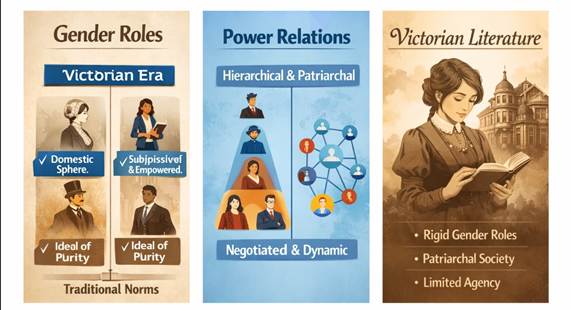
These norms were
often reflected in Victorian novels, and female characters were subjected to
the norms of patriarchy, which influenced their lives. An example is marriage
which was many times presented as the end-all be-all of women, both social need
and economic insurance. But these limits were implicitly criticized by numerous
authors who depicted inner conflicts and rebellion of female heroes.
Women in the
novels of today are depicted as autonomous and self-willful
people bargaining their positions in the society. In comparison to their female
counterparts in the Victorian period, modern female characters are not
restricted to domestic environments but engage in professional, political, as
well as, creative world. What is more, modern literature broadens the
discussion of gender, including the topic of sexuality, intersectionality and
non-binary identities. This inclusive attitude can be used to understand power
relations in a broader, more complex way that can no longer be defined in the
terms of male supremacy and female subjection.
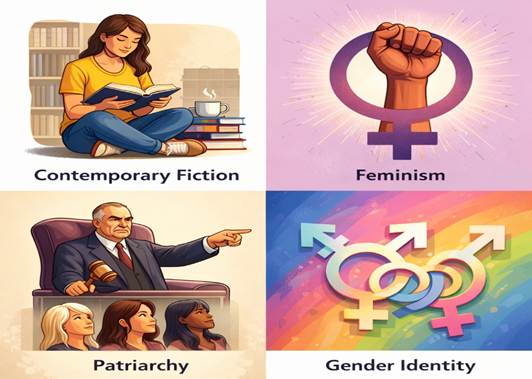
Another important
distinction is in the very conceptualization of power. Although Victorian
literature is inclined to discuss power as a stable and hierarchical order, it
can be seen that modern literary works tend to discuss it fluid, decentralized,
and negotiable. Power is no longer considered only as domination but as a
dynamic process throughout which there is resistance, adaptation and
transformation. This change is consistent with the current theoretical
frameworks that highlight the socially constructed character of gender and the
plurality of power relations.
However, despite
these developments, modern literature has no complete mastery over the effects
of a historical power structure. Patriarchal ideology still exists in subtle
and sophisticated forms which are often embodied in the form of internalized
norms, social expectations, and the system of inequalities. Consequently, the
analysis of gender and power in literature can be approached in a critical
manner that accommodates both developments and developments.
This study is
based on the fact that literature is a reflection and critique of the society.
The comparison of the Victorian and contemporary novels will help the study
determine the trends of transformation and stability in the way the questions
of gender and power are represented. It attempts to help provide responses to
some important questions: How has the literary depiction of gender roles
changed over time? How are some modern texts opposing or supporting the
conventional systems of power? And to what degree do historical ideologies
still play out in the narratives of the modern?
In this
comparative analysis, the paper will make a contribution to continuing debates
on the literary and gender studies field, by putting light on the place of
literature in de-factoring social change. The study highlights the significance
of literature sources as the arenas of ideological struggle and cultural change
by analyzing the interaction of gender and power in
various epochs.
Literature review
The characters of
gender and power relations in the literature have changed through time into the
description of male dominance and female subordination into more complex and
multi-layered interpretations. Previous literary criticism usually emphasized on
how the women were depicted to be passive or oppressed and in particular, in
traditional societies. The recent researches have however furthered this debate
to examine the culturally specific and dynamic operations of power in subtle
and dynamic terms. The articles selected to enrich this study provide the
research with an excellent conceptual and informational foundation to the
construction, challenge and transformation of gender and power in literary
texts.
Chiasoka
(2023) adds to this discussion by suggesting a
decolonial feminism concept to a literary analysis. It states that gender
oppression cannot be explained solely by patriarchy, it needs to be considered
in the context of colonial past and cultural oppression. According to Chiasoka,
the work of literature is normally the result of these forces of power, here;
women are subdued by males and even, they are under colonial practices that
determine identity, culture and social status. The approach is helpful
particularly in comparative literary analysis because it is possible to
introduce the differences in the ways in which gender relations diffuse in
societies in an otherwise interrelated process of inequality via international
systems. It also helps the readers look beyond the Western feministic models,
and consider other cultural experiences in writing.
Likewise, Conroy
et al. (2019) explore the issue of how gender and power are produced with tools of
competing discourse of tradition, unity, and rights. Being framed within the
context of the health studies and research, the theoretical insights are of
great relevance to literature. According to the authors, power is non-existent
and is a constantly negotiated one in the context of social relations and
cultural beliefs. This idea can be easily applied to the preferred literary
works in which the characters are likely to stand in between the traditional
portrayals of their characters and the desire to start gaining their freedom.
Their work can be fruitful to understand that literature is a field opposed to
other ideologies on gender and puts opposite ones in one another.
The article by Gunnarsson
et al. (2016) contributes to the argument and utilizes the
critical realism framework filling the gap between social construction and
material reality. Gender is produced in the process as well as being
conditioned by tangible constructs of the actual world such as economics,
politics and institutions. This dual nature is useful to literary analysis as
it enables the researchers not only to analyze the
ways in which gender can and is depicted in the texts, but also how the
representations can be related to the actual conditions of the society. It
indicates that there is no literature that is autonomous but literature that is
highly pushed by the world, where the literature is created.
Feminist literary
investigation is one of the issues Oan (2024) is especially worried about, because it
analyses literary works of some of the authors known among the South Asians. It
illustrates that women authors diagnose literature as an asset to rebel against
the patriarchal norm and enact rebellion. Through personalities and stories,
these authors form women who have to struggle with authority, wish to be left
alone and reclaim their place in the society. This work by Oan is especially
applicable to this study since it indicates how literature can be actively involved
to remodel societal constructs of gender. It also points out the need to
embrace non-Western views in the study of literature in order to have a more
thorough understanding of gender relations.
The problem of
gender and power are taken one step further by Williams
and Knudson-Martin (2013), to the sphere of relations and
interpersonal communication. Their work discloses the presence of power
imbalance in the normal communication with each other, particularly in love
relations. This observation has a significant part to play in literary analysis
since the majority of novels reflect on the concept of personal relationships
being a reflection of the aspects of the society. Through the analysis of the
role of power in those relations, the paper can offer a more in-depth
explanation of the mechanisms of gender inequality reproduction and opposition
both on an individual and a social level.
Mechita et al.
(2024) place the discourse into context of the
modern fiction and demonstrate how the gender roles and the power system is
redefined in the modern literature. They conclude that even rigid gender norms
are traditionally being overlooked in the modern novels and are illustrating
more elastic and diverse identities. Women have been labeled
as independent and confident and the male is more sensitive and emotionally
diversified in nature. The transformation of this nature can be seen as a
symptom of the broader social change and imply that literature is influenced by
the changing notions of identity and power. The article assists in arguing that
contemporary literature plays a key role in questioning the traditional
hierarchies and more representative images.
Though both
articles by Clancy
et al. (2018) and Petrova
and Simcock (2021) focus on energy studies, they provide us
with the understanding of how the concept of gender stereotypes and power
relations is embedded in the discourse. As a part of their study, they prove
that even in technical subjects, gender assumptions still play a role as a
factor in knowledge production and representation. This discovery has a great
repercussion in the world of literary study since it stresses the need to
critically study how language and stories influence our comprehension of
gender. This means that literature like any other discourse can uphold or
destroy the systems of power that are already in place.
Felski
(2003) comes with a more inclusive approach to
feminist literary criticism, as she does not only discuss the evolution of the
discipline. Theorizing about the modern criticism, she states that it is time
to get beyond merely protesting the system of patriarchy to rather appreciate
the intricacy of literary works. According to Felski his feeling is that a
literature must not only be valued due to its ideological worth, but we must
also keep in mind the aesthetics and emotion of a literature. It is the mode of
more moderated and subtle interpretation, which is imperative in both the study
of Victorian and modern novels.
Finally, Risman
(2004) is a sociological approach in the sense that
he defines gender as a social order, which are manifest on a variety of levels
individual level, interactional level and institutional level. This particular
perception will be of particular use in the analysis of literature since the
historical researcher can make her efforts twice and even thrice to comprehend
how the roles of gender happen and influence the character in different
circumstances and conditions. It also pinpoints the problem of power being sustained
by the everyday routine along with the social institutions why it is easier to
refer the issues introduced in literature to the real-life processes.
Overall, the
literature surveyed has demonstrated to complicate and underdisciplined the
analysis of gender and power in literature. Compared to former tools, which
mainly oriented at the constitution of inequality, the more recent research
findings address the negotiating and flowing power. All these show that in
addition to being a reflection of the society literature is a potent tool of
contestation and transformation of gender relations. This theory base assists
the current study on comparative analysis of the Victorian and contemporary
novels and it offers the tools and means to comprehend the continuity as well
as change in the gender discourse.
1)
Construction
of Gender Roles
The roles of
genders are strict in Victorian novels and socialized. Women are traditionally
depicted as passive, nurturing, and morally superior creatures who are
localized to domestic areas, whilst males are in roles of authority in a social
lifestyle. The subject female identity is mostly developed in connection with
the male subjects: fathers, husbands, guardians and thus posing dependency. An
example is that heroines tend to live up to standards of obedience and
sacrifice and any form of breaking these standards leads to either social
marginalization or moral censure.
The modern novels
are more flexible and diverse in their interpretation of gender roles in
contrast. The characters of female sex are portrayed as independent people with
their identities, dreams, and opinions. They are not limited to the domestic
world anymore; they take part in the professional and social life. Moreover,
modern literature is disrupting the conventional masculinity, through depicting
male characters who are not only vulnerable, but also emotional. This change is
indicative of a larger cultural shift of questioning and redefining gender
norms.
2)
Representation
of Power Structures
The predominant
types of power in the Victorian literature are hierarchical and patriarchal.
The men possess an economic, legal and social power and the power of women is
restricted and indirect. Marriage is one of the main processes that keep these
relations of power and the social status of women and their security are
greatly conditioned by their marriage relations. It is also possible to see
that even in the cases when female characters are strong or independent, their
power is limited by the social norms.
Modern literature,
though, conceptualizes force in the more negotiated and dynamic form. Power is
not also only concentrated in the authority figures, male, but is shared in
different social and cultural spaces. There is a pattern towards women becoming
more in control of their lives, pushing conventional hierarchies and redefining
relationships. Further, power is shown to be functioning through discourse,
identity and social interaction and not just through institutional dominance.
3)
Agency
and Autonomy
Agency is an
essential issue of gender representation that has evolved especially when
comparing the Victorian and contemporary texts. In Victorian literature, female
agency is mostly restricted to inner resistance or indirect rebellion. Although
in a few instances characters demonstrate dexterity and ethical prowess, their
freedom of action is often limited due to extrinsic factors. Their stories
frequently end with compromising, in which the needs of the person are seen as
secondary to the needs of the society.
Agency is more
personally stated and exercised in modern-day novels. Protagonists are female,
independent, career driven and create a ruckus against derogatory structures.
They do not only play passive roles to male dominance but they are real players
who create their own fate. This heightened agency is indicative of the impact
of a feminist ideology and the rise in the awareness of women rights in
contemporary society.
4)
Resistance
and Subversion
Anti-establishment
in Victorian literature is usually symbolic and implicit. Women who break the
concept of female constraints can do it via individual sense of right, ethical
bravery or passive resistance. Nevertheless, this resistance is normally within
reasonable limits and it is seldom that it brings systemic change. The effects
of blatant rebellion are usually dramatic, which helps to urge the restrictions
placed on women.
On the contrary,
modern literature foreshadows opposition as a main theme. Challenging social
norms, subverting authority, and destabilizing oppressive systems, characters
are active and engage in the world. This opposition does not exist as purely
gender, but it is intertwined with a set of questions of class, race, and
sexuality. The modern texts therefore convey a more extreme and drastic
approach to social change, focusing on being able to redefine the relations of
power.
5)
Intersectionality
and Diverse Identities
Intersectional
perspectives are one of the most important achievements of the modern
literature. In comparison to the Victorian texts, which in most cases revolve
solely around limited expression of gender in the context of a homogenous
social setup, the contemporary novels recognize the multifaceted Ness of the
identity. Gender is perceived to make cross-section with other variables like
class, ethnicity and sexuality and leading to various experiences of power and
marginalization.
6)
Continuity
and Change
Although a
comparative analysis of the Victorian and contemporary novels indicates much
advancement in the way gender and power relations are being portrayed, it also
highlights the fact that there are still some structural and ideological
continuities. This fusion of change and perpetuation brings into light that the
evolution of literature is not simple and that developments of the gender
discourse are not linear but dynamic and stratified.
The expanded
visibility and agency of female characters of the modern literature has been one of the clearest spheres of change as well.
Modern female heroes do not necessarily exist in the narrow social constructs
that could so often define Victorian heroines, but are frequently portrayed as
confident and capable of forming their personal destinies. They defy
patriarchal conventions, prove their identities and are involved in both indoor
and outdoor life. This change is a part of the greater socio-cultural
tendencies, such as the impact of feminist movements, legal changes, and the
shifting perceptions surrounding gender equality.
Nevertheless, in
spite of progress, some elements of the Victorian ideal of gender also remain
in the modern narratives, although in more delicate forms. Off conservative
ideas about femininity, e.g. emotional work, nurturing, the need to juggle both
career and home life, etc. still linger in most contemporary texts. Even when
female characters are depicted in a strong light, they are frequently rated by
their relationships, appearance, or conformity to unattainable social
constructs. This makes it seem that overt types of patriarchy may have died
out, but unspoken norms will still cause gender representation to affect.
On the same note,
change and continuity are evident in how male characters are presented as well.
In more modern literature, men are being increasingly portrayed as emotional
and psychologically in depth and no longer the hard and fixed masculinity of the
Victorian literature. However, the demands that men be placed in positions of
authority and dominance have not been completely destroyed. Male power in most
storylines remains either institutional, economic, or symbolic, which shows
that traditional power entities remain strong.
Final conclusion
This paper has
tried to examine how the relationship between gender and power comes about in
the English literature, through the study of the Victorian and the contemporary
novels. The results unveil a noticeable direction of change of the inflexible
patriarchal systems to more flexible, variety-filled, and controversial images
of gender. At the same time, it can be demonstrated in the analysis that such
transformation is not completely homogeneous and complete in the sense that the
components of the historical inequality continue to operate within modern
literary discourses.
The Victorian
literature has been a reflection of the social hierarchy, which is founded on
the rigid gender roles and-hierarchical structure of power. The women were
primarily confined in their homes with their personality founded on the premise
of purity, obedience and dependence. Marriage, law and religion were
institutions that put in to the hands of the male authority all the power.
Despite the fact that a part of authors was initially mentally challenged on
the basis of these structures, literary discourse and most of the literary
publications were supporting patriarchate, narrowing the female agency as well
as endorsing the gender-based inequalities.
On the other hand,
change in the way gender and power are depicted, not to mention how they are
conceptualized is one of monumental shift in the contemporary literature. The
female characters are increasingly becoming independent, assertive and
self-directed and bargaining the case at the society. The picture of power as a
strict hierarchical system has been changed as one that is stream like in its
relation and negotiation, and renegotiation inability. It is also possible to
expand the gender discourse with the current texts, introducing the
intersectional frames of thinking, considering a complex relationship between
gender, classes, race, and sexuality.
The study however
mentions the continuity of certain ideological continuities as well. Even
though things have become more visible and people are equally empowered, there
tend to be some invisible means of constraint like internalized norms,
expectations in a society or even existence of institutional inequalities that
still exist. This signifies that despite the disappearance of conspicuous
patriarchy redo vices, there is diffusion of power structures in literature
work, and social facts.
The existence of
alteration and permanence accentuate the complexity of the discourse on gender
in books. The modern novel neither completely negates the old but rather
carries out a dialogue with it and supports the old at the same time
challenging it and making it new. The evolution of the literature, then,
becomes a decisive sphere, in which not only are reflected the relationships of
power, but absolutely criticized and turned into something other.
In conclusion, it
can be reiterated that this comparative analogy study affirms that English
literature plays a critical role in documenting and defining the shift in
technology of genders, and power relations.
ACKNOWLEDGMENTS
None.
REFERENCES
Chiasoka, A. F. (2023). Decolonial Feminism and Gender in Literature: Challenging Patriarchal and Colonial Power Structures. Literature and Linguistics Journal.
Clancy, J. S., Skutsch, M., and Batchelor, S. (2018). Gender Myths in Energy Poverty literature: A critical discourse analysis. Energy Research & Social Science, 38, 9–18. https://doi.org/10.1016/j.erss.2018.01.010
Conroy, A. A., Ruark, A., and Tan, J. Y. (2019). Re‑Conceptualising Gender and Power Relations for Sexual and Reproductive Health: Contrasting Narratives of Tradition, Unity, and Rights. Culture, Health & Sexuality, 22 (Suppl 1), 48–64. https://doi.org/10.1080/13691058.2019.1666428
Felski, R. (2003). Literature After Feminism. American Literary History, 15(1), 108–127. https://doi.org/10.1093/alh/15.1.108
Gunnarsson, L., Martinez Dy, A., and van Ingen, M. (2016). Critical Realism, Gender and Feminism: Exchanges, Challenges, Synergies. Journal of Critical Realism, 15(5), 433–439. https://doi.org/10.1080/14767430.2016.1211442
Mechita, U., Kalita, P., Choudhury, M., Satola, D., and Sharma, V. (2024). Feminist Reimaginings in 21st Century British Fiction: A Study of Gender and Power in Contemporary Novels. American Journal of Psychiatric Rehabilitation. https://doi.org/10.69980/ajpr.v28i1.85
Oan, M. N. (2024). Feminist Literary Inquiry: Analyzing Gender Dynamics in the Works of Begum Rokeya and Anita Desai. ABC Journal of Advanced Research, 13(2), 57–68. https://doi.org/10.18034/abcjar.v13i2.798
Petrova, S., and Simcock, N. (2021). Gender, Sexuality and Feminist Critiques in Energy Research: A Review and Call for Transversal Thinking. Energy Research & Social Science, 75, 102005. https://doi.org/10.1016/j.erss.2021.102005
Risman, B. J. (2004). Gender as a Social Structure: Theory Wrestling with Activism. Gender & Society, 18(4), 429–450. https://doi.org/10.1177/0891243204265349
Williams, K., and Knudson-Martin, C. (2013). Do Therapists Address Gender and Power in Infidelity? A Feminist Analysis of the Treatment Literature. Journal of Marital and Family Therapy, 39(3), 271–284. Https://Doi.Org/10.1111/J.1752-0606.2012.00303.x
 This work is licensed under a: Creative Commons Attribution 4.0 International License
© Granthaalayah 2014-2025. All Rights Reserved.

