Reimagining 21st Century Skills in the Light of NEP 2020: A Transformative Framework for Holistic Education
|
Paonam Suhela Devi 1*, Dr. Neha Rawat 2 1 PhD Scholar, Department of
Teacher Education, Nagaland University, Kohima Campus, Nagaland 2 Assistant Professor, Department of Teacher
Education, Nagaland University, Kohima Campus, Nagaland |
|
|
|
ABSTRACT |
||
|
The present study aims to examine the necessary components of the 21st Century Skills framework within the context of NEP 2020 by probing its alignment with major global frameworks of 21st century skills. For this the study employed a methodology of a systematic analysis of policy documents and related literature establishing a comparative and comprehensive picture among the 21st century skills frameworks of ATC21S, OECD (2009), P21, and NEP 2020. A comparative table of identifying and giving “emphasis” on the skills from the different frameworks using a four-point scale (4 = Very High, 3 = High and 2 = Moderate emphasis) has been done. The findings show that the 21st Century Skills highlighted in NEP 2020 exhibit a strong alignment with the P21 framework. However, NEP 2020 distinguishes itself by placing a significantly greater emphasis on moral and ethical dimensions of education, extending beyond the scope of P21 and other international frameworks. Keywords: 21st Century Skills, 21st Century
Competencies, ATC21S, P21, Framework for OECD Countries (2009) and NEP 2020 |
||
INTRODUCTION
The traditional models of imparting education globally, mainly focus on content acquisition and rote learning,. Their conventional ways are increasingly becoming inadequate in preparing learners for the complexities of 21st century life. The transformations of the 21st century education, influenced by globalization, technological advancement, and socio-economic changes, have extensively redefined the processes and purposes of education. Consequently, there has been an emergent worldwide emphasis on the development of 21st century skills, encompassing critical thinking, creativity, collaboration, communication, and ethical reasoning, among others. Various international frameworks, such as ATC21S, OECD (2009), and P21, have explained the skills of 21st century necessary for 21st century education. In the Indian perspective, the beginning of the National Education Policy (NEP) 2020 marks a significant paradigm shift towards multidisciplinary, holistic, and skill-oriented education. NEP 2020 envisages a globally proficient education system that not only nurtures cognitive development but also emphasizes social, emotional, and ethical aspects of education by developing of 21st century skills of learners and teachers. NEP 2020 envisions an internationally competent educational system that prioritizes social, emotional, and ethical aspects of education in addition to supporting cognitive development by enhancing students' and teachers' 21st century skills. At the center of NEP 2020 is the development of thinking skills, particularly critical and analytical thinking to question, and interpret information rather than passively memorize content. This approach promotes problem-solving and informed decision-making skills, which are vital for addressing real-world challenges. Similarly vital is the nurturing of creativity and innovation. NEP advocates for multidisciplinary and experiential learning, where students engage in design, arts, cultural studies and inquiry-based activities. The NEP 2020 also emphasizes the importance of digital skills recognizing the integration of digital tools, coding, and computational thinking into education. In addition, NEP 2020 strongly emphasizes values and ethical development. It aims to develop empathy, respect for diversity, constitutional values, and environmental awareness for responsible citizens. The NEP 2020 also stresses the development of life skills as soft skills, in the form of communication, collaboration, leadership, and emotional intelligence.
Despite the importance of 21st century skills in policy discourse, there is a need to critically examine how NEP 2020 defines and conceptualizes these 21st century skills in relation to major international frameworks of 21st century skills. Understanding the convergences and divergences among these major 21st century skills frameworks is essential for contextualizing India’s educational developments within the global landscape and for identifying unique contributions of NEP 2020. To achieve this, the current study aims to investigate the essential components of the 21st century skills framework within NEP 2020 by comparatively analyzing it with the ATC21S, framework for OECD countries (2009), and P21 frameworks. By identifying core 21st century skills and examining the degree of emphasis placed on each, the study seeks to provide a nuanced understanding of how NEP 2020 reimagines 21st century skills.
Objective
and Methodology of the study:
To create a comparative description of different
frameworks of 21st Century skills, and to explore the essentials for
21st Century Skills framework in National Education Policy (NEP)
2020. For this, the study employs the methodology of content analysis of
published documents and related literature.
Understanding
21st century skills in global scenario
21st century skills are a collection of capabilities and competencies that are considered essential for success in the modern world, particularly in the 21st century. Possessing these skills is often seen as crucial for an individual to thrive in the rapidly changing and interconnected world. Let us outline some prominent definitions of 21st century skills.
“21st century skills are a set of abilities that students need to develop in order to succeed in the information age. They can be defined as a combination of core academic subjects with essential skills such as creativity, critical thinking, communication, and collaboration, along with information, media, and technology skills necessary for success in work and life” Partnership for 21st Century Learning (2019).
The Organization for Economic Co-operation and Development (OECD) states that 21st century skills are "a set of skills that are essential for the demands of the 21st century, including skills related to digital literacy, problem-solving, creativity, and social and emotional intelligence."
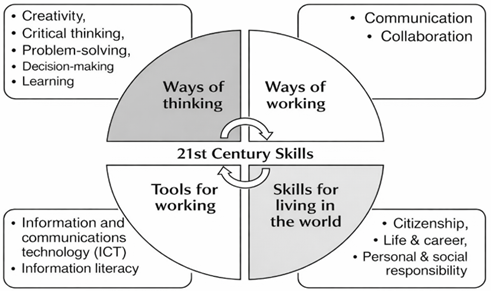
According to the Assessment and Teaching of 21st Century Skills (ATC21S) project, these “skills include ways of thinking (creativity, critical thinking), ways of working (communication, collaboration), tools for working (ICT literacy), and skills for living in the world (citizenship and personal responsibility) ATC21S (2012)”.
21st Century Skills or “21st century competences” are “an overarching concept for the knowledge, skills, and dispositions that citizens need to be able to contribute to the knowledge society Voogt and Roblin (2010).”
Wagner (2008) identifies “key survival skills for the 21st century, including critical thinking, collaboration, agility, initiative, effective communication, accessing and analyzing information, and curiosity”.
Kay and Greenhill (2011) highlight that “21st century skills integrate academic knowledge with higher-order thinking, technology skills, and life and career skills required for global competence”.
The above definitions highlight the importance of a wide range of skills, which are often integrated into educational curricula and training programs to equip individuals to meet the demands of the 21st century. 21st Century Skills have been the focus of educational reform in several countries, including the U.S., Australia, Finland, and Singapore. Especially in the U.S., the focus on 21st Century Skills is the core of educational reform Eguchi (2014). The concept of 21st century skills has been explained by different countries through their educational frameworks. In the United States, the Partnership for 21st Century Learning framework defines 21st century skills as a mix of critical thinking, creativity, collaboration, communication, digital literacy, and life skills Partnership for 21st Century Learning (2019). In OECD countries, the Organization for Economic Co-operation and Development describes the 21st century skills as the key competencies that combine knowledge, skills, attitudes, and values to deal with real-life challenges OECD (2005). The European Union and its European Union Key Competences Framework, highlights digital skills, personal development, and active citizenship for lifelong learning as necessary 21st century skills European Union (2018). In Singapore, the national framework emphasizes critical thinking, communication, and global awareness as essential skills for successful living in a multicultural society Ministry of Education Singapore (2010). In Australia, the Australian Curriculum focuses on general capabilities and skills as ethical understanding, intercultural awareness, and creative thinking ACARA (2018). In India, the National Education Policy 2020 stresses critical thinking, creativity, digital literacy, and values-based education for holistic development Government of India (2020). Overall, these perspectives show that 21st century skills refer to a combination of cognitive, social, digital, and ethical abilities needed to succeed in modern global society.
Major
initiatives in the development of frameworks of 21st Century Skills
Several global initiatives have significantly contributed
to the development of 21st century skills by redefining educational
priorities toward competency-based education. U.S. Department of Labor in 1994
stated SCANS (1994) report focused primarily
on thematic competencies such as Communication and Collaboration, Information
Acquisition and Research, Productivity and Problem Solving, and Creativity and
Innovation as necessary 21st century skills. Across several leading
21st century skills frameworks, common competencies include
information and communication technology, communication, collaboration,
creativity, problem-solving, critical thinking, and social skills. The most
thorough thematic summary of major “21st century
skills/competencies”, including Core Competencies, was proposed by the
Partnership for 21st Century Learning (P21) in 2002 Partnership for 21st Century Learning (2016).
Other major platform is OECD
(2018)
that identifies three “transformative competencies” by distinguishing three
different types of skills: cognitive and metacognitive; social and emotional;
and practical and physical and the third is ATC21S.
In the United States, the Partnership for 21st Century Learning developed a extensively recognized framework emphasizing the 4Cs—critical thinking, creativity, communication, and collaboration—along with digital literacy and life skills Partnership for 21st Century Learning (2019). Similarly, the Organisation for Economic Co-operation and Development identified key competencies that incorporate knowledge, skills, attitudes, and values necessary for addressing complex real-life challenges through its DeSeCo project OECD (2005). The European Union introduced the Key Competences for Lifelong Learning framework, focusing on digital competence, personal development, and active citizenship European Union (2018). Globally, the UNESCO has promoted initiatives such as Education for Sustainable Development and Global Citizenship Education, which stress peace, sustainability and intercultural understanding UNESCO (2017). Furthermore, the Assessment and Teaching of 21st Century Skills (ATC21S) project has influenced defining and assessing collaborative problem-solving and digital skills in educational contexts Griffin et al. (2012). In Asian context, Singapore’s national framework emphasizes communication, critical thinking and global awareness as indispensable competencies for students of 21st century Ministry of Education Singapore (2010). In India, the National Education Policy 2020 represents a major reform initiative that integrates critical thinking, creativity, digital literacy, and holistic development into the education system Government of India (2020).
21st
Century skills frameworks for ATC21S, P21 and 21st Century skills
and competencies framework for OECD countries (2009)
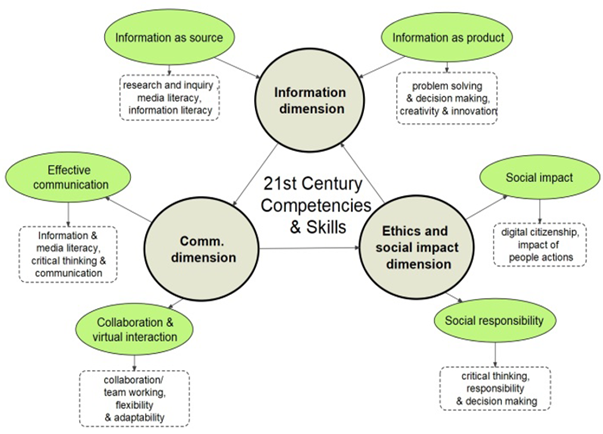
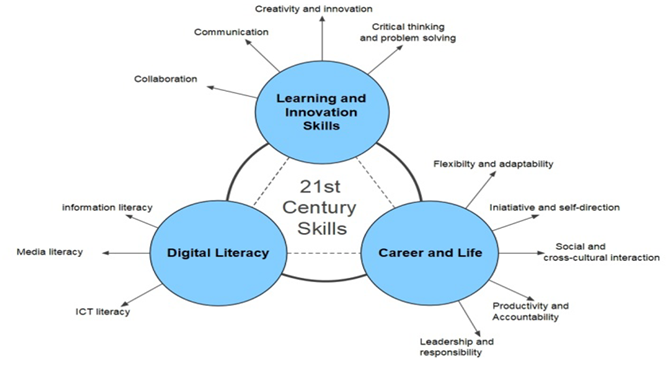
Assessment & Teaching of 21st Century Skills (ATC21S), an organization with international collaboration based in Australia Griffin et al. (2012) in 2010, organized 21st Century Skills into ways of Working, Ways of Thinking, Skills for Living in the World, and Tools for Working. The organization emphasized the importance of creativity, critical thinking, communication and collaboration (4Cs) as key of success in the 21st century. Ananiadou and Claro (2009) presented a preliminary framework for the study on 21st Century Skills and Competencies for New Millennium Learners in OECD Countries, aiming to investigate whether and how OECD countries teach and assess 21st century skills in August 2009. The framework was termed as 21st Century Skills and Competencies. Though they clearly stated the relation between skills and Competence in their report, they used both terms “skills and competencies” and also used them interchangeably as different countries use them. Figure 2 shows their proposed framework. In all frameworks, the Partnership for 21st Century Learning framework (often called the P21 Framework) is one of the most influential models for defining and organizing 21st century skills in education. The Learning framework for 21st Century skills of P21 highlights essential competencies for modern learners, particularly the 4Cs—critical thinking, creativity, communication, and collaboration—along with digital literacy. It also integrates life and career skills with core academic subjects to prepare learners for success in a global, technology-driven world. Let us compare and comprehend each of these major frameworks through following Figure 1, Figure 2 and Figure 3.
|
Figure 1
|
|
Figure 1 21st Century Skills Framework. Redrawn
Based on the ATC21S Framework Proposed by Binkley et al.
(2010) |
|
Figure 2
|
|
Figure 2 21st Century Skills and Competencies
Framework for OECD Countries (2009) Proposed by Ananiadou and Claro (2009) |
|
Figure 3
|
|
Figure 3
21st Century Skills Framework of P21, Adapted from Framework for 21st
Century Learning |
21st
century skills in National Education Policy (NEP) 2020
National Education Policy 2020 also envisages the necessity of holistic development of students by inculcating 21st Century Skills. It mandates the creation of globally competent and all-rounder individuals equipped with key 21st Century Skills. The policy emphasized developing these skills in various paragraphs of the document. The National Education Policy 2020 emphasizes the development of 21st century skills to prepare learners for a dynamic, knowledge-based, and technology-driven world. It shifts the focus of education from rote memorization to the cultivation of critical thinking, problem-solving, and analytical abilities through inquiry-based and experiential learning (NEP 2020, paras 4.4, 4.5). The policy highlights the importance of creativity and innovation by promoting multidisciplinary and holistic education, integrating arts, sciences, and vocational subjects (NEP 2020, paras 4.6, 11.8). It also underscores the need for effective communication and collaboration skills through interactive and participatory pedagogies (NEP 2020, paras 4.4, 4.7). In addition, NEP 2020 stresses digital literacy, technological competence, and computational thinking, along with the integration of ICT in education (NEP 2020, paras 23.2, 23.3). The policy further incorporates life skills such as adaptability, leadership, resilience, and ethical decision-making, along with values like empathy, respect for diversity, and constitutional ideals (NEP 2020, paras 1.3, 4.4). By encouraging competency-based learning and global citizenship, NEP 2020 aims to develop well-rounded individuals equipped with the knowledge, skills, and attitudes necessary for the 21st century (NEP 2020, paras 4.4, 6.1).
From the above discussion, it is evident that a framework of 21st Century Skills based on NEP 2020 is taking shape by analyzing and reflecting on what and which skills the policy felt necessary to be developed. The study also identifies and creates the proposed framework of 21st century skills of NEP 2020 in its next section.
Relationship
between 21st Century skills frameworks of ATC21S, for OECD countries
(2009), P21 and NEP 2020
Though there is not any single sufficiently agreed upon listing of skills for 21st century skills globally but some of the core skills that commonly occurred as skills or associated skills across major frameworks of 21st century skills can be recognized as significant skills defining 21st century skills. The study attempts to list all such skills as taken from major frameworks with respect to framework for OCED countries (2009), ATC21S (2010), P21, and NEP-2020 shown in the following Table 1. The following Table 1 gives number (1, 2, 3, 4) under each framework to each skill based on the degree of “emphasize” on that skill. The skills in the frameworks are described on the four-point scales as ranging from 4-Very high emphasis, 3-High emphasis and 2-Moderate emphasis. Let us study the comparative emphasize in each of the frameworks as follows:
|
Table 1 |
|
Table 1 Comparative Emphasize in Number
on Each Skill Across Various Frameworks of the Study |
||||
|
Framework of 21st
Century Skills and Competencies |
ATC21S (2010) |
for OECD
countries (2009) |
P21 |
NEP 2020 |
|
Sub-Skills |
||||
|
Critical thinking & Problem solving |
4 |
4 |
4 |
4 |
|
Creativity & Innovation |
4 |
4 |
4 |
4 |
|
Communication |
4 |
4 |
4 |
4 |
|
Collaboration |
4 |
4 |
4 |
4 |
|
Information literacy |
4 |
4 |
4 |
4 |
|
Media Literacy |
3 |
4 |
4 |
3 |
|
ICT Literacy |
4 |
4 |
4 |
4 |
|
Flexibility & Adaptability |
4 |
4 |
4 |
4 |
|
Initiative & Self-direction |
3 |
3 |
4 |
4 |
|
Social & Cross-cultural Innovation |
3 |
4 |
4 |
4 |
|
Productivity & accountability |
3 |
3 |
4 |
4 |
|
Leadership & Responsibility |
3 |
3 |
4 |
4 |
|
Inter personnel |
3 |
3 |
4 |
4 |
|
Moral & Ethics |
3 |
4 |
3 |
4 |
|
(4-Very high
emphasis, 3-High emphasis and 2-Moderate emphasis) |
||||
Discussion
and interpretation
The comparative Table 1 presents a cross-framework analysis of four prominent models of 21st century skills—ATC21S (2010), OECD (2009), Partnership for 21st Century Learning, and NEP 2020. The numerical values indicate the degree of emphasis placed on each sub-skill (with higher values representing stronger emphasis).
A clear pattern emerging from the table is the strong consensus across all four frameworks on core cognitive and learning skills. The skills creativity & innovation, critical thinking & problem solving, collaboration, communication, information literacy, and ICT literacy consistently achieve the highest rating (4) across all the 21st century skills frameworks of the study. This highlights a “universal recognition” that these competencies form the basis of 21st century education. These skills are essential for navigating complex, technology-driven, and knowledge-based societies. Let us further understand the complete picture each skill wise as follows:
1) Critical
thinking & problem-solving skills
With ACT21S, both critical thinking & problem solving
are emphasized as key skills under ‘Ways of thinking’. With 21st
Century Skills and Competencies framework established for OECD countries (2009), Critical thinking was
included as a key skill for the sub-dimension effective communication under the
Communication dimension and problem-solving thinking was included as a key
skill for the sub-dimension Information as a product under the Information dimension.
Regarding P21 frameworks, critical thinking & problem solving were
emphasized as key skills in the 4C’s (Critical Thinking and Problem Solving)
under Learning and Innovation. Regarding NEP-2020, critical thinking &
problem-solving were emphasized as key skills on page no.4 of the policy
document.
2) Creativity
& innovation skills
All the frameworks discussed here and NEP-2020 emphasized Creativity & innovation skills. With ACT21S, both Creativity & innovation skills are under ‘Ways of thinking’. For 21st Century Skills and Competencies framework established for OECD countries (2009), both skills are included in the sub-dimension ‘Information as product’ under the ‘Communication dimension’. Regarding P21 frameworks, both were emphasized as key skills in the 4C’s (Critical Thinking and Problem Solving) under Learning and Innovation. Regarding NEP-2020, both skills were emphasized as key skills in para 11.2 of page no.46 of the policy document.
3) Communication
Skills
Communication is included under ‘Ways of working’ in ACT21S. For 21st Century Skills and Competencies framework established for OECD countries (2009), it was included as a key skill for the sub-dimension of effective communication under the Communication dimension. Regarding P21 frameworks, it was included as a key skill in the 4C’s (Critical Thinking and Problem Solving) under Learning and Innovation. Relating to NEP-2020, communication skills were emphasized often as key skills in page no.5, para 1.2, 4.24, 11.1,11.2, 11.4,11.6,15.9 and 22.1 of the policy documents.
4) Collaboration
Skills
Collaboration was included under ‘Ways of working’ in the case of ACT21S. For 21st Century Skills and Competencies framework established for OECD countries (2009), it was included as a key skill for the sub-dimension ‘Collaboration and virtual interaction’ under the ‘Communication dimension’. In NEP-2020, collaboration skills were emphasized as key skills in para 4.8, 4.24, and 5.11 of the policy documents.
5) Information Literacy
In ACT21S, information literacy was included as ‘information literacy’ under ‘Tools for working’. While 21st Century Skills and Competencies framework established for OECD countries (2009), it was included as a key skill for the sub-dimension ‘Information as source’ under ‘Information dimension’. Regarding P21 frameworks, information literacy was included as ‘information literacy’ under ‘Digital Literacy’. For OECD countries, it was included as a key skill for the sub-dimension ‘Effective communication’ under the ‘Communication dimension.’ Social & cross-cultural interaction Social skills are related to its’ theme ‘Skills for living in the world’. However, cross-cultural interaction is not evident.
6) Information
and communications technology (ICT) and information literacy
It is also called as Media Literacy. Media Literacy is a key skill in the 4C’s (Critical Thinking and Problem Solving) under Learning and Innovation. ICT literacy was included under “Tools for working” in ACT21S and as ‘Digital citizenship’ under ‘Social impact sub-dimension’ for 21st Century Skills and Competencies framework established for OECD countries (2009). Regarding NEP-2020, “ICT Literacy” was emphasized as digital literacy as a key skill in para 4.24 and 21.5 of the policy document.
7) Flexibility
& adaptability
It is related to the sub-theme ‘Skills for living in the
world’ under ‘Tools for working’ in ACT21S and as Social & cross-cultural
interaction. Social skills are related to its’ theme, “Skills for living
in the world”. However, cross-cultural interaction is not evident in ACT21S.
These skills are observed as related to the social responsibility
sub-dimension under the ethics and social impact dimension for 21st
Century Skills and Competencies framework established for OECD countries (2009). Relating to NEP-2020,
cross-cultural interaction is evident as cultural awareness, expression, and
empathy were emphasized as key skills in para 22.2, 22.4, 22.8, 25.1, and 26.2
of the policy document.
8) Interpersonal
Skills
Interpersonal is related to its’ theme, “Skills for living in the world,” in the case of ACT21
9) Moral & ethics
Moral & ethics are covered under the Ethics and social impact dimension in 21st Century Skills and Competencies framework established for OECD countries (2009). Moral and ethics are also one of the important skills of NEP-2020.
In nutshell, all four frameworks emphasize on core skills
such as critical thinking & problem solving, creativity &
innovation, communication, collaboration, information literacy, and ICT
literacy constantly giving them the highest rating (4) across all
frameworks. Though, deviation is evident in media literacy skills. While
ATC21S, it is rated as (3), for OECD countries
(2009), P21 and NEP 2020 frameworks give it very high importance
(4).This imply that past frameworks like ATC21S may not have fully estimated
the fast expansion of digital media, whereas more recent frameworks, especially
NEP 2020, strongly accept the importance of media awareness in fighting
misinformation and fostering digital citizenship.
Another significant divergence is seen in self-direction, productivity & accountability, and leadership & responsibility. These are clearly emphasized (3) in ATC21S and for OECD countries (2009), but receive strong emphasis (4) in P21 and NEP 2020. This indicates a change from thinking skills to life and career skills, highlighting the growing importance of learner’s responsibility, autonomy, and leadership in 21st century modern education systems.
The skills of social and cross-cultural interaction also reveal contrasting preferences viz (3) with ATC21S, whereas for OECD countries (2009), P21 and NEP 2020 highlight this skill strongly (4). This may signify differing relative priorities, with NEP 2020 particularly stressing inclusivity, cultural sensitivity, diversity aligning with the Indian socio-educational ethos.
Additionally, skills like moral & ethical values demonstrate noteworthy variation. For OECD countries (2009) and NEP 2020 allot high importance (4) to these competencies, aligning with a holistic and value-based educational approach. In contrast, ATC21S put relatively less emphasis on these aspects rated (3) for ATC21S and suggesting a more skill-centric rather than value-oriented perspective.
Overall, the interpretation of the table highlights an evolution in 21st century skills frameworks. Earlier framework ATC21S primarily focused on cognitive and technological competencies. In contrast, later frameworks like P21 and NEP 2020 adopt a more comprehensive and integrated approach, incorporating life skills, ethical values, and socio-cultural skills and competencies.
The Emerging Framework of 21st Century
Skills in NEP 2020
From the above discussion it is evident that among all, NEP 2020 emerges as the most holistic framework, balancing cognitive, technological, social, and ethical dimensions, thereby aligning education with the demands of the 21st century and the broader goal of developing responsible global citizens.
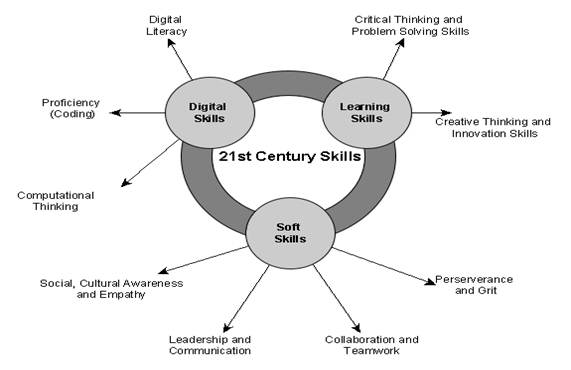
A comparative analysis of NEP 2020, shows that the higher-order cognitive skills encompass within them sub skills Critical thinking and problem-solving, creativity and innovative thinking. Similarly, Soft Skills comprise Cultural awareness and empathy, perseverance and grit, collaboration and teamwork, leadership, and communication within them. Lastly, Digital Skills of NEP 2020 comprised of sub-skills digital literacy, coding, and computational thinking. NEP 2020 also mention Life skills are, specifying the components as cooperation, teamwork, communication, and resilience (Para 4.24.). However, most components of Life skills (e.g. teamwork, communication and resilience as perseverance and grit) are covered under Soft Skills at NEP 2020.
It is evident from the discussion that those skills relating to 21st Century Skills of NEP-2020 has closer similarity to the 21st Century Skills framework of P21. However, NEP-2020 goes deeper with Morals and ethics than P21 or any other framework. In this light, the study proposes the following framework of 21st century skills in special context of NEP 2020 by selecting certain skills and delimiting some skills mentioned in the NEP 2020.
|
Figure 4
|
|
Figure 4 21st
Century Skills Proposed Transformative Framework of NEP-2020 for Holistic
Education |
Conclusion
The analysis of the study reveals that the 21st
Century Skills articulated in NEP 2020 are closely aligned with globally
recognized frameworks, particularly that of the Partnership for 21st
Century Learning (P21), in emphasizing core competencies such as critical
thinking, creativity, communication, and collaboration. Among all the
frameworks NEP 2020 being the latest one proposes a holistic framework for 21st
century skills necessary for 21st century education. It implements a holistic and
value-oriented approach, wherein moral reasoning, ethics, constitutional
values, and socio-emotional development are central to the formation of 21st
century education. The NEP 2020 intensely envisages that learners of 21st
century skills not only have employability skills but can also be responsible
and empathetic, and sensible global citizens. Additionally, the NEP 2020
redefines and expands the scope of soft skills by including them within
a concept of life skills. However the effective
implementation of NEP 2020’s 21st century skills will need adequate
financial investment, teacher preparedness, curriculum reforms, and constant
collaboration among stakeholders. Overall, NEP 2020 presents a transformative
framework that has the potential to redefine education by harmonizing global
competencies with indigenous values and ethical foundations.
ACKNOWLEDGMENTS
None.
REFERENCES
Ananiadou, K., and Claro, M. (2009). 21st Century Skills and Competences for New Millennium Learners in OECD Countries (OECD Education Working Papers No. 41). OECD Publishing. https://doi.org/10.1787/218525261154
Assessment and Teaching of 21st Century Skills. (2012). Defining Twenty-First Century Skills. Springer.
Binkley, M., et al. (2010). Defining 21st Century Skills. In Assessment and Teaching of 21st Century Skills (White Paper 1). University of Melbourne. https://doi.org/10.1007/978-94-007-2324-5_2
Eguchi, A. (2014). Educational Robotics for Promoting 21st Century Skills. Journal of Automation, Mobile Robotics and Intelligent Systems, 8(1), 5–11. https://doi.org/10.14313/JAMRIS_1-2014/1
Griffin, P., McGaw, B., and Care, E. (Eds.). (2012). Assessment and Teaching of 21st Century Skills. Springer. https://doi.org/10.1007/978-94-007-2324-5
Kay, K., and Greenhill, V. (2011). Twenty-First Century Students Need 21st Century Skills. In G. Wan and D. M. Gut (Eds.), Bringing Schools Into the 21st Century (pp. 41–65). Springer. https://doi.org/10.1007/978-94-007-0268-4_3
Kothari,
D. S. (1966).
Education and National Development, Report of the
Education Commission, 1964–66. NCERT.
MHRD.
(2020). National
Education Policy 2020. Ministry of Human Resource and Development,
Department of Education.
Organisation for Economic Co-operation
and Development. (2018). The Future of Education and Skills:
Education 2030. OECD Publishing.
Partnership for 21st Century Learning. (2019). Framework for 21st Century
Learning. Battelle for Kids.
Partnership for 21st Century Skills. (2004). Partnership for 21st Century Skills - Score Content Integration.
Department of Education, Ohio.
Voogt,
J., and Roblin, N. P. (2010). 21st Century Skills. University
of Twente.
Wagner, T. (2008). The Global Achievement Gap: Why Even Our Best Schools Don't Teach the New Survival Skills Our Children Need-And What We Can Do About It. Basic Books.
 This work is licensed under a: Creative Commons Attribution 4.0 International License
© Granthaalayah 2014-2026. All Rights Reserved.