Original Article
A Critical Study of Socio-Political, Religious, and Aesthetic Dimensions in the Songs of Bob Dylan
|
Sneha Patel 1 1 Research Scholar,
Department of English, Kalinga University, Raipur, Chhattisgarh, India 2 Assistant Professor, Department of English,
Kalinga University, Raipur, Chhattisgarh, India |
|
|
|
ABSTRACT |
||
|
The book will unpack the relationship between lyric, versification and protest poetics in Bob Dylan’s songs by situating his work in a modern literary discourse. This study should elucidate points about the way Dylan’s lyrics work beyond even established music, and they are clearly covenant via reading diverse as poetic texts with emotional depth, structural innovation and socio-political engagement. Using a qualitative textual analytical approach, the paper explores key aspects of lyricism (e.g., subjectivity, imagery and symbolic expression) in conjunction with versification forms like rhyme and rhythm. Special focus is placed on Dylan as a prophets of resistance, addressing themes like civil rights, wars and social justice ingrained in his protest songs. The study also examines the impact of biblical and spiritual imagery, which inspires added layers or moral and philosophical meaning in his work. Moreover, the study examines the rhetorical strategies that reinforce Dylan’s lyrics as a cultural and political vehicle of persuasion. Overall, these findings indicate that Dylan's novel integration of poetic form with musical expression opens up contemporary poetry to wider generative possibilities than ever before, while simultaneously inflating a critical gap that must be crossed between high and popular art in order to sustain literature as the most effective device for social critique and change. Keywords: Lyricism, Versification, Protest
Poetry, Bob Dylan, Song Lyrics as Literature, Socio-Political Critique, Religious
Imagery |
||
INTRODUCTION
Lyricism and
versification, which forms the two major Roots of English Literature. Lyricism
is a writing style that seeks to express personal emotionality, subjectivity
and musicality in words; in its late 19th-century sense, lyricism was limited
mostly to short, song-like pieces. Versification, however, refers to the
regular structure of poetry in meter, rhyme, rhythm and stanzas. All three
together compose the aesthetic and communicative coordinates of poetic
discourse. These notions have transformed within contemporary literary studies
beyond a mapped out canon of written poetry Abrams
and Harpham (2015).
Bob Dylan and the
acknowledgment of his songs as works of literature has helped fuel a growing academic
appreciation for song lyrics. His lyrics serve as prime examples of musical
texts that can be seen as sophisticated literary artefacts, marrying oral
traditions with the written poetic word Rick (2004).
Because of the combination of all these new-gen voices together, it flips the
existing hierarchy built around written and oral or sung poetry on its head: in
turn, widening what can be analyzed in a literary sense.
|
|
Song lyrics are
poetic texts that retain a connection to the aurality of language. Lyrics use
metaphor, symbolism, imagery, and narrative devices similar to traditional
poems — but they also utilize rhythm and musicality that complements lyricism's
referential power Attridge (2015). Therein
song lyrics must be considered an essential domain for exploring contemporary
socio-cultural, political and aesthetic articulations.
Aim and Research Objectives
The primary aim of
this study is to critically examine lyricism and versification in the songs of
Bob Dylan, with particular emphasis on their socio-political, religious, and
aesthetic dimensions.
The specific objectives are:
·
To
analyze the elements of lyricism and their role in conveying emotional and
subjective experiences.
·
To
examine the patterns of versification, including rhyme, rhythm, and structural
variations.
·
To
evaluate song lyrics as a modern poetic form within literary discourse.
·
To
explore the integration of protest, socio-political critique, and spiritual
themes in Dylan’s works.
Theoretical Framework
Key Elements of Lyricism
Lyricism is
fundamentally decided by emotional intensity, personal voice and musical
quality. It highlights the subjective, often related as a short and vivid
presentation of what is happening in the speaker's mind and heart. As Abrams
and Harpham (2015) maintain, lyric poetry involves
foregrounding “the utterance of a single speaker who expresses a state of mind
or feeling,” establishing therefore a sense of intimacy between text and
audience. Subjectivity is reinforced by figurative language, imagery and tonal
variance.
Even in modern
contexts, lyricism encapsulates more than just the written word but musical
captions to that writing where the resonance of emotions becomes something
greater through audible performance. As articulated by Culler
(2015), lyric poetry, and thus in a broader sense song lyrics function
within the realm of the performative, engaging audience members in an
experiential space rather than simply sharing information. This viewpoint is
especially pertinent when examining the lyrics of Bob Dylan, as his prose often
traverses the divide between self and society.
Versification: Rhyme, Rhythm, Meter, and Structure
Versification—the
technical machinery of poetic language (the rhyme schemes, metrical patterns,
rhythms, stanzaic forms) Versification was based on a regular meter and rhyme,
as in classical poetic forms; traditional versification is often at odds with modern
poetry's embrace of free verse and irregular structures that afford greater
expressive flexibility Attridge (2015). And
metrical regularity is but one form of such rhythm; there can be variation in
stress, pacing, patterns of sound.
Unlike in most
written prosody, rhythm in song lyrics is intimately interwoven with musical
composition, generating a tension between the linguistic and auditory elements
of the text. Regular or slant rhyme gives the text its cohesion and fortifies
memorization; structural variance allows for innovation, theme-intonation,
variation. Bob Dylan’s songs are hybrids of song and poem: they employ both
ballad stanza and free verse techniques. A departure from the conventions of
poetry, his use of irregular rhyme schemes, shifting rhythms and structures. Ricks (2004).
Song as a Modern Poetic Form
The adequacy of
song lyrics as a modern poetic form is an important aspect of contemporary
literary criticism. Song brings together the art of words and musical
performance, expanding the sensory and interpretive possibilities available to
poetry. According to Middleton
(1990), popular music lyrics are “ forms of
cultural expression that combine a poetic use of language with broader social
significance,” thus providing an important medium for voicing collective
definitions and experiences.
In that sense, the
works of Bob Dylan are at the forefront as they signify remixing between
lyricism, versification and socio-political commentary. His wordplay shows that
song is one way to bear good poetry, to address complicated themes while
remaining accessible and emotional. In addition, Dylan's receiving the Nobel
Prize in Literature in 2016 reiterates that song lyrics is a literary form.
This recognition affirms that the boundaries of poetry are not confined to
written texts but extend to performative and musical forms that engage
audiences in diverse and meaningful ways.
Life and Works of Bob Dylan
Brief Biography and Literary Influences
Bob Dylan
(disambiguation) Bob Dylan (born Robert Allen Zimmerman, 1941), as a musician
become one of the most powerful language and cultural artists in the twentieth
century. Growing up in Minnesota, Dylan was profoundly influenced by American
folk forms, blues sounds and early rock and roll. His formative artistic
influences played a significant role in shaping the development of his early
sound, including another generation of folk musicians like Woody Guthrie whose
socially aware songwriting had lifelong impact on Dylan’s thematic interests
and stylistic approach Shelton (2011).
Musical influences aside, Dylan’s lyricism speaks to a deep engagement with
literary traditions. He was influenced by poets like Walt Whitman, T. S. Eliot
and Arthur Rimbaud. You can see these influences in his use of free verse,
symbols, surreal images and broken structures. As Ricks
(2004) points out, Dylan’s lyrics often exhibit a quintessential “fusion
of high literary tradition with vernacular expression,” leading to new
definitions of poetic language.
Phases of His Musical and Poetic Career
The career of Bob
Dylan can be broadly divided into distinct phases, each marked by stylistic
evolution and thematic expansion:
·
The
Folk and Protest Phase (early 1960s): Dylan emerged as the protest singer, writing songs that engaged with
civil rights, social injustice and war. Albums like The Freewheelin’ Bob Dylan
secured his status as a prophet of political dissent.
·
The
Bipolar Electric and Experimental Phase (mid-1960s): Dylan’s shift to electric instrumentation
marked a major change in both musical form and poetic complexity. Albums like
Highway 61 Revisited feature surreal imagery, nonlinear narratives, avant-garde
versification.
·
The
Reflective and Spiritual Phase (1970s–1980s): Dylan dabbled with more personal
introspection as well as religious themes, most notably after his foray into
Christianity. His lyrics drew on biblical symbolism and moral exploration.
·
The
Later and Contemporary Phase (1990s–present): Dylan’s later works reflect a synthesis of
preceding styles, combining folk, blues and literary influences with
transcendent considerations of history, mortality and identity.
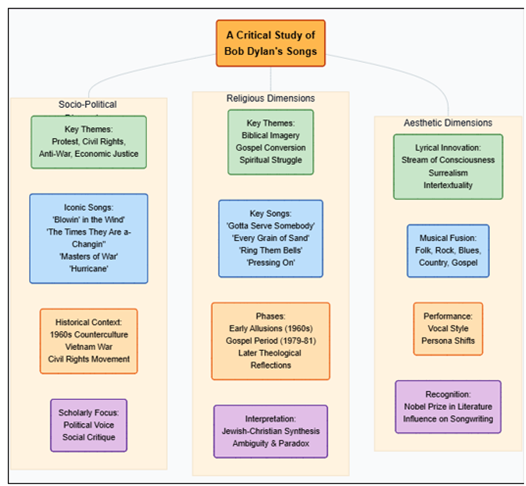
Protest Poetics and Resistance
Themes of Protest, Civil Rights, and War
Bob Dylan's early
work is characterized in part by its engagement with protest themes, especially
those that concern civil rights, war and inequity. His lyrics denounce the
volatile socio-political climate of 1960s America, tackling issues from racial
discrimination to militarism to generational conflict. For example, songs such
as Blowin’ in the Wind ask rhetorical questions regarding freedom and justice,
human suffering, moral urgency without didacticism. Similarly, Masters of War
presents a stark critique of militaristic power structures, employing
accusatory language and stark imagery to convey outrage and resistance Marqusee (2005).
Analysis of Selected Protest Songs
Dylan’s protest
songs are distinguished by their poetic sophistication and rhetorical
effectiveness:
·
Blowin’
in the Wind (1963): The
song uses rhetorical questions and simple yet powerful imagery to voice
universal concerns about peace and human rights. Its open-ended shape demands
interpretation, enhancing its lyrical and philosophical amplitude.
·
The
Times They Are A-Changin’ (1964): A model of prophetic structure the song calls for social change and
generational transformation. Its repetitive, rhythmic versification multiplies
its persuasive and mobilizing effect.
·
Masters
of War (1963): Characterized by direct address and intense
emotional tone, this song critiques the architects of war. The stark language
and minimalistic structure amplify its moral condemnation.
Dylan as a Voice of Resistance
Bob Dylan occupies
a special place at the vociferous center of modern cultural and literary
conversation as an activist. His narratives address more than simple protest,
expressing greater existential and moral questions that resonate with a wide
range of listeners over the course of generations. Unlike the typical protest
writer, Dylan often uses ambiguity, symbolism and irony in his works so they
can operate on many interpretive levels. His work contributed considerably to
the establishment of a “cognitive praxis” used in social movements, as Eyerman
and Jamison (1998) have argued, informing not only collective
identity
Moreover, Dylan’s
refusal to be confined to a single ideological stance enhances his credibility
as an artist. His evolving perspectives and stylistic experimentation reflect a
commitment to artistic authenticity rather than rigid political alignment. This
complexity underscores his enduring influence as both a poet and a cultural
critic.
Socio-Political and Religious Dimensions
Representation of Social Issues and Political Critique
Bob Dylan Song's
in Depth Analysis Engages Deep into the socio-political Atmosphere of Modern
America, Right from inspired singing in 60's. His lyrics serve as a vehicle for
social commentary, taking on questions around racial injustice, economic
inequality, war and institutional power. Instead of taking a didactic or
instructive approach, he more often uses indirect and symbolic means to draw
attention to systemic flaws and moral hypocrisy.
Songs such as
Blowin’ in the Wind and The Times They Are A-Changin’, for instance, convey the
urgency of civil rights and social change via rhetorical questioning and
prophetic exhortation. These works avoid explicit political prescriptions,
encouraging listeners to consider the ongoing wrongs in a critical light. As Marqusee (2005) writes, Dylan’s protest songs
“encode political dissent in poetic ambiguity,” thus cutting their
interpretative and cultural scope. Furthermore, Dylan’s critique is not simply
aggrieved but reacts to a larger existential threat of authority, freedom, and
human responsibility. His lyrics frequently challenge dominant ideologies and
question the legitimacy of political power, positioning him as a significant
voice within protest literature Eyerman
and Jamison (1998).
Use of Biblical and Spiritual Imagery
There are many
striking aspects to Bob Dylan’s lyricism, but one of its most distinguishing
features is the omnipresence of biblical and spiritual imagery. Basing his work
upon Judeo-Christian traditions, Dylan infuses it with motifs and symbols, as
well as narrative structures that evoke themes of sin, redemption, judgment and
salvation. This dimension can be detected in spades during his late 1970s
“Christian phase,” although religious elements exist throughout the work. Songs
like All Along the Watchtower and Every Grain of Sand demonstrate his use of
allegory and scriptural resonance.
The imagery often
reflects apocalyptic visions, moral, and spiritual introspection, aligning his
work with the tradition of prophetic poetry. As Ricks
(2004) argues, Dylan’s lyrics demonstrate a “moral seriousness rooted in
biblical consciousness,” enabling them to transcend immediate political
contexts. Importantly, Dylan’s use of religious imagery is not confined to
doctrinal expression; rather, it serves as a symbolic framework for exploring
universal human experiences. The interplay between the sacred and the secular
enriches his poetic language, allowing for multiple layers of meaning and
interpretation Gray (2006).
Poetic Style and Versification
Imagery, Symbolism, and Metaphor
The poetic style
of Bob Dylan is marked by a rich and complex use of imagery, symbolism, and
metaphor. His lyrics often juxtapose concrete and abstract elements, creating
vivid mental pictures that convey emotional and intellectual depth. For
example, surreal and fragmented imagery in songs like Desolation Row reflects
the influence of modernist and symbolist traditions.
Symbolism plays a
crucial role in Dylan’s work, enabling him to address complex themes
indirectly. Objects, characters, and settings frequently carry multiple
meanings, contributing to the interpretive openness of his lyrics. Metaphorical
language further enhances this complexity, allowing Dylan to articulate
abstract ideas such as freedom, alienation, and resistance in tangible and
relatable terms Culler (2015).
Narrative Voice and Tone
Dylan’s narrative
voice is highly dynamic, shifting between personal, collective, and prophetic
perspectives. At times, he adopts the role of an observer, recounting events
with detachment; at other moments, he speaks as a participant or moral
commentator. This fluidity enables him to engage with diverse themes and
audiences.
The tone of his
lyrics varies widely, encompassing irony, satire, anger, and introspection. In
protest songs, the tone is often urgent and confrontational, whereas in
reflective or spiritual compositions, it becomes contemplative and subdued.
This tonal diversity contributes to the emotional richness and rhetorical
effectiveness of his work Attridge (2015).
Use of Rhyme, Rhythm, and Free Verse
In terms of
versification, Bob Dylan demonstrates a highly innovative approach that blends
traditional and modern techniques. While many of his early songs follow
conventional folk structures with regular rhyme schemes and rhythmic patterns,
his later works increasingly incorporate free verse and irregular forms.
Rhyme in Dylan’s
lyrics ranges from simple end rhymes to more complex internal and slant rhymes,
enhancing both musicality and meaning. Rhythm is closely aligned with musical
composition, yet it also reflects poetic considerations such as stress patterns
and pacing. His use of free verse allows for greater flexibility, enabling
shifts in tone, emphasis, and narrative flow.
As Attridge (2015) notes, modern poetic rhythm often
departs from strict metrical to achieve expressive variation, a principle
clearly evident in Dylan’s work. His ability to manipulate versification
techniques contributes significantly to the uniqueness and enduring impact of
his poetic style.
Persuasive Power and Protest Albums
Rhetorical Strategies in Lyrics
The persuasive
power of Bob Dylan’s lyrics lies in their sophisticated use of rhetorical
strategies that combine poetic artistry with political engagement. His
songwriting effectively employs the classical appeals of ethos, pathos, and
logos, creating a multidimensional persuasive framework.
·
Ethos
(credibility): Dylan
establishes authenticity through his alignment with folk traditions and his
engagement with real social issues. His association with grassroots movements
enhances the trustworthiness of his voice Eyerman
and Jamison (1998).
·
Pathos
(emotional appeal):
Emotional resonance is central to Dylan’s protest songs. Through evocative
imagery and direct address, songs like Masters of War generate anger, empathy,
and moral urgency, compelling listeners to reflect on injustice.
·
Logos
(logical appeal): Dylan
frequently uses rhetorical questioning and narrative reasoning, particularly in
Blowin’ in the Wind, where a sequence of questions encourages critical thinking
rather than prescribing fixed answers.
Impact of Major Protest Albums
The protest albums
of Bob Dylan have had a profound cultural and literary impact, solidifying his
role as a transformative figure in both music and poetry.
·
The
Freewheelin’ Bob Dylan (1963):
This album marked Dylan’s emergence as a protest voice, featuring iconic songs
that address civil rights and peace. Its lyrical simplicity combined with
thematic depth made it widely accessible and influential.
·
The
Times They Are A-Changin’ (1964): Often regarded as a manifesto for social change, this album captures
the spirit of a generation demanding transformation. Its prophetic tone and
structured versification reinforce its persuasive power.
·
Bringing
It All Back Home (1965) and Highway 61 Revisited (1965): These albums represent Dylan’s transition
toward more complex and experimental forms. While retaining socio-political
concerns, they introduce surreal imagery and expanded poetic structures,
influencing both music and modern poetry.
Conclusion
Key Findings
This study
demonstrates that the works of Bob Dylan represent a unique synthesis of
lyricism, versification, and protest poetics. His lyrics effectively integrate
emotional depth, structural innovation, and socio-political critique,
establishing song as a powerful medium of literary expression. The analysis
reveals that Dylan’s use of rhetorical strategies enhances the persuasive
impact of his work, while his innovative approach to versification expands the
boundaries of poetic form. Furthermore, his incorporation of religious imagery
and symbolic language adds layers of philosophical and moral complexity.
Contribution to Modern Poetic Discourse
The contribution
of Bob Dylan to modern poetic discourse is both significant and transformative.
By elevating song lyrics to the status of literature, he challenges traditional
distinctions between high and popular art. His work exemplifies how poetry can
function within performative and musical contexts without sacrificing depth or
complexity. Moreover, Dylan’s integration of protest themes with poetic
innovation has influenced subsequent generations of writers and musicians,
reinforcing the role of art as a vehicle for social critique and cultural
reflection. His recognition with the Nobel Prize in Literature further
legitimizes the study of song lyrics within academic literary frameworks.
ACKNOWLEDGMENTS
None.
REFERENCES
Abrams, M. H., and Harpham, G. G. (2015). A Glossary of Literary Terms. Cengage Learning.
Attridge, D. (1995). Poetic Rhythm: An Introduction. Cambridge University Press.
Eyerman, R., and Jamison, A. (1998). Music and Social Movements: Mobilizing Traditions in the Twentieth Century. Cambridge University Press. https://doi.org/10.1017/CBO9780511628139
Gray, M. H. (2006). The Bob Dylan Encyclopedia. Continuum.
Masur, L. P. (2007). Review of Wicked Messenger: Bob Dylan and the 1960s. American Quarterly, 59(1). https://doi.org/10.1353/aq.2007.0030
Middleton, R. (1990). Studying Popular Music. McGraw-Hill Education.
Müller, R. (2017). Review of Theory of the Lyric, by J. Culler. Arbitrium, 35(2), 297–301. https://doi.org/10.1515/arb-2017-0020
O’Neill, L., and Serembus, J. (2020). The Concept of Evil in Bob Dylan’s Art. Ultimate Reality and Meaning, 37(1–2), 87–98. https://doi.org/10.3138/uram.37.1-2.87
Shelton, R., Thomson, E., and Humphries, P. (1986). No Direction Home: The Life and Music of Bob Dylan. William Morrow.
 This work is licensed under a: Creative Commons Attribution 4.0 International License
© Granthaalayah 2014-2026. All Rights Reserved.