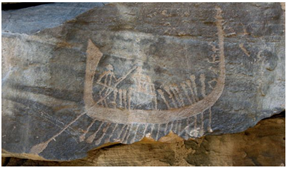
SOME VISUAL REPRESENTATIONS OF SHIP BUILDING AND NAVIGATION IN ANCIENT INDIAN ART
Dr. Anjali Pandey 1
1 Head
of Department, Drawing and Painting Department, Government M.L.B. Girls P. G.
Autonomous College, Bhopal, India
|
|
|
ABSTRACT |
|
|
The maritime heritage of the Indian subcontinent is deeply rooted in its extensive river system and vast network of coastlines, which enabled communication, trade, and cultural interaction from ancient times Ray (2018), Tripati (2011). Although historical texts and archaeological findings have traditionally been the main sources for understanding this seafaring past, visual depictions of vessels in early Indian art present a unique and often overlooked form of evidence. This study investigates these artistic representations across a wide timeframe—from the Indus Valley Civilization through to the early medieval era—using an interdisciplinary approach that integrates archaeology, art history, and cultural analysis. By examining
images found on terracotta items, seals, sculpted reliefs, and murals, the
research considers how such depictions convey knowledge about shipbuilding,
trade routes, symbolic systems, and societal customs linked to maritime
activities Ray (2018), Chakrabarti (2001). These visual records are interpreted not simply as ornamental or
storytelling devices, but as significant reflections of everyday life,
spiritual beliefs, and economic conditions Additionally, they reveal regional
differences in vessel design, navigation methods, and the ways maritime
imagery was incorporated into religious and artistic contexts Deloche (1994), McGrail (2001). |
|||
|
Received 22 January 2025 Accepted 26 February
2025 Published 31 March 2025 Corresponding Author Dr.
Anjali Pandey, anjali_pandey11@yahoo.com
DOI 10.29121/granthaalayah.v13.i3.2025.6848 Funding: This research
received no specific grant from any funding agency in the public, commercial,
or not-for-profit sectors. Copyright: © 2025 The
Author(s). This work is licensed under a Creative Commons
Attribution 4.0 International License. With the
license CC-BY, authors retain the copyright, allowing anyone to download,
reuse, re-print, modify, distribute, and/or copy their contribution. The work
must be properly attributed to its author.
|
|||
|
Keywords: Ship Figurines, Maritime Archaeology,
Ancient India, Visual Representations, Terracotta Art, Cultural Symbolism,
Trade Networks |
|||
1. INTRODUCTION
The
extensive artistic heritage of India encompasses a wide range of themes. Art
forms such as paintings, seals, terracotta, pottery, sculptures, panels,
reliefs, and coins have portrayed various aspects of human life. The rich
maritime historical tradition of ancient India experienced a significant
resurgence in maritime activities 2 (m.indianetzone.com- Indian Maritime
History).
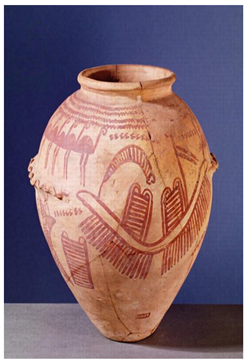
The
Indian subcontinent’s location, bordered by the Arabian Sea, the Bay of Bengal,
and the Indian Ocean, has long supported a dynamic maritime culture. Major
rivers like the Indus, Ganga, and Godavari contributed to internal
communication networks, facilitating the exchange of goods, populations, and
ideas Chakrabarti
(2001). Evidence from archaeology, literature, and
inscriptions consistently highlights the central role of seafaring in the
development of ancient Indian society Ray (2018), Tripati (2011).
Yet,
despite the range of available sources, visual depictions of ships and boats
remain a less-studied area. Such images appear across various art
forms—terracotta artifacts, carved seals, stone carvings, and wall paintings
Unlike textual accounts, which frequently reflect elite perspectives, visual
representations can provide more direct insight into practical maritime
activities and technical expertise McGrail
(2001), Deloche (1994). Ray (2018).
Trade
is also the part of our cultural legacy. In ancient times, the joys and
challenges of travel were influenced by geographical conditions. The portrayals
of navigation across different artistic mediums highlight the importance of
shipping and navigation since around 6000 years ago. The term navigation is
derived from the Sanskrit word 'Nav.' Both literature and art indicate that
India had established its own shipping practices in ancient times. (hinduonline.co/shipbuilding
and navigation)
Some
sketchy evidence of boat sailing throughout the prehistoric and protohistoric
eras was shown by Indian artists. The surface of the pots and the walls of the
caverns served as canvases for the expression of the local culture. Both
Mohenjo-Daro and Harappa were important economic hubs, and trade contributed to
the civilization's cultural growth. (www.thoughtdots.com) Indus Valley
Civilisation: Trade & Culture The Sindhu
civilization's seals show how shipbuilding and navigation were at their peak in
India around 6000 B.C. The earliest documented tidal port in the world was
constructed by the Harappans around 2400 B.C. The lengthy cost line offered all
the facilities required for shipping. Perhaps the first example of marine
engineering created by humans is the dock that was excavated from Lothal, which
is located near the Gulf of Khambhat, is particularly significant due to the
presence of a dockyard-like structure, reinforcing interpretations of maritime
and riverine trade. The boat depictions from this period suggest familiarity
with both inland and coastal navigation. Although the figurines are schematic,
their standardized forms indicate shared conventions and technical
understanding Gujarat. The trade could not have been conducted without
navigation skill. (India’s_Maritime_Heritage-www.maritimetraining
documents).
The
witness of Indian maritime merchants is described by the employment of a
magnetic compass. According to the detail investigation, the ship was
constructed of wood. The masts indicate that they were used for seafaring.
Graffiti and seals on potsherds from the Harappa site provide direct proof of
the earliest sailing ships in Bronze Age art. Numerous excavations from the
Harappan site demonstrate the use of enormous ocean-going ships and tiny, flat
boats for cultural and communication purposes. (www.maritimeheritageofindia.com)
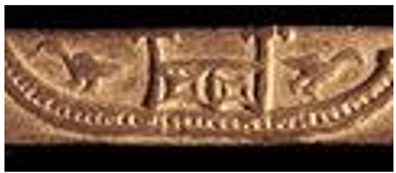
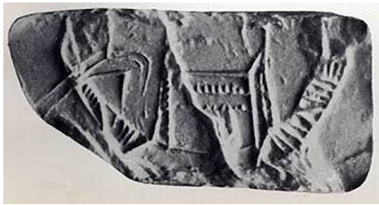
The Mohenjo-Daro three-sided moulded
terracotta amulet features a flat-bottomed boat with a cabin in the middle.
Large protrudes from the back of the boat, and two "disha
kak" birds that face each other are seated on
the deck. They helped the sailor locate the land.The
other two side of the seal have symbols of Indus script
and a figure of snout nosed ‘Gharial’ with fish in its mouth. Some terracotta
toy boats are also found from the Harappa site. (www.harappa.com)
“The
representation of ships on seal indicates maritime activity and there are
enough evidences to show that the people of Sindhu
Valley civilization carried on trade not only with other parts of India but
also with Sumer and the centers of culture in Western Asia, and with Egypt and
Crete” (R.C. Majumdar 1952)
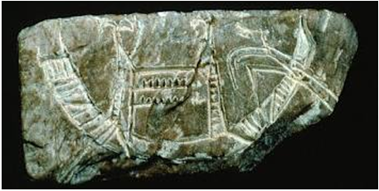
The
Rigveda contains numerous mentions of ships used to navigate the Samudra. The
Atharv Veda refers to well-constructed and spacious boats. The ancient text
Yukti KalpTaru outlines the process of shipbuilding
and provides comprehensive details about different types of ships. Marco Polo
noted the comfort, convenience for passengers, and the decoration and
embellishment of Indian vessels. Precious metals like gold, silver, and copper
were commonly used for decorative purposes. (hinduonline.co/shipbuilding
and navigation)
The Mauryan, Chola, Satavahana, and Gupta
dynasties made significant contributions to maritime endeavors.
(m.indianetzone.com) The cultural exchanges between India and Southeast Asia
were closely linked to maritime trade, craftsmanship, art, andliteracy.
(https://en.wikipedia.org/wiki/Indian_maritime_-history)
The panel reliefs of Sanchi, Bharut, and Amravati depict the presence of shipping in
ancient India.
“There are passages in Indian works which
prove the early existence of the Indian Ocean and the somewhat later occurrence
of trading voyages undertaken by Hindu merchants to the shores of Persian Gulf
and its rivers. No commerce can thrive unless fostered by national shipping”
(hinduonline.co/shipbuilding and navigation)
In
Indian art not much representation of boats and ships are found after Indus
civilization. The little evidences lost costal city Poompuhar (it is believed that this port city washed away
from repeated flood and erosion) describes about the antique pottery and other
remainsof450B.C.ECholasDynasty. (www.maritimeheritageofin-dia.com)
After
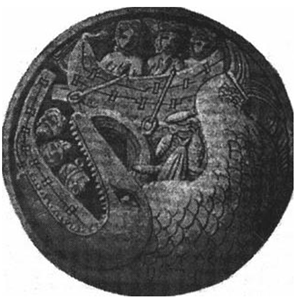
IInd century B.C. Bharhut, Sanchi and Amrawati have some carved panels on maritime activities. In
the panel of the Bharhut, three sailors are sailing the ship raked at both
ends. The ship is of primitive style. Coconut fiber
is used for sewing the Timber together. A big fish (monster) is attacking and
swallowing the travelers fallen into the sea. D.
Barua suggested the scene as rescue of Vasu Gupta from the mouth of whale. Chandra
Moti. (1997)
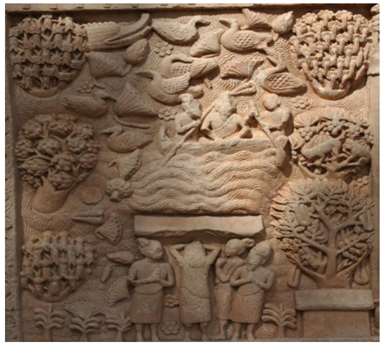
After
the 2nd century B.C., carved panels depicting maritime activities can be found
at Bharhut, Sanchi, and Amrawati. In one of
panel
at Sanchi The artists depicted a boat with a Shardul face and the tail of a
fish turned upward. The cabin is centrally located, and a man is seen rowing
the boat. The decorative elements indicate that it is a royal ship. Chandra
Moti. (1997)
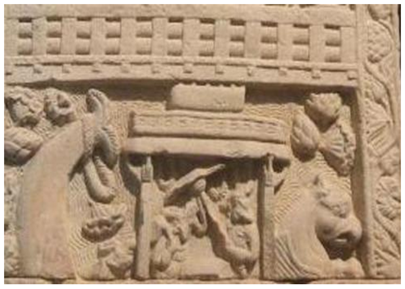
The
panel of the pillar from Amravati also has the cabin or Mandap in the
middle in which the sacred symbol of
Lord Buddha is placed on Throne. The bottom of the ship is flat and the bow is squares. A Buddhist monk is seated nearby with folded
hands. Chandra
Moti. (1997)
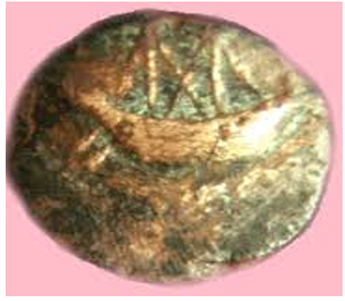
In the 1st and 2nd cent.
A.D. maritime activities were also appeard on the
coins of Andhra-Satvahan Period. King Gautamiputra Yajnashri satkarni issued the coins having ship motifs. The ships
represent the contemporary characteristics of ship building. The deck of the
ship is flat, flag and the two masts can be seen.
Also, ore were used to steer the ship. (Tripathi Alok,2006)
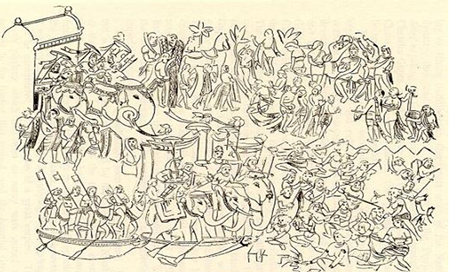
Some
masterpieces representations of Indian ships are painted in Ajanta caves. There
are two large panels Purnavdan of cave 2nd
and Sinhalavdan of cave 17th. In cave 2nd
the boat has three masts and
sail. The bow and stern of the ship are marked with the symbol of eye. In cave
17th the Vijay’s voyage to Shri Lanka, the boats are represented in
the shape of bowl with the three masts. The bow of the boat is in ‘Makar’
shape. (Tripathi Alok,2006)
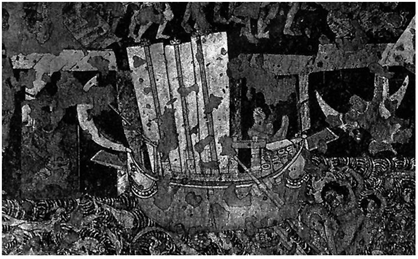
In
cave IInd the ship with three masts and four sail is
depicted. On the stern the square frame is fluttering from an oblique. Twelve
pots are kept in a shaded pavilion. The symbol of the eye on bow and the stern
of the ship are visible. Fishes and Mermaids are swimming in the sea. (Tripathi Alok,2006)
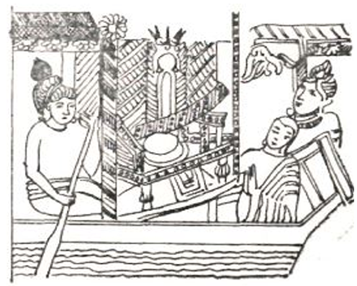
The
third one seems as a pleasure boat. The shape of the
boat looks like a basket, having the symbol of the eye on bow and stern. A
curtained Mandap is located in the center. A royal
man with his courtesans is seated; one of them is holding an “Chatra’. The two
boats men owe the boat from the both ends. Some fishes
are shown around the boat. The painting
seems to be of Gupta- Vakatak period of 4th
-6th cent A.D. Chandra
Moti. (1997)
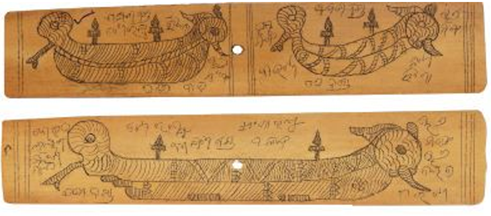
‘Amva Vilas Bihara, a manuscript
on ‘Talpatra’ (Palm) leaf of 5th cent
B.C.E. depicts the traditional boat building technique of that time. Chandra
Moti. (1997)
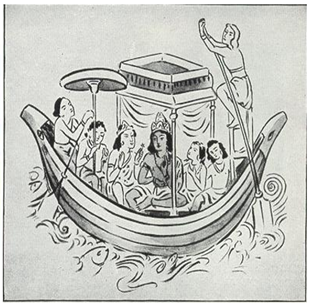
The
evidence of ship and boat figurines becomes more regionally diverse. Terracotta
boat models from sites such as Chandraketugarh (West
Bengal), Ahichchhatra (Uttar Pradesh), and Amaravati
(Andhra Pradesh) display increased complexity, including multiple passengers,
oars, rudders, and sometimes sails.
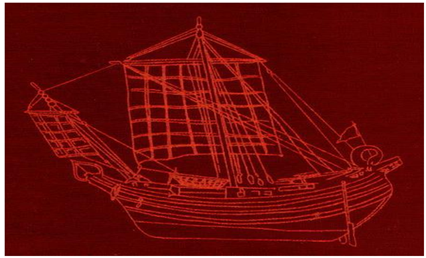
These
developments coincide with the expansion of long-distance trade networks,
particularly Indo-Roman trade.
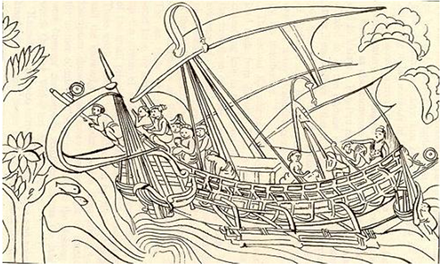
Archaeological
finds of Roman coins, amphorae, and luxury goods at Indian ports strengthen the
argument that these figurines reflected real maritime practices.
In
riverine regions, especially the Ganga–Brahmaputra delta, boat figurines
emphasize flat-bottomed designs suitable for shallow waters, highlighting
regional adaptations. Such details provide indirect evidence of environmental
knowledge and technological innovation.
The Chola dynesty (200-1279) reached the peaks in foreign trade and
maritime activity. There influences were extended overseas to China and South East Asia. https://en.wikipedia.org/wiki/Indian_maritime_history
Indian
marine engineering and shipbuilding were well established before the arrival of
Europeans. https://en.wikipedia.org/wiki/Indian_maritime_history
“There
was a mercantile colony of Indians in an island off the African coast in the
first century A.D. The adventurous spirit of the Indians carried them even as
far as the North Sea, while their caravans traveled
from one end of Asia to the other” R.C.
1952.)
The
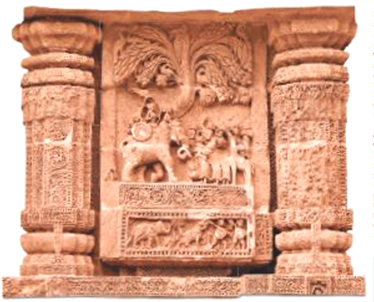
panel of sun temple Konark reveals the trade linkages with other part of the
world. The panel depicts giraffe shows that animals were brought from Africa. www.maritimeheritageofindia.com
Goods and ideas from India
began to play major role in extending the influence and transmission of
cultural heritage, religion, art & craft, social customs etc. Hindu and
Buddhism travelled and established alongside maritime trade. https://en.wikipedia.org/wiki/Indian_maritime_history
“The studies of Ocean and sea basin are
attracting increased interest at present. For
some they offer novel perspectives of the economic, cultural and
biological exchanges and networks that are vital for the understanding the
modern world”. Lamberent Visit
et al. (2006)
2. CULTURAL AND RITUAL SIGNIFICANCE
Beyond
their artistic and archaeological value, ship and boat figurines carried deep
cultural meanings. Water in Indian thought is associated with fertility,
purification, transition, and cosmic order. Boats, as vehicles that traverse
water, naturally acquired symbolic associations with transformation and
protection.
Some
figurines may have functioned as votive offerings, dedicated to deities or
river spirits to ensure safe journeys or commercial success. Ethnographic
parallels can be observed in contemporary practices such as offering miniature
boats during river festivals or immersing symbolic vessels during ritual
ceremonies.
Boats
also appear in association with kingship and power. Control over waterways
implied economic strength and political authority. Figurines and visual
representations of ships may thus have reinforced royal ideology and the
importance of trade networks.
3. CONCLUSION
The images of Ships and boats in ancient Indian art are essential for reconstructing historical seafaring practices shedding light on technological development, commercial systems, and symbolic interpretations Tripati (2011), Ray (2003).This work hightlights the importance of integrating visual materials with physical archaeological data in maritime studies. Future research could build on these findings through digital reconstructions and comparative studies across cultures.
CONFLICT OF INTERESTS
None.
ACKNOWLEDGMENTS
None.
REFERENCES
Casson, L. (1995). Ships and Seafaring
in Ancient Times. British Museum Press.
Chakrabarti, D. K. (2001). The Archaeology of Ancient Indian Trade
Routes. Oxford University Press.
Chandra Moti. (1997). Trade and Trade Routes in Ancient India. Abhinav Publication.
Deloche, J. (1994). Transport and Communications
in India Prior to Steam Locomotion. Oxford University
Press.
Gupta, S. P. (2004). The Indus Civilization. Archaeological Survey of India.
Lamberent Visit, D., Martins, L., and Ogborn, M. (2006). Current, Vision and Voyages: Historical Geographies of the Sea. Journal of Historical Geography, 32. https://doi.org/10.1016/j.jhg.2005.10.004
Majumdar, R. C. (1977). Ancient India (212–213).
McGrail, S. (2001). Boats of the World:
From the Stone Age to Medieval Times. Oxford University Press.
Ray, H. P. (2003). The Archaeology of Seafaring
in Ancient South Asia. Cambridge University Press.
Ray, H. P. (2018). Maritime Cultural Landscapes of the Indian Ocean. Journal of Maritime Archaeology,
13(2), 167–180.
Tripathi, A. (2006). Antiquity of Sailing Ships
of the Indian Ocean: Evidences From Ancient Indian Art. Ziff Journal, 25–34.
Tripati, S. (2011). Maritime Archaeology: Some Insights
From Indian Waters. Current Science, 100(11), 1648–1655.
Wheeler, R. E. M. (1959). Early India and Pakistan. Thames and Hudson.
hinduonline.co/shipbuilding and navigation
India_Maritime_Heritage-www.maritimetraining documents
https://en.wikipedia.org/wiki/Indian_maritime_history
www.maritimeheritageofindia.com
www.hinduwisdom.info/seafaring in ancient india
 This work is licensed under a: Creative Commons Attribution 4.0 International License
© Granthaalayah 2014-2025. All Rights Reserved.