Original Article
Enhancing English Communication Skills through Task-Based Learning: Evidence from Marginalized Graduate Students
|
Roopa
Ramadevi K 1*, Ranjit Kumar Pati 1, Visweswara Rao Chenamallu 2 1 Department of English,
GIET University Gunupur, Odisha, India 2 Department of English, M.S.N. Degree and P.G
College, Vizianagaram, Andhra Pradesh, India |
|
|
|
ABSTRACT |
||
|
English communication skills are essential for academic and career advancement, yet students from marginalized communities often struggle due to limited exposure and traditional grammar-focused teaching methods. This study investigates the effectiveness of Task-Based Learning (TBL) in enhancing English communication among 30 graduate students from the Dombo community. Over an eight-week intervention, learners engaged in role plays, group discussions, problem-solving tasks, and presentations. Data were collected through pre- and post-tests, classroom observations, and student feedback. Results showed measurable gains in fluency (35%), pronunciation (25%), confidence (30%), and reduction in stage fear (10%). These findings confirm that TBL fosters practical language use, autonomy, and confidence by shifting the focus from passive learning to active communication. The study concludes that integrating TBL into rural curricula and providing teacher training can significantly improve communicative competence in underserved contexts. Keywords: Task-Based Learning (TBL), English
Communication Skills, Marginalized Students, Learner - Centered Approach,
Rural Education |
||
INTRODUCTION
English has become
the global language of opportunity and mobility, serving as a key tool for
accessing higher education, global communication, and cross-cultural
collaboration. However, for learners from marginalized and rural communities,
English often represents both a gateway and a barrier. The disparity between
urban and rural educational contexts in India continues to hinder equitable
access to quality English instruction. Among these groups, the Dombo
community—a socially and economically disadvantaged group—faces distinct
challenges such as limited exposure to English, lack of qualified teachers, and
minimal opportunities for interactive learning.
English today is
not only a subject taught in classrooms but a passport to higher education,
career growth, and social mobility. In India, where English acts as a bridge
language linking diverse linguistic backgrounds, the ability to communicate
confidently becomes a determining factor for professional success. However,
students belonging to marginalized and rural communities seldom receive equal
learning opportunities. Their exposure to English remains limited, and
communication is often confined to textbook drills, memorization, and
translation-based learning. As a result, they may possess theoretical knowledge
of grammar but struggle to express their ideas fluently in real situations.
Traditional
English teaching methods in rural areas are predominantly based on the
grammar-translation approach, emphasizing memorization of vocabulary and
grammatical rules rather than authentic communication. This teacher-centered approach neglects the functional aspect of
language learning—using English as a tool for expression, creativity, and
interaction. As a result, learners often develop theoretical knowledge without
the confidence or fluency to use English in real-world contexts Richards and Rodgers (2014).
Task-Based
Learning (TBL) has emerged as an effective alternative to traditional pedagogy
by emphasizing the use of language as a medium for accomplishing meaningful
tasks. Rooted in Communicative Language Teaching (CLT), TBL encourages learners
to engage in problem-solving, collaboration, and performance-based activities
that simulate real-world communication Ellis
(2003), Willis
(1996). Through TBL, learners acquire linguistic
forms implicitly as they negotiate meaning and perform authentic tasks such as
debates, interviews, or presentations. Unlike rote learning, TBL motivates
learners by integrating cognition, interaction, and creativity.
This study
explores the potential of TBL to bridge the communication gap among Dombo
community students by examining its effects on fluency, pronunciation,
confidence, and stage fear. It also identifies implementation challenges and
proposes recommendations for integrating TBL into rural English language
curricula. The findings are expected to contribute to the growing body of
research promoting inclusive and learner-centered
approaches to language education in marginalized settings.
Furthermore,
English today is intertwined with aspirations of social upliftment. For
students belonging to historically disadvantaged communities, acquiring English
proficiency becomes not merely an academic skill but a pathway to dignity and
equal participation. Unfortunately, the uneven quality of schooling in rural
belts, limited exposure to English-speaking environments, and societal
hesitation act as stumbling blocks. In many cases, learners possess strong
conceptual knowledge, yet their inability to communicate confidently in English
creates a psychological barrier, resulting in low academic participation and
missed opportunities.
Traditional
lecture-based and grammar-translation methods often ignore these
socio-emotional challenges. Learners memorize sentence structures and
vocabulary, but when asked to speak in real situations, they pause, switch
languages, or avoid participation entirely. This is where TBL emerges as a
powerful pedagogical bridge, allowing students to “learn by doing,” encouraging
active language use, and supporting confidence building through repeated
communicative practice.
Literature Review
Task-Based
Learning (TBL) derives from the principles of Communicative Language Teaching
(CLT), which revolutionized second language pedagogy by prioritizing
communication over grammar accuracy. According to Nunan
(2004), tasks are goal-oriented activities that
require learners to use language for authentic communication rather than
mechanical drills. Ellis
(2003) defines a task as an activity where learners
focus on meaning and use their linguistic resources to achieve a communicative
outcome. Skehan
(1998) identified three dimensions—fluency,
accuracy, and complexity—that together determine communicative competence.
Willis
and Willis (2007) proposed a
task cycle consisting of three stages: pre-task, task, and post-task. In the
pre-task stage, learners are introduced to the topic and vocabulary. The task
stage involves collaborative performance, while the post-task stage focuses on
reflection and language refinement. This cyclical process encourages active
engagement, critical thinking, and learner autonomy.
Recent studies
have extended the TBL framework to marginalized contexts. Van den Branden (2016) and Long (2015) emphasize the importance of authentic,
need-based tasks in promoting real communication. Carless
(2018) found that even in resource-limited Asian classrooms, task-based
teaching improved student motivation and participation. Nguyen
(2020) and Rahimi and
Zhang (2022) highlight the role of technology-mediated TBL, where
digital storytelling and online collaboration enhance language fluency and
learner confidence. These studies demonstrate that TBL can adapt to varying
educational contexts and foster inclusivity.
In the Indian
context, Kumaravadivelu (2006) and Rao (2021) noted
that the success of TBL depends on teacher readiness and contextual
flexibility. Despite infrastructural challenges, TBL offers transformative
potential for students who lack exposure to spoken English. It empowers
learners to become active participants in their learning journey, thus reducing
linguistic anxiety and promoting communicative competence. However, barriers
such as inadequate teacher training, limited classroom time, and rigid
assessment systems often hinder its large-scale implementation.
Additionally,
contemporary research highlights the psychological benefits of TBL. According
to MacIntyre
et al. (2021), willingness to communicate is directly
influenced by classroom climate, task support, and emotional comfort. TBL
naturally promotes these conditions by shifting focus from “performance
correctness” to “meaningful expression.” Studies in Indian rural contexts Ghosh
(2022), Shanmugam
(2023) indicate that socially anxious learners,
once hesitant to speak, became vocal participants when exposed to scaffolded
task-based environments.
In addition,
learner autonomy theory Little
(1991), Benson
(2011)supports the foundation of TBL. By allowing
learners to self-evaluate, negotiate meaning, and collaborate, TBL nurtures
independence and internal motivation. These elements are crucial for students
from marginalized spaces that often rely solely on teacher guidance.
Methodology
Research Design
The study adopted
a mixed-methods research design, integrating both quantitative and qualitative
approaches to provide a comprehensive understanding of the impact of Task-Based
Learning (TBL) on English communication skills among marginalized learners. The
mixed-method design ensured the triangulation of data and increased the
reliability of findings by combining measurable outcomes with rich, descriptive
insights.
Quantitative data
were derived from pre-test and post-test assessments that measured students’
progress in fluency, pronunciation, confidence, and stage fear, while
qualitative data were obtained through classroom observations, student
interviews, reflective journals, and teacher feedback reports. This dual
approach aligns with recommendations by Creswell and
Plano Clark (2018), who emphasize the importance of integrating
numerical and experiential data in educational research.
Learners were
first oriented to task-based learning principles, and initial hesitation was
addressed through ice-breaker conversations, brainstorming sessions, and
supportive peer interactions. The teacher acted as a facilitator, offering
prompts, demonstrating speech models, and gradually reducing assistance as
learners gained independence. Materials included cue cards, short videos,
vocabulary charts, and real-life situational scripts. Feedback mechanisms
included peer observation sheets, self-reflection notes, teacher comments, and
weekly oral feedback circles, ensuring multiple opportunities for reflection
and improvement.
Participants
Thirty graduate
students belonging to the Dombo community, a marginalized group from a rural
region of India, were purposively selected for this study. All participants
were enrolled in a language development program organized by the Department of
English, GIET University, Gunupur. The students’ age
ranged from 19 to 23 years, and the group consisted of 18 female and 12 male
learners.
The participants
had limited exposure to English outside the classroom, and most had received
instruction through traditional grammar-translation methods. They were selected
based on their willingness to participate and signed informed consent forms as
per institutional ethical guidelines Cohen et
al. (2018).
Duration and Procedure
The intervention
was conducted over eight weeks, with three 90-minute sessions per week. Each
session involved communicative, task-based activities designed to foster
language use through real-life contexts. The instructional sequence followed
the TBL framework proposed by Willis
(1996), consisting of three stages:
1)
Pre-task
phase – Introducing the
topic, brainstorming, and activating background knowledge.
2)
Task
phase – Performing tasks
collaboratively through discussions, role plays, or problem-solving.
3)
Post-task
phase – Reflecting on
performance, providing feedback, and reinforcing linguistic accuracy.
Tasks included
role plays, debates, group discussions, information-gap activities, and short
presentations. Students were encouraged to use English throughout the sessions
while teachers acted as facilitators rather than authority figures.
Data Collection Tools
The following
tools were used for data collection:
·
Pre-test
and Post-test: These
assessed students’ performance across four parameters—fluency, pronunciation,
confidence, and stage fear.
·
Observation
Checklists: Classroom
observations focused on student participation, peer interaction, and
communicative engagement.
·
Semi-Structured
Interviews: Conducted with
10 randomly selected students to capture personal experiences and perceptions
about TBL.
·
Teacher
Feedback Forms: Collected
reflections from instructors about student improvement and classroom dynamics.
·
Reflective
Journals: Students
maintained journals documenting their learning journey and challenges faced
during tasks.
Data Analysis
Quantitative data
were analyzed using paired-sample t-tests and
percentage growth analysis to compare pre-test and post-test results Field
(2018). Qualitative data from interviews and
journals were examined using thematic analysis Braun
and Clarke (2006), which identified patterns related to
motivation, anxiety, and linguistic confidence.
Findings and Analysis
A noticeable
outcome of the intervention was improved social interaction among learners.
Students who rarely interacted across small peer groups started forming
collaborative support networks. Many reported practicing English outside
classroom sessions with roommates and friends. The learning community extended
beyond the classroom as students created WhatsApp practice groups and recorded
short audio responses to daily speaking prompts. These self-initiated efforts
demonstrate the motivational shift triggered by the tasks.
Internal classroom
behavior also transformed. Initially quiet learners
volunteered to introduce daily sessions, summarize group work, and even anchor
small classroom events. Teachers noted reduced fear of judgement and increased
peer encouragement. Instead of laughing at errors, students began correcting
each other politely and celebrating successful communication attempts.
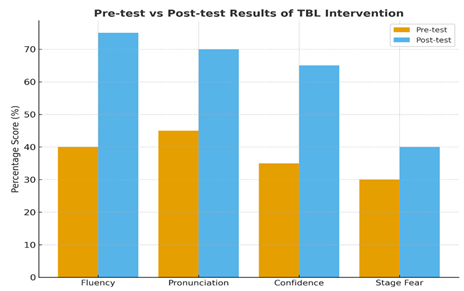
The results
demonstrated a statistically significant improvement in all four communication
parameters following the eight-week TBL intervention as shown in Table 1.
|
Table 1 |
|
Table 1 Analysis of Communication Based on
Different Skill Areas |
|||
|
Skill
Area |
Pre-test
(%) |
Post-test
(%) |
Improvement |
|
Fluency |
45 |
80 |
+35% |
|
Pronunciation |
50 |
75 |
+25% |
|
Confidence |
40 |
70 |
+30% |
|
Stage
Fear (Reduction) |
30 |
20 |
-10% |
|
Figure 1
|
|
Figure 1 Pre-Test Versus Post-Test Results of Task
Based Learning. |
Improvement in Fluency
From Figure 1, students showed marked improvement in their
ability to express ideas spontaneously without prolonged pauses or
code-switching. Activities such as role plays and group discussions provided
natural contexts for extended speech, encouraging students to negotiate meaning
and formulate responses in real time. Similar results were reported by Rahimi and Zhang (2022), who observed that
task-based interaction enhances lexical retrieval and conversational fluency.
Pronunciation and Phonetic Clarity
There was a
notable enhancement in pronunciation accuracy, attributed to repetition-based
activities like reading aloud, mock interviews, and phonetic drills
incorporated into post-task reflection sessions. Learners developed awareness
of intonation, stress, and rhythm through peer feedback and teacher modeling. This aligns with findings by Nguyen
(2020) and Levis (2022), who highlight the
role of interactive tasks in phonological development.
Confidence and Motivation
Before the
intervention, most students exhibited hesitation and a fear of being judged. By
the sixth week, over 80% of the participants reported increased comfort in
using English during discussions and presentations. Teacher observations
confirmed that students displayed greater willingness to initiate conversations
and correct each other’s errors constructively. The peer-supported learning
environment fostered through TBL was instrumental in reducing anxiety and
enhancing self-efficacy, echoing findings by Littlewood
(2020) and Carless (2018).
Reduction in Stage Fear
The inclusion of
public speaking activities such as “Pick and Speak,” extempore sessions, and
presentation days helped students gradually overcome stage fright. The
low-pressure, collaborative atmosphere encouraged learners to view mistakes as
part of learning rather than as failures. Over the eight weeks, a 10% reduction
in stage fear was recorded, which significantly improved classroom
participation and performance in English-related tasks.
Qualitative Insights
Students’
reflective journals and interviews revealed that TBL was perceived as
enjoyable, engaging, and practical. One participant wrote:
“Earlier, I used
to memorize answers for exams. Now I can talk about my ideas freely in English.
I enjoy working with my friends on activities.”
Another remarked:
“When I played the
role of a teacher in class, I forgot my fear. I realized I can speak better
than I thought.”
Such reflections
indicate a shift from passive learning to active, self-directed engagement,
aligning with the principles of learner autonomy described by Dam (1995) and Little
(1991).
Challenges Identified
Despite positive
outcomes, the study highlighted several challenges that could hinder
large-scale adoption of TBL in marginalized settings:
1)
Limited
Exposure to English:
Learners rarely used English beyond the classroom, reducing language retention
and practice opportunities.
2)
Teacher
Preparedness: Many rural
English teachers lacked familiarity with communicative and task-based pedagogy Kumaravadivelu (2006).
3)
Inadequate
Resources: The absence of
audiovisual aids, internet access, and projectors limited the variety of tasks
that could be implemented.
4)
Time
Constraints: TBL activities
required extended sessions for planning, execution, and reflection, which
clashed with rigid institutional timetables.
5)
Assessment
Practices: Traditional exams
focusing on grammar discouraged risk-taking and spontaneous communication.
Addressing these
challenges requires systemic intervention and capacity-building through policy
reform and professional development.
Another challenge
identified was the persistence of grammatical insecurity. Many learners
believed that speaking English requires “perfect grammar,” a mindset resulting
from years of traditional schooling. As a result, initial task cycles involved
hesitation and repeated translation attempts. Teachers had to consistently
reassure learners that fluency develops before grammatical perfection in
communicative settings. Moreover, some families did not understand the need for
communicative English and pressured students to prioritize exam content over
speaking practice.
Recommendations
1)
Integrate
TBL into Mainstream Curriculum:
Education boards and universities should adopt TBL principles to promote
communication-oriented language education.
2)
Teacher
Training and Workshops:
Continuous professional development programs should be organized to familiarize
teachers with task-based methodologies.
3)
Use
of Low-Cost Digital Tools:
Open-access mobile applications, podcasts, and virtual collaboration platforms
can provide additional exposure to English.
4)
Community-Based
Learning Clubs: Establishing
English clubs and peer mentorship programs can extend learning beyond the
classroom.
5)
Formative
Assessment Practices:
Incorporating portfolio evaluation and self-assessment will encourage
reflective learning and learner autonomy.
6)
Policy
Support for Inclusive Education: Governments should allocate specific funding for rural language
improvement programs focusing on marginalized learners.
Institutions must
also consider establishing Student-Led Speaking Forums, morning assembly
English slots, and cultural event participation, where learners practice
announcements, anchoring, storytelling, and debates. Furthermore, low-cost
solutions like English-only lunch breaks, pair-talk buddies, and reading
circles can sustain task-based learning even without technology. Teacher
mentorship programs and peer shadowing can support new instructors adopting
TBL. When supported holistically, TBL becomes not only a classroom strategy but
a campus-wide language development culture.
Conclusion
This study
demonstrates that Task-Based Learning (TBL) is an effective pedagogical
framework for enhancing English communication among marginalized learners. The
Dombo community students, who initially exhibited hesitation and low
confidence, achieved measurable gains in fluency, pronunciation, and
communicative competence within eight weeks of TBL intervention.
Beyond linguistic
outcomes, TBL empowered learners socially and psychologically by nurturing
self-confidence, teamwork, and learner autonomy. These findings reinforce the
argument that when learning environments emphasize meaning-making and
collaboration over rote memorization, marginalized students can achieve
substantial progress in both linguistic and interpersonal domains.
Ultimately, this
study re-affirms that communication confidence grows through authentic use, not
rote learning. For marginalized learners, spoken English becomes a medium of
empowerment — to present ideas, participate socially, and imagine broader
futures. By integrating TBL into mainstream rural education systems,
institutions can democratize language learning and strengthen academic equity.
Long-term adoption has the potential to redefine rural students’ language
identities, creating confident graduates capable of competing globally.
TBL, therefore,
serves not only as a language-learning strategy but also as a transformative
educational practice that promotes inclusion and equity in English education.
Limitations and Future Scope
This study was
limited by its small sample size and short duration. A larger, longitudinal
study across multiple institutions would provide deeper insights into the
sustained impact of TBL. Future research could explore technology-mediated TBL,
teacher training models, and gender-based participation differences in
marginalized groups. Additionally, integrating AI-based speaking tools for
pronunciation and fluency assessment could further enhance task-based language
development in under-resourced regions.
Future
explorations may also evaluate teacher attitude shifts during sustained TBL
practice, as well as parental perception development when students demonstrate
communication gains. Additionally, technology-assisted task-based learning
using mobile-friendly tools, AI speech trainers, and community radio language
clubs may further support rural learners. By combining TBL with digital
literacy, future programs can multiply the impact and reach of communicative
English beyond the classroom.
REFERENCES
Ahmed,
S., and Pawar, S. (2022). Task-Based Language
Teaching and Speaking Fluency Development Among EFL Learners.International
Journal of Language Education, 6(2), 112–127.
Ali,
F., and Khan, M. (2023). Enhancing Communicative Competence
Through Task-Based Learning
in Resource-Poor Classrooms. Arab World English
Journal, 14(1), 221–239.
Benson,
P. (2011). Teaching and Researching
Autonomy. Routledge.
Bourdieu, P. (1991). Language and Symbolic Power. Harvard University Press.
Braun, V., and Clarke, V. (2006). Using Thematic Analysis in Psychology. Qualitative Research in Psychology, 3(2), 77–101. https://doi.org/10.1191/1478088706qp063oa
Cohen, L., Manion, L., and Morrison, K. (2018). Research Methods in Education (8th ed.). Routledge. https://doi.org/10.4324/9781315456539
Dam,
L. (1995).
Learner Autonomy 3: From Theory to Classroom Practice.
Authentik.
Devkota,
K., and Bagale, S. (2021). Students'
Perceptions of Task-Based Language
Teaching in Developing
English Speaking Skills.
Journal of NELTA, 26(1–2), 148–163.
Ellis,
R. (2003). Task-Based Language Learning and Teaching. Oxford University
Press.
Field,
A. (2018). Discovering Statistics Using IBM SPSS Statistics (5th ed.). Sage.
Freire,
P. (1970). Pedagogy of the Oppressed.
Continuum.
Ghosh, S. (2022). Equity and English Pedagogy for Rural Learners in India. International Journal of Indian Education, 17(1), 78–94.
Kumaravadivelu, B. (2006). Understanding Language Teaching: From Method to Postmethod. Routledge. https://doi.org/10.4324/9781410615725
Lantolf,
J. P., and Thorne, S. L. (2006). Sociocultural Theory and the Genesis of
Second Language Development.
Oxford University Press.
Little, D. (1991). Learner Autonomy 1: Definitions, Issues, and Problems. Authentik.
Littlewood, W. (2007). Communicative and Task-Based Language Teaching in East Asian Classrooms. Language Teaching, 40(3), 243–249. https://doi.org/10.1017/S0261444807004363
Long,
M. H. (2015).
Second Language Acquisition and Task-Based
Language Teaching.
Wiley-Blackwell.
MacIntyre, P. D., Clément, R., Dörnyei, Z., and Noels,
K. A. (2021).
Affective Factors and Willingness
to Communicate in L2 Learning. Modern Language Journal, 105(2), 302–320.
Mansoor,
A., and Rahman, S. (2022). Task-Supported Language
Teaching in South Asian Contexts: Pedagogical Implications. Journal of Language
and Education, 8(4), 35–47.
Nguyen, T. (2020). Task-Based Peer Interaction and Speaking Performance in EFL Classrooms. TESOL International Journal, 15(2), 56–72.
Nunan, D. (2004). Task-Based Language Teaching. Cambridge University Press. https://doi.org/10.1017/CBO9780511667336
Pham,
H., and Nguyen, L. (2023). Improving Oral Communication in Vietnamese Rural Universities Through TBLT. Asian EFL Journal, 25(3), 90–118.
Prabhu,
N. S. (1987).
Second Language Pedagogy.
Oxford University Press.
Riasati, M., and Rahimi, M. (2019). Willingness to Communicate in English as a Foreign Language: The Role of TBLT. Journal of Applied Linguistics and Language Research, 6(5), 45–60.
Richards, J. C., and Rodgers, T. S. (2001). Approaches and Methods in Language Teaching (2nd ed.). Cambridge University Press. https://doi.org/10.1017/CBO9780511667305
Shanmugam, R. (2023). Bridging the Rural English Gap Through Learner-Centered Pedagogy. Indian Journal of Educational Technology, 5(2), 110–122.
Skehan, P. (1998). A Cognitive Approach to Language Learning. Oxford University Press. https://doi.org/10.1177/003368829802900209
Sultana, S. (2019). Marginalized Learners and English Language Identities in South Asia. Journal of Language, Identity and Education, 18(6), 391–406.
Van den Branden, K. (2006). Task-Based Language Education: From Theory to Practice. Cambridge University Press. https://doi.org/10.1017/CBO9780511667282
Willis, J. (1996). A Framework for Task-Based Learning. Longman.
Appendix
Sample Task 1 – Role Play: At the
Marketplace
Objective: To
practice transactional English and polite requests.
Instructions: Students perform a dialogue between a shopkeeper and a customer.
Focus: Use of polite expressions, negotiation language, and real-time corrections.
Sample Task 2 – Group Problem-Solving: Planning a Community Event
Objective: To
encourage teamwork and English-based
decision-making.
Instructions:
Groups design an awareness campaign
for their village (topic:
Clean Environment).
Focus: Vocabulary expansion, persuasive speech, and presentation skills.
Sample Task 3 – Presentation: “My Dream Profession”
Objective: To develop public speaking skills and self-confidence.
Instructions: Each student prepares
a 2-minute talk about their dream
job.
Focus: Pronunciation, intonation, and audience interaction.
Student
Feedback (Selected Excerpts)
“TBL helped me to speak English without fear.”
“Group
discussions gave me confidence to express my ideas.”
“Earlier, I memorized notes, but now I can speak naturally.”
 This work is licensed under a: Creative Commons Attribution 4.0 International License
© Granthaalayah 2014-2026. All Rights Reserved.