Original Article
UNIVERSALISATION AND QUALITY OF ELEMENTARY EDUCATION OF BIMSTEC COUNTRIES: A COMPARATIVE INVESTIGATION
|
Saiyab Mollick 1 1 Research Scholar,
Department of Education, University of Kalyani, Nadia, Pin- 741235, India 2 Professor, Department of Education,
University of Kalyani, Nadia, Pin- 741235, India |
|
|
|
ABSTRACT |
||
|
The enhancement and universalisation of elementary education are vital for global discussions on Sustainable Development Goal 4 (SDG-4). BIMSTEC countries (Bangladesh, Bhutan, India, Myanmar, Nepal, Sri Lanka, and Thailand) are facing challenges like enrolment, retention, and infrastructure. Objectives of the study include examining the policy frameworks, constitutional provisions, and governmental initiatives undertaken by BIMSTEC countries to enhance elementary education, as well as comparing the elementary education systems of these countries with respect to universal focus, quality improvement, and inclusivity strategies. This study employed a qualitative approach using document-based analysis along with comparative investigation strategy to explore the policy frameworks, constitutional provisions, and governmental initiatives undertaken by BIMSTEC countries to strengthen elementary education. The result found that BIMSTEC countries have taken strategies to enhance elementary education across three main areas like universal access, quality improvement, and inclusivity. Countries in the BIMSTEC region, including Bangladesh, Myanmar, India, Bhutan, Nepal, Sri Lanka, and Thailand focus on compulsory primary education, quality enhancement, and inclusivity in their educational systems. While Bangladesh and Myanmar advocate for access, India mandates education for ages 6-14, and Bhutan offers free education. Quality efforts vary with initiatives such as improving learning outcomes in Bangladesh and fostering holistic education in Bhutan. Inclusivity is emphasized through various strategies, including stipends for disadvantaged groups in Bangladesh and reservation policies in India, highlighting a commitment to equitable education across the region. Keywords: BIMSTEC Countries, Elementary Education, Universalisation of Education, Quality of Education |
||
INTRODUCTION
The
universalisation and quality enhancement of elementary education are the major
issues of global discourse on education, especially related to Sustainable
Development Goals (SDG-4). BIMSTEC, countries namely Bangladesh, Bhutan, India,
Myanmar, Nepal, Sri Lanka, and Thailand have historical, cultural, and
socio-economic linkages which have shaped their paths of progress and
development, especially in relation to elementary education. Though there is
some improvement in making elementary education more accessible, there are
challenges remaining, especially in relation to enrolment, retention, equity,
and quality of learning and teachers' preparedness and infrastructural
facilities. Universalisation of elementary education is not only making it free
and compulsory for all school-going children but also ensuring their meaningful
participation and completion of education. Reforms and policies of BIMSTEC
countries have been influenced by constitutional and national policies.
However, merely increasing the number of educational institutions is not
sufficient for quality enhancement of learning. Poverty, rural-urban
disparities, gender disparities, socio-economic disparities, and digital
disparities are some of the challenges faced in achieving quality elementary
education. The dimensions of quality in elementary education in this context
include a relevant curriculum, qualified and motivated teachers, child-centred
pedagogical approaches, inclusive educational setting, adequate infrastructure,
systems of formative assessment, and governance structures that sustain
accountability. In this context, there is a shift in the policy agenda of the
BIMSTEC countries to move beyond quantitative expansion to qualitative
development in education, with a greater emphasis on competency-based learning,
technology-based learning, teacher development, and inclusive education
systems. In this context, a comparative analysis of the agenda on
universalization and quality in the context of the BIMSTEC countries reveals
interesting similarities and differences in their approaches to education
governance, financing, decentralization, and evaluation. By analysing the
approaches to elementary education in these countries, more holistic and
contextually relevant strategies can be formulated to promote sustainable
development in the context of their shared development agenda.
|
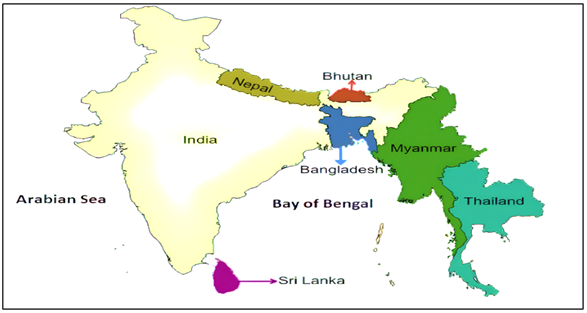
Figure 1
|
This study
critically examines the policies, progress, and gaps in universal elementary
education in BIMSTEC (Bay of Bengal Initiative for Multi-Sectoral Technical and
Economic Cooperation) countries, viz., Bangladesh, Bhutan, India, Myanmar,
Nepal, Sri Lanka, and Thailand.
This study has
tried to bring out regional as well as national-level features. The focus of
this study has been on the policy initiatives, constitutional provisions, and
governmental efforts adopted by the concerned nations to raise the standards of
elementary education.
Objectives of the Study
1)
To study
the policy frameworks, constitutional provisions and governmental initiatives
prevailing in BIMSTEC countries to strengthen elementary education.
2)
To
compare the contemporary elementary education system prevailing in BIMSTEC
countries in reference to universal focus, quality improvement and inclusivity
strategy.
Design of the Study
Research Method Used
The study has
employed a qualitative approach, focusing on document-based investigation to
explore the policy frameworks, constitutional provisions, and governmental
initiatives prevailing in BIMSTEC countries to strengthen elementary education.
A comparative investigation strategy has also been utilised to derive findings
from the gathered data.
Document analysis
is a systematic procedure for reviewing or evaluating documents both printed
and electronic (computer-based and Internet-transmitted) material. Like other
analytical methods in qualitative research, documentary analysis requires that
data be examined and interpreted in order to elicit meaning, gain
understanding, and develop empirical knowledge Bowen
(2009), Corbin and
Strauss (2008). Comparative study is a kind of method that analyses
phenomena and then put them together to find the points of differentiation and
similarity Miri and Dehdashti (2019), Mokhtarianpour (2016). This approach has aimed to comprehensively
understand the strategies and commitments made by these nations to improve
their educational systems at the elementary level.
Data Source
The present study
has utilised a diverse range of primary data sources, including official
reports from UNESCO, UNICEF, UNDP, and the World Bank, along with National
education policy documents and the annual reports from the Ministries of
Education of BIMSTEC countries.
Evidentiary
research articles, books, and comparative education literature related to
policy frameworks, constitutional provisions, and governmental initiatives
prevailing in BIMSTEC countries have also been utilised as data sources in the
present study.
Data Collection Procedure
The data
collection procedure was a thorough investigation of documents and literature
pertinent to the study. The researchers collected all relevant data and
followed record keeping method to preserve all the documents.
Data Validation
Data validation
has been conducted, confirming the integrity of the collected data through both
external and internal validity measures. Primarily, the data has undergone
refinement via external validation to confirm the authenticity of the sources,
which helps to ascertain that it is neither a forgery nor invalid. To evaluate
internal validity, the data has been thoroughly scrutinized to assess the
accuracy and credibility of the content within the source, placing an emphasis
on reliability, potential biases, and factual consistency.
Data Analysis Technique
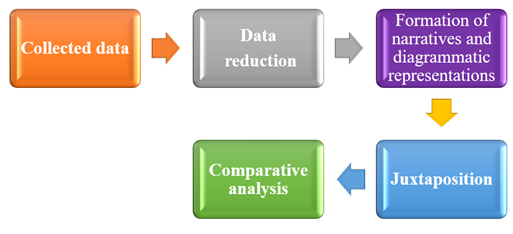
After collecting
data, the researcher conducted data analysis techniques utilised various steps
which included data reduction, formation of narratives and diagrammatic
representations of the data, as well as juxtaposition and comparative analysis
methods to derive insights from the findings Koul (2018).
|
Figure 2
|
|
Figure 2 Steps of Data
Analysis Procedure |
Data Analysis, Result and Discussion
Policy frameworks, constitutional provisions and governmental initiatives prevailing in BIMSTEC countries to strengthening elementary education
Policy Frameworks
Researchers
compared the policy frameworks prevailing in BIMSTEC countries towards
strengthening elementary education. The existing policy frameworks in India for
strengthening primary education include the National Policy on Education (1986
and 1992) which focuses on achieving universalisation of elementary education
and reduction in drop outs, the Right to Education Act (2009) which ensures
provision of free and compulsory education, and the National Education Policy
(NEP) 2020, which focuses on developing foundational learning in literacy and
numeracy, pre-schooling and structural transformations. Similarly, the
Compulsory Primary Education Act (1990) enforced universalisation of primary
education in Bangladesh; while the National Education Policy (2010) has focused
towards quality enhancement of education keeping in mind expansion of primary
education up to Grade VIII, achieving gender equity, child centred education,
among other issues. Hence there is a clear shift from focus on access towards
quality. The Education Blueprint for Bhutan 2014-2024 and the revised National
Education Policy (NEP) 2020 too has a balanced approach focusing on
universalisation of primary education, while at the same time focussing on
competency-based learning, information and communication technology (ICT), and
governance reforms. Thus, the primary education policy framework of Nepal has a
strong focus towards achieving compulsory and free basic education, enhancing
early grade learning, multilingual education and inclusive access by keeping in
mind cultural and linguistic diversity. Meanwhile the primary education policy
framework of Sri Lanka has a strong focus towards curriculum reform, teacher
education, ensuring quality in education and promoting the principles of equity
in education through the National Education Commission Act and Policy
Framework, by adopting a reformist approach towards quality. Similarly, the
policy framework of primary education in Myanmar too has focused towards
achieving universalisation of primary education through attaining universal
completion of primary education and improvement of teachers’ quality, which
indicates the strengthening of foundational aspects of the education system.
The policy framework of Thailand on the other hand, has adopted a long-term
approach towards reforms through the National Education Act and National
Education Plan (2017-2036) and hence has promoted competency-based curriculum,
awareness about lifelong learning, equity, and the global competitiveness of
higher education. Overall, policy frameworks at the regional level brings out
the shared goals and achievements of countries towards strengthening primary
education within a decade by focusing on moving away from access towards
quality, equity, competency-based learning and structural transformations at
national levels, while moving at different speeds, and adopting different
approaches based on the legal provisions as well as depth and breadth of the
policy frameworks.
Table 1
|
Table 1 Shows the Policy
Frameworks of BIMSTEC Countries, Undertaken to Strengthen Elementary
Education |
||
|
BIMSTEC Countries |
Representative Sources |
Analytical Findings |
|
India |
NEP 1986, 1992 |
Focused on universalizing
elementary education, reducing dropout rates, and improving teacher education
and school infrastructure. |
|
NEP, 2020 |
Emphasizes foundational
literacy and numeracy, integrating early childhood care with primary
education, and aims to enhance access and learning outcomes by 2030 through
structural reforms. |
|
|
RTE Act, 2009 |
Mandates free education for
children aged 6-14. |
|
|
Bangladesh |
Act, 1990 |
Mandates compulsory primary
education for children aged 6–10, promoting universal access and increasing
enrolment in both rural and urban areas. |
|
National Education |
Emphasises universal quality
primary education, expansion from Grade V to VIII, child-centred teaching,
recruitment of qualified teachers, and gender equality. |
|
|
Policy of 2010 |
||
|
Bhutan |
NEP, 2022 |
Focusing on universal
access, Early Childhood Care and Development integration, and a
competency-based, learner-cantered pedagogy. |
|
Bhutan Education Blueprint
2014-2024 |
Improving quality and
efficiency in basic education, key focus areas include enhancing student
learning outcomes, strengthening teacher quality and leadership, expanding
ICT integration, improving governance and accountability, and ensuring
equitable access for rural and remote communities. |
|
|
Nepal |
National Education |
Ensuring compulsory and free
basic education, strengthening early grade learning, promoting mother
tongue-based multilingual education, improving teacher management and
capacity building, and integrating technical and vocational elements, while
also fostering inclusive and equitable access to education. |
|
Policy, 2076 (2019) |
||
|
Sri Lanka |
National Education Commission Act (1991) |
Recommendations on
curriculum reform, teacher education, school management, and quality
assurance, including at the primary level
(Government of Sri Lanka, 1991). |
|
National Education Policy
Framework (NEPF) |
Universal access and
participation, quality and relevance of curriculum, child-cantered and
activity-based learning, Equity in education. |
|
|
Myanmar |
National Education Strategic
Plan (NESP) 2016–2021 |
Focused on universal access
and completion of primary schooling and improvement of teaching quality and
teacher education. |
|
Thailand |
National Education Plan
(2017–2036) |
Quality education, equity,
efficiency, and global relevance |
|
National Education Act B.E.
2542 |
Focus on education reform
and lifelong learning |
|
|
Basic Education Core Curriculum B.E. 2551 (2008) |
Competency-based learning
and lifelong education |
|
Constitutional Provisions
Comparison of
constitutional provisions among BIMSTEC countries was done. India has articles 21A and 45 in its
Constitution. These articles guarantee free and compulsory education for
children aged 6 to 14 years. They also recognize the importance of early
childhood care and education. Bangladesh is similar to India. Article 17 of its
Constitution states that education should be free and compulsory. Nepal has
article 31(2) in its Constitution. These articles guarantee free and compulsory
basic education and also free education up to the secondary level. So, Nepal
covers more years of free education than India and Bangladesh. Sri Lanka’s
approach is different. They focus on universal and equal access at all levels,
but it’s under directive principles. That means it’s more like a policy goal,
not a strict legal right. Myanmar guarantees free and compulsory primary
education and says education is a citizen’s right. But how it’s actually done
depends on laws passed later. Thailand requires at least 12 years of free and
quality education. That’s one of the longest guarantees in the region. Bhutan
offers free education up to Class X. Overall, it shows that all countries in
the region are committed to providing universal and free basic education.
Table 2
|
Table 2 Shows the
Constitutional Provisions of BIMSTEC Countries, Undertaken to Strengthen
Elementary Education |
||
|
BIMSTEC Countries |
Representative Sources |
Analytical Findings |
|
India |
Article 21A |
Education a fundamental
right for all children aged 6–14. |
|
Fundamental Duties |
To
provide opportunities for education between the age of six to fourteen years. |
|
|
Article
45 |
Mandates
early childhood care and education for children below six years. |
|
|
Bangladesh |
Article 17 |
Mandates free and compulsory
education for all children. |
|
Nepal |
Article
31(1) |
Every
citizen can access basic education. |
|
Article
31(2) |
Every citizen shall have the
right to compulsory and free basic education, and free education up to the
secondary level (Constituent Assembly Secretariat, 2015). |
|
|
Sri Lanka |
Article
27(2-h) |
Universal and equal access to education at all
levels. |
|
Myanmar |
Article
28(c) |
Free and compulsory primary education. |
|
Section
366(a) |
Every citizen has right to
education. |
|
|
Section
366 (b) |
Basic education which the
Union prescribes by law as compulsory. |
|
|
Thailand |
Section
54 |
Mandates
the provision of free and quality education for at least 12 years. |
|
Bhutan |
Article 9(16) |
Free education for all school-going children up to Class X. |
Governmental Initiatives
Comparative view
of governmental initiatives among BIMSTEC countries is discussed. India,
through Sarva Shiksha Abhiyan (2001),
expanded infrastructure and teacher recruitment to universalize access, while
the Mid-Day Meal Scheme addressed attendance and child nutrition; more
recently, the NIPUN Bharat Mission (2021)
has shifted focus toward achieving Foundational Literacy and Numeracy (FLN) by
Grade 3, reflecting a move from access to measurable learning outcomes.
Bangladesh, under Primary Education Development Program IV (PEDP IV),
emphasizes quality improvement, teacher training, and inclusive education,
complemented by school feeding and stipend programs that reduce socio-economic
barriers and promote equitable participation. Bhutan combines equity and
modernization through its School Feeding Programme, Central Schools Programme
for remote learners, and ICT integration initiatives, indicating a balanced
approach between inclusion and technological advancement. Nepal, via the School
Sector Development Plan (2016-2023) and the School Education Sector Plan
(2022-2032), prioritizes universal completion, equity, and improved learning
outcomes, supported by school meal programs in remote regions to strengthen
retention. Sri Lanka focuses on institutional strengthening and literacy
enhancement through sector-wide development programmes, alongside school meal
initiatives targeting disadvantaged areas. Myanmar concentrates on school
grants and stipend programs to directly support infrastructure and vulnerable
students, reflecting a foundational capacity-building model. Meanwhile,
Thailand adopts a comprehensive welfare-oriented approach through its 15-Year
Free Education Policy, covering tuition and learning materials, and reinforces
quality through OBEC reforms and ICTdriven digital
learning initiatives. Overall, it shows a regional trend where earlier programs
focused mainly on increasing access to education.
Table 3
|
Table 3 Shows the
Governmental Initiatives of BIMSTEC Countries, Undertaken to Strengthen
Elementary Education |
||
|
BIMSTEC Countries |
Representative Sources |
Analytical Findings |
|
India |
Sarva Shiksha Abhiyan (SSA),
2001 |
To achieve Universal
Elementary Education (UEE), improving school infrastructure and recruitment
and training of teachers. |
|
Mid-Day Meal |
Improved enrolment,
attendance, nutrition. |
|
|
Scheme, |
||
|
NIPUN Bharat |
To ensure that every child
achieves Foundational Literacy and Numeracy (FLN) by Grade 3. |
|
|
Mission, 2021 |
||
|
Bangladesh |
Primary Education
Development Program IV (PEDP IV |
Focus on improving learning
outcomes, expanding pre-primary education, enhancing teacher training,
developing infrastructure, and promoting inclusive education. |
|
School Feeding |
Aims to increase student
attendance, nutrition, and concentration in classrooms |
|
|
Program, 2002 |
||
|
Stipend programmes |
Focus on underprivileged
families to reduce socioeconomic barriers and promote attendance, while free
textbook distribution ensures equal access to learning materials, alleviating
financial burdens on families. |
|
|
Bhutan |
School Feeding Programme |
Improve student attendance,
nutrition, and concentration in classrooms (Ministry of Education, 2019). |
|
Central Schools Programme |
This initiative introduced
to improve the quality and equity of education, particularly for students
from remote and disadvantaged areas. |
|
|
ICT Integration in Schools |
ICT-based initiatives such
as digital classrooms, computer labs, and online learning platforms to
modernize teaching and learning in primary education (Ministry of Education,
2020). |
|
|
Nepal |
School Sector Development
Plan 2016–2023 |
Improving access, equity,
and learning outcomes in basic education. |
|
School Education Sector Plan
(SESP) 2022–2032 |
Aims to ensure universal
completion of quality basic education. |
|
|
School meal program |
Improve attendance,
retention, and student nutrition in remote regions. |
|
|
Sri Lanka |
Education Sector Development
Framework and Programme (ESDFP) |
This programme strengthened
institutional capacity and improved learning outcomes. |
|
General Education Sector
Development Programme (GESDP) |
Focus on improving literacy
and numeracy at primary level, strengthening school leadership, enhancing
monitoring and evaluation systems. |
|
|
School meal programs |
To improve attendance and
student health, particularly in disadvantaged regions. |
|
|
Myanmar |
School Grants |
To provide financial support
directly to schools for infrastructure, teaching materials cost. |
|
Stipend programs |
To support children from
poor and disadvantaged families, encouraging school attendance and retention. |
|
|
Thailand |
15-Year Free Education
Policy |
To provide free education
from pre-primary to upper secondary level. This initiative covers tuition
fees, textbooks, learning materials, uniforms, and other educational
expenses, reducing financial barriers for families |
|
Office of the Basic
Education Commission (OBEC) Reforms |
focusing on school quality
assurance, teacher development and performance evaluation, infrastructure
improvement and educational supervision and monitoring. |
|
|
ICT and Digital Learning
Initiatives |
Enhance teaching and
learning in elementary schools, particularly in remote areas |
|
Comparative analysis of contemporary elementary education system prevailing in BIMSTEC countries in reference to universal focus, quality improvement and inclusivity strategy
Universal focus
Comparative view
of universal focus among BIMSTEC countries to strengthening elementary
education. Bangladesh and Myanmar prioritise free and mandatory primary
education, demonstrating a strong commitment to ensuring that every child
receives a minimal level of education. India is enforcing free and compulsory
education for children aged 6–14. Bhutan guarantees free education. In contrast
to the majority of BIMSTEC members, Nepal offers free education up to Grade 12.
Goals for universal literacy are given top priority in Sri Lanka. With an
intentional focus on minimising regional disparities, Thailand requires free
and high-quality education, emphasising both equity and quality aspects.
Overall, it demonstrates a shared regional goal of universal access to
education, although there are variations in the length of free education, legal
enforceability, and emphasis on literacy, quality, and regional equity.
Quality Improvement Approach
Comparative
analysis finds that Bangladesh has successfully increased enrolment, but it
still needs to close quality gaps by concentrating on raising learning outcomes
and closing the gap between urban and rural schools. Bhutan integrates values,
competencies, and general child development into its reform framework, adopting
a comprehensive and learner-centred approach to education. To improve
educational quality across the country, India places a strong emphasis on
structural and systemic reforms, such as curriculum restructuring, foundational
literacy initiatives, and institutional accountability mechanisms. In order to
improve classroom procedures and give local education authorities more
authority, Myanmar places a high priority on teacher development and
decentralisation. Nepal supports inclusive pedagogy, early grade support, and
kid-friendly learning environments. To maintain high literacy rates and raise
primary standards, Sri Lanka concentrates on curriculum reforms and
strengthening governance. In the meantime, competency-based curricula,
learner-centred education, and school quality assurance systems are being
advanced in Thailand. While each nation prioritises different reform levers,
such as governance, pedagogy, teacher capacity, or systemic restructuring,
overall shows a regional shift from access-driven expansion to quality-focused
transformation.
Inclusivity Strategy
Comparative
estimation explores that disadvantaged groups are given priority in Bangladesh
through stipends, gender-focused programs, and focused assistance for
low-income and rural areas. Bhutan fosters inclusive learning environments by
incorporating students from a variety of backgrounds and remote locations into
a nurturing, morally grounded educational system. Through reservation policies
and special programs to lessen educational inequality, India targets
marginalised populations, including minority groups, Scheduled Castes,
Scheduled Tribes, and economically weaker sections. In order to provide
context-specific solutions that address regional, ethnic, and socioeconomic
diversity, Myanmar has adopted flexible and localised education models.Nepal's constitution and
policies, which include provisions for children with disabilities and
multilingual education based on mother tongue, exhibit a strong emphasis on
equity and inclusivity. In order to maintain high literacy and lessen
inequalities between provinces, Sri Lanka places a strong emphasis on equity in
access and participation. In the meantime, Thailand improves accessibility and
infrastructure, especially in underserved and rural areas, to strengthen
inclusivity. Overall, it shows that all BIMSTEC countries try to achieve
inclusive education, but their methods are different. Some focus on improving
the education system and building infrastructure, while others provide welfare
programs and special support for disadvantaged groups.
Overall Comparison
Table 4
|
Table 4 Shows the
Comparison of the Elementary Education System of BIMSTEC Countries in
Reference to the Universal Focus, Quality Improvement Approach and
Inclusivity Strategy |
|||
|
BIMSTEC Country |
Universal Focus |
Quality Improvement Approach |
Inclusivity Strategy |
|
Bangladesh |
Free & compulsory
education |
Enrolment, quality gaps |
Focus on disadvantaged
groups |
|
Bhutan |
Ensures free access |
Holistic &
learner-cantered education |
Inclusive learning
environments |
|
India |
Right to Education Act Free & compulsory
education |
Structural & systemic
reforms |
Targeting marginalized
populations |
|
Myanmar |
Free
and compulsory primary education |
Teacher development
&decentralization |
Localized and flexible
education models |
|
Nepal |
Free education up to Grade
12 |
Child-friendly learning |
Strong focus on inclusivity
& equity |
|
Sri Lanka |
Universal literacy goals |
Governance & curriculum
reforms |
Focuses Equity |
|
Thailand |
Free and quality education,
Reducing regional disparities |
Learner-cantered education |
Infrastructure &
accessibility improvements |
Conclusion
The study tried to
portray a comprehensive picture of the Universalization and Quality of
Elementary Education of BIMSTEC Countries. The researcher has presented the
policy frameworks, constitutional provisions, and governmental initiatives
undertaken by BIMSTEC countries to enhance elementary education, as well as
comparing the elementary education systems of these countries with respect to
universal focus, quality improvement, and inclusivity strategies. The
researcher has pointed out that many countries have made good progress in
increasing access to education, but differences still exist in providing equal
quality learning for all. Constitutional provision helped to achieve universal enrollment, student retention and active participation,
especially among marginalized and poor communities. Many policies and
government initiatives undertaken by BIMSTEC focus on improving the quality of
education through better learning outcomes and teacher development. But there
are some problems, such as teacher shortages, lack of proper training, lack of
infrastructure and socio-economic inequalities make it difficult to implement
these policies effectively.
All BIMSTEC
countries offer universal and free education at the elementary level. However,
their strategies for enhancing quality and inclusiveness difference from each
other. In Nepal and Thailand, free education is offered at higher levels, while
learnercentred teaching is emphasized. In India and
Sri Lanka, structural and governance reforms in the education sector is
emphasized for enhancing quality in education. In Myanmar, teacher development
and decentralized education systems are emphasized, while in Bhutan, holistic
and learner-centred education is emphasized. In Bangladesh, more emphasis is
given to enrollment rates, but still, some gaps in
quality remain. All BIMSTEC countries are trying their best to enhance the
quality of education by focusing on access, quality of learning, and
inclusiveness for disadvantaged groups.
Finally, it is
important to highlight the need for strong regional cooperation with BIMSTEC
nations emphasised to address the challenges faced by elementary education.
Future policy must focus on foundational literacy, teacher quality, monitoring
systems, and inclusive practices to ensure that universal access is balanced
with quality for transformative education development.
ACKNOWLEDGMENTS
None.
REFERENCES
Bowen, G. (2009). Document Analysis as a Qualitative Research Method. Qualitative Research Journal, 9, 27–40. https://doi.org/10.3316/QRJ0902027
BIMSTEC. (n.d.). Science, Technology and Innovation.
Government of India. (2002). Eighty-Sixth Amendment of the Constitution of India.
Koul, L. (2018). Methodology of Educational Research (4th ed.). Vikas Publishing House.
Ministry of Education and Skills Development. (2020). 34th Education Policy Guidelines and Instructions 2020.
Ministry of Education and Skills Development. (2022). National Education Policy (draft).
Ministry of Education. (1999). National Education Act B.E. 2542 (1999).
Ministry of Education. (2002). Compulsory Education Act B.E. 2545.
Ministry of Education. (2005). Enriching Education to Empower Future Generations of Sri Lanka. https://planipolis.iiep.unesco.org/sites/default/files/ressources/sri_lanka_moe_profile_english.pdf
Ministry of Education. (2020). National Curriculum Framework for Secondary Education.
Ministry of Education. (2024). Education Policy of the Fiscal Year 2025–2026.
Ministry of Education. (2025). Transforming General Education.
Miri,
S., and Dehdashti, S. Z. (2019). A Short Introduction to Comparative
Research.
Mokhtarianpour, M. (2016). Islamic Model of Iranian Pattern Development Process Model. The Pattern of Islamic Development of Iran, 4(8), 9–30.
National Education Commission. (2022a). National Education Policy Framework (2020–2030): Extended summary.
National Education Commission. (2022b). National Education Policy Framework (2020–2030): Full text.
National Education Commission. (2024). Research Publications.
 This work is licensed under a: Creative Commons Attribution 4.0 International License
© Granthaalayah 2014-2026. All Rights Reserved.