
Review Article
Ancient Wisdom for Modern Leaders: Lessons from the Mahabharata on Ethical, Strategic, and Transformational Leadership
|
Dr. Sayak
Gupta 1* 1 Assistant Professor,
Department of Management, Netaji Subhas University, Jamshedpur, India |
|
|
|
ABSTRACT |
||
|
Leadership in the modern era faces unprecedented complexity, ethical ambiguity, and the need for transformational capacity across organizations and societies. While contemporary leadership theories offer analytical frameworks, there is growing recognition that ancient philosophical texts provide rich, context-sensitive insights for guiding leaders. This paper examines the Mahabharata as a source of ethical, strategic, and transformational leadership lessons. Through a literature review and integrative discussion, the study highlights how key characters exemplify moral discernment, relational intelligence, and visionary guidance. Ethical leadership, grounded in the concept of dharma, illustrates the alignment of personal virtue with societal responsibility. Strategic leadership demonstrates the importance of foresight, stakeholder engagement, and moral accountability. Transformational leadership emphasizes self-development, service, and inspiration of followers. The paper also identifies future research directions, including cross-cultural applications, leadership development programs, ethical decision-making in technological contexts, and integrative leadership frameworks. By bridging ancient wisdom with contemporary theory, this study provides a holistic perspective on cultivating ethical, strategic, and transformational leaders for the complexities of the 21st century. Keywords: Ethical Leadership, Strategic
Leadership, Transformational Leadership, Dharma, Cross-Cultural Leadership, Leadership
Development, Ancient Wisdom in Management |
||
INTRODUCTION
Leadership in the
modern era is facing unprecedented complexity, ethical ambiguity, and a growing
need for transformational capacity across organizations and societies. Leaders
are increasingly expected not only to deliver operational performance but also
to uphold moral values, inspire collective purpose, and navigate multi-layered
socio-cultural challenges Northouse
(2019). While contemporary leadership theories
provide analytical frameworks for understanding leader behavior, there is
growing recognition that ancient texts and philosophical traditions offer rich,
context-sensitive insights that remain relevant for contemporary leaders Sendjaya
and Sarros (2002). Among these, the Mahabharata, one of the
longest and most influential epics of ancient India, provides a detailed
account of leadership dynamics, portraying ethical dilemmas, strategic
decision-making, and transformational journeys that are applicable even today Srinivasan
(2015).
The Mahabharata is more than a literary or religious text;
it serves as a repository of human experience, presenting characters confronted
with moral choices, conflict resolution, and duty (dharma) under complex
circumstances Hiltebeitel
(1990). These narratives encapsulate leadership
challenges that are highly relevant to modern organizational contexts, such as
ethical decision-making, stakeholder management, and adaptive strategy
formulation Deshpande
(2018). For example, Krishna’s guidance to Arjuna in
the Bhagavad Gita demonstrates how leaders can balance duty, personal values,
and the greater good, offering practical insights for ethical leadership under
pressure Prasad
(2003). Similarly, the strategic planning and
tactical foresight demonstrated during the Kurukshetra war exemplify the
integration of ethics and strategy in decision-making, which parallels modern
strategic leadership practices Javidan
and Teagarden (2011).
Ethical
leadership, or adherence to dharma, is a recurring theme throughout the epic.
Modern scholarship emphasizes ethical leadership as foundational to
organizational legitimacy, trust, and sustainable performance Brown
and Treviño (2006). The challenges faced by Yudhishthira, who
struggles to reconcile personal virtue with political necessity, highlight the
enduring tension between ethics and strategy in leadership Kakar
(1983). These lessons underscore that ethical
leadership is not merely compliance with rules but involves integrity,
accountability, and empathy, all of which are crucial for guiding organizations
in complex environments Lemoine
et al. (2019).
Strategic
leadership, which involves envisioning, planning, and implementing actions that
shape organizational futures, is another core lesson from the Mahabharata.
The epic portrays strategy not as abstract reasoning but as context-sensitive
judgment informed by moral and relational considerations Javidan
and Teagarden (2011). Leaders such as Bhishma and Vidura
demonstrate how strategic choices are closely tied to ethical commitments,
emphasizing the importance of foresight, negotiation, and alliance-building in
leadership.
Finally, the Mahabharata
illustrates transformational leadership, showing leadership as a process of
development rather than a fixed trait. Key characters evolve through adversity,
self-reflection, and service, inspiring followers and transforming their social
and political environment Northouse
et al. (2019). These narratives align closely with modern
understandings of transformational leadership, highlighting vision,
inspiration, and the cultivation of followers as essential elements of
effective leadership.
By examining the Mahabharata,
contemporary leaders can gain valuable insights into ethical, strategic, and
transformational dimensions of leadership. Integrating these ancient lessons
into modern leadership practice provides a richer, more holistic perspective
that remains critical in a complex, globalized world.
|
Figure 1 |
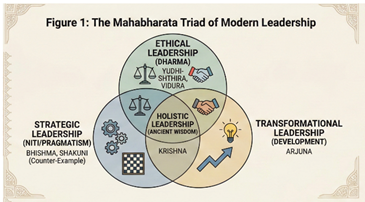
|
Figure 1 The Mahabharata Triad of Modern Leadership Source: Authors'
Own Conceptualization Based on the Integrated Literature Review |
|
Figure 2 |
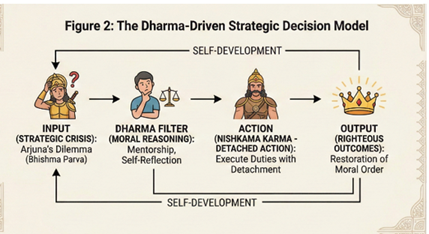
|
Figure 2 The Dharma
-Driven Strategic Decision Model Source: Authors' Own Conceptualization
Based on the Integrated Literature Review |
|
Figure 3 |
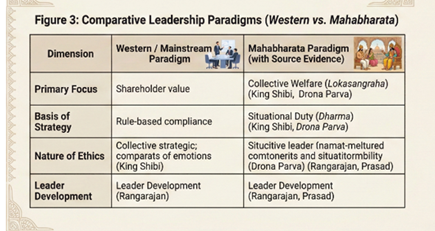
|
Figure 3 Comparative
Leadership Paradigms (western VS. Mahabharata) Source: Authors'
Own Conceptualization Based on the Integrated Literature Review |
|
Figure 4 |
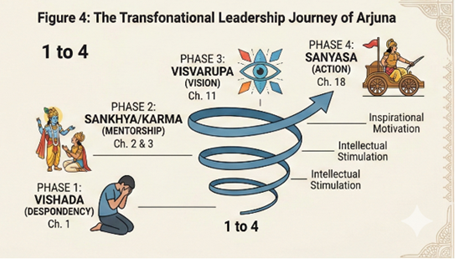
|
Figure 4 The Transfonational Leadership Journey of
Arjuna Source: Authors'
Own Conceptualization Based on the Integrated Literature Review |
An infographic
illustrating modern, strategic, and transformational leadership paradigms using
concepts and characters from the Mahabharata. Note: Diagram integrates Figure 1 shows how Krishna's holistic approach
integrates the otherwise distinct leadership domains exemplified by
Yudhishthira, Bhishma, and Arjuna, Figure 2 visualizes the internal ethical filtering
process taught to Arjuna in the Bhagavad Gita, Figure 3 provides a high-level comparison of the
value systems driving Western and ancient Indian management models, Figure 4 maps Arjuna's developmental arc across
specific chapters of the Bhishma Parva.
|
Table 1 |
|
Table 1 Key Leadership Themes in the
Mahabharata and Modern Leadership Theories |
||||
|
Leadership Dimension |
Mahabharata Example |
Modern Leadership Theory |
Key Lessons |
Sources |
|
Ethical Leadership |
Yudhishthira’s dilemma over dharma |
Ethical Leadership, Authentic Leadership |
Integrity, accountability, balancing personal
virtue with societal duty |
Brown & Treviño (2006); Radhakrishnan (1999);
Ciulla (2004); Sinha (1995) |
|
Strategic Leadership |
Bhishma and Vidura’s counsel in Kurukshetra |
Strategic Leadership, Responsible Leadership |
Foresight, stakeholder consideration, moral
accountability |
Boesche (2002); Maak & Pless (2006); Javidan
& Teagarden (2011) |
|
Transformational Leadership |
Krishna inspiring Arjuna |
Transformational, Servant, Spiritual Leadership |
Vision, motivation, self-development, empowering
followers |
Bass (1985); Burns (1978); Fry (2003); Greenleaf
(1977); Northouse (2019) |
Literature Review
Leadership and Indigenous Knowledge Systems
The intersection
of ancient philosophical traditions and contemporary leadership theory has
increasingly attracted scholarly attention, particularly in the context of
value-based and culturally grounded leadership models. While mainstream
leadership scholarship has largely developed within Western epistemological
traditions, recent research emphasizes the importance of integrating
non-Western perspectives to construct more globally relevant frameworks House et
al. (2004). Ancient Indian texts and classical
traditions have been examined not merely as mythological narratives but as
repositories of political, ethical, and organizational thought that inform
modern leadership discourse Sharma
et al. (2013).
Scholars argue
that leadership theories rooted in indigenous traditions provide
context-sensitive insights often absent from universalist models. The GLOBE
study demonstrated the significance of cultural dimensions in shaping
leadership expectations and practices across societies House et
al. (2004). In the Indian socio-cultural context,
leadership ideals frequently emphasize moral authority, relational harmony, and
spiritual grounding rather than purely transactional performance metrics Sinha
(1995). This orientation suggests that leadership
effectiveness is deeply embedded within cultural and philosophical frameworks.
Rangarajan
(2009) contends that ancient Indian political thought conceptualizes
leadership as stewardship of collective welfare rather than assertion of
individual dominance. This stewardship perspective resonates strongly with
stakeholder theory, which views leaders as custodians of diverse stakeholder
interests rather than agents of shareholder primacy Freeman
(1984). These parallels indicate that indigenous
wisdom traditions provide conceptual bridges to contemporary organizational
ethics and governance models.
Ethical Leadership and Moral Philosophy
Ethical leadership
has emerged as a foundational area within leadership studies, emphasizing
integrity, fairness, accountability, and normative influence Ciulla
(2004). Research indicates that leaders who
demonstrate strong moral identity positively influence organizational culture
and employee conduct Aquino
and Reed (2002). Ethical leadership is increasingly
associated with long-term sustainability, trust formation, and reputational
legitimacy.
Indian
philosophical thought provides a complementary moral framework through the
concept of dharma, which integrates personal virtue with contextual duty Radhakrishnan (1999). Unlike rigid rule-based systems, dharma
reflects situational moral reasoning that balances competing responsibilities.
Comparative cultural research further suggests that Eastern ethical systems
often emphasize relational obligations and collective well-being over
individual autonomy Hofstede
(2001).
Additionally, the
integration of spirituality in leadership has gained scholarly attention. Fry (2003) theory of spiritual leadership proposes that
intrinsic motivation, altruistic values, and a transcendent sense of purpose
enhance organizational commitment and productivity. Such findings reinforce the
argument that ethical leadership is not solely compliance-driven but grounded
in internalized moral consciousness and purpose-driven action.
Strategic Leadership and Responsible Governance
Strategic
leadership research defines effective leaders as those capable of envisioning
the future, aligning organizational resources, and maintaining competitiveness
in dynamic environments Ireland
and Hitt (2005). However, contemporary scholarship
increasingly argues that strategic decisions must incorporate ethical foresight
and social responsibility to remain sustainable Maak and Pless (2006).
Historical
analyses of classical Indian governance traditions reveal advanced
understandings of diplomacy, alliance-building, and pragmatic statecraft Boesche
(2002). These traditions conceptualize strategy as
an interplay between prudence, ethics, and situational awareness. Rather than
treating strategy as purely instrumental, such perspectives embed moral
considerations within long-term planning.
Responsible
leadership frameworks echo this integrated approach by asserting that strategic
success must be aligned with stakeholder trust, institutional legitimacy, and
long-term societal impact Maak and Pless (2006). This synthesis of strategy and morality
broadens contemporary strategic leadership discourse beyond short-term
performance metrics.
Transformational and Servant Leadership Perspectives
Transformational
leadership theory, introduced by Burns
(1978) and later expanded by Bass (1985), emphasizes the leader’s role in inspiring
followers through vision, moral example, intellectual stimulation, and
individualized consideration. Empirical studies have linked transformational
leadership to higher levels of organizational commitment, innovation, and
follower satisfaction Judge
and Piccolo (2004).
Similarly, servant
leadership theory prioritizes humility, empathy, stewardship, and follower
development Greenleaf
(1977). Both approaches underscore the relational
and developmental aspects of leadership, highlighting the importance of
empowering others rather than exercising control.
Research on
spiritual and values-based leadership further aligns with these perspectives. Fry (2003) argues that leadership grounded in
altruistic values and meaningful purpose fosters both organizational
effectiveness and personal fulfillment. Such models support the view that
transformational change requires inner development, ethical conviction, and
service-oriented orientation.
Cross-Cultural and Integrative Leadership Frameworks
Cross-cultural
leadership studies highlight the limitations of applying Western-centric
leadership models universally Rockstuhl
et al. (2011). As organizations operate in increasingly
global contexts, scholars advocate integrative frameworks that draw from
diverse philosophical traditions.
Authentic
leadership theory, for example, emphasizes self-awareness, relational
transparency, balanced processing, and internalized moral perspective Avolio
and Gardner (2005). These characteristics resonate strongly
with reflective traditions that prioritize introspection and moral clarity in
leadership practice.
Collectively, the
literature indicates that ethical grounding, strategic foresight, and
transformational capacity are interdependent dimensions of effective
leadership. Indigenous philosophical traditions enrich contemporary leadership
theory by providing deeper moral and cultural foundations. Integrating these
perspectives enables the development of more holistic, globally relevant
leadership frameworks capable of addressing the ethical and strategic
complexities of the modern world.
|
Table 2 |
|
Table 2 Indigenous Wisdom and
Cross-Cultural Leadership Insights |
|||
|
Indigenous Concept |
Leadership Implication |
Modern Relevance |
Sources |
|
Dharma |
Contextual moral reasoning, ethical stewardship |
Ethical decision-making, stakeholder-centered
leadership |
Radhakrishnan (1999); Sinha (1995); Sharma (2013) |
|
Karma (Action & Consequences) |
Accountability for outcomes |
Responsible leadership, long-term strategic
planning |
Prasad (2003); Rangarajan (2009) |
|
Seva (Selfless Service) |
Servant leadership |
Transformational & servant leadership,
employee engagement |
Fry (2003); Greenleaf (1977); Ciulla (2004) |
Discussion
The review of
literature on leadership in the context of the Mahabharata reveals multiple
intersections between ancient wisdom and contemporary leadership theory. One of
the key insights is the integration of ethics, strategy, and transformational
capacity, which modern frameworks often treat as distinct domains. While
Western leadership models emphasize measurable outcomes, efficiency, and
transactional authority, the Mahabharata portrays leadership as a holistic
process encompassing moral discernment, relational intelligence, and
purpose-driven action Sharma
(2013), Fry (2003).
Ethical leadership
emerges as a foundational element. Leaders in the epic, such as Yudhishthira
and Vidura, consistently grapple with moral dilemmas, highlighting that
leadership effectiveness cannot be divorced from ethical integrity.
Contemporary research reinforces this notion, showing that ethical conduct
strengthens organizational legitimacy, builds trust, and enhances long-term
sustainability Ciulla
(2004), Brown
and Treviño (2006). The literature also suggests that ethical
frameworks derived from indigenous traditions, such as dharma, provide nuanced
guidance for balancing competing obligations—a lesson highly relevant in
today’s complex, multicultural organizations.
Strategic
leadership in the epic is deeply intertwined with ethical considerations.
Decisions are informed not only by pragmatism and foresight but also by the
consequences for stakeholders and society at large Boesche
(2002), Maak and Pless (2006). This integrative perspective mirrors
emerging leadership scholarship emphasizing responsible strategic planning and
stakeholder-centric approaches. By studying strategic narratives in the
Mahabharata, modern leaders can appreciate the value of foresight,
alliance-building, and contingency planning, while also understanding that
strategy without moral grounding can result in organizational and societal
harm.
Transformational
leadership is another salient theme. Characters such as Krishna and Bhishma
demonstrate that true leadership involves inspiring others, cultivating moral
courage, and enabling followers to reach their potential Burns
(1978), Bass (1985). Modern transformational and servant
leadership models share this focus on relational and developmental aspects, yet
the epic adds a spiritual and ethical dimension that broadens the understanding
of leadership beyond mere influence and vision Fry (2003), Greenleaf
(1977).
A cross-cultural
perspective reinforces that integrating indigenous philosophical insights
enriches contemporary leadership practice. Authenticity, self-reflection, and
moral clarity are central to both ancient and modern paradigms Avolio
and Gardner (2005). Leaders today face globalized challenges
ethical ambiguity, cultural diversity, and rapid technological change that
demand adaptive, ethically informed, and transformational leadership
approaches. The Mahabharata provides not just illustrative examples but a
conceptual framework for navigating these complexities by linking ethical
reflection, strategic foresight, and human development.
In conclusion, the
discussion highlights that leadership lessons from the Mahabharata are not
merely theoretical or historical curiosities. They offer actionable insights
for modern leadership practice: the necessity of ethical grounding, the
integration of strategy and morality, and the transformational development of
self and followers. By bridging ancient wisdom with contemporary theory,
leaders can cultivate holistic competencies that address the multifaceted
challenges of today’s organizational and societal landscapes.
|
Table 3 |
|
Table 3 Leadership Character Profiles from the
Mahabharata |
|||||
|
Character |
Leadership Type |
Key Traits |
Modern Relevance |
Example Scenario |
Sources |
|
Yudhishthira |
Ethical Leadership |
Integrity, fairness, moral courage |
Ethical frameworks, authentic leadership |
Decision-making under political and moral
conflict |
Kakar (1983); Ciulla (2004); Brown & Treviño
(2006) |
|
Krishna |
Transformational Leadership |
Visionary, inspirational, strategic guide |
Transformational, servant leadership |
Guidance to Arjuna in Bhagavad Gita |
Fry (2003); Bass (1985); Burns (1978); Prasad
(2003) |
|
Bhishma |
Strategic Leadership |
Foresight, ethical pragmatism |
Responsible strategic planning |
War counsel, alliance formation |
Boesche (2002); Maak & Pless (2006); Javidan
& Teagarden (2011) |
|
Vidura |
Ethical & Strategic Advisor |
Wisdom, impartiality, relational intelligence |
Ethical leadership, stakeholder management |
Statecraft and diplomacy advice |
Sharma (2013); Rangarajan (2009) |
Future Directions
Building on
insights from the Mahabharata and contemporary leadership literature, several
avenues emerge for future research and practical application. These directions
aim to integrate ethical, strategic, and transformational leadership insights
into modern organizational and societal contexts.
Cross-Cultural Leadership Models
Future research
should explore how principles derived from the Mahabharata can inform
culturally adaptive leadership models. While Western leadership frameworks
often prioritize transactional efficiency, integrating indigenous ethical and
relational principles could produce globally relevant leadership paradigms.
Comparative studies across cultures can examine how dharma-based ethics
influence decision-making, conflict resolution, and stakeholder engagement in
multinational organizations.
Leadership Development Programs
Practical
implementation of ancient wisdom in leadership development represents a
promising area. Future work could design training programs that blend
reflective practices, ethical reasoning, and strategic foresight inspired by
epic narratives. Techniques such as scenario-based learning, moral dilemma
simulations, and mentorship programs could be developed to foster
transformational leadership qualities and moral resilience in emerging leaders.
Ethical and Responsible Strategy Research
The integration of
ethics into strategic decision-making remains a critical area for future
inquiry. Scholars could explore frameworks for responsible strategy that
balance competitive objectives with social, environmental, and moral
considerations, drawing explicitly on lessons from the Mahabharata.
Longitudinal studies could examine how ethical foresight impacts organizational
sustainability, stakeholder trust, and crisis management outcomes.
Spirituality and Leadership Effectiveness
Emerging research
suggests that spirituality and purpose-driven leadership enhance ethical
conduct, follower engagement, and organizational performance Fry (2003). Future studies could investigate how
spiritual and philosophical dimensions of leadership, as exemplified in the
epic, influence modern organizational culture. This includes examining
intrinsic motivation, moral identity, and purpose alignment as mediators of
leadership effectiveness.
Technology and Ethical Leadership
As organizations
increasingly rely on artificial intelligence and data-driven decision-making,
the ethical dilemmas of technology adoption require nuanced leadership. Future
research can explore how dharma-inspired ethical frameworks can guide
responsible AI use, algorithmic transparency, and decision-making
accountability, ensuring that strategic objectives do not compromise ethical
and societal standards.
Integrative Leadership Frameworks
Finally, future
research should aim to develop integrative leadership frameworks that unify
ethical, strategic, and transformational dimensions. By synthesizing insights
from ancient texts, cross-cultural studies, and contemporary leadership theory,
scholars can offer models that are both theoretically robust and practically
actionable. Such frameworks could be tested across industries, geographies, and
organizational scales to evaluate their applicability in addressing complex,
dynamic challenges.
In summary, the
Mahabharata offers a rich foundation for future research and practice. By
exploring cross-cultural applicability, integrating ethical reasoning into
strategy, embedding reflective and spiritual practices in leadership
development, and adapting frameworks for emerging technological contexts,
scholars and practitioners can extend the relevance of ancient wisdom to meet
the demands of 21st-century leadership.
Conclusion
The examination of
leadership through the lens of the Mahabharata provides a rich,
multidimensional perspective that is highly relevant for contemporary leaders.
This epic demonstrates that effective leadership is not merely about positional
authority or operational competence; it is a synthesis of ethical integrity,
strategic foresight, and transformational capacity. Leaders like Yudhishthira,
Krishna, Bhishma, and Vidura exemplify the integration of moral discernment,
relational intelligence, and visionary guidance, highlighting lessons that
transcend time and cultural boundaries.
Ethical
leadership, as emphasized in the epic, underscores the importance of aligning
decisions with core values and societal welfare, rather than pursuing
short-term gains. Strategic leadership insights reveal that successful outcomes
depend not only on careful planning and resource alignment but also on moral
accountability and stakeholder consideration. Transformational leadership in
the Mahabharata illustrates that true leadership inspires growth, commitment,
and collective purpose among followers, reflecting the importance of service,
mentorship, and personal development in guiding teams and organizations.
Integrating these
ancient insights into modern leadership practice offers a holistic framework
capable of addressing the complex, dynamic, and ethically ambiguous challenges
of today’s globalized organizations. Leaders who internalize the principles of
dharma, balance strategic imperatives with ethical responsibility, and
cultivate transformational influence are better equipped to navigate crises,
inspire trust, and foster sustainable growth.
In conclusion, the
Mahabharata is not only a historical or philosophical text but a practical
guide for contemporary leadership. Its narratives encourage leaders to approach
their roles with moral clarity, strategic prudence, and a commitment to
developing and empowering others. By bridging ancient wisdom with modern
leadership theory, organizations can cultivate leaders who are not only
effective in achieving goals but also exemplary in shaping ethical, resilient,
and transformative organizational cultures.
ACKNOWLEDGMENTS
None.
REFERENCES
Aquino, K., and Reed, A. (2002). The Self-Importance of Moral Identity. Journal of Personality and Social Psychology, 83(6), 1423-1440. https://doi.org/10.1037/0022-3514.83.6.1423
Avolio, B. J., and Gardner, W. L. (2005). Authentic Leadership Development: Getting to the Root of Positive forms of Leadership. The Leadership Quarterly, 16(3), 315-338. https://doi.org/10.1016/j.leaqua.2005.03.001
Bass, B. M. (1985). Leadership and Performance Beyond Expectations. Free Press.
Boesche, R. (2002). The First Great Political Realist: Kautilya and his Arthashastra. Lexington Books.
Brown, M. E., and Treviño, L. K. (2006). Ethical Leadership: A Review and Future Directions. The Leadership Quarterly, 17(6), 595-616. https://doi.org/10.1016/j.leaqua.2006.10.004
Burns, J. M. (1978). Leadership. Harper & Row.
Ciulla, J. B. (2004). Ethics, the Heart of Leadership (2nd ed.). Praeger. https://doi.org/10.5040/9798216967286
Deshpande, R. (2018). Strategic Insights from the Mahabharata: Implications for Modern
Leadership. Journal of Management History, 24(1), 45-63.
Freeman, R. E. (1984). Strategic Management: A Stakeholder Approach. Pitman.
Fry, L. W. (2003). Toward a Theory of Spiritual Leadership. The Leadership Quarterly, 14(6), 693-727. https://doi.org/10.1016/j.leaqua.2003.09.001
Greenleaf, R. K. (1977). Servant Leadership: A journey into the Nature of Legitimate Power and
Greatness. Paulist Press.
Hiltebeitel, A. (1990). The Rāmāyaṇa and Mahābhārata: A Study in
Comparison. SUNY Press.
Hofstede,
G. (2001).
Culture's Consequences: Comparing Values, Behaviors, Institutions and
Organizations Across Nations (2nd ed.). Sage Publications.
House, R. J., Hanges, P. J., Javidan, M., Dorfman, P. W., and Gupta, V. (2004). Culture, Leadership, and Organizations: The GLOBE Study of 62 Societies. Sage Publications.
Ireland, R. D., and Hitt, M. A. (2005). Achieving and Maintaining Strategic Competitiveness in the 21st Century. Academy of Management Executive, 19(4), 63-77. https://doi.org/10.5465/ame.2005.19417908
Javidan, M., and Teagarden, M. B. (2011). Conceptualizing and Measuring Strategic Leadership across Cultures: The GLOBE study. Journal of World Business, 46(4), 588-602.
Judge, T. A., and Piccolo, R. F. (2004). Transformational and Transactional leadership: A Meta-Analytic Test. Journal of Applied Psychology, 89(5), 755-768. https://doi.org/10.1037/0021-9010.89.5.755
Kakar, S. (1983). The inner world: A Psycho-Analytic Study of Childhood and Society in India. Oxford University Press.
Lemoine, G. J., Hartnell, C. A., and Leroy, H. (2019). Taking Stock of Moral Approaches to Leadership: An Integrative Review of Ethical, Authentic, and Servant Leadership. Academy of Management Annals, 13(1), 148-187. https://doi.org/10.5465/annals.2016.0121
Maak, T., and Pless, N. M. (2006). Responsible Leadership in a Stakeholder Society. Journal of Business Ethics, 66(1), 99-115. https://doi.org/10.1007/s10551-006-9047-z
Northouse, P. G. (2019). Leadership: Theory and Practice (8th ed.). Sage Publications.
Prasad,
M. (2003).
Ethical Dilemmas and Moral Leadership in the Bhagavad Gita. Journal of Business
Ethics, 45(1-2), 45-59.
Radhakrishnan, S. (1999). Indian philosophy (Vol. 1). Oxford University Press.
Rangarajan, L. N. (2009). Kautilya: The Arthashastra. Penguin Books.
Rockstuhl, T., Seiler, S., Ang, S., Van Dyne, L., and Annen, H. (2011). Beyond General Intelligence: Cultural Intelligence and Cross-Border Leadership effectiveness. Journal of Social Issues, 67(4), 825-840. https://doi.org/10.1111/j.1540-4560.2011.01730.x
Sendjaya, S., and Sarros, J. C. (2002). Servant leadership: Its Origin, Development, and Application in Organizations. Journal of Leadership & Organizational Studies, 9(2), 57-64. https://doi.org/10.1177/107179190200900205
Sharma,
A. (2013). The
Hindu Tradition: A Concise Introduction. Routledge.
Sinha,
J. B. P. (1995).
The Cultural Context of Leadership and Power. Sage Publications.
Srinivasan, R. (2015). Leadership Lessons from the Mahabharata: Ancient Wisdom for a
Turbulent World. International Journal of Leadership Studies, 10(2), 211-229.
 This work is licensed under a: Creative Commons Attribution 4.0 International License
© Granthaalayah 2014-2026. All Rights Reserved.


