Original Article
Harnessing Himalayan Wisdom: Indigenous Knowledge Systems and Sustainable Ecological Stewardship in India
|
Dr. Sivakumar
M V 1, Virendra Kumar 2 1 Associate Professor,
Department of International Relations and Politics, Central University of
Kerala, India 2 Research Scholar, School of Global Studies,
Central University of Kerala, India |
|
|
|
ABSTRACT |
||
|
The Indian Himalayan Region (IHR) is a part of the most ecologically sensitive and culturally diverse treasures extending along the west to Jammu and Kashmir and eastward to Arunachal Pradesh; it is known as the Water Tower of Asia, providing all the major rivers, biodiversity, as well as home to various indigenous communities. The paper explores how Indigenous Knowledge Systems (IKS) that communities living in the Himalayas have developed throughout the centuries could promote sustainable management, i.e., in three spheres of agriculture, water management, and biodiversity preservation. This study adopts a qualitative approach, employing selected case studies of the communities found in the Himalayan region, ethnographic spottings, and a systematic literature review of the indigenous ecological practices. The results have revealed that Himalayan IKS can be significant in sustaining agriculture, water resource-effectiveness, and preservation of biodiversity due to adaptive, low-impact, and community-oriented practices. These processes demonstrate that the environmental problem has a context-oriented solution, and this type of system provides effective alternatives to the contemporary models of development that are resource-consuming. The paper concludes that Himalayan Indigenous Knowledge Systems, however relevant, are growing under threat, due to the fast pace of modernisation, marginalisation of the policy, and climate change; integrating IKS with contemporary scientific approaches is thus necessary in enhancing adaptive capacity, the sustainability, and the long-term ecological integrity of the Himalayan ecosystem. The paper contends that the recognition and institutionalization of indigenous wisdom are essential for developing a comprehensive and resilient framework of environmental governance in India. Keywords: Indigenous Knowledge, Himalayan
Region, Sustainability, Ecological Knowledge, Resource Management |
||
INTRODUCTION
The Indian
Himalayan Region (IHR), which is a geologically active region that stretches
approximately 2,500 kilometers and occupies 16.2% of India’s geographical
territory, is an important ecological and strategic region. This region is
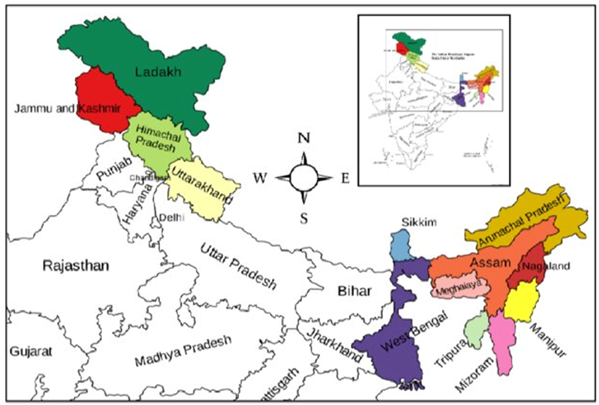
spread across 13 Indian States and Union Territories, UTs (e.g. Jammu and
Kashmir, and Ladakh), and the entirely enclosed states 9 (e.g. Himachal
Pradesh, Uttarakhand, Sikkim, Arunachal Pradesh, Nagaland, Manipur, Mizoram,
Tripura, and Meghalaya) as well as the Partially Covered two States, Assam only
the hill districts (Karbi Anglong and Dima Hasao) and West Bengal only the hill
district of Darjeeling and Kalimpong. It is to be known as the 'Water Tower of
Asia,' just because of a source of many rivers as well as feeding major river
systems such as the Indus, the Ganges, and the Brahmaputra rivers, which feed
hundreds of millions downstream. It contains one-third of the total Indian
forest cover.
|
Figure 1
|
|
Figure 1 The Indian
Himalayan Region (IHR), Highlighting Eleven States and Two Union Territories Source: Junaid et al. (2024) |
|
|
An estimated 370
million indigenous people, often known as "first" or
"original" people, live on about 20% of our world and have a strong
cultural and historical connection to their biodiversity Negi et al. (2023). Their diverse experience is with a tight
rein in cultural harmony and environment, ensuring sustainable management of
resources and environmental protection in a changing global environment Magni
(2017). The Convention on Biological Diversity
(CBD) defines the concept of traditional knowledge as the wisdom, creativity,
and practices of indigenous and local communities around the world that have
accumulated over years of practical experience and learning after trial and
error Gadgil
et al. (1993). Moreover, this information is transmitted
and further through the generations as a part of the cultural transmission, and
it symbolizes the mutual relationship that exists between individuals and their
environment. Traditional knowledge systems are hence critical to the lives of
millions of people Negi and Maikhuri (2013).
The native
communities have worked out locally related strategies to manage their fragile
ecologies and limited natural resources, including community forests, terracing
agriculture, and indigenous water collection. These strategies are flexible in
nature and reliant on an exceedingly descriptive interpretation of local
ecology, and most frequently, are embedded in spiritual traditions and cultural
norms that determine the human-environment interactions. The ecological balance
and subsistence livelihoods that were maintained through such Indigenous
Knowledge Systems have always been very significant in the Indian Himalayan
Region. Nevertheless, the contemporary rate of climatic change, technological
transformation, market evolution, and the active isolation of the indigenous
population in the sphere of mainstream decision-making are becoming an
escalating risk to the further survival of such knowledge systems. Despite the
fact that these mechanisms are highly applicable in the protection of
biodiversity and in helping to build resilience to climate change, the
indigenous ecological regimes are still on the margins of mainstream
development and policy approaches.
In this regard,
this work examines how the Himalayan Indigenous Knowledge Systems can be used
to develop sustainable development, especially when it comes to the traditional
agricultural systems, water management systems, and biodiversity conservation
plans. The research argues that there exists a necessity to merge the
indigenous ecological experience with the contemporary scientific approaches to
enhance the ecological resiliency and stand with the sustainability of the
Himalayan socio-ecological system.
Literature Review
Indigenous
Knowledge Systems (IKS) are receiving greater attention among people,
researchers, policy makers, etc. regarding their application to aid sustainable
development, particularly in the Indian Himalayan region. In this part, it is
going to be crucial for the reason that demonstrates the diversity and depth of
these time-honoured ancient ecological practices. These practices have been shown to be very
useful for sustainable agriculture practices, water management, and
biodiversity preservation. The following are some of the important works that
throw light on the significance of IKS in the Himalayan context.
Shruthi
et al. (2022)pointed out that there is a manner in which
the natives of Uttarakhand, in the Indian Himalayas, manage to keep their
livelihoods in eco-friendly ways. The authors accentuate the ancient practices
in agriculture, such as terrace agriculture, Kuls-intelligent water systems,
that have been supporting food security and a healthy environment since time
immemorial. They also demonstrate that these communities possess a
comprehensive knowledge of how to manage their ecosystems, which is very
important because the climate is becoming more erratic Shruthi
et al. (2022). O'Neill and others found that the
indigenous knowledge system is a refuge that safeguards the rich biodiversity
in the Eastern Himalayan region. Moreover, the researcher again sheds light on
the importance of local knowledge in safeguarding medicinal plants, water
sources, as well as ensure way to flourish forest ecosystems. It claims that,
particularly in the face of environmental degradation and deforestation
occurring on a large scale, such old traditions are the basic keys to creating
ecological resilience and enhancing sustainable development O'Neill et al. (2017).
Ingty's study,
which was grounded in Sikkim and Arunachal Pradesh, found that there were
improvements just because of residents' efforts; they developed resistance
against climate change through going deeper into age-old ecological practices
by using time-tested practices, such as agroforestry, crop rotation, and
livestock management. The authors propose to combine these traditional
practices with the modern strategies in order to come up with good results and
strengthen the local resilience mechanism Ingty
(2017). Sharma immerses himself in the numerous
agricultural lifestyles of the Western Himalayas, where local agricultural
practices such as organic farming and seed saving have increased the
biodiversity and ensured the soil remains healthy. Moreover, authors have
suggested the methods that are again time-tested and provide long-lasting
solutions to daily farming problems, particularly those that occur on a
macro-scale level in areas where water deficit and soil erosion occur Sharma
et al. (2023). Nagahama's work is more about the Van
Panchayats, i.e., community-managed forests in Uttarakhand. These ways the
community was preserving biodiversity and the forest over there. In her work,
the author figures out that indigenous folks understand how to utilise these
forest resources sustainably so that future generations can enjoy the same. For
the preservation of these strategies, it is important to acknowledge and
incorporate these time-tested activities in the mainstream framework Nagahama
et al. (2022). Joshi and his team visit the ancient
techniques of water management, which people have been using for centuries,
demonstrating how and in what way to manage water even in the rugged Himalayas.
They make forays into such examples as the Kul irrigation systems in Himachal
Pradesh and the system of Zabo in Nagaland. The authors also justify why these
old techniques matter today, when climate change exacerbates the existing water
issues Joshi et
al. (2023).
Subba
(2009) pointed out that the traditional knowledge
of the Limbu, Bhutia, and Lepcha communities in Sikkim and Bhutan is one of the
main pillars, i.e., working to develop some sort of resilience in the Eastern
Himalaya. These communities did a good job to ensure food security, especially
when the climate is unstable. They are paying much attention to
agro-biodiversity, i.e., the production of hardy crops such as buckwheat and
millet in place of industrial monocultures. In addition, community-based
management and seed sovereignty guarantee independence from the outside market
in times of environmental disturbance. He also finds that contemporary
adaptation policy should incorporate such a vernacular wisdom to deal with the
local vulnerabilities of the Himalayan ecosystem Subba
(2009).
According to Kumar et
al. (2021), the conventional cultivation techniques,
e.g., seed exchange and mixed cropping, have long been helping the communities
to deal with the climate-related issues, such as crop failures and low yield
during the erratic rains Kumar et
al. (2021). Singh et
al. (2017) re-examines the idea of sacred groves in the
Western Himalayas and examines how these special places are treasure troves of
biodiversity, which are preserved by the spiritual and cultural practices of
local people. The study emphasizes the fact that such groves not only help to
preserve the life of rare animals and plants, but also serve as one of the main
forces that make the ecological balance intact Singh et
al. (2017). With a focus on organic farming, insect
control, and soil fertility management, NITI Aayog examines the significance of
“traditional knowledge system” in sustainable agricultural practices in the
“Indian Himalayan Region” Aayog
(2018).
Ramakrishnan (2007) figures out that in IHR, the indigenous
knowledge system has a rich history, folks know how to manage forests in a
sustainable manner so that people can get benefits from not only timber
products but also from non-timber forest products and medicinal plants.
Furthermore, the authors also emphasize how crucial it is to incorporate these
traditional methods into official forest management systems in order to
increase sustainability and maintain the health of forests Ramakrishnan (2007). Jasmine et al.
(2012) pointed to the fact that it is not possible to make these
practices as mainstream practices without national efforts, strategies, and
programs. In doing so, the documentation
on different platforms, such as the Traditional Knowledge Digital Library
(TKDL) and the People's Biodiversity Registers (PBRs), as well as the
implementation of traditional knowledge throughout the country, is necessary Jasmine
et al. (2016).
The aims and
actions include integration at the national and regional level to improve
cross-border mediation, policy interpretation, and national cooperation. “The
Department of Ayurveda” under the “Ministry of Health and Family Welfare” made
a team with the CSIR from the Ministry of Science and Technology to launch the
“Traditional Knowledge Digital Library (TKDL)”(www.tkdl.res.in). This digital
library is a special project by the Government of India designed to (i)
safeguard traditional knowledge and (ii) stop its misuse by breaking down
language and format barriers, while also making this knowledge available to
patent examiners in five additional languages Jasmine
et al. (2016).
Methodology
The research
methodology that is utilized in this study is qualitative, interpretive
research based on an interdisciplinary lens of political ecology and
sustainability science to explore the application of Indigenous Knowledge
Systems (IKS) in sustainable ecological stewardship within the Indian Himalayan
Region (IHR). Owing to the context-specific, experiential, and culturally
embedded nature of indigenous knowledge, a qualitative method is most
appropriate to capture the complex community-environment interactions. This
research relies mainly on secondary sources of information—peer-reviewed
articles, ethnographic studies, policy papers, government publications, and
institutional reports on Himalayan ecology, indigenous practices, and
sustainable development—that have been systematically retrieved from Scopus,
Web of Science, JSTOR, and Google Scholar.
The discussion is
based on the case-based evidence that has been specifically chosen to cover
diverse ecological regions of Western, Central, and Eastern Himalayas and
concentrates on the traditional behavior in the realms of agriculture, water
management, and preservation of biodiversity. Thematic analysis was used to
analyse the data to develop common patterns in terms of ecological resilience,
resource governance, and knowledge transmission. Political ecology analytical
lens stimulated the critical review of power relations and policy
marginalisation, and sustainability science facilitated the review of adaptive
capacity and long-term ecological sustainability. The issue of ethics was
upheld by the fact that the indigenous knowledge was found in a respectful
manner. Despite the use of secondary sources, the methodology does offer a
sound structure through which the relevance of Himalayan indigenous wisdom in
the modern context can be understood.
Findings and Discussion
This study's
findings indicate the crucial significance of Indigenous Knowledge Systems
(IKS) in supporting sustainability, biodiversity protection, as well as climate
resilience in the IHR. The findings of the study are presented in this part
along with a discussion of their implications for sustainable development
through an examination of traditional ecological practices in agriculture,
water management, and biodiversity preservation.
Role of IKS in Biodiversity Conservation
Usually, each and
every village had notional areas of woods and alpine meadows, and resource
usage within these 'common lands' was determined by community’s consent.
Indigenous tribes have long practiced biodiversity conservation, especially in
developing nations. The knowledge of the use of Phyto-resources can be useful
in a significant way in preserving some species, including endangered species Negi et al. (2018). Due to its high dependence on natural
resources, the IHR is more predominant in the traditional knowledge systems and
practices. The local people in the region have a strong spiritual and cultural
heritage and have developed a symbiotic relationship with nature Vidyarthi
et al. (2013). The people in the area more or less rely on
traditional ecological knowledge as a means of sustaining and controlling the
forest resources to maintain ecological balance. The indigenous ways of
biodiversity conservation portray forests as sacred forests, holy forest
patches, or sacred groves. When a forest or a patch of forest is devoted to a
local deity, then, automatically, the biodiversity of the area is preserved Negi and Maikhuri (2013). There have been reports of about 5800 holy
groves in IHR, with 5000 of those being in Himachal Pradesh alone Sharma
and Kumar (2021).In the IHR, sacred groves and woods are home
to a variety of endangered, rare, and unique plant species in addition to
significant wildlife. A research conducted in Uttarakhand revealed that the
sacred groves and woodlands were home to rare, endangered, and endemic kinds of
medicinal plants (MPs) Negi et al. (2018). With 343 plant species—at least 50 of which
are medicinal—the Tark Eshwar holy Forest in Uttarakhand is among the greatest
examples of a holy forest. One of Uttarakhand's oldest sacred groves, Hariyali
Devi SG is renowned for its abundant floral and faunal variety; around 80 plant
species from 44 families are said to have significant economic significance Singh et
al. (2017).
|
Table 1 |
|
Table 1 Indigenous
Knowledge Systems and Biodiversity Conservation Practices in the Indian
Himalayan Region |
||||
|
Indigenous Practice |
Region/State |
Key Conservation Mechanism |
Biodiversity Outcomes |
Notable Sources |
|
Sacred Groves (Devta Ban /
Bugyal) |
Himachal Pradesh and
Uttarakhand |
Deity-led governance: Strict
taboos against felling green wood or wearing leather inside the grove. |
High carbon sequestration;
protection of Quercus (Oak) and Cedrus deodara (Deodar) stands. |
Negi
and Maikhuri (2013), Sharma
and Kumar (2021) |
|
Tarkeshwar Sacred Forest |
Pauri Garhwal, Uttarakhand |
Zonal protection: Total ban
on extraction within a defined radius of the temple. |
Home to 343 plant species;
crucial micro-watershed for local springs. |
Negi
et al. (2018) |
|
Zabo System |
Phek District, Nagaland |
Integrated resource
management: Combining Forest preservation, water harvesting, and organic
farming. |
Preservation of indigenous
paddy varieties and local fish species; soil erosion control. |
Singh
et al. (2018) |
|
Apatani Integrated Land Use |
Ziro Valley, Arunachal
Pradesh |
Community-enforced
agroforestry: High-efficiency nutrient cycling without chemical inputs. |
Conservation of Pinus
wallichiana and high-altitude bamboo; sanctuary for migratory birds. |
Sundriyal et al. (2002) |
|
Van Panchayats |
Uttarakhand |
Democratized forest
councils: Rules for lopping, grazing, and fire protection set by villagers. |
Stabilized forest cover;
recovery of non-timber forest products (NTFPs) like Rhododendron. |
Sati (2023) |
|
Monpa Sorig (Sowa Rigpa) |
Tawang, Arunachal Pradesh |
Amchi (Traditional
Medicine): Sustainable harvesting cycles for high-altitude herbs. |
Protection of Aconitum and
Picrorhiza kurroa (vulnerable medicinal herbs). |
Tsering et al. (2017) |
Over 40,000
hectares of natural forest land are covered by the holy groves in the five
northeastern Indian states of Arunachal Pradesh, Assam, Manipur, Meghalaya, and
Sikkim Upadhyay
et al. (2019). The use of forest resources for religious
purposes is permitted when people are in need. Hence, the conservation and
sustainable use of the forest ecosystem in Uttarakhand by means of sacred
forests and sacred groves are important, and it is aligned with the main
objectives of the Convention on Biological Diversity of 2021. Another form of
forest management that is equally important is Van Panchayats or community
forests, which play a significant role in maintaining the ecological balance,
biodiversity conservation, and reduction of poverty in Uttarakhand Germain
et al. (2018). To protect and manage the forest, there
must be councils; these councils will look after the harvesting of wood,
fodder, as well as Non-Timber Forest Products (NTFPs). This will help to use
forest resources in a responsible way Pande et
al. (2022). The Van Panchayats have been instrumental,
playing a great role in biodiversity conservation and preventing deforestation.
Indigenous societies in their area made unwritten laws that govern their
forest, which in turn get long-term benefits from the forest. Studies indicate
that over 500 million people are actively taking part in community-managed
forests Niraula
and Pokharel (2016).
Role of IKS in Water Harvesting and Management
In the Himalayas,
water is an essential resource for daily life and agriculture. The goal of
indigenous water management techniques is to harvest and distribute water
resources fairly among community members while making the best use of limited
supplies. The indigenous communities of Kumaon region in Uttarakhand have IK to
collect rainwater to use water throughout year for drinking and irrigation.
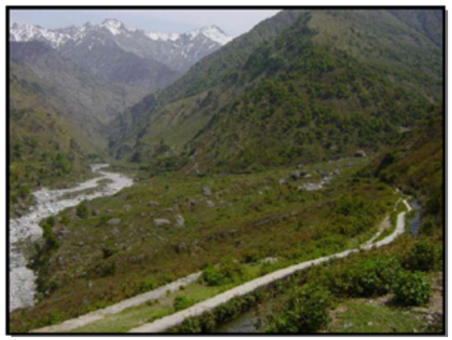
This approach gave rise to traditional water management practices. Guhls and
Kuls (Irrigation Canals): For generations, indigenous irrigation systems known
as Guhls or Kuls have diverted water from mountain streams to agricultural
areas in Himachal Pradesh and Uttarakhand Rawat
and Sah (2009). These locally constructed,
community-managed systems are intended to decrease soil erosion, cut down on
evaporation, and preserve water. Besides watering crops, guls also powered
Gharats—our local water mills—and provided drinking water. In some spots, we
first dam the stream’s flow to form the irrigation canal. For irrigating fields
using a Gul or Kul, we build a small dam called Baan in our local tongue, or
Kulayana in the Kumauni dialect.
|
Figure 2
|
|
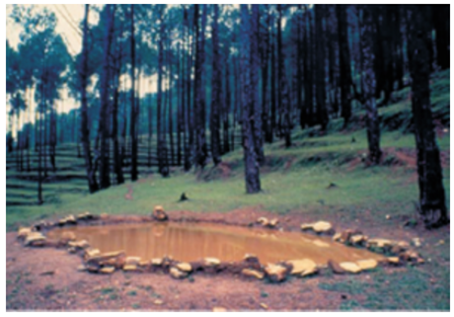
As for Khal, it’s all about gathering
rainwater in the big natural dips you find across the hills. They are often
found in the saddle between two crests on top of mountains Prasad
and Sharma (2019). Occasionally, little ponds are also
excavated to catch rainfall. Water that has collected in Khals is utilized for
irrigation during the lean time.
|
Figure 3
|
|
Figure 3 Indigenous
Rainwater Harvesting System Khals in the Himalayan Region Source: https://ecoheritage.cpreec.org/traditional-knowledge-of-water-management-in-kumaon-himalaya/ |
Jhora (Water
Channelling Systems): In
Sikkim and Darjeeling, indigenous water channelling systems called Jhora are
utilized to gather and store monsoon water for cultivation and drinking Bhatt et
al. (2024). These systems, which are frequently
maintained by the community as a whole, are essential in ensuring water supply
during times of drought. Dhara is a popular drinking water source that is found
in both valleys and mountain crests Bhandari
and Kaur (2023). Naula is meant to gather water from
underground springs. These springs have extremely delicate flows that can be
disrupted by water flowing via carved outlets from a spring or underground
source Sah (2023).
Dhaan: Water gathered from tiny and huge streams
gives the form of a lake. Irrigation and animal bathing are two uses for the
collected water Rawat
and Sah (2009). The IHR a home to several groups of people
that hold springs, lakes, and rivers in high regard. These bodies of water are
frequently protected by traditional conservation practices that limit excessive
usage or contamination. For instance, the Lepcha people in Sikkim preserve holy
lakes by enforcing customs and restricting the use of water Joshi et
al. (2023).
The Apatani Zaro
tribes in the lower Subansiri district of Arunachal Pradesh have a system that
gathers both surface water and groundwater to irrigate their fields Singh
(2023). The Apatani people make bamboo frames to
support earthen dams, about 0.6 meters tall, which split the valleys into neat
plots. Each plot features an exit on one side and an inlet on the opposite
side, with the inlet of a lower plot doubling as the exit for the one above it.
There are deeper channels linking these intake and output points by simply
opening or closing the inlets and outlets points whenever necessary; they can
flood the terraced plots with water or let it drain away from their plots. To capture
stream water, they build sturdy walls—2 to 4 meters high and 1 meter
thick—along the forested hillsides. From there, a network of channels carries
the water down to their fields.
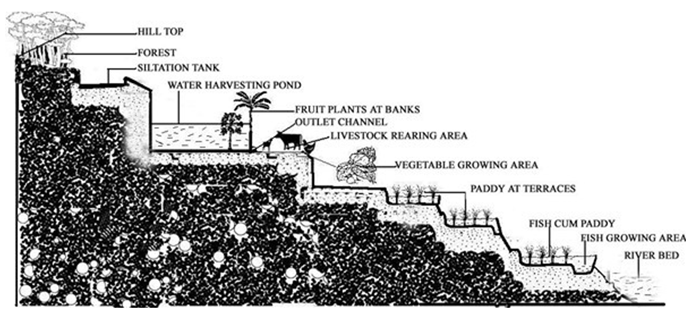
Zabo: The north-eastern Indian state of Nagaland
uses the Zabo method, which translates to "impounding run-off." Also
referred to as the Ruza system, it integrates agriculture, forestry, and animal
care with water conservation Negi et al. (2023).
|
Figure 4
|
|
Figure 4 Ruza: Indigenous
Rainwater Harvesting Practice in Nagaland Source: https://india.mongabay.com/2023/08/ruza-a-traditional-water-harvesting-system-for-the-water-scarce-mountains/ |
Cheo-ozihi: The Mazi River passes through the Angami
settlement of Kwigema in Nagaland Bhattacharya (2015). A very long canal carries river water
downstream, feeding into a network of smaller channels that branch off from it.
Bamboo pipes are often used to guide the water toward the terraces. One of
these channels is called Cheo-oziihi, which translates to "water."
Cheo, the person responsible for designing this 8–10 km waterway with its many
offshoots, oversaw its design Das et al. (2023). Numerous terraces in Kwigwema and a few
terraces in the nearby community are irrigated by this creek. The village water
budget is distributed among the three khels. Drip Irrigation with Bamboo: The
Meghalaya's Indigenous communities have an Indigenous Knowledge technique for
tapping stream and spring water by utilizing bamboo pipelines to irrigate farms
Kumar
and Madhukar (2019). To ensure the water resources in the IHR
remain sustainable, these time-honoured water management practices show a deep
understanding of the area's hydrology and climate.
Role of IKS in Sustainable Agricultural Practices
The Himalayan
people depend on agriculture as a source of their livelihood, and the
traditional methods of farming have been adapted to suit the varying heights,
slopes, and climates of the region. Traditional farming methods refer to the
earliest methods of farming that traditional farmers have been using for a long
period of time. These approaches are aimed at satisfying the current demands,
as well as keeping in mind the future generations. This is why the antique
agricultural experience of the indigenous people, namely seed keeping, is
highly essential to maintain the agricultural diversity in the region Maikhuri
et al. (2001). The knowledge related to biodiversity of
the indigenous people has a vital place in the regional food security, as shown
by the diversity of crops and landraces used in different IHR agricultural
systems Negi and Maikhuri (2013). Repeated crop rotation and mix cropping, to
utilize land to the optimum level and enhance the fertility of the soil, the
farmers of the Himalayas often grow numerous different crops, such as barley,
millet, pulses, and maize. The application of organic manure and the use of
crop rotation methods maintain the health of the soil and also help farmers to
decrease the use of chemical fertilizers Kumar et
al. (2023). The fact that the indigenous knowledge
system sustains agrodiversity is significant because of (i) Enhancing
productivity of each piece of land, (ii) enhancing soil health by incorporating
legumes, (iii) reducing the financial losses associated with the crop against
peststicide, fertiliser etc. (iv) improving yields per hectare, (v) expanding
food choices, and (vi) preventing soil erosion Semwal
and Maikhuri (2015).
|
Figure 5
|
|
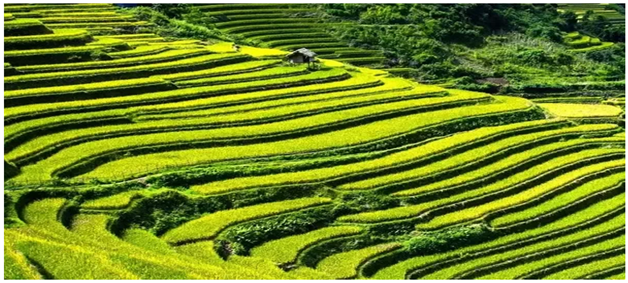
Figure 5 Terrace Farming as
an Indigenous Agricultural Practice in the Himalayas Source: https://timesofagriculture.in/terrace-farming-in-india-step-farming-india/ |
Within the Indian
Himalayan Region (IHR), there are high slopes and limited flat surfaces for the
same reasons, terrace farming is considered one of the best agricultural
practices over there Rathore
and Shashni (2023). Indigenous peoples have been doing terrace
farming for a long time, in this method, they establish tiers of fields on
steep slopes to prevent soil erosion and make sure that more land can be
cultivated. The terraces help to retain the water, avoid runoff, and create
microclimates that favor farming. The most common type of agricultural
practices in Meghalaya is the terrace farming with bamboo drip irrigation, and
Nagaland has the ZABO system as well as all-aldar-based farming Jeeva et
al. (2006).
|
Figure 6
|
|
Figure 6 Illustration of
Land Management in Zabo Farming System Source: Singh et al. (2012) |
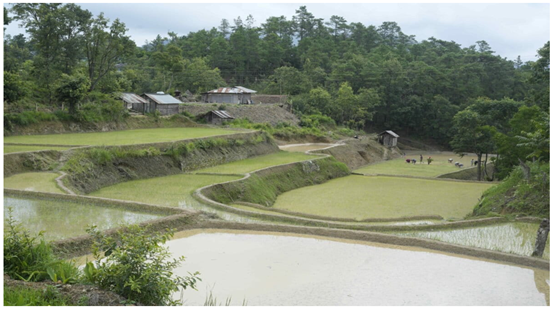
The Apatani people
practice an advanced agri-aquaculture system, which is typified by wet rice and
pisciculture, which is cultivated at elevated altitudes alongside the valley
landscapes (approximately 1600 m). The practice is based on the high level of
annual precipitation in the area of 1700 mm and is supported by a complicated
system of hydrological springs and streams Bhattacharya (2015). The Apatani keep the landscape very
productive and ecologically balanced by sustaining gentle slopes so as to
maximize water retention and nutritious flow Bhattacharya (2015).
|
Figure 7
|
|
Figure 7 Indigenous Apatani
Fish–Paddy Sustainable Farming Practice, Arunachal Pradesh Source: https://dics.co/current-affairs/arunachals-apatani-tribe |
Many of the
Indigenous communities in the Himalayas cultivate a wide variety of traditional
crops, which are more adapted to the local climate. Preserving such varieties
of crops can improve the agro-biodiversity of the region and also help people
cope with changing weather conditions Rajpurohit
and Jhang (2015). Forest litter is traditionally used as
bedding in cow barns, and a combination of litter and bovine excrement is used
as manure in agricultural fields Blume
and Leinweber (2004). Jhum is an agricultural method that is
practiced by tribal communities in some parts of the Eastern Himalayas, which
involves the rotation of crops across various parcels of land that enables soil
health to be rejuvenated when the areas are not under crop production Paul et al. (2017). In order to maintain the soil moisture and
retain the natural soil structure, farmers in certain regions apply zero or low
tillage to prevent the disruption of the soil, this ensures that the microbial
activity of the soil remains intact and decreases soil erosion Singh et
al. (2019). Himalayan farmers avoid the use of chemical
pesticides to protect their crops against pests and diseases; they have
alternatives that are made from natural products such as neem leaves, cow
urine, and other treatments based on plants Das et al. (2019). The farmers also use agricultural waste,
leaves, and plant remains as mulch to cover the soil. Mulching enhances
moisture retention and decreases the growth of weeds and supplies organic
material to the soil when it decomposes Singh et
al. (2019). The Himalayan indigenous agricultural
systems are very few, but very resilient and sustainable. They emphasize
considerably the need to have a balance between the conservation of natural
resources and the production of food.
Conclusion
The present rate
of development has inflicted irreversible damage to the Himalayan ecosystems,
which are no longer able to supply products and services for regional survival.
Moreover, modern usage patterns have brought forth a new way of life that transcends
numerous cultural and ethnic lines, most of which are exploitative in nature.
The mainstream of people, without their knowledge, has increased the rate of
homogeneity, and this has made our systems prone to abuse and eventual
degradation of the natural resources in the future. The indigenous knowledge,
which is grounded in cohabitation and communitarianism, has developed according
to the climate and natural environments.
This study has
demonstrated that far from being obsolete, IKS—such as the integrated rice-fish
agriculture of the Apatani, terrace farming, the sophisticated Zabo water
management systems, Gul or Kul for water harvesting in western Himalaya, Jhora,
water channelling systems in Sikkim and Darjeeling, and the community-led
biodiversity conservation within sacred groves, van panchayat of Uttarakhand,
and Monpa Sorig (Sowa Rigpa) from Tawang,
Arunachal Pradesh, and many more systems provide realistic, low-impact models
for sustainable environmental governance.
IKS shown great
character while coping with ecological degradation, but has still not been
given proper space in the mainstream, so that slowly-slowly breakingdown these
cultural frameworks that support them. Indigenous knowledge systems can play a
key role in global sustainability efforts, that's why these systems need to be
protected. When thinking about more affluent developmental paths, it means
there is a need for a transdisciplinary synthesis that paves the way for deep
collaboration between stakeholders, policymakers, and Indigenous
knowledge-practitioners, and such a synthesized approach is necessary to arrive
at truly effective environmental governance and sustainability.
REFERENCES
Aayog, N. (2018). Contributing to Sustainable Development in the Indian Himalayan Region. NITI Aayog.
Bhandari, S., and Kaur, H. (2023). Conservation Strategies for the Traditional Water Systems: A Case of Almora City, Uttarakhand. Journal of the Institution of Engineers (India): Series A, 104(4), 807–817. https://doi.org/10.1007/s40030-023-00759-0
Bhatt, H., Jugran, H. P., and Pandey, R. (2024). Cultural Ecosystem Services Nexus with Socio-Cultural Attributes and Traditional Ecological Knowledge for Managing Community Forests of Indian Western Himalaya. Ecological Indicators, 166, 112379. https://doi.org/10.1016/j.ecolind.2024.112379
Bhattacharya, S. (2015). Traditional Water Harvesting Structures and Sustainable Water Management in India: A Socio-Hydrological Review. International Letters of Natural Sciences, 37. https://doi.org/10.56431/p-a84p4z
Blume, H., and Leinweber, P. (2004). Plaggen Soils: Landscape History, Properties, and Classification. Journal of Plant Nutrition and Soil Science, 167(3), 319–327. https://doi.org/10.1002/jpln.200420905
Das, A., Gujre, N., Devi, R. J., Rangan, L., and Mitra, S. (2023). Traditional Ecological Knowledge Towards Natural Resource Management: Perspective and Challenges in North East India. In Sustainable Agriculture and the Environment (275–294). Elsevier. https://doi.org/10.1016/B978-0-323-90500-8.00019-1
Das, K., Sinha, T., and Prasad, S. N. (2019). Conservation of Plant Biodiversity Through Indigenous Knowledge in Rural Household: A Review. International Journal of Current Microbiology and Applied Sciences, 8(6), 1934–1943. https://doi.org/10.20546/ijcmas.2019.806.231
Gadgil, M., Berkes, F., and Folke, C. (1993). Indigenous Knowledge for Biodiversity Conservation. Ambio, 22, 151–156.
Germain, R., Ghosh, C., and Jayasuriya, M. (2018). Community Forestry in the State of Uttarakhand, India: Not Meeting the Needs of the Villagers. Small-Scale Forestry, 17, 225–242. https://doi.org/10.1007/s11842-017-9384-z
Ingty, T. (2017). High Mountain Communities and Climate Change: Adaptation, Traditional Ecological Knowledge, and Institutions. Climatic Change, 145(1), 41–55. https://doi.org/10.1007/s10584-017-2080-3
Jasmine,
B., Singh, Y., Onial, M., and Mathur, V. B. (2016). Traditional Knowledge Systems in India for
Biodiversity Conservation. [Journal information incomplete], 15(2).
Jeeva, S. R. D. N., Laloo, R. C., and Mishra, B. P. (2006). Traditional Agricultural Practices in Meghalaya, North East India. [Publication Details not Provided].
Joshi, M., Luitel, K., Barfal, S. S., Kuniyal, J., and Pande, K. (2023). Significance of Indigenous Knowledge Systems in Water Conservation and Management: A Study from Sikkim Himalaya. In Traditional Ecological Knowledge of Resource Management in Asia (159–174). Springer. https://doi.org/10.1007/978-3-031-16840-6_10
Junaid, D., Prajapati, V., Chauhan, R., Dhodi, K., and KC, J. (2024). Analysing Tourism Research in the Indian Himalayan Region to Identify Gaps and Propose Sustainable Development Strategies. Journal of Mountain Research, 19(1), 285–297. https://doi.org/10.51220/jmr.v19-i1.30
Kumar, A., and Madhukar, A. (2019). Management of Traditional Water System and Their Conservation in North Eastern Region Through Local Traditional Wisdom. AIP Conference Proceedings, 2142(1). https://doi.org/10.1063/1.5122648
Kumar,
A., Saha, S., Layek, J., Babu, S., Kumar, R., Choudhary, A. K., and Das, A.
(2023). Organic
Farming in Indian Himalayan Region: Innovations for Sustainability. Indian
Journal of Agronomy, 68, 36–51.
Kumar, P., Sharma, P. K., Kumar, P., Sharma, M., and Butail, N. P. (2021). Agricultural Sustainability in Indian Himalayan Region: Constraints and Potentials. Indian Journal of Ecology, 48(3), 649–661.
Magni, G. (2017). Indigenous Knowledge and Implications for the Sustainable Development Agenda. European Journal of Education, 52(4), 437–447. https://doi.org/10.1111/ejed.12238
Maikhuri, R., Rao, K., and Semwal, R. (2001). Changing Scenario of Himalayan Agroecosystems: Loss of Agrobiodiversity, an Indicator of Environmental Change in Central Himalaya, India. Environmentalist, 21, 23–39. https://doi.org/10.1023/A:1010638104135
Nagahama, K., Tachibana, S., and Rakwal, R. (2022). Critical Aspects of People's Participation in Community-Based Forest Management from the Case of Van Panchayat in Indian Himalaya. Forests, 13(10), 1667. https://doi.org/10.3390/f13101667
Negi, V. S., and Maikhuri, R. K. (2013). Socio-Ecological and Religious Perspective of Agrobiodiversity Conservation: Issues, Concern and Priority for Sustainable Agriculture, Central Himalaya. Journal of Agricultural and Environmental Ethics, 26, 491–512. https://doi.org/10.1007/s10806-012-9386-y
Negi, V. S., Kewlani, P., Pathak, R., Bhatt, D., Bhatt, I. D., Rawal, R. S., Sundriyal, R., and Nandi, S. (2018). Criteria and Indicators for Promoting Cultivation and Conservation of Medicinal and Aromatic Plants in Western Himalaya, India. Ecological Indicators, 93, 434–446. https://doi.org/10.1016/j.ecolind.2018.03.032
Negi, V. S., Pathak, R., Sekar, K. C., Rawal, R., Bhatt, I., Nandi, S., and Dhyani, P. (2018). Traditional Knowledge and Biodiversity Conservation: A Case Study from Byans Valley in Kailash Sacred Landscape, India. Journal of Environmental Planning and Management, 61(10), 1722–1743. https://doi.org/10.1080/09640568.2017.1371006
Negi, V. S., Pathak, R., Thakur, S., Joshi, R. K., Bhatt, I. D., and Rawal, R. S. (2023). Scoping the Need of Mainstreaming Indigenous Knowledge for Sustainable use of Bioresources in the Indian Himalayan Region. Environmental Management, 72(1), 135–146. https://doi.org/10.1007/s00267-021-01510-w
Niraula, R. R., and Pokharel, B. K. (2016). Community Forest Management as Climate Change Adaptation Measure in Nepal's Himalaya. In Climate Change Adaptation Strategies—An Upstream-Downstream Perspective (101–120). Springer. https://doi.org/10.1007/978-3-319-40773-9_6
O'Neill, A. R., Badola, H. K., Dhyani, P. P., and Rana, S. K. (2017). Integrating Ethnobiological Knowledge into Biodiversity Conservation in the Eastern Himalayas. Journal of Ethnobiology and Ethnomedicine, 13, 1–14. https://doi.org/10.1186/s13002-017-0148-9
Pande,
S., Pande, D., and Pande, I. D. (2022). Van Panchayats of Uttarakhand as Role Model
for Community Forest Management. [Publication Details Not Provided].
Paul, S., Tripathi, A., Burman, R. R., Panggam, M., Ray, S., Kalita, N., Vanlalduati, R., and Singh, A. (2017). Jhum Cultivation and its Consequences on Forest and Environment in Eastern Himalayan Tract of India: A Participatory Assessment. Range Management and Agroforestry, 38(1), 121–126.
Prasad, C., and Sharma, R. (2019). Water Resources and Their Traditional Management in Kedarnath Valley of Garhwal Himalaya, India. International Journal of Hydrology, 3, 194–203. https://doi.org/10.15406/ijh.2019.03.00180
Rajpurohit, D., and Jhang, T. (2015). In Situ and Ex Situ Conservation of Plant Genetic Resources and Traditional Knowledge. In Plant Genetic Resources and Traditional Knowledge for Food Security (137–162). Springer. https://doi.org/10.1007/978-981-10-0060-7_8
Ramakrishnan, P. (2007). Traditional Forest Knowledge and Sustainable Forestry: A North-East India Perspective. Forest Ecology and Management, 249(1–2), 91–99. https://doi.org/10.1016/j.foreco.2007.04.001
Rathore, S., and Shashni, S. (2023). Indigenous Knowledge System and Livelihood Option of Natives of Lahaul and Spiti District, Himachal Pradesh. In Climate Change Adaptation, Risk Management and Sustainable Practices in the Himalaya (213–235). Springer. https://doi.org/10.1007/978-3-031-24659-3_10
Rawat, A. S., and Sah, R. (2009). Traditional Knowledge of Water Management in Kumaon Himalaya. [Publication Details Not Provided].
Sah, R. (2023). Indigenous Water Knowledge: Religious Values and Cultural Practices. In Indigenous and Local Water Knowledge, Values and Practices (97–117). Springer. https://doi.org/10.1007/978-981-19-9406-7_7
Sati, V. P. (2023). Sustainable Forest Management in the Himalaya. Springer. https://doi.org/10.1007/978-3-031-21936-8
Semwal, R., and Maikhuri, R. (2015). Valuing Traditional Agrobiodiversity for Sustainable Development in Uttarakhand. In Ecosystem Services and its Mainstreaming in Development Planning Process (92–114). [Publisher Not Provided].
Sharma, A., Shashni, S., and Rathore, S. (2023). Traditional Knowledge System for Sustainable Agriculture Practices of Rural Communities of North-Western Himalaya, India. In Traditional Ecological Knowledge of Resource Management in Asia (191–210). Springer. https://doi.org/10.1007/978-3-031-16840-6_12
Sharma, S., and Kumar, R. (2021). Sacred Groves of India: Repositories of a Rich Heritage and Tools for Biodiversity Conservation. Journal of Forestry Research, 32(3), 899–916. https://doi.org/10.1007/s11676-020-01183-x
Shruthi Gopirajan, A. T., Kumar, P., and Joshi, P. K. (2022). Unraveling the Complex and Dynamic Himalayan Socio-Ecological Systems: A Systematic Review. Environment, Development and Sustainability, 24(2), 1532–1559. https://doi.org/10.1007/s10668-021-01527-5
Singh, N. C. (2023). Sustainable Natural Resource Management Through Traditional Ecological Knowledge: A Perspective on the Role of Apatani Tribal Women, Arunachal Pradesh. In Traditional Ecological Knowledge of Resource Management in Asia (239–259). Springer. https://doi.org/10.1007/978-3-031-16840-6_14
Singh, R. J., Deshwal, J., Sharma, N., Ghosh, B., and Bhattacharyya, R. (2019). Effects of Conservation Tillage Based Agro-Geo-Textiles on Resource Conservation in Sloping Croplands of Indian Himalayan Region. Soil and Tillage Research, 191, 37–47. https://doi.org/10.1016/j.still.2019.03.012
Singh,
R. K., Hannah, K., Asangla, A., Bharali, R., and Borkotoky, D. (2018). Zabo: A Time-Tested Integrated
Farming System Practiced by Chakhesang Tribe of Nagaland. Indian Journal of
Hill Farming, 31(1).
Singh, R. K., Singh, V., Rajkhowa, C., and Deka, B. C. (2012). Zabo: A Traditional Way of Integrated Farming. In B. C. Deka et al. (Eds.), Resilient Shifting Cultivation: Challenges and Opportunities (114–117). [Publisher not Provided].
Singh, S., Youssouf, M., Malik, Z. A., and Bussmann, R. W. (2017). Sacred Groves: Myths, Beliefs, and Biodiversity Conservation—A Case Study from Western Himalaya, India. International Journal of Ecology, 2017, Article 3828609. https://doi.org/10.1155/2017/3828609
Subba, J. (2009). Ingenious Agricultural Heritage Systems and Sustainable Agricultural Ecosystems Management in Sikkim. In Bio-Cultural Diversity and Sustainable Development in North East India: Status, Vision and Challenges (86). [Publisher not provided].
Sundriyal, R. C., Upreti, T. C., and Varuni, R. (2002). Bamboo and Cane Resource Utilization and Conservation in the Apatani Plateau, Arunachal Pradesh, India: Implications for Management. Journal of Bamboo and Rattan, 1(3), 205–246. https://doi.org/10.1163/156915902760184277
Tsering, J., Gogoi, B. J., Hui, P. K., Tam, N., and Tag, H. (2017). Ethnobotanical Appraisal on Wild Edible Plants used by the Monpa Community of Arunachal Pradesh. Indian Journal of Traditional Knowledge, 16(4), 626–637.
Upadhyay, K. K., Japang, B., Singh, N. S., and Tripathi, S. (2019). Status and Socio-Ecological Dimensions of Sacred Groves in Northeast India. Journal of Applied and Natural Science, 11(3), 590–595. https://doi.org/10.31018/jans.v11i3.2121
Vidyarthi, S., Samant, S. S., and Sharma, P. (2013). Traditional and Indigenous uses of Medicinal Plants by Local Residents in Himachal Pradesh, North Western Himalaya, India. International Journal of Biodiversity Science, Ecosystem Services and Management, 9(3), 185–200. https://doi.org/10.1080/21513732.2013.823113
 This work is licensed under a: Creative Commons Attribution 4.0 International License
© Granthaalayah 2014-2026. All Rights Reserved.