Original
Article
An artist of upcycled creation: Manveer Singh Gautam
|
Dr. Adesh Kheriwal 1* 1 Freelance writer, India |
|
|
|
ABSTRACT |
||
|
Indian contemporary art is engaging with social, scientific, ideological, religious, and eugenic forces. Basically contemporary young artists are increasingly using this approach. This research paper is presenting a case study on Delhi based artist Manveer Singh Gautam. This case study shows the creative appearance of making trash to treasure. Manveer’s artworks are made from discarded pieces of plastic collected from over four hundred homes in Delhi. Through this case study, we have made a dedicated effort to understand Manveer’s artworks and his themes, with the aim of highlighting the social message conveyed by his artworks and the scientific perspectives embedded in them, which can improve the environment. This research paper expresses social awareness, creative methodology of making and desire to convert waste to valuable articles. Manveer's artworks primarily utilize discarded pieces of polythene, beer bottles, and other waste materials. The aim of these creations is to transform unsightly plastic waste into beautiful and attractive scenes of nature. He collects beer bottles from hilly areas, where people often carelessly litter and damage the natural beauty, and incorporates them into his artwork to raise awareness about environmental pollution and its harmful effects. Manveer's artworks primarily utilize discarded pieces of polythene, beer bottles, and other waste materials. The aim of these creations is to transform natural landscapes by removing plastic waste and presenting beautiful and captivating scenes. He collects beer bottles from areas where people have carelessly littered, thus preventing further environmental damage, and incorporates them into his artwork. The artist has also expressed his true identity through his creations. Manveer's works have been exhibited in several countries, with pieces like "Eco Warrior in Search of Food," "Beercity," and "Nature Covered by Plastic" are masterpieces of art. Their works convey strong and empowering messages to society and promote a scientific temperament, and the goal of this research paper is to bring these contributions to a global level. Keywords: Manveer Singh Gautam, Trash, Waste,
Contemporary Art, Environment, Plastic |
||
INTRODUCTION
Evidence of the
development of art is found alongside the continuous evolution of humankind.
Europe and American continent witnessed various art movements, including the
Renaissance, Baroque, Rococo, Neoclassicism, Romanticism, Realism,
Impressionism, Cubism, Fauvism, Expressionism, Futurism, Dadaism, Surrealism,
and many other art movements. In the history of world art, mostly limited and
traditional mediums have been used, but in Europe, this barrier was broken by
the Dadaist artist Marcel Duchamp. He began to use objects as they were, rather
than relying on specific mediums, which gave modern art a new perspective. In
the changes observed in the art of several generations, we see the origins of
environmental art. In the 1960s and 70s, artists like Robert Smithson, and
after the 1990s, Benjamin Von Wong, Agnes Denes, Andy Goldsworthy, Olafur
Eliasson, and others presented the beauty of environmental art to the world.
However, this was not enough. Artists from various countries such as Gilbert
Calderon Angeles, Wim Delvoye, Jean Shin, Tom Deininger, HA Schult, and Steven
Rodrig successfully attempted to transform waste into works of art. Among
these, German artist Ha Schult is very famous for creating artworks from waste
and garbage. The book “Trash People” Sim (2014) provides detailed information about Schult's
works. The globalization of art has led to the rise of numerous ideologies and
art styles in Indian contemporary art. India has countless artists whose
experimental work is a source of inspiration for artists worldwide. The concept
of new media art holds special importance in the minds of contemporary young
artists, the foundation which was laid by renowned artists like Vivan Sundaram,
Subodh Gupta, Jitish Kallat,
Vibha Galhotra, Jayshree Bhattacharya, Bharti Kher, Hema Upadhyay, Sarika
Bajaj, Shilpa Gupta, Jagannath Panda, Shantamani Muddaiah, Atul Dodiya, Atul
Bhalla, Vishwanath Mallabadi Davangere, and Mudasir
Rashid. As a result, we see countless talented young Indian contemporary new
media artists like Girjesh Kumar Singh, Santhamani Muthaiya, Birendra Yadav,
Manveer Singh Gautam, and Madhukar Mucharla. All
these young artists have their own unique style and medium, and Manveer Singh
Gautam holds a special place among them; because Manveer works on both the problem
and the solution through his artworks. Manveer primarily highlights issues
related to environmental improvement. Due to his connection to rural areas, he
has a deep connection with nature. Therefore, his artworks often incorporate
waste collected from various naturally beautiful places in India. Beer City, ye
tera ghar ye mera ghar, Eco Warriors, Hanifa Valley, Urban Land, etc., are
beautiful examples of their artistic style. Manveer Singh's works have been
exhibited both in India and abroad. His creations reflect an unwavering
curiosity about profound questions of human consciousness. His artwork clearly
demonstrates an attempt to broaden the narrow confines of human intellect.
Manveer identifies himself as an artist influenced by social activism and the Ambedkarite social reform ideology. He is currently working
on several new art pieces in his studio in Chhatarpur, Delhi.
|
Figure 1
|
|
Figure 1 Kho Jaye Kahi, MLP
and Other Waste Material, Artist- Manveer Singh Gautam, Image Source- Artist |
|
Figure 2
|
|
Figure 2 Lag Ja Gale, MLP
and Other Waste Material Artist- Manveer Singh Gautam, Source- Artist |
A
study on Early life and art education
Manveer Singh was born on June 17, 1993, into a farming family in Haridwar. After his father, Babu Ram, secured a government job in Rewari, the entire family moved to Rewari, Haryana, where Manveer received his early education. In his childhood, Manveer began showing signs of disability in both his legs. He says, “The problems with my legs started in childhood due to a doctor's negligence. I had a high fever, and a general practitioner gave me an overdose of an injection, which caused me to lose the ability to walk or stand. There might have been other reasons, but that's what I was told. After that, I was taken to a traditional healer who applied some medicine to both my legs and bandaged them, advising me to keep them away from water. However, one of my legs got wet, resulting in a permanent disability in that leg, which was a very painful moment for me.” Due to his interest in art, Manveer enrolled in the prestigious Lalit Kala Mahavidyalaya (College of Art) in Delhi, where he received art education under the guidance of renowned art guru Abhimanyu. Contemporary young artist Birendra Yadav was also studying there at the time. Manveer's early works predominantly feature acrylic paints, but these paintings display an extraordinary beauty in their various shades of color. This magnificent use of color attracted him to the idea of incorporating non-recyclable polythene into his artwork. This marked the beginning of his journey as an environmentalist artist, which led to him being known as "The Plasticwala." Gautam (2021)
|
Figure 3
|
|
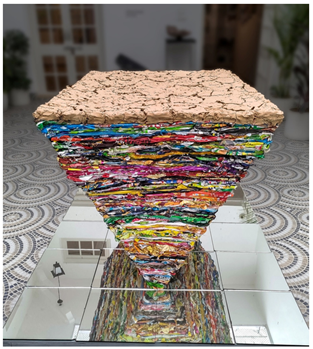
Figure 3 Hanifa Velley,
MLP, 1500 Pet Bottels, Desert Sand, Used Clothes, Fevicol, Plyboard. Artist- Manveer Singh Gautam, Image
Source-Artist |
Objective
and approach behind the artworks
Manveer has been a
music lover and an environmental enthusiast since childhood. He loves peaceful
environments where he can enjoy the melodious sound of the flute. The flute
helps in concentrating the mind. Most artists prefer to play the flute with
their eyes closed, amidst the sound of flowing water by the banks of a river.
However, these riverbanks no longer offer a peaceful environment; instead, they
are littered with plastic wrappers, beer cans, and broken bottle pieces.
Manveer's artworks exhibit three fundamental elements: emotion, devotion, and
revolution. Emotion reflects the artist's personal feelings, devotion expresses
his dedication to nature, and revolution points towards improving the habits of
the people of India. Manveer primarily uses multi-layered plastic, which is
non-recyclable and single-use plastic, in his creations. Through his artwork,
he is not only protecting nature from the harm caused by these materials but
also creating incredibly beautiful pieces. They have connected with over four
hundred families through this initiative. These families collect MLP
(multi-layer plastic) waste in transparent boxes at their homes, which Manveer
calls "Habit Changer Box." Karelia
(2021) These boxes are then brought to the studio,
where the contents are sorted according to priority. The plastic pieces are then used to create
artworks as needed. Manveer strives to express his creations in a logical and
sensitive manner. Manveer collects non-recyclable plastics that nobody uses by
going door-to-door. A complete monthly record of this plastic is also
maintained, which includes data on the plastic usage of each family, showing
how much plastic each family used in a given month. This makes it easy to
understand how many kilograms of plastic each family uses in a month. Naturally, this will increase awareness among
these households about reducing plastic consumption, thus initiating a new
process of change in society. This process of social reform has never been seen
before. From this plastic, Manveer creates sculptures of wild animals such as
leopards, giraffes, tigers, bears, and vultures, which play a role in balancing
the ecosystem. Manveer's work underwent a significant transformation primarily
through his collaboration with the renowned contemporary artist Vibha
Galhotra. Previously, his work mostly
consisted of traditional oil and acrylic paintings. Manveer assisted Vibha for
approximately four years, during which time his artistic vision and techniques
evolved considerably. Vibha Galhotra is currently involved in projects related
to environmental conservation. Kheriwal and Gurcharan (2022)Today, there are
numerous artists who give special importance to issues like environmental
protection, and Manveer is one of them. He said, “Being a devout lover of
nature, I illustrated the serene beauty of nature in my paintings. However, I
realized that I had been only depicting nature in my paintings. My effortsdidn’t materialize into anything that actually
helped the environment heals from the effects of our environment destruction.
So, in order to make an impact full effort and enliven my ideology, I decided
to use plastic itself to create artworks and in past seven years more than
three Metric ton MLP and one Metric PET ton plastics I have been up cycled into
artworks. Now in Delhi we are collecting plastic from more than 400 houses on
regular basis.” Singh
(2023)
|
Figure 4
|
|
Figure 4 Tandav, Acrylic on
Canvas, Artist- Manveer Singh Gautam, Image Source- Artist |
|
Figure 5
|
|
Figure 5 Unity, MLP
Wrappers, Plywood, Iron Net, Staple Pin, Nails, Artist- Manveer Singh Gautam,
Image Source- Artist |
Process
and technique
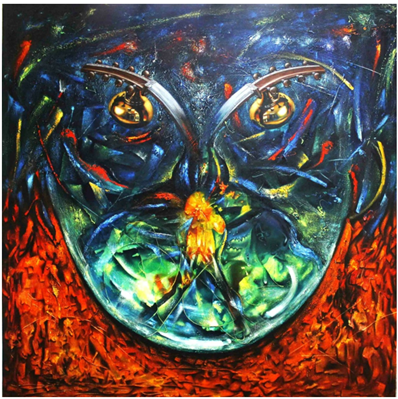
Manveer's creations begin with colorful acrylic paintings and abstract forms, including artworks such as Tandav, Hop, The Golden River, and The Wind over Ocean. A shift in his medium is evident from 2018 onwards, when Manveer began incorporating MLP (multi-layered plastic) into his artwork. His initial works primarily feature landscapes. In these paintings, single-use plastics are separated by color and then applied to the canvas according to the scene – blue for the sky, brown for the earth, green for the grass, white for the snow, and other specific colors for various elements. Regarding this process, he says, “I remove plastic from nature's landscapes and incorporate it into my own landscapes so that the natural landscape can regain its true beauty.” Sarkar (2025)Following this, Manveer collected plastic from various locations and created sculptures from it at those same sites, generating awareness in those areas. These sculptures include representations of leopards, eco-warriors, Bengal tigers, and turtles, which fundamentally depict the life cycle of nature.
|
Figure 6
|
|
Figure 6 Plastic Water
Drain, MLP, Fiber Pipe, Plastic, Artist- Manveer Singh Gautam, Image Source-
Artist |
Major
artworks that have been exhibited in India and other countries
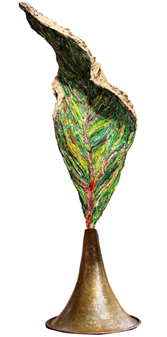
All of contemporary artist Manveer Singh's artworks are inspired by logical and sensitive issues, initially reflecting rural influences, domestic animals, and nature, and later pointing towards social change. During journey of the Himalayas 2024 he creatively depicted the region's rare flora and fauna. In this series, the artist has created a set of five sculptures depicting three endangered species from South Asia. Their titles are whimsical snippets from popular film songs, since the artist felt that one gets to see these species only in the “reel” world of social media these days, rather than in real life. One is ‘Lag ja gale: Himalayan brown bear’ Figure 7 The Himalayan Brown Bear is visible here in a hugging posture, resembling the natural scenario where it hugs the tree thus. The figure has a violent red scar running across its chest, with plastic flowing out of it. Second is ‘Ye Tera Ghar Ye Mera Ghar: Snow leopard Sculpture’ Snow Leopard, made of fishing nets, with plastic waste inside its body. This figure stands atop a pedestal resembling a piece of earth, with barren, infertile earth having plastic waste buried underneath. The deceiving glitter of the plastic should remind one of the fleeting deceits of luxury, afforded at the long-lasting cost of environmental destruction. This piece alludes to the condition of this mountain-dwelling leopard today: erstwhile majestic, now reduced to migrant wanderers roaming around in semi-urban areas after losing its natural habitat to rampant deforestation and the third is ‘Kho Na Jaye Ye , 3 Golden Langur Sculpture’ Figure 8 he Pictured a Golden Langur, currently located solely in the regions of Assam and Bhutan. This species was identified fewer than a hundred years ago, but is currently threatened. The body is composed of discarded items such as ghost nests, egg cartons, MLP wrappers, etc. The face is made from repurposed tires—an urban resource representing roads created by deforesting areas, thus highlighting the human-caused disruption in the harmonious bond between wildlife and the environment. Due to the human-like appearance of these monkeys' eyes, Manveer crafted them from glass, allowing viewers to see their own eye reflections within them. The title hints at the present condition of this species while also suggesting being adrift in someone else’s gaze. If we talk about some work which has created in other countries we will start from Africa in 2023. He depicted In Togo, West Africa; the “In Search of Food” installation has highlighted the long-term decline in the zebra population in Africa. Here, Manveer has addressed the serious issues of zebras migrating towards urban areas due to the decreasing availability of greenery and trees. This work is currently on display in a garden in Togo. In 2022 he visited Riyadh Saudi Arabia where he created Hanifa Velley Figure 9. The artwork is about landscape transformation, how plastic replaces the nature, plastic reach everywhere from the top of Everest to depth of ocean. So this time to grab the attention of locals in the Jax Art Festival , Saudi Arabia he brought a piece of desert from history the Hanifa Valley to show that even desert is no more untouched by plastic too. The belly of our motherland is filled by plastic. Karelia (2021)Many layers have been building up under the sand, so this is 21st century layer we added in earth’s layer that is Plastic. The crack in land is about pain of nature through pollution. He tries to narrate the story with found images and text on wrappers. The two eyes in image are of young generation who raise a question to us, that is what we left for them, a destroyed Planet. He did several projects including government and private. Among these project Bhuvneshwar development authority and Bhuvneshwar smart city ltd organize an art camp at golden beach where he created large size installation named ‘Unity Figure 11.’ In this project he did one day site specific public art installation of fifteen feet collage of 250 small large Olive Ridley sea turtle sculpture out of plastic at Puri beach to raise awareness about the negative impacts of plastic waste on the environment, particularly the sea and aquatic life. He used plastic wrappers, wood, fishnet, staple pins, and an iron nail. Odisha has a special link with the Olive Ridley sea turtles and its long coast is famous across the globe for many mass nesting sites. However, with the plastic level rising in the sea water day-by-day, his work at Puri beach showed the tragedy which is likely to happen as the baby turtles might not feel safe to go to the sea once they hatch. His work is giving a loud message to make people aware of the pollution being originate could play our tiny roles to contain it. He has used the mythical symbolism of Olive Ridley as it’s conned from plastics and how vacation with Odisha’s coast line is well recognized. Sahu (2021)
|
Figure 7
|
|
Figure 7 Sare Jahan Mein
Shor Hai Dharti Ant Ki Aur Hai, MLP, Clay, Copper, Artist- Manveer Singh Gautam,Image Source- Artist |
In addition to
these works, Sare jahan mein
shor hai dharti ant ki aur hai Figure 12, knowledge gives you wings, flying
carpet, Busherhri topi
(Rain shelter), Tiger family, Snow leopard, Delhi darshan, Seascape, Injured
Earth, Nature covered by plastic Vol-1 and 2, beer tree, Landscape in plastic,
Plastic water drain, Futuristic Earth core Figure
13, High hope and much more. These all art
works are made by Multi-Layer-Plastic (Non- recyclable- Plastic). He has also
experimented in acrylic colours as we can see in the artworks, Sunrise at Rumbak, chanchal mann during lockdown, Buffalo, B-fall, Hope, Modern
relation, Raas leela, The golden river and Tandav Figure 14 etc.
RESEARCH METHODOLOGY
Writing any
research paper requires following a specific process, but this research paper
attempts to understand the subject through a qualitative case study, utilizing
interviews, documentation, literature reviews, observation, ethical
considerations, and data analysis methods which provide a collective and
calculated process to understand artworks along with the artist.
LITERATURE REVIEW
The research paper
draws upon interviews, newspaper articles, online articles, YouTube podcasts, catalogs, portfolios, interviews with the DW news agency,
and other sources. Articles such as
"Art with a Heart: Manveer Singh B Debi Prasad Sahu," "Artists
in NCR Rise to Confront Climate Emergency" by Tanisha Saxena, and
"Delhi Artist Diverts 250 kg of Plastic from Landfills: Turns Waste into
Stunning Art" were studied in detail.
Discussions with the artist and other online discussions were also analyzed.
AIM AND OBJECTIVE
The objective of
this research paper is to present the growing environmental awareness among
contemporary young artists, their creative use of media, logical intelligence,
and emotional expression of themes, representation of Indian civic sense, and
the transformation of waste into beautiful works of art.
FINDINGS
During the
research paper writing and study, we found that the artist has raised awareness
among Indian citizens about the proper use of MLP (Multi-Layered Plastic).
Previously, the subject of MLP was unknown to many, but this research paper has
created awareness about the correct use of plastic. The artist's works reflect
a combination of the principles of Dr. Ambedkar and Mahatma Gandhi.
|
Figure 8
|
|
Figure 8 Futuristic Earth
Core, MLP, Clay, Glass, Artist- Manveer Singh Gautam, Image Source- Artist |
CONCLUSION
Environmental
protection should be a fundamental part of the functioning of citizens and
governments in every country today. Many
environmentalists, scientists, social reformers, philosophers, and artists,
from the past to the present, have worked towards this goal, achieving success
while also facing numerous challenges. Manveer's works presents a revolutionary
approach to environmental protection. As a result, approximately 400 families
have shown a change in their behavior and a reduction
in plastic consumption. This is not merely a written account but a verifiable
reality. Manveer's efforts have contributed to solving a major problem in
India. While this may not be comparable to the technology used in Finland, a
country that generates electricity from waste, it is a beginning. Many young
artists are now working in this field, giving a new direction to awareness
regarding environmental pollution and plastic use in the future.
REFERENCES
Gautam, M. S. (2021, December 19). Manveer Singh Plasticvalla [Video]. YouTube.
Karelia, G. (2021, June 5). Delhi Artist Diverts 250 kg of Plastic From Landfills; Turns Waste into Stunning Art. The Better India.
Kheriwal,
A., and Gurcharan, S. (2022). Interpreting the Profound Portrayal of Nature in the Works of Artist
Vibha Galhotra. ShodhKosh: Journal of Visual and Performing Arts, 3(1),
2775–292. https://doi.org/10.29121/shodhkosh.v3.i1.2022.106
Sahu, P. D. (2021, December 16). Art With a Heart: Manveer Singh. My City Links.
Sarkar, A. (2025, June 4). Paiwand Studio and Plasticvalla: The Art of Fashioning Waste. The Voice of Fashion.
Sim, D. (2014, April 2). Load of Rubbish: Eco-Artist HA Schult’s “Trash People” Sculptures. International Business Times.
Singh, M. (2023, June 5). World Environment Day: Delhiites Swear by the 3Rs to Beat Plastic Pollution. Hindustan Times.
 This work is licensed under a: Creative Commons Attribution 4.0 International License
© Granthaalayah 2014-2026. All Rights Reserved.