Original Article
EVALUATION OF VITAMIN-C AND SPIRULINA (ARTHROSPIRA PLATENSIS) SUPPELENTATION DIET ON GROWTH PERFORMANCE, ANTI-OXIDANTS AND CARCASS COMPOSITION OF ROHU, LABEO ROHITA (HAMILTON, 1822)
|
Ranjana Damle
1, Manoj Singh 1*, Jham Lal 2, Dushyant Kumar Damle 2 1 Department of Zoology,
Kalinga University, Naya Raipur, Chhattisgarh-492101, India 2 Late Shri Punaram
Nishad College of Fisheries, Dau Shri Vasudev Chandrakar Kamdhenu
Vishwavidyalaya, Durg, Chhattisgarh-491995, India |
|
|
|
ABSTRACT |
||
|
An experiment was conducted for 60 days to evaluate the growth performance, anti-oxidants and carcass composition of rohu, Labeo rohita, under different dietary treatments. The study comprised fourtreatments with three replicates each, along with a control group. This study prepared 4 experimental feeds, which included Control (0), T1 (10 g), T2 (15 g) and T3 (20 g) of spirulina powder-containing diet. The proximate composition of vitamin-C enriched spirulina included crude protein (57.63 ± 0.66%), lipid (8.24 ± 0.35%), moisture (7.27 ± 0.30%), ash (10.20 ± 0.15%), and Nitrogen-Free Extract (NFE) (16.65 ± 0.57%) was observed. The nutritional profile of experimental diets was observed, such as crude protein (30.36-30.73%), lipids (5.17-5.57%), moisture (8.26-8.64%), ash (15.17-15.87%), crude fibre (9.92-11.27%), and nitrogen-free extract (27.92-30.73%). The highest growth performance such as length gain (9.26±0.057), weight gain (12.80±0.10), percentage weight gain (304.76±2.38), specific growth rate (0.67±0.002), protein efficiency ratio (2.43±0.014), hepatosomatic index (0.039±0.001), and intestinal somatic index (0.48±0.005) were observed in T3, whereas the highest feed conversion ratio (1.67±0.028) was in the control group compared to the other treatment groups. The highest anti-oxidant activities including catalase(256.34±1.98), glutathione s-transferases (176.64±0.31) and superoxide dismutase (45.37±0.80) was observed in T3 compared to the other treatment groups. The highest carcass composition was observed such as crude protein (16.64±0.049), crude lipid (6.35±0.036), moisture (70.46±0.088), ash (2.64±0.041), and NFE (6.50±0.14) compared to the other treatment groups. The acceptable range of water quality parameterswas observed during the experiment.The results suggest that the specific dietary T3 group enhanced the overall growth, anti-oxidantsand carcass composition of L. rohita. Keywords: Labeo Rohita, Spirulina, Growth Performance, Anti-oxidants, Carcass Composition, Water Quality |
||
INTRODUCTION
Aquaculture, the farming of aquatic organisms, has become
a crucial sector for meeting global seafood demand and ensuring sustainable
food production. The industry has seen significant growth and transformation
over recent years, driven by technological advancements, changing consumer
preferences, and environmental considerations. The global aquaculture market
was valued at approximately $204 billion in 2020 and is projected to reach $262
billion by 2026, reflecting a compound annual growth rate of about 4.5%. This
growth is primarily attributed to the increasing demand for seafood amid
declining wild fish stocks. Fish farming remains the largest segment,
accounting for 66% of the market, with species such as salmon, trout, and sea
bass being the most popular FAO (2024). Asia dominates global
aquaculture, accounting for over 90% of total production. China alone
contributes about 56.7% of global aquatic animal production and 59.5% of algal
production. Other regions like the Americas, Europe, and Africa contribute
significantly less, at 3.6%, 2.7%, and 1.9%, respectively FAO (2024). Generally, fish
species show relatively high protein demand in the diet. Fish meal and soybean
meal are the main protein ingredients in fish diets. These protein sources are
the most expensive feeds and are not always available Kristofersson and Anderson (2006). Therefore, the need
to search for alternative protein sources enhances the scientific community to
find viable and accessible solutions Thum et al. (2022). Novel proteins are of
major concern in the aquaculture feed industry. Due to the continuous increase
in the cost of fishmeal, many studies have started evaluating the economic
feasibility and optimum use of these novel proteins as fishmeal substitutes Zhang et
al. (2020).
Macro- and
microalgae have been used as dietary supplements to improve the nutritional
performance and health status of farmed fish species Güroy et al.
(2011). S. platensis, a fast-growing cyanobacterium
of large size (0.5 mm), has been considered as a potential alternative protein
source for cultured fish Abdel-Latif
et al. (2022). The reason for this is that it is thought
to be a good source of protein, essential amino acids, vitamins, minerals,
gamma-linolenic acid, antioxidants like carotenoids (C-phycocyanin),
antimicrobial properties, and anticancer activity Wan et al. (2021).Spirulina has been produced commercially for
about 20 years and is sold mostly as a human food additive, medicine, and food coloring agent. Nonetheless, about 30% of the current world
algal output is sold for animal feeding applications, and over 50% of the
current global production of Spirulina is used as a feed supplement Rando
and Rene (2020).
Spirulina, a
blue-green microalga, is increasingly recognized as a valuable component in
fish feed due to its rich nutritional profile, including high protein content,
essential fatty acids, vitamins, minerals, and bioactive compounds such as
phycocyanin and carotenoids. Its inclusion in fish diets promotes improved
digestion by enhancing the breakdown of otherwise indigestible feed components,
thereby increasing nutrient absorption and feed efficiency. Additionally,
spirulina stimulates enzyme production that converts fats into energy rather
than storage, leading to better growth performance and more uniform weight gain
in fish. The natural pigments in spirulina also enhance fish coloration, an
important factor in aquaculture marketing, while its immune-boosting properties
reduce disease incidence and reliance on antibiotics, thereby contributing to
more sustainable aquaculture practices Spínola
et al. (2024). Hematologically,
spirulina has been shown to improve blood parameters such as hemoglobin (Hb), mean corpuscular hemoglobin
(MCH), mean corpuscular hemoglobin concentration
(MCHC), and hematocrit (HCT), which are indicative of
enhanced red blood cell production and overall health status in fish. These
effects are attributed largely to the bioactive pigment phycocyanin, which
supports bone marrow function and immune responses. Spirulina’s antioxidant
compounds, including phycocyanin, carotenoids, and chlorophyll, confer potent
free radical scavenging activity that mitigates oxidative stress in fish
tissues. This antioxidant capacity helps protect fish from cellular damage
caused by reactive oxygen species (ROS), improving their resilience to
environmental and pathogenic stressors Selmi et
al. (2011).
Ascorbic
acid is an essential micronutrient for fish. Many fish species cannot
synthesize vitamin C. The inability to synthesize vitamin C is owing to a lack
of the enzyme L-gulonolactone oxidase (GLO, EC
1.1.3.8), which catalyzes the conversion of L-gulonolactone to AA in liver and kidney Roy and Guha (1958). Vitamin C is an indispensable nutrient required for
growth, immune response and maintenance of the physiological process in
different animals including fishes Al-Amoudi
et al. (1992). Several studies have demonstrated the
individual effects of Spirulina and
vitamin C on the growth, survival, skeletal deformities, reproduction and
immune responses in various organisms James et
al. (2006).Vitamin C is essential for fish growth, reproduction, and health Xie et al. (2006), adverse stress, minimize toxicity
by water contaminants, and exert an immunomodulatory effect Tewary and
Patra (2008). Furthermore;
it acts as a metabolic antioxidant, detoxifying numerous peroxide metabolites,
thus protecting cell membranes and other intracellular componentsandprocesses
that are sensitiveto oxidation Sandell
and Daniel (1988). It is also a cofactor in the
hydroxylation of praline and lysine in the synthesis of collagen, a component
of connective tissues, blood vessels, bone matrix, and scartissue
in wound repair Chaterjee
(1978).
L. rohita, referred to as rohu, is a freshwater carp species
that is widely dispersed in South Asian rivers and ponds. Rohu is a huge
omnivore fish known for its characteristic arched head and silvery colouration. It can reach astonishing sizes of up to 45kg
and about 2m in length, however most individuals are much smaller. Its natural
range includes India, Pakistan, Bangladesh, Nepal, Myanmar, and Vietnam, with
introductions into other regions for aquaculture purposes. Rohu thrives in
temperate and tropical water bodies and is known for its flexibility, making it
an important component of riverine ecosystems and inland fisheries Arifuzzaman
(2018). L. rohita is a
major freshwater fish species that belongs to the Cyprinidae
family. This species is mostly found in rivers and ponds in temperate and
tropical climates, including India, Bangladesh, Nepal, Myanmar, and Pakistan.
Rohu thrives in freshwater habitats, particularly rivers and ponds. It loves
regions with plenty of foliage, which provides both refuge and food. During the
southwest monsoon season, the species breeds in shallow waterways and spawns on
fertile floodplains Ahasan
et al. (2020). Adult L. rohita
can grow to be two meters long and weigh up to 45 kilogrammes.
The fish has huge, overlapping cycloid scales that help with taxonomic
classification Yadav
and Paul (2023). L. rohita, as a
column feeder, is important to the aquatic ecology because it consumes plant
material and contributes to nutrient cycling in its habitat. It is frequently
farmed alongside other carp species, such as Cirrhina
mrigala (a bottom feeder) and Catla
catla (a surface feeder), to assist optimise space and resources in aquaculture Gopikrishna
(2023). Rohu is one of three principal carps in India
that are widely cultivated in aquaculture systems,
therefore it has outstanding economic and nutritional value. It is highly
prized for its quick growth, appetising flesh, and
use as a principal species in polyculture practices, where it is raised with
other carps to maximise productivity. Rohu's feeding
habits change throughout its life cycle: the species consumes zooplankton in
its early stages before transitioning to a diet dominated by phytoplankton and
submerged vegetation as it matures.L. rohitais ease of multiplication and tolerance to a variety
of water conditions have made it a cornerstone of Asian aquaculture Nandeesha et
al. (2013). There has been no previous research on the
nutritional profile, growth, anti-oxidant activity,
and carcass composition of L. rohita following
feeding with spirulina.
Materials and Methods
Location of the work
The study were conducted in the L.S.P.N. College of Fisheries' Live
Fish Laboratory Department of Aquaculture in Kawardha,
Chhattisgarh.
Experimental fish
The experimental
fish will collect from the local state-owned private hatcheries at Pondi, Kabirdham (C.G.), India.
Feed formulation
The nutritional
needs required to prepare the experimental meals were taken into consideration
when choosing the materials for fish feed. Every feed ingredient was purchased
from the Kawardha local market. In order to guarantee
quality and nutritional sufficiency, S. platensis was also bought from the
market and its proximate composition was examined before feed formulation.Three experimental diets with 30% crude protein
were created after the proximate analysis by adding varying amounts of S.
platensis meal: 10 g (T1), 15 g (T2), and 20 g (T3) per 100 g of feed.
Additionally, a control diet (T0) was made without S. platensis meal. Standard
feed ingredients including fish meal, vitamin C, rice bran, groundnut oil cake,
tapioca flour, and a vitamin/mineral premix made up the control diet Table 1.
Table 1
|
Table 1 Ingredient Composition for
Experimental Fish Feed. |
||||
|
Ingredients |
Control (g) |
T1 (g) |
T2 (g) |
T3 (g) |
|
Spirulina platensis meal |
0 |
10 |
15 |
20 |
|
Fish meal |
25 |
15 |
10 |
5 |
|
Vitamin-C |
1 |
1 |
1 |
1 |
|
Rice bran |
40 |
40 |
40 |
40 |
|
Groundnut oil cake |
23 |
23 |
23 |
23 |
|
Tapioca flour |
10 |
10 |
10 |
10 |
|
Vitamin/Mineral premix |
1 |
1 |
1 |
1 |
|
Note: Vitamin-C
tablet Celin trade name- 500mg. |
||||
Experimental design
In accordance with
a completely randomised design (CRD), 120 fingerlings of L. rohita
with initial average weights ranging from 4.30±0.11g and initial average
lengths ranging from 5.32±0.06 cm will be randomly assigned to four distinct
experimental groups, including control, T1, T2, and T3, each with three
replicates.
Feeding trial
Fish were fed all
of the prepared meals in pellet form. After being acclimated in aquarium tanks
(12 × 18 × 24 cm) for five days, L. rohita
fingerlings with an average weight of 4.30±0.11 g and an average length of
5.32±0.06 cm were taken from the fish nursery at Khairbana (Kala). They were then split up into four groups,
three of which were given experimental diets, and the fourth group was kept on
a control diet (without spirulina). Three duplicates of each food therapy,
including the control, were used.Fish weight and
length measurements were made at the start of the experiment, and every two
weeks after that, the rise in fish weight and length was recorded. Twice daily,
at 9 AM and 4 PM, each fish received 5% of their body weight in food. The
remaining feed and excrement were taken out of the water prior to feeding. All
of the fish were collected at the conclusion of the trial, weighed, and
measured. A few fish were also dried in order to determine their body
composition. Every day, aquarium water quality indicators like temperature, pH,
and dissolved oxygen (DO) were measured.
Nutritional profile of spirulina and experimental feed (Carcass composition)
The proximate
composition of the fish under trial was ascertained at the conclusion of the
trial using the APHA (2005) for the contents of moisture, protein, fat,
and ash, respectively.
Protein analysis
Five grams of
dried spirulina, feed and fish sample was taken in a flask and mixed with
digestion mixture (potassium sulphate + copper) and transferred to a flask
containing 200 mL of concentrated H2SO4. This flask was placedon
a heating block, the heaters were turned on and the
flask was kept there until white fumes stopped appearing and the solution
became clear, indicating completion of the digestion process. The solution was
removed away from the heater and then cooled. The solution was diluted with the
addition of 60 mL of distilled water and its pH was
raised to 6.5–7 by adding 45% NaOH solution. Then five to six drops of
indicator solution was added and the flask was
connected with a condenser with the tipimmersed in
standard acid and heated until NH3 was evaporated. The final solution mixture
was then titrated against NaOH. Protein contents were then determined applying thefollowing mathematical formula:

Lipid extraction
The soxhelt apparatus was set and 5 g of sample was placed in
the extraction thimble and transferred to the condenser. Petroleum ether was
filled in a flask and the apparatus was switched on.
This process was continued for 16 hours. Then turned the heaters wereswitched off, and the flask was removed and gently
dried on the same heater. When thecontents of the
flask smelled oily, they were removed and weighed and the fat content in the
test sample was calculated using the following formula.

Moisture content
Feed sample was
weighed, placed in Petri dish and then dried in oven overnight at 105°C for
overnight. Petri dish was taken out the next day and weighed again. The loss in
weight represented the moisture contents and was determined. The percentage is
determined by the following formula:
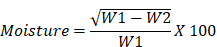
Where W1 = initial
weight of the sample
W2 = final weight
of the sample
Ash determination
Ten grams of
sample was taken in a crucible and weighed. Crucible with sample was placed in
muffle furnace at a temperature of 550°C for 5–6 hours. When the sample turned
white, it was taken out and weighed again. White-coloured contents remaining at
the bottom of the crucible represented ash, which was carefully weighed and its
percentage present in the feed was calculated by the following formula.

Growth performance parameters
After 60 days of
the experimental period, the weight (grams) and length (centimeters)
of every fish in the aquariums was measured separately Lal et al. (2022), Lal et al. (2023a). Growth performance was evaluated using the
formulae given below.
Length gain (cm)

Weight gain (g)

Percentage weight gain (%)

Specific growth rate (%)

Survivability (%)

Mortality (%)

Feed conversion ratio (FCR) (g)

Proteinefficiency ratio (PER) (g)

Hepato-somatic index (HSI) (g)

Intestinal Somatic Index (ISI) (g)

Anti-oxidants parameters
The catalase
activity was measured according to the protocol outlined by (Claiborne, 1985).
50 mM Na3PO4 buffer at neutral pH and 19 mM H2O2 made with a Na3PO4 buffer make
up the reaction mixture. To a cuvette in a 3 ml reaction mixture, 300 μl of H2O2, 50 μl of
samples, and 2.65 ml of Na3PO4 buffer were added. The consumption of H2O2 at
240 nm was used to measure the reaction at 25 °C. According to Lal et al. (2025), the CAT activity was measured as nmol H2O2
vanished/min/mg protein (ε240nm = 0.0436 m/M/cm).
The Superoxide
Dismutase activity was calculated using the methodology of Taufek
et al. (2016). 0.005 mM xanthine oxidase, 0.05 mM xanthine, 0.01 mM cytochrome
c, 0.1 mM EDTA, and 50 mM sodium phosphate buffer make up the reaction
mixture's final concentration. When xanthine oxidase was added to the enzyme
extract at 25 °C and 550 nm absorbance, the reaction started. SOD activity,
which is a measurement of its capacity to stop 50% cytochrome c reduction, was
expressed as nmol/min/mg protein.
Glutathione
S-transferase activity was evaluated by measuring its response to 1-
chloro-2,4-dinitrobenzene (CDNB) at 340 nm Taufek et al.
(2016). The assay mixture contains 60 mM CDNB
(dissolved in ethanol), 60 mM glutathione (GSH), and 100 mM sodium phosphate
buffer (pH 6.5). GST activity was measured as the amount of enzyme that
catalysed the GSH conjugate per minute and 1 μmol
of CDNB at 25 °C (ε340nm = 9.6 mM−1 cm−1), expressed as
nmol/min/mg protein.
Water parameter analysis
The water
temperature, dissolve oxygen (DO), pH, alkalinity, and total hardness of the
tank water were measured and recorded biweekly prior to sampling using
conventional methods APHA (2005). DO and temperature are taken in the early
morning, between 7-8:30 AM. Water temperature and dissolve oxygen levels were
measured using the APHA (2005) standard approach. The pH was determined using a
digital pH meter 335 (Systronics). The total
alkalinity and hardness of water were tested using APHA (2005) standard methods Damle et
al. (2023), Lal et al. (2023b).
Temperature
A mercury
thermometer with a minimum count of 0.1°C was used to record the water
temperature from each experiment-reared tank every day at midday. A glass
thermometer set at degrees Celsius was used to measure the water's temperature.
The thermometer was lowered into the water tank and left there for two to four
minutes in order to measure the water's temperature.
Dissolved oxygen
A 100 ml DO bottle
was used to collect water samples from the experimental tanks. Following
collection, 1 ml of MnSO4 & KI solution was added via pipette and slowly
sank into the DO bottle's bottom. The bottle was firmly sealed and shaken to
thoroughly mix. When 1 millilitre of concentrated H2SO4 was added, the
precipitate that had formed dissolved. Now, 250 ml of this solution was placed
in a conical flask, and 50 ml of it was titrated against freshly prepared 0.025
N Na2S2O3 until the blue starch indicator turned colourless at the end.After that the dissolve oxygen was calculated by the
following formula:
Dissolve oxygen (ppm) = 
pH
The water's pH was
measured using a pH meter (HM Digital, PH 80). A pH 7 buffer solution was used
to calibrate the pH meter before to use. Next, a buffer solution with known pH
values of 4.0 and 10 was used to check the pH meter. The water sample from the
experimental aquarium tank was then subjected to a direct pH measurement.
Alkalinity
The total
alkalinity of water was determined using APHA (2005). A 100 ml water sample was obtained from an
experimental reared tank and placed in a 250 ml conical flask with 3-4 blobs of
phenolphthalein index, which turned the water pink. The water was titrated with
0.02 (N) H2SO4 until the rose hue faded. The volume (ml) of acid used was
recorded. Then 2-3 blobs of the methyl orange index were assembled in the same
water. If the water turns yellow, it is titrated with the same acid until a
faint orange endpoint appears.The volume (ml) of acid
used in the second titration was also recorded, and the alkalinity was
estimated by taking the total volume of acid used into account. Total
alkalinity was estimated using the following formula:
 Volume of H2SO4
(N/50) consumed
Volume of H2SO4
(N/50) consumed
Total hardness
The total hardness
of water was assessed using APHA's standard methodology (2005). In a conical
flask, combine 50 ml of sample water with 5 mi of buffer. Add a sprinkle of
Eriochrome black-T indicator and tritrate against a
standard EDTA solution until the wine red turns blue, indicating the end point.
Keep track of how much standard EDTA you use. The total hardness was estimated
using the following formula:

Statistical analysis
The data obtained
were analysed by SAS (1999; statistical package; version 22.0 for Windows).
Data obtained from studies based on completely randomized experimental design
were subjected to one-way analysis of variance. Results were considered
significant at P < .05. Means of each treatment including control then were
compared using Duncan’s multiple range test for level of statistical
significance among treatments.
Results
The proximate composition of spirulina
The proximate
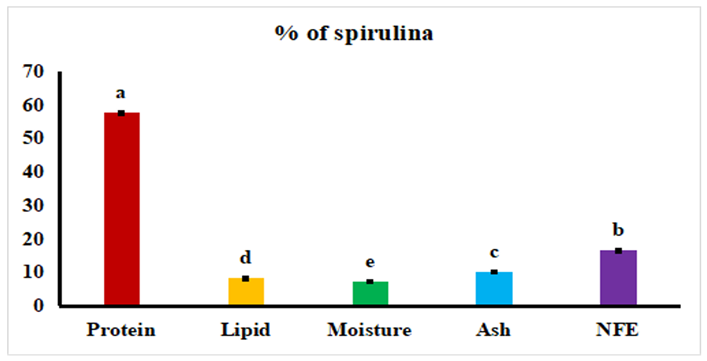
composition analysis of Spirulina dry powder revealed a high nutritional profilepresented in the Table 2 and Figure 1. The protein content was found to be 57.63 ±
0.66%, indicating that Spirulina is a rich source of protein. The lipid content
was recorded as 8.24 ± 0.35%, while the moisture content was 7.27 ± 0.30%,
suggesting low water content suitable for storage and shelf life. The ash
content, representing the total mineral composition, was 10.20 ± 0.15%.
Additionally, the Nitrogen Free Extract (NFE), which includes carbohydrates and
other soluble components, was observed to be 16.65 ± 0.57%. These results
confirm that Spirulina is a nutrient-dense microalga with significant protein
and mineral content, making it a valuable supplement for aquaculture and human
nutrition.
Table 2
|
Table 2 Proximate Composition of Spirulina Dry
Powder. |
||
|
S.No. |
Parameters |
% |
|
1 |
Protein |
57.63±0.66a |
|
2 |
Lipid |
8.24±0.35d |
|
3 |
Moisture |
7.27±0.30e |
|
4 |
Ash |
10.20±0.15c |
|
5 |
Nitrogen Free Extract (NFE) |
16.65±0.57b |
|
Figure 1
|
|
Figure 1 Proximate Composition of Spirulina (dry
weight). *Data are Presented as Mean±SE. There is a
Statistically Significant Difference (p<0.05) Among the Differentparameters. |
The proximate composition of experimental feed
The proximate
composition of experimental feed is shown in Table 3. The proximate composition of the
experimental feed was determined by measuring nitrogen-free extract (NFE), ash,
moisture, crude protein, fat, and crude fibre. There were no statistically
significant differences between treatment groups (p<0.05). The T3 group had
the highest crude protein content (30.73±0.115), while the control groups had
the lowest value (30.36±0.152). The T3 groups had the lowest result
(5.17±0.015), whereas the control group had the highest crude lipid
(5.57±0.020).The moisture content was highest (8.64±0.020) in the control group
and lowest (8.26±0.025) in the T3 group. The control group had the most crude ash (16.23±0.020), whereas the T3 group had the
lowest (15.17±0.020) among the treatment groups. The control group had the
highest crude fibre level (11.27±0.020) and the T3 group had the lowest
(9.92±0.055) among the treatment groups. The T3 group had the highest nitrogen
free extract (30.73±0.165) and the control group had
the lowest value. Despite slight variations between treatments, there were no
significant differences (p < 0.05) in the proximate composition of the
experimental meals.
Table 3
|
Table 3 Proximate Composition of Different
Experimental Feeds. |
||||||
|
Treatment |
Protein |
Lipid |
Moisture |
Ash |
Fibre |
Nitrogen
free extract (%) |
|
|
(%) |
(%) |
(%) |
(%) |
(%) |
|
|
Control |
30.36±0.152 |
5.57±0.020 |
8.64±0.020 |
16.23±0.020 |
11.27±0.020 |
27.92±0.192 |
|
T1 |
30.36±0.208 |
5.43±0.020 |
8.45±0.015 |
15.87±0.020 |
10.87±0.020 |
29.00±0.251 |
|
T2 |
30.53±0.208 |
5.36±0.025 |
8.35±0.020 |
15.63±0.020 |
10.36±0.025 |
29.75±0.232 |
|
T3 |
30.73±0.115 |
5.17±0.015 |
8.26±0.025 |
15.17±0.020 |
9.92±0.055 |
30.73±0.165 |
|
F-Value |
2.95 |
195.64 |
186.9 |
1450.95 |
925.87 |
93.14 |
Values are means ±
SD, n = 3 per treatment group. Means in a column without a common superscript
letter differ (P < 0.05) as analyzed by one-way
ANOVA and the DUNCAN test.
The growth performance
The growth
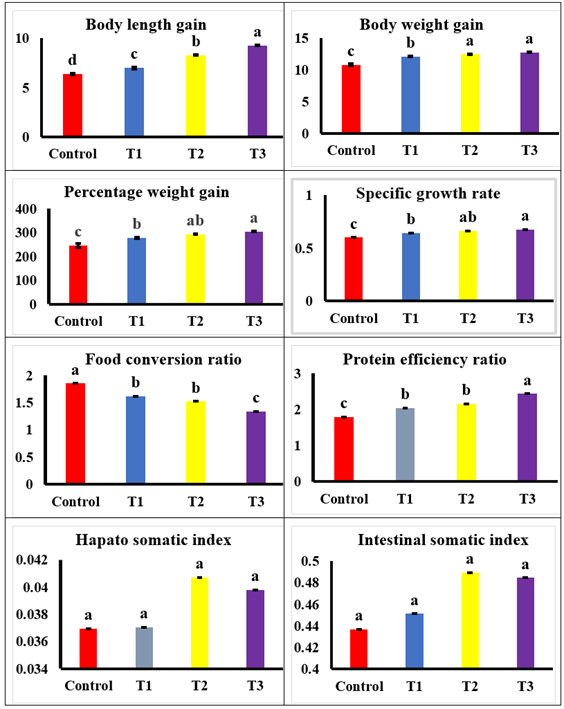
performance of L. rohita is presented in Figure 2. Fish growth performance can be measured
using length increase, weight gain, percentage weight gain, specific growth
rate, protein efficiency ratio, food conversion ratio, hepatosomatic index, and
intestinal-somatic index. The T3 group had the highest survivorship of 70% when
compared to the other treatment groups. When compared to the other therapy
groups, the control group had the greatest mortality rate, at 40%. There is a
significant difference (p>0.05) between all treatment groups. The T3 group
had the most length growth (9.26±0.057a), whereas the control group had the
smallest (6.40±0.10d) among the treatment groups.In
comparison to the other treatment groups, the T3 group experienced the most
weight gain (12.80±0.10a), while the control group experienced the lowest
(10.83±0.30c). In comparison to the other treatment groups, the T3 group
experienced the largest percentage weight gain (304.76±2.38a), while the
control groups experienced the lowest (246.62±16.07c). In comparison to the
other treatment groups, the T3 group showed the highest specific growth rate
(0.67±0.002a), whereas the control groups showed the lowest (0.59±0.022c). The
difference between all treatment groups is statistically significant
(p>0.05).The control group had the highest food conversion ratio
(1.85±0.15a), while the T3 group had the lowest (1.33±0.007c) when compared to
the other treatment groups. The T3 group had the highest protein efficiency
ratio (2.43±0.014a), while the control groups had the lowest (1.78±0.14c) when
compared to the other treatment groups. A statistically significant (p>0.05)
variation in length increase was seen between the groups. The T2 group had the
greatest hepato-somatic index (0.040±0.003a), whereas the control groups had
the lowest (0.036±0.004a) in comparison to the other treatment groups. The T3
group had the greatest intestinal-somatic index (0.48±0.005a), whereas the
control group had the lowest (0.43±0.06a) among the treatment groups. A
statistically significant (p>0.05) difference in length gain was reported
between the groups.
|
Figure 2
|
|
Figure 2 Growth Performance of L. Rohita; A.Body Length Gain; B.Body
Weight Gain; C.Percentage Weight Gain; D.Specific Growth Rate (SGR); e.Food
Conversion Ratio (FCR); f.Protein Efficiency Ratio
(FCR); g.Hapato Somatic Index (HSI); h.Intestinal Somatic Index (ISI) *Data are Presented as mean±SE. Different Superscripts Indicate Statistically
Significant Difference (p<0.05) Among the Experimental Groups. |
Anti-oxidants activities parameters
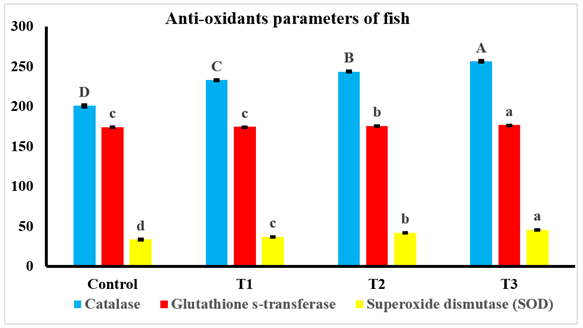
The antioxidant activity parameters of L. rohita during the experimental period are presented in Table 4 and Figure 3.The results showed notable statisticallysignificantly (p>0.05)differences among the treatment groups, indicating the influence of dietary treatments on the antioxidant defense system of the fish.The highest catalase activity (256.34 ± 1.98ᵃ) was recorded in the T3 group, while the lowest (200.73 ± 2.51ᵈ) was observed in the control group. Similarly, glutathione S-transferase (GST) activity was significantly higher in the T3 group (176.64 ± 0.31ᵃ) compared to the control group, which showed the lowest value (173.95 ± 0.83ᶜ). These findings suggest that the T3 treatment enhanced the enzymatic antioxidant response in L. rohita.Furthermore, superoxide dismutase (SOD) activity followed a similar trend, with the highest activity (45.37 ± 0.80ᵃ) observed in the T3 group and the lowest (33.40 ± 0.95ᵈ) recorded in the control group. Overall, the results indicate that fish in the T3 treatment group exhibited significantly improved antioxidant enzyme activities compared to the control, reflecting enhanced oxidative stress resistance and better physiological status.
Table 4
|
Table 4 Anti-oxidant
Parameters of L. Rohita During the Experimental Period. |
|||
|
Treatment |
CAT (nmol mg−1 protein) |
GST (nmol mg−1 protein) |
SOD (nmol mg−1 protein) |
|
Control |
200.73±2.51d |
173.95±0.83c |
33.40±0.95d |
|
T1 |
232.90±1.54c |
174.50±0.27c |
36.93±0.18c |
|
T2 |
243.76±1.77b |
175.60±0.19b |
42.05±0.30b |
|
T3 |
256.34±1.98a |
176.64±0.31a |
45.37±0.80a |
|
F-Value |
432.201 |
18.906 |
201.227 |
Values are means ± SD, n = 3 per treatment group. Means in a column
without a common superscript letter differ (P < 0.05) as analyzed
by one-way ANOVA and the DUNCAN test.
|
Figure 3
|
|
Figure 3 Anti-oxidants
Parameters of L. rohita. *Data are Presented as Mean±SE. Different Superscripts Indicate Statistically
Significant Difference (p<0.05) Among the Experimental Groups. |
The carcass composition of L. rohita
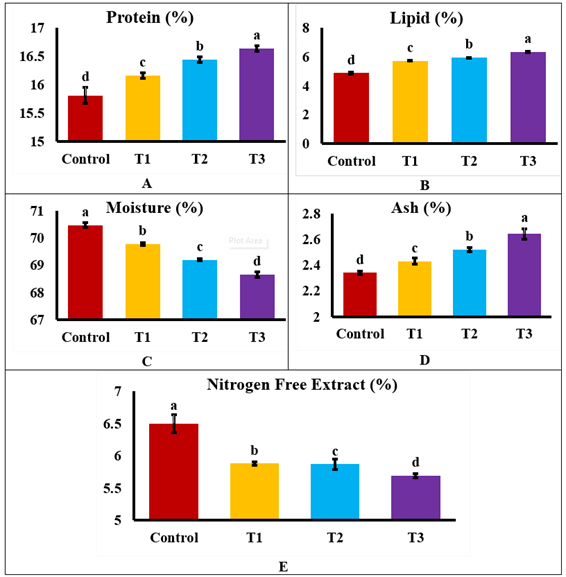
The carcass composition of experimental fish was observed at end of the experiment are presented in Table 5 and Figure 4. The nutritional composition of the experimental fish such as analyses of crude protein, lipid, moisture, ash, and nitrogen-free extract (NFE). There is a statisticallysignificantly (p>0.05)difference all among the treatemnt groups. The highest crude protein (16.64±0.049a) was observed in the T3 group whereas the lowest value (15.81±0.14d) was observed in the control groups compared to the other treatment groups.The highest crude lipid(6.35±0.036a) was observed in the T3 group whereas the lowest value (4.88±0.08d) was observed in the control groups compared to the other treatment groups.The highest moisture content(70.46±0.088a) was observed in the control group while the lowest (68.66±0.10d) was observed in the T3 groups, although it differ significantly from the fish reared on diets T2 and T1.The highest crude ash(2.64±0.041a) was observed in the T3 group while the lowest (2.34±0.015d) was observed in the control groupscompared to the other treatment groups.The highest nitrogen free extract(6.50±0.14a) was observed in the control group and lowest (5.69±0.032d) in the T3 groupscompared to the other treatment groups. There is a significantly significantly (p>0.05)difference in between all among the treatment groups.
Table 5
|
Table 5 The Carcass Compositionl. Rohita at the End of the Experiment 60th
days (Wet basis). |
|||||
|
Treatment |
Crude protein (%) |
Crude lipid (%) |
Moisture (%) |
Ash (%) |
Nitrogen free extract (%) |
|
Control |
15.81±0.14d |
4.88±0.08d |
70.46±0.088a |
2.34±0.015d |
6.50±0.14a |
|
T1 |
16.16±0.047c |
5.73±0.025c |
69.77±0.047b |
2.43±0.025c |
5.88±0.025b |
|
T2 |
16.44±0.05b |
5.95±0.015b |
69.20±0.037c |
2.52±0.015b |
5.87±0.077c |
|
T3 |
16.64±0.049a |
6.35±0.036a |
68.66±0.10d |
2.64±0.041a |
5.69±0.032d |
|
F-Value |
53.346 |
529.270 |
300.670 |
68.094 |
50.665 |
Values
are means ± SD, n = 3 per treatment group. a-dMeans
in a column without a common superscript letter differ (P < 0.05) as
analyzed by one-way ANOVA and the DUNCAN test.
|
Figure 4
|
|
Figure 4 Carcass Composition of L. rohita. *Data are Presented as Mean±SE.
Different Superscripts Indicate Statistically Significant Difference
(p<0.05) all Among the Groups. |
The water quality parameters
Table 6 shows the water quality parameters
of the experimental fish that were recorded during the experiment. Temperature,
dissipated oxygen, pH, hardness, and alkalinity were all found to be within the
permissible range of water quality parameters. Fish survival, growth, and
health depend on several aspects of water quality. A fish's capacity to carry
out basic tasks like breathing, feeding, and reproduction is directly impacted
by variables like dissolved oxygen, pH, temperature, and the presence of
contaminants. Healthy fish populations and aquaculture success depend on
maintaining ideal water quality. In the control group, the water temperature
ranged from 24.85 to 27.9, while in the T1 groups, the temperature ranged from
23 to 27.4. Throughout the trial period, the T1 group had the largest dissolved
oxygen range (5.31–5.9) and the T2 group had the lowest (5.2–6.52). The T2
group had the largest pH range (7.45–7.8) during the trial period, while the
control group had the lowest (6.09–6.67). Throughout the testing period, the
control group had the highest water hadness
(63.4-64.31), whereas the T3 group had the lowest (61.1-63.8). During the
testing period, the T2 group had the greatest water alkalinity range
(77.5-78.7), whereas the control group had the lowest (76.2-77.7).
Table 6
|
Table 6 The Water Quality Parameters of L. Rohita
During the Experimental Period. |
|||||
|
Treatment |
Temperature (°C) |
Dissolved oxygen (mg/L) |
pH |
Hardness (mg/L) |
Alkalinity (mg/L) |
|
Control |
24.85-27.9 |
5.3-6.1 |
6.09-6.67 |
63.4-64.31 |
76.2-77.7 |
|
T1 |
23-27.4 |
5.31-5.9 |
6.7-7.83 |
63.4-64 |
76.3-77.7 |
|
T2 |
24.4-26.2 |
5.2-6.52 |
7.45-7.8 |
62.6-63.7 |
77.5-78.7 |
|
T3 |
25.5-27.8 |
5.21-6.95 |
6.5-7.35 |
61.1-63.8 |
77.2-78.6 |
Values are represented as a range of water quality parameters during the
experimental periods.
Discussions
Proximate composition of spirulina and feed
Including
spirulina in fish feed significantly enhances fish performance by providing
high-quality protein and nutrients, which improves overall growth, survival,
and feed utilization, as demonstrated by studies on various species. The
proximate composition of fish fed spirulina-supplemented diets shows increased
protein retention and desirable carotenoid content, leading to better growth
parameters, pigmentation, and potentially a more robust immune system, although
the optimal inclusion level varies by species and target outcome Jana et al. (2014). Studies on incorporating spirulina
into fish feed consistently report positive impacts on fish growth and health
metrics, such as weight gain, length increase, and improved survival rates,
often attributing these benefits to the increased feed intake and nutrient
digestibility facilitated by the dietary spirulina.
The proximate analysis of fish carcasses reveals enhanced protein retention and
desirable carotenoid deposition, which boosts fish color and market appeal,
making spirulina a valuable functional feed additive for aquaculture. While
spirulina can act as a protein and carotenoid supplement, its high nutrient
content, including essential minerals and vitamins, can also promote overall
fish well-being, improve growth, and potentially boost immune responses,
thereby supporting sustainable aquaculture practices Al-Deriny et al. (2020)
Fish
diets with 30% spirulina have significantly higher protein content (about 55%)
in fish body composition than diets with lower inclusion levels, as well as
improved fatty acid profiles with elevated omega-3 levels such as EPA and DHA.
Protein concentration in spirulina-based fish feed pellets ranges from 35% to
nearly 39%, depending on the formulation, with injectable spirulina protein
efficiently substituting fishmeal protein without sacrificing growth
performance. Thus, spirulina-containing fish feed is high in protein, healthy
fats (omega-3s), vitamins, and minerals, making it a nutritious and sustainable
alternative or addition to traditional fishmeal-based diets Soma et al. (2024). In several marine fish species,
such as snubnose pompano and sobaity
seabream, spirulina has a high digestibility of protein and amino acids; the sobaity seabream has superior digestibility of both
proteins and amino acids. According to Siddik et al.
(2025), adding spirulina to feed did not
decrease intake and demonstrated promise as a sustainable feed ingredient that
might replace traditional proteins. Spirulina can up to 30% replace fishmeal
protein in young Nile tilapia feeds without affecting mortality, feed intake,
or growth performance. According to Soma et al. (2024), n-3 LC-PUFA (EPA and DHA), which
are crucial for fish and consumer nutrition, are also preserved by spirulina.Spirulina feeding improves fish health by
boosting immunity, decreasing illness mortality, and perhaps reducing the need
for antibiotics and other treatments. According to Al Mamun et al. (2023), spirulina promotes development and
nutritional utilisation by stimulating good gut flora
and enzyme activities. According to a meta-analysis of several studies, adding
Spirulina meal (SPM) to the diet considerably increases fish growth (final body
weight, specific growth rate), feed efficiency (feed conversion ratio), and
protein utilisation (protein efficiency ratio)
without having an adverse effect on the hepatosomatic index or fish condition.Fishmeal can be replaced with up to 22-25% or
supplemented with 1.5-2.3% at optimal inclusion rates Li et al. (2022). Antioxidants and immune stimulants
are among the nutraceutical qualities of spirulina that enhance sustainable
aquaculture techniques by enhancing fish welfare and stress resistance Ujjwal
et al. (2025).
Growth performance
The
current study's growth and feed utilisation
parameters for L. rohita showed an upward trend up to
20% of fish meal replaced with S. platensis. This
could be due to vital vitamins, minerals, and amino acids, as well as higher
feed intake and nutrient digestibility. Teimouri
et al. (2013) found that rainbow trout fed 5% S.
platensis performed significantly worse in terms of growth than those fed 7.5%
and 10% S. platensis. They also found that the percentage of weight gain
increased from 113.1 ± 4.8% to 131.4 ± 7.7% when fed a diet containing 2.5–10%
S. platensis. However, Akter et
al. (2023) found that using S. platensis in
place of fishmeal in the diet of Ompok pabda produced the highest growth performance at the 15%
level when compared to the control. High-quality protein and bioactive
substances that are crucial for promoting growth are found in S. platensis Da Silva et al. (2021). According to earlier research,
fish that were fed diets supplemented with algae grew more effectively Riano et al. (2012). Abdel-Tawwab
and Ahmad (2009) found a lower FCR value (1.22 ±
0.02) in the 5% level of S. platensis replacement and a higher FCR value in the
control diet. They also observed a maximum PER value (2.91 ± 0.08) in the 5%
level of S. platensis incorporation and a minimum PER value in the control
diet. Roohani et al.
(2018) observed comparable results in
terms of survival rate. According to James et
al. (2006), S. platensis improved the
intestinal flora in fish by breaking down indigestible feed components to
extract more nutrients and encouraging the creation of enzymes that transport
lipids for metabolism rather than storage.The
statement also supports the current study's increased feed utilisation
pattern. According to earlier studies, the high levels of vitamins, minerals,
essential amino acids, linoleic acid, and linolenic acid that S. platensis
provides in the diet enhance feed utilisation and
growth performance Cao et al. (2018), Roohani et al.
(2018).
The
growth performance of fish is positively impacted when spirulina is added to
their diet. Research indicates that adding spirulina to fish feed increases the
length, weight, and survival rate of a variety of fish species. For instance, a
meal containing 5% spirulina produced greater length (13.07 cm), average weight
growth (60.4 g), and survival (94%) in Pangasius sutchi
than control feeds devoid of spirulina. According to Jana et al. (2014), spirulina increases feed intake,
nutrient digestibility, and provides vital vitamins and minerals that support
growth promotion. When compared to fish fed the control
diet, fish fed diets containing Spirulina (5 g/kg) exhibited noticeably
superior development and feed utilisation.The
current study demonstrated that adding spirulina to the diet improved fish
growth. These outcomes might be the consequence of increased feed intake and
nutrient digestibility. Additionally, spirulina contains a
number of nutrients, particularly vitamins and minerals, which may aid
in promoting fish growth. These findings concur with those of a number of
researchers who showed that feeding fish spirulina increased their survival and
growth rates Belay et
al. (1993), Hayashi
et al. (1998), Hirahashi et
al. (2002). Accordingly, diet supplemented
with spirulina powder increased the feed conversion ratio and growth rates for
striped jacks, Pseudocaranx Dentex Watanabe
et al. (1990). The fish given 5% spirulina showed
the largest length gain (28.3 cm), whereas the control group showed the lowest
(20 cm). The fish fed 5% spirulina showed the maximum weight gain, whereas the
control group (20 grammes) showed the lowest. The control group's survival rate
was nearly 100%, whereas the fish given 5% spirulina had the highest survival
rate. During a 90-day culture trial, Nandeesha et
al. (2001) investigated the effects of S.
platensis meal on the growth of two important carps from India, catla (Catla catla)
and rohu (L. rohita).Higher levels of Spirulina
inclusion in rohu resulted in improvements in the specific growth rate and
protein efficiency ratio, however in catla, these
metrics did not differ significantly from the control treatment. In our
investigation, however, we found that adding spirulina to the feed greatly
improved the Pangasius sutchi's length, weight gain,
and survival.Dietary spirulina
meal supplementation dramatically increases fish final body weight, specific
growth rate, protein efficiency ratio, and lowers feed conversion ratio,
indicating improved feed utilisation, according to a
thorough meta-analysis. For fish diets, spirulina supplementation amounts
should be between 1.5% and 2.3%. Spirulina can replace fishmeal in fish diets
up to about 22%–25% without having an adverse effect on growth Li
et al. (2022). Spirulina inclusion up to 7.5–10%
has been shown in other research to boost growth in certain fish species while
also improving feed utilisation and immunity.
According to Al Mamun et al. (2023), spirulina is a sustainable simproving feedhows promise for
enhancing fish development performance in aquaculture.
Anti-oxidants parameters
The anti-oxidants parameters were represented in the Table 4. Adding Spirulina to fish feed
enhances antioxidant parameters in fish by providing natural antioxidants like
phycocyanin, beta-carotene, and superoxide dismutase (SOD). These compounds
scavenge free radicals, improving the fish's antioxidant status, immune
response, and resistance to stress and disease. Specific antioxidant parameters
measured often include superoxide dismutase (SOD) activity, catalase (CAT)
activity, and levels of glutathione peroxidase (GPx),
all of which are elevated in fish fed Spirulina-supplemented diets Eissa et
al. (2024). Similarily,
Faheem
et al. (2022) reported the hepatic lipid
peroxidation decreased significantly in fish fed with a 1 and 5% Spirulina
supplemented diet. The activity of catalase, glutathione-S-transferase, and
glutathione levels increased significantly in the livers of fish fed with 1%
Spirulina supplemented diets while no significant differencewas
observed for hepatic superoxide dismutase levels when compared to the control.
Several
antioxidant compounds (glutathione) and enzymes (catalase, superoxide
dismutase, glutathione peroxidase, glutathione reductase, etc.) make up the
body’s anti-oxidant defense system that detoxifies
reactive oxygen and nitrogen species through a series of reaction cascades.
Recently, a great deal of research focused on supplementing the fish diet with
additives that can enhance the natural anti-oxidant
level and alleviate oxidative stress. In the present study, fish were not
challenged with any stress but it is generally
accepted that an enhanced and better anti-oxidant
system will provide better resistance against oxidative stress. In the present
study, the level of lipid peroxidation decreased in the fish fed with 1 and 5%
Spirulina diets. The activity of catalase, glutathione-S-transferase, and
glutathione levels increased significantly (p < 0.05) in fish livers fed
with 1% Spirulina-supplemented diets. Spirulina is a rich source of bioactive
compounds such as catechins, phycobiliproteins, allophycocyanin, and phycocyanins Takeuchi
et al. (2002). Catechins have
the ability to chelate metal ions, scavenge
reactive oxygen species, and produce antioxidant enzymes Bernatoniene and Kopustinskiene (2018). Similarly, phycocyanin and
allophycocyanin have the properties of antioxidants Esteban
(2012). The presence of these bioactive
components in Spirulina may be responsible for the improved antioxidant status
of grass carp.
The
association between fish immunity and antioxidant properties is
well-established. Antioxidative enzymes like SOD, GPx,
and CAT reduce oxidative stress by lowering reactive oxygen species (ROS)
levels Xavier
et al. (2021). MDA, a marker for lipid
peroxidation, reveals oxidative damage to lipids. Our study showed significant
escalations in the activity of CAT, SOD, and GPx
enzymes and a decline in MDA contents in fish fed with SP and CUR-NPs,
indicating the antioxidant effect of these additives. Similar findings were
observed in White leg shrimp supplied with CURNPs and in Nile tilapia
supplemented with CUR-NPs Bhoopathy et
al. (2021), Moghadam
et al. (2021). Recent investigations confirmed
the positive role of CUR-NPs additions on the antioxidant status of Nile
tilapia Abdel-Tawwab et al. (2022). Various
studies have recognized the beneficial impacts of S. platensis on the
antioxidant ability of several fish species Mahmoud
et al. (2018), Awad et al. (2022), Teimouri
et al. (2019), Mohammadiazarm et al. (2021). Curcumin’s antioxidant properties
are linked with the activation of antioxidative enzymes and the nuclear
transcription factor erythroid 2 (Nrf2) signaling pathways, which removes free
radicals Xu et al. (2018). Polyphenols found in these
additives also promote antioxidant activity by scavenging ROS and preventing
oxidative deterioration Bishayee et al.
(2011), Moskaug et al.
(2005). Spirulina’s antioxidant properties
can be attributed to its chemical composites, including vitamins, C-phycocyanins, β-carotene, and minerals, particularly
phycocyanin, which alters cyclooxygenase-2 and guards against oxidative
deterioration Awad et al. (2022), Karadeniz
et al. (2009).
Carcass composition of L. rohita
The
carcass composition of L. rohita, an Indian major
carp widely cultured across South Asia, is aindicator
of its nutritional quality and commercial value. The primary components
assessed in carcass analysis are moisture, crude protein, lipid (fat), and ash
on a wet weight basis. At the start of growth trials, the carcass typically
contains high moisture (around 79.28%), moderate protein (approximately
11.93%), low fat (about 2.45%), and ash contents near 3.90%. These values
change noticeably with dietary variations and as culture duration progresses,
largely reflecting metabolic processes and growth patterns in the species Joshi
(2018). The proximate composition of fish
varied significantly between the treatments. Protein percentage in carcass was
found maximum at 10% levels of spirulina substututions
followed by 5% and control (0%). An inverse relationship between fat, moisture
and ash deposition were observed. This finding agreed
with earlier findings of Takeuchi
et al. (2002) and Nandeesha et
al. (1998) in tilapia, Oreochromis niloticus
and rohu, L. rohita respectively. Similarly, Chandra
and Saxena (2012) reported the effectiveness of S.
platensis as a source of protein in rohu diets. There was significant difference in the average
carcass composition of the fish among treatments. Some studies indicated althoughsomeprotein sources can replace or spare fish meal
without impairing growth, fat composition might increase unacceptably Esmaeili
et al. (2017). Based on our results, spirulina
increased protein and decreased fat content in whole body. It can be due to
improvements in protein and fat metabolism by spirulina due to some mechanismsmentioned in the section
above. Similarly, other studies reported significant effects of spirulina in
increasing whole‐body protein content Promya and Chitmanat (2011), Velasquez
et al. (2016) and decreasing whole‐body fat
content Cao et al. (2018), Teimouri
et al. (2016). However, in our research ash and
moisture were not affected by dietary spirulina, findings which are
incompatible with other research reporting increased or decreased ash content
in whole body Tongsiri et al.
(2010), and decreased whole body moisture
content Promya and Chitmanat (2011), Tongsiri et al.
(2010), Velasquez
et al. (2016). Spirulina mass production methods andconditions might affect its
nutritional composition, including proximal composition (fat and protein
content), amino acid and fatty acid profiles, and this may explain the distinct
findings of research done in different species Takeuchi
et al. (2002).
In
present research, lipid content in whole body increased only in fishfed the highest supplementation level of spirulina (8%
FMS), unlike other spirulina‐based diets.The
incorporation of Spirulina into fish diets has been widely reported to
influence body composition, particularly by enhancing lipid deposition in fish
tissues. Spirulina is rich in essential fatty acids, including linoleic and
gamma-linolenic acids, which can be directly utilized for lipid synthesis and
storage in the fish body Becker
(2007). The high digestibility and
superior nutrient profile of Spirulina improve lipid absorption and metabolism,
leading to increased fat content in muscle tissues Olvera-Novoa
et al. (1998). Furthermore, bioactive components
such as carotenoids, vitamins, and antioxidants present in Spirulina may
modulate metabolic enzymes associated with lipid biosynthesis, thereby
enhancing lipid accumulation Kumar et
al. (2022). Several studies have demonstrated
that dietary supplementation with Spirulina significantly elevates the lipid
content of fish. For instance, Ibrahem and Ibrahem
and Ibrahim (2014) reported a notable increase in
whole-body lipid levels of Nile tilapia (O. niloticus) fed diets supplemented
with S. platensis. Similarly, Teimouri
et al. (2013) observed enhanced lipid deposition
in rainbow trout (Oncorhynchus mykiss) following dietary inclusion of
Spirulina, attributing this to improved feed utilization and altered lipid
metabolism. These findings suggest that Spirulina not only serves as a high-quality
protein source but also acts as a functional feed additive promoting lipid
synthesis and storage, ultimately improving the energy reserves and nutritional
quality of fish flesh.
As L. rohita is fed formulated diets with increasing protein
levels such as 28%, 31%, 34%, or 37% protein there is typically a reduction in
carcass moisture and ash, accompanied by a marked increase in crude protein and
fat content. For instance, after a 60-day feeding experiment, moisture drops to
as low as 74.10%, protein content can rise to nearly 14–15%, and fat content
may reach up to 4.58% in fingerlings provided with a 34% protein diet. This
shift demonstrates that higher dietary protein and lipid
enhance the proximate body composition, particularly boosting muscle protein
and fat reserves, which are vital for fish growth and market quality Salam et
al. (2020). Environmental factors, fish age,
and soil or pond pH also influence carcass
composition. Studies reveal that older L. rohita tend
to accumulate higher fat and protein levels in their muscles, while juvenile
fish have relatively higher moisture. Alkaline pond conditions (high soil pH)
can modulate protein synthesis and lipid accumulation compared to neutral
conditions, underlining the importance of culture environment in determining
final fish quality. Such age- and environment-dependent
biochemical profiles help optimize aquaculture practices for higher quality
yields Dwivedi
et al. (2025).
Comparative
assessments show that L. rohita possesses slightly
lower average muscle protein (around 39%) and water content (roughly 74%) than
some other carps like Cirrhinus mrigala, but has comparable
or higher dry matter and fat content (around 13-14%). This makes L. rohita a reliably nutritious food fish, well-suited for
consumers seeking protein-rich and moderately low-fat diets. Ash content,
indicating mineral deposition, usually remains stable but can reflect dietary
mineral intake and environmental conditions Sikandar
et al. (2020). Feed additives can further
influence carcass composition. For example, the inclusion of functional
ingredients or supplements like poultry waste biochar in the diet has been
shown to enhance crude protein and lipid deposition in L. rohita,
as well as improve mineral content and feed conversion. This indicates that
targeted feed interventions can not only optimize growth but also upgrade the
fish's nutritional value for human consumption, making it a strategic tool in
value-added aquaculture Khalid
et al. (2024). Nutritional indices derived from
carcass analysis not only help determine optimal feeding strategies for maximum
growth, but also offer insights into nutrient
retention and conversion efficiencies. The shift in carcass composition with
age, feeding rates, and diet formulation provides practical information to
farmers and researchers aiming for high-quality production with enhanced
protein and oil content, which are crucial traits for both domestic and export
markets Dwivedi
et al. (2025)
Water quality parameters of fish
The
temperature of the water varied between 24°C and 30°C during the experiment.
Other water quality metrics that were within the optimum ranges for carp growth
included pH (7.29-7.46) and dissolved oxygen (7.73-8.06 ppm) Jhingran (1991). The culture and production of L. rohita depend heavily on water quality factors since they
have a direct impact on the survival, growth, and health of the fish. The
following are important factors to keep an eye on for effective aquaculture
management: temperature, pH, dissolved oxygen (DO), total alkalinity, ammonia
concentration, and hardness. While water temperatures between 25°C and 36°C are
generally favourable for L. rohita,
28°C to 30°C is excellent.The
ideal metabolic and enzymatic processes necessary for growth and development
are facilitated by this temperature range. Growth performance may be adversely
affected by deviations from this range since they may result in metabolic
stress and decreased feeding efficiency. To preserve the stability of
physiological processes and enzymatic activity in the fish tissues, the pH of
the rearing water should be kept close to neutral or slightly alkaline, usually
between 7.0 and 8.5 Mahamood
et al. (2021).
A crucial
factor in L. rohita culture is dissolved oxygen,
which should be at least 6 to 7 mg/L to ensure proper respiration and metabolic
activity. Hypoxic conditions caused by low dissolved oxygen levels make fish
more vulnerable to illness, experience stress, and develop anaemia.
To keep these dissolved oxygen levels within the ideal range, frequent aeration
and efficient water movement are necessary. Since too much CO2 lowers pH and
causes respiratory problems, free carbon dioxide levels must also be managed.Total alkalinity and hardness are two aspects of
water chemistry that affect the water's buffering capabilities and ionic
equilibrium; alkalinity levels between 20 and 300 mg/L and hardness levels
around 150 mg/L are ideal for preserving fish health and water stability Biswal
et al. (2020). Among chemical contaminants,
ammonia, particularly in its unionised form (NH3), is
extremely hazardous to L. rohita even at low doses.
Ammonia is produced by fish waste as well as the decomposition of uneaten feed
and organic debris, and it has an effect on gill
function, oxygen intake, and immunological defence
processes. To reduce physiological stress, keep unionised
ammonia concentrations at 0.02 mg/L. Proper feeding management, regular water
exchange, and/or the use of biofloc or probiotic
systems can assist reduce ammonia accumulation and enhance water quality.Heavy metals like cadmium, chromium, and nickel
that are present in culture water in excess of allowable levels can
bioaccumulate in L. rohita organs, interfering with
biochemical pathways and producing harmful consequences that manifest as
changed haematological and enzymatic parameters Tabrez
et al. (2022).
The
physiological well-being and biochemical makeup of L. rohita
are likewise impacted by the quality of the water. Different environmental
factors, such as temperature and dissolved oxygen, have an impact on the
metabolism of proteins, lipids, and carbohydrates in the fish's head, trunk,
and tail. Stress brought on by low water quality impairs tissue repair and
causes oxidative damage, as seen by alterations in biochemical markers and
antioxidant enzyme activity. Changes in biochemical content are correlated with
seasonal and regional variations in water quality, highlighting the
significance of ongoing water monitoring to maximise
feeding and growth tactics and lower mortality Kaur (2020). Haematological
parameters are also linked to fish health and water quality, and they can be
indicators for environmental stress in L. rohita. Anaemia,
immunosuppression, and a reduced ability to transport oxygen are all indicated
by decreases in red and white blood cells as well as haemoglobin
levels brought on by exposure to less-than-ideal water conditions, such as
wastewater or sewage contamination. Thus, routine monitoring of these blood
parameters in conjunction with physicochemical water testing can measure fish
health indirectly, giving a thorough picture of the cultural environment and
directing prompt adjustments Rout et al. (2017). Efficient management of water
quality parameters necessitates the use of integrated techniques such as
regular water testing, proper oxygenation, balanced feeding regimens, and waste
collection. Culture systems with adequate water depth, flow rates, and natural
or artificial aeration maintain consistent temperature and oxygen levels. The
use of probiotics and biofloc technology improves
water quality by lowering harmful nitrogen compounds and improving fish gut
health. Collectively, these approaches improve feed conversion ratios,
accelerate growth, minimise mortality, and ensure
long-term production yields in L. rohita aquaculture Nesara
and Sheethal (2020).
Conclusions
The
60-day feeding trial revealed that dietary inclusion of S. platensis
significantly enhanced the growth performance, antioxidant activity, and
carcass composition of L. rohita. Among all dietary
treatments, fish fed with the T3 diet containing 20 g spirulina powder per kg
feed exhibited the highest growth parametersincluding
length gain, weight gain, percentage weight gain, and specific growth ratealong with an improved protein efficiency ratio and
lower feed conversion ratio, indicating efficient nutrient utilization.The
antioxidant enzyme activities, including catalase, glutathione S-transferase,
and superoxide dismutase, were markedly higher in the T3 group, suggesting
strengthened oxidative defense mechanisms and improved physiological health.
Additionally, the carcass composition of L. rohita in
the T3 group showed higher crude protein and lipid content, reflecting superior
muscle development and nutritional quality of the fish.Throughout the experiment, water quality
parameters remained within the optimal range, ensuring a stable rearing
environment. Overall, the study concludes that supplementation of 20 g
spirulina powder per kg feed (T3) effectively improves growth, antioxidant
capacity, and carcass quality of L. rohita,
highlighting its potential as a beneficial natural feed additive in aquaculture
nutrition.
ACKNOWLEDGMENTS
The authors would
like to express their profound gratitude to the Vice Chancellor of Kalinga
University, Naya Raipur, Chhattisgarh-492101, India, and the Dean of the Late
Shri Punaram Nishad College of Fisheries, Dau Shri
Vasudev Chandrakar Kamdhenu Vishwavidyalaya, Durg, Chhattisgarh-491995, Indiafor providing the necessary facilities for the study.
REFERENCES
AOAC.
(2005). Official
Methods of Analysis (18th ed.).
Association of Official Analytical Chemists.
APHA. (2005). Standard Methods for the Examination of Water and Wastewater. American Public Health Association.
Abdel-Latif, H. M., El-Ashram, S., Sayed, A. E. D. H., Alagawany, M., Shukry, M., Dawood, M. A., and Kucharczyk, D. (2022). Elucidating the Ameliorative Effects of the Cyanobacterium Spirulina (Arthrospira Platensis) and Several Microalgal Species Against the Negative Impacts of Aquatic Contaminants in Freshwater Fish: A Review. Aquaculture, 554, 738155. https://doi.org/10.1016/j.aquaculture.2022.738155
Abdel-Tawwab, M., Eissa, E.-S. H., Tawfik, W. A., Abd Elnabi, H. E., Saadony, S., Bazina, W. K., and Ahmed, R. A. (2022). Dietary Curcumin Nanoparticles Promoted the Performance, Antioxidant Activity, and Humoral Immunity, and Modulated the Hepatic and Intestinal Histology of Nile Tilapia Fingerlings. Fish Physiology and Biochemistry, 48, 585–601. https://doi.org/10.1007/s10695-022-01066-4
Abdel-Tawwab, M., and Ahmad, M. H. (2009). Live Spirulina (Arthrospira Platensis) as a Growth and Immunity Promoter for Nile Tilapia, Oreochromis Niloticus (L.), Challenged with Pathogenic Aeromonas Hydrophila. Aquaculture Research, 40(9), 1037–1046. https://doi.org/10.1111/j.1365-2109.2009.02195.x
Ahasan, H., Jiaur, R., Milon, S. M., and Najiah, M. (2020). Breeding Performance of Riverine Rohu (Labeo Rohita) and Growth Performance of F1 Progenies Reared in Hapas. Journal of Sustainability Science and Management, 15(2), 24–32.
Akter, T., Hossain, A., Rabiul Islam, M., Hossain, M. A., Das, M., Rahman, M. M., … Abdel-Tawwab, M. (2023). Effects of Spirulina (Arthrospira Platensis) as a Fishmeal Replacer in Practical Diets on Growth Performance, Proximate Composition, and Amino Acids Profile of Pabda Catfish (Ompok Pabda). Journal of Applied Aquaculture, 35(1), 69–82. https://doi.org/10.1080/10454438.2021.1936740
Al Mamun, M., Hossain, M. A., Saha, J., Khan, S., Akter, T., and Banu, M. R. (2023). Effects of Spirulina Platensis Meal as a Feed Additive on Growth Performance and Immunological Response of Gangetic Mystus Mystus Cavasius. Aquaculture Reports, 30, 101553. https://doi.org/10.1016/j.aqrep.2023.101553
Al-Amoudi, M. M., El-Nakkadi, A. M. N., and El-Nouman, B. M. (1992). Evaluation of Optimum Dietary Requirement of Vitamin C for the Growth of Oreochromis Spilurus Fingerlings in Water from the Red Sea. Aquaculture, 105(2), 165–173. https://doi.org/10.1016/0044-8486%2892%2990128-8
Al-Deriny, S. H., Dawood, M. A., Abou Zaid, A. A., El-Tras, W. F., Paray, B. A., Van Doan, H., and Mohamed, R. A. (2020). The Synergistic Effects of Spirulina Platensis and Bacillus Amyloliquefaciens on the Growth Performance, Intestinal Histomorphology, and Immune Response of Nile Tilapia (Oreochromis Niloticus). Aquaculture Reports, 17, 100390. https://doi.org/10.1016/j.aqrep.2020.100390
Arifuzzaman, M. (2018). Studies on the Growth and Production of Rohu (Labeo Rohita) in Intensive Aquaculture System Using Floating Feed. https://doi.org/10.13140/RG.2.2.25682.02245
Awad, L. Z., El-Mahallawy, H. S., Abdelnaeim, N. S., Mahmoud, M. M., Dessouki, A. A., and ElBanna, N. I. (2022). Role of Dietary Spirulina Platensis and Betaine Supplementation on Growth, Hematological, Serum Biochemical Parameters, Antioxidant Status, Immune Responses, and Disease Resistance in Nile Tilapia. Fish and Shellfish Immunology, 126, 122–130. https://doi.org/10.1016/j.fsi.2022.05.040
Becker, E. W. (2007). Micro-Algae as a Source of Protein. Biotechnology Advances, 25(2), 207–210. https://doi.org/10.1016/j.biotechadv.2006.11.002
Belay, A., Ota, Y., Miyakawa, K., and Shimamatsu, H. (1993). Current Knowledge on Potential Health Benefits of Spirulina. Journal of Applied Phycology, 5(2), 235–241. https://doi.org/10.1007/BF00004024
Bernatoniene, J., and Kopustinskiene, D. M. (2018). The Role of Catechins in Cellular Responses to Oxidative Stress. Molecules, 23(4), 965. https://doi.org/10.3390/molecules23040965
Bhoopathy, S., Inbakandan, D., Rajendran, T., Chandrasekaran, K., Reddy, B. A., Kasilingam, R., Ramesh, K. V., and Dharani, G. (2021). Dietary Supplementation of Curcumin-Loaded Chitosan Nanoparticles Stimulates Immune Response in the White Leg Shrimp Litopenaeus Vannamei Challenged with Vibrio Harveyi. Fish and Shellfish Immunology, 117, 188–191. https://doi.org/10.1016/j.fsi.2021.08.002
Bishayee, A., Bhatia, D., Thoppil, R. J., Darvesh, A. S., Nevo, E., and Lansky, E. P. (2011). Pomegranate-Mediated Chemoprevention of Experimental Hepatocarcinogenesis Involves Nrf2-Regulated Antioxidant Mechanisms. Carcinogenesis, 32, 888–896. https://doi.org/10.1093/carcin/bgr045
Biswal, A., Srivastava, P. P., Gupta, S., Jayant, M., and Varghese, T. (2020). Study on Alteration of Critical Water Quality Parameters and Selected Metabolic Response of Labeo Rohita Fingerling Subjected to Transportation Stress. Journal of Animal Research, 10(4), 563–568. https://doi.org/10.30954/2277-940X.04.2020.13
Cao, S. P., Zou, T., Zhang, P. Y., Han, D., Jin, J. Y., Liu, H. K., and Xie, S. Q. (2018). Effects of Dietary Fishmeal Replacement with Spirulina Platensis on the Growth, Feed Utilization, Digestion and Physiological Parameters in Juvenile Gibel Carp (Carassius Auratus Gibelio Var. CAS III). Aquaculture Research, 49, 1320–1328. https://doi.org/10.1111/are.13590
Chandra, G., and Saxena, A. (2012). Effect of Dietary Spirulina Level on Growth and Chemical Composition of Carcass in Rohu, Labeo Rohita (Hamilton). Journal of Experimental Zoology, India, 15(2), 583–585.
Chaterjee, I. B. (1978). Ascorbic Acid Metabolism. World Review of Nutrition and Dietetics, 30, 69–87. https://doi.org/10.1159/000401236
Claiborne. (1985). Catalase Activity. In R. A. Greenwald (Ed.), Handbook of Methods for Oxygen Radical Research. CRC Press.
Da Silva, M. R. O. B., Da Silva, G. M., Da Silva, A. L. F., De Lima, L. R. A., Bezerra, R. P., and Marques, D. D. A. V. (2021). Bioactive Compounds of Arthrospira Spp. (spirulina) with Potential Anticancer Activities: A Systematic Review. ACS Chemical Biology, 16(11), 2057–2067. https://doi.org/10.1021/acschembio.1c00568
Damle, D., Kumar, R., Ahilan, B., et al. (2023). The Effect of Habitat Manipulation on Early Gonad Maturation of Channa Striata in Captive Condition. Indian Journal of Animal Research, 57(11), 1462–1468. https://doi.org/10.18805/IJAR.B-5177
Dwivedi, P., Dhyani, P., Pandey, S., Pandey, N., Awasthi, S., and Giri, P. (2025). Comparative Analysis of Biochemical Constituents in Labeo Rohita (Ham.) from Normal and Alkaline Soil Ponds. Journal of Neonatal Surgery, 14, 509–514. https://doi.org/10.63682/jns.v14i8.7631
Eissa, E. S. H., Khattab, M. S., Elbahnaswy, S., Elshopakey, G. E., Alamoudi, M. O., Aljarari, R. M., … Naiel, M. A. (2024). The Effects of Dietary Spirulina Platensis or Curcumin Nanoparticles on Performance, Body Chemical Composition, Blood Biochemical, Digestive Enzyme, Antioxidant and Immune Activities of Oreochromis Niloticus Fingerlings. BMC Veterinary Research, 20(1), 215. https://doi.org/10.1186/s12917-024-04058-z
Esmaeili, M., Abedian Kenari, A., and Rombenso, A. (2017). Effects of Fish Meal Replacement with Meat and Bone Meal Using Garlic (Allium Sativum) Powder on Growth, Feeding, Digestive Enzymes and Apparent Digestibility of Nutrients and Fatty Acids in Juvenile Rainbow Trout (Oncorhynchus Mykiss Walbaum, 1792). Aquaculture Nutrition, 23, 1225–1234. https://doi.org/10.1111/anu.12491
Esteban, M. A. (2012). An Overview of the Immunological Defenses in Fish Skin. ISRN Immunology, 2012, 853470. https://doi.org/10.5402/2012/853470
FAO. (2024). The State of World Fisheries and Aquaculture 2024. Food and Agriculture Organization.
Faheem, M., Jamal, R., Nazeer, N., Khaliq, S., Hoseinifar, S. H., Van Doan, H., and Paolucci, M. (2022). Improving Growth, Digestive and Antioxidant Enzymes and Immune Response of Juvenile Grass Carp (Ctenopharyngodon Idella) by Using Dietary Spirulina Platensis. Fishes, 7(5), 237. https://doi.org/10.3390/fishes7050237
Gopikrishna, G. (2023). Application of Molecular Markers in Aquaculture. In Frontiers in Aquaculture Biotechnology (47–53). Academic Press. https://doi.org/10.1016/B978-0-323-91240-2.00014-2
Güroy, D., Güroy, B., Merrifeld, D. L., Ergün, S., Tekinay, A. A., and Yiğit, M. (2011). Effect of Dietary Ulva and Spirulina on Weight Loss and Body Composition of Rainbow Trout, Oncorhynchus Mykiss (Walbaum), During a Starvation Period. Journal of Animal Physiology and Animal Nutrition, 95, 320–327. https://doi.org/10.1111/j.1439-0396.2010.01057.x
Hayashi, O., Hirahashi, T., Katoh, T., Miyajima, H., Hirano, T., and Okuwaki, Y. (1998). Class Specific Influence of Dietary Spirulina Platensis on Antibody Production in Mice. Journal of Nutritional Science and Vitaminology, 44(6), 841–851. https://doi.org/10.3177/jnsv.44.841
Hirahashi, T., Matsumoto, M., Hazeki, K., Saeki, Y., Ui, M., and Seya, T. (2002). Activation of the Human Innate Immune System by Spirulina: Augmentation of Interferon Production and NK Cytotoxicity by Oral Administration of Hot Water Extract of Spirulina Platensis. International Immunopharmacology, 2(4), 423–434. https://doi.org/10.1016/S1567-5769%2801%2900166-7
Ibrahem, M. D., and Ibrahim, M. A. (2014). The Potential Effects of Spirulina Platensis (Arthrospira Platensis) on Tissue Protection of Nile Tilapia (Oreochromis Niloticus) Through Estimation of P53 Level. Journal of Advanced Research, 5(1), 133–136. https://doi.org/10.1016/j.jare.2013.03.009
James, R., Sampath, K., Thangarathinam, R., and Vasudevan, I. (2006). Effect of Dietary Spirulina Level on Growth, Fertility, Coloration and Leucocyte Count in Red Swordtail, Xiphophorus Helleri. Israeli Journal of Aquaculture–Bamidgeh, 58(2), 97–104. https://doi.org/10.46989/001c.20433
Jana, A., Saroch, J. D., and Borana, K. (2014). Effect of Spirulina as a Feed Supplement on Survival and Growth of Pangasius Sutchi. International Journal of Fisheries and Aquatic Studies, 1(5), 77–79.
Jhingran, A. (1991). Precomputation in a Complex Object Environment. In Proceedings. Seventh International Conference on Data Engineering (652–653). IEEE Computer Society. https://doi.org/10.1109/ICDE.1991.131514
Joshi, B. C. (2018). Biochemical Composition of Carcass of Labeo Rohita Fingerlings Fed with Formulated Diet Having By-Catch Fish Wastes as Protein Source. Journal of Environmental Bio-Sciences, 32(2), 271–273.
Karadeniz, E., Yilmaz Kandir, S., Balcilar, M., and Beyazit Onal, Y. (2009). Determinants of Capital Structure: Evidence from Turkish Lodging Companies. International Journal of Contemporary Hospitality Management, 21(5), 594–609. https://doi.org/10.1108/09596110910967827
Kaur, R. (2020). Effect of Water Quality Parameters on Biochemical Composition of Labeo Rohita (Ham.) (Doctoral Dissertation, Punjab Agricultural University Ludhiana).
Khalid, M. A., Hussain, S. M., Ali, S., Ali, Q., Rizwan, M., Paray, B. A., … Naeem, A. (2024). Impact of Feeding Biochar Sources in Rohu (Labeo Rohita): Evaluating the Growth, Nutrient Absorption, Carcass Composition, Haematology and Mineral Status. Journal of Animal Physiology and Animal Nutrition, 108(4), 1028–1037. https://doi.org/10.1111/jpn.13949
Kristofersson, D., and Anderson, J. L. (2006). Is there a Relationship Between Fisheries and Farming? Interdependence of Fisheries, Animal Production and Aquaculture. Marine Policy, 30, 721–725. https://doi.org/10.1016/j.marpol.2005.11.004
Kumar, A., Ramamoorthy, D., Verma, D. K., Kumar, A., Kumar, N., Kanak, K. R., Marwein, B. M., and Mohan, K. (2022). Antioxidant and Phytonutrient Activities of Spirulina Platensis. Energy Nexus, 6, 100070. https://doi.org/10.1016/j.nexus.2022.100070
Lal, J., Biswas, P., Singh, S. K., Debbarma, R., Deb, S., Yadav, N. K., and Patel, A. B. (2023a). Moving Towards Gel for Fish Feeding: Focus on Functional Properties and its Acceptance. Gels, 9, 305. https://doi.org/10.3390/gels9040305
Lal, J., Biswas, P., Singh, S. K., Debbarma, R., Mehta, N. K., Deb, S., Sharma, S., Waikhom, G., and Patel, A. B. (2023b). Effects of Dietary Aromatase Inhibitors on masculinization of rosy barb (Pethia conchonius): Evidence from growth, coloration and Gonado-Physiological Changes. PLOS ONE, 18(11), e0287934. https://doi.org/10.1371/journal.pone.0287934
Lal, J., Biswas, P., Singh, S. K., Debbarma, R., Vaishnav, A., Waikhom, G., … Meena, D. K. (2025). Investigating the Potential of Fish Muscle-Based Gels as Functional Feed Supplements for Eco-Friendly Aquaculture. Aquaculture Reports, 43, 103017. https://doi.org/10.1016/j.aqrep.2025.103017
Lal, J., Kumar, P., Rai, S., Srivastava, P. P., Kumar, S., Ram, R. K., and Rai, S. C. (2022). Effect of HUFA- and Vitamin C-Enriched Live Food, Infusoria on Growth and Survival of Clarias Magur (Hamilton, 1822) Larvae. Aquaculture Research, 53, 5865–5874. https://doi.org/10.1111/are.16054
Li, L., Liu, H., and Zhang, P. (2022). Effect of Spirulina Meal Supplementation on Growth Performance and Feed Utilization in Fish and Shrimp: A Meta-Analysis. Aquaculture Nutrition, 2022(1), 8517733. https://doi.org/10.1155/2022/8517733
Mahamood, M., Javed, M., Alhewairini, S. S., Zahir, F., Sah, A. K., and Ahmad, M. I. (2021). Labeo Rohita, a Bioindicator for Water Quality and Associated Biomarkers of Heavy Metal Toxicity. NPJ Clean Water, 4(1), 17. https://doi.org/10.1038/s41545-021-00107-4
Mahmoud, M. M., El-Lamie, M. M., Kilany, O. E., and Dessouki, A. A. (2018). Spirulina (Arthrospira Platensis) Supplementation Improves Growth Performance, Feed Utilization, Immune Response, and Relieves Oxidative Stress in Nile Tilapia (Oreochromis Niloticus) Challenged with Pseudomonas Fluorescens. Fish and Shellfish Immunology, 72, 291–300. https://doi.org/10.1016/j.fsi.2017.11.006
Moghadam, H., Sourinejad, I., and Johari, S. A. (2021). Growth Performance, Haemato-Immunological Responses and Antioxidant Status of Pacific White Shrimp Penaeus Vannamei fed with Turmeric Powder, Curcumin and Curcumin Nanomicelles. Aquaculture Nutrition, 27(6), 2294–2306. https://doi.org/10.1111/anu.13363
Mohammadiazarm, H., Maniat, M., Ghorbanijezeh, K., and Ghotbeddin, N. (2021). Effects of Spirulina Powder (Spirulina Platensis) as a Dietary Additive on Oscar Fish, Astronotus Ocellatus: Assessing Growth Performance, Body Composition, Digestive Enzyme Activity, Immune-Biochemical Parameters, Blood Indices and Total Pigmentation. Aquaculture Nutrition, 27(1), 252–260. https://doi.org/10.1111/anu.13182
Moskaug, J. Ø., Carlsen, H., Myhrstad, M. C., and Blomhoff, R. (2005). Polyphenols and Glutathione Synthesis Regulation. The American Journal of Clinical Nutrition, 81(1), 277S–283S. https://doi.org/10.1093/ajcn/81.1.277S
Nandeesha, M. C., Gangadhar, B., Varghese, T. J., and Keshavanath, P. (1998). Effect of Feeding Spirulina Platensis on the Growth, Proximate Composition and Organoleptic Quality of Common Carp, Cyprinus Carpio L. Aquaculture Research, 29(5), 305–312. https://doi.org/10.1111/j.1365-2109.1998.tb01135.x
Nandeesha, M. C., Gangadhara, B., Manissery, J. K., and Venkataraman, L. V. (2001). Growth Performance of two Indian Major Carps, Catla (Catla Catla) and Rohu (Labeo Rohita) Fed Diets Containing Different Levels of Spirulina Platensis. Bioresource Technology, 80, 117–120. https://doi.org/10.1016/S0960-8524%2801%2900085-2
Nandeesha, M. C., Sentilkumar, V., and Antony Jesu
Prabhu, P. (2013).
Feed Management of Major Carps
in India, with Special Reference to Practices Adopted in Tamil Nadu. In On-Farm Feeding
and Feed Management in Aquaculture (FAO Fisheries and Aquaculture Technical
Paper No. 583, pp. 433–462). FAO.
Nesara, K. M., and Sheethal, K. U. (2020). Profile of Water Quality Parameters in Culture of Labeo Rohita Supplemented with Lactobacillus Sporogenes. International Journal of Fisheries and Aquatic Studies, 8(1), 311–315.
Olvera-Novoa, M. A., Domínguez-Cen, L. J., Olivera-Castillo, L., and Martínez-Palacios, C. A. (1998). Effect of the Use of the Microalga Spirulina Maxima as Fish Meal Replacement in Diets for Tilapia, Oreochromis Mossambicus (Peters), Fry. Aquaculture Research, 29(10), 709–715. https://doi.org/10.1046/j.1365-2109.1998.29100709.x
Promya, J., and Chitmanat, C. (2011). The Effects of Spirulina Platensis and Cladophora Algae on the Growth Performance, Meat Quality and Immunity Stimulating Capacity of the African Sharptooth Catfish (Clarias Gariepinus). International Journal of Agriculture and Biology, 13, 77–82.
Rando, B. F., and Rene, E. R. (2020). Production of Micronutrient Enriched Algae, Microorganisms and Insects for Food and Feed: Perspectives and Updates. Research and Review Insights, 4, 1–3. https://doi.org/10.15761/RRI.1000159
Riaño, B., Hernández, D., and García-González, M. C. (2012). Microalgal Based Systems for Wastewater Treatment: Effect of Applied Organic and Nutrient Loading Rate on Biomass Composition. Ecological Engineering, 49, 112–117. https://doi.org/10.1016/j.ecoleng.2012.08.021
Roohani, A. M., Abedian Kenari, A., Fallahi Kapoorchali, M., Sayad Borani, M., Jalil Zorriehzahra, M., Smiley, A. H., Esmaeili, M., and Nishioka Rombenso, A. (2018). Effect of Spirulina (Spirulina Platensis) as a Complementary Ingredient to Reduce Dietary Fish Meal on the Growth Performance, Whole-Body Composition, Fatty Acid and Amino Acid Profiles, and Pigmentation of Caspian Brown Trout (Salmo Trutta Caspius) juveniles. Aquaculture Nutrition, 25(3), 1–13. https://doi.org/10.1111/anu.12885
Rout, S. K., Behera, L., Sona, B., Jana, D., Chakraborty, S., and Anupama, R. (2017). Alteration in Haematological Parameters of Labeo Rohita (Hamilton) Exposed to Different Concentrations of Sewage Water. Journal of the Inland Fisheries Society of India, 49(1), 27–34.
Roy, R. N., and Guha, B. C. (1958). Species Difference in Regard to the Biosynthesis of Ascorbic Acid. Nature, 182(4631), 319–320. https://doi.org/10.1038/182319a0
Salam, M. A., Rana, K. S., Ahmmed, M. R., and Noor, A. M. (2020). Growth Response of Juvenile Rohu (Labeo Rohita) to Wheatgrass Powder Supplemented Diet. Research in Agriculture, Livestock and Fisheries, 7(3), 533–543. https://doi.org/10.3329/ralf.v7i3.51372
Sandell, L. J., and Daniel, J. C. (1988). Effects of Ascorbic Acid on Collagen mRNA Levels in Short Term Chondrocyte Cultures. Connective Tissue Research, 17(1), 11–22. https://doi.org/10.3109/03008208808992790
Selmi, C., Leung, P. S., Fischer, L., German, B., Yang, C. Y., Kenny, T. P., … Gershwin, M. E. (2011). The Effects of Spirulina on Anemia and Immune Function in Senior Citizens. Cellular and Molecular Immunology, 8(3), 248–254. https://doi.org/10.1038/cmi.2010.76
Siddik, A., Zehra, S., Saleh, R., De Mello, P. H., Laranja, J. L., Alghamdi, M. A., … Mohamed, A. H. (2025). Protein, Energy, and Amino Acids Digestibility of Spirulina (Arthrospira Platensis) Fed to Snubnose Pompano Trachinotus Blochii and Sobaity Seabream Sparidentex Hasta. Frontiers in Sustainable Food Systems, 9, 1530889. https://doi.org/10.3389/fsufs.2025.1530889
Sikandar, M. A., Hassan, Z., Basit, A., Khan, R., and Ozdemir, F. A. (2020). Virtual Analysis on Proximate Body Composition of Labeo Rohita and Cirrhinus Mrigala. Turkish Journal of Agriculture–Food Science and Technology, 8(1), 105–109. https://doi.org/10.24925/turjaf.v8i1.105-109.2812
Soma, K., Kals, J., Opiyo, M. A., Ndambi, A., García-Cubero, R., Barbosa, M. J., … Vernooij, A. (2024). Toward Sustainable Food Systems: Can Spirulina (Arthrospira Platensis) Become a Sustainable Source of Protein to Enhance the Nutritional Benefits of Cultured Nile Tilapia (Oreochromis Niloticus)? Frontiers in Sustainable Food Systems, 8, 1283150. https://doi.org/10.3389/fsufs.2024.1283150
Spínola, M. P., Mendes, A. R., and Prates, J. A. (2024). Chemical Composition, Bioactivities, and Applications of Spirulina (Limnospira Platensis) in Food, Feed, and Medicine. Foods, 13(22), 3656. https://doi.org/10.3390/foods13223656
Tabrez, S., Zughaibi, T. A., and Javed, M. (2022). Water Quality Index, Labeo Rohita, and Eichhornia Crassipes: Suitable Bio-Indicators of River Water Pollution. Saudi Journal of Biological Sciences, 29(1), 75–82. https://doi.org/10.1016/j.sjbs.2021.10.052
Takeuchi, T., Lu, J., Yoshizaki, G., and Satoh, S. (2002). Effect on the Growth and Body Composition of Juvenile Tilapia Oreochromis Niloticus Fed Raw Spirulina. Fisheries Science, 68, 34–40. https://doi.org/10.1046/j.1444-2906.2002.00386.x
Taufek, N. M., Aspani, F., Muin, H., Raji, A. A., Razak, S. A., and Alias, Z. (2016). The Effect of Dietary Cricket Meal (Gryllus Bimaculatus). Fish Physiology and Biochemistry, 42(4), 1143–1155. https://doi.org/10.1007/s10695-016-0204-8
Teimouri, M., Amirkolaie, A. K., and Yeganeh, S. (2013). The Effects of Spirulina Platensis Meal as a Feed Supplement on Growth Performance and Pigmentation of Rainbow Trout (Oncorhynchus Mykiss). Aquaculture, 396, 14–19. https://doi.org/10.1016/j.aquaculture.2013.02.009
Teimouri, M., Yeganeh, S., Mianji, G. R., Najafi, M., and Mahjoub, S. (2019). The Effect of Spirulina Platensis Meal on Antioxidant Gene Expression, Total Antioxidant Capacity, and Lipid Peroxidation of Rainbow Trout (Oncorhynchus mykiss). Fish Physiology and Biochemistry, 45(3), 977–986. https://doi.org/10.1007/s10695-019-0608-3
Teimouri, M., Yeganeh, S., and Amirkolaie, A. K. (2016). The Effects of Spirulina Platensis Meal on Proximate Composition, Fatty Acid Profile and lipid peroxidation of Rainbow Trout (Oncorhynchus Mykiss) Muscle. Aquaculture Nutrition, 22(3), 559–566. https://doi.org/10.1111/anu.12281
Tewary, A., and Patra, B. C. (2008). Use of Vitamin C as an Immunostimulant: Effect on Growth, Nutritional Quality, and Immune Response of Labeo Rohita (Ham.). Fish Physiology and Biochemistry, 34, 251–259. https://doi.org/10.1007/s10695-007-9184-z
Thum, G., Cappai, M. G., Bochert, R., Schubert, H., and Wolf, P. (2022). Nutrient Profile of Baltic Coastal Red Algae (Delesseria Sanguinea), Baltic Blue Mussel (Mytilus spp.) and King Ragworm (Alitta Virens) as Potential Feed Material in the Diet of Rainbow Trout (Oncorhynchus Mykiss Walbaum, 1792): A Preliminary Assessment. Agriculture, 12(2), 196. https://doi.org/10.3390/agriculture12020196
Tongsiri, S., Mang-Amphan, K., and Peerapornpisal, Y. (2010). Effect of Replacing Fishmeal with Spirulina on Growth, Carcass Composition and Pigment of the Mekong Giant Catfish. Asian Journal of Agricultural Sciences, 2, 106–110.
Ujjwal, A., Pundir, G., and Tyagi, N. (2025). Exploring the role of Spirulina in Aquaculture: A Comprehensive Review. Journal of Science Innovations and Nature of Earth, 5(1), 34–37. https://doi.org/10.59436/jsiane.329.2583-2093
Velasquez, S. F., Chan, M. A., Abisado, R. G., Traifalgar, R. F. M., Tayamen, M. M., Maliwat, G. C. F., and Ragaza, J. A. (2016). Dietary Spirulina (Arthrospira Platensis) Replacement Enhances Performance of Juvenile Nile Tilapia (Oreochromis Niloticus). Journal of Applied Phycology, 28(2), 1023–1030. https://doi.org/10.1007/s10811-015-0661-y
Wan, D., Wu, Q., and Kuča, K. (2021). Spirulina. In Nutraceuticals (2nd ed., 959–974). Academic Press. https://doi.org/10.1016/B978-0-12-821038-3.00057-4
Watanabe, T., Liao, W. L., Takeuchi, T., and Yamamoto, H. (1990). Effect of Dietary Spirulina Supplementation on Growth Performance and Flesh Lipids of Cultured Striped Jack. Journal of Tokyo University of Fisheries, 77, 231–239.
Xavier, M. J., Dardengo, G. M., Navarro-Guillén, C., Lopes, A., Colen, R., Valente, L. M., Conceição, L. E., and Engrola, S. (2021). Dietary Curcumin Promotes Gilthead Seabream Larvae Digestive Capacity and Modulates Oxidative Status. Animals, 11, 1667. https://doi.org/10.3390/ani11061667
Xie, Z., Niu, C., Zhang, Z., and Bao, L. (2006). Dietary Ascorbic Acid May be Necessary for Enhancing the Immune Response in Siberian Sturgeon (Acipenser Baerii), a Species Capable of Ascorbic Acid Biosynthesis. Comparative Biochemistry and Physiology Part A: Molecular and Integrative Physiology, 145(2), 152–157. https://doi.org/10.1016/j.cbpa.2006.05.015
Xu, X. Y., Meng, X., Li, S., Gan, R. Y., Li, Y., and Li, H. B. (2018). Bioactivity, Health Benefits, and Related Molecular Mechanisms of Curcumin: Current Progress, Challenges, and Perspectives. Nutrients, 10, 1553. https://doi.org/10.3390/nu10101553
Yadav, A., and Paul, N. (2023). Morphometric Analysis of Fish, Labeo Rohita in Lucknow, Uttar Pradesh, India. World Journal of Biology Pharmacy and Health Sciences, 14(3), 122–128. https://doi.org/10.30574/wjbphs.2023.14.3.0259
Zhang, F., Man, Y. B., Mo, W. Y., and Wong, M. H. (2020). Application of Spirulina in Aquaculture: A Review on Wastewater Treatment and Fish Growth. Reviews in Aquaculture, 12(2), 582–599. https://doi.org/10.1111/raq.12341
 This work is licensed under a: Creative Commons Attribution 4.0 International License
© Granthaalayah 2014-2026. All Rights Reserved.