GOVERNANCE AND ETHICS IN PUBLIC ADMINISTRATION WITH A FOCUS ON ETHICAL PRINCIPLES AND DECISION-MAKING PROCESSES
G. Mohan 1, Dr. Yogendra Kumar 2
1 Research
Scholar, (Public Administration) Sunrise University, Alwar, Rajasthan, India
2 Professor, Research Supervisor, School of
Humanities and Social Studies, Sunrise University, Alwar, Rajasthan, India
|
|
|
ABSTRACT |
|
|
Good
governance is the foundation of good public administration, as it makes
administration accountable, transparent, and honest in their decision-making.
This study has discussed the ethics compliance of the public administrators
and has discussed their effects on the effectiveness of decision making and
governance. The compliance with five major ethical principles, including
Integrity, Transparency, Accountability, Fairness, and Responsiveness, and
the associations with the performance and governance indicators of the low
level of corruption, high level of public trust, and policy implementation
were assessed using data of 100 administrators. The findings suggest that
increased ethical compliance is related positively to better decision-making
and better governance results. These results highlight the essence of the
introduction of ethical frameworks in the administrative practice to enhance
the institutional performance and trust in the administration. |
|||
|
Received 07 March 2024 Accepted 08 April 2024 Published 31 May 2024 DOI 10.29121/granthaalayah.v12.i5.2024.6668 Funding: This research
received no specific grant from any funding agency in the public, commercial,
or not-for-profit sectors. Copyright: © 2024 The
Author(s). This work is licensed under a Creative Commons
Attribution 4.0 International License. With the
license CC-BY, authors retain the copyright, allowing anyone to download,
reuse, re-print, modify, distribute, and/or copy their contribution. The work
must be properly attributed to its author.
|
|||
|
Keywords: Governance, Ethics, Public
Administration, Ethical Principles, Decision-Making, Integrity, Transparency,
Accountability
|
|||
1. INTRODUCTION
Governance is supported by the public administration, which converts policies into actions and provides much needed services to the society. The efficiency of the administration depends not on technical skills alone but also on the ethical behaviour. This means that ethical behaviour is required to make sure that decisions and actions are informed by the principles of fairness, transparency and accountability, which leads to a sense of public trust and legitimacy. In a system where the role of the administration is critical to both social and economic repercussions of administrative decisions, the aspect of ethical standard pivoting becomes a major issue of good governance.
Ethics in the administration of the state is not only about the adherence to the rules and regulations, but also about moral judgment, integrity, and subservience to the common good. The nature of the society usually exposes the public officials to intricate situations in which competing demands and conflicting targets need to be struck. Making decisions in such a situation should be carefully considered in terms of ethical principles to make sure that the decisions made are fair, accountable, and oriented on the expectations of the society. Ethical governance offers a guideline through which administrators can guide themselves through these struggles without facing the challenges.
Besides directing the behaviour of individuals, principles of ethics influence the culture of organizations in administrative establishments. An organization that has a culture of integrity and accountability promotes the use of ethical standards in all administrations. Not only can corruption and inefficiency be minimized, but also an environment encourages the public officials to work in a professional and committed way. Organizations can instill ethics by institutionalizing ethics which help to make the governance processes fair, transparent and responsive to the needs of the citizen.
Ethical governance is now as important as it has never been with the ever-increasing complexity of the public administration, which is also conditioned by globalization, technological development, and the wave of public scrutiny. Ethical considerations should be incorporated in the decision-making processes to deal with the emerging challenges and win the confidence of the populace. Enhancement of ethics in the administration of states is therefore critical towards attaining good governance, enhanced service delivery, and sustainable development within society.
2. LITERATURE REVIEW
Androniceanu (2021) studied the contribution of transparency in the administration of the people and the importance of transparency in democratic governance. The research indicated that transparency was one of the mechanisms used to curb corruption, enhance accountability, and elevate the level of trust of citizens in government institutions. The study opined that transparent administrators had a better judgment and made more ethical decisions, which resulted to better governance consequences. The results also showed that transparency deficiency usually led to the suspicion and incompetence of the administrative procedures by the people.
Frederickson (2015) explored the connection between ethics and government and made a number of claims concerning the ethical behaviour in governing. This paper has highlighted that integrity; fairness and accountability are some of the ethical principles that were critical in making good decisions. It indicated that administrators who incorporated moral standards in their day to day running of their organizations were in a better position to deal with complicated moral issues and retain the confidence of the people around them. The study also revealed that the violations of ethics in most cases were caused by the institutional vulnerabilities or influence of political and organizational ranks.
Herasymiuk et al. (2020) examined the concepts of integrity and good governance in the context of the public administration with the emphasis on their practical application. The research discovered that integrity-promoting institutions had greater adherence to the ethical codes of conduct and an enhanced organizational culture. The authors came up with the conclusion that the ethical governance was strengthened when the administrators were buttressed by formal mechanisms, including codes of conduct, ethical training programs, and oversight structures. It was also noted that unethical conduct had a direct impact on the quality of decision-making and the efficiency of the organization.
Maw (2020) examined how ethical decisions were made in public administration and pointed out at the models and structures used in the administration. The research found out that the ethical consideration in terms of policy and operational decisions was integrated using the rational, incremental and mixed-scanning approaches. Maw also reported that administrators who logically employed ethical frameworks could balance conflicting priorities effectively as well as being fair and accountable. The study also pointed out that ethical decision making led to sustainable governance by building of confidence of the people and minimizing cases of corruption or misuse of power.
3. RESEARCH METHODOLOGY
This study set out to discuss how ethical principles can be incorporated in the decision making processes in the field of public administration and how this decision making process has influenced the results of governance. The relevant data were gathered and analyzed systematically and analytically using administrative reports, scholarly literature, and institutional publications. The research methodology was oriented towards the comprehension of trends of ethical behaviour, model decision-making and governance in the case of public administrators, which gives a profound evaluation of the ethics of administrative practices.
3.1. Research Design
The research design used in the study was qualitative and analytical. The design focused on assessing the secondary materials and institutional files to define tendencies in ethical values and decision-making procedures. The patterns and correlations of ethical compliance and governance effectiveness were interpreted using analytical methods that allowed making a systematic interpretation of administrative ethics.
3.2. Sample Size and Population
The sample population of this research comprised of the public administrators and institutions engaged in formulating policies, governing and delivering services. 100 administrators were taken into account, which represent various government departments and levels of administration. The sample was chosen to have a holistic picture regarding ethical decision-making in various fields of the public administration.
3.3. Data Collection
The sources of data included published administrative reports, government documentation, and policy manuals and institutional guidelines and peer-reviewed literature. The focus was given to the information describing ethical practices, governance systems, and decision-making procedures in the area of administration of the state. The methodology guaranteed the availability of valid and context-based information.
3.4. Data Collection Tools and Instruments
The data collected was organized and interpreted using analytical methods (content analysis matrices and comparative evaluation tables). The data were grouped into the categories of ethical principles and approaches to decision-making and governance outcomes to reveal patterns and correlations. These tools helped accomplish systematic evaluation without necessarily having to gather primary data or do face-to-face surveys.
3.5. Data Analysis
Thematic and comparative methods were used to analyze data. Integrity, accountability, transparency, fairness, and responsiveness were listed as key themes and were measured to determine their influence on the decision-making process. The relationship between ethical obedience and governance effectiveness was also examined by a comparative analysis and the analytical insights were presented in tables to be understood in a logical and systematic manner.
4. RESULTS AND DISCUSSION
This section is the discussion of the research result on ethical adherence, effectiveness of decision making and outcome of governance among the public administrators. The analysis discusses the allocation of the ethical principles and the effects that these strategies have on the decision-making and the resultant effects on the important governance indicators. Tables and figures are used to show data so as to give numerical and visual interpretation of the trends being followed.
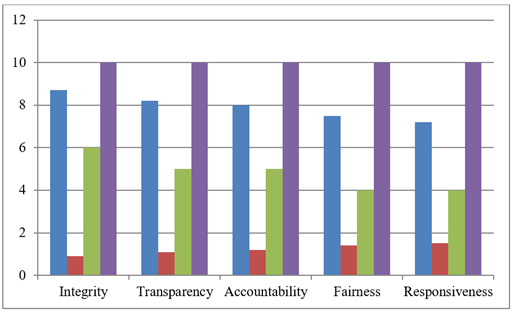
Table 1 shows the scores in the Ethical Compliance of the administrators in the populace in five principles, namely, Integrity, Transparency, Accountability, Fairness, and Responsiveness. The table presents the mean score out of 0-10 scale, the standard deviation, the minimum, and the maximum values and the distribution of the adherence levels, of each principle. These scores are graphically presented in Figure 1 with the use of bars to depict the mean level of adherence to each of the five ethical principles and have easy comparison between each other.
Table 1
|
Table 1 Ethical Adherence Scores Among Administrators |
||||
|
Ethical
Principle |
Mean
Score (0-10) |
Std.
Dev |
Minimum |
Maximum |
|
Integrity |
8.7 |
0.9 |
6 |
10 |
|
Transparency |
8.2 |
1.1 |
5 |
10 |
|
Accountability |
8.0 |
1.2 |
5 |
10 |
|
Fairness |
7.5 |
1.4 |
4 |
10 |
|
Responsiveness |
7.2 |
1.5 |
4 |
10 |
Figure 1
|
Figure 1 Graphical Representation of Ethical Adherence Scores Among Administrators |
Table 1 and Figure 1 have shown that the overall results means of the five ethical principles showed that Integrity had the highest adherence score 8.7, next was Transparency 8.2 and Accountability 8.0. Fairness and Responsiveness were rated lower in terms of mean with 7.5 and 7.2 respectively. The standard deviations indicate an inconsistency in the adherence levels between administrators, which is an indication of variance in the degrees of uniformity with which each of the principles was exercised. This has shown that although the basic ethical principles were largely kept, there were still some weaknesses, especially in the areas of Responsiveness and Fairness.
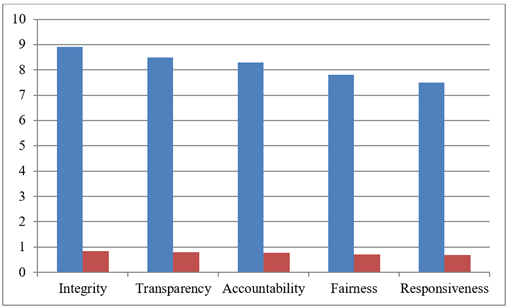
Table 2 shows the Decision-Making Effectiveness Scores of the public administrators in five ethical principles such as Integrity, Transparency, Accountability, Fairness and Responsiveness. The table presents the average decision-making score and correlation with overall governance performance of each of the principles. Figure 2 graphically represents the same data by means of the use of bars to visualize the mean scores of decision-making of each ethical principle, and allows one to compare visually the results across the principles.
Table 2
|
Table 2 Decision-Making Effectiveness Scores by Ethical Principle |
||
|
Ethical
Principle |
Mean
Decision-Making Score |
Correlation
with Governance Score |
|
Integrity |
8.9 |
0.84 |
|
Transparency |
8.5 |
0.79 |
|
Accountability |
8.3 |
0.77 |
|
Fairness |
7.8 |
0.71 |
|
Responsiveness |
7.5 |
0.68 |
Figure 2
|
Figure 2 Graphical Representation of Decision-Making Effectiveness Scores by Ethical Principle |
Table 2 and Figure 2 show that ethical principles were very strong determinants of the effectiveness of decision-making among administrators. The largest mean decision-making score was 8.9 and the value closest to the governance performance (0.84) was Integrity, and the next scores were Transparency (8.5, 0.79), and Accountability (8.3, 0.77). Fairness and Responsiveness had a little less score and correlation. The results of these studies indicate that the greater ethical standards, especially integrity and transparency, are followed, the greater and more efficient is the decision-making process in the field of public administration.
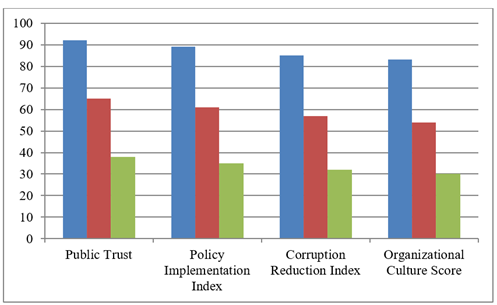
Table 3 shows the results of the governance which are Public Trust, Policy Implementation Index, Corruption Reduction Index, and Organizational Culture Score at three levels of ethical compliance, which are High (8-10), Moderate (5-7), and Low (<5). Graphic representation of the same data in Figure 3 gives a graphic representation of the results of the various indicators of governance in comparison with the various levels of ethical adherence in the form of bars, and a visual comparison of the results is possible across the categories.
Table 3
|
Table 3 Governance Outcomes Based on Ethical Adherence |
|||
|
Governance
Outcome |
High
Ethical Adherence (Score 8-10) |
Moderate
Adherence (Score 5-7) |
Low
Adherence (Score <5) |
|
Public
Trust |
92 |
65 |
38 |
|
Policy
Implementation Index |
89 |
61 |
35 |
|
Corruption
Reduction Index |
85 |
57 |
32 |
|
Organizational
Culture Score |
83 |
54 |
30 |
Figure 3
|
Figure 3 Graphical Representation of Governance Outcomes Based on Ethical Adherence |
The findings in Table 3 and Figure 3 indicate that the greater the ethical compliance of administrators, the greater the governance performance. The highest scores of high ethical adherence (92, 89, 85, and 83) were the highest scores of high ethical adherence in Public Trust, Policy Implementation, Corruption Reduction and Organizational Culture scores. This implies that ethical behaviour directly and quantitatively affects the performance of governance.
The results indicate that there is a definite correlation between the ethical compliance, effectiveness of decision-making, and the performance of governance. The administrators with better marks in ethical principles had more effective decision-making and better governance outcomes in all indicators. The findings demonstrate the importance of ethics in improving administrative effectiveness, citizen confidence and corporate culture.
5. CONCLUSION
In public administration effective governance is utterly ethically oriented to inform the decision-making process and influence organizational culture. The research showed that integrity, transparency, accountability, fairness, and responsiveness in decision making affected, positively, the governance outcomes and effectiveness of decision making such as, public trust and policy implementation, reduction of corruption, and organizational culture. Administrators who remained ethical in all instances performed better in all indicators, and this shows that ethics have a quantifiable contribution to administrative effectiveness and legitimacy. These results indicate the significance of instilling ethical systems in the operations of the people institutions to achieve responsible, transparent, and fair governance, which will guarantee sustainable and credible public administration.
CONFLICT OF INTERESTS
None.
ACKNOWLEDGMENTS
None.
REFERENCES
Androniceanu, A. (2021). Transparency in Public Administration as a Challenge for a Good Democratic Governance. Administratie Si Management Public, (36), 149–164. https://doi.org/10.24818/amp/2021.36-09
Chapman, R. A. (2019). Ethics in Public Service for the New Millennium. In Ethics in Public Service for the New Millennium (217–231). Routledge. https://doi.org/10.4324/9781315191645-14
Dmochowski, M., Jurczuk, A., & Szczepankowski, R. (2019). Ethics in Public Administration. Szczepankowski.
Farazmand, A. (Ed.). (2023). Global Encyclopedia of Public Administration, Public Policy, and Governance. Springer Nature. https://doi.org/10.1007/978-3-030-66252-3
Fejzullahu, A., & Batalli, M. (2019). The Role of Ethics in Public Administration. SEER: Journal for Labour and Social Affairs in Eastern Europe, 22(2), 267–278. https://doi.org/10.5771/1435-2869-2019-2-267
Frederickson, H. G. (2015). Ethics and Public Administration: Some Assertions. In Ethics and public Administration (243–261). Routledge. https://doi.org/10.4324/9781315704524
Herasymiuk, K., Martselyak, O. V., Kirichenko, Y. N., Zhmur, N. V., & Shmalenko, I. I. (2020). Principles of Integrity and Good Governance in Public Administration. International Journal of Management, 11(4).
Koliba, C. J., Meek, J. W., Zia, A., & Mills, R. W. (2017). Governance Networks in Public Administration and Public Policy. Routledge. https://doi.org/10.4324/9781315093451
Maw, N. T. (2020). Ethical Decision-Making in Public Administration (Doctoral Dissertation). MERAL Portal.
Menzel, D. C. (2015). Research on Ethics and Integrity in Public Administration: Moving Forward, Looking Back. Public Integrity, 17(4), 343–370. https://doi.org/10.1080/10999922.2015.1060824
Nabatchi, T. (2018). Public Values Frames in Administration and Governance. Perspectives on Public Management and Governance, 1(1), 59–72. https://doi.org/10.1093/ppmgov/gvx009
Ondrová, D. (2017). Challenges of Modern Public Administration and Ethical Decision-Making. Rocznik Administracji Publicznej, (3), 255–279. https://doi.org/10.4467/24497800RAP.17.015.7066
Perry, J. L., & Christensen,
R. K. (2015). Handbook of Public Administration.
John Wiley & Sons.
Rachmad, Y. E. (2016). Building an Ethical Culture in Public Administration. The United Nations and The Education Training Centre.
Songklin, P. (2016, December). Ethics in Public Administration: Theoretical Foundation. In International Conference on Ethics in Governance (ICONEG 2016) (390–393). Atlantis Press. https://doi.org/10.2991/iconeg-16.2017.87
 This work is licensed under a: Creative Commons Attribution 4.0 International License
© Granthaalayah 2014-2024. All Rights Reserved.