GENDER DIFFERENCES IN STUDENT PARTICIPATION AND PERFORMANCE IN PHYSICAL EDUCATION
V. Prathapreddy Gudimetla 1, Dr. Mukesh Kumar 2
1 Research
Scholar, Physical Education, Sunrise University, Alwar, Rajasthan, India
2 Associate
Professor, Research Supervisor, School of Education and Physical Education,
Sunrise University, Alwar, Rajasthan, India
|
|
|
ABSTRACT |
|
|
The research
examined the gender disparity in student participation and student
performance in Physical Education. The research design adopted was
descriptive and comparative and a sample of 100 students including 50 male
students and 50 female students was taken to carry out the study using a
simple random sampling method. The structured participation questionnaire,
physical fitness tests, skill-based tests, and practical evaluation records
were used to collect the data. The data obtained underwent analysis in the
form of mean, standard deviation, independent t-test, and correlation
analysis. The results showed that there was a statistically significant
difference in the participation scores between the male and the female
students as the male students exhibited more levels of participation in
contrast to the female students. Nevertheless, there was no significant
gender difference in the performance scores meaning that there were similar
performance results between the two groups. Also, participation and performance
were found to be significantly and positively correlated
implying that the more individuals were engaged in the activities of the Physical Education, the better they performed. The
study has outlined to promote equal participation
opportunities and a more inclusive Physical Education environment to improve the student participation and attainment. |
|||
|
Received 13 May 2024 Accepted 22 June 2024 Published 31 July 2024 DOI 10.29121/granthaalayah.v12.i7.2024.6667 Funding: This research
received no specific grant from any funding agency in the public, commercial,
or not-for-profit sectors. Copyright: © 2024 The
Author(s). This work is licensed under a Creative Commons
Attribution 4.0 International License. With the
license CC-BY, authors retain the copyright, allowing anyone to download,
reuse, re-print, modify, distribute, and/or copy their contribution. The work
must be properly attributed to its author.
|
|||
|
Keywords: Gender Differences, Participation,
Performance, Physical Education, Students |
|||
1. INTRODUCTION
Physical Education is important in the overall growth in students since it has the role of ensuring physical fitness, motor skills, mental well-being as well as social interaction. Frequent attendance of Physical Education activities is not only about health-related results but also about discipline, teamwork, leadership and self-confidence. With more emphasis on balanced development within educational institutions, it is necessary to know the factors that determine student engagement and performance in Physical Education.
The issue of gender has been regarded as a critical variable in terms of participation and performance in physical activities. The variations among male and female students can be a result of the physiological conditions, the psychological impact, social requirements, and cultural standards. Male students in most scenarios are usually viewed as being more engaged in sports and female students may face limitations of either not being motivated, given enough opportunities or stereotypical attitudes towards physical abilities.
Although these perceptions have been there, there is recent research, which indicates that performance disparities are not necessarily huge in cases where equal opportunities, facilities, and motivation are given. Patterns of participation, however, can remain different, which affects developing abilities and general performance. Thus, comparing the gender variations in participation and performance provides the worth of understanding the behaviour of a student, his/her engagement, and academic outcomes.
The present study aims to investigate gender disparity in student engagement and achievement in Physical Education. Through a comparison between the level of participation and the level of performance, the research aims to determine whether there are significant differences in the level of participation and performances and to emphasize the need to create an inclusive Physical Education space that enables all students to participate equally and develop.
2. REVIEW OF LITERATURE
Leo et al. (2022) studied the connection between perceived teachers’ behaviour and student engagement on Physical Education with the mediating role of basic psychological needs and self-determination motivation. The research found that supportive teaching behaviours had a positive effect on the engagement of students in terms of improvement of autonomy, competence, and relatedness. The results were able to underline that motivation processes were an important factor which influenced student involvement and engagement in Physical Education environments.
Maro (2018) examined the gender variation in cognitive and affective reactions in the Tanzanian Physical Education setup through the achievement goal framework. The research found that there were variations in the perceptions, emotional reactions and achievement orientations of male and female students. It was noted that gender affected the interpretation of the students with respect to success, effort and competence and hence determining the engagement and experiences of students during Physical Education activities.
Portela-Pino et al. (2020) examined gender variation in motivation and barriers to physical exercise among adolescents. The authors of the study identified that women students had more barriers associated with the body image, the absence of confidence and social support, but the male students exhibited greater intrinsic motivation towards physical activity. The study highlighted those motivation differences and perceived challenges played an important role in influencing differences in the level of participation among genders.
Tanaka et al. (2018) objectively evaluated the physical activity and sedentary time of primary school children in relation to sex, grade, and the kinds of Physical Education lessons. The findings showed significant gender disparity, as the boys tend to have more moderate-vigorous physical activities than girls. The experiment implied that the structure of the lesson and the type of activity had an impact on the movement patterns and the level of participation of the students.
Wang and Chen (2022) measured the satisfaction of psychological needs, self-determined motivation and the level of physical activity among students in Physical Education comparing the results in terms of gender and school level. The research indicated that self-determined motivation and participation in physical activity was highly predicted by satisfaction of psychological needs. Gender differences were noted which means that there are differences in motivational control and activities participation between the male and female students.
3. RESEARCH METHODOLOGY
This section shows the methods and procedures of the study on gender differences in the participation of students and the performance in Physical Education, research design, sampling, variables, data collection tools, analysis methods, and ethical considerations.
3.1. Research Design
The present research study employed the descriptive and comparative research design in the study of gender dissimilarities on student involvement and achievement in the Physical Education. This design was found to be suitable because it allows the researcher to outline the current situations and compare variations of male and female students in a systematic manner. The method assisted in examining the patterns of participation and the outcome of performance without presenting any experimental interference.
3.2. Sample and Sampling Technique
The sample was conducted on a group of 100 students including 50 female students and 50 male students. Simple random sampling method was used to select the participants so that they would be fair and equally have a chance to participate. Even the equal representation of the two sexes made it possible to compare the results meaningfully and enhance their credibility.
3.3. Participants’ Characteristics
The participants were members of the identified age range [insert age group, e.g., 15-18 years / undergraduate students] and attended classes in Physical Education. Only the students who were medically fit and able to take part in physical activities were taken. Students who did not have injuries, physical restrictions or medical complications that would affect their participation in the study or their performance were locked out in order to preserve the validity of the study.
3.4. Variables of the Study
Gender was considered as the independent variable, but it was divided into male and female students. The dependent variables were the student attendance in Physical Education and their performance. Participation included aspects of attendance, engagement, interest and involvement in activities and performance was in the form of physical fitness measures, proficiency in the required skills and also practical assessment outcomes.
3.5. Data Collection Tools
Student participation data were gathered using the instrument of a structured questionnaire that sought to determine the level of attendance, involvement, motivation, and engagement in the Physical Education activities. Physical fitness tests, skill-based evaluation, and academic/practical assessment records were used to determine the performance data. These tools offered qualitative and quantitative data regarding student behaviour and achievement.
3.6. Procedure of Data Collection
Participants were informed on the purpose and importance of the study and agreed to participate in the study before gathering the data. The participation questionnaire was conducted in a controlled setting to guarantee that there were clarity and accuracy of the responses. Fitness tests, skills tests and teacher recordings were summarized to make sure that performance-related data was objective and consistent.
3.7. Statistical Techniques Used
The data collected were analyzed using the descriptive and inferential statistical methods. Mean and standard deviation were calculated to describe participation and performance scores. Independent t-test was used to identify the significance of the differences between the male and female students.
3.8. Ethical Considerations
Ethical considerations were so strongly followed in the study. The research was voluntary and confidentiality was taken into account, and the data gathered were only used in the research. The participants were assured that their answers were to be anonymous and that this would not interfere with their academic achievement.
4. RESULT AND DISCUSSION
This section gives the data collected analysis and interpretation to discuss the gender variations in participation and performance among students in Physical Education. The research findings have been tabulated and plotted in terms of figures so as to easily compare the scores of participations, performance and the correlation existing between participation and performance.
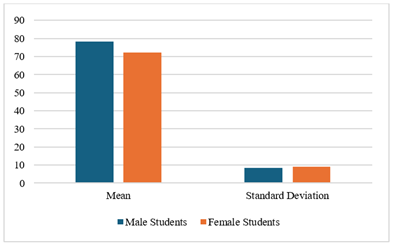
Table 1 shows comparative statistics of the participation scores of male and female students with the sample size (N), mean, standard deviation, and the t-value obtained. The table is a quantitative summary of central tendency and variability in participation levels of both groups of genders. In line with this, in Figure 1, the average and standard deviation of the participation scores is graphically illustrated, which allows comparing the pattern of participation between the male and the female students visually.
Table 1
|
Table 1 Comparison of Participation Scores between Male and Female Students |
||||
|
Gender |
N |
Mean |
Standard Deviation |
t-value |
|
Male Students |
50 |
78.4 |
8.25 |
3.21* |
|
Female Students |
50 |
72.1 |
9.1 |
|
|
*Significant at
0.05 level |
||||
Figure 1
|
Figure 1 Mean and Standard Deviation of Participation Scores of Male and Female Students |
The results show that the male learners (Mean = 78.40, SD = 8.25) were scoring higher on the participation scores compared to the female learners (Mean = 72.10, SD = 9.10). The t -value of (3.21) is noteworthy at the 0.05 level which implies that there is a statistically significant difference in participation between the two genders. This implies that the male learners were more engaged in the Physical Education activities. The difference can be explained by the fact that they may be more interested in sports, more confident in physical activities, or have influences on participation behaviour by their sociocultural background.
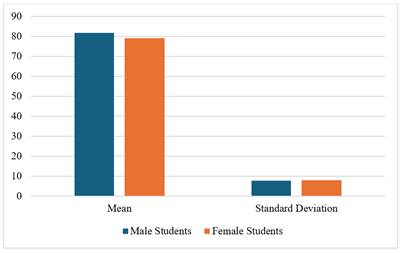
Table 2 shows comparative results of the performance ratings of male and female students with the sample size (N), mean, standard deviation, and t-value calculated. The table allows summarizing the central tendency and dispersion of the performance outcomes of the two genders. The comparison of mean performances scores in terms of male and female students is visually represented in Figure 2 that gives a graphical representation of performance differences between male and female students.
Table 2
|
Table 2 Parison of Performance Scores Between Male and Female Students |
||||
|
Gender |
N |
Mean |
Standard Deviation |
t-value |
|
Male Students |
50 |
81.75 |
7.8 |
1.68 |
|
Female Students |
50 |
79.2 |
8.05 |
|
Figure 2
|
Figure 2 Comparison of Mean Performance Scores between Male and Female Students |
The results demonstrate that the performance scores of male students (Mean = 81.75, SD = 7.80) were a little higher in contrast to female students (Mean = 79.20, SD = 8.05). Calculated t-value (1.68) is however not significant at level of 0.05 and hence the difference observed is not significant. This implies that the level of performance of both the male and female students in Physical Education was not different. The finding means that though they have little differences, gender did not have a significant effect on student performance outcomes.
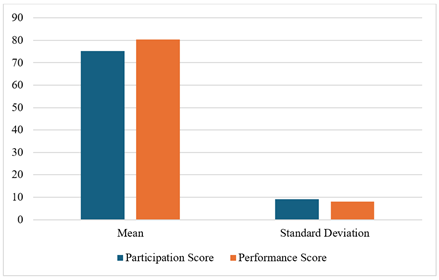
Table 3 is used to provide the statistical summary of the scores of participations and performance with their mean values, standard deviations, and calculated coefficient of correlation (r). The table indicates the relationship between the two variables since it demonstrates the central tendency and variability of the variables. Fig 3 presents the relationship between participation and performance graphically where we can have a visual representation of the relationship between the two variables.
Table 3
|
Table 3 Relationship between Participation and Performance |
|||
|
Variable |
Mean |
Standard Deviation |
Correlation (r) |
|
Participation Score |
75.25 |
9.05 |
0.62* |
|
Performance Score |
80.48 |
7.95 |
|
|
*Significant at 0.05 level |
|||
Figure 3
|
Figure 3 Graphical Representation of Relationship between Participation and Performance |
The correlation analysis shows that there is a positive correlation between participation and performance (r = 0.62), which has a significant value (0.05). This is an indication that the higher the level of participation by the students the better their performance in Physical Education. The result highlights that active participation, engagement and attendance in physical education activities are linked with better physical fitness and skill results.
5. CONCLUSION
The present research investigated gender variation in student attendance and achievement in Physical Education in a descriptive and comparative method. The results showed the statistically significant difference in participation levels, as the male students presented a higher score in the participation compared to the female students. There was, however, no significant sex difference in performance scores which suggests that both boys and girls had similar performance when evaluated by use of physical fitness tests and skill-based tests. Moreover, a positive, significant correlation between participation and performance emerged to show that the more individuals were involved in the activities of the Physical Education, the better they performed on them. These findings indicate that although gender differences can affect the participation behaviour, there are no significant differences in performance abilities between genders. The research highlights the necessity of encouraging equal opportunities in participation, greater motivation of the female students, and an inclusive Physical Education atmosphere to make all learners equally engaged and developed.
CONFLICT OF INTERESTS
None.
ACKNOWLEDGMENTS
None.
REFERENCES
Aguillon, S. M., Siegmund, G. F., Petipas, R. H., Drake, A. G., Cotner, S., and Ballen, C. J. (2020). Gender Differences in Student Participation in an Active-Learning Classroom. CBE—Life Sciences Education, 19(2), Article ar12. https://doi.org/10.1187/cbe.19-03-0048
Bang, H., Won, D., and Park, S. (2020). School Engagement, Self-Esteem, and Depression of Adolescents: The Role of Sport Participation and Volunteering Activity and Gender Differences. Children and Youth Services Review, 113, Article 105012. https://doi.org/10.1016/j.childyouth.2020.105012
Behzadnia, B., Adachi, P. J., Deci, E. L., and Mohammadzadeh, H. (2018). Associations Between Students' Perceptions of Physical Education Teachers' Interpersonal Styles and Students' Wellness, Knowledge, Performance, and Intentions to Persist at Physical Activity: A Self-Determination Theory Approach. Psychology of Sport and Exercise, 39, 10–19. https://doi.org/10.1016/j.psychsport.2018.07.003
Chen, W., Hammond-Bennett, A., Hypnar, A., and Mason, S. (2018). Health-Related Physical Fitness and Physical Activity in Elementary School Students. BMC Public Health, 18(1), Article 195. https://doi.org/10.1186/s12889-018-5107-4
Ferriz-Valero, A., Østerlie, O., García Martínez, S., and García-Jaén, M. (2020). Gamification in Physical Education: Evaluation of Impact on Motivation and Academic Performance within Higher Education. International Journal of Environmental Research and Public Health, 17(12), Article 4465. https://doi.org/10.3390/ijerph17124465
Fierro-Suero, S., Sáenz-López, P., Carmona-Márquez, J., and Almagro, B. J. (2022). Achievement Emotions, Intention to be Physically Active, and Academic Achievement in Physical Education: Gender differences. Journal of Teaching in Physical Education, 42(1), 114–122. https://doi.org/10.1123/jtpe.2021-0230
Gholidahaneh, M., Ghorbani, S., and Esfahaninia, A. (2020). Effects of Basic Psychological Needs Satisfaction in Physical Education on Leisure-Time Physical Activity Behaviour of Primary School Students: Mediating Role of Autonomous Motivation.
Jansson, A., Sundblad, G. B., Lundvall, S., Bjärsholm, D., and Norberg, J. R. (2022). Gender Differences and Inequality? A 20-Year Retrospective Analysis Based on 39,980 Students' Perceptions of Physical Education in Sweden. Journal of Teaching in Physical Education, 42(2), 371–382. https://doi.org/10.1123/jtpe.2021-0270
Kessels, U., Heyder, A., Latsch, M., and Hannover, B. (2018). How Gender Differences in Academic Engagement Relate to Students' Gender Identity. In Gender and educational achievement (116–125). Routledge.
Kuśnierz, C., Rogowska, A. M., and Pavlova, I. (2020). Examining Gender Differences, Personality Traits, Academic Performance, and Motivation in Ukrainian and Polish Students of Physical Education: A Cross-Cultural Study. International Journal of Environmental Research and Public Health, 17(16), Article 5729. https://doi.org/10.3390/ijerph17165729
Leo, F. M., Mouratidis, A., Pulido, J. J., López-Gajardo, M. A., and Sánchez-Oliva, D. (2022). Perceived Teachers' Behaviour and Students' Engagement in Physical Education: The Mediating Role of Basic Psychological Needs and Self-Determined Motivation. Physical Education and Sport Pedagogy, 27(1), 59–76. https://doi.org/10.1080/17408989.2020.1850667
Maro, C. N. (2018). Gender Differences on Cognitive and Affective Responses within Tanzanian Physical Education Context: Achievement Goal Approach. Situations, 30, 41.
Portela-Pino, I., López-Castedo, A., Martínez-Patiño, M. J., Valverde-Esteve, T., and Domínguez-Alonso, J. (2020). Gender Differences in Motivation and Barriers for the Practice of Physical Exercise in Adolescence. International Journal of Environmental Research and Public Health, 17(1), Article 168. https://doi.org/10.3390/ijerph17010168
Tanaka, C., Tanaka, M., and Tanaka, S. (2018). Objectively Evaluated Physical Activity and Sedentary Time in Primary School Children by Gender, Grade, and Types of Physical Education Lessons. BMC Public Health, 18(1), Article 948. https://doi.org/10.1186/s12889-018-5910-y
Wang, L., and Chen, R. (2022). Psychological Needs Satisfaction, Self-Determined Motivation, and Physical Activity of Students in Physical Education: Comparison Across Gender and School Levels. European Journal of Sport Science, 22(10), 1577–1585. https://doi.org/10.1080/17461391.2021.1978558
 This work is licensed under a: Creative Commons Attribution 4.0 International License
© Granthaalayah 2014-2024. All Rights Reserved.