HUMAN IMPACTS ON BIODIVERSITY AND ECOSYSTEMS THROUGH THE LENS OF CONSERVATION BIOLOGY
Arelli Raj Kumar 1 , Dr. Sunil Chauhan 2

1 Research
Scholar, Zoology, Sunrise University, Alwar, Rajasthan, India
2 Research
Supervisor, School of Science, Sunrise University, Alwar, Rajasthan, India
|
|
|
ABSTRACT |
|
|
Human
activities are also being cited as the greatest causes of loss of
biodiversity and degradation of eco systems across the globe. This paper will
address the anthropogenic forces of degrading biodiversity and ecosystems
using the context of conservation biology with a major emphasis on the
following anthropogenic agents as habitats, pollutants, global warming,
overexploitation, and invasive species. The study examines the impacts of
these drivers on the biodiversity and ecosystem processes and ecological
stability of various ecosystems. It also evaluates the impacts of loss of
biodiversity due to human activities on ecosystem services, interactions
between species and the ecological stability and sustainability at long-term.
Besides, the investigation examines the success of conservation biology
measures and interventions in reducing anthropogenic impacts and facilitating
ecosystem restoration. The combination of conservation biology and
evidence-based methods in the study outlines the important ways to enhance
the biodiversity conservation and ecosystem restoration, which can be useful
in conservation planning and sustainable environmental management. |
|||
|
Received 09 June
2024 Accepted 12 July 2024 Published 31 August 2024 Corresponding Author Anjay
Kumar Mishra, anjaymishra2000@gmail.com DOI 10.29121/granthaalayah.v12.i8.2024.5110 Funding: This research
received no specific grant from any funding agency in the public, commercial,
or not-for-profit sectors. Copyright: © 2024 The
Author(s). This work is licensed under a Creative Commons
Attribution 4.0 International License. With the
license CC-BY, authors retain the copyright, allowing anyone to download,
reuse, re-print, modify, distribute, and/or copy their contribution. The work
must be properly attributed to its author.
|
|||
|
Keywords: Biodiversity Loss, Anthropogenic Impacts,
Ecosystem Functioning, Conservation Biology, Ecosystem Services |
|||
1. INTRODUCTION
The basis of ecosystem functionality, structure, and resilience is biodiversity, which promotes ecological processes that are important in sustaining the ecosystem and ecosystem services that are vital to human well-being. Though, high population growth, industrialization, urbanization, and increased exploitation of resources have greatly transformed natural ecosystems in the world. Such anthropogenic alterations have increased the pace of species extinctions, ecological interactions, as well as decreasing genetic, species and ecological diversity. The complicated interaction of human actions and the decline of the biodiversity have thus been a primary concern of ecological research and environmental management.
Conservation biology is a syntactic approach to scientific examination of the effects of anthropogenic stresses on biodiversity and ecosystems. Conservation biology tries to understand how human actions destabilize ecological processes and ecosystem functioning through the examination of habitat fragmentation, pollution, climate change, and overexploitation of biological resources and the introduction of invasive species. This discipline highlights the significance of biodiversity conservation not only with regard to the survival of species but also long-term sustainability of ecosystem processes and services through the combination of ecological theory and empirical evidence.
Against this backdrop, the current paper examines human contributions to biodiversity and ecosystems using the prism of conservation biology with specific regards to ecological resilience, ecosystem services, and conservation interventions. Comparing the causes and effects of the destruction in biodiversity, the research seeks to emphasize the importance of conservation measures in reducing the negative changes that are caused by humans on the environment. This is much needed in informing the effective conservation planning, making policy decisions, and ensuring sustainable relations of human societies to natural ecosystems.
2. LITERATURE REVIEW
Millhauser and Earle (2022) studied biodiversity using long-term human history, and showed that the interaction between humans and the environment in the past played a key role in determining the current ecosystems. Their article highlighted historical and archaeological views as valuable sources of information on the tendencies of species adaptation, landscape change and survival. The authors maintained that historical knowledge of human activities was critical in guiding the current conservation biology approaches and preventing this simplified thinking about natural ecosystems.
De Faria Lopes (2017) evaluated the role of human bias in ecological research and the propensity of conservation behavior to be culturally and socially and scientifically inordinate. It was observed in the study that ecological analysis did not always consider local knowledge systems and human considerations in biodiversity management. It concluded that conservation success would be strengthened by the integration of ethnobiological perspectives that would bring into harmony ecological ambitions and human behaviours and cultural contexts.
Chase et al. (2020) investigated biodiversity conservation and employed a metacommunity ecology framework and showed how spatial connectivity and species dispersal affected biodiversity among fragmented landscapes. Their results indicated that anthropogenic habitat fragmentation changed the metacommunity structure that resulted in the modification of species compositions and ecosystem processes. The authors indicated that the ecological processes that occur at various spatial scales was advantageous to conservation planning.
McGuire et al. (2023) explored how the past environmental and ecological dynamics shaped the conservation of the biodiversity on a fast-evolving planet. The analysis has emphasized that present distributions of biodiversity and reactions of the ecosystems were influenced by previous climatic changes and anthropogenic land-use. It concluded that the implementation of deep-time perspectives in conservation biology had the positive effect of increasing the ability to anticipate ecological reactions to current and future anthropogenic strains.
3. RESEARCH METHODOLOGY
The research methodology defines the systematic steps followed to explore the effects of human beings on the biodiversity and ecosystems in a conservation biology setup. It describes the research design, sampling strategy, methods of data collection, measurement of variables and analytical procedures that were used to assure scientific rigor and reliability. This approach to methodology allows organised evaluation of genetic influence of anthropogenic pressures, biodiversity reactions, and conservation results.
3.1. Research Design
The research took the descriptive and analytical research design based on the principles of conservation biology. This design was believed to be suitable to study the effects of human activities on the biodiversity and ecosystem operations in a systematic manner with the aim of also studying the conservation-related responses. The study combined ecological and socio-environmental approaches to evaluate the anthropogenic stressors and their effects on the biodiversity patterns, ecological services, and ecological resilience.
3.2. Sample Size and Population
The research was carried out on a sample size of 100 which comprised of the select ecological units and stakeholders involved with biodiversity conservation. This sample was comprised of observations of representative terrestrial and freshwater ecosystems with different levels of human disturbance. The areas of study included ecologically important areas that are under anthropogenic stresses that include habitat alteration, pollution and resource misuse. The areas were chosen to ensure that they represented a variety of ecological conditions and conservation issues so that the full impact of humans on the ecosystems can be considered.
3.3. Data Collection Methods
In the study, both primary and secondary data were used. Structured field observations, ecological surveys and standardized questionnaires that were given to respondents engaged in environmental management and conservation practices were used to collect primary data. Peer-reviewed journals, conservation reports, government publications, and databases that covered biodiversity and ecosystem studies were used to gather secondary data. Such a mixture guaranteed data consistency and the depth of research analysis.
3.4. Variables and Measurement
The anthropogenic drivers (loss of habitation, pollution, effects of climate change, overexploitation, and invasive species) were taken as the independent variables in the study. Dependent variables were biodiversity indicators (species richness, abundance and diversity indices) and ecosystem attributes (eco systems services, ecological resilience and ecosystem functioning). Measurement was done through the previously known ecological indicators, survey-based indices and qualitative assessment scales that are generally used in conservation biology studies.
3.5. Data Analysis
Descriptive and inferential statistical analyses procedures were utilized to analyze the collected data. The frequency distributions, percentages, and means were the descriptive statistics that were used to summarize the patterns of human impacts and biodiversity responses observed. Relationships between anthropogenic drivers and biodiversity indicators were investigated with the help of inferential analysis. An analysis of qualitative data on the field and secondary sources was carried out in terms of their thematic analysis in order to justify quantitative results. The simultaneous analysis made it easy to grasp the full scope of human roles on biodiversity and the conservation strategies that work or do not.
4. RESULT AND DISCUSSION
This section provides and explains the empirical evidence obtained as a result of the analysis of the anthropogenic pressures, biodiversity indices, and ecosystem features over the study region. The findings are classified into three thematic elements that dwell upon the strength of human-made drivers, the tendencies of biodiversity reaction to diverse levels of disturbance, and the way conservation management affects performance in an ecosystem. The combined discussion points out the dynamics between human operations, the condition of biodiversity, and conservation results in a framework of conservation biology.
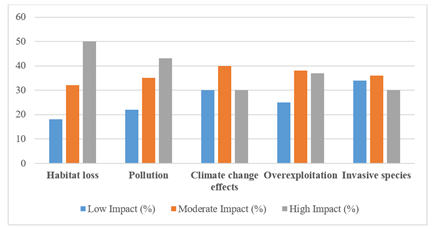
Table 1 shows the distribution of the significant anthropogenic drivers within the study area based on the level of impact of low, moderate, and high impact. The table is a summary of the relative intensity of the habitat loss, pollution, effects of climate changes, over exploitation, and effects of invasive species expressed in percentage representation in the sampled units.
Table 1
|
Table 1 Distribution of Anthropogenic Pressures Across the Study Area |
|||
|
Anthropogenic Driver |
Low Impact (%) |
Moderate Impact (%) |
High Impact (%) |
|
Habitat loss |
18 |
32 |
50 |
|
Pollution |
22 |
35 |
43 |
|
Climate change effects |
30 |
40 |
30 |
|
Overexploitation |
25 |
38 |
37 |
|
Invasive species |
34 |
36 |
30 |
Figure 1
|
Figure 1 Graphical Representation on Distribution of Anthropogenic Pressures across the Study Area |
The evidence shows that loss of habitats and pollution were the most eminent anthropogenic pressures and more percentage of observations lay within the high impact category. The effects of climate change and invasive species were more evenly distributed in the impacts across the levels of influence whereas overexploitation demonstrated moderate to high levels of impact. In general, the table indicates a significant difference in degree of human pressures throughout the study area.
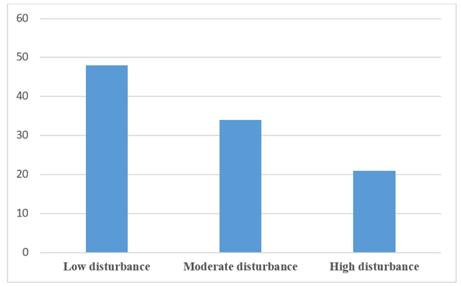
Table 2 shows the biodiversity indicators at the varying levels of human disturbance. It provides an overview of the mean species richness, species abundance, and the Shannon diversity index (H 7) of low disturbance, moderate disturbance, and high disturbance categories within the area of study.
Table 2
|
Table 2 Biodiversity Indicators under Different Levels of Human Disturbance |
|||
|
Level of Disturbance |
Mean Species Richness |
Species Abundance |
Diversity Index
(H′) |
|
Low disturbance |
48 |
High |
3.42 |
|
Moderate disturbance |
34 |
Moderate |
2.61 |
|
High disturbance |
21 |
Low |
1.78 |
Figure 2
|
Figure 3 Graphical Representation on Biodiversity Indicators under Different Levels of Human Disturbance |
These data indicate a steady decrease in the indicators of biodiversity as the level of human disturbance increases. The value of mean species richness and index of diversity under low disturbance was the highest and followed by moderate and high disturbance levels, which showed that there is a negative correlation between the anthropogenic pressure and the biodiversity condition.
Table 3 gives a comparison of important ecosystem characteristics of conserved, moderately managed and poorly managed areas. The table captures changes in the state of ecosystem services, ecological resilience, ecosystem services functioning and total biodiversity in varying conditions of conservation management.
Table 3
|
Table 3 Ecosystem Attributes and Conservation Outcomes |
|||
|
Ecosystem Attribute |
Conserved Areas |
Moderately Managed
Areas |
Poorly Managed Areas |
|
Ecosystem services
status |
High |
Moderate |
Low |
|
Ecological resilience |
Strong |
Moderate |
Weak |
|
Ecosystem functioning |
Stable |
Partially stable |
Degraded |
|
Overall biodiversity
level |
High |
Moderate |
Low |
The data demonstrate that conserved areas performed more with all the attributes whereas poorly controlled areas performed less ecosystem services, weak resilience, and poor functioning. The intermediate conditions seen in moderately managed areas indicated the conservation management has a very crucial role to play in ensuring the health and the biodiversity of the ecosystem.
5. CONCLUSION
The results of this paper have shown that human actions have very important and quantifiable effects on the biotic and abiotic properties of the environment, and habitat loss and pollution by human actions have proven to be the most powerful anthropogenic factors in the study area. The monitored reduction in species richness, abundance, and diversity with the rising rates of human disturbance indicates the pressures of human presence on the ecosystems being highly sensitive and the adverse correlations between biodiversity loss and ecosystem stability. Also, a comparative study on the ecosystem characteristics showed that the conserved areas had enhanced ecosystem services, better ecological resilience, and stable functioning compared to moderately managed and poorly managed areas. This finding highlights the importance of proper conservation management as a means of reducing the degradation caused by humans and supporting the biodiversity. The study, on the whole, supports the significance of applying the principles of conservation biology to the process of environmental planning and management in order to support the long-term ecological sustainability and conservation of biodiversity.
CONFLICT OF INTERESTS
None.
ACKNOWLEDGMENTS
None.
REFERENCES
Aisher, A., and Damodaran, V. (2016). Introduction: Human-Nature Interactions through a Multispecies lens. Conservation and Society, 14(4), 293-304. https://doi.org/10.4103/0972-4923.197612
Angeler, D. G. (2016). Viewing Biodiversity Through the Lens of Science… and art! SpringerPlus, 5(1), 1174. https://doi.org/10.1186/s40064-016-2831-z
Castillo-Figueroa, D. (2018). Beyond Specimens: Linking Biological Collections, Functional Ecology and Biodiversity Conservation. Revista Peruana de Biología, 25(3), 343-348. https://doi.org/10.15381/rpb.v25i3.14246
Chase, J. M., Jeliazkov, A., Ladouceur, E., and Viana, D. S. (2020). Biodiversity Conservation Through the lens of Metacommunity Ecology. Annals of the New York Academy of Sciences, 1469(1), 86-104. https://doi.org/10.1111/nyas.14378
Cole, B., Bradley, A. V., Willcock, S., Gardner, E., Allinson, E., Hagen‑Zanker, A., … Whelan, M. (2023). Using a Multi‑Lens Framework for Landscape Decisions. People and Nature, 5(4), 1050-1071. https://doi.org/10.1002/pan3.10474
Comizzoli, P., Brown, J. L., and Holt, W. V. (Eds.). (2019). Reproductive Sciences in Animal Conservation (1-10). Springer. https://doi.org/10.1007/978-3-030-23633-5_1
Correia, A. M., and Lopes, L. F. (2023). Revisiting Biodiversity and Ecosystem Functioning Through the lens of Complex Adaptive Systems. Diversity, 15(8), 895. https://doi.org/10.3390/d15080895
De Faria Lopes, S. (2017). The Other Side of Ecology: Thinking about the Human Bias in our Ecological Analyses for Biodiversity Conservation. Ethnobiology and Conservation, 6. https://doi.org/10.15451/ec2017-08-6.14-1-24
Evans, M. C. (2021). Re‑Conceptualizing the role(s) of Science in Biodiversity Conservation. Environmental Conservation, 48(3), 151-160. https://doi.org/10.1017/S0376892921000114
McGuire, J. L., Lawing, A. M., Díaz, S., and Stenseth, N. C. (2023). The Past as a lens for Biodiversity Conservation on a Dynamically Changing Planet. Proceedings of the National Academy of Sciences, 120(7), e2201950120. https://doi.org/10.1073/pnas.2201950120
Miličić, M., Popov, S., Branco, V. V., and Cardoso, P. (2021). Insect Threats and Conservation Through the Lens of Global Experts. Conservation Letters, 14(4), e12814. https://doi.org/10.1111/conl.12814
Millhauser, J. K., and Earle, T. K. (2022). Biodiversity and the Human Past: Lessons for Conservation Biology. Biological Conservation, 272, 109599. https://doi.org/10.1016/j.biocon.2022.109599
Taggart‑Hodge, T. D., and Schoon, M. (2016). The Challenges and Opportunities of Transboundary Cooperation Through the Lens of the East Carpathians Biosphere Reserve. Ecology and Society, 21(4). https://doi.org/10.5751/ES-08669-210429
Vilà, M., Dunn, A. M., Essl, F., Gómez‑Díaz, E., Hulme, P. E., Jeschke, J. M., … Gallardo, B. (2021). Viewing Emerging Human Infectious Epidemics through the Lens of Invasion Biology. BioScience, 71(7), 722-740. https://doi.org/10.1093/biosci/biab047
Wittman, H., Chappell, M. J., Abson, D. J., Kerr, R. B., Blesh, J., Hanspach, J., … Fischer, J. (2017). A Social-Ecological Perspective on Harmonizing Food Security and Biodiversity Conservation. Regional Environmental Change, 17(5), 1291-1301. https://doi.org/10.1007/s10113-016-1045-9
 This work is licensed under a: Creative Commons Attribution 4.0 International License
© Granthaalayah 2014-2024. All Rights Reserved.