EXAMINING THE ROLE OF ARTIFICIAL INTELLIGENCE IN ENHANCING PERSONALIZATION STRATEGIES AND CUSTOMER EXPERIENCE IN E-COMMERCE
G. Mukund 1, Dr. Harshit Tripathi 2
1 Research
Scholar (Commerce) Sunrise University, Alwar, Rajasthan, India
2 Assistant Professor, Research Supervisor, School
of Commerce and Management Studies, Sunrise University, Alwar, Rajasthan,
India
|
|
|
ABSTRACT |
|
|
The swift
development of e-commerce has made it highly significant that businesses are
able to provide extremely customized shopping experiences to maintain the
level of customer loyalty and elevate the level of satisfaction. The tool of
Artificial Intelligence (AI) has become a decisive instrument in advancing
personalization strategies based on the data analytics, machine learning, and
predictive algorithms. This study explores the use of AI to understand how it
can be used to improve personalization and make the customer experience
better in online stores. The goal of the study is to examine the different AI
technologies that have been implemented to achieve personalization, how they
have affected customer engagement and customer satisfaction and the challenges
and practices linked with the deployment of AI solutions such as ethical
considerations and data privacy considerations. Drawing upon the present
practices and the results, the study offers clues to the opportunities of
integrating AI strategically to maximize the level of personalization, to
provide excellent customer experience, and to remain competitive in the
digital market. It is assumed that the findings will add to the academic
knowledge as well as the practical implementation of AI-based personalization
in e-commerce. |
|||
|
Received 07 February 2024 Accepted 08 March 2024 Published 30 April 2024 DOI 10.29121/granthaalayah.v12.i4.2024.6664 Funding: This research
received no specific grant from any funding agency in the public, commercial,
or not-for-profit sectors. Copyright: © 2024 The
Author(s). This work is licensed under a Creative Commons
Attribution 4.0 International License. With the
license CC-BY, authors retain the copyright, allowing anyone to download,
reuse, re-print, modify, distribute, and/or copy their contribution. The work
must be properly attributed to its author.
|
|||
|
Keywords: Artificial Intelligence (AI),
Personalization Strategies, Customer Experience, E-Commerce, Data Privacy |
|||
1. INTRODUCTION
The e-commerce phenomenon has changed how consumers mix with businesses turning the conventional shopping experiences to interactive, online platforms due to its fast development. Personalization has become a major difference maker in this dynamic environment, where businesses can tailor products, services and marketing plans in line with the tastes of each customer. Having consumer data in large volumes, businesses have the opportunity as well as the challenge of providing tailored experiences to their customers, which results in customer satisfaction and retention. AI has emerged as a crucial resource in this respect, providing more sophisticated features, including machine learning, predictive analytics, and recommendation engines that could enable e-commerce platforms to know, assume, and act on customer needs better.
The personalization that is AI-based allows the e-commerce companies to leave the generic marketing and the general user experience. A platform is able to make personalized product suggestions, offer personalized promotions, and even offer instant customer service through smart algorithms based on browsing records, shopping history, and social media, making it possible to personalize product recommendations, personalized promotions, as well as provide real-time customer service. This does not only boost customer participation but the entire shopping experience thus resulting in better conversion rate and brand loyalty. Having adopted AI technologies in the approach to personalization, the companies will have an upper hand in the market that is becoming more relevant, convenient, and immediate.
Along with its advantages, the use of AI in e-commerce has its problems. The application of AI-based personalization implies that the information about consumers should be carefully handled, privacy rules must be observed, and ethical implications of automated decision making should be considered. Also, companies have to make sure that AI systems are open, objective and correspond to the expectations of consumers. This is essential to understand these challenges, as well as the strategies that result in the successful integration of AI to make it even more effective in terms of personalization and improving the overall customer experience. This study aims to examine these aspects and offer insights on how AI will be used to create personalized, customer-centric e-commerce settings.
2. LITERATURE REVIEW
Upreti et al. (2023) researched the application of artificial neural networks in e-commerce, as well as, personalization and customer experience. They established that AI enabled neural networks were effective in examining the customer behavior, such as browsing and purchasing patterns, to provide individualized recommendations. This personalization enhanced user interaction, decision making during purchases, and improved the overall customer satisfaction showing the promise of AI to turn the ordinary e-commerce platforms into dynamic and customer-focused systems.
Rafi (2023) explored the role of AI in customer experience in online more. The case study has underscored that the AI technology used to facilitate communication between customers and the organization like chatbots, virtual assistants, and predictive analytics were helpful in streamlining customer communication and enhancing efficiency in their services. Individual advice and live support were found to enhance convenience and feeling of care thus, customer satisfaction and loyalty. The study highlighted the use of AI as a strategic instrument of establishing smooth and responsive shopping experiences.
Ifekanandu et al. (2023) considered how AI has helped to increase customer loyalty by working on personalization. They discovered that tailored experiences, which are based on AI, like personalized promotions and product suggestions, enhanced engagement and re-purchasing. Personalization served as one of the primary mediators between AI adoption and customer loyalty, which highlights the relevance of personalized experience in the context of establishing long-lasting customer relationships in e-commerce.
Daqar and Smoudy (2019) examined the role of AI in customer experience operationally. They stated that AI automated the routine and made custom recommendations that made the process more effective and satisfying to users. The capability of AI in predicting customer needs and providing consistent and relevant interactions increased engagement and value addition, and this attribute illustrates how AI can be used to improve the quality of services and competitiveness in online markets.
3. RESEARCH METHODOLOGY
This study explore how Artificial Intelligence (AI) can be used to increase personalization strategies and customer experience within the e-commerce industry. A research methodology has been crafted in a systematic way that will allow to gather, analyze and interpret the data so that reliability and validity of results will be ensured. The methodology has been outlined in the following sub-sections.
3.1. Research Design
The research took a descriptive research design in order to examine the implementation and the impact of AI technologies on customer experience in e-commerce platforms. The research design suited is descriptive research because it gives an in-depth knowledge of the current practices, trends and patterns without manipulating the study environment. With this design, the study examines the connection between AI-based strategies of personalization and customer engagement and satisfaction and loyalty, offering information about the usefulness and difficulties of AI implementation in e-commerce.
3.2. Sample Size and Population
The researchers used e-commerce users in Delhi, India as the study location because the area has one of the highest rates of online shopping platforms and AI-driven services. The convenience sampling method was used to select a sample of 200 respondents. The respondents were selected among those who are familiar with using e-commerce platforms, where AI technologies are applied, and it was assumed that they would be able to give relevant and informed information about the personalization strategies and customer experience. The sample size was found to be adequate in order to represent the study population and give statistically significant results.
3.3. Data Collection Method
The structured questionnaire was used to collect primary
data to measure the perceptions, experiences, and satisfaction of the users
with AI-driven personalization in e-commerce. The questionnaire was composed of
closed-ended and Likert-scale questions to assess different factors of
experiences, engagement, and customer satisfaction. The secondary data was also
examined based on the existing literature, academic journals, reports, and case
studies on AI in e-commerce to reinforce the primary findings and also to
provide a theoretical framework of the study.
3.4. Variables and Measurement
The variables that were taken into account in the study were the following:
· Independent Variable: The use and adoption of AI in e-commerce, which can be measured by the availability and adoption of AI-based tools: recommendation systems, chatbots, predictive analytics, and personalization algorithms.
· Dependent Variables: Customer engagement, satisfaction and overall shopping experience, assessed on the Likert-scale statements (e.g., strongly agree to strongly disagree) and using such metrics as perceived convenience, relevance of recommendations, and desire to continue using AI-enabled services.
· Control Variables: Demographics such as age, gender, education and frequency of online shopping, in order to control differences in user experience and perception.
3.5. Data Analysis
The data obtained was examined through quantitative methods of statistics. The demographics and general perceptions towards AI adoption were summarized using descriptive statistics such as the mean, frequency and percentage distribution. The correlation and regression analysis were used as inferential statistics to compute the correlation between AI implementation and the results of customer experience. The analysis aided in determining the success of personalization strategies based on AI and their effects on engagement and satisfaction and any considerable challenges experienced by users.
4. RESULT AND DISCUSSION
In this section, one can find the results of the research conducted on the application of the Artificial Intelligence (AI) in the context of improving personalization strategies and customer experience in online shopping. The analysis of the data of 200 respondents was based on the descriptive and inferential statistics and the obtained results are reflected in the context of the research purposes.
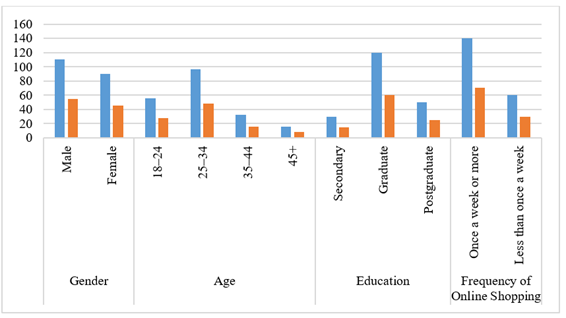
Table 1 is the demographic profile of respondents that took part in the study. The independent variables in the table are, gender, age, education and frequency of online shopping. A clear categorization of respondents has also been given in the table with the frequency and percentage of each category. Figure 1, which provides a graphical representation of the demographic distribution, is attached to it in order to summarize the characteristics of the study sample visually.
Table 1
|
Table 1 Demographic Profile of Respondents |
|||
|
Demographic Variable |
Category |
Frequency |
Percentage (%) |
|
Gender |
Male |
110 |
55 |
|
Female |
90 |
45 |
|
|
Age |
18–24 |
56 |
28 |
|
25–34 |
96 |
48 |
|
|
35–44 |
32 |
16 |
|
|
45+ |
16 |
8 |
|
|
Education |
Secondary |
30 |
15 |
|
Graduate |
120 |
60 |
|
|
Postgraduate |
50 |
25 |
|
|
Frequency of Online
Shopping |
Once a week or more |
140 |
70 |
|
Less than once a week |
60 |
30 |
|
Figure 1
|
Figure 1 Graphical Representation on Demographic Profile of Respondents |
The statistics indicate that 55 percent of the respondents were men and 45 percent were women out of 200 respondents. The highest age group was 2534 years which constituted 48 percent of the sample with 1824 years being the next highest age group (28 percent). Concerning education, most of the respondents expressed a graduate degree (60%), with 25 and 15 expressing postgraduates and secondary qualification respectively. Concerning online shopping habit, 7 out of 10 participants indicated that they have used online shopping at least once in a week meaning that they are very active users of online shopping sites. The demographic features present the full picture of the population under study and can be used to analyze the perceptions and experiences regarding AI-powered personalization of e-commerce.
Table 2 provides a summary of awareness and the usage of different AI-enabled tools among the respondents on the e-commerce websites. The AI devices that were used in the research are product recommendations, customer support chatbots using AI, personalized offers or promotions, and predictive analytics. The table gives the number of respondents that identified each of the tools and the percentage. This detail brings to the fore the high usage and adoption of AI technologies in the e-commerce setting as perceived by the users.
Table 2
|
Table 2 Use of AI-Enabled Tools in E-Commerce Platforms |
||
|
AI Tool |
Respondents Aware |
Percentage (%) |
|
Product
Recommendations |
170 |
85 |
|
AI Chatbots for
Customer Support |
144 |
72 |
|
Personalized
Offers/Promotions |
130 |
65 |
|
Predictive Analytics |
112 |
56 |
The report shows that most respondents (85) had heard about AI-based product suggestions, so it is the best-known AI tool. Customers admitted 72 percent of chatbots that will provide support, and 65 percent admitted personalized offers and promotions. A marginally less noticeable to users, predictive analytics was identified by 56% of respondents. These findings indicate that AI is commonly used by e-commerce platforms, and the most evident aspect, which improves the experience and interaction of the user, is the product recommendation system.
Table 3 shows the effect of AI on customer engagement and satisfaction on e-commerce platforms. Four main statements connected with AI-driven recommendations, personalized content, AI-powered customer support, and the shopping experience are included in the table. The perceptions of respondents were determined using a Likert scale and the table indicates the proportion of respondents who agreed with, or strongly agreed with the statement, was neutral or disagreed and strongly disagreed. This gives a general picture regarding the effectiveness of AI tools in improving the shopping experience of the user.
Table 3
|
Table 3 Impact of AI on Customer Engagement and Satisfaction |
|||
|
Statement |
Strongly Agree/Agree
(%) |
Neutral (%) |
Disagree/Strongly
Disagree (%) |
|
AI-driven
recommendations make shopping more convenient |
78 |
12 |
10 |
|
Personalized content
increases engagement with the platform |
70 |
18 |
12 |
|
AI-enabled customer
support improves satisfaction |
68 |
20 |
12 |
|
AI enhances overall
shopping experience |
72 |
15 |
13 |
The findings show that three-quarters of the participants (78 percent) agreed or strongly agreed that AI-based suggestions made shopping more convenient. Equally, 7 out of 10 said that they were more engaged with the platform because of personalized content, and 68 out of 100 said that their satisfaction was elevated because of AI-assisted customer service. On the whole, 72 percent of respondents believed that AI provided them with a better experience in general shopping. These results show that users have a strong positive attitude towards the role of AI in enhancing convenience, engagement, and satisfaction, and it plays an important role in making the e-commerce environment more individualized and convenient to use.
5. CONCLUSION
The article emphasizes the important role of Artificial Intelligence (AI) in the personalization strategy and customer experience in e-commerce. The results show that AI-enhanced applications such as product suggestions, customized offers, predictive analytics, and chatbots are highly adopted and accepted by the customers, and they are useful in making the experience more convenient, interactive, and more satisfying. According to respondents, they enjoyed the tailor-made content and AI-based services and felt connected to e-commerce platforms better. Simultaneously, the research demonstrated obstacles, including the issue of data privacy, irrelevant suggestions at times, and the decrease of human interaction, which makes the implementation of AI ethical and transparent an essential requirement. In general, the study proves that AI does not only enable personalized, customer-focused experiences but also can give e-commerce enterprises an upper hand in a highly dynamic online environment. When approaching the issue of privacy and ethics through a strategic use of AI technologies, companies can maximize the level of personalization, increase customer loyalty, and provide a high-quality user experience, which will help them achieve sustainable growth and long-term interest in online shopping.
CONFLICT OF INTERESTS
None.
ACKNOWLEDGMENTS
None.
REFERENCES
Asante, I. O., Jiang, Y., Hossin, A. M., & Luo, X. (2023). Optimization of Consumer Engagement with Artificial Intelligence Elements on Electronic Commerce Platforms. Journal of Electronic Commerce Research, 24(1), 7–28.
Bawack, R. E., Wamba, S. F., Carillo, K. D. A., & Akter, S. (2022). Artificial Intelligence in E-Commerce: A Bibliometric Study and Literature Review. Electronic Markets, 32(1), 297–338. https://doi.org/10.1007/s12525-022-00537-z
Chen, J. S., Le, T. T. Y., & Florence, D. (2021). Usability and Responsiveness of Artificial Intelligence Chatbot on Online Customer Experience in E-Retailing. International Journal of Retail & Distribution Management, 49(11), 1512–1531. https://doi.org/10.1108/IJRDM-08-2020-0312
Daqar, M. A. M. A., & Smoudy, A. K. (2019). The Role of Artificial Intelligence on Enhancing Customer Experience. International Review of Management and Marketing, 9(4), 22–31. https://doi.org/10.32479/irmm.8166
Gao, Y., & Liu, H. (2023). Artificial Intelligence-Enabled Personalization in Interactive Marketing: A Customer Journey Perspective. Journal of Research in Interactive Marketing, 17(5), 663–680. https://doi.org/10.1108/JRIM-01-2022-0023
Goriparthi, R. G. (2020). AI-Enhanced
Big Data Analytics for Personalized E-Commerce Recommendations. International Journal of Advanced
Engineering Technologies and Innovations, 1(2), 246–261.
Ifekanandu, C. C., Anene, J. N., Iloka, C. B., & Ewuzie, C. O. (2023). Influence of Artificial Intelligence (AI) on Customer Experience and Loyalty: Mediating Role of Personalization. Journal of Data Acquisition and Processing, 38(3), 1936.
Khrais, L. T. (2020). Role of Artificial Intelligence in Shaping Consumer Demand in E-Commerce. Future Internet, 12(12), 226. https://doi.org/10.3390/fi12120226
Li, L., Lin, J., Luo, W., & Luo,
X. R. (2023). Investigating
the Effect of Artificial
Intelligence on Customer Relationship Management Performance in E-Commerce Enterprises. Journal of Electronic
Commerce Research, 24(1), 68–83.
Moura, S., Reis, J. L., & Rodrigues, L. S. (2021). The Artificial Intelligence in the Personalisation of the Customer Journey: A Literature Review.
Patil, M., & Rao, M. (2018, November). Studying the Contribution of Machine Learning and Artificial Intelligence in the Interface Design of E-Commerce Site. In Smart Intelligent Computing and Applications: Proceedings of the Second International Conference on SCI 2018, Volume 2 (197–206). Springer Singapore. https://doi.org/10.1007/978-981-13-1927-3_20
Rafi, A. H. (2023). The Impact of Artificial Intelligence on
Customer Experience in E-Commerce Platforms.
International Journal of Technology, Management and Humanities, 9(04), 118–136.
Rafi, A. H., Alam, S., Shahrin, I., Chowdhury, A. A. A., Shoiab, S., Sayem, U., & Pinon, M. U. (2022). The Role of AI and Chatbots in Enhancing International Customer Experience.
Upreti, K., Gangwar, D., Vats, P., Bhardwaj, R., Khatri, V., & Gautam, V. (2023, August). Artificial Neural Networks for Enhancing E-Commerce: A Study on Improving Personalization, Recommendation, and Customer Experience. In International Conference on Electrical and Electronics Engineering (141–153). Springer Nature Singapore. https://doi.org/10.1007/978-981-99-8661-3_11
Vinaykarthik, B. C. (2022, October). Design of Artificial Intelligence (AI) Based User Experience Websites for E-Commerce Application and Future of Digital Marketing. In 2022 3rd International Conference on Smart Electronics and Communication (ICOSEC) (1023–1029). IEEE. https://doi.org/10.1109/ICOSEC54921.2022.9952005
 This work is licensed under a: Creative Commons Attribution 4.0 International License
© Granthaalayah 2014-2024. All Rights Reserved.