Original Article
IN VITRO ANTIBACTERIAL POTENTIAL OF DIFFERENT COMBINATION OF PLANT EXTRACT OF SOME COMMON WEED PLANTS AGAINST XANTHOMONAS ORYZAE AND AGROBACTERIUM SPP
|
Tanushri Saha
1*, Suchi Modi 1 1 Department of Botany,
Rabindranath Tagore University, Mendua, Bhopal
464993, Madhya Pradesh, India |
|
|
|
ABSTRACT |
||
|
The present study investigates the antibacterial activity of various polyherbal combinations against two significant plant pathogens, Xanthomonas oryzae (ATCC 35933) and Agrobacterium spp. (ATCC 12210), both of which are known to cause major crop losses. Using the agar well diffusion method, five different polyherbal combinations (F-1 to F-5) were evaluated at a concentration of 100 mg/ml. The results showed a progressive increase in antibacterial activity from F-1 to F-5, with F-5 exhibiting the largest zones of inhibition—21 mm against X. oryzae and 25 mm against Agrobacterium spp. This enhanced activity is attributed to the synergistic action of phytochemicals within the polyherbal mix. The findings highlight the potential of polyherbal combinations as eco-friendly biopesticides and suggest that such natural alternatives could play a significant role in sustainable agricultural practices. Further studies are recommended to validate these results under field conditions and optimize formulations for commercial use. Keywords: Polyherbal Combination, Antibacterial
Activity, Xanthomonas Oryzae, Agrobacterium Spp., Biopesticide, Phytochemicals,
Sustainable Agriculture, Zone of Inhibition |
||
INTRODUCTION
Pathogenic
bacteria present a major threat to global agriculture, causing significant
yield losses in economically important crops and threatening food security. To
combat these pathogens, chemical bactericides are widely employed. While
effective, their indiscriminate use poses severe ecological risks.
Chemical
pesticides not only eliminate harmful microorganisms but also disrupt the
balance of beneficial microbes and insects in the environment. This contributes
to biodiversity loss, soil degradation, and the emergence of resistant
microbial strains, challenging long-term agricultural sustainability.
In response to
these concerns, biopesticides have gained attention as safer, eco-friendly
alternatives. Derived from natural sources such as microbes, plant extracts,
and biochemical compounds, biopesticides offer targeted pathogen control with
minimal harm to non-target organisms and the environment.
Among natural
sources, weed plants are particularly promising. These species are widespread,
low-maintenance, and often resistant to herbivores and microbial infections due
to their inherent chemical defenses Saha and Modi (2024). Their bioactive compounds
offer potential for use in natural plant protection formulations.
The present study
investigates the antibacterial efficacy of aqueous extracts from seven commonly
occurring weed species—Datura metel, Alternanthera sessilis, Calotropis gigantea, Argemone mexicana, Tridax procumbens, Lantana camara, and Sida acuta. These
extracts were tested against Agrobacterium spp and
Xanthomonas oryzae, to assess their
potential as natural alternatives to synthetic bacteriocides,
aiming to promote sustainable agricultural practices.
Material and method
Collection of Plant Material
In the present
study, a total of seven weed plants were selected: Datura metel,
Alternanthera sessilis, Calotropis gigantea, Argemone
mexicana, Tridax procumbens, Lantana camara, and Sida
acuta. These plants were chosen based on their well-documented antimicrobial
properties, as reported in previous research studies. The plant materials were
collected from areas in and around Bhopal, Madhya Pradesh, India. After
collection, the plants were taxonomically identified and authenticated by Dr.
Suman Mishra, CEO of the Herbal Testing and Research Laboratory, Bhopal, Madhya
Pradesh, India. Detailed information about the selected weed plants is
presented in Table 1.
Processing of Plant Material for Extraction
After collecting
the weed plants, the next step is to prepare them for extraction. First, the
collected plant material is thoroughly washed and cleaned to remove dirt and
impurities. The cleaned material is then dried in the shade to preserve the
phytochemicals, which may degrade under direct sunlight or high temperatures.
Once the plant samples are properly dried, they are ground into a fine powder.
This powdered form is then used in the subsequent step to obtain the plant
extract.
Extraction Procedure
Defatting
Process: Prior to
extraction, the powdered plant samples were subjected to a defatting process to
remove lipophilic substances such as oils, waxes, and greasy materials that may
interfere with subsequent extraction. Petroleum ether was used as the defatting
solvent. The powdered samples were thoroughly mixed with petroleum ether,
filtered, and the residue was dried and sieved to ensure uniform particle size
before further use.
Soxhlation
Extraction Method: The
defatted leaf powders of seven different weed species were used for aqueous
extraction via the Soxhlation method. For each plant sample, 20 grams of
defatted leaf powder were placed in a Soxhlet extractor (250 mL capacity), and
distilled water—a polar solvent—was used as the extraction medium. The
Soxhlation was carried out at a temperature range of 60°C to 80°C for a
continuous period of 24 hours. Handa et
al. (2008)
After completion
of the extraction, the aqueous extract was concentrated by evaporating the
excess solvent using a boiling water bath until a semi-solid or solid residue
was obtained. The percentage yield of each extract was calculated using the
following formula
% yield = Weight of Extract. x 100
Weight of crude subtract take before extraction
Preliminary Phytochemical Test
1)
Organoleptic
Properties:-After obtaining the phytochemical extracts, the organoleptic
properties—such as taste, color, and aroma—are
assessed through visual and sensory evaluation. These observations provide
valuable insights into the quality and authenticity of herbal products Heinrich
et al. (2009). The Organoleptic property is given in Table 2.
2)
Phytochemical
Analysis:-This section involves the qualitative analysis of various
phytochemicals such as alkaloids, flavonoids, terpenoids, and saponins,
following the standard methods outlined by Harborne
(1998). Additionally, the presence of trace
elements in the plant extracts was also examined. These phytochemicals are
known for their potential role in pest control Isman
(2000). The results of the phytochemical analysis
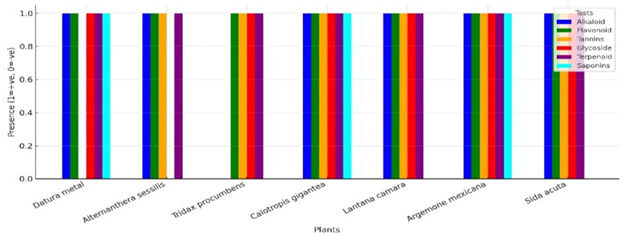
are represented by graphics Figure 1.
Table 1
|
Table 1 Selected Weed Plants and Their Reported
Antimicrobial Properties |
|||||
|
S.No. |
Botanical name |
Common name |
Family |
Reported anti microwave
activity |
Reference |
|
1 |
Datura metel |
Thorn Apple |
Solanaceae |
Antibacterial and antifungal
activity against clinical pathogens |
Sharma
et al. (2019) |
|
2 |
Alternanthera sessilis |
Sessile Joyweed |
Amaranthaceae |
Effective against E. coli,
S. aureus, and P. aeruginosa |
Rao
and Pillai (2018) |
|
3 |
Calotropis gigantea |
Crown Flower |
Asclepiadaceae |
Inhibits fungal growth and
bacterial infections |
Kumar
and Singh (2020) |
|
4 |
Argemone mexicana |
Mexican Poppy |
Papaveraceae |
Broad-spectrum antimicrobial
properties |
Mehta
et al. (2017) |
|
5 |
Tridax procumbens |
Coat Buttons |
Asteraceae |
Effective against
Gram-positive bacteria |
Jain
et al. (2015) |
|
6 |
Lantana camara |
Wild Sage |
Verbenaceae |
Antibacterial and antifungal
activities |
Verma
and Rao (2016) |
|
7 |
Sida acuta |
Wireweed |
Malvaceae |
Antibacterial,
anti-inflammatory, antipyretic |
Okoli
et al. (2002), Nworu et al., (2010) |
|
Figure 1
|
|
Figure 1 Comparative Analysis of Phytochemical
Constituents in Seven Medicinal Plant Species |
Table 2
|
Table 2 The Results of the Phytochemical Analysis
and Organoleptic Property |
|||||
|
S.N. |
Aqueous
Extract of |
Organoleptic
Properties |
|||
|
Colour |
Texture |
Odor |
Percentage
Yield |
||
|
1 |
Datura
metal |
Dark
Brown |
Greasy
texture |
Intense,
Aromatic, Unpleasant |
26.13% |
|
2 |
Alternanthera
sessilis |
Chocolate
Brown |
Crystal
Texture, |
Intense,
Aromatic, Unpleasant |
27.86% |
|
3 |
Tridax procumbens |
Chocolate
Brown |
Hard
Sticky paste, rough texture |
Intense,
Aromatic, Unpleasant |
26.53% |
|
4 |
Calotropis
gigantea |
Black |
Hard
Sticky paste, rough texture |
Intense,
Aromatic, Unpleasant |
27.06% |
|
5 |
Lantana
camara |
Black |
Crystal
texture |
Intense,
Aromatic, Unpleasant |
21.06% |
|
6 |
Argemone
mexicana |
Chocolate
Brown |
Hard
Sticky paste, rough texture |
Intense,
Aromatic, Unpleasant |
32.26% |
|
7 |
Sida
Acuta |
Chocolate
Brown |
Hard
Sticky paste, rough texture |
Intense,
Aromatic, Unpleasant |
26% |
Preparation of Combinations of Plant Extracts
Aqueous extracts
of individual plants were prepared and used to formulate a stock solution at a
concentration of 100 mg/mL using distilled water. This stock solution served as
the basis for preparing various combinations of plant extracts. Binary, ternary
(tri-herbal), and polyherbal combinations were formulated by mixing the
individual extracts in a 1:1 ratio. These prepared combinations were
subsequently evaluated for their antimicrobial activity. Detailed information
on the specific phytochemical extract combinations is presented in Table 3.
Table 3
|
Table 3 Herbal Formulations Overview |
|||
|
S.No. |
Combination Name |
Combination Code |
Aqueous Extracts Used |
|
1 |
Triherbal |
Formulation – 1 |
Datura metel, Sida acuta, Alternanthera sessilis |
|
2 |
Polyherbal (4 herbs) |
Formulation – 2 |
D. metel,
S. acuta, A. sessilis, Tridax
procumbens |
|
3 |
Polyherbal (5 herbs) |
Formulation – 3 |
D. metel,
S. acuta, A. sessilis, T. procumbens, Calotropis
gigantea |
|
4 |
Polyherbal (6 herbs) |
Formulation – 4 |
D. metel,
S. acuta, A. sessilis, T. procumbens, C. gigantea,
Lantana camara |
|
5 |
Polyherbal (7 herbs) |
Formulation – 5 |
D. metel,
S. acuta, A. sessilis, T. procumbens, C. gigantea,
L. camara, Argemone mexicana |
Test Bacteria
For the present
investigation, bacterial cultures were initially revived in nutrient broth.
Specifically, Agrobacterium spp. and Xanthomonas oryzae were inoculated into
nutrient broth (HiMedia) using lyophilized cultures
obtained from ATCC. All procedures were carried out under aseptic conditions
within a laminar airflow cabinet. The inoculated broths were incubated at
37 °C for 24 to 48 hours. Upon observation of turbidity, indicating active
bacterial growth, inoculum was aseptically transferred using an inoculation
loop onto nutrient agar plates and slants. These cultures were incubated under
the same conditions to allow colony development on a solid medium. The
resulting cultures were designated as stock cultures and maintained for use
throughout the research Table 4
Table 4
|
Table 4 List of Microorganisms Used in Present
Work for Antimicrobial Studies |
|||
|
S.N. |
Microorganism |
Pathogen
Type |
Accession
Number |
|
1 |
Agrobacterium
spp. |
Pathogenic
Bacteria |
ATCC-12210 |
|
2 |
Xanthomonas
oryzae |
Pathogenic
Bacteria |
ATCC-35933 |
Antibacterial assay
The bacterial
cultures used in the present investigation were initially revived in nutrient
broth. Specifically, nutrient broth (HiMedia) was
inoculated with lyophilized cultures of Agrobacterium spp. and Xanthomonas
oryzae, obtained in vials from ATCC. All procedures were conducted aseptically
under a laminar air flow cabinet. The inoculated broths were incubated at 37°C
for 24 to 48 hours. Upon observing turbidity, indicating microbial growth, inocula were taken using an inoculation loop and streaked
onto nutrient agar plates and slants. These were further incubated under the
same conditions to develop visible bacterial colonies on solid media. These
cultures were then maintained as stock cultures for use throughout the
research.
Result
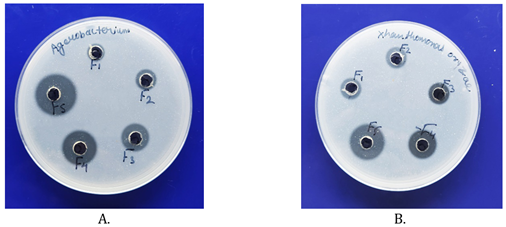
The antibacterial
activity of five polyherbal formulations (F-1 to F-5) was evaluated against
Xanthomonas oryzae (ATCC 35933) and Agrobacterium spp. (ATCC 12210) using the
agar well diffusion method at a stock concentration of 100 mg/ml. The results
indicated a progressive increase in the zone of inhibition with each
formulation, suggesting enhanced antibacterial efficacy with successive
formulations. Among all, F-5 exhibited the highest activity, producing zones of
inhibition of 21 mm and 25 mm against X. oryzae and Agrobacterium spp.,
respectively Image 1. The lowest activity was observed in F-1,
with inhibition zones of 11 mm and 9 mm against the respective bacterial
strains. These findings demonstrate that F-5 was the most effective
formulation, followed by F-4, F-3, F-2, and F-1 in descending order of
activity. All necessary information
related to the result is given in Table 5.
Table 5
|
Table 5 Results of antibacterial activity of
Polyherbal Combination |
|||
|
S.N. |
Sample
Stock |
Zone of
inhibition (Φ in mm) against test microbes |
|
|
|
(100
mg/ml) |
Xanthomonas
oryzae |
Agrobacterium |
|
1 |
F-1 |
11 mm |
9 mm |
|
2 |
F-2 |
13 mm |
12 mm |
|
3 |
F-3 |
15 mm |
17 mm |
|
4 |
F-4 |
17 mm |
21 mm |
|
5 |
F-5 |
21 mm |
25 mm |
|
Image 1
|
|
Image 1 Antibacterial Activity of Plant
Extracts Combination on Bacterial
Sample. A.
Agrobacterium spp., B. Xanthomonas oryzae. |
Discussion
The current study
assessed the antibacterial potential of various polyherbal combinations against
Xanthomonas oryzae and Agrobacterium spp., two major bacterial pathogens in
agriculture. A clear trend of increasing antibacterial activity was observed
from combination F-1 to F-5, as reflected by the progressively larger zones of
inhibition. Among these, F-5 demonstrated the strongest effect, suggesting a
higher concentration or more effective synergy of bioactive compounds.
The enhanced
performance of F-5 highlights the advantage of using polyherbal combinations,
which allow multiple phytochemicals to act together against microbial targets.
This synergistic action not only boosts efficacy but may also reduce the risk
of resistance. These findings are consistent with earlier reports Nisar et
al. (2017), Upadhyay
et al. (2020) that emphasize the superior antimicrobial
properties of combined herbal extracts compared to individual ones.
Overall, the
antibacterial activity demonstrated by the polyherbal combinations—especially
F-5—underscores their potential as effective, plant-based alternatives to
chemical pesticides. Their natural origin, environmental safety, and promising
efficacy position them as valuable tools in sustainable crop protection.
Further work on formulation optimization and field validation is recommended to
support their practical application Mishra
et al. (2018), Pandey
et al. (2019).
Conclusion
The results of
this study clearly demonstrate the antibacterial potential of polyherbal
combinations against key agricultural pathogens, Xanthomonas oryzae and
Agrobacterium spp. Among the tested combinations, F-5 showed the highest
efficacy, indicating the critical role of synergistic interactions among
bioactive plant compounds. These findings support the use of polyherbal
combinations as promising natural alternatives to synthetic pesticides,
offering a sustainable and environmentally friendly approach to crop
protection. Further research, including field trials and formulation
refinement, is essential to translate these laboratory results into practical
agricultural applications.
ACKNOWLEDGMENTS
None.
REFERENCES
Handa,
S. S., Khanuja, S. P. S., Longo, G., and Rakesh, D. D. (2008). Extraction Technologies for Medicinal and Aromatic Plants
(260). UNIDO and ICS-UNIDO.
Harborne,
J. B. (1998). Phytochemical Methods: A Guide to
Modern Techniques of Plant Analysis. Springer.
Heinrich, M., Barnes, J., Gibbons, S., and Williamson, E. M. (2009). Fundamentals of Pharmacognosy and Phytotherapy. Elsevier.
Isman, M. B. (2000). Plant Essential oils for Pest and Disease Management. Crop Protection, 19(8–10), 603–608. https://doi.org/10.1016/S0261-2194%2800%2900079-X
Jain,
D., Verma, A., and Pandey, R. (2015). Antibacterial Properties of Tridax Procumbens L. Against Human Pathogens.
International Journal of PharmTech Research, 8(4), 229–233.
Kumar,
A., and Singh, M. (2020). Phytochemical and Antimicrobial
Screening of Calotropis Gigantea.
International Journal of Herbal Medicine, 8(1),
44–49.
Mehta,
V., Sharma, R., and Kapoor, S. (2017). Argemone Mexicana: A Review on its Traditional Uses and Pharmacological Activities. Asian
Journal of Biomedical and Pharmaceutical Sciences,
7(63), 30–35.
Mishra,
S., Chauhan, P. S., Chauhan, S., and Gaur, A. (2018). Antimicrobial
Potential of Polyherbal
Formulations. Journal of Plant Pathology, 100(1),
155–160.
Nisar, T., Iqbal, M., Raza, A., Safdar, M., and Iftikhar, F. (2017). Antimicrobial Activity of Herbal Extracts. Journal of Applied Pharmaceutical Science, 7(11), 193–198.
Okoli, R.I. et al. (2002). Phytotherapy Research, 16(8), 726-728. https://doi.org/10.1002/ptr.991
Pandey,
R. R., Bajpai, P., and Singh, S. P. (2019). Efficacy of Herbal Extracts Against
Agricultural Pathogens. Plant Protection Quarterly, 34(2), 65–72.
Rajan,
P., Babu, S., and Meenakshi, S. (2019). Preliminary Screening of Antimicrobial Properties of Sida Acuta Leaf Extracts. World
Journal of Pharmaceutical Research, 8(6), 245–252.
Rao,
P., and Pillai, R. (2018). Evaluation of Antimicrobial Activity of Alternanthera Sessilis. Indian
Journal of Pharmacognosy, 10(2), 77–83.
Sharma,
A., Gupta, R., and Tiwari, S. (2019). Antimicrobial Potential of Datura Metel Extracts Against Clinical Isolates. Journal of Medicinal
Plants Research, 13(4), 112–117.
Upadhyay,
S., Dixit, A., and Bhattacharya, S. (2020). Phytochemical Synergy and Antimicrobial Effectiveness in Polyherbal
Formulations. International Journal of Phytotherapy
and Phytopharmacology, 4(2), 95–102.
Verma, S., and Rao, M. (2016). Antimicrobial Efficacy of Lantana Camara Against Human Pathogens. International Journal of Pharmacy and Pharmaceutical Sciences, 8(10), 99–104.
 This work is licensed under a: Creative Commons Attribution 4.0 International License
© Granthaalayah 2014-2025. All Rights Reserved.