
Original Article
Nominal Immiserizing Growth: Technological Progress, Deflation, and Foreign Currency Accumulation
|
Yasunori Fujita
1* 1 Keio University, Japan |
|
|
|
ABSTRACT |
||
|
This paper develops a simple domestic macroeconomic model to examine how technological progress can generate immiserizing growth in nominal terms. While productivity improvements typically raise real output, the model shows that technological progress may sharply reduce prices when the price elasticity of demand is sufficiently low. As a result, the GDP deflator declines and nominal GDP falls over time despite continuous growth in real output. The analysis further demonstrates that declining nominal income leads to an expansion of foreign currency transactions, as domestic expenditure on goods decreases. By explicitly focusing on nominal GDP and price dynamics rather than real output alone, this paper provides a new interpretation of immiserizing growth and highlights an overlooked channel linking technological progress, deflation, and foreign currency accumulation. Keywords: Immiserizing Growth, Domestic Macroeconomy, Technological Progress,
Nominal GDP, Foreign Currency |
||
INTRODUCTION
Technological
progress is typically regarded as a fundamental source of economic growth and
improved living standards. In standard growth models, productivity improvements
raise real output and consumption, thereby enhancing social welfare. However, a
long-standing tradition in international economics has emphasized that economic
growth need not be unambiguously beneficial when it induces adverse price
movements. The seminal contribution by Bhagwati
et al. (1958) shows that growth can reduce welfare if it leads to a sufficiently
large deterioration in relative prices, a phenomenon known as immiserizing growth.
Closely related to
this insight is the observation that changes in relative prices generate a
wedge between production-based measures of output and income-based indicators.
In open economies, real GDP does not necessarily capture changes in purchasing
power when export and import prices move. Kohli et
al. (2004) demonstrates that real domestic income may
diverge substantially from real GDP due to terms-of-trade effects, while Kehoe
and Ruhl (2008) and Reinsdorf
et al. (2010) emphasize central role of deflators in
shaping both real and nominal income dynamics. These studies suggest that price
movements are not merely a secondary feature of growth but can fundamentally
alter the interpretation of macroeconomic performance.
A further strand
of research focuses specifically on the accumulation of foreign exchange
reserves and official foreign assets. Aizenman and
Lee (2007) distinguish precautionary motives from
mercantilist motives, while policy-oriented studies by the International Monetary Fund. (2011) and the European
Central Bank. (2006) highlight the macroeconomic costs of
sustained reserve accumulation, particularly under sterilized intervention.
More recently, Adler et
al. (2019) document systematic patterns of foreign
exchange intervention and show how such policies affect inflation and monetary
conditions. These contributions indicate that rising foreign currency holdings
may coexist with disinflationary or deflationary pressures. At the same time,
modern macroeconomic research has increasingly linked technological progress
and globalization to persistently low inflation. Studies such as Gopinath
et al. (2015) and Forbes
et al. (2019) argue that global competition and
technological innovation weaken pricing power and flatten Phillips curves,
generating sustained downward pressure on prices.
Despite these
advances, most existing studies focus primarily on real variables—such as real
GDP, productivity, or welfare—and treat nominal aggregates as secondary. In
particular, mechanism through which technological progress lowers the GDP
deflator, thereby reducing nominal GDP even as real output expands, has
received relatively little attention in formal dynamic models. Moreover,
interaction between deflationary price dynamics and accumulation of foreign
assets has not been fully explored in a parsimonious theoretical framework.
This paper
contributes to the literature by extending Fujita
et al. (2025) and developing a simple domestic
macroeconomic model that explicitly incorporates foreign currency transactions.
The model abstracts from goods trade and instead focuses on interaction between
technological progress, price formation, nominal income, and foreign currency
purchases. We show that when the price elasticity of demand is sufficiently
low, technological progress leads to a sharp decline in prices, causing nominal
GDP to fall over time even as real output grows. At the same time, trading
volume of foreign currency increases as nominal income is reallocated away from
domestic goods expenditure. This mechanism provides a new interpretation of immiserizing growth in nominal terms.
The remainder of
the paper is organized as follows. Section 2 presents the basic model. Section
3 analyzes the conditions under which technological
progress generates immiserizing growth and increased
foreign currency transactions. Section 4 concludes.
BASIC MODEL
Let us consider a
domestic macroeconomic economy in which goods and foreign currency are traded
using money. Let Y(t), F(t), and M(t) denote the transaction volume of goods,
foreign currency purchases in domestic currency terms, and money supply in
period t, respectively.
We assume that
foreign currency is only purchased and not sold during the periods under
consideration. This assumption captures a situation in which households and
firms accumulate foreign assets as a store of value under persistent domestic
price declines. In addition, output produced in period t-1 constitutes income
in period t. Let P(t) denote the price of goods in period t. Then, total income
in period t, which is equal to the money supply M(t), is given by

This formulation
relies on the principle of three-sided equivalence, according to which
production GDP equals distribution GDP.
We further assume
that total income in period t, M(t), is fully spent on goods and foreign
currency purchases within the same period. Since expenditure on goods in period
tis P(t)Y(t) and expenditure on foreign currency in domestic currency terms is
F(t), budget constraint in period t is expressed as

Demand for goods
in period t is assumed to increase with disposable income net of foreign
currency purchases, M(t)-F(t), and to decrease with the price level P(t).
Accordingly, demand function for goods, Y^D (t), is specified as

where A is a
positive constant, ε is a positive constant that expresses price
elasticity of demand, and c is a marginal propensity to consume that satisfies
0<c<1.
On the supply
side, output grows at a constant rate g due to technological progress. Letting
Y_0 denote initial output, supply of goods in period t, Y^S (t), is given by

We assume full
employment and market clearing in every period, so that goods demand equals
goods supply, Y^D (t)=Y^S (t)=Y(t). Therefore, the equilibrium condition is
written as

Technological progress, immiserizing growth and trading volume of foreign currency
We are now ready
to derive the condition under which the economy in this paper exhibits immiserizing growth.
First,
substituting equation (2) into equation (5) and rearranging terms yield

Since the
left-hand side of equation (6) represents nominal GDP in period t, it follows
that nominal GDP is negatively related to P(t)^(ε-1)-c. Specifically, if
P(t)^(ε-1)-c increases over time, nominal GDP decreases, whereas if
P(t)^(ε-1)-c decreases over time, nominal GDP increases.
Equation (6) can
also be rewritten to determine the price level P(t) as

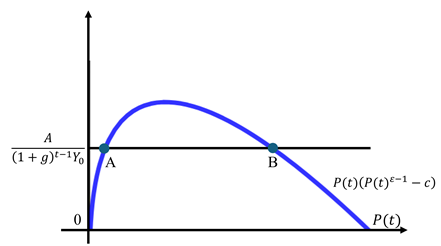
When ε<1,
Figure 1(i) illustrates that equation (7) admits two
solutions for P(t), denoted by points A and B. Let the right-hand side of
equation (7) be denoted by R. Taking the total differential of equation (7), we
obtain

At point A, the
condition εP(t)^(ε-1)-c>0 holds. Hence,
a small increase in the price raises the left-hand side of equation (8),
implying that P(t) must decrease to restore equality. This confirms that point
A is a stable equilibrium.
In contrast, at
point B, the condition εP(t)^(ε-1)-c<0
holds. In this case, a small increase in the price lowers the left-hand side of
equation (8), implying that P(t) must increase further to satisfy the equation.
Therefore, point B is an unstable equilibrium.
In what follows,
we focus on the stable equilibrium at point A and adopt it as the equilibrium
price level.
Figure 1
|
Figure 1 (a) Determination
of the Equilibrium Price P(t)when ε<1 |
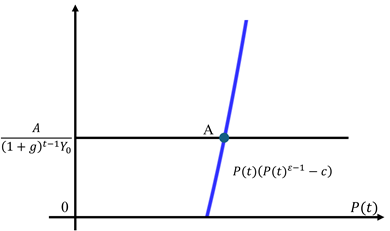
In contrast, when
ε>1, Figure 1(ii) shows that P(t) is uniquely determined at point A and
exhibits stable behavior.
|
Figure 1 (b)
Determination of the Equilibrium Price P(t)when ε>1 |
Since  decreases over time, from Figures 1(i) and 1(ii), we obtain the
following Lemma 1.
decreases over time, from Figures 1(i) and 1(ii), we obtain the
following Lemma 1.
Lemma 1.
Suppose that the
supply of goods grows over time due to technological progress.
Regardless of
whether ε<1or ε>1, the equilibrium price P(t) decreases
monotonically over time.
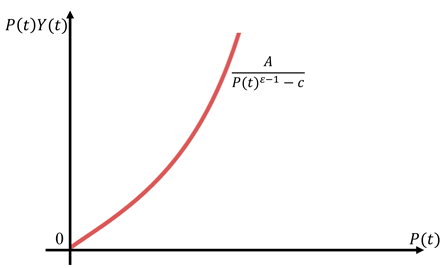
Graph of (6), on
the other hand, is depicted as an increasing curve as in Figure 2(i) if ε<1.
Figure 2
|
Figure 2 (a) Dynamics of Nominal
GDP P(t)Y(t)when ε<1. |
As prices decline
in response to technological progress, nominal GDP decreases over time,
illustrating Lemma 2(i).
|
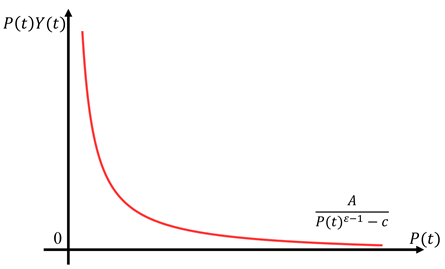
Figure 2 (b) Dynamics
of Nominal GDP P(t)Y(t)when ε>1 |
As prices decline
in response to technological progress, nominal GDP increases over time,
illustrating Lemma 2(ii).
Figures 2(i) and 2(ii), in conjunction with Lemma 1, lead to the
following result, stated as Lemma 2.
Lemma 2.
(i)If ε<1, technological progress induces a
monotonic decline in nominal GDP, P(t)Y(t), despite continuous growth in real
output.
(ii)If
ε>1, technological progress induces a monotonic increase in nominal
GDP, P(t)Y(t).
M(t)is given at
the beginning of period t,. Hence, from equation (2),
a decrease in P(t)Y(t)leads to an increase in F(t). Combining this result with
Lemma 1 and Lemma 2(i), we obtain the following
Proposition.
Proposition.
When the price
elasticity of demand is sufficiently low (ε<1), technological progress
generates immiserizing growth in nominal terms:
nominal GDP declines over time, while the trading volume of foreign currency
increases.
Concluding remarks
This paper has
shown that technological progress can generate immiserizing
growth in nominal terms by sharply reducing prices and, consequently, nominal
GDP. Unlike the traditional literature, which focuses on welfare or real
income, our analysis highlights the central role of the GDP deflator in shaping
macroeconomic outcomes.
The results also
suggest a novel interpretation of rising foreign currency transactions in
low-inflation or deflationary environments: foreign asset accumulation may
reflect not only precautionary motives but also a mechanical consequence of
declining nominal income. This perspective may help to reconcile persistent
external surpluses with weak nominal growth observed in several advanced
economies.
Extending the
model to incorporate unemployment, endogenous growth, and two-way foreign asset
trading remains an important avenue for future research.
ACKNOWLEDGMENTS
None.
REFERENCES
Adler, G., Lisack, N., and Mano, R. (2019). Large-Scale Foreign Exchange Intervention: Evidence from a New Dataset (IMF Working Paper No. 19/40). International Monetary Fund.
Aizenman, J., and Lee, J. (2007). International Reserves: Precautionary Versus Mercantilist Views, Theory and Evidence. Open Economies Review, 18(2), 191-214. https://doi.org/10.1007/s11079-007-9030-z
Bhagwati, J. (1958). Immiserizing Growth: A Geometrical Note. Review of Economic Studies, 25(3), 201-205. https://doi.org/10.2307/2295990
European Central Bank. (2006). The Accumulation of Foreign Reserves (ECB Occasional Paper Series No. 43).
Forbes, K. (2019). Inflation Dynamics: Dead, Dormant, or Determined Abroad? Brookings Papers on Economic Activity, Spring, 257-338. https://doi.org/10.1353/eca.2019.0015
Fujita, Y. (2025). Reconsidering the Immiserizing Growth in a Simple Domestic Macroeconomic Model with Financial Assets. Archives of Business Research, 13(3), 237-241. https://doi.org/10.14738/abr.133.18343
Gopinath, G. (2015). The International Price System. In Jackson Hole Economic Policy Symposium Proceedings. Federal Reserve Bank of Kansas City. https://doi.org/10.3386/w21646
International Monetary Fund. (2011). Reserve Accumulation and International Monetary Stability (IMF Policy Paper).
Kehoe, T. J., and Ruhl, K. J. (2008). Are Shocks to the Terms of Trade Shocks to Productivity? Review of Economic Dynamics, 11(4), 804-819. https://doi.org/10.1016/j.red.2008.04.001
Kohli, U. (2004). Real GDP, Real Domestic Income, and Terms-of-Trade Changes. Journal of International Economics, 62(1), 83-106. https://doi.org/10.1016/j.jinteco.2003.07.002
Reinsdorf, M. (2010). Terms of Trade Effects: Theory and Measurement. Review of Income and Wealth, 56(S1), S177-S205. https://doi.org/10.1111/j.1475-4991.2010.00384.x
 This work is licensed under a: Creative Commons Attribution 4.0 International License
© Granthaalayah 2014-2026. All Rights Reserved.

