Original Article
An Assessment of Health Precariousness among Draft Horses in Senegal: The Case of the Rufisque Department (Dakar Region)
|
Nteme-Ella G.
S. 1*, Ntsama F. 2, Diagne M. S. A.
1, Bakou S. 3 1 Department of
Anatomy-Histology-Embryology, Inter-State School of Veterinary Sciences and
Medicine (EISMV) of Dakar, Senegal 2 Institute for Public Law Studies (IEDP),
Jean Monnet Faculty of the University of Paris-Saclay, France 3 Department of Biology and Animal Production-Nangui
University Abrogoua. 02 BP: 801 Abidjan 02 Côte d’Ivoire |
|
|
|
ABSTRACT |
||
|
This study investigated the health precariousness of draft horses in the Rufisque Department (Dakar Region, Senegal), with a particular focus on their conditions of care, use and maintenance. To this end, a survey adopting a pragmatic approach—adapted to field constraints and grounded in an integrated vision of animal health—was conducted among 134 owners, all male, aged between 17 and 63 years (mean age: 32 years). These individuals owned a total of 153 working adult draft horses, corresponding to an average of 1.1 horses per owner. The draft horses, housed in traditional stables, were all male and belonged to the local breeds Mpar (n = 63), Mbayar (n = 47), Fleuve (n = 23), and Foutanké (n = 20). The fact that both the owner and animal samples included in this study consisted exclusively of males reflects biological realities as well as local socio-cultural determinants. Regarding marital status, 57% of the owners were married, 41% were single, and 2% were divorced. Overall, the observed management practices for draft horses were suboptimal, particularly with respect to housing, feeding, and veterinary follow-up. Although more than 90% of the horses received over 2 kg of feed daily and had regular access to water, significant disparities persisted, exposing some animals to nutritional and health risks. The use of modern veterinary medicine remains limited, with most care still relying on traditional practices. Analysing health precariousness enables the development of the so-called “Southern pathway,” a normative, political, economic, and social approach that fosters the creation and implementation of tools, techniques, and innovations without stigmatization, while highlighting the connections between human and animal health precariousness. Overall, the health precariousness of Senegalese draft horses must be viewed in light of the low population size of working equids, raising economic concerns related to the profitability of the equine and asinine sectors and not necessarily reflecting their actual contribution to Senegalese society. Finally, this study highlights the urgent need to strengthen the capacities of local stakeholders in equine healthcare in order to sustainably improve the health, productivity, and welfare of draft horses and to combat their precariousness, particularly in terms of health. Keywords: Draft Horses, Animal Husbandry and Care,
Health Precariousness, Rufisque |
||
INTRODUCTION
The horse is an
herbivorous mammal belonging to the family Equidae and the order Perissodactyla,
which populated vast grasslands long before the emergence of humankind. Over
the millennia, it was first hunted and later, following its domestication, used
as a pack, riding, and draft animal Barone
(1996), Abderrahim
(2008), Gauchot
and Chuit (2014). Equus caballus, its scientific name,
possesses numerous qualities that vary according to breed, age, coat color, and
other factors Cissé et
al. (2025), Gauchot
and Chuit (2014), Ndour
(2010).
The horse has
served as an animal of war and transportation, thereby facilitating the
expansion of trade and the emergence of civilizations across vast territories.
Considered “the noblest conquest of humankind,” it is arguably the animal that
has most profoundly shaped human history and progress.
In Senegal, horses
are used in rural areas as draught or draft animals for cart traction, support
to agricultural and livestock activities, and the transport of agricultural
products to markets; they therefore remain a key means of transportation Adjelakara
Mossus (2008), Ndour
(2010), Diop and Fadiga (2018), ANSD
(2023). In practice, the breeding and use of
working equids generate an ecosystem that brings together numerous
stakeholders, including cart and carriage drivers, suppliers of inputs (fodder,
concentrate feeds, medicines), and service providers (veterinarians, cart
repairers, farriers, saddlers, etc.) Ly (2003), Akpo (2004), Diop and Fadiga (2018).
From a legal
standpoint, the circulation of horse-drawn vehicles used for the commercial
and/or domestic transport of people and goods within Senegal is specifically
governed by the provisions of Interministerial Decree No. 18457 of 9 December
2016. In addition to requirements relating to the technical characteristics and
operation of horse-drawn vehicles, this decree mandates that every horse
residing in Senegal be provided with a health and identification booklet.
Beyond the specification of applicable penalties in cases of infringement, the
text explicitly includes provisions aimed at preserving animal health and
protecting public health. In this regard, it requires that equids used for
commercial purposes (public transport of people and goods) be certified as fit
for service by the competent authority responsible for issuing certificates of
fitness. Furthermore, it establishes a mandatory special health inspection
every six (06) months to assess the health status of animals engaged in
animal-drawn transport activities.
In urban
environments, especially in Dakar, despite the presence of motorized vehicles,
horses contribute to urbanization through the transport of construction
materials on building sites, as well as people, goods, and household waste Mandé
(1990), Ly (2003), Diop and Fadiga (2018). However, the contribution of draft equids
to the national economy is generally considered relatively modest in terms of
gross domestic product (GDP). Nevertheless, the value of their traction power
far exceeds a purely economic perspective and would merit greater consideration
in sectoral policies and strategies for the development of livestock
production, agriculture, and transport Diop and Fadiga (2018). This contrast is notably reflected in the
attention paid to their health status. Indeed, draft horses, like racehorses,
should benefit from appropriate and optimal care, particularly in terms of
nutrition, hygiene, and health. However, in Dakar, some owners—primarily
focused on financial gain—do not always provide the attention and care these
animals require Pizzetta
(2015), Diop and Fadiga (2018), ANSD
(2023).
In a context
marked by widening inequalities in human development UNDP (2025) and in line with the national program for
the development of the equine sector in Senegal Niang et
al. (2009), CEP and
MEPA (2016), MEPA
(2016), MASAE
(2025), it appears particularly relevant to examine
the situation, physical health, and welfare of draft horses in Dakar. Although
the overall situation at the national level tends to improve—given that the
development of equine husbandry is now a governmental priority Bah (1993), CEP and
MEPA (2016), MEPA
(2016), MEPA
(2019), Lejosne
(2023), Mbaye
(2023), MASAE
(2025)—the health precariousness of draft equids
has long been reflected in the limited importance accorded to them within
animal health and livestock policies Diop and Fadiga (2018).
While the concepts
of “precariousness” and “health precariousness” are relatively recent and well
documented in relation to humans Alternatives Économiques (2014), Spira
(2017), Vaucelle
(2021), Avise
(2025)—where they refer to “a social situation in
which living and employment conditions are marked by a high degree of
uncertainty” Alternatives Économiques (2014)—they remain only marginally mobilized in
animal health. In contexts such as France, this concept is still essentially
associated with humans, even when animals are at the centre of concern. This
situation is partly explained by the fact that precariousness is expressed in
domains such as employment, housing, food, health, education, family life, or
social integration, placing individuals at the margins of poverty Spira
(2017), Vaucelle
(2021), Avise
(2025). An illustration of this dichotomy is the
initiative “Veterinarians for all”, which aims to “support and empower people
in situations of precariousness with regard to their responsibilities toward
animals, while preserving the human–animal bond, sometimes the last barrier
against social exclusion” Guérin
(2021).
In Senegal, where
issues of precariousness and poverty remain significant—as illustrated by the
Harmonized Survey on Households Living Standards (EHCVM) ANSD
(2024) and a Human Development Index (HDI) of 0.530
in 2025—new approaches are nevertheless emerging that seek to break down
barriers between academic knowledge and social concerns. These include studies
on the costs and benefits of animal welfare Nalovic
(2023), Dasinieres
(2025) as well as integrated approaches under the
“One Health” concept. Within this framework, and by analogy with the reference
definition of human health, animal health may be defined as “a state of optimal
physical, social, and ethnic well-being, and not merely the absence of disease
or infirmity” Ntsama Abah (2025). The term “ethnic” here refers to
animal ethnicity, understood as the set of natural or acquired behavioural
habits and lifestyles specific to an animal or a group of animals Marin (n.d.). This definition should be considered
alongside that of ANSES
(2018), which defines animal welfare as “a positive
mental and physical state related to the satisfaction of physiological and
behavioural needs,” as well as the position of the World Organisation for
Animal Health (WOAH), for which animal welfare constitutes a component of
animal health WOAH (2025).
Thus, animal
health precariousness may be understood as the situation of an animal or an
animal population lacking sufficient access to regular health monitoring and to
reliable, accessible, and effective medical care, capable of objectively and
sustainably improving their health and living conditions.
It is within this
perspective that the present study focuses on the health precariousness of
draft horses in the Rufisque Department, in the Dakar Region, with particular
emphasis on their conditions of use and management. To this end, a survey
adopting a pragmatic approach—adapted to field constraints and embedded within
an integrated vision of animal health—was conducted among draft horse owners in
Rufisque.
Materials and Methods
The Ecole
Inter-Etats des Sciences et Médecine Vétérinaires (EISMV) is affiliated with
Cheikh Anta Diop University (UCAD) in Dakar. Accordingly, all experimental
procedures were conducted in compliance with the recommendations of the UCAD
Research Ethics Committee UCAD (2024) and applicable Senegalese legislation.
Selection and characteristics of the study area
In the Dakar
Region, draft horses are used for the transport of people and goods,
particularly in areas that are difficult to access by cars and other motorized
vehicles. Consequently, they are mainly concentrated in the peri-urban zones of
Dakar, notably in Rufisque, due to the proximity of farriers and, above all,
the availability of vacant land allowing the establishment of traditional
stables, commonly referred to as “thioury”. Within these facilities,
owners are able to tether their animals individually.
Accordingly, this
study was conducted from March to June 2021 (four months) in the Rufisque
Department, located approximately 25 km southeast of the city of Dakar, between
parallels 14°41′ and 14°46′ North latitude and meridians
17°15′ and 17°20′ West longitude, at the extreme western edge of
the Senegalese–Mauritanian Meso-Cenozoic sedimentary basin. Rufisque is the
only department in the Dakar Region that encompasses both urban and rural
areas. Divided into three district municipalities and covering an area of 371
km², Rufisque constitutes the sole terrestrial entry and exit route to Dakar,
the capital city of Senegal.
According to
statistics from the National Agency for Statistics and Demography ANSD
(2023), equids account for approximately 2% of the
livestock population recorded in Rufisque, as well as in the other departments
of the Dakar Region Table 1. However, the distribution of horses,
donkeys, and other livestock categories in the Rufisque Department differs
significantly from that observed in the other departments of the Dakar Region
(p < 0.05; α = 0.05). In Rufisque, there is approximately one donkey
for every five horses. These proportions differ from regional statistics, which
indicate approximately one donkey for every seven horses across the entire
Dakar Region, and about one donkey for every thirty horses in the other
departments of this region Table 1.
Table 1
|
Table 1 Distribution of Horses, Donkeys, and Other
Livestock Populations in Rufisque and the Dakar Region |
|||
|
Livestock type |
Rufisque Department |
Other departments (excluding
Rufisque) |
Dakar Region |
|
Horses |
4,015 |
3,255 |
7,270 |
|
Donkeys |
927 |
116 |
1,043 |
|
Other livestock |
1,55,831 |
1,35,442 |
2,91,273 |
|
Total |
1,60,773 |
1,38,813 |
2,99,586 |
|
Source: ANSD
(2023) |
|||
Draft horse owners included in the study
Sampling strategy
In order to
reconcile speed and practicality, remain economically affordable, and limit
respondent burden, a non-probability sampling method based on voluntary
participation of animal owners was adopted. Owners included in this study were
recruited in areas with a high concentration of equine populations, making it
possible to enrol a sufficiently large and representative sample of draft
horses while facilitating the acquisition of consent from the greatest possible
number of owners.
Technical and educational materials
Survey forms were
developed to collect data from the various stakeholders involved in equine
sector activities in Rufisque (horses, owners, users). The design of the survey
forms, as well as data processing and analysis, were carried out using several
computer-based tools, including Microsoft Office 2016® (Word®, Excel®), XLSTAT®
(versions 2022.4.5 and 2025.1.3), IBM SPSS Statistics® (version 25), R (version
4.5.1) R Core Team (2025), RStudio Posit
Team (2025), BiostaTGV iPLesp et
al.(n.d.), and Sample Size Calculators Kohn and Senyak (2025).
The methodological
choices resulted from a combination of recommendations derived from the social
sciences Cibois
(2007), Martin
(2007), Rédaction
Quanti IHMC (n.d.) and from biological, medical, and veterinary
research Toma et al. (2010), StatCan (2021), Jauzein
(2022), Rédaction
Thot Cursus (2022), Rédaction
Quanti IHMC (n.d.).
Study methods
The study methods
primarily relied on interviews with owners and on the identification of the
animals included in the study.
Owner interviews
Questionnaires
were administered at various locations, depending on the availability of horse
owners, including animal resting sites, in front of shops, at the owners’
homes, or at the clinic. These interviews were structured around the parameters
recorded in the survey forms, notably including:
·
the
socio-economic status of the owners (name, region of origin, main occupation,
etc.).
·
herd
structure (total number of animals, breeds used, etc.).
Animal identification
Despite legal
requirements, such as those stipulated by Interministerial Decree No. 18457 of
9 December 2016 regulating animal-drawn vehicle transport in Senegal, the
animal identification system remains in the process of modernization CEP and
MEPA (2016), MEPA
(2016). Consequently, the identification of horses
included in this study relied on traditional descriptive identification.
Establishing a
horse’s descriptive identification is equivalent to creating its identity card.
The objective is to record all characteristics enabling its identification,
including species, sex, breed, age, height, coat color, type of service,
extremities, and distinctive markings Chuit
(1991), Douart
(2008), Dubois
(2014), IFCE (2019), Cissé et
al. (2025). In addition to being identified by a
sequential number assigned at the time of enrolment in the study, the horses
were systematically linked to their respective owners.
Results
This section
presents the characteristics of the owners included in the study, the typology
of the horses owned, as well as selected aspects related to the management and
use of draft horses in Rufisque.
General characteristics of horse owners
Data were
collected from 134 owners, all male, aged between 17 and 63 years, with a mean
age of 32 years. These individuals owned a total of 153 working adult draft
horses, all male, belonging to local breeds (Mpar, Mbayar, Fleuve, and
Foutanké) and housed in traditional stables.
With regard to
marital status, 57% of the owners were married, 41% were single, and 2% were
divorced. None of the owners were native to the Dakar Region; however, they
resided there for professional reasons. They belonged to various ethnic groups
in Senegal, mainly Serer (42%), Wolof (33%), Lebou (17%), and Fulani (Peul)
(8%).
Typology of draft horses owned by the proprietors
Among the 153
locally bred draft horses owned by the proprietors included in this study, 63
individuals (41%) belonged to the Mpar breed, 47 (31%) to the Mbayar breed, 23
(15%) to the Fleuve breed, and 20 (13%) to the Foutanké breed.
The mean number of
horses per owner was 1.1. However, the number of horses owned ranged from one
(1) to five (5), and 97% of owners owned one (1) to two (2) horses. In
addition, 31% of the horses were aged between 2 and 5 years, 40% between 5 and
10 years, and 29% were over 10 years old.
Activities of the horses
The horses were
used for various types of activities. Of the 153 horses in the sample, 106
(69%) were used for cart traction, 32 (21%) for carriage traction, while 15
horses (10%) were alternately used for both types of traction.
With respect to
working duration, the majority of owners (78%) worked their animals throughout
the entire week, whereas the remaining owners (22%) used them for six days per
week.
Selected aspects of horse husbandry and care
The management,
care, use, and handling of horses were assessed based on various aspects of
their living conditions, including housing (accommodation and environment),
feeding (quality, quantity, hydration, and schedule), and health, with a
primary focus on physical well-being.
Housing
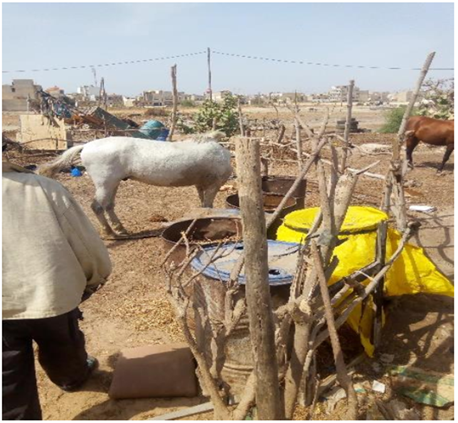
None of the horses
encountered were truly free-ranging. During rest periods, they were most often
kept tethered in a “thioury”, which in practice corresponds to a vacant
plot of land. This type of housing is not necessarily optimal with regard to
their ethology, particularly due to the absence of fencing, roofing, and
adequate or sufficient bedding, among other shortcomings Figure 1.
|
Figure 1
|
|
Figure 1 Traditional Resting Area (“thioury”) of Draft Horses in Rufisque. |
Feeding
According to the
survey results, the horses’ diet mainly consisted of groundnut hay, millet,
sorghum, and maize. However, the feeding regimen varied among owners. Among the
134 respondents, nearly 29% reported providing 5–7 kg of feed per day to their
animals, while 64% supplied between 2 and 5 kg per day, and only 7% offered 1–2
kg per day.
Regarding feeding
frequency, 76% of owners provided two daily meals, whereas 24% offered three.
Watering was also an important component of dietary management: the majority of
owners (approximately 83%) used tap water, while the remaining 17% relied on well
water. Furthermore, 28% of owners reported watering their horses twice daily,
with higher proportions for those providing water three times a day (39%) or ad
libitum (33%).
Health
Concerning medical
history, 93 horses (61% of the sample) that had experienced various diseases
were treated exclusively with traditional medicine (use of tree leaves, herbal
decoctions, and occasionally amulets or talismans attached to the horse’s body).
In contrast, 54 horses (35%) were treated solely with modern veterinary
medicine, and only 6 horses (4%) received combined treatments integrating both
traditional and modern approaches.
It should be noted
that veterinary consultations were not systematic, with animals most often
being cared for directly by their owners. This situation is particularly
concerning for oral and dental conditions, as owners acknowledged that they do
not routinely examine the horses’ oral cavities.
Discussion
In sub-Saharan
Africa, the importance of using draft animals for agriculture and transport,
particularly in rural areas, is widely recognized. In this context, draft
animals—including horses, donkeys, camels, buffaloes, and cattle—represent a
major source of animal traction, helping to reduce the physical burden of
agricultural work as well as other activities such as transportation. Their
contribution is multifaceted and varies depending on the context, whether
exclusively rural, urban, or mixed Munzinger
et al. (1982), Starkey
and Faye (1990), Wilson
(2003), FAO (2010), Diop and Fadiga (2018), Miara et
al. (2023).
The Dakar Region
aligns with this observation: equid exploitation is widespread, both in urban
centres and in peri-urban areas, such as the Rufisque Department. In urban
centres, these animals are used for transporting people and various materials
and goods—including cement bags, rebar, gas cylinders, beverages, household
waste collection, and agricultural products to markets—usually for a fee.
Although donkeys
can also perform such tasks in urban settings, they are less visible in large
urban centres such as Rufisque, where the horse remains the preferred draft
animal Diop and Fadiga (2018).
Contribution of the health precariousness approach
In a context
marked by growing inequalities within human societies, and where animal health
is not limited to the mere prevention of contagious diseases, numerous concepts
have emerged emphasizing the unity of nature and health: “One Health”, “One
Forensic”, “One Violence”. etc. NFAHW
Council (2017), Garcia
(2017), Fraser
(2018), García-Ruiz et
al. 2025, Ntsama Abah (2025), Centre pour la Communication Scientifique Directe. (n.d.). These approaches also advocate for
integrating social, environmental, and economic concerns into activities of a
company or organization, in interaction with all relevant stakeholders—for
example, through corporate social responsibility (CSR) frameworks Eurogroup
for Animals (2018), Delcros
(2023), Falc’hon
(2023), Garcin
(2023), A (2024), B and AFP (2024), Gisie
(2024), Sourdet
(2024), Gayraud
(2025). It is thus essential to pursue approaches
that do not stigmatize and that take into account the realities of the most
disadvantaged populations.
Generally, animal
research emphasizes physical health and/or animal welfare dimensions Lerner
(2008), Lerner
(2016). While these approaches are relevant, they
can fragment animal health issues by prioritizing a particular aspect or
dimension of sanitary and zoonotic problems Ntsama Abah (2025). For instance, animal experimentation should
not be conflated with autopsy.
It is important to
emphasize that animal health is not limited to contagious diseases, and it is
not always advisable to separate welfare or wellbeing from health Ntsama Abah (2025). Contemporary developments recommend
simultaneously considering individual, collective, and environmental
dimensions. Animal suffering may be individual, collective, or related to
specific environmental conditions. This is particularly critical for aquatic
species, whose survival is directly affected by variations in temperature,
pressure, or chemical properties of their environment (salinity, oxygen levels,
etc.) Ntsama Abah (2025).
In this context,
the interministerial decree n° 18457 of 9 December 2026, which states that “it
is prohibited to employ equids (for commercial and/or domestic purposes) whose
weakness, illness, vices, infirmities, injuries, lameness, or decrepitude render
them unfit for traction,” aligns with national, regional, and international
recommendations ANSES
(2018), Nteme
Ella et al. (2025), WOAH (2025).
Moreover, it is
essential not to “dehumanize” humans in the process of better humanizing
animals. The relevance of approaches focused on abuse, CSR, or law enforcement
necessarily depends on the context. The law itself operates within social and
economic environments Von Jhering (1875), Aspe and Jacqué (2012), Rouvière
(2018), Rom et al. (2022) and acts that compromise animal health or
welfare cannot be assessed without considering the underlying circumstances.
Depending on the situation, mistreatment may result from negligence, behavioral
disorders (e.g., Noah’s or Diogenes syndromes), incidental infractions (such as
theft or non-compliance with transport standards), or intentional cruelty
toward animals, with or without profit Ascione
et al. (2007), Hayes
(2010), Andrade
and Anneberg (2014), Devitt
et al. (2015), Jegatheesan et
al. 2017, Fraser
(2018), Stumpf
et al. (2023), Animal
Equality United Kingdom (2024), Touré
(2020), Universities Federation for Animal Welfare, and Fraser
(2024), UNODC
(2024), Magalie
(2025), EWFN (n.d.), TRACE Wildlife Forensics Network (n.d.).
In cases of
neglect or insufficient veterinary care, it is crucial to situate the debate in
the Senegalese or African context, which differs significantly from European or
North American settings. Animal Health Canada or AHC (formerly National Farmed
Animal Health and Welfare Council or NFAHW Council) emphasizes that rural
populations are generally disadvantaged regarding animal health and welfare due
to geographic factors, limited access to resources, and barriers to veterinary
services NFAHW
Council. (2017), AHC (2022).
In Senegal, ranked
among low-HDI countries (169ᵗʰ out of 193 countries) UNDP (2025), a substantial portion of the population
lives in poverty or precarious conditions, characterized by instability,
uncertainty, and fragility. For these individuals and families, integrating the
study of animal health precariousness within a multidisciplinary,
interdisciplinary, and transdisciplinary perspective allows the development of
the “Southern approach”: a normative, political, economic, and social framework
that promotes the implementation of context-appropriate, non-stigmatizing
solutions.
This approach also
implies considering traditional knowledge and practices in modern veterinary
medicine. Facing the challenges in developing countries (costs, accessibility,
diverse sociocultural contexts), many international bodies recommend endogenous
health development strategies that integrate traditional medicine, using
substances derived from the animal, plant, and mineral kingdoms. These
recommendations are accompanied by the need to establish a modernized and
coherent legal framework that guarantees safe and accessible care while valuing
historical and cultural knowledge Dembélé
(1997), WHO (1991), WHO (2013), WHO (2025), Tchetan
et al. (2021), Ntsama Abah (2025).
Sample characteristics compared to the Senegalese and African context
In our sample, all
horses were male. This observation is noteworthy because dental formulas vary
between males and females Barone
(1996), Boyer
(2007), Douart
(2008). However, this is not surprising in the
Senegalese context. Most horses remain intact, very few are gelded, and
consequently, geldings are scarce. Additionally, draft work is considered a
low-status activity, generally reserved for males and, to a lesser extent,
geldings. As a result, the use of females for draft work, particularly mares,
is minimal or non-existent. Although data remain limited, the literature
already indicates that primary draft animals are adult males, geldings, and, to
a lesser extent, non-productive females Lawrence
et al. (1993), du Toit et al. (2008), Mota-Rojas
et al. (2021). An argument often cited by owners reluctant
to use females is that they are generally less powerful than males Santos
et al. (2015), Tariq
(2024).
The owners
included in this study were all male, reflecting in part the social realities
of Senegal Mbow (2000), Fall-Sokhna
and Thiéblemont-Dollet (2009), Diop and Fadiga (2018) and the difficulty of addressing gender
issues in some research contexts. This sociological reality, combined with
occasional material constraints Diop and Fadiga (2018), may give the impression that the role of
females in animal traction is overlooked. In reality, especially in rural or
mixed settings, draft work is used as a means to alleviate labour-intensive
tasks, such as water collection.
It is also
important to note that alongside horses, there is often a significant
population of donkeys, as in Rufisque, where they represent 18.8% of domestic
equids ANSD
(2023). Donkey-drawn carts are generally operated
by women during transhumance periods and are used to transport children, young
livestock (lambs, kids), and household items (mattresses, utensils, tarpaulins,
wardrobes, etc.) Diop and Fadiga (2018).
According to ANSD
(2023), the male population in Rufisque is 289,670
individuals, representing approximately 7% of the Dakar region’s population.
This proportion corresponds to slightly more than half of the department’s
total population. Senegal’s age pyramid reflects the typical structure of a
developing country. In the Dakar region, about 67% of the population is of
working age (15–64 years), while only 2% work in the agricultural sector, which
includes crop farming, livestock, and mixed activities Vitta
(1936). This proportion is supported by the fact
that 99% of Dakar households engage in agro-pastoral activities DAPSA
(2023). However, extreme poverty is less pronounced
in this region compared to other parts of Senegal ANSD
(2024).
The studied sample
represents approximately 3% of working-age men in the agricultural sector,
which is an indicative estimate to be refined. Regarding marital status, the
proportions observed in our sample do not differ statistically from national
data (single: 38%; married: 56%; divorced/separated/widowed: 6%) according to
Fisher’s exact test ANSD
(2023). The average number of horses per owner in
our study (1.1) is lower than the regional and departmental average (2 horses
per household), which is the highest in Senegal ANSD
(2023), DAPSA
(2023). Compared to other species, the average
number of animals per household in Dakar is as follows: goats 11.8; sheep 6.9;
cattle 5.1; with the exception of poultry ANSD
(2023), DAPSA
(2023). This contributes to the perception that the
economic contribution of draft equids is modest.
In general, our
sample shows a predominance of Mpar (41%) and Mbayar (31%) horses compared to
Fleuve (15%) and Foutanké (13%) horses in Rufisque. This distribution can be
explained by the fact that Mpar and Mbayar horses, being more compact, are
better adapted to sandy areas Ndour
(2010), MEPA
(2019).
Regarding draft
horse management, evaluated based on housing, feeding, and physical health, our
results reveal that practices vary among owners and require improvement,
particularly following the repercussions of the COVID-19 pandemic ANSD
(2021). As reported by Ndour
(2010), horses are often tethered in unprepared
open areas called “thioury”, exposing them to adverse weather and
security risks.
Within the
framework of Senegal’s equine sector development program Niang et
al. (2009), CEP and
MEPA (2016), MEPA
(2016), MASAE
(2025), it would be desirable for authorities, in
collaboration with stakeholders (civil society organizations, breeders’
associations, etc.), to develop more suitable living spaces for draft horses in
Rufisque. This measure is particularly important given the extensive nature of
the husbandry system. Indeed, transitioning from an extensive to an intensive
system can lead to the emergence of dental disorders in equids Muñoz et
al. (2010), Jacques
et al. (2011), Lima et al. (2011), Leite et
al. (2019).
Overall, more than
90% of owners feed their horses more than 2 kg of feed per day, and over 80%
provide water. This aligns with observations by Diop and Fadiga (2018), who noted that feed and water constitute
the largest expense category for equine-drawn vehicles (carts and carriages),
representing approximately 79% of daily costs, with an average expenditure of
six euros per day in the Dakar region. However, disparities in feeding and
watering frequency suggest a risk of nutritional deficiency, potentially
leading to low performance and disease onset Mandé
(1990), Djimadoum
(1994).
Health monitoring and the assessment of health precariousness in draft horses
Regarding health
monitoring and medical care, veterinary consultation is not systematic: more
than half of the horses are treated exclusively using traditional methods.
Beyond this lack of veterinary follow-up and the predominance of traditional
medicine, the health of these horses requires various adjustments, as many
owners do not manage their animals adequately Ndour
(2010), Diop and Fadiga (2018). These observations are not surprising,
given that Diop and Fadiga (2018) reported that the cost of healthcare for
equine-drawn vehicles (carts and carriages) represents only 3% of daily
expenses, estimated at an average of six euros in the Dakar region.
A clear example of
the health precariousness of draft horses is the early detection of dental
disorders. Oral hygiene is rarely, if ever, practiced by owners in the Rufisque
department Djimadoum
(1994), Ndour
(2010), Diouf
(2013). Yet, even minor dental issues can
compromise chewing efficiency, promote digestive disorders, deteriorate the
overall condition of the animal, and reduce its draft performance White
(1990), Dixon
and Dacre (2005), Tamzali
(2006), Cox et al. (2007), du Toit et al. (2009a), du Toit et al. (2009b), Dubois
(2014).
This health
precariousness is exacerbated by the fact that many conditions, particularly
those that are visible and accessible, such as wounds, are mostly treated using
traditional remedies. A paradox arises: without imaging or thorough dental
examination, visual diagnosis between persistent deciduous teeth and
supernumerary teeth (polydontia) can be difficult, depending on wear and tooth
location.
Among the Peul,
for instance, disease recognition distinguishes external and internal
illnesses, fatal and non-fatal conditions, and illnesses affecting young versus
adult animals. It also incorporates a supernatural component, ranging from
superstition to beliefs whose rationality may be debated. Pragmatically,
through keen observation, they perform incisions or excisions with knives on
infected wounds, abscesses, or tumours, before suturing with plant fibres or
applying palm oil or other remedies that appear effective Bah (1993), Lobry
(2003). However, for fractures or supernumerary
teeth, veterinary intervention remains necessary.
The aim is not to
favour traditional medicine over conventional medicine, or vice versa, but to
choose the most appropriate solution according to the socio-economic context.
Beyond contemporary imperatives, such as combating antimicrobial resistance
(AMR) Ntsama Abah (2025), WOAH (n.d.), the “World Health Organization (WHO) (2025)” emphasizes that traditional medicine “refers to codified or
non-codified systems for healthcare and well-being, comprising practices,
skills, knowledge and philosophies originating in different historical and
cultural contexts, which are distinct from and pre-date biomedicine, evolving
with science for current use from an experience-based origin. Traditional
medicine emphasizes nature-based remedies and holistic, personalized approaches
to restore balance of mind, body and environment.”
This health
precariousness should also be considered in light of the small population of
draft equids, raising questions about the economic profitability of the equine
and donkey sectors and not always reflecting their social contribution Diop and Fadiga (2018).
The prosperity of
any livestock sector largely depends on the theoretical and practical knowledge
of stakeholders. Therefore, strengthening the capacity and expertise of these
actors is essential. In this context, equine dentistry remains nascent in intertropical
Africa due to insufficient infrastructure, a lack of expertise adapted to
vulnerable contexts, prohibitive costs of specialized care, and the imprecision
of visual diagnoses.
Developing the
equine sector in Senegal is now a governmental priority, supported by
international collaborations, for example with Morocco or France Ba (2023), Lejosne
(2023), Mbaye
(2023). In this regard, the EISMV recently
established a residency program in working equid medicine, representing a
sustainable development avenue for the veterinary profession and the health of
working equids in intertropical Africa Lejosne
(2023).
These findings
highlight the importance of implementing awareness campaigns on oral health and
health monitoring for draft horses among breeders, in order to reduce health
precariousness and improve both performance and animal welfare.
Sample size and statistical power
In practice, it is
easier to recruit a horse when it is in a resting area or requires veterinary
or farriery services than when it is actively engaged in economic work for its
owner or about to return home. However, the application of appropriate statistical
methods allows for consideration of individual variability and sampling
fluctuations, which often simplify reality Piant
(2007), Indrayan
and Mishra (2021), CEP and
MEPA (2016).
If the conditions
for applying Fisher’s exact test were met for our data Bower
(2003), Indrayan
and Mishra (2021), Hae-Young,
2017), it is then pertinent to examine the statistical power of this
study. According to ANSD, the equine population of Rufisque in 2020–2021 was
estimated at 4,942 individuals, including 927 donkeys (18.8%) and 4,015 horses
(81.2%) ANSD
(2023). However, the available data did not specify
the male-to-female ratio, particularly for draft horses.
In the absence of
context-specific data for Senegal, one can refer to ratios observed in similar
studies du Toit et al. (2008) or among racehorses, which indicate that
approximately 65–75% of horses are males (stallions and geldings), due to their
physical strength, endurance, and focus Tariq
(2024). Based on this, it can be estimated that the
population of male draft horses in Rufisque in 2021 ranged between 2,610 and
3,011 individuals.
For a confidence
level of 80% and a margin of error of 5%, the expected sample size would
therefore be between 155 and 156 individuals. The number of horses included in
this study closely matches this estimate. In the absence of more detailed
censuses in the Senegalese context, it is reasonable to consider that this
study has sufficient statistical power while optimizing human, financial, and
logistical resources.
Limitations and scope of the study
This study
presents several limitations, particularly regarding the recruitment methods
for owners and animals, the assumptions employed (male/female ratio), and the
obtained sample size. Indeed, the sample of owners and animals included in this
study was not constituted using a probabilistic sampling method (simple random,
systematic, stratified, etc.), which limits the assumptions that can be made
about the distribution of the observed variables. This also introduces
challenges in terms of sample quality, as the data collected from owners were
more or less conditioned by their availability.
In this context,
it is not possible to completely rule out the existence of selection or
undercoverage bias, meaning that certain units of the population had little or
no chance of being included in the sample. As mentioned previously, the absence
of female animals in our sample illustrates this limitation and prevents the
formulation of robust hypotheses regarding the similarity between our sample
and the equine population of Rufisque. This precaution is particularly relevant
because, in the Dakar region, observations related to draft horses cannot be
directly extrapolated to racehorses, which operate under different economic
paradigms focused on performance and the inclusion of imported breeds Ba (2023).
Furthermore, the
male/female ratio used in this study deserves attention. Not only was this
ratio not derived from data specific to the Senegalese context, but it was
primarily based on studies concerning racehorses Touzot-Jourde (2006) or donkeys du Toit et al. (2008). The male/female ratio of horses depends on
several factors, such as the animal’s level of confinement or freedom, its use
(breeding, work, leisure), genetic selection, and local or national practices Santos
et al. (2015).
These
methodological limitations should, however, be put into perspective. The
primary objective of this study was not to impose a rigid methodology that
could bias the results, but rather to adopt a pragmatic approach suited to
field realities in order to better understand the precarious conditions of
draft horses in Rufisque, in the Dakar region. This approach is particularly
relevant in contexts where acts of neglect, cruelty, or animal mistreatment are
frequently encountered Ascione
et al. (2007), Hayes
(2010), Andrade
and Anneberg (2014), Devitt
et al. (2015), Jegatheesan et
al. 2017, Fraser
(2018), Stumpf
et al. (2023), Animal
Equality United Kingdom (2024), Touré
(2020), Universities Federation for Animal Welfare, and Fraser
(2024), UNODC
(2024), Magalie
(2025), EWFN (n.d.), TRACE Wildlife Forensics Network (n.d.).
It is recognized
that many disciplines can contribute their methods and knowledge to
understanding “health precariousness”: sociology, history, anthropology,
demography, political science, law, philosophy, etc. Anonymous
(2017). Within this framework, this study, which
bridges academic knowledge and social concerns, provides an original and
essential contribution to understanding the health of draft horses in Senegal
and Africa. It should also be noted that, in certain African regions, access to
complete and reliable data has historically been a significant obstacle to
veterinary and epidemiological research Spinage
(1973), Putt et al. (1987), Chabchoub
et al. (2005), Ntsama
et al. (2024), Nteme
Ella et al. (2025). In this context, the data collected,
despite field constraints, represent a significant advance for an approach such
as ours.
Conclusion
In Senegal, the
horse plays a major socio-economic role, particularly in densely populated
areas such as the urban and peri-urban centres of the Dakar region. However,
draft horses remain, in a singular way, marginalized in terms of care and
welfare. Despite their economic and social importance, these horses face
significant health constraints that limit their performance and contribution to
human activities.
In terms of
zootechnical and health management, deficiencies have been observed regarding
housing, feeding, and veterinary follow-up, responsibilities that primarily
fall on the owners. In a context where animal health is not limited to the
prevention of transmissible diseases—as illustrated by recent concepts such as
“One Health”, “One Forensic” or “One Violence”—the study of health
precariousness opens the way to what could be called the “Southern approach.”
This normative, political, economic, and social approach aims to develop tools,
techniques, and innovations that do not stigmatize, but instead examine the
link between human and animal precariousness.
While further
studies are needed to deepen the dialogue between academic knowledge and social
concerns, particularly in contexts where animal health precariousness has
persisted for decades, it is essential to raise awareness and strengthen the
skills of stakeholders in the equine sector. These actions will improve the
health of draft horses and ensure responsible, sustainable, and beneficial use
for both animals and local populations.
ACKNOWLEDGMENTS
None.
REFERENCES
A, T. (2024, February 22). Haute-Marne : Des Dizaines De Cadavres De Vaches En Putréfaction Retrouvés Dans Une Ferme. TF1 INFO.
Abderrahim. (2008). Affections Dentaires Chez Le Cheval : Étude Bibliographique (Thèse d’exercice en médecine vétérinaire). ENMV.
Adjelakara Mossus, J. B. (2008). Contribution Au Développement De La Filière Equine : État Actuel De La Maréchalerie Au Sénégal (Thèse d’exercice en médecine vétérinaire, EISMV).
Agence Nationale de la Statistique et de la Démographie (ANSD). (2021). Enquête Nationale Sur L’Emploi Au Sénégal : Quatrième Trimestre 2020 (Note D’informations). Ministère de l’Économie, du Plan et de la Coopération (République du Sénégal).
Agence Nationale de la Statistique et de la Démographie (ANSD). (2023). Situation Économique Et Sociale De La Région De Dakar 2020–2021 (p. 126). Ministère de l’Économie, du Plan et de la Coopération (République du Sénégal).
Agence Nationale de la Statistique et de la Démographie (ANSD). (2024). Enquête Harmonisée Sur Les Conditions De Vie Des Ménages (EHCVM II) Au Sénégal : Rapport Final (121).
Akpo, Y. (2004). Contribution À L’identification Des Métiers Du Cheval Dans La Région De Dakar Et Comparaison Avec La Situation Au Maroc (Thèse d’exercice en médecine vétérinaire, EISMV).
Alternatives Économiques. (2014, February 10). Précarité, Définition. Alternatives Économiques.
Andrade, S. B., and Anneberg, I. (2014). Farmers Under Pressure: Analysis of the Social Conditions of Cases of Animal Neglect. Journal of Agricultural and Environmental Ethics, 27(1), 103–126. https://doi.org/10.1007/s10806-013-9456-9
Animal Equality United Kingdom. (2024, October 22). Spain’s Most Notorious Factory Farm Abuse Case Set for Retrial After Acquittal Declared Null and Void.
Animal Health Canada (AHC). (2022, January 10). Le Conseil National Sur La Santé Et Le Bien-Être Des Animaux D’élevage Change De Nom Pour Santé Animale Canada (SAC).
Anonymous. (2017). La « Précarité Sanitaire » : Corps, Politique, Expériences. Calenda. https://doi.org/10.58079/y0h
Anses. (2018). Avis De L’Anses Relatif Au « Bien-Être Animal : Contexte, Définition Et Évaluation » (Saisine n° 2016-SA-0288; 34).
Ascione, F. R., Weber, C. V., Thompson, T. M., Heath, J., Maruyama, M., and Hayashi, K. (2007). Battered Pets and Domestic Violence: Animal Abuse Reported by Women Experiencing Intimate Violence and By Nonabused Women. Violence Against Women, 13(4), 354–373. https://doi.org/10.1177/1077801207299201
Aspe, C., and Jacqué, M. (2012). Le Statut Juridique Et Économique Des Choses Naturelles. In Natures Sociales (105–142). https://doi.org/10.4000/books.editionsmsh.12837
Avise. (2025, November 14). Précarité Et ESS : Les Actions De L’économie Sociale Et Solidaire Pour Lutter Contre La Précarité. https://www.avise.org/precarite-et-ess
B, F., and AFP. (2024, February 23). “Plus De 40 Cadavres” : Enquête Ouverte Après La Découverte D’animaux Morts Dans Un Élevage De Haute-Marne. BFMTV.
Ba, A. (2023). Les Chevaux Et Poneys De Sport Au Sénégal : Typologie, Pratiques Alimentaires, Activités Et Principales Pathologies (Thèse d’exercice en médecine vétérinaire, EISMV).
Bah, M. S. (1993). The Importance of Traditional Veterinary Medicine (TVM) in Animal Health Programmes. In P. R. Lawrence, K. Lawrence, J. T. Dijkman, and P. H. Starkey (Eds.), Research For Development Of Animal Traction In West Africa–Recherche Pour Le Développement De La Traction Animale En Afrique De L’Ouest (33–36). International Livestock Centre for Africa (ILCA).
Barone,
R. (1996).
Anatomie Comparée Des Mammifères Domestiques (Tome 3) : Splanchnologie 1 :
Appareil Digestif Et Appareil Respiratoire. Vigot.
Bower, K. M. (2003). When To Use Fisher’s Exact Test. ASQ Six Sigma Forum Magazine, 2(4), 35–37.
Boyer, B. (2007). Les Affections Dentaires Chez Le Cheval (Thèse d’exercice en médecine vétérinaire, ENVT).
Cellule des Études et de la Planification (CEP), and Ministère de l’Élevage et des Productions Animales (MEPA). (2016). Plan National De Développement De L’Élevage (PNDE) (83). République du Sénégal.
Centre pour la Communication Scientifique Directe. (n.d.). Une Seule Violence. Sciencesconf.org. Retrieved January 15, 2026, from https://1seuleviolence.sciencesconf.org/
Chabchoub, A., Landolsi, F., Ali, M. B., and Jones, K. (2005). Contribution À L’étude Des Dominantes En Pathologie Bucco-Dentaire Chez Les Équidés De Travail En Tunisie. Revue Méd. Vét.
Chuit, P. A. (1991). Anomalies Dentaires : La Dentisterie Équine De Tous Les Jours. Bulletin Des GTV, 1, 81–89.
Cibois, P. (2007). Les Méthodes D’analyse D’enquêtes. PUF.
Cissé, B., Ndiaye, B., Bathily, A., Sarr, I., Fall, A. G., and Diouf, M. N. (2025). Caractérisation Phénotypique Des Équins De Races Locales Dans Le Bassin Arachidier Et La Zone Des Niayes Au Sénégal. Revue d’Élevage et de Médecine Vétérinaire des Pays Tropicaux, 78(37575), 1–9. https://doi.org/10.19182/remvt.37575
Cox, R., Proudman, C. J., Trawford, A. F., Burden, F., & Pinchbeck, G. L. (2007). Epidemiology of Impaction Colic in Donkeys in the UK. BMC Veterinary Research, 3(1), 1. https://doi.org/10.1186/1746-6148-3-1
DAPSA (Direction de l’Analyse, de la Prévision et des Statistiques Agricoles). (2023). Rapport De L’Enquête Agricole Annuelle (EAA) 2022–2023 (p. 52). République du Sénégal.
Dasinieres, L. (2025, February 24). L’économie Au Service De La Condition Animale. CNRS Le Journal.
Delcros, G. (2023, April 3). Pourquoi Intégrer La Condition Animale À La RSE ? Éthique Animale.
Dembélé, S. (1997). Recherche Sur La Réglementation De La Médecine Traditionnelle En Afrique Noire (Thèse de doctorat en droit). Université Bordeaux IV.
Devitt, C., Kelly, P., Blake, M., Hanlon, A., and More, S. J. (2015). An Investigation into the Human Element of On-Farm Animal Welfare Incidents in Ireland. Sociologia Ruralis, 55(4), 400–416. https://doi.org/10.1111/soru.12069
Diop, M., and Fadiga, M. L. (2018). Évaluation De La Contribution Économique Des Équidés De Trait Au Sénégal (70 p.). Brooke – Bureau d’Afrique de l’Ouest.
Diouf, M. (2013). Dominantes Pathologiques Du Cheval : Cas Des Pathologies Diagnostiquées En Clinique Équine Au Sénégal (Thèse d’exercice en médecine vétérinaire, EISMV).
Dixon, P. M., and Dacre, I. (2005). A Review of Equine Dental Disorders. The Veterinary Journal, 169(2), 165–187. https://doi.org/10.1016/j.tvjl.2004.03.022
Djimadoum, J. (1994). Dominantes Pathologiques Chez Les Chevaux De Traits Urbains Dans La Région De Dakar : Résultats D’une Enquête Clinique (Thèse d’exercice en médecine vétérinaire, EISMV).
Douart, C. (2008). Les Dents Des Équidés. In Les Dents Des Mammifères Domestiques (30). ENV Nantes.
Dubois, A. (2014). Effets De La Dentisterie Sur La Locomotion Du Cheval : Étude Sur Huit Chevaux (Thèse d’exercice en médecine vétérinaire, Oniris).
EWFN. (n.d.). About Wildlife Forensic Fund. Retrieved November 2, 2025
Eurogroup for Animals. (2018, June 13). New Investigation Reveals the Suffering of Maître Coq Broiler Chickens.
FAO. (2010). Draught Animal Power: An Overview.
Falc’hon, K. (2023, July 6). Intensive Farming: Record Fine for France’s Biggest Pig Farm Over Sewage Spill. Mediapart.
Fall-Sokhna, R., and Thiéblemont-Dollet, S. (2009). Du Genre Au Sénégal : Un Objet De Recherche Émergent ? Questions de Communication, 16(2), 159–176. https://doi.org/10.4000/questionsdecommunication.350
Fraser, D. (2018, October 17). Qu’est-Ce Que Nous Entendons Par “Un Seul Bien-Être” ? [Conférence].
Garcia, R. (2017). “Un Seul Bien-Être” : Un Cadre Pour Favoriser L’application Des Normes De L’OIE Sur Le Bien-Être Animal. Bulletin de l’OIE, 2017(1), 3–8. https://doi.org/10.20506/bull.2017.1.2588
Garcin, R. (2023). La Responsabilité Sociétale Des Entreprises De Soin Vétérinaire : Pratiques Et Modalités D’appropriation (Thèse d’exercice en médecine vétérinaire, VetAgro Sup).
Gauchot, J.-Y., and Chuit, P. (2014). Particularités Des Affections Bucco-Dentaires Chez Le Cheval. Bulletin de l’Académie Vétérinaire de France, 167(1), 33–44. https://doi.org/10.4267/2042/53721
Gayraud, F. (2025, March 4). La Responsabilité Sociétale Des Entreprises (RSE) : Comprendre, Agir Et Performer. QUALIBLOG.
Gisie, L. (2024). Reconnaître Les Animaux Comme Parties Prenantes En France. RSDA.
Guérin, J. (2021). Une Certaine Idée De La Profession À Défendre. La Revue de l’Ordre des Vétérinaires, 76, 8–9.
Hae-Young, K. (2017). Statistical Notes for Clinical Researchers: Chi-Squared Test and Fisher’s Exact Test. Restorative Dentistry and Endodontics, 42(2), 152–155. https://doi.org/10.5395/rde.2017.42.2.152
Hayes, V. (2010). Detailed Discussion of Animal Hoarding. Animal Legal and Historical Center.
IFCE. (2019). Bien-Être Et Comportement Animal. Équipedia (IFCE).
Indrayan, A., and Mishra, A. (2021). The Importance of Small Samples in Medical Research. Journal of Postgraduate Medicine, 67(4), 219–223. https://doi.org/10.4103/jpgm.JPGM_230_21
Institut Pierre Louis d’Epidémiologie et de Santé Publique (iPLesp), INSERM, and Sorbonne Université. (n.d.). BiostaTGV – Statistiques En Ligne. Retrieved August 2, 2025, from
Jacques, R. E., Garcia, C. A., Ricardo, J., Souza, M. D., Costa, M. D. S., Ferreira, C., and Moreira, H. L. M. (2011). Alterações Odontológicas Presentes Em Equinos Da Raça Crioula E O Efeito Da Idade Na Presença Destas Irregularidades Dentárias. Encontro de Pós-Graduação da UFPEL, 15, 1–4.
Jauzein, F. (2022, April 22). Différents Types D’études Épidémiologiques. Planet-Vie.
Jegatheesan, B., Enders-Slegers, M.-J., Ormerod, E., and Boyden, P. (2020). Understanding the Link Between Animal Cruelty and Family Violence: The Bioecological Systems Model. International Journal of Environmental Research and Public Health, 17(9), 3116. https://doi.org/10.3390/ijerph17093116
Kohn, M., and Senyak, J. (2025, January 9). Confidence Interval for A Proportion. UCSF CTSI Sample Size Calculators.
Kulnides, N., and Lorsirigool, A. (2023). The Role of Veterinarians in Forensic Science: A Review. World’s Veterinary Journal, 13(3), 452–458. https://doi.org/10.54203/scil.2023.wvj49
Lawrence, P. R., Lawrence, K., Dijkman, J. T., and Starkey, P. H. (Eds.). (1993). Research for Development of Animal Traction in West Africa–Recherche Pour Le Développement De La Traction Animale En Afrique De L’Ouest. International Livestock Centre for Africa (ILCA).
Leite, C. T., Duarte, C. A., Mozzaquatro, F. D., Mistieri, M. L. A., Machado, I. R. L., Porciuncula, M. L., Leoni, L. S., Döwich, G., Góss, G. C., Santini, A. P., and Pereira, E. P. (2019). Survey of Dental Diseases in Crioulo Breed Horses Reared in an Extensive Farming System. Arquivo Brasileiro de Medicina Veterinária e Zootecnia, 71(1), 21–27. https://doi.org/10.1590/1678-4162-10331
Lejosne, P. (2023). La Santé Des Équidés De Travail, Un Paramètre Incontournable Lors D’une Approche Global Health Dans Certaines Régions D’Afrique (Thèse d’exercice en médecine vétérinaire, VetAgro Sup).
Lerner, H. (2008). The Concepts of Health, Well-Being And Welfare as Applied to Animals: A Philosophical Analysis of the Concepts With the Regard to the Differences Between Animals. Linköping University Electronic Press.
Lerner, H. (2016). Conceptions of Health and Disease in Plants and Animals. In Handbook of the Philosophy Of Medicine (1–15). Springer Netherlands. https://doi.org/10.1007/978-94-017-8706-2_19-1
Lima, J. T. M., Andrade, B. S. C., Schwarzbach, S. V., De Marval, C. A., Leal, B. B., Faleiros, R. R., and Alves, G. E. S. (2011). Ocorrência De Doença Infundibular, Sobremordida E Ganchos Em Equinos De Cavalaria Militar. Arquivo Brasileiro de Medicina Veterinária e Zootecnia, 63, 6–11. https://doi.org/10.1590/S0102-09352011000100002
Lobry, M. (2003). Les Soins Au Bétail Chez Les Peuls : Une Tradition Ancestrale. Bulletin de la Société Française d’Histoire de la Médecine et des Sciences Vétérinaires, 2(2), 77–83. https://doi.org/10.3406/bhsv.2003.896
Ly, C. (2003). Le Transport Hippomobile Urbain Au Sénégal : Importance Économique Et Enjeux. In P. Lhoste (Ed.), Résumé Exécutif De L’atelier International D’échange (15). CIRAD-CIRDES.
Magalie. (2025, March 5). À Savoir—Les Syndromes De Noé Et De Diogène. SPA de Lyon et du Sud-Est.
Mandé, C. D. (1990). Contribution À L’étude De La Peste Équine Au Sénégal (Thèse d’exercice en médecine vétérinaire, EISMV).
Marin, L. (n.d.). Ethnique Animale [Manuscript]. Retrieved August 17, 2025, from
Martin, O. (2007). L’analyse De Données Quantitatives : L’enquête Et Ses Méthodes. Armand Colin.
Mbaye, K. (2023, October 19). Filière Équine : La Coopération Entre Le Maroc Et Le Sénégal Prend Du Galon. Le 360 Afrique.
Mbow, P. (2000). Démocratie, Droits Humains Et Castes Au Sénégal. Journal des Africanistes, 70(1–2), 71–91. https://doi.org/10.3406/jafr.2000.1220
Miara, M., Boudes, P., Rabier, T., and Gafsi, M. (2023). Animal Traction in Developed Countries: The Reappropriation of A Past Practice Through Agroecological Transition. Journal of Rural Studies, 103, 103124. https://doi.org/10.1016/j.jrurstud.2023.103124
Ministère de l’Agriculture, de la Souveraineté Alimentaire et de l’Élevage (MASAE). (2025, February 22). Un Nouvel Élan Pour La Filière Équine Au Sénégal.
Ministère de l’Élevage et des Productions Animales (MEPA). (2016). Rapport De Revue Sectorielle 2016. République du Sénégal.
Ministère de l’Élevage et des Productions Animales (MEPA). (2019). Rapport De Revue Sectorielle 2019. République du Sénégal.
Mota-Rojas, D., Braghieri, A., Álvarez-Macías, A., Serrapica, F., Ramírez-Bribiesca, E., Cruz-Monterrosa, R., Masucci, F., Mora-Medina, P., and Napolitano, F. (2021). The Use of Draught Animals in Rural Labour. Animals, 11(9), 2683. https://doi.org/10.3390/ani11092683
Munzinger, P., Deutsche Gesellschaft für Technische Zusammenarbeit, and Max-Eyth-Gesellschaft für Agrartechnik (Working Group “International Cooperation for Agricultural Mechanisation”). (1982). Animal Traction in Africa (H. Burgess, Trans.). Deutsche Gesellschaft für Technische Zusammenarbeit.
Muñoz, L., Vidal, F., Sepúlveda, O., Ortiz, O., and Rehhof, C. (2010). Patologías Dentales En Incisivos, Caninos Y Primer Premolar En Caballos Chilenos Adultos. Archivos de Medicina Veterinaria, 42(1), 85–90. https://doi.org/10.4067/S0301-732X2010000100012
NFAHW Council. (2017). Rapport Provisoire Sur Un Seul Bien-Être (7). CNSBEAE.
Nalovic, A. (2023, November 7). 1er Épisode—Économie Et Bien-Être Animal : Les Deux Faces D’une Même Pièce ? Epidalis.
Ndour, C. K. (2010). Caractéristiques Biomorphométriques Et Les Principales Pathologies Du Pied Du Cheval De Trait Dans La Région De Dakar (Sénégal) (Thèse d’exercice en médecine vétérinaire, EISMV).
Niang,
I., Bassirou Fall, A., and Wal Fadjri. (2009). Un Bel Avenir Pour La Filière Équine Au
Sénégal. Équ’idée, Automne, 11–13.
Nteme
Ella, G. S., Ntsama Abah, F., Aoussi, S., and Bakou, S. (2025). Particularités Ostéologiques Du
Pied Du Grand Aulacode (Thryonomys swinderianus, Temminck, 1827). C@C, 13,
1–35.
Ntsama Abah, F. d’Assise. (2025). La Mise En Œuvre Du Droit International De La Santé Animale Et Des Zoonoses (Thèse de doctorat). Université Paris-Saclay.
Ntsama, F., Noh, S. M., Tizzani, P., Ayangma Ntsama, C. F., Nteme Ella, G. S., Awada, L., and Djatche Tidjou, G. S. (2024). Identification of Risk Factors on Rabies Vaccine Efficacy from Censored Data: Pre-Travel Tests for Dogs and Cats from Yaoundé (2005–2015). Research in Veterinary Science, 174, 105278. https://doi.org/10.1016/j.rvsc.2024.105278
Piant, H. (2007). Des Procès Innombrables : Éléments Méthodologiques Pour Une Histoire De La Justice Civile D’Ancien Régime. Histoire and Mesure, 22(2), 13–38. https://doi.org/10.4000/histoiremesure.2483
Pizzetta,
A.-L. (2015).
Analyse Des Données Scientifiquement Établies En Dentisterie Des Équidés (Thèse
d’exercice en médecine vétérinaire). VetAgro Sup.
Posit Team. (2025). RStudio: Integrated Development Environment for R. Posit.
Putt, S. N. H., Shaw, A. P. M., Woods, A. J., Tyler, L., and James, A. D. (1987). Veterinary Epidemiology and Economics in Africa: A Manual for Use in the Design and Appraisal of Livestock Health Policy. International Livestock Centre for Africa.
R Core Team. (2025). R: A Language and Environment For Statistical Computing. R Foundation for Statistical Computing.
Rédaction Quanti IHMC. (n.d.). Les Tests De Significativité : Comment Faire ? Retrieved August 2, 2025, from
Rédaction Thot Cursus. (2022, September 20). BiostaTGV : Logiciel Gratuit Permettant De Faire Des Statistiques En Ligne. Thot Cursus.
Rom,
M. C., Hidaka, M., and Walker, R. B. (2022). Introduction to Political Science.
OpenStax, Rice University.
Rouvière, F. (2018). Le Droit Doit-Il Se Contempler Dans Le Miroir De La Société ? RTDCiv. Revue Trimestrielle de Droit Civil, 04, 1020.
Santos, M. M., Maia, L. L., Nobre, D. M., Oliveira Neto, J. F., Garcia, T. R., Lage, M. C. G. R., Melo, M. I. V. de, Viana, W. S., Palhares, M. S., Silva Filho, J. M. da, Santos, R. L., and Valle, G. R. (2015). Sex Ratio of Equine Offspring is Affected By the Ages of the Mare and Stallion. Theriogenology, 84(7), 1238–1245. https://doi.org/10.1016/j.theriogenology.2015.07.001
Sourdet, A. (2024, October 21). La Démarche RSE Dans Le Monde Vétérinaire. proveto.
Spinage, C. A. (1973). A Review of the Age Determination of Mammals By Means of Teeth, With Especial Reference to Africa. African Journal of Ecology, 11, 165–187. https://doi.org/10.1111/j.1365-2028.1973.tb00081.x
Spira, A. (2017). Précarité, Pauvreté Et Santé. Bulletin de l’Académie Nationale de Médecine, 201(4–6), 567–587. https://doi.org/10.1016/S0001-4079%2819%2930446-7
Starkey, P., and Faye, A. (1990). Animal Traction for Agricultural Development. CTA.
StatCan (Government of Canada). (2021, September 2). Les Statistiques : Le Pouvoir Des Données ! Statistique Canada.
Stumpf, B. P., Calácio, B., Branco, B. C., Wilnes, B., Soier, G., Soares, L., Diamante, L., Cappi, C., Lima, M. O., Rocha, F. L., Fontenelle, L. F., and Barbosa, I. G. (2023). Animal Hoarding: A Systematic Review. Brazilian Journal of Psychiatry, 45(4), 356–365. https://doi.org/10.47626/1516-4446-2022-3003
Tamzali, Y. (2006). Chronic Weight Loss Syndrome in the Horse: A 60 Case Retrospective Study. Equine Veterinary Education, 18(6), 289–296. https://doi.org/10.1111/j.2042-3292.2006.tb00465.x
Tariq, N. (2024, September 9). Are Race Horses Male Or Female? Solved! Bay Area Equestrian Network.
Tchetan, E., Olounlade, A. P., Azando, E. V. B., Quinet, M., Marcotty, T., Hounzangbe-Adoté, S. M., Quetin-Leclercq, J., and Gbaguidi, F. A. (2021). La Médecine Ethnovétérinaire À La Croisée De La Recherche Scientifique : Synthèse Des Connaissances Et Perspectives. Revue d’Élevage et de Médecine Vétérinaire des Pays Tropicaux, 74(3), 167–175. https://doi.org/10.19182/remvt.36762
Toma, B., Dufour, B., Benet, J.-J., Sanaa, M., Shaw, A., and Moutou, F. (2010). Épidémiologie Appliquée À La Lutte Collective Contre Les Maladies Animales Transmissibles Majeures (3e éd.). AEEMA.
Touré, B. (2020, July 12). Maltraitance Des Animaux : Que Dit La Loi ? Le blog de la 48ème Promotion.
Touzot-Jourde, G. (2006). L’examen De La Cavité Orale Du Cheval Permet De Déceler Les Fractures Dentaires. La Semaine Vétérinaire, 1249.
UCAD. (2024). Comité D’éthique De La Recherche De L’UCAD. Portail de la Recherche – UCAD.
UNDP. (2025). A Matter of Choice: People and Possibilities in the Age of AI. United Nations. https://doi.org/10.2139/ssrn.5353261
UNODC. (2024). World Wildlife Crime Report 2024: Trafficking in Protected Species. UN Publication.
Universities Federation for Animal Welfare, and Fraser, D. (2024, February 7). Interview with Author David Fraser – Understanding Animal Welfare: The Science in its Cultural Context (Second Edition).
Vaucelle, S. (2021). La Précarité Sanitaire En France, Aux Marges Des Services Publics Locaux D’eau Et D’assainissement. In L. Bony, C. Lévy-Vroelant, and M. Tsanga Tabi (Eds.), Précarités En Eau : Un État Des Lieux En Europe (87–100). Ined Éditions. https://doi.org/10.4000/books.ined.16170
Vitta, C. (1936). La Coopération Internationale En Matière D’agriculture. RCADI, 56, 300–413. https://doi.org/10.1163/1875-8096_pplrdc_A9789028609327_04
WOAH. (2025, July 2). Statement at the Side-Event: “Implementing the 2024 AMR Political Declaration: Industry Accountability and Equity in Agrifood Sector Transformation” (44th Session of the FAO Conference, C 44, Rome, Italy).
WOAH. (n.d.). Antimicrobial Resistance. Retrieved January 15, 2026,
White, N. A. (1990). The Equine Acute Abdomen. Lea and Febiger.
Wilson, R. T. (2003). The Environmental Ecology Of Oxen Used For Draught Power. Agriculture, Ecosystems & Environment, 97(1), 21–37. https://doi.org/10.1016/S0167-8809%2803%2900118-X
World Health Organization (WHO). (1991). Principes Directeurs Pour L’évaluation Des Médicaments À Base De Plantes (WHO/TRM/91.4; 5).
World Health Organization (WHO). (2013). Stratégie De L’OMS Pour La Médecine Traditionnelle 2014–2023 (75).
World Health Organization (WHO). (2025, November 28). Médecine Traditionnelle.
du Toit, N., Burden, F. A., and Dixon, P. M. (2009a). Clinical Dental Examinations of 357 Donkeys in the UK. Part 1: Prevalence of Dental Disorders. Equine Veterinary Journal, 41(4), 390–394. https://doi.org/10.2746/042516409X368912
du Toit, N., Burden, F. A., and Dixon, P. M. (2009b). Clinical Dental Examinations of 357 Donkeys in the UK. Part 2: Epidemiological Studies on the Potential Relationships Between Different Dental Disorders, and Between Dental Disease and Systemic Disorders. Equine Veterinary Journal, 41(4), 395–400. https://doi.org/10.2746/042516409X368903
du Toit, N., Burden, F. A., and Dixon, P. M. (2008). Clinical Dental Findings in 203 Working Donkeys in Mexico. The Veterinary Journal, 178(3), 380–386. https://doi.org/10.1016/j.tvjl.2008.09.013
Von Jhering, R. (1875). Le Combat Pour Le Droit (A.-F. Meydieu, Trans.).
 This work is licensed under a: Creative Commons Attribution 4.0 International License
© Granthaalayah 2014-2026. All Rights Reserved.