Original Article
From Ethnopharmacological Knowledge to Experimental Validation: Therapeutic Profiling of Indian Medicinal Plants
|
Dr. Sushil Das 1 1 Associate Professor and HOD, Department of Botany,
Rabindranath Tagore University, (Sir J. C. Bose Campus) Sagar Basti, Postoffice
and District - Hojai (Assam), India 2 HOD and Associate Professor, Department of
Botany Dhing College Dhing
Nagaon Assam, India |
|
|
|
ABSTRACT |
||
|
Ethnopharmacological studies play a vital role in documenting traditional medicinal knowledge and identifying plant-based therapeutic resources. The present study aimed to document selected medicinal plants traditionally used by indigenous communities in India and to evaluate their therapeutic applications. Ethnopharmacological data were collected through field surveys and interactions with knowledgeable local informants. A total of five medicinal plant species belonging to five different botanical families were documented. Leaves were the most frequently used plant part, followed by roots, rhizomes, and stems. The recorded plants were traditionally employed for the treatment of skin disorders, respiratory ailments, stress-related conditions, wound healing, and immune enhancement. A comparison of traditional claims with existing scientific literature revealed a strong correlation between ethnomedicinal uses and reported pharmacological activities. The findings highlight the importance of ethnopharmacological documentation in preserving indigenous knowledge, promoting sustainable utilization of medicinal plants, and providing a scientific basis for future phytochemical and pharmacological investigations. Keywords: Ethnopharmacology, Indian Medicinal
Plants, Traditional Knowledge, Ayurveda, Bioactive Compounds, Drug Discovery. |
||
INTRODUCTION
India is one of
the world’s richest centers of medicinal plant
diversity, with over 7,000 plant species reported to possess therapeutic
properties Fabricant
and Farnsworth (2001), Kala et al. (2004). This extensive botanical wealth, combined
with long-standing indigenous knowledge systems, has supported the widespread
use of plant-based remedies across diverse cultural and ecological regions. In
rural and tribal communities, traditional medicines continue to play a crucial
role in primary healthcare due to their accessibility, affordability, and
cultural relevance.
Ethnopharmacology
is an interdisciplinary field that investigates traditional medicinal practices
by integrating ethnobotanical knowledge with pharmacological and phytochemical
evaluation Heinrich
et al. (2009). The discipline focuses on documenting
indigenous plant use while scientifically validating their safety, efficacy,
and therapeutic potential. Indian traditional medical systems such as Ayurveda,
Siddha, Unani, and folk medicine have systematically preserved extensive
knowledge of herbal formulations for preventive and therapeutic purposes Patwardhan
et al. (2004).
In recent years,
growing concerns over adverse effects of synthetic drugs and the rise of
drug-resistant pathogens have intensified interest in plant-derived
therapeutics Newman
and Cragg (2020). Ethnopharmacological research thus serves
as a critical link between traditional knowledge and modern drug discovery,
contributing to sustainable healthcare development and biodiversity
conservation.
Materials and Methods
Study Area
The
ethnopharmacological survey was conducted in selected rural and tribal regions
of India, characterized by rich floral diversity and a strong dependence on
traditional healthcare practices. These regions represent varied ecological
conditions and cultural backgrounds, allowing comprehensive documentation of
indigenous medicinal knowledge.
Ethnopharmacological
Data Collection
Primary data were
collected through field surveys, semi-structured interviews, and group
discussions with traditional healers, herbal practitioners, elderly villagers,
and knowledgeable community members. Information was gathered on local plant
names, parts used, preparation methods, modes of administration, dosage, and
ailments treated. Prior informed consent was obtained from all participants,
and ethical guidelines for ethnobotanical research were strictly followed.
Plant
Collection and Identification
Medicinal plant
specimens reported during the survey were collected from their natural
habitats. The plants were identified using standard taxonomic keys and floras,
and authentication was confirmed by botanists. Voucher specimens were prepared
and deposited in a recognized herbarium for future reference.
Data Analysis
The collected
ethnopharmacological data were systematically organized and analyzed
to determine the frequency of plant use, commonly treated ailments, and
frequently utilized plant parts. Traditional claims were compared with
available pharmacological and phytochemical literature to assess scientific
relevance and therapeutic potential.
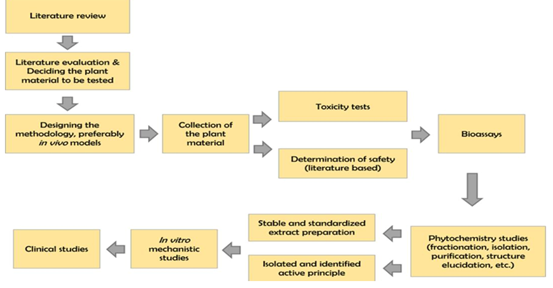
Schematic representation of the methodology adopted in the present study
|
Fiugre 1
|
Flow Diagram of Ethnopharmacological Study
Study Area
Selection
↓
Ethnopharmacological
Survey
↓
Interaction with
Indigenous Communities
↓
Documentation of
Medicinal Plants
↓
Plant
Identification and Authentication
↓
Data Analysis
↓
Ethnomedicinal
Applications
Results
The
ethnopharmacological survey documented five medicinal plant species belonging
to five different botanical families, indicating a wide taxonomic diversity in
traditional healthcare practices. The recorded plants included Azadirachta indica (Meliaceae),
Ocimum tenuiflorum (Lamiaceae),
Withania somnifera
(Solanaceae), Curcuma longa (Zingiberaceae), and Tinospora cordifolia (Menispermaceae).
Leaves were the
most frequently used plant part, accounting for two of the five documented
species (Azadirachta indica and Ocimum tenuiflorum). Other plant parts utilized included roots (Withania somnifera), rhizomes
(Curcuma longa), and stems (Tinospora cordifolia),
demonstrating diverse harvesting practices depending on therapeutic
application.
The documented
plants were traditionally used for the management of skin disorders,
respiratory ailments, stress-related conditions, wound healing, and immune
enhancement. Skin-related disorders and respiratory ailments were commonly
treated using leaf-based preparations, while roots and rhizomes were primarily
associated with stress relief and wound healing, respectively. Stem-based
remedies were mainly employed for enhancing immunity.
Overall, the
results highlight the extensive use of locally available medicinal plants in
treating common health ailments and emphasize the reliance of indigenous
communities on plant-based therapies for primary healthcare.
|
Table 1 |
|
Table 1 Ethnopharmacological Uses of
Selected Medicinal Plants |
||||
|
Plant Species |
Plant Family |
Plant Part Used |
Traditional Use (General) |
Traditional Use (Specific) |
|
Azadirachta indica |
Meliaceae |
Leaves |
Skin disorders |
Skin disorders |
|
Ocimum tenuiflorum |
Lamiaceae |
Leaves |
Leaves |
Respiratory ailments |
|
Withania somnifera |
Solanaceae |
Roots |
Roots |
Stress relief |
|
Curcuma longa |
Zingiberaceae |
Rhizome |
Rhizome |
Wound healing |
|
Tinospora cordifolia |
Menispermaceae |
Stem |
Stem |
Immunity enhancement |
Discussion
The present
ethnopharmacological documentation highlights the continued reliance of
indigenous communities on medicinal plants for the management of common health
ailments. The recorded use of five plant species belonging to different
botanical families reflects a broad traditional knowledge base and supports
earlier reports that emphasize the richness of India’s ethnomedicinal heritage.
The dominance of leaf usage observed in the study aligns with previous
ethnopharmacological findings, as leaves are easily accessible, renewable, and
often rich in bioactive compounds.
The traditional
application of Azadirachta indica for skin disorders
and infections is well supported by its documented antimicrobial and
anti-inflammatory properties. Similarly, Ocimum tenuiflorum
is widely recognized for its therapeutic role in respiratory ailments due to
its expectorant and immunomodulatory effects. The use of Withania
somnifera roots for stress relief corresponds with
its established adaptogenic and anti-stress activity, while Curcuma longa
rhizome use for wound healing reflects its known antioxidant and
anti-inflammatory potential. The inclusion of Tinospora
cordifolia for immunity enhancement further demonstrates the empirical
understanding of immunostimulatory plants in traditional medicine.
The strong
correlation between traditional claims and scientifically reported
pharmacological activities underscores the relevance of ethnopharmacological
studies in identifying potential plant-based therapeutic agents. Such
documentation not only aids drug discovery efforts but also plays a crucial
role in preserving indigenous knowledge systems that are increasingly
threatened by modernization and habitat loss.
Conclusion
The study
documents selected medicinal plants commonly used by indigenous communities and
highlights their therapeutic relevance in traditional healthcare practices. The
findings demonstrate that ethnopharmacological knowledge is closely aligned
with scientifically validated medicinal properties, emphasizing the credibility
of traditional medicine. The frequent use of easily available plant parts,
particularly leaves, reflects sustainable utilization practices. Overall, the
study reinforces the importance of ethnopharmacological research in conserving
traditional knowledge, promoting biodiversity, and providing valuable leads for
future pharmacological and phytochemical investigations.
REFERENCES
Fabricant, D. S., and Farnsworth, N. R. (2001). The Value of Plants Used in Traditional Medicine for Drug Discovery. Environmental Health Perspectives, 109(S1), 69–75. https://doi.org/10.1289/ehp.01109s169
Heinrich, M., Barnes, J., Gibbons, S., and Williamson, E. M. (2009). Fundamentals of Pharmacognosy and Phytotherapy. Elsevier.
Kala, C. P., Dhyani, P. P., and Sajwan, B. S. (2004). Developing the Medicinal Plants Sector in Northern India: Challenges and Opportunities. Journal of Ethnobiology and Ethnomedicine, 1, Article 1. https://doi.org/10.1186/1746-4269-1-1
Newman, D. J., and Cragg, G. M. (2020). Natural Products as Sources of New Drugs Over the Nearly four Decades from 1981 to 2019. Journal of Natural Products, 83(3), 770–803. https://doi.org/10.1021/acs.jnatprod.9b01285
Patwardhan, B., Vaidya, A. D. B., and Chorghade, M. (2004). Ayurveda and Natural Products Drug Discovery. Current Science, 86(6), 789–799.
 This work is licensed under a: Creative Commons Attribution 4.0 International License
© Granthaalayah 2014-2025. All Rights Reserved.