
Original Article
Financial Literacy in the Digital era: The role of Technology and Innovation in Transforming Investment Decisions
|
Dr. Renati Jayaprakash Reddy 1*, Pushpa M 2 1 Professor, Acharya
Institute of Management and Sciences, Bangalore, India 2 AIMS Centre for Advanced Research Centre,
University of Mysore, India |
|
|
|
ABSTRACT |
||
|
This study examines the significance of technology and innovation in enhancing financial literacy (FL) in the digital era and transforming investment decisions (ID) among Private Higher Educational teachers in Bengaluru Urban. Primary data was collected through self- administered questionnaire from 128 respondents and tested using SPSS Version 26. The reliability of the data was measured using “Cronbach’s alpha”, descriptive statistics to estimate mean and SD for the demographic data and Regression Analysis to validate the association among variables. The study’s finding reveals the significant role of Technology and Innovation in improving FL, thereby exerting a direct effect on individual's ID. The study highlights the need for educational institutions to conduct practical- oriented sessions for teachers on the integration of technology and innovation in the area of FL. The adoption of financial tools and applications is essential as teacher serves as a learner and also a facilitator in enhancing the next generation to be more rational and sustainable in their financial choices. The government should initiate subsidized access to e-learning platforms, digital tools and financial planning software for teachers to support continuous learning. Keywords: Financial Literacy, Technology and
Innovation, Investment Decisions. |
||
INTRODUCTION
The financial
sector has transformed significantly due to the new paradigm of Industry 4.0,
which is based on emerging technologies such as Artificial Intelligence (AI),
cyber-physical systems, and Internet of Things (IoT). Gunasekaran
et al. (2024), Bai et al. (2022) and subsequently has created the phenomenon
of financial technologies (FinTech), which provide new tools and innovations to
enable individuals in managing their personal finances and facilitate
investment decisions Islam
and Khan (2024). Robo-advisors and digital wallets are
lowering the cost and complexity of financial services as these technologies
enable people to manage their investments. However, the eventual success of
those services will depend mainly on the users’ FL and the education that
surrounds digital financial competences Ariwangsa et
al. (2024). Additionally, Lal et al. (2025) identifies three drivers of DFL being
economic resources, educational background, and digital involvement, and also
argues that inequality in access to digital resources may magnify distinctions
in levels of financial decision-making. These findings support the need to
investigate FL not as discrete and isolated rather as a function of digital
competencies that influence the investment behavior
in the digital age.
The rapid growth
in digital technology is changing the financial landscape and allowing
individuals to access information and financial services Darwish
et al. (2025). Hassan
et al. (2024) demonstrate that Fintech self-efficacy
moderates the FL investment behavior, implying that
literacy and digital confidence together shape the technology
based investment choices. Bai et al. (2023) reveals that FL contributes to investment
decision making and thus enhances wellbeing, while Luo et al. (2023) draw on micro-level evidence from China to
show that the FL of households increases the likelihood of profit in equity
investments. Mishra
et al. (2024) demonstrate that women who possess a high
level of DFL will be more likely to adopt Fintech services and make better
investment decisions, illustrating how DFL can lessen gender disparities in
financial inclusion.
Xie and Chen (2024) also indicated, households with a high level
of DFL are more likely to be entrepreneurs and investors, underscoring the
larger societal economic impacts of being digitally competent. Similarly, Olajide
et al. (2024) examined multiple generational differences
on usage of social media for investment advice, and
found that younger generations are more influenced by digital content for
investment decisions, which impacts their financial satisfaction. These studies
demonstrate the influence of both formal and informal digital networks in
shaping investment choices. Along with these transformations, individuals must
learn to comprehend and effectively manage financial products and platforms.
Although technology is widely available, an inadequate FL and behavioral biases can still lead to adverse financial
outcomes Aftab et
al. (2025). Therefore, FL is needed to minimize risks
associated with digital tools, leading to more prudent financial decisions.
Individuals who possess greater FK are better able to analyze
risks, diversification opportunities, and evade fraudulent schemes.
The study is
focused on examining the impact of technology and innovation in enhancing FL in
the digital era and transforming investment decisions among private higher
educational teachers in Bengaluru urban. As the academic space continues to
change, the role of the teacher is not just delivering static knowledge, rather
developing the digital and financial skills to navigate complex information
system. Therefore, studying their perception becomes essential.
Review of Literature
Technology and Innovation in Enhancing FL
Technology and
innovation have emerged as fundamental drivers to enhance FL in this digital
era. For example, Digital Financial Literacy (DFL), extends existing knowledge
and skills of FL to locate and tailor digital financial services, and is
increasingly referred to as a necessity for effective financial decision-making
Khatri
et al. (2025). In addition, an empirical study supported
the mediating effects of DFL on financial decision making. Kumar et
al. (2022), describes DFL as a component of individual
financial wellness, and suggests that collaborative educational and policy
responses are necessary. Technological advances, such as fintech, have been
demonstrated to improve accessibility to budgeting tools, expense tracking, and
savings habits Cahyono
and Susbiyani (2025). The following discussions indicate the
effects of fintech and digital tools on personal finance management behavior. Waliszewski
and Warchlewska (2020) concluded that social-economic
characteristics were significantly impacted the satisfaction level in AI-based
financial planning, while Gautam
et al. (2022) reported the fintech adoption through credit
card schemes that were positively
correlated to digital literacy, especially in contexts with unskilled
populations. In accordance with this, Zhang
and Fan (2024) reported that mobile FinTech usage can
enhance financial well-being when paired with adequate literacy levels.
Researchers have also shown that simulation-based learning methods sustain
student interaction and retention of the information around financial concepts
more effectively than traditional instruction Belgacem
et al. (2024). Using the Technology Acceptance Model
(TAM), Jariyapan et
al. (2022) found that perceived usefulness is the most
significant predictor of behavioral intention to
adopt crypto currencies, with FL and perceived risk being significant
explanatory factors. Despite the growing body of literature, there is still
inadequate study on the combined effects of technology and innovations on FL
within the digital age, particularly in the context of private higher education
teachers in Bengaluru City. To address this gap, the hypothesis considered in
this study is:
H1: Technology and
innovation is positively associated in enhancing FL in
the digital era.
Impact of FL on Investment decisions
The advancements
of digital technologies, along with behavioral
finance, have created decision-making determinants beyond the FL components,
such as attitudes, risk tolerance, and technology-based platforms. Seraj, Alzain, and Alshebami (2022)
found that FL significantly improved investor decisions, particularly when
moderated by overconfidence of investors. Andersson
et al. (2023) revealed that FK, when mediated by behavioral finance variables, helps capital market
investors make informed decisions. Rahmiyati and Somodiharjo (2025) expanded on this study and confirmed
evidence of a relationship between FL, behavioral
biases, and individual investment performance in Indonesia. Innovative methods
were also used to further support the relationship. Jariyapan et
al. (2022) emphasized the need of FL in the high-risk,
technology-driven investment space. Kumar et
al. (2023) explored the behavioral,
psychological, and demographic-based factors of household investment decisions,
offering evidence that digital financial literacy (DFL) serves as a partial
moderator between financial capability and decision-making and included
psychological and behavioral aspects of investment
decisions for a sustained financial future. Likewise, Aisa (2021) also investigated FL and the use of technology-based investment
platforms on students’ intention to invest in the capital market. Both FL and
the usage of the investment platform were determined to have a significant
relation to investment intentions, and it was concluded that early use of
financial investment tools would prompt students to actively engage with
financial decision-making. Likewise, Zaimovic et al.
(2023) systematically reviewed the relationship between FL and FB by
highlighting DFL as a growing determinant of improved decision-making.
Stressing these digital investment preparedness gaps, Yeo et al. (2023) extended the literature by introducing behavioral finance concepts to the Theory of Financial
Planning Behavior (TFPB) within a descriptive
contextual model that provides a more accurate account of investment
decision-making across diverse contexts. The existing work has explored the
impact of FL on investment decisions; limited studies have investigated this
relationship in the context of technology and innovation-driven improvements in
FL. There is a need to examine how technology-enabled advancements in FL lead
to informed investment decisions. Thus, the study postulates the following
hypothesis:
H2: FL
significantly influences investment decisions.
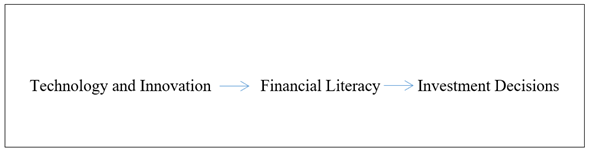
Conceptual
Framework
Research Methodology
The present study
adopts the framework of descriptive and explanatory research design. The
descriptive design was employed to analyze the
demographic characteristics and the explanatory design was used to examine the
effect of Technology and Innovation on FL and its impact on ID. The population of the study comprised
teachers working in private higher educational institutions in Bangalore Urban.
Using non- probability convenience sampling, a total of 128 respondents were
selected to represent the study sample. Data was collected with a structured
questionnaire that included three items measuring Technology and Innovation,
Financial Literacy, and Investment Decisions. Data was analyzed
using SPSS Version 26: The reliability of the questionnaire was measured using
“Cronbach’s alpha”, descriptive statistics to estimate mean and variability for
the demographic data and Regression Analysis to validate the association among
variables.
Results
Reliability Results
|
Table 1 |
|
Table 1 Reliability Statistics for the Overall measure |
|
|
Reliability Statistics |
|
|
Cronbach's Alpha |
N |
|
0.93 |
29 |
|
Source: SPSS 26 |
|
Table 1 presents the internal reliability of the
scale. The overall reliability of the 29 items indicates Cronbach’s Alpha of
.930, validating strong internal consistency. In general, Cronbach’s Alpha
above .70 demonstrates the stated variables are good to use. Nunnally
(1975)
|
Table 2 |
|
Table 2 Reliability Statistics for Individual
Constructs |
||
|
Constructs |
Reliability Statistics |
|
|
|
Cronbach's Alpha |
N |
|
Financial Literacy |
.826 |
5 |
|
Technology and
Innovation |
.914 |
10 |
|
Investment Decisions |
.893 |
14 |
|
Source: SPSS 26 |
||
Table 2 outlines the reliability scale per
construct. The Cronbach’s Alpha for Financial Literacy (5 items) = .826;
Technology and Innovation (10 items) = .914; and Investment Decisions (14
items) = .893 results show the items in each construct are highly consistent
and reliable.
|
Table 3 |
|
Table 3 Demographic Profile |
|||
|
Demographic Profile |
Frequency |
Percent |
|
|
< 30 years |
22 |
17.2 |
|
|
31-40 years |
64 |
50 |
|
|
41-50 years |
30 |
23.4 |
|
|
Age |
> 50 years |
12 |
9.4 |
|
Male |
44 |
34.4 |
|
|
Gender |
Female |
84 |
65.6 |
|
Post Graduate |
96 |
75 |
|
|
Educational
Qualification |
Doctorate |
30 |
23.4 |
|
Post-Doctoral |
2 |
1.6 |
|
|
Years of Work
Experience |
< 5 years |
14 |
10.9 |
|
6-10 years |
44 |
34.4 |
|
|
11-15 years |
32 |
25 |
|
|
16-20 years |
20 |
15.6 |
|
|
>20 years |
18 |
14.1 |
|
|
Unmarried |
22 |
17.2 |
|
|
Marital Status |
Married |
102 |
79.7 |
|
Divorced |
4 |
3.1 |
|
|
Nuclear |
72 |
56.3 |
|
|
Type of family |
Joint |
46 |
35.9 |
|
Single Parent |
10 |
7.8 |
|
|
< 5lakh |
42 |
32.8 |
|
|
Annual income |
5 to 10 lakh |
64 |
50 |
|
10 Lakh to 15 lakh |
12 |
9.4 |
|
|
>15 lakh |
10 |
7.8 |
|
|
Note: N = 128 |
|||
Table 3 summarizes the demographic profile of the
respondents.
A total of 128
respondents represented demographic characteristics. The sample shows that the
majority (50%) was aged 31-40 years, 23.4% were 41-50 and 9.4% are above 50
years. The gender distribution includes 65.6% female and 34.4% male. Regarding
education, 75% hold post graduate, 23.4% are with Doctorate and 1.6%
post-doctoral. In terms of work experience, 34.4% have 6-10 years, 25% with
11-15 years and 10.9 less than 5 years. 79.7% of the respondents are married,
and 56.3% were in a Nuclear Family. Income level indicates 50% of them earn
between 5 to 10 lakhs, 32.8% below 5 lakhs, and 7.8% above 15 lakhs.
|
Table 4 |
|
Table 4 Descriptive Statistics |
|||
|
Constructs |
Descriptive Statistics |
||
|
No of items |
Mean |
Std. Deviation |
|
|
Statistic |
Statistic |
||
|
Financial Literacy |
5 |
3.625 |
.81289 |
|
Technology and
Innovation |
10 |
3.1578 |
.83446 |
|
Investment Decisions |
14 |
3.7857 |
.61908 |
|
Output:
SPSS 26, Note* N=128 |
|||
The descriptive
statistics of the constructs are presented in Table 4 FL, measured with the scale of 5 items, shows a mean of 3.63 (SD =
0.81), suggesting moderate financial knowledge among the respondents.
Technology and Innovation, based on the set of 10 constructs has a mean of 3.16
(SD = 0.83), indicating moderate average with more spread in responses compared
to Financial Literacy. Investment Decisions measured with the set of 14 items,
had the highest mean of (M = 3.79, SD = 0.62) with lower variability.
Regression Analysis
|
Table 5 |
|
Table 5 Technology and Innovation in Enhancing FL in the Digital Era |
||||||
|
Coefficientsa |
||||||
|
Model |
Unstandardized
Coefficients |
Standardized
Coefficients |
t |
Sig. |
||
|
B |
Std. Error |
Beta |
||||
|
1 |
(Constant) |
2.049 |
0.243 |
8.419 |
0 |
|
|
Technology and
Innovation |
0.499 |
0.075 |
0.512 |
6.696 |
0 |
|
|
Dependent Variable:
Financial literacy |
||||||
Table 5 demonstrates the regression results. The
regression analysis studied the effect of Technology and Innovation on
Financial Literacy. In which financial literacy is taken as the dependent
variable, technology and innovation as the independent variable. The results
reveals that Technology and innovation is significantly associated with
Financial Literacy (B = 0.499, t = 6.696, p < .001.The standardized
coefficient (β = .512) indicates the increase in Technology and Innovation
will likely improve Financial Literacy levels.
|
Table 6 |
|
Table 6 Impact of FL on Individuals ID |
||||||
|
Coefficientsa |
||||||
|
Model |
Unstandardized Coefficients |
Standardized Coefficients |
t |
Sig. |
||
|
B |
Std. Error |
Beta |
||||
|
1 |
(Constant) |
2.253 |
0.21 |
10.749 |
0 |
|
|
Financial Literacy |
0.423 |
0.056 |
0.555 |
7.494 |
0 |
|
|
Dependent Variable: Investment Decisions |
||||||
The model shows
Investment decision as a dependent variable and financial literacy as a
predictor. The results from regression analysis indicates a strong positive
influence of FL on Investments decisions (B = .423, t = 7.494, p < .001).
The standardized coefficient (β = .555) reveals that respondents with
higher level of financial literacy leads to a sound investment decisions.
Overall, the
regression results provide evidence for the proposed hypotheses, showing the
important role of Technology and Innovation on improving Financial Literacy,
thereby exerting a direct effect on an individual's investment decision.
|
Table 7 |
|
Table 7 Hypotheses Testing
Results |
|||||
|
Hypotheses |
Relationship Tested |
Standardized Beta
(β) |
t-value |
Sig. (p-value) |
Conclusion |
|
H1 |
Technology and Innovation ➝ Financial Literacy |
0.512 |
6.696 |
0 |
Accepted |
|
H2 |
Financial Literacy ➝ Investment Decisions |
0.555 |
7.494 |
0 |
Accepted |
|
Source: Authors Computation |
|||||
The hypotheses
results are presented in Table 7 Technology and Innovation have a significant impact in increasing
financial literacy in the digital age (β: .512, t-value: 6.696, p-value:
.000). Hence H1 is supported. Similarly Financial Literacy significantly
influences Investment decisions (β: .555, t-value: 7.794, p-value: .000)
supporting H2.
Discussion
The study examined
financial literacy in the digital era and investigated the role of technology
and innovation in shaping investment decisions among private higher educational
institutions teachers in Bengaluru urban. The findings obtained from a regression
analysis indicates the significance of Technology and Innovation in enhancing
FL, suggesting that digital tools
support individuals in comprehending and managing financial ideas. This aligns
with the work of Ferilli et al.
(2024) where DFL is claimed to be a key factor in
enhancing financial well-being and promoting effective decision making.
Moreover, Furinto et al.
(2023) states that the development of FL was
successful and the fintech aspects were a major element in contributing to the
improvements. Moreover, the results suggest that Technology and innovation is
significantly related to FL, and these findings are consistent with recent
works, namely, Ariwangsa et
al. (2024) found FL as a main influencer of investment
decisions made by small and medium businesses, with technology representing a
moderating aspect to strengthen the relationship between FL and ID making. Futhermore, Raut and Kumar (2023) explains that an individuals
who has a high FL, can be characterized as a rational investor, as they evaluates risk and return before making any investment
decision. Overall, the discussion emphasizes that increasing financial
knowledge using technology can support better financial conduct and sustainable
investments.
Conclusion
In the present
study, the emphasis was made on three important variables- Technology and
Innovation, FL and ID. The evidence suggests that teachers in private higher
educational institutions with increased access to digital equipment and
technological advances can enhance their financial literacy and make better
informed investment decisions. The adoption of financial tools and applications
is essential as teacher serves as a learner and also a facilitator in enhancing
the next generation to be more rational and sustainable in their financial
choices. The study highlights the need
for educational institutions to conduct practical- oriented sessions for
teachers on the integration of technology and innovation in the area of
financial literacy. The government should initiate subsidized access to digital
tools, e-learning platforms, and financial planning software for teachers to
support continuous learning.
The study is
limited to the teachers of private higher educational institutions in Bengaluru
urban. The relationship between the study’s variables was tested using
regression analysis. Future studies can explore the mediating role of FL
between technology and ID across different regions. This can provide a better
understanding of the relationship between digital innovations and financial
knowledge in affecting investment behavior.
ACKNOWLEDGMENTS
None.
REFERENCES
Aftab, R., Fazal, A., and Andleeb, R. (2025). Behavioral Biases and Fintech Adoption: Investigating the Role of Financial Literacy. Acta Psychologica, 257, 105065. https://doi.org/10.1016/j.actpsy.2025.105065
Aisa, N. N. (2021). Do Financial Literacy and Technology Affect Intention to Invest in the Capital Market in the Early Pandemic Period? Journal of Accounting and Investment, 23(1), 49–65. https://doi.org/10.18196/jai.v23i1.12517
Andersson, H. (2023). The Influence of Demographic Factors and Financial Literacy on Investment Decisions Mediated by Behavioral Finance (Empirical study: On Capital Market Investors in DKI Jakarta). Journal Research of Social Science Economics and Management, 3(04). https://doi.org/10.59141/jrssem.v3i04.588
Ariwangsa, N. I. O., P, N. K. W. S. P., and P, N. K. W. L. (2024). The Impact of Financial Literacy on Investment Decisions: The Moderating Role of Financial Technology. UPI YPTK Journal of Business and Economics, 9(3), 16–22. https://doi.org/10.35134/jbe.v9i3.274
Bai, C., Li, H. A., and Xiao, Y. (2022). Industry 4.0 Technologies: Empirical Impacts and Decision Framework. Production and Operations Management. https://doi.org/10.1111/poms.13813
Bai, R. (2023). Impact of Financial Literacy, Mental Budgeting and Self-Control on Financial Wellbeing: Mediating Impact of Investment Decision Making. PLOS ONE, 18(11), e0294466. https://doi.org/10.1371/journal.pone.0294466
Belgacem, S. B., Khatoon, G., Bala, H., and Alzuman, A. (2024). The Role of Financial Technology on the Nexus Between Demographic, Socio-Economic, and Psychological Factors, and the Financial Literacy gap. SAGE Open, 14(2). https://doi.org/10.1177/21582440241255678
Cahyono, D., Susbiyani, A., Lestari, E., Fauziyah, F., Qomariah, N., and Guntu, Y.S. (2025). Role of Personal Savings in Financial Tech Impact on Family Planning in Indonesia. 7(1). https://doi.org/10.34306/att.v7i1.494
Darwish, F. S. M. (2025). Financial Literacy and Investment Decision: An Empirical Study from the Palestine Stock Exchange. Frontiers in Behavioral Economics, 4. https://doi.org/10.3389/frbhe.2025.1444022
Ferilli, G. B., Palmieri, E., Miani, S., and Stefanelli, V. (2024). The Impact of Fintech Innovation on Digital Financial Literacy in Europe: Insights from the Banking Industry. Research in International Business and Finance, 69, 102218. https://doi.org/10.1016/j.ribaf.2024.102218
Furinto, A., Tamara, D., Yenni, N., and Rahman, N. J. (2023). Financial and Digital Literacy Effects on Digital Investment Decision Mediated by Perceived Socio-Economic Status. E3S Web of Conferences, 426, 02076. https://doi.org/10.1051/e3sconf/202342602076
Gautam, R. S., Rastogi, S., Rawal, A., Bhimavarapu, V. M., Kanoujiya, J., and Rastogi, S. (2022). Financial Technology and its Impact on Digital Literacy in India: Using Poverty as a Moderating Variable. Journal of Risk and Financial Management, 15(7), 311. https://doi.org/10.3390/jrfm15070311
Gunasekaran, A., Kamble, S., Ghadge, A., and Kumar, V. (2024). Investments in Industry 4.0 technologies and Supply Chain Finance: Approaches, Framework and Strategies. International Journal of Production Research, 62(22), 8049–8055. https://doi.org/10.1080/00207543.2024.2405322
Hassan, N. C., Abdul-Rahman, A., Hamid, S. N. A., and Amin, S. I. M. (2024). What Factors Affecting Investment Decision? The Moderating Role of Fintech Self-Efficacy. PLOS ONE, 19(4), e0299004. https://doi.org/10.1371/journal.pone.0299004
Islam, K. M. A., and Khan, M. S. (2024). The Role of Financial Literacy, Digital Literacy, and Financial Self-Efficacy in Fintech Adoption. Investment Management and Financial Innovations, 21(2), 370–380. https://doi.org/10.21511/imfi.21(2).2024.30
Jariyapan, P., Mattayaphutron, S., Gillani, S. N., and Shafique, O. (2022). Factors Influencing the Behavioural Intention to use Cryptocurrency in Emerging Economies During the COVID-19 Pandemic: Based on Technology Acceptance Model 3, Perceived Risk, and Financial Literacy. Frontiers in Psychology, 12. https://doi.org/10.3389/fpsyg.2021.814087
Khatri, H., Idrees, M. A., and Sultan, F. (2025). Impact of Fintech on Financial Inclusion: The Mediating Role of Digital Financial Literacy. 4(01), 1024–1043. https://doi.org/10.55966/assaj.2025.4.1.068
Kumar, P., Islam, M. A., Pillai, R., and Sharif, T. (2023). Analysing the Behavioural, Psychological, and Demographic Determinants of Financial Decision Making of Household Investors. Heliyon, 9(2), e13085. https://doi.org/10.1016/j.heliyon.2023.e13085
Kumar, P., Pillai, R., Kumar, N., and Tabash, M. I. (2022). The Interplay of Skills, Digital Financial Literacy, Capability, and Autonomy in Financial Decision Making and Well-Being. Borsa Istanbul Review, 23(1), 169–183. https://doi.org/10.1016/j.bir.2022.09.012
Lal, S., Bawalle, A. A., Khan, M. S. R., and Kadoya, Y. (2025). What Determines Digital Financial Literacy? Evidence from a Large-Scale Investor Study in Japan. Risks, 13(8), 149. https://doi.org/10.3390/risks13080149
Luo, Z., Azam, S. M. F., and Wang, L. (2023). Impact of Financial Literacy on Household Stock Profit Level in China. PLOS ONE, 18(12), e0296100. https://doi.org/10.1371/journal.pone.0296100
Mishra, D., Agarwal, N., Sharahiley, S., and Kandpal, V. (2024). Digital Financial Literacy and its Impact on Financial Decision-Making of Women: Evidence from India. Journal of Risk and Financial Management, 17(10), 468. https://doi.org/10.3390/jrfm17100468
Nunnally, J. C. (1975). Psychometric Theory—25 Years Ago and now. Educational Researcher, 4(10), 7–21. https://doi.org/10.3102/0013189X004010007
Olajide, O., Pandey, S., and Pandey, I. (2024). Social Media for Investment Advice and Financial Satisfaction: Does Generation Matter? Journal of Risk and Financial Management, 17(9), 410. https://doi.org/10.3390/jrfm17090410
Rahmiyati, N., and Somodiharjo, K. (2025). The Impact of Financial Literacy, Investment Decision-Making, Risk Tolerance, and Behavioral Biases on Individual Investment Performance. The Es Accounting and Finance, 3(03), 223–237.
Raut, R. K., and Kumar, S. (2023). An Integrated Approach of TAM and TPB with Financial Literacy and Perceived Risk for Influence on Online Trading Intention. Digital Policy, Regulation and Governance, 26(2), 135–152. https://doi.org/10.1108/DPRG- 07-2023-0101
Cahyono, D.C., and Susbiyani, A. (2025). Role of Personal Savings in Financial Tech Impact on Family Planning in Indonesia. (n.d.). Aptisi.
Seraj,
A. H. A., Alzain, E., and Alshebami, A. S. (2022). The Roles
of Financial Literacy and Overconfidence
in Investment Decisions in Saudi Arabia. Frontiers in Psychology, 13, 1005075.
Waliszewski, K., and Warchlewska, A. (2020). Attitudes Towards Artificial Intelligence in the Area of Personal Financial Planning: A Case Study of Selected Countries. Entrepreneurship and Sustainability Issues, 8(2), 399–420.
Xie, Y., and Chen, T. (2024). A Study on the Impact of Digital Financial Literacy on Household Entrepreneurship—Evidence from China. Sustainability, 17(1), 117. https://doi.org/10.3390/su17010117
Yeo, K. H. K., Lim, W. M., and Yii, K. (2023). Financial Planning Behaviour: A Systematic Literature Review and New Theory Development. Journal of Financial Services Marketing. https://doi.org/10.1057/s41264-023-00249-1
Zaimovic, A., Torlakovic, A., Arnaut-Berilo, A., Zaimovic, T., Dedovic, L., and Meskovic, M. N. (2023). Mapping Financial Literacy: A Systematic Literature Review of Determinants and Recent Trends. Sustainability, 15(12), 9358. https://doi.org/10.3390/su15129358
Zhang, Y., and Fan, L. (2024). The Nexus of Financial Education, Literacy and Mobile Fintech: Unraveling Pathways to Financial Well-Being. International Journal of Bank Marketing, 42(7), 1789–1812. https://doi.org/10.1108/IJBM-09-2023-0531
 This work is licensed under a: Creative Commons Attribution 4.0 International License
© Granthaalayah 2014-2025. All Rights Reserved.

