Original Article
Scope of NEP 2020, NCF-FS 2022, and NCF-SE 2023 in addressing the Educational needs of Generation Alpha and Beta
|
Dr. G. Thirumoorthy 1 1 Department of Education,
Regional Institute of Education, NCERT, Ajmer, Rajasthan, India |
|
|
|
ABSTRACT |
||
|
Generation Alpha and Beta are poised to flourish in the wake of the catastrophic shift in artificial intelligence (AI) and robotics, which is poised to detach from the present, custom-bound society. Hence, it is of the hour that Generation Alpha and Beta need to accelerate through Education 4.0 to 5.0 to navigate and accommodate them into the Fourth and Fifth Industrial Revolutions (Industry 4.0 and 5.0), and they will witness the emergence of the Super Smart Society 5.0. Keeping these as a background, this article aims to describe the scope of NEP 2020, NCF-FS 2022, and NCF-SE 2023 in facilitating the transformation from Education 4.0 to 5.0 and in addressing the needs of Generation Alpha and Beta in India. Keywords: NEP 2020, NCFFS 2022, NCFSE 2023, Gen
Alpha and Beta, Educational Reform. |
||
INTRODUCTION
Human resources
are considered the most essential and prime resource among all other resources.
Because it is the only intellectual species that becomes a thinker, creator,
and decision-maker, and that identifies, manages, and effectively uses other
resources. Young and energetic human beings can learn, adapt, and evolve to
enhance productivity and growth. Skilled, competent, and healthy human
resources contribute directly to a country's development. Education is the only
tool that can transform adolescents into human capital, capable of making
value-based decisions, showing empathy, and ensuring that development is
sustainable and equitable.
With a population
of 1.45 billion in 2025, India is the most populous country in the world, and
with 356 million youths, it also has the largest young population globally.
Various Indian stakeholders have a critical role in educational planning to
effectively address the needs of the world's largest young population, which is
essential for the optimal development and utilization of human resources.
Planning for education, guiding individuals for professional development, and
integrating them into various professions is a significant challenge for the
Indian government. Because India is a subcontinent with immense diversity in
terms of education and socio-economic development, it faces unique challenges
and opportunities in implementing uniform educational policies. Keeping these
as a background, the National Education Policy 2020, followed by NCF-FS 2022
and NCF-SE 2023, was introduced to address the educational needs of Generations
Alpha and Beta and to transform them into human capital.
Educational
planning for Generations Alpha and Beta is highly challenging, as we are moving
toward Industry 4.0, which includes automation, digital transformation, and
interconnected systems to improve efficiency and productivity. This will be
followed by Industry 5.0, which articulates human-machine synergy,
sustainability, and resilience, recognizing the importance of human ingenuity
and well-being alongside technology. Ultimately, Generations Alpha and Beta
need well-rounded development to flourish in the super-smart Society 5.0, where
technology is used to tackle social challenges and enhance human well-being,
rather than solely focusing on economic growth.
This human-centric approach envisions a future where technology enhances
people's well-being, improves quality of life, and addresses societal
challenges.
UNDERSTANDING THE TRENDS OF LITERACY RATE IN INDIA
The Indian
subcontinent is rich not only in natural resources but also in human resources.
India had a flourishing Vedic education system in the north and Sangam
literature and learning in the south. However, the Greatest Generation (GI
Generation) in India began with only 9.2% literacy in the 19th century. By the
time India gained independence, the Baby Boom Generation had an average
literacy rate of just 18.33%. After independence, continuous efforts were made
initially under the State List and later under the Concurrent List to promote
literacy. As a result of these sustained initiatives, Generation Alpha has
reached an estimated literacy rate of 77.7% as of 2021.
|
Table 1 |
|
Table 1 Trends in Literacy
Rate in India |
|||||
|
S/N |
Name of generation |
Years of Born |
Literacy Rate |
||
|
Years |
Total population (Crores) |
% of literacy |
|||
|
1 |
The Greatest Generation (GI
Generation) |
1901–27 |
1901 |
23.84 |
9.2 |
|
1911 |
25.21 |
5.9 |
|||
|
1921 |
25.13 |
7.2 |
|||
|
2 |
The Silent Generation |
1928–45 |
1931 |
27.89 |
9.5 |
|
1941 |
31.87 |
16.1 |
|||
|
3 |
Baby Boom Generation |
1946–64 |
1951 |
36.11 |
18.33 |
|
1961 |
43.92 |
28.3 |
|||
|
4 |
Generation X |
1965–80 |
1971 |
54.82 |
34.45 |
|
5 |
Millennial Generation or
Generation Y |
1981–96 |
1981 |
68.33 |
43.57 |
|
1991 |
84.63 |
52.21 |
|||
|
6 |
Generation Z or iGen |
1997–10 |
2001 |
102.9 |
64.83 |
|
7 |
Generation Alpha |
2010-24 |
2011 |
121.0 |
74.04 |
|
Estimated |
|||||
|
2021 |
141.42 |
77.7 |
|||
|
8 |
Generation Beta |
2025-39 |
2031 |
153 |
Aimed 100 |
|
Sources Singh (2013), Statista (2024), and Cottrell (2024) |
|||||
The Sarva Shiksha
Abhiyan (SSA), launched in 2001, aimed to achieve Universal Elementary
Education (UEE) for children aged 6–14 years. This was followed by the
Rashtriya Madhyamik Shiksha Abhiyan (RMSA), initiated in 2009 to enhance access
to and improve the quality of secondary education. To accommodate the increased
number of students progressing to higher education, the Rashtriya Uchchatar Shiksha Abhiyan (RUSA) was launched in 2013,
providing strategic funding to state-run higher educational institutions,
including universities and colleges.
The Samagra Shiksha Abhiyan (SSA) is a comprehensive program
launched in 2018 to unify and enhance school education across India. It
integrates three previous schemes, Sarva Shiksha Abhiyan (SSA), Rashtriya
Madhyamik Shiksha Abhiyan (RMSA), and Teacher Education (TE), into a single
framework, covering education from pre-school to Class 12. Aligned with the
National Education Policy (NEP) 2020, the program strives to guarantee access
to inclusive and fair quality education for learners at every level. The scheme
has been extended for five years, from 2021–22 to 2025–26.
STATE-WISE LITERACY RATE
The National
Education Policy (NEP) 2020 and the National Curriculum Frameworks (NCFs) aim
to achieve a 100% literacy rate across India. However, reaching this milestone
requires dedicated efforts and special attention from each state. Based on data
from the Census 2011, the National Statistical Office (NSO), and the National
Family Health Survey (NFHS-5), Rana (2024) has estimated the literacy rates across the
country. The findings reveal significant fluctuations in literacy levels among
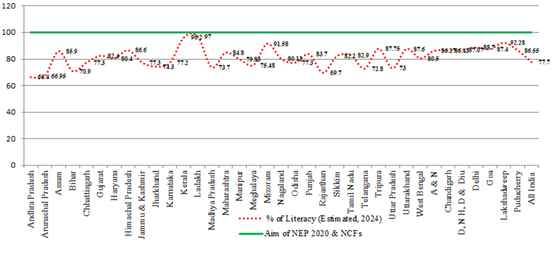
different Indian states, as illustrated in Figure 1. Ladakh has made history by achieving a
remarkable 97% literacy rate, becoming the first union territory to be
recognized as fully "functionally literate." Kerala follows closely
with a literacy rate of 96.2%, reflecting its status as one of the
top-performing states in India in the field of education. In contrast, several states continue to
struggle with low literacy levels. Andhra Pradesh records the lowest literacy
rate among all states at 66.4%, followed by Arunachal Pradesh at 66.95% and
Rajasthan at 69.7%, highlighting the regional disparities in educational
attainment across the country.
|
Figure 1 |
|
Figure 1 State-Wise Literacy Rate |
STATE-WISE ENROLMENT IN HIGHER EDUCATION
At present, the
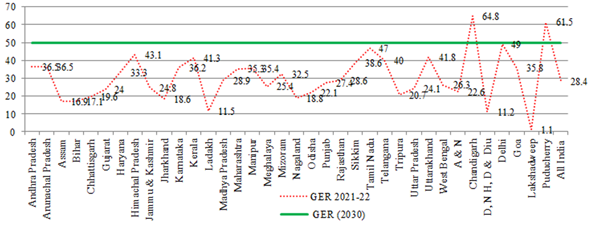
Gross Enrolment Ratio (GER, Fig. 2) is 28.4% (2021–22) (AISHE, 2022), but the
NEP 2020 strives to raise the Gross Enrolment Ratio to 50% by 2030. However,
Chandigarh (64.8%) and Puducherry (61.5%) have already attained the GER target
set by NEP 2020 Figure 1. Some states, such as Himachal Pradesh
(43.1%), Kerala (41.3%), Tamil Nadu (47.0%), Uttarakhand (41.8%), and Delhi
(49.0%), are very close to achieving this goal. These states and UTs need to
adopt customized strategies to further promote higher education and maximize
the GER to compete with globally advanced countries, such as the United States
(79.36%) Trading
Economics (2025), Canada (60%), South Korea (75%) Statista
(2025), Japan (63.17%) Trading
Economics (2025), and Australia (53%), among others HERS (2023).
|
Figure 2 |
|
Figure 2 Enrolment in Higher Education
(2023-2024) |
On the other hand,
the Gross Enrolment Ratio (GER, Fig.1) in states such as Assam (16.9%), Bihar
(17.1%), Chhattisgarh (19.6%), Jammu and Kashmir (24.8%), Jharkhand (18.6%),
Ladakh (11.5%), Meghalaya (25.4%), Nagaland (18.8%), Odisha (22.1%), Punjab
(27.4%), Tripura (20.1%), Uttar Pradesh (24.1%), West Bengal (26.3%), Andaman and
Nicobar Islands (22.6%), Dadra and Nagar Haveli and Daman and Diu (11.2%), and
Lakshadweep (1.1%) is below the national average of 28.4%. These states need
special attention to reach at least the national average and require an action
plan to increase their GER to attain the NEP 2020 vision of 50%. The GER in the
remaining states is above the national average (28.4%), but they still require
customized approaches to achieve the NEP 2020 target of 50%.
NATURE OF GEN ALPHA
For the next few
decades, NEP 2020 and NCFs, along with parents, teachers, and other
stakeholders, need to focus on planning and working together to support the
largest youth population in the world, Generation Alpha and Beta, who are
growing up in a fully digital world. Understanding their educational needs and
adopting appropriate pedagogical approaches is the need of the hour to ensure
100% school education and to maximize enrollment in
higher education.
The following
characteristics of Generation Alpha need to be addressed during educational
planning McCrindle
et al. (2020), and United
Nations International School of Hanoi (2025).
Digital natives
and diverse to Artificial Intelligence (AI): Gen Alpha are the true digital natives, navigating a universe where
technology is woven into every facet of their learning and playtime. They grow
up with access to and learn through smartphones, tablets, the internet, social
media, videos, interactive apps, augmented Reality and Virtual Reality (AR/VR)
experiences, and gamified platforms, making them highly visual and interactive
learners who naturally embrace digital literacy. They are typically comfortable
using AI-powered systems that understand and respond to their needs, creating a
sense of human-like engagement. However, this reliance on digital interaction
could cause social isolation and hinder real-world interpersonal skills, which
may have an effect on Generation Alpha, the first group to be raised in a world
shaped completely by artificial intelligence.
Global Ambassador: Generation Alpha is an everyday ambassador of global culture. With
instant access to the world through the internet, social media, and global
platforms like YouTube, online games, and digital content, they are constantly
exposed to diverse perspectives, trends, and ideas. This continuous interaction
fosters broader worldviews and quick adaptability. As digital global citizens,
Gen Alpha regularly communicates, learns, and collaborates with peers across
borders. These experiences naturally cultivate cross-cultural understanding and
empathy. They are also increasingly conscious of worldwide challenges like
climate change, social justice, and diversity. Many actively engage in global
conversations, online campaigns, and virtual forms of activism, reflecting their
early sense of social responsibility. Moreover, exposure to various languages,
accents, cuisines, and cultural practices helps them grow into open-minded,
culturally sensitive, and inclusive individuals from a young age.
Mental health
champions: Generation Alpha
is growing up in a highly competitive and achievement-oriented era. As a
result, they are naturally emerging as champions of mental health and are
emotionally and psychologically driven, recognizing the importance of emotional
care and well-being from an early age. This makes them an emotionally resilient
generation.
Free spirits: Generation Alpha is often described as a
generation of self-directed, independent mavericks, embracing a spirit of
self-reliance, confidence, and self-motivation, and showing no fear in
challenging norms. They exhibit high levels of independence, quickly navigate
the digital landscape, and possess a strong sense of autonomy. They acquire
knowledge independently and prefer making their own decisions, exploring, and
figuring things out for themselves.
Entrepreneurial
and creative wizards:
Generation Alpha is being raised in an environment shaped by instant access to
technology, creative platforms, and global connectivity. From an early age,
they use a variety of creative tools to experiment with content creation,
digital art, and small-scale entrepreneurship. With a strong maker mindset,
they learn to design, test, adapt, and innovate independently. Far from being
passive consumers, Gen Alpha actively leverages technology to bring their ideas
to life. They are natural-born innovators, constantly reimagining how things
work and showing the traits and spirit of true entrepreneurs. Fearless in
trying new ideas, learning from failure, and trying again, they are evolving
into entrepreneurial thinkers and creative problem-solvers—often referred to as
the “creative wizards” of their time.
Data saturated: Generation Alpha possesses innate traits
that enable them to navigate a world overloaded with data. Their ability to
readily access abundant information helps them make data-driven decisions and
fosters a sense of accountability. Modern algorithms shape the content they
consume, and the constant influx of data influences their understanding of the
world from an early age. This exposure makes them comfortable with digital
tools and information access. As a result, Gen Alpha is developing strong
digital literacy, effective information filtering skills, and an early
awareness of digital footprints, privacy issues, and basic data security.
Eco activism: Generation Alpha exhibits a conscious and
passionate attitude towards the environment, demonstrating signs of being more
"eco-active" than previous generations. They are increasingly
engaging in environmentally friendly practices such as recycling, minimizing
the use of packaging and single-use materials, avoiding fast fashion, and
opting for sustainable, green products. Furthermore, through experience-based
education, Generation Alpha is being encouraged to invent and find solutions to
address contemporary environmental challenges.
NATURE OF GEN BETA
McCrindle
et al. (2020) and United
Nations International School of Hanoi (2025) describe Generation Beta as children born
between 2025 and 2039. They are the first cohort expected to grow up in a world
shaped by quantum computing technologies. Generation Beta's lives will begin in
a digitally smart society enabled by Artificial Intelligence (AI) and Virtual
Reality (VR). These technologies will expand how they interact with
computer-generated environments, particularly in areas such as education and
socialization.
As teachers
transition into the role of knowledge navigators, there will be a significant
shift toward tech-driven, personalized learning. The use of AI tutors, VR
classrooms, and digital tools will enable tailored, efficient, and optimized
learning experiences. We are entering an era where hard work meets smart work,
particularly for Generation Beta. Their careers will increasingly emphasize
creativity and emotional intelligence, which will become crucial skills in a
world where automation continues to expand.
Gen Beta is going
to flourish in nonconventional global social norms; they may endorse cultural
inclusivity, empathy toward universal brotherhood, eco-conscious lifestyles,
and collective understanding. They are the first generation going to enjoy
advanced technologies such as full integration with artificial intelligence
(AI), virtual reality (VR), and the Internet of Things (IoT). The smartphone
may be replaced by brain-computer interfaces or technologies beyond our current
imagination. They live in tech-integrated families, think out of the box,
create designs, and excel in storytelling using several AI tools Jain (2025).
Unregulated
consumption of natural resources leads to critical environmental crises;
therefore, Generation Beta is compelled to embrace ethical consumption and
environmental stewardship. For them, sustainability will become an integral
part of daily life rather than just a mere choice. They must prioritize
sustainable lifestyles and advocate for environmental policies that support
renewable energy and conservation. From an early age, Gen Beta needs to make
climate-conscious decisions, favoring brands and practices
that minimize environmental harm. They are also expected to leverage innovation
to address sustainability challenges, ultimately redefining consumption as a
responsibility rather than a privilege.
NEP 2020 AND NCFS: EDUCATIONAL STRATEGIES FOR GENERATIONS ALPHA AND BETA IN THE ERA OF EDUCATION 5.0
The NEP 2020 and
NCFs aim to design an inclusive education system to serve the world’s largest
Generation Alpha and Beta population. Its vision is to enrich school education,
achieve 100% literacy, and increase the Gross Enrollment
Ratio (GER) to 50%. However, a major challenge lies in effective pedagogical
planning. Rapid social changes, the booming ICT, and the ongoing industrial
revolution present both opportunities and demands for reimagining how education
is delivered to these emerging generations.
Education 5.0 is a
conceptual, futuristic, and human-centric approach to education that
personalizes learning, ICT blending, holistic development, and values. It moves
beyond just digital learning to include well-rounded development, which
includes emotional intelligence, ethics, well-being, creativity, human-centric
collaboration, and resilient innovation.
|
Table 2 |
|
Table 2 NEP 2020 and NCFS Alignment with Gen
Alpha and Beta Pedagogy |
|
|
Gen Alpha and Beta pedagogy |
NEP and NCFs Alignment |
|
Personalized and Flexible
Learning – Prefer self-paced,
personalized experiences, Short attention spans, and
high engagement with digital platforms. |
Emphasis on flexibility in
curriculum and pedagogy. Multiple entry-exit points
in higher education shift from rote learning to competency-based,
experiential learning. Provision for multiple entry
and exit points in education. Encouragement of multi-disciplinary choices in
higher classes and the Academic Bank of Credit. |
|
Technology Integration- Digital natives, Early adopters, and comfortable with AI, VR, AR,
gamified apps, instant access to information, and brain-computer interfaces. |
Promotion of Blended
Learning, Digital Learning Platforms. National Digital Education Architecture
(NDEAR) and Ed-Tech integration. Emphasis on ICT skills,
coding, and computational thinking from early grades, Encouragement of AI,
robotics, and emerging tech exposure. |
|
Critical Thinking and
Creativity – Curious, inventive,
demand relevance and real-world application. |
Stress on inquiry-based,
discovery, and project-based learning. Shift from rote learning to
competency-based education emphasizes critical thinking, problem-solving,
design thinking, creativity, and entrepreneurial mindsets. Inclusion of
art-integrated and sports-integrated learning. |
|
Holistic and
Multidisciplinary Learning - Thrive in environments that support social-emotional learning and
real-world connections. |
Introduction of Holistic
Progress Cards. Integration of life skills,
values education, and mental health awareness. Focus on experiential
learning with community engagement and local context. |
|
Collaboration and Social
Learning - Collaborative, thrive on
social interaction through digital and real platforms. |
Encourages group activities,
peer learning, and interactive classrooms. Emphasis on arts, sports, and life
skills. Emphasis on constructivist approaches where students co-create
knowledge. Classroom design and pedagogy reflect student-centric and interactive
spaces. |
|
Global Citizenship and
Sustainability - Global thinkers are
concerned about social justice, climate change, and inclusion. |
Education for Sustainable
Development (ESD) and Global Citizenship Education (GCED) are included. Focus
on 21st-century skills, ethics, and constitutional values. |
The NEP 2020,
followed by the NCFs, is laying the foundation for Education 5.0 strategies to
prepare young human resources to thrive in Society 5.0, a super-smart society
that integrates physical, digital, and biological spaces to address societal
challenges and foster holistic human development. These policies promote
holistic and multidisciplinary education, with an emphasis on flexibility
across disciplines such as science, arts, humanities, and emerging
technologies. To cultivate skills essential for success in a super-smart
society, the policy encourages cross-disciplinary thinking and the integration
of advanced technologies like AI, IoT, big data, and Robotics. Society 5.0 also
embraces the principles of global citizenship, focusing on ethics, values,
environmental sustainability, and social responsibility, thereby supporting a
human-centric approach at its core.
The National
Education Policy (NEP) 2020 and the National Curriculum Frameworks (NCFs) are
laying the foundation for an education system that prepares learners for
Society 5.0, a society where digital transformation is harnessed to solve
complex human challenges. Society 5.0 envisions a human-centered,
technology-driven world where the integration of Education 5.0 and Industry 5.0
fosters innovation while enhancing human well-being. Both paradigms aim to
develop technological solutions that not only improve productivity but also
promote sensitivity, creativity, and ethical intelligence. Society 5.0 becomes
a truly fortunate evolution where education, industry, and technology converge
to build a more inclusive, sustainable, and adaptive future for all. At the
core of this transformation lies the use of Cyber-Physical Systems (CPS),
enabling intelligent control and human-machine collaboration.
CONCLUSION
With the highest
number of young people, India is poised to become the richest hub of human
capital. The NEP 2020 and National Curriculum Frameworks (NCFs) are visionary
frameworks that recognize the transformative potential of Education 5.0 in
preparing India’s youth for the super smart Society 5.0. By focusing on
holistic, well-rounded development, technology integration, and value-based
education, they address the distinct needs of Indian Generation Alpha and Beta.
The integration of Artificial Intelligence (AI), Cyber-Physical Systems (CPS),
and personalized learning environments aims to develop learners who are not
only professionally ready but also eco-active, empathetic, creative, and
responsible global citizens, However, to fully realize this vision, India must
invest in inclusive implementation, state and region-specific strategies, and
infrastructure readiness, ensuring that all children across India’s diverse
regions benefit from this educational revolution.
REFERENCES
Cottrell, S. (2024, December 20). A Year-By-Year Guide to the Different Generations. Parents.
Department of School Education and Literacy and AISHE. (2024). Economic Survey 2024–25: Gross enrolment ratio.
Department of School Education and Literacy. (2021). Right to Education. Ministry of Education, Government of India.
Dipanjolly, N. (2023). Literacy Rate in India 2022. International Journal for Multidisciplinary Research, 5(1), 1–10. https://doi.org/10.36948/ijfmr.2023.v05i01.1409
Emoekpere, E. (2024, May 16). Top 8 Countries with the Most Young People – UN. Businessday NG.
HERS. (2023). Higher Education Student Statistics: Key Findings From the 2023 Student Data. Australian Government Department of Education.
Indbiz. (2021, June 13). One of the Youngest Populations in the World – India’s Most Valuable Asset. Economic Diplomacy Division.
India population (Live). (2025). Worldometer.
India Population from 1901. (2025). Demographia.
Industry 5.0 vs Industry 4.0: What are the Differences? (2025). ATOSS.
Jain, R. (2025, January 31). Everything you Need to Know About Gen Beta. The Merge.
Ladakh Achieves Full Functional Literacy. (2024). Press Information Bureau, Government of India.
McCrindle, M., Fell, A., and McCrindle Research Pty Ltd. (2020). Understanding Generation Alpha [Report].
McCrindle. (2025, February 17). Welcome, Gen Beta.
Mind Blossom. (2025, January 14). Mind Blossom | Mental Health Education Services.
Ministry of Education. (2025). All India Survey on Higher Education (AISHE) 2020–2021. Press Information Bureau.
Ministry of Human Resource Development. (2020). National Education Policy 2020. Government of India.
National Steering Committee for National Curriculum Frameworks. (2022). National Curriculum Framework for Foundational Stage.
National Steering Committee for National Curriculum Frameworks. (2023). National Curriculum Framework for School Education (Pre-Draft).
Premi, M. K. (2002). Growth in literacy in India: India’s literacy panorama. In A. C. Mehta (Ed.), Education for All in India.
Rana, R. (2024, February 26). Indian States by Literacy Rate 2024. Find Easy.
Singh, H. (2016, October 17). Census 2011: Literacy Rate and Sex Ratio in India Since 1901 to 2011. Jagran Josh.
Statista. (2024, September 19). Literacy Rate in India from 1981 to 2022, by Gender.
Statista. (2025, February 12). Number of Students Enrolled in Higher Education in South Korea from 1980 to 2024.
Team, P. I. C. (2025, January 6). Generation Beta: Characteristics and Challenges. PMF IAS.
Trading Economics. (2025). Japan – School Enrollment, Tertiary (% Gross).
Trading Economics. (2025). United States – School Enrollment, Tertiary (% Gross).
United Nations International School of Hanoi. (2025, March 26). 8 Generation Alpha Characteristics to Know for 2025.
World Economic Forum. (2022). Education 4.0 India.
 This work is licensed under a: Creative Commons Attribution 4.0 International License
© Granthaalayah 2014-2026. All Rights Reserved.