Original Article
Self-Reliant India: A Role of Manufacturing and its effect on Employment Generation in making India
|
Mukesh Jyani 1* 1 Amity Business School,
Amity University Mumbai, Mumbai, India |
|
|
|
ABSTRACT |
||
|
The manufacturing sector stands as a fundamental pillar of economic growth and industrial advancement across the world. It performs the vital task of converting raw materials into finished goods while simultaneously generating employment, enhancing exports, and encouraging innovation. Acting as a connecting link between the agricultural and service sectors, manufacturing fosters large-scale industrialization, promotes self-reliance, and contributes to the sustainable progress of a nation. This research paper discusses the broad economic significance of the manufacturing sector, emphasizing its impact on GDP, employment, trade, and technological development. It further highlights how the integration of digitalization and advanced manufacturing under the industry 4.0 framework is redefining global economic systems. The paper also identifies current challenges, supportive policy frameworks, and evolving trends that influence the future contribution of manufacturing to economic prosperity. Keywords: Self-Reliant India, Manufacturing
Sector, Employment Generation, Economic Growtht |
||
INTRODUCTION
Manufacturing
occupies a central role in the economic architecture of both developed and
developing nations. It is among the most dynamic and value-creating sectors,
converting raw resources into usable products through the effective use of labor, technology, and capital. Beyond its direct
contribution to national income, the sector drives progress across multiple
areas. From an economic standpoint, manufacturing functions as a multiplier.
Each unit of value produced stimulates additional economic activity in
complementary sectors such as transport, energy, and infrastructure. This
interconnected chain promotes industrial growth, regional development, and
higher levels of national output. In addition, manufacturing provides extensive
employment opportunities, absorbing both skilled and semi-skilled labor, which contributes to reducing unemployment and
ensuring social stability. The rise of small and medium enterprises (SMEs) in
manufacturing further diversifies local economies, strengthens
entrepreneurship, and enhances competitiveness.
In the Indian
context, the manufacturing sector is widely regarded as a key instrument for
modernization and sustainable growth. Initiatives such as Make in India and the
Production Linked Incentive (PLI) schemes have been launched to strengthen
domestic manufacturing capacity, promote self-reliance, and attract global
investments. With the ongoing adoption of automation, artificial intelligence,
and data-driven manufacturing systems, the sector is steadily progressing
toward intelligent and environmentally sustainable production models.
Importance of Manufacturing for Indian Economy
·
Drives
economic growth:
Manufacturing is a cornerstone of the economy, contributing significantly to
the GDP by converting raw materials into higher-value finished products.
·
Creates
jobs: It provides employment
for millions of people, helping to reduce unemployment and poverty and moving
workers from agriculture to secondary and tertiary sectors.
·
Promotes
export and foreign exchange:
Exporting manufactured goods expands trade and brings in much-needed foreign
currency, which strengthens a nation's financial position.
·
Reduces
regional disparities:
Establishing industries in rural and backward areas can help reduce economic
inequalities between different regions.
Thus, Indian
Manufacturing sector is the backbone and provides resilience to ward off global
economic shocks and adversities of the national economic structure and acts as
a bulwark for Indian economy.
Objective
1)
To
explore the role of Manufacturing in making India Self- Reliant.
2)
To study
the impact of Manufacturing on employment generation in making India Self-
Reliant
3)
To
identify the factors responsible for employment generation and its effects.
4)
To find
out the problems faced by the Manufacturing for employment generation.
Literature Review
The manufacturing
industry has consistently played a pivotal role in India's path to economic
growth. Throughout the years, economists and scholars have analysed its effects
on job creation, export expansion, and industrial advancement. The existing
literature offers a varied perspective — one that applauds advancements while
acknowledging ongoing obstacles that influence the sector's overall
effectiveness.
The National
Council of Applied Economic Research (NCAER, 2022) highlighted that
manufacturing contributes substantially to India’s Gross Value Added (GVA) and
plays a key role in the country’s export competitiveness. According to its
findings, industries such as automotive, textiles, pharmaceuticals, steel, and
machinery have been at the forefront of India’s industrial output. However, the
report also acknowledged that outdated infrastructure, complicated regulations,
and skill shortages remain major bottlenecks that prevent consistent growth
across states and sectors.
Research Methodology:
Random
Sampling: In this sample
design, we have selected random students from various classes and streams to
answer the questionnaire independently.
Research
Analysis Tools: The data
collected through the questionnaire is further converted in pie/graphs via
statistical treatment i.e. MS-EXCEL. The research and statistical tools used in
this study are ANOVA, T test, Chi Square. ANOVA & T test, Chi Square was
carried out to find the variance in the responses and to test the
hypothesis.
Data Collection
Primary Data: Primary data was collected in the form of
questionnaires from various Students.
100 respondents filled the questionnaires.
Secondary Data: Secondary data collected from various
sources like journals, research papers, websites, newspapers and magazines etc.
Data Analysis
The primary data
analysis was done using various parameters for the analytical study of
Self-Reliant India: A Role of Manufacturing and its impact on Employment
Generation in making India.
|
Chart 1
|
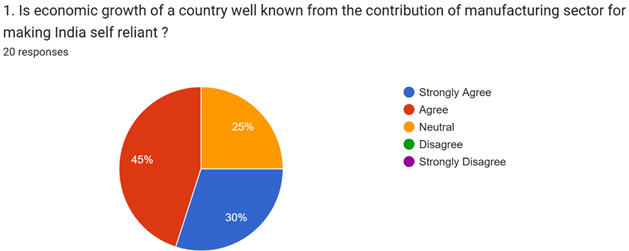
Out of 20
respondent, 30% respondent strongly agree and 30% agree and 25% are neutral
that economic growth of a country is well known from the contribution of
manufacturing sector for making India self-reliant.
|
Chart 2
|
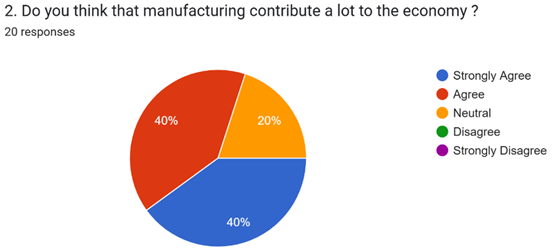
Out of 20
respondent, 40% respondent strongly agree and 40% agree and 20% are neutral
with manufacturing contributes a lot to the economy.
|
Chart 3
|
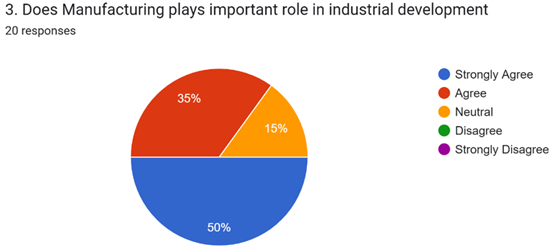
Out of 20
respondent, 50% respondent strongly agree and 35% agree and 15% are neutral
with manufacturing play’s important role in industrial development.
|
Chart 4
|
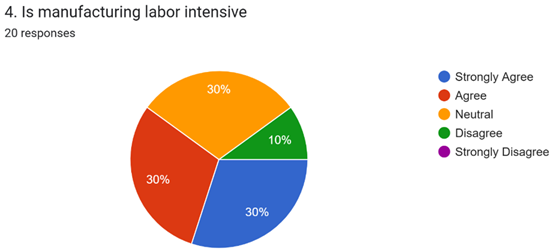
Out of 20
respondent, 30% respondent strongly agree and 30% agree and 30% are neutral and
10% disagree with is manufacturing labor intensive.
|
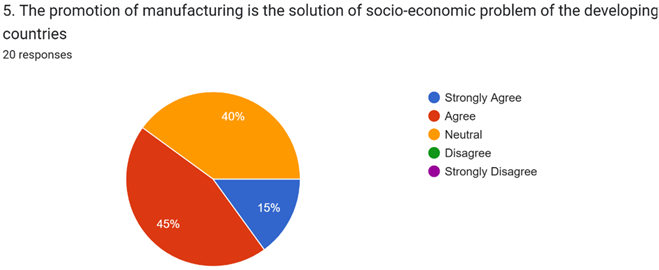
Chart 5
|
Out of 20
respondent, 15% respondent strongly agree and 45% agree and 40% are neutral
with the promotion of manufacturing is the solution of socio-economic problem
of the developing countries.
|
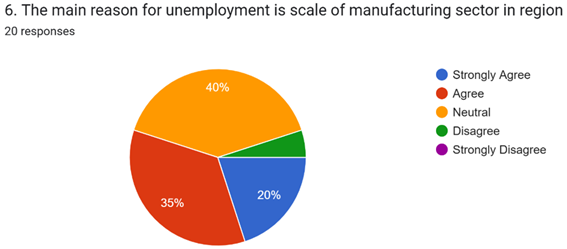
Chart 6
|
Out of 20
respondent, 20% respondent strongly agree and 35% agree and 40% are neutral and
5% disagree that main reason for the unemployment is scale of manufacturing
sector in region.
|
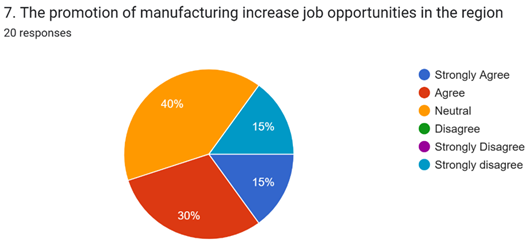
Chart 7
|
Out of 20
respondent, 15% respondent strongly agree and 30% agree and 40% are neutral and
15% disagree with the promotion of manufacturing increases job opportunities in
the region.
|
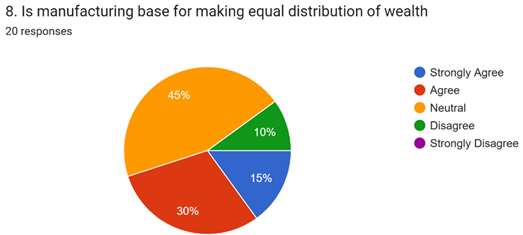
Chart 8
|
Out of 20
respondent, 15% respondent strongly agree and 30% agree and 45% are neutral and
10% disagree that manufacturing base for making equal distribution of wealth
|
Chart 9
|
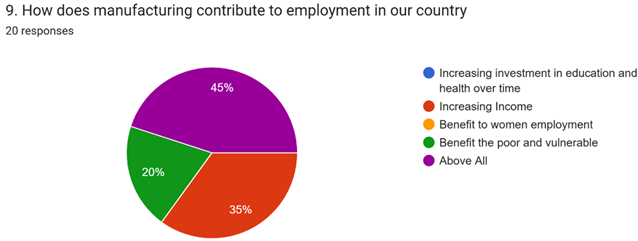
Out of 20
respondent, 45% respondent selected above all and 35% increasing income and 25%
benefit the poor and vulnerable.
Suggestions
1) It is important to improve the potential of Indian Manufacturing’s to supply good quality products to make India Self-Reliant.
2) To remain acceptable in the market, manufacturing need to be adaptable with changing market deviation and variable demand scenarios to make India Self-Reliant.
3) Engraving and support will also be needed to lead to the positive significance associated with certain Indian products and assess negative significance that can be removed to make India Self-Reliant.
Limitations
1)
The main
constraint related to our research is the ‘TIME’ limitation.
2)
Stronger
evidence of limiting factors is population.
Conclusion
Manufacturing is
more than an industrial process—it is the engine that powers economic
transformation. It strengthens the foundation of national economies, supports
exports, and drives inclusive growth by providing jobs and technology-driven
progress. Focus to be given on transfer of information and skill enhancement to
all workers who will work for growing economy. There is a need to upgrade
infrastructure utilities or any enterprise to run its operations successfully
and make an India Self-Reliant.
ACKNOWLEDGMENTS
None.
REFERENCES
https://www.ibef.org/industry/manufacturing-sector-india
https://dimerco.com/manufacturing-in-india-opportunities-and-challenges/
 This work is licensed under a: Creative Commons Attribution 4.0 International License
© Granthaalayah 2014-2025. All Rights Reserved.