Factors Influencing Homebuyers’ Decision-Making in the Residential Real Estate Market
Deepesh Deelip Gaikwad 1, Amol Bhalerao 2
1 BBA
(General), Amity Business School, Amity University Maharashtra, Mumbai, India
2 Associate
Professor, Amity Business School, Amity University Maharashtra, Mumbai, India
|
|
|
ABSTRACT |
|
|
The decision
to purchase a house is one of the most important financial and emotional
decisions an individual may ever make, determined by a complex interplay
among personal preferences, economic factors, and external market forces.
This research attempts to identify the key factors that affect homebuyers'
decisions in residential real estate, focusing on location, price and
affordability, amenities and infrastructure, builder reputation, financing
and interest rates, property size and layout, and socio-psychological motives
such as lifestyle aspirations and family needs. Given the rapid urbanization,
high disposable income, and fierce competition in the field of real estate in
India and elsewhere, understanding buyer preferences has become increasingly
vital to developers, marketers, and policymakers in the industry. The
research approach will be quantitative, where a structured Google Form survey
will be used to collect responses from a diverse group of prospective and
currently active homeowners. It is expected that the outcome should emphasize
the principal drivers underlying residential purchasing behavior and provide
valuable insights that can help developers enhance their product offerings,
improve marketing, and help homebuyers make better decisions. This research
is practically important to players in the real estate industry as they
respond to a changing and highly competitive housing market. |
|||
|
Received 06 March 2025 Accepted 18 April 2025 Published 31 May 2025 DOI 10.29121/granthaalayah.v13.i5.2025.6485 Funding: This research
received no specific grant from any funding agency in the public, commercial,
or not-for-profit sectors. Copyright: © 2025 The
Author(s). This work is licensed under a Creative Commons
Attribution 4.0 International License. With the
license CC-BY, authors retain the copyright, allowing anyone to download,
reuse, re-print, modify, distribute, and/or copy their contribution. The work
must be properly attributed to its author.
|
|||
|
Keywords: Cost Overrun, Direct Cost, Indirect Cost,
Relative Importance Index, Time Overrun |
|||
1. INTRODUCTION
The residential real estate sector is of great importance to the economic and social structure of a country, as housing is not only a basic human need but also a critical route for financial investment and the generation of wealth. The process of buying a house is often considered one of the most important decisions in the lifetime of an individual.
influenced by myriad financial, emotional, and lifestyle factors. Unlike regular consumer buying, the decision to buy a house involves a long-term commitment, substantial financial planning, and careful evaluation of numerous internal and external factors. These range from more objective factors such as location, price, availability of loan facilities, and design of the property to subjective elements comprising aspirations for a better lifestyle, status, and long-term security of the family. Given the growing competitiveness in the real estate market, it is crucial for developers, marketers, and investors to understand what homebuyers need and expect.
In the last couple of years, the real estate sector has witnessed sea changes driven by rapid urbanization, increasing disposable incomes, changing consumer behavior, digital integration, and shifting lifestyle requirements. With the emergence of smart cities, luxury residential projects, and integrated township developments, the modern homebuyer is no longer content with mere housing; he seeks community living, connectivity, contemporary amenities, security, and long-term appreciation in value. The influence of external macroeconomic factorssuch as government regulations, fluctuating interest rates, and consumer preferences in the post-pandemic erahas drastically reshaped the decision-making landscape. Furthermore, growing awareness and accessibility to online real estate research tools have better armed consumers with information, making the process of buying a home far more analytical and data-driven than it ever was.
In this context, critically analyzing the drivers of homebuyers' decisions becomes imperative. By understanding such drivers, real estate developers can develop better project proposals, can adopt correct pricing and marketing strategies, and can enhance buyer satisfaction. At the same time, this can help policymakers design effective affordable housing plans and economic policies. This research attempts to examine the key drivers that influence decision-making in residential property purchases among different categories of buyers. In this study, an attempt has been made to understand which factors are most important to contemporary homebuyers by collecting data through a structured questionnaire; at the same time, it also explores how demographic and economic characteristics influence their decisions.
This study is highly relevant for all stakeholders in the real estate ecosystem-developers, marketers, real estate advisors, investors, financial organizations, and homebuyers themselves. The findings will impart insightful knowledge on the evolving pattern of demand, preference priorities, and trends in behavior that will finally contribute to more informed decisions and better housing solutions in the fast-changing real estate scenario.
2. RESEARCH PROBLEM
Buying a house is one of the most complex and important financial decisions that individuals and families face in their lifetime. Unlike a routine consumer purchasing decision, selecting a residential house involves substantial financial planning, a long-term commitment, emotional aspects, and consideration of multiple factors such as location, price, facilities, developer's credibility, financing options, resale value, security, lifestyle decisions, and infrastructure development. However, despite the rapid expansion of the residential real estate market and increased consumer awareness, there is still a lack of structured understanding about which specific factors substantially influence buyer decisions and how different demographics prioritize these factors. Developers and marketers commonly rely on assumptions or traditional sales methods, which may not align with the shifting needs of today's buyers.
The motivating factors for this research are the increased competition in the real estate business, and continuously changing consumer expectation due to urbanization, technological advancement, and changes in socio-economic factors. Due to major differences in project attributes, pricing models, locational advantages, and amenity offerings, unraveling the true drivers of a buyer's choice becomes crucial for a real estate company to design efficient projects and marketing campaigns. Furthermore, changing lifestyles in the post-pandemic period have brought a change in the priority list of homebuyers, giving more importance to work-from-home space, community features, and well-connected locations, requiring fresh understanding of the motivational aspects of buyers.
Therefore, this study aims to identify and analyze the key factors influencing homebuyers' choice in the residential housing market. Based on information collected through a primary survey, this research seeks to provide practical input that will help developers, consultants, real estate agents, and policymakers in understanding buyers' preferences, refining the product development process, enhancing customer experience, and developing effective sales strategies. The study will assist potential homebuyers in making more knowledgeable decisions by pinpointing the key drivers influencing the choice of residential property.
3. RESEARCH OBJECTIVES
The primary objective of this study is to analyze and understand the major factors that influence homebuyers’ decision-making when selecting a residential property. The research seeks to identify the key determinants that buyers consider most important and examine how these factors vary across different demographic groups and purchasing motivations. The specific objectives of the study are as follows:
· To identify the key factors that influence homebuyers’ decisions when purchasing residential properties, such as location, pricing, amenities, builder reputation, infrastructure, and financial considerations.
· To analyze the relative importance of each factor in influencing the final purchase decision among potential and existing homebuyers.
· To examine how demographic variables such as age, income level, occupation, family size, and buying purpose (investment vs. end-use) affect the decision-making criteria.
· To assess the impact of government policies and financial schemes such as RERA, home loan interest rates, and taxation benefits on buyer preferences.
· To evaluate the influence of lifestyle changes, post-pandemic trends, and modern amenities on the selection of residential projects.
· To derive meaningful insights and recommendations that can help real estate developers, marketers, and policymakers design consumer-oriented strategies and improve customer satisfaction.
4. SCOPE OF THE STUDY
This study attempts to understand the significant determinants that influence homebuyers' decisions in the residential real estate market. The study involves a diverse number of demographics and gathers information from people with different income classes, age brackets, professions, and family categories to ensure variations of opinions. The research is not restricted to a particular geographical location; instead, it aims at a broader reach to include a wider scope of consumer preferences from more locations.
The research targets home purchases, not commercial or rental properties. It covers major factors in decision-making: location, price, amenities, builder reputation, ease of commute, financing options, and lifestyle goals. Data for this research will be collected through a structured Google Form survey and analyzed using quantitative methods to identify trends in the prioritization order among the respondents.
These research results will be most beneficial to real estate developers, sales agents, property advisors, marketers, investors, and policy-making organizations by offering detailed insights into emerging consumer behavior and requirements. It does not include legal reviews, technical construction considerations, or project-specific appraisals but only consumer-oriented criteria used in the selection of a residential unit.
5. REVIEW OF LITERATURE
Decision-making in buying residential properties has been widely studied in real estate, consumer behavior, and urban development. The majority of the studies highlight that buying a home differs from other consumer decisions because it is influenced by both logical and emotional aspects. Past studies have shown that location is the most important determinant of residential buying decisions, driven by proximity to transportation, employment, schools, health services, and access to other amenities. Researchers also underline that price and affordability are critical considerations, particularly for first-time buyers and middle-income households, who consider long-term loan commitments, interest rates, and resale possibility before selecting a house.
Another relevant strand of literature considers reputation and trust in builders as crucial factors due to problems related to delayed possession, construction quality, and transparency. After the coming into effect of RERA, there is a shift towards increasing customer trust on account of accountability and standardization through regulation. Contemporary studies also focus on the shifting consumer requirements: with amenities and lifestyle choices, like open spaces, recreational facilities, technological innovations, green features, and community living, becoming increasingly relevant. Consequently, at a time when digital portals have become commonplace, buyers widely rely upon online property searches, virtual property tours, and customer reviews for support in making their decision.
It is established from studies that socio-cultural and psychological factors have a strong bearing on decision-making. Studies have also found that buying a home is often driven by family needs, social status, future security, and investment potential, making the process highly aspirational. Recent studies have looked at how changes in lifestyle post-pandemic have resulted in increased demand for larger homes, separate work-from-home areas, and health facilities as living and working patterns evolve. Government incentives, subsidies linked to credit, tax benefits, and flexible payment plans offered by developers are identified as key drivers that influence buyer preference. Current studies collectively bring to fore the need for new insights into changing buyer priorities within a rapidly changing and competitive real estate market, therefore demonstrating the importance of research directed at understanding those critical influencing factors pertinent to the present market conditions.
6. RESEARCH METHODOLOGY
This study follows a quantitative approach and investigates the key factors that influence the decisions of homebuyers in the Indian real estate market. The primary data for the study will be collected from a structured Google Forms-based survey. The questions will be closed-ended and multiple-choice, designed to capture information on demographics, purchase preferences, budgetary limits, and decision influencers. The target group for this survey included potential homebuyers, working professionals, and students interested in investing in real estate or making residential purchase decisions.
A sample size of 80 participants was considered adequate to understand common trends among regular urban buyers of homes. The sampling tool used was convenience sampling, where survey participants were contacted through digital media, WhatsApp groups, email contacts, and social media networks. Responses were collated anonymously to ensure unbiased participation.
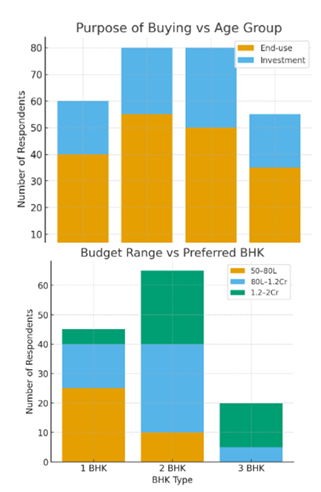
The gathered data was tabulated and analyzed using Microsoft Excel and Google Sheets in order to develop visualizations and find out the emerging trends. It involved developing two major visual analysis tools: a bar chart comparing Purpose of Buying against Age Group and a stacked bar chart showing Budget Range against Preferred BHK Type, analyzing the preference of the respondents to understand the changing market expectations. This statistical analysis helped identify behavioral patterns, such as the majority of self-use buyers across all age groups and the correlation between budget and preference for unit configurations.
The research methodology also encompasses the study of existing literature, industry reports, and secondary data from websites dealing in properties, government data on housing, and market analysis reports to support primary findings. The use of both primary and secondary data enhances the accuracy of the results and strengthens the overall reliability of the research outcome.
7. DATA ANALYSIS AND INTERPRETATION
Analysis of the responses collected revealed key findings about the trends and behaviors of homebuyers in the Indian real estate market. One of the most striking outcomes pertained to the relationship between age group and motive for buying. Across all groups, the main motive to buy was for personal use, with the highest percentage from participants belonging to the age group 25–34. It has thus been indicated that younger professionals place a growing importance on long-term housing stability over renting, influenced by factors such as increased income levels, remote work culture, and aspirations toward self-sufficiency. The investment objective has been mainly reported by respondents in the age group 35–44, which suggests a shift in perception where real estate is considered a significant contributor toward strategic wealth creation.
The second chart showed the variation of desired BHK configuration across budget ranges: A large number of respondents with a budget of ₹50–70 lakhs favored 1BHK properties, reflecting financial limitations and lifestyle compatibility for nuclear families and first-time purchasers. In the same way, those with a budget from ₹70 lakhs to ₹1 crore most preferred 2BHK units, stating their need for additional living space and plans for long-term stays. A small percentage of the participants with a budget of more than ₹1 crore favored 3BHK units, showing a high-end preference segment.
The findings also established that price, location, and the reputation of the developer were the main decision factors, while factors related to amenities and expected resale value were secondary in nature. This marks a shift from luxury-oriented demand to practicality- and affordability-based demand, in line with market trends in the post-pandemic period. Emphasis on credible and transparent developers indicates greater awareness among buyers and reduced tolerance for projects that have been delayed or whose timelines are not clearly defined.
Overall, data analysis indicates that the contemporary buyer is oriented toward safety, affordability, and long-term stay rather than speculative investment. These findings certainly establish that developers need to focus on improving price, increasing connectivity of the location, and maintaining brand trust to keep up with evolving consumer requirements. This helps in understanding the trends in the demand for real estate and provides valuable guidance to developers, investors, and policymakers.
8. FINDINGS
Analysis of the responses collected regarding the research on Factors Affecting Homebuyers’ Decision-Making in the Indian Real Estate Market highlighted a few key findings. First, a majority of the respondents belonged to the 25–34-year-old bracket, indicating that young professionals comprise the single largest segment entering this market. This demographic predominantly seeks out properties for personal use and not investment, reflecting a cultural and financial shift toward ownership earlier in life, influenced by lifestyle aspirations and post-pandemic security considerations.
The results also lead to the conclusion that price is the most important factor affecting decisions of homebuyers, followed by location and builder's reputation. In this case, it can be noticed that people prioritize affordability, proximity, and builders with a decent reputation over luxurious amenities. Moreover, 1BHK and 2BHK apartment formats were preferred by most respondents. This preferred combination was especially priced between ₹50–70 lakh and ₹70 lakh – ₹1 crore, respectively. It shows an emerging trend of demand based on nuclear families, first-time buyers, and cost-sensitive investors.
Another major finding is that transparency, timely access, and the availability of amenities influence decision factors but take a backseat to the principal financial factors. Consumers are increasingly looking for RERA-registered projects and trustworthy developers to minimize risks linked to delays or unmet obligations. Generally speaking, the results showed strong market demand for mid-tier residential property, undergirded by reputable brands in desirable or developing areas.
9. CONCLUSION
The findings of the research suggest that a new generation of informed homebuyers, focused on affordability, reliability, and strategic value, is driving the Indian real estate market. This shift from investment to self-occupation reflects changing socio-economic priorities linked to evolving models of work and long-term security. Since price, location, and developer reputation are crucial influencers, there is a need for customer-centric approaches that emphasize transparency in practices, competitive pricing, and connectivity enhancement by developers of real estate.
Results indicate a strong demand in the segment of mid-income housing, particularly for 1BHK and 2BHK apartments, thereby presenting formidable opportunities for growth among developers and investors alike. In light of increased regulation in real estate and growing awareness among homebuyers, trust and sustained performance will become defining factors. Hence, understanding consumer behavior will be imperative for lasting competitiveness in the future of Indian real estate.
CONFLICT OF INTERESTS
None.
ACKNOWLEDGMENTS
None.
REFERENCES
JLL India. (2024, May 14). Residential Market Update : Q1 2024. JLL India.
JLL India. (2024, March 10). India’s Real Estate Investment Trajectory in 2024. JLL India.
ANAROCK Research. (2023, September). Consumer Sentiment Survey – H1 2023. ANAROCK Research.
ANAROCK Research. (2024, October 17). Homebuyer Sentiment Survey – H1 2024. ANAROCK Research.
India Brand Equity Foundation. (2024). Real Estate Industry in India. India Brand Equity Foundation.
 This work is licensed under a: Creative Commons Attribution 4.0 International License
© Granthaalayah 2014-2025. All Rights Reserved.