Sri Surya Pahar: Archaeological Significance and Cultural Heritage of Assam
Gias Uddin Ahmed 1
1 Assistant
Professor, Department of History G.L. Choudhury College, Barpeta
Road, India
|
|
|
ABSTRACT |
|
|
Sri Surya Pahar, situated in the Goalpara region of Assam, is a magnificent monument of historical and archaeological value. Even though it is only 132 kilometers from Guwahati, it is still not given enough attention in the mainstream discourse on archaeology and heritage. The hilltop location, which is revered by Buddhists, Jains, and Hindus, offers proof of various religious customs from the early Common Era. This essay highlights the merging of various religions and cultures in ancient Assam by analyzing the significance of Sri Surya Pahar through its rock-cut temples, stupas, inscriptions, and sacred sculptures. (Choudhury, 2013, p. 65) The study
makes use of secondary data sources, including internet repositories,
research papers, journals, and archeological reports. The study emphasizes
Sri Surya Pahar as an important cultural heritage site by examining
historical, theological, and archaeological evidence. It also examines its
applicability to comprehending Kamarupa region cultural continuity,
architectural customs, and religious syncretism. (Chakrabarti, 2006, p. 103) |
|||
|
Received 10 June
2025 Accepted 09 July 2025 Published 31 August 2025 DOI 10.29121/granthaalayah.v13.i8.2025.6458 Funding: This research
received no specific grant from any funding agency in the public, commercial,
or not-for-profit sectors. Copyright: © 2025 The
Author(s). This work is licensed under a Creative Commons
Attribution 4.0 International License. With the
license CC-BY, authors retain the copyright, allowing anyone to download,
reuse, re-print, modify, distribute, and/or copy their contribution. The work
must be properly attributed to its author.
|
|||
|
Keywords: Sri Surya Pahar, Archaeology, Heritage,
Assam, Hinduism, Buddhism, Jainism, Sun Worship, Pilgrimage, Kamarupa |
|||
1. INTRODUCTION
Sri Surya Pahar, which translates to "Hill of the Sun," is a 54-acre ancient archeological site located in Assam's Goalpara district. Situated atop a granitic hill on the Brahmaputra's southern bank, it is home to a number of sacred artifacts and rock-cut monuments that represent the area's rich religious and cultural past. According to local mythology, the sage Vyasa carved 99,999 Shiva Lingas here, making it a second Kashi for pilgrims. Nath (1991).
The site is important to three main religions: Buddhism, Jainism, and Hinduism. Stupas, temples, rock-cut tunnels, and inscriptions from the ninth to the twelfth century CE can all be found in archaeological surveys. The coexistence of various religious traditions is exemplified by Sri Surya Pahar's iconography of Surya, Vishnu, Ardhanarisvara, and Jain Tirthankaras. Deori (2015).
Despite these findings, nothing is known about Sri Surya Pahar's historical and archaeological significance. Its cultural legacy offers vital information about the social integration, architectural customs, and religious dynamics of ancient Assam during the Vedic and early medieval eras. Chakrabarti (2006).
2. Statement of the Problem
Even while Sri Surya Pahar's religious significance has been acknowledged in the literature that is now available, its historical and archeological contributions have not been sufficiently recorded or examined, leaving large gaps in our knowledge of the region's past. The location, which traditionally functioned as a center for multireligious pilgrimages and a gathering place for groups with various languages, customs, and traditions, illustrates the intricate interaction of social, religious, and cultural factors in ancient Assam. However, efforts to recreate the larger patterns of religious, social, and cultural evolution in the Kamarupa kingdom are hampered by the lack of thorough documentation and examination of its rock-cut temples, sculptures, stupas, and other material remnants. In addition to protecting Sri Surya Pahar's material and intangible legacy, closing this gap will advance knowledge of the area's early medieval past, its diverse religious landscape, and the ways in which these factors influenced the socio-cultural development of ancient Assam.
3. Review of Literature
1) Namita Nath (2012), carried out a phenological research of the tree species in the vicinity of Sri Surya Pahar, demonstrating how ecological factors affected the region's religious practices and settlement trends. This ecological perspective is useful because it places Surya Pahar's religious and archaeological significance within an environmental framework. It implies that how people used the hill for communal or religious purposes (such as sun worship) may have been influenced or limited by the local plant cycles.
2) Nabajit Deori (2015), argues that, in contrast to earlier theories, the Buddhist stupas at Surya Pahar show early Buddhist influence in Kamarupa. By portraying Surya Pahar as a key location of Buddhist religious practice, Deori's work refutes accounts that minimize the Buddhist presence in early Kamarupa (or Assam). This has ramifications for how researchers perceive the expansion of Buddhism, monastic networks, and even patronage in northeast India.The theory is mostly dependent on architectural type rather than on inscriptional or radiometric dating, making precise chronological claims problematic. Additionally, Deori's interpretation appears to strongly rely on visual art-historical data; his thesis might be strengthened by using cross-disciplinary approaches, such as integrating with environmental or settlement archaeology.
3) Choudhury (2013), investigates Assam's pre-Ahom era archaeology, positioning Surya Pahar as a significant religious and cultural site. The research is essential to integrating Surya Pahar into more comprehensive accounts of Assam's early history. By placing it in relation to other pre-Ahom sites and highlighting continuity over ages, he offers one of the only comprehensive summaries of its material culture. In terms of settlement patterns, social stratification, or economic organization, his work may be less analytically motivated yet being rich in descriptive information. Additionally, much is yet unexcavated or inadequately documented because to the constraints of previous excavations; Choudhury himself observes that numerous archaeological aspects are still understudied.
4) Chakrabarti (2006), gives a thorough summary of historical surveys and Indian archaeological techniques pertinent to the study of Surya Pahar. Understanding Chakrabarti's methodological framework is crucial to comprehending how archaeologists have tackled locations such as Surya Pahar, including the design of surface surveys, the classification of artifacts, and the reconstruction of regional historical contexts. Additionally, he places local discoveries in the context of larger national and subcontinental patterns. Chakrabarti's approach of Surya Pahar is not as thorough as that of site-specific specialists, despite being rich in methodological theory and practice. As a result, his work functions more as a framework than as a direct interpretive study of Surya Pahar.
5) Smith (2001), examines urban archaeology and survey methodology, emphasizing how these methods contribute to the study of Sri Surya Pahar. Smith's method highlights the possibility of seeing Surya Pahar not only as a solitary sacred hill but also as a component of a broader settlement landscape that may be related to trade, residence, and ritual purposes by incorporating urban archaeology viewpoints. There are difficulties in applying urban archaeology to a site like Surya Pahar, which is primarily a rock-cut pilgrimage site; the urban model would not suit well. Some of Smith's ideas, which were first created for genuinely urban areas, run the risk of overgeneralizing or misrepresenting the hill's purpose if they are not carefully modified.
6) Barman, Bratatee (2017), 'Early Medieval Archaeological Landscape of Assam', conducted a methodical village-to-village surface survey in nine contemporary villages in the Goalpara district surrounding Surya Pahar, recording visible archaeological objects like as religious monuments, artifacts, and habitation sites. She highlights the need for archeological preservation by pointing out that some locations are under risk of erosion due to the Brahmaputra and Dudhnoi-Krishnai rivers. Instead of viewing Surya Pahar as a solitary hill shrine, her research helps place it into a network of regional settlements.
3.1. Objectives of the Study
1) To examine the historical and archaeological significance of Sri Surya Pahar.
2) To study its cultural and religious heritage as a multi-religious site.
3) To assess the contribution of archaeological findings to understanding ancient Assam.
3.2. Research Questions
1) What is the historical and archaeological significance of Sri Surya Pahar?
2) How does Sri Surya Pahar reflect the convergence of Hindu, Buddhist, and Jain traditions?
3) What do the archaeological findings reveal about the region’s cultural and social history?
4. Significance of the Study
An essential location for comprehending the early medieval history of the area, Sri Surya Pahar provides a unique insight into the religious, artistic, and cultural legacy of ancient Assam. Its rock-cut temples, sculptures, and multireligious artifacts offer important insights into architectural styles, iconography, and the fusion of Buddhist, Jain, and Hindu traditions, representing the Kamarupa kingdom's pluralistic ethos. Thestudy advances knowledge of the evolution of religious and cultural practices in Northeast India by analyzing the site's historical development, socio-cultural dynamics, and ritual practices. The report also highlights Sri Surya Pahar's potential as a hub for academic research and historical tourism, encouraging local participation, awareness, and long-term cultural preservation. In addition to helping to preserve the site's historical and archeological riches, documentation and analysis of the site enhances the story of Assam's unique cultural identity and establishes Sri Surya Pahar as a priceless resource for academics and the general public.
5. Research Methodology
The paper is based on secondary sources like research papers, articles, journals, newspapers, periodicals, paper clips, internet, website etc. In order to document rock-cut sculptures, architectural remnants, and material artifacts, a research methodology combines a review of the literature and archival records with methodical field surveys. Photographic, GIS, and stylistic analysis are used to help understand the artifacts' chronology and cultural context. In order to collect oral histories and modern cultural practices, this is supplemented with observations of living customs and interviews with local people. This enables a comprehensive interpretation of the site's multireligious legacy. In order to ensure a thorough and interdisciplinary understanding of Sri Surya Pahar's historical and cultural relevance, the study also involves comparative analysis with similar archaeological sites and an evaluation of present conservation conditions to estimate preservation needs.
6. Results and Discussion
Multi-Religious Heritage
Shiva Lingas, rock-cut stupas, and Jain Tirthankaras are among the remnants of Hindu, Buddhist, and Jain rituals found in Sri Surya Pahar. These artifacts' coexistence suggests that Assam had early religious diversity. Deori (2015).
The Sri Surya Pahar site is significant because it is the only location in Assam with remnants of the three main Indian religions: Buddhism, Hinduism, and Jainism. Numerous rock-cut Siva lingams, early historic stupas dating from 100 BC to 100 AD, and low-relief rock-cut representations of Hindu deities Surya, Vishnu, and Ardhanarisvara are also present. There are ruins from a brick temple, a stone temple, a stone-paved water stream called Ganesh Kunda, and small rock-cut caverns with rock-cut images of Jain Tirthankara, Adinath and Neminath, beneath a rock shelter. Nath (1991)
Sri Surya Pahar is an archeological site located around 150 km west of Guwahati, the capital city of Assam, and twenty kilometers southeast of the Goalpara district headquarters. On the southern bank of the Brahmaputra River, the location spans fifty-four acres and includes portions of an Archaean granitic hill. Locals refer to the hill as Satali Pahar. The entire preserved area was considered a single geographical piece, and the survey was conducted from the region's perimeter.
Sun Worship and Hindu Iconography
The rock-cut Surya and Vishnu sculptures, as well as references to the Kalika Purana, support the site's core Surya religion. The religious significance of heavenly deities in ancient Assam is exemplified by sun worshipa. Chakrabarti (2006).
The name "Sri Surya Pahar" suggests that the location was associated with the worship of the sun (Surya). Numerous literary sources attest to the fact that "Surya" (the Sun), among other Hindu deities worshipped in ancient Assam, held a significant position in the region's cultural past. The Kalika Purana contains numerous references to two places of sun worship in ancient Assam. Sri Surya Pahar, which also has iconographic significance for the religion, has been recognized as one of the locations.
Buddhist Influence
The 25 granite votive stupas show how Buddhism was practiced in Kamarupa long before it expanded throughout India. The size and direction of the stupas point to organized religious activity. Deori (2015).
There are up to 25 votive stupas of various sizes and shapes carved out of granite boulders across a vast expanse that stretches from the extreme northwest grade of the Sri Surya Pahar hill to one kilometer farther south. These stupas are notable because they demonstrate two things: Ancient Kamarupa was initially influenced by Buddhism. It contradicts the widely held notion that Buddhism was uncommon in ancient Kamarupa's cultural past. Compared to the rest of the nation, Buddhism had a far earlier influence on ancient Kamarupa.
Jain Presence
Rock-cut In Northeast India, Jain Tirthankara figures such as Adinath and Neminath are uncommon and symbolize the small but significant Jain presence in the area. Choudhury (2013).
It is crucial to note that during its lengthy history, Jainism was unable to gain any notable traction in the northeastern part of India. Very little Jain remnants have been discovered in the area thus far, with the exception of the isolated example located inside the natural caverns at Sri Surya Pahar. The footprints at Sri Surya Pahar were most likely left by Rasbhanath's followers. The Jain descriptions found here have slightly distinct iconography around their hands, but they are depicted naked in accordance with conventional Jain iconography.
Architectural Significance
The site has sculpted reliefs, water canals like Ganesh Kunda, and temples made of stone and brick. These buildings demonstrate the inventiveness of early medieval architecture of Assam. Nath (1991).
Survey archaeology has a long history that began in the nineteenth century. The growth of extensive surveys in Indian archaeology was facilitated by colonial officers and businesses like Alexander Cunningham and James Fergusson, among many others. The village-to-village surface survey in India was made possible by the survey methodology employed in those surveys. According to Huen Tsang, a Buddhist monk from the seventh century, Cunningham led surveys across the rural landscape of north and central India with an emphasis on investigating large-scale historical sites.
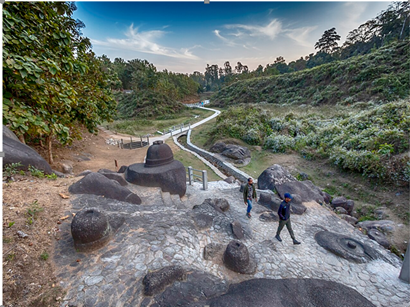
Figure 1
|
Figure 1 Ruins of Sri Surya Pahar |
The photograph The ruins of Sri Surya Pahar, a major archaeological site in Assam close to Goalpara, are renowned for its distinctive fusion of Buddhist, Jain, and Hindu ancestry. Numerous old rock-cut sculptures, Buddhist stupas, Jain carvings, and Shiva lingas carved into boulders are scattered throughout the steep terrain, indicating that it was once a thriving religious hub where various traditions coexisted. Sri Surya Pahar is thought by some academics to have been an early cultural center of the area, possibly even more important than modern-day Sivasagar, while being frequently overlooked by more well-known archaeological sites in India. Its remnants provide important information on Assam's early artistic and religious diversity.
Table 1
|
Table 1 Key Aspects of Sri Surya Pahar |
|
|
Category |
Details |
|
Location |
On a complex of hills
with rock formations close to Goalpara, Assam |
|
Historical Era |
Originating in the
early centuries of the common era, it was utilized during several religious
eras. |
|
Features of
Archaeology |
Buddhist stupas, Jain
carvings, rock-cut sculptures, hundreds of Shiva lingas, and inscriptions |
|
Religious Importance |
The unusual
cohabitation of Buddhist, Jain, and Hindu traditions in one location |
|
Cultural Significance |
Illustrates the early
multicultural and multireligious environment of Assam. |
|
Creative Components |
Ancient architectural
designs, stone engravings, and deity iconography |
|
Academic Significance |
Researchers believe it
was an ancient religious center that may have rivaled other significant early
Assam's centers. |
|
Current Situation |
Researchers, pilgrims,
and visitors are drawn to this protected archeological site. |
7. Major Findings of the Study
7.1. The major findings of the study are-
1) Sri Surjya Pahar is an important historical and archaeological site for scholars and researchers.
2) The name Surya Pahar suggests a connection to the worship of the Surya (Sun).
3) The Sun God has a unique and significant role in the religious and cultural practices of the local populace.
4) Many of the major pieces of evidence, including as the Markandaya Purana and Kalika Purana, have references to Surya worship.
5) The region's homes with unique architectural styles are extremely significant from an archaeological standpoint.
6) Rock carvings and inscriptions that date back to the ninth century are also kept there as remnants of the Jains.
7) Archaeologists discovered a sculpture of a twelve-armed Vishnu along with several other figures, including Adinath and Adityas.
8. Contemporary Relevance
Sri Surya Pahar is highly relevant today since it provides chances to promote religious studies, historical education, and cultural tourism in Assam, bridging the gap between academic study and public participation. The site's documentation, sustainable development, and preservation can offer priceless insights into Northeast India's early medieval religious integration, demonstrating the coexistence and interplay of Buddhist, Jain, and Hindu traditions within a single cultural environment. In addition to providing a venue for educational events, guided tours, and interdisciplinary research projects, the site may promote local stewardship, cultural awareness, and heritage appreciation by encouraging academic investigation and community interaction. By improving its accessibility and interpretive infrastructure, Sri Surya Pahar can become a living heritage hub that not only enhances historical knowledge but also promotes socioeconomic development through tourism, fosters cultural continuity, and fortifies the region's collective identity, making it an essential resource for academics and the general public.
9. Conclusion
The ancient religious and cultural legacy of Assam is preserved at Sri Surya Pahar. Its rock-cut temples, stupas, and multireligious monuments show how Buddhist, Jain, and Hindu traditions are all integrated.
The Archeological Survey of India (ASI) is in charge of protecting Sri Surya Pahar, which has temples spread across a sizable tract of land encircled by ponds and vegetation. The Archeological Survey of India constructed an archeological museum in the area to display unique artifacts, including as utensils and sculptures, that were found during excavations. In 1993, the Archaeological Survey of India (ASI) began excavation in Sri Surya Pahar. Nevertheless, the preliminary work was completed for short periods of time each year, revealing astounding artifacts such as Karanda Mukuta, Kirtimukha, stupa remnants, clay mortar and pestle and ritual vessels, patterned tiles, Apsaras, Purnaghat, etc. that counted the heads of deities.
The archeological investigation of the site highlights the significance of academic research and preservation. ASI's continuous efforts demonstrate its importance for upcoming studies and cultural instruction. Nath (1991). Sri Surya Pahar is a monument to Assam's rich past, where innovative architecture and religious diversity flourished. To completely comprehend its significance in the larger framework of Indian history, more multidisciplinary research is required. Chakrabarti (2006).
CONFLICT OF INTERESTS
None.
ACKNOWLEDGMENTS
None.
REFERENCES
Chakrabarti, D. K. (2006), The Oxford Companion to Indian Archaeology. Oxford University Press, 103, 118, 128.
Choudhury, R. D. (2013), Art and Archaeology of the Brahmaputra Valley of Assam, Pre-Ahom Period.
Guwahati: Spectrum Publications, 65, 91.
Deori, N. (2015), "Stupas of Surya Pahar.” Journal of Northeast Indian Archaeology, 12(2), 72,
74, 78.
Nath, S. (1991), Sri Surya Pahar. Goalpara:
Srixurjja Prakasan, 27. 36,
49, 41.
 This work is licensed under a: Creative Commons Attribution 4.0 International License
© Granthaalayah 2014-2025. All Rights Reserved.