|
|
FUNDAMENTALS OF ART-IDr. Anima Jamwal *1
|
|
|
|


Article Type: Research Article
Article Citation: Dr. Anima Jamwal. (2021). FUNDAMENTALS OF ART-I. ShodhKosh: Journal of Visual and Performing Arts,
2 (1 SE), 27-32.
https://doi.org/10.29121/shodhkosh.v2.i1(SE).2021.20
Received Date: 1 January 2021
Accepted Date: 15 February 2021
Keywords:
Art
Fundamentals
Nature
ABSTRACT
Art is like Nature. It is everywhere. As we all are a part of nature,
so are we all a part of Art. Like nature, we all see, perceive
and feel Art in different and individual ways. For one person it can be
superficial ornamentation, whereas for someone else it can be ethos of life.
For a rambler artist, it becomes a soulful spiritual experience.
1. INTRODUCTION
For most
of us, Art is the expression of human imagination involving creative skill and
producing works primarily for aesthetic power.
Since the
dawn of civilization man was mesmerized by nature and tried to beautify his
environment by copying nature. Eventually he developed this sense of beauty as
a skill and created astonishing pieces of Art in several forms as painting,
music, literature, dance, sculpture, architecture etc. With the advancement of
science and technology, there seems to be a lot of advancement in creating
designs. High grade sophisticated softwares are now
creating artistry that was once considered the magic of human fingers alone.
This also widened the areas of practical application of the science of
Art, ultimately emerging into various
professional fields of study like interior design, architecture, graphics,
animation, printing, photography etc.
Art is
unparallel related to human and their culture. It communicates experiences of
joy, sorrow, confusion, clarity and many more. It gives visual formation to
ideas and feelings, connects us to past, reflects present and anticipates
future.
Webster’s New Collegiate Dictionary defines
art as “the conscious use of skill and creative imagination especially in the
production of aesthetic objects”.
Joseph
Brodsky defines Art in his poem ‘NEW LIFE’ as…..
“Ultimately
one’s unbound/ curiosity about these empty zones/ about these objectless
vistas/ is what art seems to be all about”
Art is absolutely individualistic and universal at the same time.
It is impossible without high skills, hard work and talent. But all these
essential and indispensible qualities are worthless
if there is no artistic conception of the basic elements used for creation of a
piece of art. These basic elements and the guidelines to be followed for
application of these elements in a way to ensure a more successful and art
piece which is pleasing to eyes and aesthetically appreciable are called the
FUNDAMENTALS OF ART.

Thus,
FUNDAMENTALS OF ART are the basic ingredients that are used to create a design
and the rule or formulas to utilize these elements judiciously. For example if you
are well versed with the alphabets and grammatical rules of English language,
you are more likely to build more realistic words, sentences and paragraphs and
eventually may create a great piece of literature, but if you don’t understand theses alphabets and grammatical rules well, you might work
tirelessly to write a paragraph but it might not come out anything more than
meaningless jumbled letters. Thus the fundamentals of
art are the basic building blocks of a design.
2. ELEMENTS OF ART
The
elements of art are basic ingredients that we use to create a design. It is
like if we want to make a cup of tea we need some
basic ingredients (like tea leaves, milk, sugar and water). By various
combinations of these ingredients we can make various
types of teas like strong, light, more sweet, less sweet and so on…When we
combine these ingredients intelligently, we come up with a cup of tea that is
satisfactory and cheering. Similarly by combination of
the elements of art we can create an art-piece that is pleasing and enlivening
to our soul.
As nature
is comprised of five basic elements, the Panch-Tatvas,
so is art. There are Five basic elements of art (although some artists and
scientists suggest Seven, Eight, Ten and even Fourteen elements of art, the
following five are commonly accepted by most of them). Sometimes artworks
contain only one or few elements and sometimes they have all the elements of
art. One thing is certain however, that there would be absolutely no art
without the five elements of art.
3. THE FIVE BASIC ELEMENTS
3.1. LINE
A line is
a mark made upon a surface with its' length longer than its width. Lines can
also be defined as the path of a moving point. They clarify the edges of shapes
and structures. There are many different types of lines like Long, Short,
Thick, Thin, Curved, Wavy, Broken, Dotted, horizontal, vertical, diagonal,
Perpendicular, Parallel, Zig-zag, Spiral and more.
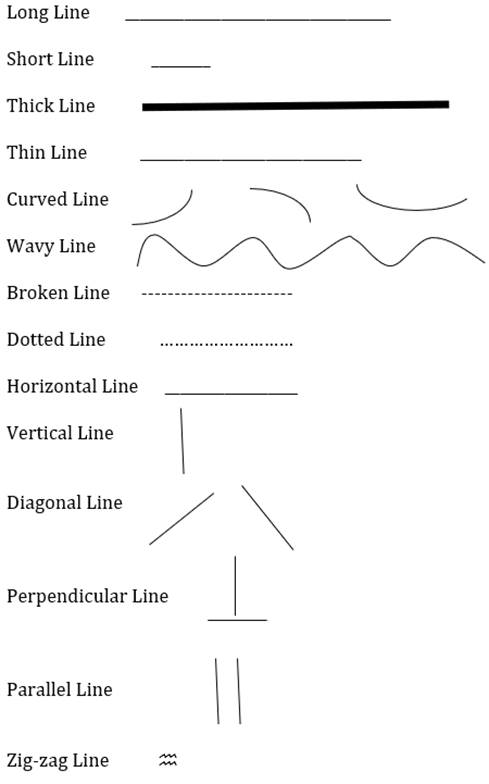
Every
line has its own characteristic and feel. The impact of combination of lines
can be very different from their individual character.
3.2. FORM OR SHAPE
When a line connects to itself, it
creates enclosure. These enclosures are
transformed into an element of art called shape. Shapes can be
two-dimensional.it means that they are flat, and have
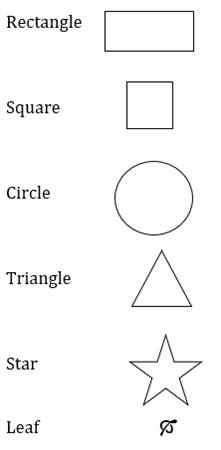
height and width. Shapes can also be geometric and organic. Geometric shapes
are mathematical, like circles, triangles, rectangles
and squares. Organic shapes come from nature, like clouds, stars
and leaves.
Form is
the next step up from shape. As we know that shape is two dimensional (Length
and Width). When we add depth to it, it create a three
dimensional- form.
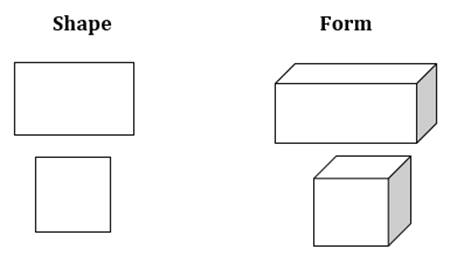
Form or
shape can be Actual or Implied. Actual form is a shape that can be seen from
all sides for example a statue whereas Implied form is created by shading and
modeling.
3.3. SPACE
The
element of space is used to vary the size and placement of lines and shapes. Space gives the
viewer a reference for interpreting an artwork.
Space deals with the illusion of depth on a flat surface but this
element can be used for very effective results in
three-dimensional art as well. Overlapping, placement, detailing and sizing are
the most common methods of manipulating the element of space. Space can be
either positive or negative. The object of attraction is the positive space
whereas the space all around it is considered the negative space. To give the
object of attention its full credit, it is very important
to plan the negative space very carefully.
3.4. COLOUR
Colour
is the most facilitating elements of art It has physical effect on us and also emotional . Children learn more easily is a colourful surrounding. Sick people recover more rapidly,in a restful and pleasant
surroundings. Colours also represent special feelings.. Eg. : Red is symbol of
love, action, enthusiasm and danger, green is the symbol of like and new
beginnings. Sometimes green is also associated with every and jealousy, blue is
the colour of calmness and white is the colour of purity. People related to aesthetics are
concerned with beauty in the choice and combination of colour.
Colour combination and choice of design play a
dramatic look and enhance the beauty of the artifact immensly.
Dimensional Qualities of the Colour
Colours
have different various characteristics, there are 3 dimensional of colour :
1) Hue: Hue is the name of colour
like blue, red or green. Hue is like family name or
surname which tells the root of the colour. A blue colour may be pure blue, green, blue
or violet blue. A pure group mix with green and will give a bright look of torquish blue. there are approximately 150 different hues
2) Value: Value is the amount of a lightness or
darkness of the colour for eg.
: We say light blue dress and dark blue dress or light yellow
flower or dark yellow flower. If we mix white with a colour
will produce a higher value of that colour and that
is lonown as TINT of that colour.
When we mix black with a colour we produce a lower
value of that colour and it
is lonown of SHADE of the colour.
3) Intensity: If refers to brilliance or purity
of colour the other name or quality of colour
Warm and Cool Colour
The term
warm and cool are frequently used in connection with colour
the warm hues are those which are associated with fire, heat
and the sun like real, yellow and orange. The cool hues are associated with
water eg. Blue, Green, Purple.
Classification of colour
Colour
may be classified as
·
Primary
10
·
Secondary
20
·
Tertiary
/ Intermediate 3o
They are
very simply depicted in form of a colour wheel.
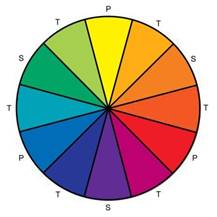
Primary Colour
They are
the most basic colour they cannot be broken down into
other colour and no combination can produce them. Primary are red, blue and yellow.
Secondary Colour
These colours are created by mixing two equal parts of primary colour like yellow and red will produce orange and red and
blue will produce violet and yellow + blue = green.
Tertiary colour
They are produce by mixing of primary colour
with an adjacent secondary colour. The intermediate colours are eg :
Red + Organge = Red orange
Violet +
Green = Red green
Red +
Yellow = Red yellow.
Colour Schemes :
Colour Schemes are actually Colour combination. They are developed from the colour wheel.
Types of Colour
Schemes
Colour schemes are divided into various groups –
1) Related Colour
Scheme.
2) Contrasting Colour
Scheme
3) Neutral Colour
Scheme
3.5. TEXTURE
How
something feels or looks like it would feel if you could touch it is called its
texture.It is the textile quality of any material. It
is the surface quality which basically describes the smoothness or roughness of
material. Texture is very dominating material it is used mainly to create
contrast in arrangement. Various material form shiny
to matte, luxurious to dull smooth to rough are used in interior designing to
make up the furnishing and background of the room. Texture has gained more important
in modern art and designing where it often replaces the traditional pattern.
Texture is important in creating essence of a piece of art and can develop very dramatic effect. There are two kinds of texture: Real
(how something actually feels, such as a sculpture)
and Implied (when an artist paints or draws a texture but it is artificial).
The elements of art are important
ingredients and tools for creation. They are not only the basic blocks but also
a carrier of thoughts and imaginations of the artist. Elements of art also
provide us the fundamental benchmark for judging a piece of art for its
aesthetic value.
Knowing these elements helps us to analyze, appreciate, write about art and create ourselves. It is fun to play with elements of
art and get magical results. We will
study more about them in the chapters following.
SOURCES OF FUNDING
None.
CONFLICT OF INTEREST
None.
REFERENCES
[1] http://ecoursesonline.iasri.res.in/mod/page/view.php?id=120905
[2] https://study.com/academy/lesson/what-are-the-seven-elements-of-art-definition-examples.html
[3] https://www.mayfieldschools.org/ElementsPrinciplesofDesign.aspx
[4] https://www.britannica.com/art/painting/Elements-of-design
[5] https://www.britannica.com/art/painting/Elements-of-design
|
|
 This work is licensed under a: Creative Commons Attribution 4.0 International License
© ShodhKosh 2020. All Rights Reserved.