1. INTRODUCTION
Consumer engagement represents a multidimensional
construct encompassing cognitive, emotional, and behavioral
dimensions that reflect the depth of interaction between consumers and brands. Brodie
et al. (2011) define consumer engagement as the degree of psychological and behavioral investment a consumer exhibits toward a brand
through active participation across various touchpoints. It involves the
processes through which consumers interact, contribute, and co-create value
with a brand, ultimately influencing brand loyalty, advocacy, and purchase
intentions. In contrast, Batra et
al. (2012)describe brand intimacy
as the emotional closeness between consumers and brands, grounded in trust,
affection, and long-term commitment. Brand intimacy reflects how deeply a brand
becomes integrated into a consumer’s life, shaping not only consumption choices
but also identity and attachment patterns.
This paper examines digital marketing from a
multi-platform perspective, seeking to understand how consumers interact with
brands across diverse digital environments. It specifically investigates the
interrelationships among social media usage, brand engagement, and brand
intimacy, conceptualizing them as interconnected constructs that collectively
shape the digital consumer experience. While existing literature Brodie
et al. (2011), Hollebeek et al. (2016), Kotler
et al. (2020) has
established the importance of engagement as a mediator between marketing
efforts and brand relationship outcomes, this study extends the discussion by analyzing how these dynamics operate across multiple social
media platforms. The paper explores the cognitive, emotional, and behavioral dimensions of brand engagement, alongside the
affective and relational attributes of brand intimacy, to develop a nuanced
understanding of how digital touchpoints—ranging from social media interactions
and personalized content to participatory campaigns—contribute to sustained
consumer-brand relationships. By examining these components in an integrated
framework, the study aims to provide empirical insights into how digital
marketing practices foster emotional connectivity, trust, and long-term loyalty
within the evolving landscape of fashion branding.
Social media has transformed the landscape of consumer
engagement by transitioning consumers from passive recipients of information to
active participants in brand ecosystems. Platforms such as Instagram, X
(formally known as Twitter), and Pinterest have redefined communication between
fashion brands and consumers, fostering interactive, real-time, and
personalized exchanges. Unlike traditional marketing, where brands maintain
control over messaging, social media democratizes influence, allowing consumers
to shape brand narratives, express opinions, and co-create trends. This
participatory dynamic repositions consumers as collaborators in the brand
experience, reinforcing the shift toward relationship-based marketing.
The interactive nature of social media supports two-way
communication that strengthens brand relationships through immediacy and
authenticity. User-generated content, interactive campaigns, and personalized
storytelling replace one-way promotional strategies, cultivating a sense of
community and belonging Barger et al. (2016).
Consumers not only consume brand messages but also contribute to them—sharing
experiences, generating discussions, and shaping perceptions. This transition
from passive consumption to active co-creation enhances engagement and embeds
brands within consumers’ digital identities.
One of the central drivers of engagement on social media
is value co-creation, facilitated through content sharing, feedback, and
peer-to-peer interactions. The rise of electronic word-of-mouth (eWOM) has amplified the significance of peer influence in
shaping brand perceptions. Consumers now rely heavily on online discussions,
reviews, and recommendations, shifting the balance of power from brands to
consumers. In this context, social capital—the trust and reciprocity cultivated
within digital communities—plays a critical role. As Gvili
and Levy Gvili
and Levy (2018)
note, content perceived as authentic and trustworthy within one’s network is
more likely to influence attitudes and behaviors.
Thus, social capital not only drives eWOM
transmission but also strengthens consumer-brand relationships by embedding
brands within social networks of trust.
Social media enables varying levels of engagement, from
low-effort behaviors (liking or sharing content) to
high-involvement actions (creating original brand-related content or
participating in advocacy campaigns). According to Tafesse
(2016), consumer engagement
encompasses cognitive (thinking and evaluating), emotional (feeling and
connecting), and behavioral (acting and
participating) dimensions. Interactive tools such as live streams, polls,
contests, and gamified experiences further deepen engagement by encouraging
active participation and immersion. These mechanisms enhance brand recall,
satisfaction, and emotional resonance, reinforcing the long-term relational
value of engagement.
Given the dynamic and fast-paced nature of social media
environments, maintaining engagement requires authenticity, relevance, and
consistency. Personalization has become a cornerstone of effective engagement
strategies. Advances in artificial intelligence and data analytics enable
brands to segment audiences, predict behavior, and
deliver tailored experiences. Personalized offers, customized recommendations,
and targeted communications enhance perceived value and emotional connection.
However, as Barger et al. (2016) caution, brands must balance personalization with
ethical considerations and data transparency to preserve consumer trust.
As digital ecosystems evolve, the future of consumer
engagement will be shaped by emerging technologies such as augmented reality
(AR), virtual influencers, and metaverse-based experiences. These innovations
will blur the boundaries between digital and physical engagement, offering
immersive and multisensory brand interactions. Yet, the core principles of
authenticity, value creation, and emotional connection will remain central to
engagement success. Brands that adapt to these shifts by fostering genuine, participatory,
and human-centered interactions will be better
equipped to sustain consumer engagement and cultivate enduring brand intimacy
in an increasingly complex digital marketplace Boechat et al. (2025).
2. research
OBJECTIVEs
The study aims to examine how fashion brands employ social
media marketing strategies to enhance consumer engagement, evaluate the
effectiveness of digital marketing content in fostering interactive
participation, and analyze how social media–driven
engagement contributes to developing brand intimacy, emphasizing emotional
attachment, trust, and sustained consumer loyalty within digital environments.
The study’s objectives are as follows:
1)
To examine how fashion brands utilize social
media marketing strategies across digital platforms to enhance consumer
engagement and participation.
2)
To evaluate the effectiveness of digital
marketing content—such as personalization, interactivity, and visual
storytelling—in influencing consumer engagement with fashion brands.
3)
To analyze the
relationship between social media–driven consumer engagement and the
development of brand intimacy, emphasizing trust, emotional attachment, and
long-term loyalty.
3. Research Gap
Based on the
reviewed literature and empirical evidence, several research gaps emerge that
justify the present study’s focus. Although a growing body of scholarship has
examined digital marketing and consumer engagement, limited industry-specific
insights exist regarding how these dynamics unfold within the fashion sector—a
domain characterized by high visual appeal, trend sensitivity, and emotional
consumer attachment. Most prior studies have analyzed
digital engagement in generic retail or service contexts, neglecting the unique
behavioral, aesthetic, and experiential dimensions
that define fashion consumption and brand interaction in social media
environments.
A second gap lies
in the lack of empirical exploration of the relationship between digital
marketing strategies, consumer engagement, and brand intimacy across multiple
social media platforms. Much of the existing research investigates engagement
through isolated lenses—focusing on either content strategy or platform
performance—without integrating how social media usage patterns collectively
shape emotional and behavioral engagement outcomes.
Furthermore, studies often emphasize engagement metrics such as likes, shares,
and comments, while overlooking the psychological and affective aspects that
contribute to enduring brand intimacy and trust.
Additionally,
there remains an unclear understanding of how strategic posting
parameters—including content frequency, timing, and format—affect sustained
engagement in the fashion industry. Although research has examined content
quality and interactivity, there is still no consensus on optimal posting
schedules, platform-specific preferences, or algorithmic responsiveness that
maximize audience involvement and brand attachment.
This study
addresses these gaps by employing a comprehensive quantitative framework to analyze how fashion brands utilize digital marketing
strategies—across multiple social platforms—to enhance consumer engagement and
brand intimacy, thereby contributing both theoretical and practical insights to
contemporary marketing scholarship.
4. Research
Methodology
The research methodology serves as the foundational
framework that guides the research design and analytical direction of a study.
It establishes the philosophical orientation through which data are collected, analyzed, and interpreted to address the stated research
objectives. As Fischer
et al. (2023) note, a well-defined research approach ensures logical coherence
between theoretical underpinnings, empirical inquiry, and research aims,
thereby enhancing the study’s internal validity. Bloomfield
and Fisher (2019) conceptualize this approach as a lens shaping methodological
decisions, influencing data collection methods, analytical techniques, and
interpretative depth.
In this study, a quantitative, descriptive approach
grounded in deductive reasoning is adopted to empirically examine the
relationships among social media usage, consumer engagement, and brand intimacy
within the fashion industry. This approach is particularly suited to
identifying measurable associations and testing theoretical propositions
through statistical validation. Quantitative methods allow for the systematic
measurement of behavioral and perceptual variables,
ensuring objectivity, replicability, and generalizability across different
digital contexts. Furthermore, the use of structured instruments and
inferential analysis strengthens the reliability of findings by minimizing
researcher bias. As the study’s primary objective is to determine correlations
rather than explore subjective meanings, the quantitative framework provides a
coherent, rigorous, and empirically grounded methodological structure for
investigating how digital marketing influences consumer engagement and
emotional connection with fashion brands.
To comprehensively capture the multiple dimensions of the
research objectives, a structured questionnaire was systematically designed and
developed (discussed in detail in the next section). The instrument was
organized into distinct sections to address the behavioral,
attitudinal, and emotional components of digital consumer engagement. The
initial section focused on demographic variables, including age, gender,
educational qualification, marital status, family income, and frequency of
social media use, thereby establishing a contextual foundation for analyzing consumer behavior
patterns. Subsequent sections explored respondents’ interaction with various
digital platforms—namely Instagram, Facebook, X, YouTube, Pinterest, and
LinkedIn—to measure engagement through quantifiable actions such as liking,
sharing, commenting, content creation, and participation in brand-led
initiatives. Another section evaluated brand intimacy, operationalized through
constructs such as identity alignment, shared values, emotional attachment, and
perceived trust toward fashion brands.
The questionnaire employed five-point Likert scales to
assess attitudinal and perceptual constructs and ranking scales to prioritize
engagement factors and evaluate platform preferences. Following Bryman
(2016), a pilot study was
conducted with 50 active social media users to assess clarity, content
validity, and ease of comprehension. Feedback from this pre-test facilitated
refinement of question phrasing and layout, ensuring the instrument’s
reliability and usability. The final version of the questionnaire incorporated
closed-ended, structured items conducive to quantitative analysis, allowing for
robust measurement of relationships between posting frequency, content
strategy, engagement intensity, and brand intimacy.
The survey items were adapted from established and
validated scales in prior studies Vivek et al. (2012)
to ensure construct validity and theoretical alignment. Reliability analysis
yielded Cronbach’s Alpha values exceeding 0.7, confirming internal consistency
across the constructs. Each construct—social media usage, engagement, and brand
intimacy—was operationalized using standardized measurement indicators from
digital marketing and consumer behavior literature.
Quantitative data derived from Likert-scale responses and observed engagement
metrics enabled the use of descriptive and inferential statistical analyses
(Principal Component Analysis).
In accordance with Walliman (2021), the questionnaire was
distributed online to capture responses from a geographically diverse and
demographically representative sample of social media users. This approach
maximized accessibility, ensured data diversity, and strengthened the
generalizability and reliability of findings within the digital marketing and
fashion branding context.
This study employed a non-probability purposive sampling
technique to select participants best suited to examine the relationship
between digital marketing, consumer engagement, and brand intimacy in the
fashion industry. The sample specifically targeted active social media users
who regularly interacted with fashion brands on platforms such as Instagram,
Facebook, X, YouTube, Pinterest, and LinkedIn.
Determining an appropriate sample size is essential to
ensure that findings are statistically valid and representative of the target
population. The sample size reflects the number of participants selected for
data collection and directly influences the accuracy, reliability, and
generalizability of results. In this study, the sample was designed to capture
meaningful insights into social media engagement behaviors
and brand intimacy among users. The calculation followed Cochran’s formula for
an infinite population, which accounts for a 95% confidence level (z = 1.96), a
population proportion of 0.50 (assumed in the absence of prior data), and a 5%
margin of error (ε = 0.05). The formula, expressed as n = (z² × p̂ ×
(1 − p̂)) / ε², provided a statistically robust framework for
determining an adequate sample size. Based on this computation, a minimum of
approximately 385 respondents was identified as sufficient to achieve the
desired confidence and precision levels for the study’s objectives.
In this study, missing data were not a concern, as the
data collection process was designed to ensure completeness and accuracy. The
survey was administered via Google Forms, where each questionnaire item was
configured as mandatory, preventing participants from submitting incomplete
responses. This approach guaranteed that only fully completed questionnaires
were recorded, resulting in a dataset with 100% response rates across all
variables. Consequently, the dataset required no imputation, omission, or additional
data cleaning procedures related to missing values, thereby enhancing the
overall reliability and integrity of the data used for analysis.
The collected data were systematically analyzed
using IBM SPSS Statistics (Version 27) and Microsoft Excel (Office 365). SPSS
served as the primary tool for conducting descriptive, inferential, and
multivariate analyses, while Excel was employed for preliminary data
organization, coding, and visualization. Descriptive statistics were applied to
summarize demographic profiles and engagement patterns, offering a clear
overview of respondents’ social media behavior and
brand interaction tendencies. To uncover latent constructs and structural
relationships among variables, Principal Component Analysis (PCA) was employed,
identifying the key underlying dimensions that influence social media
engagement and brand intimacy.
5. Questionnaire
Development and Data Collection
The questionnaire for social media users was
systematically developed to capture the behavioral,
interactive, and emotional dimensions of engagement with fashion brands in
digital environments. The instrument was structured around three core
constructs—Social Media Usage, Social Media Engagement, and Brand Intimacy—each
reflecting a distinct but interrelated aspect of consumer interaction and
relationship-building with fashion brands on online platforms.
Construct 1: Social Media Usage measured users’ frequency,
patterns, and intensity of activity related to fashion content. This included behaviors such as following fashion brands or influencers,
participating in online contests, viewing or sharing visual content (e.g.,
short-form videos, reels), and engaging with digital campaigns. The construct
aimed to assess the level of user exposure and participation within
fashion-focused social media ecosystems. Prior research indicates that
frequency and type of platform use strongly influence brand-related engagement
and loyalty behaviors Naeem and Ozuem (2021), Xiao
and Chen (2025).
Hence, this construct provided foundational insights into how digital
visibility and habitual media consumption shape the consumer’s likelihood of
engaging with brand content.
Construct 2: Social Media Engagement explored the
interactive and participatory behaviors of users
across digital platforms. This construct included actions such as liking,
commenting, sharing, and responding to brand-generated or user-generated
content. It represents the behavioral expression of
engagement and highlights how consumers actively contribute to a brand’s
digital presence and reach. Existing studies affirm that engagement intensity
varies across platforms and depends heavily on the nature of brand content and
posting strategy Wang
and Lee (2020).
By measuring these behaviors, the construct provided
a quantifiable understanding of active user participation and its role in
reinforcing brand visibility and digital community interaction.
Construct 3: Brand Intimacy examined the emotional and
relational aspects of consumer-brand engagement. This included elements such as
trust, loyalty, perceived authenticity, and emotional closeness toward fashion
brands. The construct evaluated how personalized communication, responsiveness,
and authentic representation strengthen consumers’ emotional attachment and
long-term relationship with brands. Prior studies in the context of fashion
social media marketing have demonstrated that sustained engagement fosters
deeper emotional bonds, leading to enhanced brand loyalty and advocacy Naeem and Ozuem (2021), Wang
and Lee (2020).
As discussed in Table 1, the questionnaires
for social media users were systematically structured to ensure clarity,
logical flow, and alignment with the study’s research objectives.
|
Table
1 Questionnaire Design and Construct Development
|
|
Survey Group
|
Section / Construct
|
Number of questions
|
Examples of
Measurement Items
|
|
Social Media Users
Survey
|
Demographics
|
6
|
Age, Gender,
Education, Occupation, Annual family income, Frequency of social media use.
|
|
|
Construct 1: Social
Media Usage
|
5
|
Following fashion
brands and influencers; viewing short-form content; participating in
contests; exposure to AR features.
|
|
|
Construct 2: Social
Media Engagement
|
4
|
Responding to
user-generated content; appreciation for visuals and storytelling;
interactive and personalized brand content.
|
|
|
Construct 3: Brand
Intimacy
|
5
|
Perceived trust,
loyalty, acknowledgment by brands, emotional attachment, customer
testimonials.
|
|
|
TOTAL
|
20
|
|
A total of 1400 active social media users were approached
via social media platforms like Instagram, LinkedIn, Facebook communities etc.
using purposive sampling, as these platforms provided direct access to the
population. The survey resulted in 418 completed questionnaires.
During the data cleaning phase, the procedures recommended
by Moore
et al. (2021) were
systematically applied to maintain the accuracy, validity, and integrity of the
dataset. Each questionnaire response was carefully reviewed for completeness,
internal consistency, and respondent attentiveness. Instances of
straight-lining—where participants selected identical responses across
items—were identified as indicators of low engagement. Consequently, four such
cases were excluded, resulting in a final valid dataset comprising 414
responses. This meticulous screening process ensured that only authentic and
reliable data were retained, thereby strengthening the robustness and
credibility of the dataset for subsequent statistical analyses.
Each item in the questionnaire utilized a five-point
Likert scale ranging from Strongly Agree (5) to Strongly Disagree (1), enabling
respondents to indicate the degree of their agreement with each statement. The
research adhered strictly to ethical standards, ensuring transparency,
integrity, and voluntary participation. All respondents provided informed
consent prior to completing the structured questionnaire, confirming their
understanding and willingness to participate.
6. Data
Analysis
The data analysis in this study followed a structured
quantitative analytical framework, employing appropriate statistical tools and
software to ensure methodological rigor, reliability, and replicability. The
selection of analytical techniques was guided by the study’s objectives, the
nature of the data collected, and the requirement for valid and generalizable
findings. This framework was designed to systematically evaluate how digital
marketing strategies influence consumer engagement and brand intimacy within
the fashion industry while adhering to established statistical and scientific
standards.
To identify underlying dimensions and interrelationships
among the study constructs, Principal Component Analysis (PCA) was employed as
the primary data reduction technique. PCA was used to uncover latent factors
influencing digital marketing strategies, social media engagement, and brand
intimacy. Given the exploratory nature of this research, PCA was preferred over
Confirmatory Factor Analysis (CFA), as it allowed the identification of
empirical groupings and patterns rather than testing a predefined model. This
approach was particularly suitable since the constructs had been adapted to the
Indian fashion brand context, where limited prior validation existed. By
extracting meaningful components from large datasets, PCA established a robust
foundation for interpreting the structural relationships between digital
marketing variables and engagement outcomes.
The analysis utilized IBM SPSS Statistics (Version 27) and
Microsoft Excel (Office 365) as the main analytical tools. SPSS was used for
complex statistical testing—including reliability analysis and factor
analysis—owing to its capacity for managing large datasets and performing both
descriptive and inferential computations. Several analytical procedures were
systematically applied to address the study’s objectives: Descriptive analysis
provided an overview of the dataset, summarizing demographic characteristics,
social media usage patterns, and engagement behaviors.
Measures such as mean, median, standard deviation, and percentage distribution
were used to capture central tendencies and variability. These statistics
helped identify response trends and ensured that subsequent inferential
analyses were grounded in accurate data representations.
The internal consistency of constructs was tested using
Cronbach’s Alpha, with values ≥ 0.70 considered acceptable for social
science research George and Mallery (2018), Nunnally
(1978).
Separate reliability tests were conducted for the marketing professional and
social media user groups to ensure comparability. Alpha values between 0.70 and
0.90 indicated strong internal consistency, confirming that the questionnaire
items measured the constructs of digital marketing, engagement, and brand
intimacy reliably.
PCA was conducted to identify latent dimensions and reduce
interrelated variables into interpretable factors while retaining maximum
variance. Prior to extraction, Kaiser-Meyer-Olkin (KMO) and Bartlett’s Test of
Sphericity were applied to verify sampling adequacy and data suitability. KMO
values above 0.70 confirmed that correlations among variables were sufficient
for factor extraction, while a significant Bartlett’s Test (p < 0.01)
validated the presence of meaningful relationships. Varimax rotation was then
applied to achieve orthogonality and interpretability, with components
retaining eigenvalues greater than 1.0 and factor loadings above 0.50
considered significant. These parameters ensured statistical robustness and
conceptual clarity.
In summary, the systematic application of statistical
techniques—supported by SPSS and Excel—ensured a methodologically rigorous,
transparent, and replicable data analysis process. The integration of
descriptive, reliability and factor analyses allowed the research to uncover
meaningful patterns and validate theoretical linkages among the study
variables. Through this structured analytical design, the study achieved
internal consistency, empirical robustness, and theoretical alignment,
contributing credible insights into how digital marketing strategies enhance
engagement and foster brand intimacy in contemporary fashion branding.
7. Scope of
Research
The scope of this research is pan-India, focusing on
active social media users who engage with digital marketing content shared by
fashion brands across multiple platforms such as Instagram, Facebook, YouTube,
and Pinterest. The study captures behavioral,
interactive, and emotional dimensions of engagement within India’s diverse
digital ecosystem, emphasizing how consumers perceive, respond to, and develop
emotional connections with fashion brands. By examining patterns of social
media usage, content interaction, and brand intimacy, the research provides an
empirically grounded understanding of how digital marketing strategies
influence consumer engagement and loyalty. The findings are relevant to digital
marketing professionals, brand strategists, and fashion marketers, offering
insights into consumer-driven engagement dynamics that can inform more
personalized, authentic, and data-based marketing approaches. Thus, the study
contributes to both academic theory and industry practice by linking user behavior analytics with strategic applications in digital
fashion marketing.
8. Data
Interpretation
8.1. Demographics:
Age
The age distribution of the 414 social media users who
participated in the survey reveal a pronounced concentration among younger
cohorts, with 48.6% of respondents aged 18–24 years and 20.3% falling within
the 25–34-year category. Collectively, these groups represent 68.9% of the
total sample, signifying that the majority of individuals engaging with
fashion-brand content on social media are young adults. The remaining
respondents comprise 15.5% aged 35–44 years, 12.6% aged 45–54 years, and 3.1%
aged 55 years and above.
The predominance of respondents within the 18–34 age group
underscores that fashion-related engagement on social media platforms is
youth-oriented, reflecting the digital affinity and visual content preferences
typical of this demographic. Younger consumers are particularly responsive to
trend-led and visually engaging media formats, such as influencer-driven
campaigns, short-form videos, and interactive content, which aligns closely
with the study’s objective of assessing how digital marketing strategies stimulate
consumer engagement. Nevertheless, the inclusion of 31.1% of respondents aged
35 and above provides valuable heterogeneity to the dataset. Middle-aged and
older users may exhibit distinct engagement motivations—prioritizing aspects
such as product quality, reliability, and brand authenticity—compared to
younger users’ emphasis on novelty and social appeal. This demographic
variation reinforces the need for age-segmented analysis in subsequent
sections, facilitating comparisons of content preferences, trust levels, and
brand intimacy across age groups. Overall, the age composition suggests that
while the digital fashion engagement ecosystem remains predominantly
youth-driven, the meaningful representation of older cohorts warrants
comparative analysis to capture diverse behavioral
and emotional engagement patterns across generational segments.
8.2. DEMOGRAPHICS:
Gender
The survey results from 414 social media users indicate a
balanced gender distribution among participants. Of the total respondents,
48.6% were female, while 51.4% were male, demonstrating near parity in
representation. This equilibrium suggests that both genders are actively
engaged on social media platforms in the context of fashion-related digital
marketing and consumer interaction. The balanced composition enhances the
representativeness and validity of the findings, as it allows for a more
comprehensive understanding of how digital marketing strategies influence
engagement behaviors across gender groups.
8.3. DEMOGRAPHICS:
Educational Level
The educational qualifications of the 414 social media
users reveals that 6.5% of respondents had completed high school, 53.4% held an
undergraduate degree, 36% possessed a postgraduate qualification, and 4.1% had
attained a doctoral degree. Collectively, more than 90% of participants had at
least an undergraduate education, indicating that the sample represents a
highly educated cohort. This educational profile suggests that respondents are
likely to demonstrate advanced digital literacy, greater capacity for critical
evaluation of online content, and more discerning engagement behaviors with fashion brand communications compared to
less-educated users. The high concentration of educated participants enhances
the analytical depth of this study, as it enables the exploration of complex
constructs such as trust formation, perceived authenticity, and
information-based engagement.
8.4. DEMOGRAPHICS:
Occupation
The survey of 414 social media users indicates that
students (41.3%) and employed individuals (37.9%) form the majority,
highlighting the dominance of young, digitally active users engaging with
fashion brands online. Self-employed respondents (15.9%) suggest an
entrepreneurial segment using social media for both personal and professional
fashion interests, while minimal representation of unemployed (4.1%) and
retired (0.7%) users underscores that digital marketing in fashion primarily
targets and influences the working-age and student demographics, who are more
responsive to online promotional efforts and exhibit higher digital engagement.
8.5. How often
do you use social media
Social media constitutes an integral part of respondents’
daily routines. A substantial majority (85.5%) access these platforms multiple
times a day, while 9.4% use them once daily, indicating near-universal
engagement. Only 1.7% and 3.4% use social media a few times a week or rarely,
respectively. This high frequency highlights the strategic significance of
digital marketing for fashion brands in sustaining engagement, enhancing
visibility, and fostering personalized consumer interaction.
8.6. Reliability
TESTS
8.6.1.
Social Media Usage (Reliability)
As presented in Table 2, the construct Social
Media Usage recorded a Cronbach’s Alpha of 0.788, demonstrating strong internal
consistency across the five measurement items. This indicates that the scale
effectively captures respondents’ frequency and behavioral
patterns of social media activity related to fashion brands. The reliability
value, approaching 0.8, confirms consistency in user responses, validating the
instrument’s dependability for further analysis. These findings reinforce that
frequent and active social media engagement provides a reliable basis for
examining how user interactions contribute to broader digital marketing
strategies and consumer-brand engagement within the fashion domain.
|
Table
2 Reliability Statistics,
Social Media Usage
|
|
Reliability Statistics
|
|
Cronbach’s Alpha
|
Cronbach’s Alpha Based
on Standardized Items
|
N of Items
|
|
0.788
|
0.792
|
5
|
8.6.2.
Social Media Engagement
(Reliability)
As indicated in Table 3, the Social Media
Engagement scale achieved a Cronbach’s Alpha of 0.763 (0.767 standardised),
reflecting satisfactory internal consistency. This demonstrates that the items
effectively capture various engagement dimensions, including liking,
commenting, sharing, and content creation. The reliability result confirms that
the instrument consistently measures users’ engagement behaviors
toward fashion brands, supporting its suitability for subsequent analyses
examining the relationship between engagement, trust, and brand intimacy within
digital marketing contexts.
|
Table
3 Reliability Statistics,
Social Media Engagement
|
|
Reliability Statistics
|
|
Cronbach’s Alpha
|
Cronbach’s Alpha Based
on Standardized Items
|
N of Items
|
|
0.763
|
0.767
|
4
|
8.6.3.
Brand Intimacy (Reliability)
As shown in Table 4, the Brand Intimacy
scale achieved a Cronbach’s Alpha of 0.861, reflecting excellent internal
consistency across the five items. This high reliability confirms that the
scale effectively captures key dimensions of emotional connection, including
attachment, trust, and self-association with brands. The result indicates that
respondents’ consistent perceptions of closeness and loyalty accurately
represent genuine emotional engagement, validating the construct’s robustness
for further analysis of how digital interactions strengthen long-term
consumer–brand relationships.
|
Table
4 Reliability Statistics, Brand Intimacy
|
|
Reliability Statistics
|
|
Cronbach’s Alpha
|
Cronbach’s Alpha Based
on Standardized Items
|
N of Items
|
|
0.861
|
0.860
|
5
|
8.6.4.
KMO and Bartlett’s Test for
Social Media Users Survey
Table 5 presents the outcomes
of the Kaiser-Meyer-Olkin (KMO) and Bartlett’s Test of Sphericity, conducted to
evaluate the data’s suitability for factor analysis. The KMO value of 0.927,
well above the recommended threshold of 0.6, indicates excellent sampling adequacy
and supports the appropriateness of the dataset for identifying latent factors
associated with social media usage and engagement Kaiser (1974).
Bartlett’s Test of Sphericity is statistically significant (Approx. Chi-Square
= 1857.749, df = 91, p < 0.001), confirming strong
correlations among variables. Collectively, these results validate that the
dataset is robust for multivariate analysis, ensuring that the factor structure
derived can reliably capture the key dimensions influencing consumer
engagement, emotional connection, and brand intimacy within digital fashion
marketing contexts Bartlett (1950), Tabachnick
and Fidell (2019).
|
Table
5 KMO and Bartlett’s
Test, Social Media Users Survey
|
|
KMO and Bartlett’s
Test
|
|
Kaiser-Meyer-Olkin
Measure of Sampling Adequacy.
|
|
0.927
|
|
Bartlett’s Test of
Sphericity
|
Approx. Chi-Square
|
1857.749
|
|
|
df
|
91
|
|
|
Sig.
|
.000
|
8.7. Principal
Component Analysis
8.7.1.
PCA: Communalities
Table 6 presents the
communalities derived from the Principal Component Analysis (PCA) of survey
data examining social media users’ engagement with fashion brands.
Communalities represent the proportion of variance in each variable explained
by the extracted factors. High extraction values for items such as “The way a
brand interacts with me on social media influences my brand loyalty” (0.679),
“My trust in a brand increases when I engage with them on social media
platforms” (0.659), and “Personalized recommendations from a fashion brand
increase my trust in the brand” (0.632) indicate strong associations with
underlying dimensions of consumer engagement and trust. Conversely, lower
communalities, such as for “I prefer short-form video content (like Reels) over
long-form content” (0.340), suggest a weaker contribution to the factor
structure.
Although a few items showed communalities below 0.50, they
were retained because they represent theoretically important aspects of the
construct. According to Hair et al. (2019) and Field
(2024), variables may be
retained if they contribute meaningfully to the factor structure and improve
interpretability post-rotation. The rotated component matrix confirmed
satisfactory loadings for these items, validating their inclusion in the
analysis.
Overall, the findings emphasize that interactive,
personalized, and authenticity-driven digital marketing approaches—such as
personalized recommendations, responsive communication, and user-generated
content—significantly enhance consumer engagement, trust, and loyalty toward
fashion brands. In contrast, content format preferences exert a relatively
limited impact. These results highlight that fostering personal connection,
transparency, and authenticity on social media platforms can serve as effective
strategies for strengthening brand–consumer relationships and sustaining
engagement in digital fashion marketing contexts Dangaiso (2024), Nasidi et al. (2022).
|
Table
6 PCA: Communalities
|
|
Communalities
|
|
Initial
|
Extraction
|
|
I follow fashion
brands on social media.
|
1.000
|
0.489
|
|
Social media content
influences my interest in a fashion brand.
|
1.000
|
0.595
|
|
I follow fashion
influencers
|
1.000
|
0.513
|
|
I prefer short-form
video content (like Reels) over long-form content (like on YouTube).
|
1.000
|
0.340
|
|
Social media giveaways
and contests influence my engagement with the fashion brand.
|
1.000
|
0.408
|
|
High-quality visuals
and storytelling
|
1.000
|
0.544
|
|
The use of AR features
(e.g., virtual try-ons) increases my engagement.
|
1.000
|
0.452
|
|
User-generated content
(e.g., reposting user reviews) increases trust.
|
1.000
|
0.601
|
|
Personalized content
recommendations increase my engagement.
|
1.000
|
0.625
|
|
My trust in a brand increases when I engage with them on social media
platforms
|
1.000
|
0.659
|
|
The way a brand
interacts with me on social media influences my brand loyalty.
|
1.000
|
0.679
|
|
Personalized
recommendations from a fashion brand increase my trust in the brand
|
1.000
|
0.632
|
|
I feel valued when a
brand acknowledges my comments.
|
1.000
|
0.558
|
|
I trust brands more
when they showcase real customer testimonials.
|
1.000
|
0.464
|
|
Extraction Method:
Principal Component Analysis.
|
|
|
8.7.2.
PCA: Total Variance Explained
Table 7 and Figure 1 illustrate the results
of the Principal Component Analysis (PCA) conducted to determine the latent
dimensions shaping social media users’ engagement with fashion brands. In
exploratory social science studies, a cumulative variance of around 50% is
considered satisfactory, given the multidimensional nature of behavioral constructs Field
(2024), Hair et al. (2019). The PCA extracted two
components with eigenvalues exceeding 1, collectively explaining 54.004% of the
total variance, thereby confirming the dataset’s adequacy for further
interpretation.
Component 1, explaining 46.674% of the variance,
represents Social Media Engagement and Interaction. High-loading variables on
this component relate to behavioral activities such
as frequent social media use, liking and sharing branded posts, commenting, and
following fashion influencers. This dimension reflects the behavioral
aspect of engagement—how users actively participate, interact, and express
brand affinity through visible, measurable online behaviors.
Component 2 accounts for 7.329% of the variance and
corresponds to Trust and Brand Intimacy. Variables associated with this
component reflect emotional factors such as perceived authenticity, emotional
attachment, loyalty, and trust in digital brand communication. This component
captures the emotional dimension of engagement, emphasizing how users’
affective connections influence their sense of closeness and sustained
engagement with fashion brands.
Together, the two extracted components establish a
two-dimensional structure of social media engagement, encompassing both behavioral participation and emotional bonding. While the
first reflects the extent of users’ online activity, the second highlights
their deeper psychological connection and brand trust. The cumulative variance
of 54.004% demonstrates a strong explanatory power, validating that these
components collectively capture the essence of user engagement with fashion
brands in digital environments.
Although a few variables recorded communalities below
0.50, they were retained based on theoretical significance and contribution to
overall interpretability. As supported by Field
(2024) and Hair et al. (2019), such variables may
enhance conceptual completeness despite lower statistical extraction values.
The rotated component matrix confirmed satisfactory factor loadings,
substantiating the reliability and coherence of the final factor structure for
subsequent analytical interpretation within the framework of digital marketing
and consumer engagement research.
|
Table
7 Total Variance Explained
|
|
Total Variance
Explained
|
|
Component
|
Initial Eigenvalues
|
Extraction Sums of
Squared Loadings
|
Rotation Sums of
Squared Loadings
|
|
Total
|
% of Variance
|
Cumulative %
|
Total
|
% of Variance
|
Cumulative %
|
Total
|
% of Variance
|
Cumulative %
|
|
1
|
6.534
|
46.674
|
46.674
|
6.534
|
46.674
|
46.674
|
4.097
|
29.263
|
29.263
|
|
2
|
1.026
|
7.329
|
54.004
|
1.026
|
7.329
|
54.004
|
3.464
|
24.74
|
54.004
|
|
3
|
0.976
|
6.968
|
60.972
|
|
|
|
|
|
|
|
4
|
0.9
|
6.43
|
67.402
|
|
|
|
|
|
|
|
5
|
0.71
|
5.073
|
72.474
|
|
|
|
|
|
|
|
6
|
0.676
|
4.828
|
77.303
|
|
|
|
|
|
|
|
7
|
0.537
|
3.837
|
81.14
|
|
|
|
|
|
|
|
8
|
0.527
|
3.761
|
84.901
|
|
|
|
|
|
|
|
9
|
0.419
|
2.993
|
87.894
|
|
|
|
|
|
|
|
10
|
0.402
|
2.872
|
90.766
|
|
|
|
|
|
|
|
11
|
0.376
|
2.685
|
93.451
|
|
|
|
|
|
|
|
12
|
0.336
|
2.4
|
95.851
|
|
|
|
|
|
|
|
13
|
0.314
|
2.24
|
98.091
|
|
|
|
|
|
|
|
14
|
0.267
|
1.909
|
100
|
|
|
|
|
|
|
|
Extraction Method: Principal Component Analysis.
|
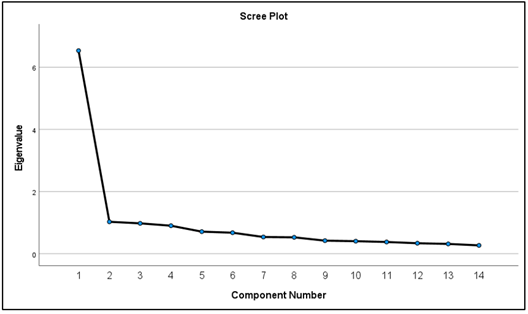
Figure 1 Scree Plot: Total Variance
Explained
8.7.3.
Rotated Component Matrix
Table 8 presents the results
of the Rotated Component Matrix, which clarifies the structure of the two
extracted components identified through Principal Component Analysis (PCA). The
rotation, performed using the Varimax method with Kaiser Normalization, enhances
interpretability by maximizing variable loadings on specific components,
thereby distinguishing the behavioral and emotional
dimensions of social media engagement with greater precision.
The Rotation Sums of Squared Loadings Table 8 indicates two distinct
factors influencing consumer behavior: Social Media
Usage (29.3% variance) and Brand Intimacy (24.7% variance). The first factor,
Social Media Usage and content driven engagement, represents active interaction
with content, including user-generated content, personalized recommendations,
high-quality visuals, storytelling, and AR features. High loadings
(0.508–0.758) indicate that these elements significantly enhance engagement,
implying that fashion brands can foster deeper connections by creating
interactive, personalized, and visually appealing content.
The second factor, Brand Intimacy, reflects trust,
loyalty, and emotional connection, with high loadings (0.511–0.779) on items
such as brand acknowledgment of comments, personalized recommendations, and
showcasing customer testimonials. This suggests that engagement on social media
translates into stronger consumer-brand relationships when brands actively
foster trust and emotional attachment, reinforcing the importance of social
media as a tool not only for promotion but also for cultivating long-term loyalty.
|
Table
8 Rotated Component Matrix
|
|
Rotated Component
Matrix
|
|
|
Component 1
|
Component 2
|
|
I follow fashion brands on social media.
|
0.464
|
0.524
|
|
Social media content
influences my interest in a fashion brand.
|
0.538
|
0.553
|
|
I follow fashion
influencers
|
0.553
|
|
|
I prefer short-form
video content (like Reels) over long-form content (like on YouTube).
|
0.538
|
|
|
Social media giveaways
and contests influence my engagement with the fashion brand.
|
0.524
|
|
|
User-generated content
(e.g., reposting user reviews) increases trust.
|
0.753
|
|
|
Personalized content
recommendations increase my engagement.
|
0.758
|
|
|
High-quality visuals
and storytelling
|
0.707
|
|
|
The use of AR features
(e.g., virtual try-ons) increases my engagement.
|
0.508
|
|
|
The way a brand
interacts with me on social media influences my brand loyalty.
|
|
0.779
|
|
My trust in a brand increases when I engage with them on social media
platforms
|
|
0.763
|
|
Personalized
recommendations from a fashion brand increase my trust in the brand
|
|
0.758
|
|
I feel valued when a
brand acknowledges my comments.
|
|
0.678
|
|
I trust brands more
when they showcase real customer testimonials.
|
|
0.511
|
Two items— “I follow fashion brands on social media.” and
“Social media content influences my interest in a fashion brand.”—exhibited
cross-loadings across components. These cross-loadings were theoretically
expected, as such items conceptually bridge social media usage and brand
loyalty. Both items were retained as their loadings were strong and
theoretically aligned with the assigned components.
9. Conclusion
This study provides a comprehensive empirical examination
of how social media usage, engagement behaviors, and
emotional connection collectively shape consumer–brand relationships within the
digital fashion ecosystem. Drawing on data from active social media users
across India, the findings establish that digital marketing
strategies—particularly those centered on
interactivity, personalization, and content quality—play a decisive role in
transforming passive audience exposure into meaningful engagement and,
ultimately, brand intimacy. The study confirms that engagement is not a
singular construct but a multidimensional process encompassing both behavioral participation and emotional attachment, thereby
reinforcing its centrality in contemporary relationship marketing frameworks.
The results demonstrate that social media platforms have
evolved beyond their traditional function as promotional tools into dynamic
relational environments where consumers actively co-create brand meaning.
High-frequency usage patterns, with the majority of respondents engaging
multiple times daily, indicate that digital platforms are deeply embedded in
consumers’ everyday routines. This habitual interaction creates continuous
opportunities for brands to engage with users, but more importantly, it underscores
the expectation of ongoing, relevant, and value-driven communication. Consumers
no longer perceive themselves as passive recipients of brand messages; instead,
they act as active participants who interpret, respond to, and reshape brand
narratives within digital communities.
The Principal Component Analysis further strengthens these
insights by identifying two dominant dimensions underlying consumer engagement:
Social Media Usage/Engagement and Brand Intimacy. Together, these components
explain a substantial proportion of variance, confirming the robustness of the
conceptual framework. The first dimension reflects observable behaviors such as following brands, interacting with
content, and participating in digital campaigns. The second dimension captures
affective outcomes, including trust, emotional attachment, and perceived brand
authenticity. Importantly, the findings suggest a sequential and reinforcing
relationship between these dimensions—frequent and meaningful engagement behaviors contribute to the development of emotional
closeness and long-term loyalty. This progression highlights engagement as a
transitional mechanism that converts digital interaction into relational depth.
The study advances existing literature by reaffirming the
multidimensional nature of consumer engagement and extending its application
within the fashion industry context. It integrates principles from relationship
marketing and social exchange theory, demonstrating that sustained interactions
characterized by value exchange, responsiveness, and personalization lead to
stronger consumer–brand relationships. Unlike traditional models that emphasize
transactional outcomes, the findings highlight engagement as a cumulative and
evolving process, where repeated interactions foster familiarity, trust, and
identification with the brand. This reinforces the conceptualization of
engagement as a continuum that progresses from cognitive attention to behavioral participation and ultimately to emotional
commitment.
Furthermore, the study contributes to the understanding of
digital consumer behavior by emphasizing the symbolic
and experiential dimensions of fashion consumption on social media. Engagement
is not merely functional but also expressive, allowing consumers to construct
and communicate identity, lifestyle, and social belonging. The interactive and
visual nature of digital platforms enhances this process, enabling users to
engage with brands in ways that are both personally meaningful and socially
visible. As a result, fashion brands operate not only as commercial entities
but also as cultural symbols embedded within consumers’ digital lives.
From a managerial standpoint, the findings offer several
strategic implications for fashion brands seeking to strengthen their digital
presence and consumer relationships. First, while consistent posting remains
important for maintaining visibility, it is the quality and relevance of
content that drive meaningful engagement. Brands must prioritize content that
is visually compelling, emotionally resonant, and aligned with audience
preferences. Second, personalization emerges as a critical driver of engagement
and trust. Tailored recommendations, customized communication, and
responsiveness to user feedback enhance perceived value and foster a sense of
individual recognition.
Third, interactivity plays a pivotal role in deepening
engagement. Features such as user-generated content, live interactions, polls,
and immersive technologies encourage active participation and create a more
engaging brand experience. These tools transform social media from a passive
viewing platform into an interactive space for dialogue and co-creation.
Fourth, authenticity and transparency are identified as foundational elements
of brand intimacy. Consumers increasingly value sincerity, ethical conduct, and
genuine communication, and they are more likely to develop trust and loyalty
toward brands that demonstrate these attributes consistently.
Additionally, the study highlights the importance of
integrating data-driven insights with creative storytelling. While analytics
can inform strategic decisions regarding content timing, format, and audience
segmentation, the emotional dimension of engagement requires a human-centered approach. Brands must balance technological
capabilities with authenticity and creativity to build meaningful connections
with their audiences.
In conclusion, this research establishes that social media
engagement functions as a critical mediator between digital marketing efforts
and the development of brand intimacy in the fashion industry. The findings
underscore that the effectiveness of digital marketing lies not merely in
increasing visibility or reach but in fostering genuine, sustained
relationships with consumers. Engagement emerges as a process of co-created
value, where brands and consumers collaboratively shape experiences, meanings,
and identities. By demonstrating the interconnected roles of behavioral interaction and emotional connection, the study
contributes to both academic discourse and industry practice. Ultimately, it
affirms that in the contemporary digital landscape, the strength of a brand is
defined not by its presence alone but by the depth of the relationships it
cultivates with its audience.
CONFLICT OF INTERESTS
None.
ACKNOWLEDGMENTS
None.
REFERENCES
Barger, V., Peltier, J. W., and Schultz, D. E. (2016). Social Media and Consumer Engagement: A Review and Research Agenda.
Journal of Research in Interactive Marketing, 10(4), 268–287. https://doi.org/10.1108/JRIM-06-2016-0065
Bartlett, M. S. (1950). Tests of Significance in Factor Analysis. British Journal of
Psychology, 3(2), 77–85. https://doi.org/10.1111/j.2044-8317.1950.tb00285.x
Batra, R., Ahuvia, A., and Bagozzi, R. P. (2012). Brand Love. Journal of Marketing, 76(2), 1–16. https://doi.org/10.1509/jm.09.0339
Bloomfield, J., and Fisher, M. J. (2019). Quantitative Research Design. Journal of the Australasian
Rehabilitation Nurses Association, 22(2), 27–30. https://doi.org/10.33235/jarna.22.2.27-30
Boechat, A. C., Dias, J. A., and Feital, M. P. S. de
A. (2025). The Impact of Artificial Intelligence on
Fashion: A Study of Consumer Satisfaction in Portugal. In M. Kurosu and A.
Hashizume (Eds.), Human-Computer Interaction (271–290). Springer Nature
Switzerland. https://doi.org/10.1007/978-3-031-93838-2_19
Brodie, R. J., Hollebeek, L. D., Jurić, B., and Ilić, A.
(2011). Customer Engagement: Conceptual Domain,
Fundamental Propositions, and Implications for Research. Journal of Service
Research, 14(3), 252–271. https://doi.org/10.1177/1094670511411703
Bryman, A. (2016). Social Research Methods. Oxford University Press.
Dangaiso, P. (2024).
Conceptualising and Examining a Social Media Marketing Framework to Predict
Consumer Buying Intentions in Emerging Apparel Markets. Cogent Business and
Management, 11(1), Article 2413377. https://doi.org/10.1080/23311975.2024.2413377
Field, A. (2024). Discovering Statistics
Using IBM SPSS Statistics.
Sage Publications.
Fischer, H. E., Boone, W. J., and Neumann, K. (2023). Quantitative Research Designs and Approaches. In Handbook of Research
on Science Education (28–59). Routledge. https://doi.org/10.4324/9780367855758-3
George, D., and Mallery, P. (2018).
Descriptive Statistics. In IBM SPSS Statistics 25 Step by Step (126–134).
Routledge. https://doi.org/10.4324/9781351033909-14
Gvili, Y., and Levy, S. (2018). Consumer
Engagement with eWOM on Social Media: The Role of Social Capital. Online
Information Review, 42(4), 482–505. https://doi.org/10.1108/OIR-05-2017-0158
Hair, J. F., Black, W. C., Babin,
B. J., Anderson, R. E., and Tatham, R. L. (2019). Multivariate Data Analysis. Cengage Learning.
Hollebeek, L. D., Conduit, J., and Brodie, R. J.
(2016). Strategic Drivers, Anticipated and
Unanticipated Outcomes of Customer Engagement. Journal of Marketing Management,
32(5–6), 393–398. https://doi.org/10.1080/0267257X.2016.1144360
Kaiser, H. F. (1974). An Index of Factorial
Simplicity. Psychometrika, 39(1), 31–36. https://doi.org/10.1007/BF02291575
Kotler, M., Cao, T., Wang, S., and Qiao, C. (2020). Marketing Strategy in the Digital Age: Applying Kotler’s Strategies
to Digital Marketing. World Scientific. https://doi.org/10.1142/11737
Moore, Z., Harrison, D. E., and Hair, J. (2021). Data Quality Assurance Begins Before Data Collection and Never Ends:
What Marketing Researchers Absolutely Need to Remember. International Journal
of Market Research, 63(6), 693–714. https://doi.org/10.1177/14707853211052183
Naeem, M., and Ozuem, W. (2021). Developing
UGC Social Brand Engagement Model: Insights from Diverse Consumers. Journal of
Consumer Behaviour, 20(2), 426–439. https://doi.org/10.1002/cb.1873
Nasidi, Q. Y., Ahmad, M. F., and Dahiru, J. M. (2022). Exploring Items for Measuring Social Media Construct: An Exploratory
Factor Analysis. Journal of Intelligent Communication, 1(2), 13–18. https://doi.org/10.54963/jic.v2i1.53
Nunnally, J. C. (1978).
An Overview of Psychological Measurement. In Clinical Diagnosis of Mental
Disorders: A Handbook (97–146). https://doi.org/10.1007/978-1-4684-2490-4_4
Tabachnick, B. G., and
Fidell, L. S. (2019). Using
Multivariate Statistics
(7th ed.). Pearson.
Tafesse, W. (2016). An
Experiential Model of Consumer Engagement in Social Media. Journal of Product
and Brand Management, 25(5), 424–434. https://doi.org/10.1108/JPBM-05-2015-0879
Vivek, S. D., Beatty, S. E., and Morgan, R. M. (2012). Customer Engagement: Exploring Customer Relationships Beyond
Purchase. Journal of Marketing Theory and Practice, 20(2), 122–146. https://doi.org/10.2753/MTP1069-6679200201
Walliman, N. (2021). Research Methods: The
basics. Routledge. https://doi.org/10.4324/9781003141693
Wang, T., and Lee, F. Y. (2020). Examining Customer Engagement and Brand Intimacy in Social Media
Context. Journal of Retailing and Consumer Services, 54, Article 102035. https://doi.org/10.1016/j.jretconser.2020.102035
Xiao, S., and Chen, X. (2025). Measuring Social Media Customer Engagement with Brands Based on
Information Entropy: An Application Case of Luxury Brand. Journal of Brand
Management, 32(3), 184–202. https://doi.org/10.1057/s41262-024-00376-7

 ,
Pradeep Joshi 2
,
Pradeep Joshi 2