
|
|
|
|
Original Article
ML and RAG-Based Intelligent System for Yoga Pose Recognition and Corrective Guidance
|
Dr. Harish
Barapatre 1*, Pratik Malgunde 2, Atharva Pratap 2, Rayan Shaikh 2 1 Associate Professor,
Department of Computer Engineering, Yadavrao Tasgaonkar Institute of
Engineering and Technology, Bhivpuri Road Karjat, Maharashtra, 410201, India 2 Student, Department
of Computer Engineering, Yadavrao Tasgaonkar Institute of Engineering and
Technology, Bhivpuri Road Karjat, Maharashtra, 410201 India |
|
|
|
ABSTRACT |
||
|
Yoga pose recognition has gained significant importance in digital health and fitness systems, where accurate posture assessment and corrective feedback are critical for safe practice. Traditional computer vision–based approaches rely on pose estimation models but often lack contextual understanding and personalized guidance. To address this limitation, this paper proposes a hybrid framework that integrates Machine Learning (ML)–based pose recognition with Retrieval-Augmented Generation (RAG) for intelligent feedback generation. The system utilizes human pose estimation techniques to extract skeletal keypoints and classify yoga poses using supervised learning models. Subsequently, a RAG module retrieves relevant expert knowledge from a curated yoga knowledge base and generates context-aware corrective suggestions. This dual-layer architecture ensures both high recognition accuracy and meaningful interpretability of results. The proposed approach aims to bridge the gap between static classification systems and interactive AI-driven coaching by enabling real-time feedback and adaptive recommendations. The framework is designed as a conceptual model with potential applicability in mobile health applications, smart fitness systems, and remote yoga training platforms. By combining data-driven learning with knowledge retrieval mechanisms, the system enhances both usability and reliability in real-world scenarios. Keywords: Yoga Pose Recognition, Machine
Learning, Retrieval-Augmented Generation, Computer Vision, Human Pose
Estimation, Digital Health, AI-Based Fitness Systems |
||


INTRODUCTION
Yoga has emerged
as a widely adopted practice for improving physical health, mental well-being,
and overall lifestyle balance. With the increasing demand for digital fitness
solutions, automated yoga training systems have gained attention as a scalable
alternative to in-person instruction. However, accurate pose execution is
critical in yoga, as improper posture can reduce effectiveness and may even
lead to injuries. This creates a strong need for intelligent systems capable of
recognizing poses and providing corrective guidance in real time.
Recent
advancements in Computer Vision and Machine Learning have enabled the
development of human pose estimation models that can detect skeletal keypoints
from images and videos. Techniques such as OpenPose and MediaPipe have
significantly improved the accuracy of body landmark detection. These
approaches allow systems to classify yoga poses based on spatial relationships
between joints. Despite these advancements, most existing systems focus only on
classification and lack the ability to provide meaningful feedback or
corrections tailored to the user.
Another limitation
of current approaches is the absence of contextual intelligence. While deep
learning models can achieve high classification accuracy, they operate as
black-box systems and do not explain why a pose is incorrect or how to improve
it. This reduces user trust and limits practical usability, especially for
beginners who require guided instruction.
To overcome these
challenges, this work introduces a hybrid framework that combines ML-based pose
recognition with Retrieval-Augmented Generation. The ML component handles pose
detection and classification using extracted skeletal features, while the RAG
module retrieves relevant yoga knowledge and generates human-like corrective
suggestions. This integration enables the system to move beyond simple
classification and provide interpretable, context-aware feedback.
The key
contributions of this work are:
1)
A
unified ML + RAG architecture for yoga pose recognition and intelligent
feedback generation.
2)
Integration
of pose estimation with knowledge retrieval to enhance explainability.
3)
A
conceptual design for real-time corrective guidance in digital fitness systems.
4)
A
scalable framework adaptable to mobile and edge-based deployment environments.
This approach
aligns with the growing trend of combining data-driven models with
knowledge-based systems to create more robust and user-centric AI solutions. By
incorporating both recognition and reasoning capabilities, the proposed system
aims to improve the effectiveness of automated yoga training platforms.
Literature Review
Yoga pose
recognition has been extensively explored using computer vision and machine
learning techniques. Early approaches relied on handcrafted feature extraction
from images, followed by traditional classifiers such as Support Vector
Machines (SVM) and K-Nearest Neighbors (KNN). These methods were limited in
handling complex body variations and lacked robustness under real-world
conditions.
With the
advancement of deep learning, pose estimation frameworks such as OpenPose and
MediaPipe enabled accurate extraction of human skeletal keypoints. Several
studies utilized these frameworks to classify yoga poses using Convolutional
Neural Networks (CNNs) and Recurrent Neural Networks (RNNs). While these models
achieved high classification accuracy, they primarily focused on pose
identification rather than correction or feedback.
Recent research
has also explored temporal modeling techniques, where sequential pose data is
processed using Long Short-Term Memory (LSTM) networks to capture motion
patterns. This improves recognition in dynamic yoga sequences. However, such
models still lack interpretability and fail to provide actionable insights to
users.
Another line of
work focuses on real-time fitness coaching systems using wearable sensors and
vision-based tracking. These systems attempt to provide feedback by comparing
user poses with predefined templates. Although effective to some extent,
template-based approaches are rigid and do not adapt well to individual body
differences or varying skill levels.
In parallel, the
emergence of Retrieval-Augmented Generation has transformed how AI systems
generate context-aware responses. RAG combines information retrieval with
generative models to produce more accurate and grounded outputs. It has been
widely applied in domains such as question answering, healthcare, and
education, where domain knowledge is essential. However, its application in
fitness and yoga guidance remains largely unexplored.
Most existing yoga
recognition systems suffer from three major limitations:
1)
Lack of
interpretability and explainable feedback
2)
Absence
of domain knowledge integration
3)
Limited
personalization for users
To better
understand the current landscape, Table 1 presents a comparative analysis of key
approaches.
Table 1
|
Table 1 Comparative Analysis of
Existing Methods |
||
|
Paper |
Method |
Limitation |
|
Pose Estimation + CNN |
Keypoint extraction +
classification |
No feedback mechanism |
|
LSTM-based Sequence
Model |
Temporal pose analysis |
High complexity, no
interpretability |
|
Template Matching
Systems |
Predefined pose
comparison |
Rigid, not adaptive |
|
Sensor-based Systems |
Wearable data + ML |
Requires hardware,
costly |
|
RAG-based Systems
(general domain) |
Retrieval + generation |
Not applied to yoga
domain |
From the analysis,
it is evident that while significant progress has been made in pose detection
and classification, there is a clear gap in combining recognition with
intelligent, knowledge-driven feedback systems. This motivates the need for a
hybrid ML and RAG-based framework for yoga pose recognition and guidance.
Research Gap and Problem Statement
Despite
significant advancements in yoga pose recognition using Machine Learning and
Computer Vision, existing systems remain largely limited to pose classification
without delivering meaningful corrective guidance. Most approaches rely on
frameworks such as OpenPose and MediaPipe to extract skeletal keypoints and
then apply classification models. While these techniques achieve reasonable
accuracy, they fail to address practical usability in real-world yoga training
scenarios.
The critical
research gaps identified from the literature are as follows:
1)
Lack
of Intelligent Feedback
Current systems
can detect whether a pose is correct or incorrect but do not explain why the
pose is incorrect or how to correct it. This limits user learning and reduces
system effectiveness.
2)
Absence
of Knowledge Integration
Most ML-based
models operate purely on data-driven learning and do not incorporate structured
yoga knowledge such as posture alignment rules, breathing techniques, or expert
recommendations.
3)
Limited
Personalization
Existing
approaches treat all users uniformly and do not adapt feedback based on
individual differences such as flexibility, posture variation, or skill level.
4)
Poor
Interpretability
Deep learning
models function as black-box systems, making it difficult to generate
explainable outputs that users can trust and follow.
5)
Underutilization
of RAG in Fitness Domain
Although
Retrieval-Augmented Generation has shown strong performance in knowledge-driven
applications, its integration with pose recognition systems for generating
contextual feedback has not been adequately explored.
Based on these gaps, the problem can be formally defined as:
There is a need to
design an intelligent yoga pose recognition system that not only classifies
poses accurately but also provides real-time, personalized, and context-aware
corrective feedback using integrated knowledge sources.
The challenge lies
in combining visual pose understanding with knowledge-based reasoning in a
unified framework. The system must be capable of extracting meaningful features
from human posture, evaluating correctness, retrieving relevant domain
knowledge, and generating human-like guidance that is both accurate and
interpretable.
To address this
problem, this paper proposes a hybrid ML and RAG-based framework that bridges
the gap between pose recognition and intelligent feedback generation. The
proposed system aims to enhance user engagement, improve learning outcomes, and
provide a scalable solution for digital yoga training platforms.
Proposed Framework And System Architecture
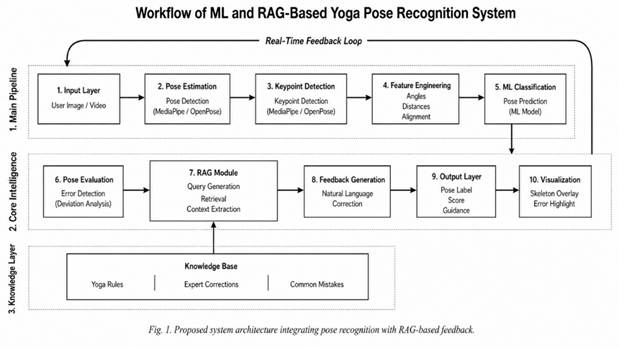
The proposed
system follows a hybrid architecture that integrates Machine Learning–based
pose recognition with Retrieval-Augmented Generation to provide intelligent and
context-aware feedback. The framework is designed as a modular pipeline to
ensure scalability, interpretability, and real-time performance.
Figure 1
|
Figure 1 Shows the Proposed
System Architecture |
Overall System
Flow
Input (User
Video/Image)
·
Pose
Detection and Keypoint Extraction
·
Feature
Engineering
·
Pose
Classification (ML Model)
·
Pose
Evaluation Module
·
RAG-Based
Knowledge Retrieval
·
Feedback
Generation Module
·
Final
Output (Pose Label + Corrective Guidance)
Component
Description
1)
Input
Layer
The system accepts
user input in the form of images or real-time video streams. This allows both
offline analysis and live yoga session monitoring.
2)
Pose
Detection and Key point Extraction
Human body
landmarks are extracted using pose estimation frameworks such as Media Pipe or
Open Pose. These frameworks identify key joints such as shoulders, elbows,
hips, knees, and ankles, forming a skeletal representation of the human body.
3)
Feature
Engineering
The extracted key points
are transformed into meaningful features such as:
·
Joint
angles (e.g., elbow angle, knee angle)
·
Distance
between joints
·
Body
alignment metrics
These features
provide a structured representation for classification.
4)
Pose
Classification Module
A supervised ML
model (e.g., Random Forest, SVM, or Neural Network) is used to classify the
yoga pose based on engineered features. The output is a predicted pose label
(e.g., Tree Pose, Warrior Pose).
5)
Pose
Evaluation Module
This module
compares the user’s pose with an ideal reference pose. It identifies deviations
such as incorrect angles, misalignment, or imbalance. The output is an error
vector representing posture deviations.
6)
RAG-Based
Knowledge Retrieval
The system uses a
RAG pipeline to retrieve relevant information from a curated yoga knowledge
base. This includes:
·
Correct
posture descriptions
·
Common
mistakes
·
Expert
correction guidelines
The retrieval step
ensures that feedback is grounded in domain knowledge rather than generated
arbitrarily.
7)
Feedback
Generation Module
Using the
retrieved knowledge and detected pose errors, a generative model produces
personalized corrective feedback. For example:
“Straighten your
back and raise your left arm slightly higher to maintain balance.”
8)
Output
Layer
The final output
includes:
·
Detected
pose label
·
Confidence
score
·
Detailed
corrective suggestions
·
Optional
visual overlay for guidance
System Characteristics
·
Real-time
capable for live yoga sessions
·
Explainable
output through knowledge integration
·
Scalable
for mobile and web-based deployment
·
Adaptable
for different user skill levels
This architecture
effectively combines visual intelligence with contextual reasoning, enabling
the system to move beyond traditional classification models and deliver
meaningful user-centric guidance.
Mathematical Model
The proposed
system integrates pose estimation, classification, deviation analysis, and
RAG-based feedback generation into a unified mathematical framework. The model
is designed to quantify pose correctness and generate interpretable guidance.
1)
Pose
Feature Representation
The human pose is
represented as a set of keypoints extracted from the image:
Display Format:
P = {p₁,
p₂, p₃, …, pₙ} … (Eq. 1)
Word Equation
Format:
P = {p_1, p_2,
p_3, \ldots, p_n}
Where:
P = Set of body
keypoints
pᵢ = (xᵢ,
yᵢ) coordinates of the i-th joint
n = Total number
of detected joints
These keypoints
are further transformed into feature vectors based on joint angles and
distances.
Pose
Classification Function
The classification
model maps feature vector F to a pose label Y:
Display Format:
Y = f(F) … (Eq. 2)
Word Equation
Format:
Y = f(F)
Where:
F = Feature vector
derived from keypoints
f(.) = Trained ML
classifier
Y = Predicted yoga
pose class
2)
Pose
Deviation (Error) Calculation
The deviation
between user pose and ideal pose is computed using feature difference:
Display Format:
E = ||F_user
− F_ref|| … (Eq. 3)
Word Equation
Format:
E = |F_{user} -
F_{ref}|
Where:
E = Pose error
magnitude
F_user = Feature
vector of user pose
F_ref = Feature
vector of reference (ideal) pose
This error helps
identify incorrect posture elements.
3)
Weighted
Pose Score
To evaluate pose
quality, a weighted scoring function is used:
Display Format:
Score =
α₁E₁ + α₂E₂ + α₃E₃ + … +
αₖEₖ … (Eq. 4)
Word Equation
Format:
Score = \alpha_1
E_1 + \alpha_2 E_2 + \alpha_3 E_3 + \ldots + \alpha_k E_k
Where:
Eₖ =
Individual error components (e.g., arm angle, leg alignment)
αₖ =
Weight assigned to each component
Score = Overall
pose correctness score
Lower score
indicates better alignment with the ideal pose.
4)
RAG-Based
Feedback Generation
The final feedback
is generated by combining pose error and retrieved knowledge:
Display Format:
Feedback = G(R(K,
Q), E) … (Eq. 5)
Word Equation
Format:
Feedback = G(R(K,
Q), E)
Where:
K = Knowledge base
(yoga instructions, corrections)
Q = Query
generated from detected pose and errors
R(K, Q) =
Retrieved relevant knowledge
G(.) = Generative
model
E = Pose error
vector
This equation
ensures that feedback is both data-driven (from E) and knowledge-grounded (from
K).
Overall Interpretation
The mathematical model defines a pipeline where:
·
Keypoints
→ Features → Classification
·
Features
→ Error → Score
·
Error +
Knowledge → Feedback
This structured
formulation ensures that the system is not only predictive but also explainable
and interpretable.
Algorithm AND
Pseudocode
The proposed
algorithm integrates pose detection, classification, deviation analysis, and
Retrieval-Augmented Generation-based feedback generation into a unified
workflow.
Algorithm: ML +
RAG-Based Yoga Pose Recognition and Feedback System
Input:
User image/video
frame I
Knowledge base K
(yoga rules, corrections)
Reference pose
features F_ref
Output:
Predicted pose
label Y
Pose score Score
Corrective
feedback Feedback
Steps:
1)
Acquire
Input
Capture image/frame I from camera or dataset
2)
Pose
Detection
Extract keypoints P from I using pose
estimation model
P = {p₁, p₂, …, pₙ}
3)
Feature
Extraction
Compute feature vector F from keypoints P
(joint angles, distances, alignment metrics)
4)
Pose
Classification
Apply trained ML model
Y = f(F)
5)
Pose
Deviation Calculation
Compute error
vector
E = F −
F_ref
6)
Pose
Scoring
Calculate weighted
score
Score = Σ
(αₖ × Eₖ)
7)
Query
Formation for RAG
·
Generate
query Q based on:
·
Predicted
pose Y
Error vector E
Example:
“Errors in Warrior
Pose: bent back, low arm height”
8)
Knowledge
Retrieval
Retrieve relevant
documents
D = R(K, Q)
Feedback
Generation
9)
Generate
corrective feedback
Feedback = G(D, E)
10) Output Results
Display:
·
Pose
label Y
·
Score
·
Corrective
feedback
11) (Optional) Real-Time Loop
Repeat steps 1–10
for continuous video input
Algorithm
Characteristics
·
Modular
design (each component independent)
·
Supports
real-time processing
·
Combines
deterministic (ML) and generative (RAG) logic
·
Enables
explainable AI through structured feedback
This algorithm
ensures a seamless flow from pose detection to intelligent guidance, making the
system suitable for real-world yoga training applications.
Methodology AND Working
The proposed
system follows a structured pipeline that integrates visual pose understanding
with knowledge-driven feedback generation. Since this is a conceptual
framework, the methodology focuses on the logical working of each component and
how they interact to produce accurate and explainable outputs.
1)
Data
Acquisition
The system
operates on two types of inputs:
·
Static
images (for offline analysis)
·
Real-time
video streams (for live yoga sessions)
A dataset of
labeled yoga poses is used to train the pose classification model. The dataset
may include multiple pose categories with variations in body alignment,
lighting conditions, and camera angles to improve robustness.
2)
Preprocessing
The input
image/frame is processed to enhance quality and consistency:
·
Resize
and normalize input frames
·
Remove
noise and background disturbances
·
Standardize
input format for pose estimation
This step ensures
stable keypoint extraction regardless of environmental variations.
3)
Pose
Estimation
Human body
landmarks are extracted using pose estimation models such as MediaPipe. The
model identifies key joints and generates a skeletal structure representing the
human posture.
4)
Feature
Engineering
From the extracted
keypoints, meaningful features are computed:
·
Joint
angles (e.g., elbow, knee, hip angles)
·
Relative
distances between joints
·
Symmetry
and alignment measures
These features are
normalized and converted into a structured feature vector suitable for machine
learning models.
5)
Model
Training and Classification
A supervised ML
model is trained using labeled pose data. During inference:
·
The
feature vector is passed to the trained model
·
The
system predicts the yoga pose label
·
A
confidence score is generated
This step forms
the core recognition component of the system.
6)
Pose
Evaluation
The predicted pose
is compared with an ideal reference pose stored in the system:
·
Compute
deviation for each feature
·
Identify
incorrect body parts (e.g., bent knee, tilted spine)
·
Generate
an error vector representing posture differences
This evaluation
step enables the system to move beyond classification and quantify correctness.
7)
RAG-Based
Feedback Generation
The system
integrates Retrieval-Augmented Generation to provide intelligent feedback:
·
Query
Formation: Convert pose errors into a structured query
·
Retrieval:
Fetch relevant yoga instructions and correction rules from knowledge base
·
Generation:
Produce natural language feedback using a generative model
This ensures that
feedback is:
·
Context-aware
·
Knowledge-grounded
·
Human-readable
8)
Output
Generation
The final output
includes:
·
Detected
pose label
·
Pose
correctness score
·
Detailed
corrective suggestions
Optional features
may include visual overlays highlighting incorrect joints.
9)
Evaluation
Strategy (Conceptual)
Since this is a
conceptual framework, evaluation is defined as:
·
Classification
accuracy for pose recognition
·
Error
detection consistency
·
Quality
of generated feedback (relevance and clarity)
10) System Loop for Real-Time Application
For live
applications:
·
The
system continuously processes video frames
·
Feedback
is updated dynamically
·
Users
can adjust posture in real time
Overall Working
Summary
Input →
Preprocessing → Pose Estimation → Feature Extraction →
Classification → Error Detection → RAG Retrieval → Feedback
Generation → Output
This methodology
ensures that the system not only detects yoga poses but also provides
meaningful and actionable guidance, making it suitable for intelligent fitness
and digital health applications.
Expected Results and Discussion
The proposed ML
and Retrieval-Augmented Generation-based yoga pose recognition system is
expected to demonstrate improved functionality compared to traditional pose
classification systems. Since the framework is conceptual, the results are
discussed in terms of logical outcomes and system capabilities rather than
numerical performance metrics.
1)
Improved
Pose Recognition Accuracy
By leveraging
structured feature extraction from pose keypoints and supervised machine
learning models, the system is expected to achieve reliable classification
across multiple yoga poses. The use of normalized joint angles and alignment
features enhances robustness against variations in body shape, camera angle,
and lighting conditions.
2)
Effective
Pose Error Detection
The
deviation-based evaluation mechanism enables the system to identify specific
posture errors rather than providing binary correct/incorrect outputs. This
fine-grained analysis allows detection of:
·
Incorrect
limb angles
·
Body
misalignment
·
Imbalance
in posture
Such detailed
error identification is critical for real-world usability.
3)
Context-Aware
Feedback Generation
The integration of
RAG is expected to significantly improve the quality of feedback. Unlike
traditional systems that rely on predefined rules, the proposed framework
retrieves domain-specific knowledge and generates human-like corrective
suggestions. This leads to:
·
More
natural and understandable feedback
·
Reduction
in generic or repetitive responses
·
Improved
user engagement
4)
Enhanced
Interpretability
The system
provides transparent outputs by linking detected errors with knowledge-based
explanations. This improves trust and usability, especially for beginners who
require guided instruction.
5)
Real-Time
Guidance Capability
The modular
architecture supports real-time processing, allowing users to receive
continuous feedback during live yoga sessions. This creates an interactive
training experience similar to a human instructor.
6)
Comparative
Advantage Over Existing Systems
Compared to
traditional ML-only approaches:
·
ML-only
systems → Detect pose but do not explain errors
·
Proposed
system → Detect pose + explain + guide correction
Compared to
rule-based systems:
·
Rule-based
systems → Static and non-adaptive
·
Proposed
system → Dynamic, knowledge-driven, and adaptive
7)
Practical
Applicability
The system is
expected to be applicable in:
·
Mobile
fitness applications
·
Smart
home workout systems
·
Online
yoga training platforms
·
Rehabilitation
and physiotherapy support
Limitations (Expected)
·
Performance
may depend on quality of pose estimation
·
RAG
output quality depends on knowledge base design
·
Real-time
performance may require optimization for edge devices
Overall Discussion
The proposed
system shifts the paradigm from simple pose recognition to intelligent guidance
systems. By combining visual intelligence with knowledge retrieval and
generation, it creates a more holistic and user-centric solution. The framework
is expected to enhance both learning outcomes and user experience in digital
yoga platforms.
Conclusion and Future Scope
This paper
presented a hybrid ML and Retrieval-Augmented Generation-based framework for
yoga pose recognition and intelligent feedback generation. The proposed system
addresses key limitations of existing approaches by integrating pose
estimation, classification, deviation analysis, and knowledge-driven feedback
into a unified architecture. Unlike traditional systems that focus only on pose
detection, the proposed framework enhances interpretability by providing
context-aware and personalized corrective guidance.
The integration of
machine learning with retrieval-augmented generation enables the system to move
beyond static classification and deliver meaningful insights to users. By
leveraging structured pose features and domain-specific knowledge, the system
ensures that feedback is both accurate and human-readable. This makes the
framework suitable for real-time applications in digital fitness, remote yoga
training, and health monitoring systems.
From a design
perspective, the modular architecture allows flexibility in model selection,
knowledge base expansion, and deployment across different platforms such as
mobile devices and web-based applications. The conceptual nature of the
framework ensures that it can be extended and adapted to various real-world
scenarios without significant structural changes.
Future Scope
1)
Several
directions can be explored to enhance the proposed system:
Integration with
Advanced Deep Learning Models
Future work can
incorporate transformer-based architectures and advanced pose estimation
techniques to improve recognition accuracy and robustness.
2)
Personalized
Feedback Mechanisms
User-specific
parameters such as flexibility, age, and experience level can be incorporated
to generate more customized guidance.
3)
Multimodal
Learning
Combining visual
data with audio or wearable sensor data can improve system reliability and
enable more comprehensive analysis.
4)
Real-Time
Edge Deployment
Optimizing the
system for edge devices can enable low-latency processing for mobile and
wearable applications.
5)
Expansion
of Knowledge Base
Enhancing the RAG
knowledge repository with expert-curated yoga datasets can improve feedback
quality and diversity.
6)
Clinical
and Rehabilitation Applications
The framework can
be extended for physiotherapy and rehabilitation scenarios where posture
correction is critical.
In summary, the
proposed ML and RAG-based system provides a strong foundation for
next-generation intelligent fitness applications by combining recognition,
reasoning, and guidance into a single cohesive framework.
ACKNOWLEDGMENTS
None.
REFERENCES
Breiman,
L. (2001). Random
Forests. Machine Learning, 45(1), 5–32.
Cao,
Z., Hidalgo, G., Simon, T., Wei, S., and Sheikh, Y. (2021). OpenPose: Realtime Multi-Person 2D
Pose Estimation using Part Affinity Fields. IEEE Transactions on Pattern
Analysis and Machine Intelligence, 43(1), 172–186.
Carreira,
J., and Zisserman, A. (2017). Quo Vadis, Action Recognition? A New Model and the Kinetics Dataset.
In Proceedings of the IEEE Conference on Computer Vision and Pattern
Recognition (6299–6308).
Chen,
T., and Guestrin, C. (2016). XGBoost: A Scalable Tree Boosting System. In Proceedings of the ACM
SIGKDD International Conference on Knowledge Discovery and Data Mining
(785–794).
Cortes,
C., and Vapnik, V. (1995). Support-Vector Networks. Machine Learning, 20(3), 273–297.
Devlin,
J., Chang, M.‑W., Lee, K., and Toutanova, K. (2019). BERT: Pre-training of Deep
Bidirectional Transformers for Language Understanding. In Proceedings of the
Conference of the North American Chapter of the Association for Computational
Linguistics (4171–4186).
Everingham, M., Van Gool, L., Williams, C. K. I., Winn, J., and
Zisserman, A. (2010).
The PASCAL visual object classes (VOC) challenge. International Journal of
Computer Vision, 88(2), 303–338.
Girshick,
R. (2015). Fast
R‑CNN. In Proceedings of the IEEE International Conference on Computer
Vision (1440–1448).
Goodfellow, I., Pouget‑Abadie, J., Mirza, M., Xu, B.,
Warde‑Farley, D., Ozair, S., Courville, A., Bengio, Y. (2014). Generative Adversarial nets. In
Advances in Neural Information Processing Systems (2672–2680).
He,
K., Zhang, X., Ren, S., and Sun, J. (2016). Deep Residual Learning for Image
Recognition. In Proceedings of the IEEE Conference on Computer Vision and
Pattern Recognition (770–778).
He,
P., Liu, W., Gao, J., and Chen, W. (2020). DeBERTa: Decoding-enhanced BERT with
Disentangled Attention. arXiv preprint arXiv:2006.03654.
Hochreiter, S., and Schmidhuber, J. (1997). Long Short‑Term Memory. Neural
Computation, 9(8), 1735–1780.
Kingma,
D. P., and Ba, J. (2015). Adam: A Method for Stochastic Optimization. In Proceedings of the
International Conference on Learning Representations.
Krizhevsky, A., Sutskever, I., and Hinton, G. E. (2012). ImageNet classification with Deep
Convolutional Neural Networks. In Advances in Neural Information Processing
Systems (1097–1105).
LeCun,
Y., Bengio, Y., and Hinton, G. (2015). Deep learning. Nature, 521, 436–444.
Lewis,
P., Perez, E., Piktus, A., Petroni, F., Karpukhin, V., Goyal, N., Küttler, H.,
Lewis, M., Yih, W.‑T., Rocktäschel, T., Riedel, S., and Kiela, D. (2020). Retrieval‑Augmented
Generation for Knowledge‑Intensive NLP Tasks. In Advances in Neural
Information Processing Systems.
Mikolov,
T., Chen, K., Corrado, G., and Dean, J. (2013). Efficient Estimation of Word
Representations in Vector Space. Arxiv Preprint arXiv:1301.3781.
Pavlakos,
G., Zhou, X., Derpanis, K. G., and Daniilidis, K. (2017). Coarse‑To‑Fine
Volumetric Prediction for Single‑Image 3d Human Pose. In Proceedings of
the IEEE Conference on Computer Vision and Pattern Recognition (7025–7034).
Redmon,
J., Divvala, S., Girshick, R., and Farhadi, A. (2016). You Only Look once: Unified,
Real‑Time Object Detection. In Proceedings of the IEEE Conference on
Computer Vision and Pattern Recognition (779–788).
Ren,
S., He, K., Girshick, R., and Sun, J. (2017). Faster R‑CNN: Towards Real‑Time
Object Detection with Region Proposal Networks. IEEE Transactions on Pattern
Analysis and Machine Intelligence, 39(6), 1137–1149.
Shotton,
J., Fitzgibbon, A., Cook, M., Sharp, T., Finocchio, M., Moore, R., Kipman, A.,
and Blake, A. (2011).
Real‑Time Human Pose Recognition in Parts from Single Depth Images. In
Proceedings of the IEEE Conference on Computer Vision and Pattern Recognition
(1297–1304).
Simonyan,
K., and Zisserman, A. (2014). Very Deep Convolutional Networks for Large‑Scale Image
Recognition. arXiv preprint arXiv:1409.1556.
Toshev,
A., and Szegedy, C. (2014). DeepPose: Human Pose Estimation via deep neural networks. In
Proceedings of the IEEE Conference on Computer Vision and Pattern Recognition
(1653–1660).
Vaswani,
A., Shazeer, N., Parmar, N., Uszkoreit, J., Jones, L., Gomez, A. N., Kaiser,
Ł., and Polosukhin, I. (2017). Attention is all you need. In Advances in Neural Information
Processing Systems (5998–6008).
Zhang, F., Bazarevsky, V., Vakunov, A., Sung, G., Chang, C.‑L., and Grundmann, M. (2019). MediaPipe: A Framework for Building Perception pipelines. arXiv preprint arXiv:1906.08172.
|
|
 This work is licensed under a: Creative Commons Attribution 4.0 International License
© IJETMR 2014-2026. All Rights Reserved.