
|
|
|
|
Original Article
Impact of Influencer Marketing on Consumer Engagement and Brand Perception
|
Muskan Yadav 1* 1 Phd Research Scholar, Vikrant
University Gwalior, Madhya Pradesh, India 2 Assistant
Professor, Madhav Institute of Technology and Science (Deemed University)
Gwalior, Madhya
Pradesh, India |
|
|
|
ABSTRACT |
||
|
Influencer marketing in the digital world has turned into a trendy approach that enables businesses to connect with consumers through the voice of reputable figures on platforms such as Instagram, YouTube, and Tik Tok. Conventional advertising was often not relatable, sincere, or trustworthy, which this form of marketing offers. This study aims to explore the impact of influencer marketing on brand perception and consumer engagement. Specifically, it examines the impact of marketing strategies, the type of content, and the reputation of influencers on customer perceptions and brand trust. A primary data gathering method was used in a quantitative study design. One hundred randomly chosen respondents were given a standardized questionnaire. Regression and correlation tests were used in SPSS to evaluate the data, which was gathered via Google Forms, and look at the correlations between the variables. Findings indicate that influencer marketing techniques can account for more than three-quarters of the variance, and they significantly enhance consumer interactions. Furthermore, there is a high correlation between influencer credibility and brand authenticity and trust, and 56.4% of consumers' perceptions are influenced by the sort of material. These results underscore the importance of realistic engaging content when it comes to establishing positive brand relationships. Influencer marketing is one of the most effective tactics to engage with more people and increase brand awareness. By investing in authentic influencer collaborations and numerous content programs, brands are in a more favorable position to foster loyalty and build long-lasting customer relationships. Keywords: Influencer Marketing, Consumer
Engagement, Brand Perception, Influencer Credibility, Social Media Strategy,
Brand Trust, Digital Marketing |
||


INTRODUCTION
The influencer marketing tactic has become one of the
essential aspects of a modern-day digital strategy, redefining the ways of
brand communication towards audiences. In simple words, influencer marketing is
based on using people, called influencers, who command a lot of credibility,
knowledge or fame within a given niche in such platforms as Instagram, YouTube,
Tik Tok etc. The content generated by these influencers endorse brands,
products or services usually in a way that is perhaps more authentic and relatable
when compared to advertisements. This genuineness can be explained by the fact
that the influencer has developed a rapport with their admirers and they can
rely on them so the endorsement will be more effective. Singh et al. (2023), Kumar et al. (2025)
Among the major advantages of any influencer marketing consists in the fact it helps to increase brand awareness and reaches people of target demographics with an impressive level of precision. Influencers are used to reach audiences of highly engaged communities that may lead to more personal connections and a bond in the brand. Such partnering may make the brands inspiring to trust and be credible as people are likely to trust the suggestions of people they follow rather than generic corporate messaging. Moreover, the influencer marketing system is incredibly flexible and can be adapted to any company; it is possible to work with mega-celebrities, but also with micro-influencers, whose smaller audience has a higher conversion rate because of its increased engagement. Chacko (2025), Singh et al. (2023)
The effectiveness of an influencer marketing strategy is predetermined by the thought-out match between the image of an organization and the values and viewers of an influencer. Good campaigns tend to consist of clear collaborations with the influencer having flexibility to be creative in showcasing sponsored products in such a manner that it aligns well to the typical tones and subject contents they express. This does not only hold on to more authenticity but it also increases perception of value of the endorsement. Sponsored posts, product placements, live demos, unboxing, videos, and even immersive experiences via emerging technologies such as augmented reality (AR) and virtual reality (VR) are campaign options. Whilst the latter has become a popular trend in campaigns as brand owners consider making campaigns more interactive, engaging and unforgettable. Nunes (2025), Influencity (2024), Singh et al. (2023)
Not without its challenges, influencer marketing is. Locating the ideal influencer, calculating the return on investment (ROI), and maintaining authentic relationships that appear not forced and counterfeit are among the obstacles that brands often encounter. The other concern is transparency, as without the proper disclosure of sponsored endorsements, followers will become suspicious. Fraudulent followers, exaggerated follower counts, and finding a balance between creative expression and brand messages remain issues in the industry. Kumar et al. (2025)
As artificial intelligence (AI) becomes central to
identifying relevant influencers, tracking campaign effectiveness, and content
for specific audiences, influencer marketing will only become increasingly more
data-driven in the future. Influencer partnerships could change as a result of
the ongoing adoption of new technologies like augmented reality, virtual
reality, and virtual influencers in online environments like the
metaverse. In order to be relevant and
trustworthy in this quickly changing environment, companies and influencers
will need to modify their strategies in response to consumer demands for more
genuine and meaningful interactions. Singh (2024), Mursalin
et al. (2023)
Brand perception and consumer interaction are highly related concepts that have a deep influence on the long-term prosperity of a company. Consumer engagement means how brands communicate to their clientele in ways that generate a continuous relationship with the significant valuable personal engagements during the customer journey. Such interactions (encompassing customer services, social media interactions all the way to brand communities) create more emotional attachments customers have to brands, transforming the customers into proactive brand advocates. As a result of creating engagement successfully, brands experience rises in word-of-mouth marketing, brand loyalty and even average sales per client. It has been reported that the specific engagement strategies, like interactive social media campaign or customer engagement marketing where customers share ideas or innovative content with the company, are particularly effective in strengthening these ties. Xu (2024), Mason.wm. (2023)
All interactions between a customer and a brand could influence brand perception, or the mental image and reputation the brand has in the minds of the customers. The same notion is not only affected by the advertising and branding quests but also by the total customer experience encompassing product quality, interactions with customers and other related marketing activities meant to influence this perception. An example is those brands that use highly graphic, interactive content in social media such as in the luxury vehicle industry case of Mercedes-Benz and have in addition to enhancing visibility also achieved greater customer devotion and a better brand image. On the same note, it has also been established that meme marketing and culturally relevant materials have a better chance of forming emotional connections so long as brands do not lose authenticity and credibility in their message. Kour (2015), Hamzah et al. (2021), Xu (2024)
Psychological components of engagement are paramount in this case. When customers are brought into the content creation process, asked for feedback or are involved in co-creating products, their ownership and loyalty will be enhanced, and they will become more likely to judge the brand positively and refer it to other customers. Listening and adjusting according to consumer input places the brands as in communication-sensitive and customer-focused, an element that would lead to further positive brand perception.When these results are quantified with things such as Net Promoter Scores, brand sentiment analysis, and direct feedback brands can redevelop their approach to the world and create a positive feedback loop. Mason.wm. (2023)
Essentially, consumer engagement leads to
better-established consumer perceptions about a brand that are favorable. By pursuing intelligent engagement and genuine
interactions brands are able to develop significant relationships that will
lead to advocacy, repeated purchase and strong reputation all of which are the
foundation of long term market success. Hamzah
et al. (2021), Xu (2024), Kour (2015)
Aim of the study
“This study aims to examine the impact of influencer marketing on consumer engagement and brand perception. It specifically explores how influencer credibility, content type, and marketing strategies shape consumer attitudes and brand trust.
Objectives
·
Impact
of Influencer Marketing Strategies on Consumer Engagement
·
Relationship between Influencer
Credibility and Brand Authenticity & Trust
· Influence of Content Type on Consumer Attitude and Brand Perception
Hypothesis
·
There is significant Impact of Influencer Marketing Strategies on Consumer
Engagement
·
There is no significant Impact of Influencer Marketing Strategies on Consumer
Engagement
· There is significant Relationship between Influencer Credibility and Brand Authenticity & Trust
· There is no significant Relationship between Influencer Credibility and Brand Authenticity & Trust
· There is significant Influence of Content Type on Consumer Attitude and Brand Perception
· There is No significant Influence of Content Type on Consumer Attitude and Brand Perception
Literature review
Mohammad et al. (2024) This study investigates the ever-changing field of influencer marketing and how it affects Jordanian consumers' perceptions of brands on social media. The study explores how influencer marketing tactics fit in with regional values and customs to affect customer views in the context of Jordan's rich cultural legacy and close-knit community. Information for the study was gathered from a sample of 455 online retailers' customers. To examine data pertaining to the measurement model and the structural model, the study used structural equation modeling (SEM) techniques. According to the study's findings, influencer marketing significantly improves brand perception, with trustworthiness having the most effect. As a result, choosing influencers who have real ties to Jordanian culture should be given preference. This will enable more authentic representation since deeper resonance is produced when brand values are strategically aligned with those of the local audience and influencers are encouraged to produce local content.
Yong et al. (2024) Businesses advertise on a variety of social media platforms, such as Facebook, Instagram, TikTok, and Xiaohongshu. With the development of the technologies and the fact that people could more easily create their career on social media, influencer marketing has become one of the tools that could help people to make consumers more engaged in the digital platforms and possibly impact brand loyalty. Given the increasing popularity of this phenomena, this study looks at the impact of influencer marketing in the Malaysian setting. Descriptive analysis was used to offer generalizable recommendations to businesses on the effects of adopting the influencer marketing strategy as a business strategy. The findings of this research provide valuable data to organizations that would want to enhance their marketing strategies and stimulate consumer outreach to acquire a better market niche.
Sijabat et al. (2023) Social-media has become a potent instrument in the current digital era that has the potential to reach a wider audience. In advertising a product, it is important to be able to utilize the appropriate media to reach both the current and potential customers. The use of social media influencers (SMI) will help in communicating the message of the company to current and potential customers successfully. This question is based on three key questions underlying the issues mentioned. (1) What is the impact of SMI on customer brand perception (CBP) and customer brand engagement (CBE)? (2) What is CBE effect of CBP? (3) Is the link between SMI and CBP mediated by CBE? The Big Cola brand was investigated on the background of a study of the customers of Big Cola in West Java, Indonesia. Purposive sampling was used to gather quantitative data from 154 respondents in three different regions: Bekasi, Bogor, and Depok. The data was then analyzed using structural equation modeling (SEM) with SPSS and Smart-PLS statistical software. The outcome showed that SMI had a favorable and substantial effect on CBE and CBP. Additionally, CBE has a major and favorable impact on how people perceive a company. Lastly, it is discovered that CBE significantly mediates the relationship between SMI and brand CBP. Influencer marketing on social media will improve consumer engagement and brand perception, and as customer involvement increases, so will brand perception. Businesses can use these facts to guide their decision-making when selecting the most effective promotional media.
Liu (2021) Marketing managers are interested in influencer marketing as it has emerged as a novel and effective brand marketing tactic with the growth of social media. Based on earlier research, this study suggests a dual-route effect research paradigm to better understand how influencer marketing affects brand engagement. According to the model, during the content interaction between the audience and the influencer, the parasocial relationship has a favorable impact on the source's credibility, which in turn raises the brand's reputation. Immersion in content also makes brand material more enjoyable. In the end, brand engagement would be fostered by both brand reputation and brand content delight. The study offers management implications as well as a possible paradigm for evaluating influencer marketing in future studies.
Jaitly and Gautam (2021) Social-media is now the go-to platform for businesses looking to disseminate product information, sway public opinion, and acquire followers due to its accessibility and extensive usage. To do this, social media influencers serve as vibrant third-party advocates, disseminating a brand's message to a global audience. Social media ads attract customers that have a favorable view toward the credibility of social media. The current study looks at how agency’s view using social media influencers and how they contribute to brand visibility and customer engagement. For this reason, the study also uses a systematic review to evaluate the various approaches these influencers use to sway consumers. The study's conclusions show that because these influencers are better at speaking to a certain demographic, they have a significant impact on consumers' attitudes and perceptions. Influencers' new technology tools give agencies a competitive edge in customer engagement and brand exposure when compared to traditional advertising tactics.
Research Method
Research Design
The research design used in the study is quantitative because this type of research design is appropriate in conducting a methodical study of the relationship between the variables based on the numeracy data and statistical manipulation. The design will assist the researcher to identify the effects of influencer marketing on consumer engagement and brand perception with bias and with measurable outcomes.
Research Approach
The main research concept adopted in the study is that the study will be done over original data that is not analyzed earlier or it is not referred to previous research. That will ensure that the insights collected is recent and that it is specifically to the topic, particularly in the new environment of social media and influence marketing.
Proposed Method
The study combined the use of a structured questionnaire as the main tool in the data gathering process. The research instrument was the questionnaire, which meant a combination of 5-point scales (Likert scale) to assess different elements of influencer marketing (the suitability of its strategy, its credibility, the form of content provided, the engagement of a consumer, and the perception of brand) as a whole. The tabular structure enabled the homogenous obtaining of measurable answers.
Sample Size
The sample size is 100 respondents who were selected using the random method of sampling. The sample was representative and free of any bias since they belonged to different age categories, education levels, and fields of knowledge. This measure assisted in portraying a wide-angle view of the reactivity of various demographics to the influencer-based marketing processes.
Data Collection
The data was collected by using online questionnaire (Google Forms) as the delivery method since it covered a large number of participants and efficiently spread the survey. The questionnaire had a friendly format and an individual was supposed to fill it at his or her own time. Participation was optional and everything was held in confidence as ethical requirement.
Data Analysis
SPSS (Statistical Package for the Social Sciences) was used to examine the data that was gathered. In order to determine the relationships between variables, such as influencer strategies and consumer engagement, as well as credibility and brand trust, statistical approaches like regression analysis and Pearson correlation were used. The data was thoroughly summarized and demographic characteristics were analyzed using descriptive statistics.
Result
“Table 1
|
Table 1 Age of the
respondents. |
||
|
Age |
||
|
Frequency |
Percent |
|
|
20-25 |
21 |
21.0 |
|
26-30 |
20 |
20.0 |
|
31-35 |
13 |
13.0 |
|
36-40 |
18 |
18.0 |
|
Above 41 |
28 |
28.0 |
|
Total |
100 |
100.0 |
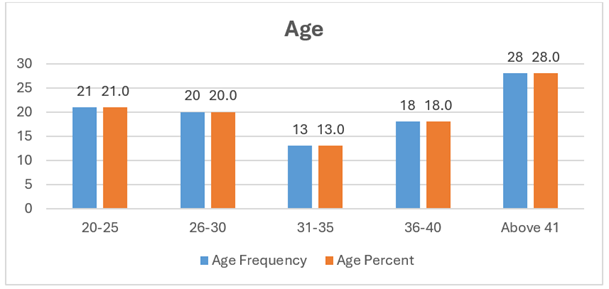
The above table
discusses the frequency and percentage of age of the respondents. In 20-25 age
group, Frequency is 21 and percentage is 21.0%. In 26-30 age group, Frequency
is 20 and percentage is 20.0%. In 31-35 age group, Frequency is 13 and
percentage is 13.0%. In 36-40 age group, Frequency is 18 and percentage is
18.0%. In above 41 age group, Frequency is 28 and percentage is 28.0%.
|
Graph 1
|
|
Graph 1 Graphical Representation of Age of the Respondents. |
Table 2
|
Table 2 Gende of the
Respondents. |
||
|
Gender |
||
|
Frequency |
Percent |
|
|
Male |
62 |
62.0 |
|
female |
38 |
38.0 |
|
Total |
100 |
100.0 |
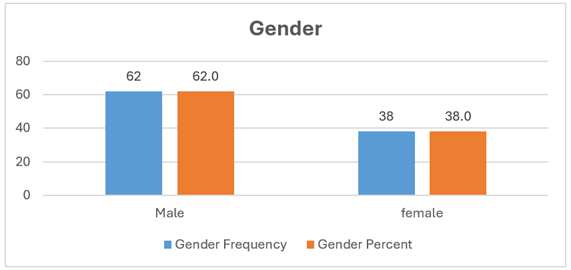
The above table discusses the frequency and percentage of gender of the respondents. In male group, Frequency is 62 and percentage is 62.0%. In Femalegroup, Frequency is 38 and percentage is 38.0%.
|
Graph 2
|
|
Graph 2 Graphical
Representation of Gende of the Respondents. |
Table 3
|
Table 3 Educational
Qualification of the Respondents. |
||
|
Educational Qualification |
||
|
Frequency |
Percent |
|
|
High School |
23 |
23.0 |
|
Higher secondary |
36 |
36.0 |
|
Graduate |
26 |
26.0 |
|
Post Graduate |
9 |
9.0 |
|
Other |
6 |
6.0 |
|
Total |
100 |
100.0 |
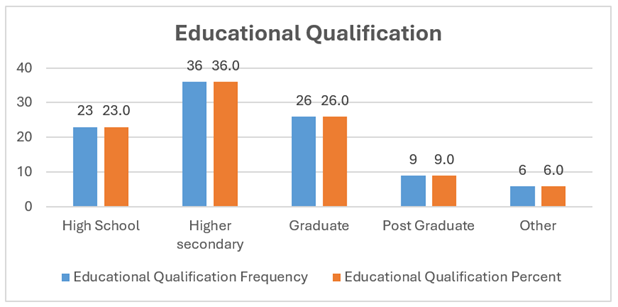
The above table discusses the frequency and percentage of Educational Qualification. In High school, Frequency is 23 and percentage is 23.0%. In Higher secondary, Frequency is 36 and percentage is 36.0%. In Graduate, Frequency is 26 and percentage is 26.0%. In Post-Graduate, Frequency is 9 and percentage is 9.0%. In Other, Frequency is 6 and percentage is 6.0%.
|
Graph 3
|
|
Graph 3 Graphical Representation of Educational Qualification of the Respondents. |
Table 4
|
Table 4 Occupation of the
Respondents. |
||
|
Occupation |
||
|
Frequency |
Percent |
|
|
Student |
17 |
17.0 |
|
Private job |
22 |
22.0 |
|
Government Job |
22 |
22.0 |
|
Business |
19 |
19.0 |
|
Other |
20 |
20.0 |
|
Total |
100 |
100.0 |
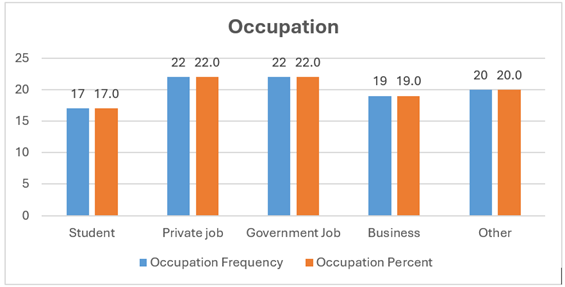
The above table discusses the frequency is 17 and percentage is 17.0%. In Private job, Frequency is 22 and percentage is 22.0%. In Government job, Frequency is 22 and percentage is 22.0%. In Business, Frequency is 19 and percentage is 19.0%. In Other, Frequency is 20 and percentage Is 20.0%.
|
Graph 4
|
|
Graph 4 Graphical Representation of Occupation
of the Respondents. |
Table 5
|
Table 5 Regression test on
Impact of Influencer Marketing Strategies on Consumer Engagement. |
||||
|
Model Summary |
||||
|
Model |
R |
R Square |
Adjusted R Square |
Std. Error of the Estimate |
|
1 |
.960a |
.922 |
.921 |
1.74746 |
|
a. Predictors: (Constant), Influencer
Marketing Strategies |
||||
|
ANOVAa |
||||||
|
Model |
Sum of Squares |
df |
Mean Square |
F |
Sig. |
|
|
1 |
Regression |
3521.496 |
1 |
3521.496 |
1153.223 |
.000b |
|
Residual |
299.254 |
98 |
3.054 |
|||
|
Total |
3820.750 |
99 |
||||
|
a. Dependent Variable: Consumer
Engagement |
||||||
|
b. Predictors: (Constant), Influencer
Marketing Strategies |
||||||
|
Coefficientsa |
||||||
|
Model |
Unstandardized Coefficients |
Standardized Coefficients |
t |
Sig. |
||
|
B |
Std. Error |
Beta |
||||
|
1 |
(Constant) |
.125 |
.680 |
.184 |
.855 |
|
|
Influencer Marketing Strategies |
.986 |
.029 |
.960 |
33.959 |
.000 |
|
|
a. Dependent Variable: Consumer
Engagement |
||||||
The regression model summary shows a strong positive link between influencer marketing strategies and consumer engagement, as evidenced by a high R value of 0.960 and a R Square of 0.922. This shows that influencer marketing methods account for about 92.2% of the variation in customer engagement. The ANOVA table verifies the model's statistical significance, with an F-value of 1153.223 and a p-value of 0.000, indicating that it is extremely significant. The coefficients table demonstrates that influencer marketing methods significantly effect consumer engagement (β = 0.986, t = 33.959, p = 0.000). The constant term is not statistically significant (p = 0.855), indicating that influencer marketing is the primary driver of customer engagement. Overall, the findings show that influencer marketing methods are a powerful predictor of consumer engagement.
Table 6
|
Table 6 Pearson
Correlation on Relationship Between Influencer Credibility and Brand
Authenticity and Trust |
|||
|
Correlations |
|||
|
Influencer Credibility |
Brand Authenticity and Trust |
||
|
Influencer Credibility |
Pearson Correlation |
1 |
.678** |
|
Sig. (2-tailed) |
.000 |
||
|
N |
100 |
100 |
|
|
Brand Authenticity and Trust |
Pearson Correlation |
.678** |
1 |
|
Sig. (2-tailed) |
.000 |
||
|
N |
100 |
100 |
|
|
**. Correlation is
significant at the 0.01 level (2-tailed). |
|||
The Pearson correlation value for Influencer Credibility, Brand Authenticity, and Trust is 0.678, showing a relatively high positive association between the two variables. This means that as an influencer's credibility grows, so does the consumer's opinion of brand authenticity and trustworthiness. The connection is statistically significant at the 0.01 level (2-tailed), with a p-value of 0.000, indicating that the association is not random. With a sample size of 100, this substantial association demonstrates the importance of influencer reputation in determining consumer impression of brands.”
Table 7
|
Table 7 Regression test on
Influence of Content Type on Consumer Attitude and Brand Perception. |
||||
|
Model Summary |
||||
|
Model |
R |
R Square |
Adjusted R Square |
Std. Error of the Estimate |
|
1 |
.751a |
0.564 |
0.560 |
2.50146 |
|
a. Predictors: (Constant), Types of Influencer Content |
||||
|
ANOVAa |
||||||
|
Model |
Sum of Squares |
df |
Mean Square |
F |
Sig. |
|
|
1 |
Regression |
793.294 |
1 |
793.294 |
126.779 |
.000b |
|
Residual |
613.216 |
98 |
6.257 |
|||
|
Total |
1406.51 |
99 |
||||
|
a. Dependent Variable:
Consumer Attitudes and Brand Perception |
||||||
|
b. Predictors: (Constant),
Types of Influencer Content |
||||||
|
Coefficientsa |
||||||
|
Model |
Unstandardized Coefficients |
Standardized Coefficients |
t |
Sig. |
||
|
B |
Std. Error |
Beta |
||||
|
1 |
(Constant) |
4.229 |
1.124 |
3.761 |
.000 |
|
|
Types of Influencer Content |
.782 |
.069 |
.751 |
11.260 |
.000 |
|
|
a. Dependent Variable:
Consumer Attitudes and Brand Perception |
||||||
The regression analysis shows a positive correlation between Type of Influencer Content, Consumer Attitudes and Brand Perception with a R value of 0.751 and a R square of 0.564. This suggests that the types of material shared by influencers account for about 56.4% of the variation in consumer attitudes and brand impression. The ANOVA table confirms that the model is statistically significant with a F-value of 126.779 and p-value of 0.000 indicating a very significant model. The coefficient table shows that the types of influencer content have a significant positive effect on the customer attitude and brand perception ((β = 0.782, t = 11.260, p = 0.000). Additionally, the constant is significant (p = 0.000), indicating a significant level of customer sentiments in the case of no content variability. In general, the review proves that various categories of influencer content are good predictors of how the customers view brands and develop their attitudes.
Discussion
This study has proven that influencer marketing significantly affects the engagement of the customer and the perception of the brand. The regression research indicates that influencer marketing strategies explain nearly 92.2% of the difference in customer engagement, which is a very strong correlation. This shows how influencers are becoming more powerful as a tactical communication tool that could grow relationships between firms and consumers. Also, consumers tend to perceive a brand as more credible when advertised by authority figures as demonstrated by the significant correlation (r = 0.678) between the credibility of influencers and brand authenticity and trust. This justifies the idea that relatability and authenticity, which are more often more apparent in influencer-created content compared to traditional advertising, are important factors in developing positive brand images.
Moreover, the results indicate that 56.4% of the difference can be attributed to the nature of influencer materials (sponsored posts, tutorials, and reviews), which significantly affect the consumer attitudes and brand perception. This means that the communication style of the influencer, the format, tone and style of the content, as well as his or her personal traits have a significant influence on customer feelings. Viewers appear to be more reactively to participatory, genuine content that suits the typical communication style of the influencer. These results corroborate the body of research showing that more individualized, imaginative, and pertinent influencer material can strengthen the bond between customers and brands.
Also, demographic data provide these results with a broader point of view. Even though some of the strategies may have to be tailored to particular audience groups, the ability to reach a vast audience, including age groups, education, and jobs, implies that influencer marketing can find favor with a diverse range of market segments. Notably, younger audiences (those between the ages of 20 and 30), who make up a sizable percentage of the respondents, are particularly open to influencer content. This tendency is in line with patterns of digital consumption around the world.
Conclusion
This study unequivocally shows that influencer marketing
is a very successful tactic for raising customer involvement and influencing
brand impression. The importance of selecting the right influencers and
employing the right information formats is supported by strong statistical
correlations between the credibility and trust of the influencers, the type of
content and customer emotions. Brands that highly value authenticity, build
trust and engage customers with relatable influencers are more likely to achieve
long-term customer loyalty and a positive brand image. The ramifications are
obvious: companies ought to spend money establishing enduring alliances with
reliable influencers whose material reflects the ideals of the brand. Moreover,
the engagement of customers can be achieved through various content techniques,
including interactive campaigns, tutorials, and unboxings, which can
significantly engage customers. The role of influencer marketing is set to
remain a major element of strategic brand communication in the evolving digital
environment as AI is integrated, along with the introduction of the latest
technologies such as AR/VR. Those brands that adapt to the altered needs of
consumers in terms of authenticity, transparency, and depth will be the most
successful.
ACKNOWLEDGMENTS
None.
REFERENCES
Chacko, A. (2025). The Benefits of Influencer Marketing (+ What the C-Suite Cares About).
Hamzah, Z. L., Abdul Wahab, H., and Waqas, M. (2021). Unveiling Drivers and Brand Relationship Implications of Consumer Engagement with Social Media Brand Posts. Journal of Research in Interactive Marketing, 15(2), 336–358. https://doi.org/10.1108/JRIM-05-2020-0113
Influencity. (2024). The Future of Influencer Marketing: Trends and Predictions for 2030.
Jaitly, R. C., and Gautam, O. (2021). Impact of Social Media Influencers on Customer Engagement and Brand Perception. International Journal of Internet Marketing and Advertising, 15(2), 220. https://doi.org/10.1504/IJIMA.2021.114336
Kour, P. (2015). The Impact of Meme Culture on Brand Perception: Assessing How Meme Marketing Influences Engagement and Relatability.
Kumar, R., Prabha, V., Kumar, M., Rehal, P., Samanta, P., and Singh, P. K. (2025). Influencer Marketing: A Review and Research Agenda Using VOSviewer. Abhigyan, 43(2), 179–197. https://doi.org/10.1177/09702385241289368
Liu, S. (2021). The Impact of Influencer Marketing on Brand Engagement: A Conceptual Framework. https://doi.org/10.2991/assehr.k.211220.383
Mason.wm. (2023). Shaping Brand Perception with Customer Participation.
Mohammad, A. A. S., Aityassine, F. L. Y., Al-Fugaha, Z. N. A., Alshurideh, M. T., Alajarmeh, N. S., Al-Momani, A., Al-Shanableh, N., Alzyoud, M., Al-Hawary, S. I. S., and Al-Adamat, A. M. (2024). The Impact of Influencer Marketing on Brand Perception: A Study of Jordanian Customers Influenced on Social Media Platforms (363–376). https://doi.org/10.1007/978-3-031-56015-6_29
Mursalin, A., Purbaningsih, Y., Fadjar Boediman, S., Siagawati, M., and Hendrik Sitaniapessy, R. (2023). Understanding AI-Driven Influencer Marketing. International Journal of Humanities, Social Sciences and Business (INJOSS), 2(3), 443–455. https://doi.org/10.54443/injoss.v2i3.90
Nunes, N. (2025). Top Influencer Marketing Trends [Updated for 2025].
Sijabat, L., Rantung, D. I., and Mandagi, D. W. (2023). The Role of Social Media Influencers in Shaping Customer Brand Engagement and Brand Perception. Jurnal Manajemen Bisnis, 9(2), 280–288. https://doi.org/10.33096/jmb.v9i2.459
Singh, R., Tiwari, D., and Tiwari, H. (2023). Influencer Marketing: Concepts, Practices, and Strategies: An Overview. EPRA International Journal of Environmental Economics, Commerce and Educational Management, 6–12. https://doi.org/10.36713/epra14005
Singh, S. (2024). The Convergence of Data Analytics and Influencer Marketing (1–18). https://doi.org/10.4018/979-8-3693-7773-4.ch001
Xu, Y. (2024). Strategic Engagement and Brand Perception: An Analysis of Social Media Marketing in the Luxury Automobile Industry. Advances in Economics, Management and Political Sciences, 105(1), 56–63. https://doi.org/10.54254/2754-1169/105/20241948
Yong, S. C. S. C., Gao, X., and Poh, W. S. (2024). The Effect of Influencer Marketing on Consumer Engagement and Brand Loyalty. International Journal of Multidisciplinary: Applied Business and Education Research, 5(7), 2357–2364. https://doi.org/10.11594/ijmaber.05.07.02
|
|
 This work is licensed under a: Creative Commons Attribution 4.0 International License
© IJETMR 2014-2026. All Rights Reserved.