
|
|
|
|
Original Article
CONSTRUCTING THE NEW VS. CONSERVING THE OLD: COMPARING CONSTRUCTION AND CONSERVATION WITHIN THE PROJECT MANAGEMENT PROCESS GROUPS
|
Mehmet Emre
Aktuna 1* 1 Independent Researcher,
Turkey |
|
|
|
ABSTRACT |
||
|
The management of architectural heritage conservation projects presents distinct challenges compared to conventional construction due to the need to preserve cultural significance, authenticity, and historical integrity. This study investigates how project management practices differ across the project life cycle in new construction and heritage conservation, addressing the research question of how conventional project management frameworks can be adapted to better support conservation contexts. A qualitative comparative analysis was conducted based on a structured literature review, examining project management practices across initiation, planning, execution, monitoring and control, and closing phases. The findings reveal that conservation projects require adaptive approaches characterized by flexible scope management, contingency-based planning, specialized procurement, multidisciplinary collaboration, and stricter change control aligned with conservation principles. Based on these findings, the study proposes a tailored, phase-based project management framework that integrates conservation priorities into conventional project management structures. The framework provides a structured approach for addressing uncertainty, stakeholder complexity, and material constraints inherent in heritage projects. The study concludes that conventional project management frameworks, while useful, require systematic adaptation to effectively respond to the specific demands of conservation practice. The proposed framework offers practical guidance for professionals and contributes to improving the alignment between project management processes and heritage conservation objectives, while highlighting the need for future empirical validation. Keywords: Heritage Conservation, Project
Management, Construction Management |
||


INTRODUCTION
The preservation
and conservation of architectural heritage have gained increasing importance as
societies recognize the cultural, historical, and socioeconomic value of such
assets Liang et
al. (2023). Architectural heritage, including
buildings, monuments, and sites, serves as a tangible link to the past,
preserving cultural identity and traditional craftsmanship Sayigh
(2019). However, heritage conservation presents
distinct challenges compared to new construction, which prioritizes
functionality, efficiency, and compliance with modern standards, whereas
conservation emphasizes authenticity, integrity, and sustainability.
In rapidly
urbanizing contexts, new construction responds to growing demands in sectors
such as education, healthcare, and housing, focusing on safety, energy
efficiency, and technological integration Rushton
(2022), Kutsevych
and Tyshkevych (2022). In contrast, heritage conservation seeks to
protect and restore historical structures while retaining their cultural
significance. It extends beyond material preservation to include intangible
values and collective memory Kubontubuh
and Martokusumo (2019), and aligns with sustainable development
through cultural resource preservation Khalil
et al. (2018). Conservation processes typically require
collaborative stakeholder engagement, as reflected in international frameworks
such as the Venice Charter and the Faro Convention Petzet
(2004), UNESCO
(2005), Spiridon
and Sandu (2015).
Project management
is central to both construction and conservation projects, yet approaches
differ significantly across the project life cycle phases: initiation,
planning, execution, monitoring, and closing. While construction projects
emphasize cost-efficiency and regulatory compliance, conservation projects
require adaptive and context-sensitive strategies aligned with conservation
ethics and legal frameworks Wells
and Lixinski (2016). Accordingly, developing integrated
management approaches is essential to support the long-term sustainability of
heritage assets within contemporary environments.
This study
examines the project life cycle in new construction and heritage conservation,
two domains that share foundational principles but differ in methodologies and
constraints. Through a comparative framework based on project life cycle
phases, the study identifies key similarities and differences in project
management practices. Particular attention is given to the specific
requirements of conservation projects, including the use of traditional
materials, specialized expertise, and regulatory constraints.
The study aims to
highlight how these differences influence project management strategies and to
identify the adaptive approaches required in conservation contexts. It also
considers the limitations of applying generalized project management frameworks
to heritage projects, where uncertainty, material constraints, and authenticity
requirements introduce additional complexity.
This study
contributes by proposing a structured comparative framework for project
management in construction and heritage conservation based on PMBOK process
groups. Unlike existing studies that discuss conservation constraints in
isolation, this study integrates these factors systematically into each project
life cycle phase, providing a structured and operational framework for
conservation-oriented project management.
MATERIALS AND METHODS
This study adopts
a qualitative comparative analysis framework to examine project management
practices across the project life cycle in new construction and heritage
conservation Ragin
(2008). Supported by an exploratory literature
review, the study synthesizes theoretical and practical insights from
peer-reviewed articles, books, and conference proceedings Frederiksen
et al. (2018), enabling a comparative understanding of
conceptual and operational differences between the two domains.
A structured
qualitative literature review was conducted to establish the theoretical
foundation of the study. The review focuses on key contributions addressing
project management practices in construction and architectural heritage
conservation. Relevant sources were identified through major academic databases
and publishers, including Google Scholar, Scopus, Web of Science,
ScienceDirect, Emerald Insight, Elsevier, EBSCO, JSTOR, Taylor and Francis,
ProQuest, Wiley Online Library, TRDizin, and Semantic Scholar. Keywords such as
“project management,” “construction,” “conservation,” “project life cycle,” and
“architectural heritage” were used in various combinations to capture relevant
studies.
Studies were
selected based on relevance, academic rigor, and thematic alignment. Inclusion
criteria required explicit discussion of project management practices in
construction or conservation, with particular emphasis on life cycle stages,
process groups, and knowledge areas. Peer-reviewed articles, conference papers,
and reputable book chapters were prioritized. The reviewed literature primarily
spans foundational and contemporary studies without strict temporal limitation.
Thematic analysis
was employed to identify patterns and differences between construction and
conservation practices. The process involved familiarization with the
literature, identification of recurring themes, and systematic coding of key
concepts related to project phases and management practices. These codes formed
the basis for comparative analysis across the project life cycle.
The literature
selection focused on widely cited and thematically relevant sources to capture
key theoretical and applied perspectives. The review was not intended to be
exhaustive, and therefore does not follow a formal systematic review protocol.
This approach allows for interpretative comparison across domains but may
introduce selection bias. The findings should therefore be understood as a
conceptual synthesis rather than a statistically representative analysis.
The analysis
generated a structured framework highlighting methodological differences,
challenges, and best practices in both domains. A phase-based comparative
analysis was conducted to examine how project management practices differ
across the life cycle, particularly in contexts where functional objectives
must be balanced with cultural and heritage considerations Keeves
(2001).
The qualitative
comparative analysis is based on a purposive selection of literature
representing key theoretical and applied contributions. The comparative
framework was developed through thematic coding of project phases and
associated management practices.
Comparative Analysis of Project Life Cycle Stages
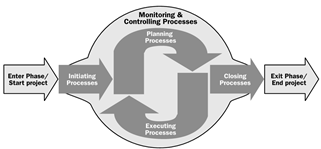
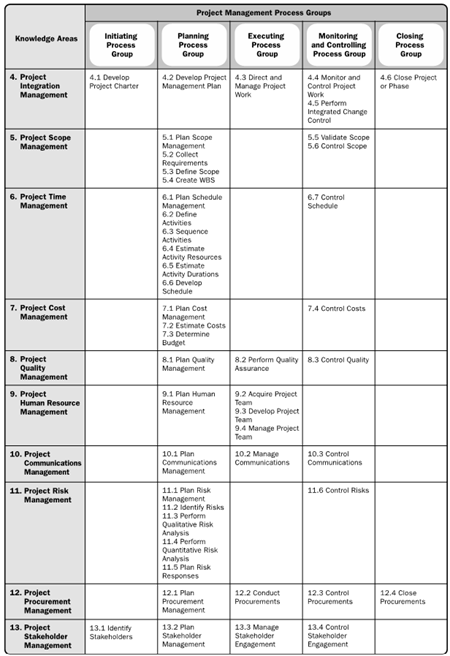
The comparative
analysis is structured using the Project Management Institute’s (PMI) process
groups and knowledge areas Project
Management Institute (2017). These frameworks organize project
management into five process groups—initiating, planning, executing, monitoring
and controlling, and closing—alongside ten knowledge areas, including scope,
cost, quality, risk, procurement, and stakeholder management. These structures
provide a systematic basis for comparing construction and conservation
practices Figure 1, Figure 2.
|
Figure 1 |
|
Figure 1 Project Management Process Groups Project
Management Institute (2017) |
|
Figure 2
|
|
Figure 2 Project Management Process Group and
Knowledge Area Mapping Project
Management Institute (2017) |
The initiation
phase defines project objectives and stakeholders. In construction, project
charters emphasize measurable goals, efficiency, and regulatory compliance Oberlender
(2000). In conservation, charters prioritize
historical significance, condition assessment, and adherence to conservation
principles such as reversibility and minimal intervention ICOMOS
(2003). Stakeholder identification is broader in
conservation, involving heritage authorities, communities, and cultural actors,
requiring more inclusive engagement strategies Atkin
and Skitmore (2008), Vandesande
et al. (2018).
The planning phase
establishes the project roadmap across knowledge areas. Planning includes
defining roles, developing a staffing plan, and establishing communication
protocols to ensure collaboration Olanrewaju
et al. (2024). Construction planning focuses on defined
scope, schedule, and cost efficiency Clough
et al. (2000), Lester
(2006). Planning in new construction includes
sequencing activities, estimating resources and durations, and developing a
detailed schedule and budget Hribar
and Asbury (1985). In new construction, quality management
focuses on meeting contemporary standards and client specifications. Planning
involves setting quality objectives, defining quality assurance and control
measures, and establishing criteria for acceptance Rumane
(2017)In conservation, planning requires adaptive
strategies due to uncertainties in existing structures, material constraints,
and regulatory requirements ICOMOS
(2003), Rebec et
al. (2022). Scope management is more flexible,
schedules and costs are less predictable, and procurement often involves
specialized materials and expertise Khan (2006), Toniolo
et al. (2014), Roy and Kalidindi (2017), Smith
(2005). The scope management is more complex,
requiring a balance between conservation and necessary modern interventions to
maintain historical integrity in conservation. The WBS must reflect tasks
sensitive to the building's existing conditions and historical significance Vandesande
et al. (2018), Almasifar
et al. (2021), Mohamed
et al. (2021).Risk and stakeholder management are also
more complex, requiring multidisciplinary collaboration Mhetre et al. (2016), Vandesande
et al. (2018), Majewski
and Altschul (2018).
The execution
phase involves implementing project plans. Construction emphasizes efficiency,
coordination, and compliance with standards Bhuiyan
(2015). New construction projects generally require
a team of architects, engineers, contractors, and labourers. The project
manager is responsible for recruiting, developing, and managing the team to
ensure efficient collaboration and high performance Low (2012). Heritage conservation, however, demands a
specialized team that includes conservation experts, historians, and skilled
artisans. Conservation focuses on preserving historical integrity through
specialized techniques and expert involvement Vandesande
et al. (2018), Aktuna
and Eskici (2024). Quality assurance in conservation
prioritizes compatibility of materials and adherence to conservation principles
ICOMOS
(2003), Van et al. (2015). Communication and stakeholder engagement
are broader and more complex due to cultural considerations Nwachukwu
et al. (2017); Yang et al. (2009). Procurement requires sourcing rare
materials and skilled labour Rotich
et al. (2021), Toniolo
et al. (2014).
The monitoring and
controlling phase ensures alignment with project objectives. Construction
focuses on performance tracking, cost control, and efficiency Burke
(2001), Hendrickson
and Au (1989). This phase includes processes such as
monitoring project work, performing integrated change control, and validating
and controlling scope, schedule, costs, quality, communications, risks,
procurements, and stakeholder engagement. Taylor
(2008). Conservation requires continuous evaluation
of interventions to maintain authenticity and structural integrity Toniolo
et al. (2014), Heras et
al. (2013). Change control is more restrictive due to
heritage considerations Hao et al. (2008), ICOMOS
(2003), Aktuna
and Eskici (2024). Scope
validation in new construction ensures that deliverables meet defined
requirements, with regular reviews to confirm alignment with project objectives
Helgason
(2010). Project managers must maintain open,
transparent communication to align conservation efforts with cultural goals and
address stakeholder concerns Vandesande
et al. (2018), Taleb et
al. (2017). Quality, risk, and procurement controls
must address uncertainties related to materials and historical conditions O’Brien (2013), Jigyasu
(2005), Reyers
and Mansfield (2001), Abazid
and Harb (2018). Unforeseen discoveries or the need for
specialized materials can lead to delays and increased costs. Flexible
contingency plans are necessary to adapt to these uncertainties Toniolo
et al. (2014), Apollo
et al. (2018).
The closing phase
finalizes project activities. This phase involves processes such as closing the
project or phase and concluding procurements Martinelli
and Milosevic (2015). In construction, this involves verifying
completion, formal acceptance, and documentation Sena-Mawuli (2021). In conservation, closing includes detailed
documentation of interventions, stakeholder approval, and ensuring compliance
with conservation standards Vandesande
et al. (2018), Aktuna
and Eskici (2024). Procurement
closure may involve ongoing maintenance considerations due to the long-term
nature of heritage preservation Toniolo
et al. (2014).
RESULTS AND DISCUSSIONS
The analysis
identifies phase-specific findings on how conservation projects require
adaptations to conventional project management practices in order to achieve
sustainable and context-sensitive outcomes.
Findings on the Initiation Phase
1)
Developing
Charter
The analysis
indicates that a conservation project charter should prioritize historical,
cultural, and aesthetic values while incorporating authenticity, minimal
intervention, and reversibility. It should also define applicable conservation
standards, legal requirements, and the existing condition of the building.
Sustainability considerations, including locally sourced materials,
environmentally responsible practices, and adaptive reuse, should be integrated
where they do not compromise heritage integrity.
2)
Identifying
Stakeholders
Findings suggest
that conservation projects involve a broader and more diverse stakeholder
environment than conventional construction. Heritage authorities, historians,
local communities, and cultural organizations may hold differing expectations
and values. Effective stakeholder mapping, early collaboration, transparent
communication, and participatory mechanisms support compliance, reduce
conflict, and strengthen long-term support.
Findings on the Planning Phase
1)
Developing
the Project Management Plan
The analysis
indicates that conservation planning should be tailored to historical and
cultural preservation requirements while meeting regulatory obligations.
Structural assessment, historical research, phased planning, expert
consultation, and team familiarity with conservation protocols are central to
effective planning.
2)
Scope
Management
Findings suggest
that conservation scope must remain controlled but flexible, as unexpected
discoveries such as artifacts, hidden damage, or structural deficiencies may
require adaptation. Embedded contingencies, specialist input, and systematic
documentation are necessary to maintain clarity and accountability.
3)
Schedule
and Cost Management
The analysis
indicates that conservation projects are especially vulnerable to delays and
cost increases due to structural uncertainty, rare materials, and approval
processes. Flexible schedules, contingency budgets, early procurement, and
detailed cost estimation improve planning resilience.
4)
Quality
Management
Findings suggest
that quality management in conservation should prioritize authenticity,
reversibility, minimal intervention, and material compatibility. Quality plans
aligned with conservation principles and supported by audits and non-invasive
inspection methods help maintain consistency.
5)
Human
Resource and Communication Management
The analysis
indicates that conservation projects require multidisciplinary teams with
shared understanding of heritage objectives. Clear communication channels,
regular coordination, and stakeholder-oriented communication materials support
both internal collaboration and external engagement.
6)
Risk
Management
Findings suggest
that conservation risks include structural instability, environmental exposure,
material shortages, and uncertainty arising from existing conditions. These
require comprehensive risk assessment, contingency planning, and regular
reassessment throughout the project.
7)
Procurement
and Stakeholder Management
The analysis
indicates that early engagement with suppliers, craftspeople, and stakeholders
is critical in conservation. Timely access to specialized resources,
transparent communication, and community participation support project
continuity and reduce stakeholder conflict.
Findings on the Execution Phase
1)
Direct
and Manage Project Work
Findings suggest
that execution in conservation prioritizes preservation of historical and
cultural value over speed and cost-efficiency. Project managers must coordinate
specialists and ensure that interventions remain minimally invasive,
reversible, and consistent with conservation objectives. A phased
implementation approach supports incremental review and adjustment.
2)
Scope
Management
The analysis
indicates that scope in conservation execution must remain adaptable to new
findings while preserving project discipline. Controlled change, supported by
documentation, helps maintain alignment with conservation principles and
regulatory requirements.
3)
Perform
Quality Assurance
Findings suggest
that quality assurance in conservation depends on regular specialist
inspections, non-invasive testing, and continuous evaluation of material and
technique compatibility. Tailored quality management systems help preserve
consistency and authenticity.
4)
Acquire,
Develop, and Manage Project Team
The analysis
indicates that conservation requires teams with specialized expertise in
traditional materials, conservation ethics, and historic construction
techniques. Inclusion of both technical experts and cultural historians
supports a more comprehensive preservation process and strengthens team
alignment with project values.
5)
Manage
Communications
Findings suggest
that communication in conservation must address the needs of diverse
stakeholders with varying levels of technical knowledge and emotional
attachment to the site. Transparent communication, regular updates, and
accessible explanations of technical matters support inclusivity and informed
participation.
6)
Conduct
Procurements
The analysis
indicates that procurement in conservation is constrained by limited
availability of suitable materials and specialist services. Ethical and
sustainable sourcing, local procurement where possible, and long-term
relationships with specialist suppliers improve reliability and alignment with
conservation objectives.
7)
Manage
Stakeholder Engagement
Findings suggest
that stakeholder engagement in conservation must remain continuous throughout
implementation. Trust, shared responsibility, and active consultation help
manage expectations and maintain support among heritage authorities,
communities, historians, and cultural organizations.
Findings on the Monitoring and Control Phase
1)
Monitor
and Control Project Work
The analysis
indicates that monitoring in conservation must assess not only progress against
plan but also the effect of interventions on historical authenticity and
physical condition. Regular inspections, photographic records, and detailed
reporting are necessary to support informed control.
2)
Perform
Integrated Change Control
Findings suggest
that change control in conservation requires stricter evaluation than in
conventional construction. Proposed changes must be assessed against
authenticity, reversibility, and cultural significance, ideally through review
involving conservation experts and key stakeholders.
3)
Validate
and Control Scope
The analysis
indicates that scope control in conservation is essential to prevent drift
caused by unforeseen discoveries or expanding intervention demands. Regular
consultation with specialists and authorities helps maintain alignment with
preservation priorities.
4)
Control
Schedule and Costs
Findings suggest
that schedule and cost control in conservation require flexibility due to
regulatory delays, hidden defects, and scarcity of specialized inputs. Time
buffers, contingency funding, regular cost review, and proactive procurement
planning improve control.
5)
Control
Quality
The analysis
indicates that quality control in conservation extends beyond technical
compliance to the protection of historical and cultural value. Frequent audits
and specialist review are necessary to confirm the compatibility of methods and
materials with conservation principles.
6)
Control
Communications and Stakeholder Engagement
Findings suggest
that communication control should ensure that all stakeholder groups remain
adequately informed and engaged. Structured communication planning and regular
meetings support expectation management and reduce misunderstanding.
7)
Control
Risks and Procurements
The analysis
indicates that conservation risk and procurement control must address
structural uncertainty, unexpected historical discoveries, and challenges in
sourcing appropriate materials. Early supplier engagement, collaboration with
traditional craftspeople, and regular contract review strengthen project
control.
Findings on the Closing Phase
Close Project
or Phase
Findings suggest
that closing a conservation project requires more than formal completion. It
must confirm that the structure’s historical and cultural significance has been
preserved in accordance with conservation standards. This includes
comprehensive documentation of methods, materials, and interventions;
stakeholder approval; and preparation of maintenance and monitoring plans to
support long-term preservation.
Close
Procurements
The analysis
indicates that procurement closure in conservation is more demanding than in
standard construction due to the specialized nature of materials and services.
Verification of compliance, detailed source records, and documentation of
techniques used are important for future maintenance and restoration. Long-term
relationships with specialist suppliers and artisans also support continuity
and authenticity in later interventions.
Proposed Framework for Conservation Project Management
Based on the
comparative analysis and phase-specific findings, this study proposes a
tailored project management framework for architectural heritage conservation
aligned with PMBOK process groups.
The framework is
structured around the five project life cycle phases (initiation, planning,
execution, monitoring and control, and closing) while incorporating
conservation-specific priorities that differentiate it from conventional
construction project management.
In the initiation
phase, the framework emphasizes heritage-based project definition, including
cultural value assessment, regulatory alignment, and early stakeholder
integration. In contrast to construction projects, the project charter
incorporates conservation principles such as authenticity, reversibility, and
minimal intervention.
In the planning
phase, the framework introduces adaptive planning mechanisms that account for
uncertainty in existing structures, material constraints, and regulatory
processes. Flexible scope definition, contingency-based scheduling, and
specialized procurement strategies are central components.
In the execution
phase, the framework prioritizes controlled and reversible interventions
supported by continuous expert involvement. Implementation is structured in
phases, allowing iterative validation of conservation outcomes and adjustment
based on emerging findings.
In the monitoring
and control phase, the framework integrates conservation-focused evaluation
criteria, including the impact of interventions on historical integrity. Change
control processes are more restrictive and require validation against
conservation principles and stakeholder expectations.
In the closing
phase, the framework extends beyond project completion to include
documentation, stakeholder validation, and long-term maintenance planning. This
ensures continuity of conservation efforts and supports future interventions.
Overall, the
proposed framework adapts traditional project management principles to the
specific requirements of heritage conservation by embedding flexibility,
interdisciplinary collaboration, and value-based decision-making throughout the
project life cycle.
The proposed
framework is summarized in Table 1, highlighting key differences between
conventional construction project management and conservation-oriented
adaptations across project life cycle phases Table 1.
While the PMBOK
framework provides a structured foundation for project management, its
application to heritage conservation remains limited. Existing studies have
noted that standardized project management models often assume predictability,
clearly defined scope, and linear workflows, which contrast with the
uncertainty and context-dependence of conservation projects. In this context,
adaptive and agile project management approaches may offer complementary
perspectives, particularly in addressing uncertainty and iterative
decision-making in conservation projects. Alternative approaches, including
adaptive management and iterative decision-making models, may offer greater
flexibility in addressing unforeseen conditions and evolving stakeholder
expectations. However, these approaches are less formalized and lack the
structured guidance provided by PMBOK. The proposed framework therefore
represents an attempt to bridge this gap by adapting conventional project
management principles to the specific conditions of heritage conservation.
|
Table 1 |
|
Table 1 Proposed Conservation Project Management
Framework Based on Project Life Cycle Phases |
||
|
Project Phase |
Conventional Construction
Approach |
Conservation-Oriented
Adaptation (Proposed Framework) |
|
Initiation |
Project charter defines
scope, objectives, budget, and stakeholders with focus on efficiency and
compliance |
Project charter integrates
cultural significance, authenticity, and conservation principles; expanded
stakeholder identification including heritage authorities, communities, and
cultural actors |
|
Planning |
Fixed scope, linear
scheduling, cost optimization, standard procurement strategies |
Flexible scope with
contingencies; adaptive scheduling and budgeting; inclusion of structural
assessment, historical research, and specialized procurement for traditional
materials and expertise |
|
Execution |
Emphasis on speed,
cost-efficiency, and standardized construction practices |
Emphasis on minimally
invasive and reversible interventions; phased implementation; continuous
involvement of conservation experts and specialists |
|
Monitoring and Control |
Performance tracking focused
on time, cost, and quality compliance |
Monitoring includes
assessment of impact on historical integrity; stricter change control aligned
with conservation principles; enhanced documentation and stakeholder
validation |
|
Closing |
Project completion,
handover, and documentation for operational use |
Extended closing including
detailed conservation documentation, stakeholder approval, and long-term
maintenance and monitoring planning |
CONCLUSIONS and RECOMMENDATIONS
This study
demonstrates that project management approaches in heritage conservation differ
fundamentally from those in new construction. While construction projects
emphasize functionality, efficiency, and cost control, conservation projects
require adaptive strategies that prioritize authenticity, cultural integrity,
and minimal intervention. Across all project phases, these differing objectives
necessitate context-sensitive management approaches.
In the initiation
phase, findings indicate that conservation projects require charters grounded
in historical significance, regulatory compliance, and sustainability
considerations. Early stakeholder identification and engagement, including
heritage authorities, local communities, and experts, are essential for
establishing a shared understanding and long-term support.
In the planning
phase, conservation projects require flexible and specialized management plans.
These must incorporate detailed assessments, contingency mechanisms, and
compliance with conservation standards. Uncertainty in existing conditions
necessitates adaptable scope management, while schedule and cost planning must
account for potential delays and specialized resource requirements.
Multidisciplinary collaboration and structured communication are central to
effective planning.
In the execution
phase, conservation practices rely on controlled, minimally invasive, and
reversible interventions. Continuous involvement of specialists ensures
alignment with conservation principles. Adaptive scope management, rigorous
quality assurance, and stakeholder-oriented communication support both
technical accuracy and broader acceptance. Procurement processes must address
the sourcing of specialized materials and expertise.
During monitoring
and control, conservation projects require continuous evaluation of both
project performance and the impact of interventions on heritage values. Change
control must be strictly aligned with authenticity and reversibility
principles. Flexible schedule and cost control mechanisms, combined with
regular quality audits and stakeholder communication, are necessary to manage
uncertainties effectively.
In the closing
phase, conservation projects extend beyond formal completion to include
comprehensive documentation, stakeholder validation, and long-term maintenance
planning. Detailed records of interventions and material use support future
conservation efforts, while sustained relationships with specialists and
suppliers enhance continuity. Where appropriate, adaptive reuse can support
long-term functionality without compromising heritage value.
Overall, the
findings confirm that conservation projects require tailored project management
approaches that respond to regulatory, material, technical, and cultural
complexities. These challenges demand specialized expertise, interdisciplinary
coordination, and flexible management strategies.
This study is
based on a qualitative review of existing literature and does not include
empirical validation of the proposed framework. The selection of sources,
although guided by relevance and academic rigor, may introduce bias and does
not represent a fully systematic review. Additionally, the framework is
conceptual in nature and may require adaptation when applied to specific
project contexts.
Recommendations
Based on the
findings, the following recommendations are proposed:
·
Development
of conservation-specific project management frameworks aligned with
international conservation principles
·
Integration
of digital tools and documentation methods to improve planning, monitoring, and
knowledge transfer
·
Strengthening
interdisciplinary collaboration among engineers, conservation specialists, and
cultural stakeholders
·
Adoption
of adaptive management approaches that accommodate uncertainty in heritage
contexts
·
Further
research on cost–benefit analysis, funding models, and regulatory frameworks in
conservation projects
·
Exploration
of cross-cultural project management practices to enhance stakeholder
collaboration in diverse contexts
Future research
should focus on empirical validation of the proposed framework and the
application of digital and interdisciplinary approaches to improve conservation
project outcomes.
ACKNOWLEDGMENTS
None.
REFERENCES
Abazid, M., and Harb, H. (2018). An Overview of Risk Management in Construction Projects. Academic Research International, 9(2), 73–79.
Aktuna, M. E. (2024). Taşınmaz Kültür Varlıklarının Korunmasında Sürdürülebilir Bütüncül Bir Yönetim Sisteminin Geliştirilmesi (Doctoral dissertation, Ankara Hacı Bayram Veli Üniversitesi).
Aktuna, M. E., and Eskici, B. (2024). Restoration Manager: Adapting Project Delivery Methods for the Restoration of Architectural Heritage. Turkish Journal of Engineering, 8(2), 265–281. https://doi.org/10.31127/tuje.1386599
Almasifar, N., Canbolat, T. Ö., Akhavan, M., and González-Lezcano, R. A. (2021). Proposing a New Methodology for Monument Conservation “Scope Management” by the Use of an Analytic Hierarchy Process Project Management Institute System and the ICOMOS Burra Charter. Sustainability, 13(21), 11895. https://doi.org/10.3390/su132313174
Apollo, M., Grzyl, B., and Pawel, J. (2018). The Influence of Historical Conditions on Time and Cost of Construction Projects. MATEC Web of Conferences, 222, 01003. https://doi.org/10.3311/CCC2018-090
Atkin, B., and Skitmore, M. (2008). Stakeholder Management in Construction. Construction Management and Economics, 26(6), 549–552. https://doi.org/10.1080/01446190802142405
Bhuiyan, S. H. (2015). Implication of PMBOK in the Construction Industry (Doctoral Dissertation, BRAC University).
Burke,
R. (2001).
Project Management: Planning and Control Techniques (3rd ed.). Wiley.
Clough, R. H., Sears, G. A., and Sears, S. K. (2000). Construction Project Management (4th ed.). Wiley.
Frederiksen, L., Phelps, S. F., and Kimmons, R. (2018). Introduction to Literature Reviews. Rapid Academic writing.
Hao, Q., Shen, W., Neelamkavil, J., and Thomas, R. (2008, July). Change Management in Construction Projects. In Proceedings of the International Conference on Information Technology in Construction CIB W78 (15–17).
Helgason, V. (2010). Project Scope Management (Doctoral Dissertation, Reykjavik University).
Hendrickson, C. T., and Au, T. (1989). Project Management for Construction: Fundamental Concepts for Owners, Engineers, Architects, and Builders. Prentice Hall.
Heras, V., Wijffels, A., Cardoso, F., Vandesande, A., Santana, M., Van Orshoven, J., Steenberghen, T., and Van Balen, K. (2013). A Value-Based Monitoring System to Support Heritage Conservation Planning. Journal of Cultural Heritage Management and Sustainable Development, 3(2), 130–147. https://doi.org/10.1108/JCHMSD-10-2012-0051
Hribar, J. P., and Asbury, G. E. (1985). Elements of Cost and Schedule Management. Journal of Management in Engineering, 1(3), 138–148. https://doi.org/10.1061/(ASCE)9742-597X(1985)1:3(138)
ICOMOS. (2003). Principles for the Analysis, Conservation and Structural Restoration of Architectural Heritage.
Jigyasu, R. (2005). Towards Developing Methodology for Integrated Risk Management of Cultural Heritage Sites and Their Settings. International Journal of Disaster Risk Science, 6(1), 7–18.
Keeves, J. P. (2001). Comparative Research in Education: IEA Studies. In International encyclopedia of the social and behavioral sciences (2421–2427). Elsevier. https://doi.org/10.1016/B0-08-043076-7/02350-0
Khalil, A., Hammouda, N., and El-Deeb, K. (2018). Implementing Sustainability in Retrofitting Heritage Buildings: Case Study, Villa Antoniadis, Alexandria, Egypt. Heritage, 1(1), 57–87. https://doi.org/10.3390/heritage1010006
Khan, A. (2006). Project Scope Management. Cost Engineering, 48(6), 12–16.
Kubontubuh, C. P., and Martokusumo, W. (2019). Meeting the Past in the Present: Authenticity and Cultural Values in Heritage Conservation at the Fourteenth-Century Majapahit Heritage Site in Trowulan, Indonesia. International Journal of Heritage Studies, 26(5), 469–479. https://doi.org/10.1080/13527258.2019.1652923
Kutsevych, V., and Tyshkevych, O. (2022). Modern Direction of General Secondary Education Formation. Містобудування та територіальне планування. https://doi.org/10.32347/2076-815X.2022.80.248-260
Lester, A. (2006). Project Management, Planning and Control: Managing Engineering, Construction, and Manufacturing Projects to PMI, APM, and BSI Standards (5th ed.). Elsevier.
Liang, W., Ahmad, Y., and Mohidin, H. H. B. (2023). The Development of the Concept of Architectural Heritage Conservation and its Inspiration. Built Heritage, 7(21). https://doi.org/10.1186/s43238-023-00103-2
Low, C. A. (2012). Human Resource Management in a Project Team (Doctoral Dissertation, Universiti Tunku Abdul Rahman).
Majewski, T., and Altschul, J. H. (2018). Heritage Management. In The Encyclopedia of Archaeological Sciences. Wiley. https://doi.org/10.1002/9781119188230.saseas0296
Martinelli, R. J., and Milosevic, D. Z. (2015). Project Management Toolbox. Wiley. https://doi.org/10.1002/9781119174820
Mhetre, K. V., Konnur, B. A., and Landage, A. B. (2021). Risk Management in the Construction Industry. In Lecture notes in civil engineering (Vol. 111,657–664). Springer.
Mohamed, M., Dewidar, K., Elattar, S., and Khodeir, L. (2021). Identifying the Role of Project Management in Sustainable Refurbishment of Heritage Buildings. Journal of Urban Research, 41(1), 79–101. https://doi.org/10.21608/jur.2021.55501.1045
Nwachukwu, C. V., Udeaja, C., Chileshe, N., and Okere, C. E. (2017). The Critical Success Factors for Stakeholder Management in the Restoration of Built Heritage Assets in the UK. International Journal of Building Pathology and Adaptation, 35(4), 304–331. https://doi.org/10.1108/IJBPA-07-2017-0030
O’Brien, J. J. (2013). Construction Inspection Handbook: Quality Assurance/Quality Control (4th ed.). Springer.
Oberlender, G. D. (2000). Project Management for Engineering and Construction (2nd ed.). McGraw-Hill.
Olanrewaju, O. I., Bello, A. O., Semiu, M. A., and Mudashiru, S. A. (2024). Critical Barriers to Effective Communication in the Construction Industry: Evidence from Nigeria. International Journal of Construction Management, 1–19. https://doi.org/10.1080/15623599.2024.2362018
Petzet, M. (2004). Principles of Preservation: An Introduction to the International Charters for Conservation and Restoration 40 Years After the Venice Charter. In International charters for conservation and restoration (Vol. 1, 7–29). ICOMOS.
Project Management Institute. (2017). A Guide to the Project Management Body of Knowledge (PMBOK® Guide). Project Management Institute.
Ragin, C. C. (2008). What is Qualitative Comparative Analysis?
Rebec, K. M., Deanovič, B., and Oostwegel, L. (2022). Old Buildings Need New Ideas: Holistic Integration of Conservation-Restoration Process Data Using Heritage Building Information Modelling. Journal of Cultural Heritage, 55, 30–42. https://doi.org/10.1016/j.culher.2022.02.005
Reyers, J., and Mansfield, J. (2001). The Assessment of Risk in Conservation Refurbishment Projects. Structural Survey, 19, 238–244. https://doi.org/10.1108/02630800110412480
Rotich, J. C., Keitany, P., and Sang, H. W. (2021). Code of Conduct and Procurement Management in Selected Public Secondary Schools: Evidence in Kenya. https://doi.org/10.37284/eajbe.3.1.298
Roy, D., and Kalidindi, S. (2017). Critical Challenges in Management of Heritage Conservation Projects in India. Journal of Cultural Heritage Management and Sustainable Development, 7(3), 290–307. https://doi.org/10.1108/JCHMSD-03-2017-0012
Rumane, A. R. (2017). Quality Management in Construction Projects. CRC Press. https://doi.org/10.1201/9781315098425
Rushton, T. (2022). Modern Methods of Construction. Journal of Building Survey, Appraisal and Valuation, 10(4). https://doi.org/10.69554/BWYR2011
Sayigh, A. (2019). Sustainable Vernacular Architecture: How the Past can Enrich the Future. Springer International Publishing. https://doi.org/10.1007/978-3-030-06185-2
Sena-Mawuli, P. S. (2021). Assessment of Project Closing Procedures at Ghana Ports and Harbours Authority-Tema (Doctoral dissertation, Kwame Nkrumah University of Science and Technology).
Smith, J. (2005). Cost Budgeting in Conservation Management Plans for Heritage Buildings. Structural Survey, 23(2), 101–110. https://doi.org/10.1108/02630800510593675
Spiridon, P., and Sandu, I. (2015). Conservation of Cultural Heritage: From participation to Collaboration. ENCATC Journal of Cultural Management and Policy, 5(1), 43–52. https://doi.org/10.3389/ejcmp.2023.v5iss1-article-4
Taleb, H. A., Ismail, S., Wahab, M. H., Mardiah, W. N., Rani, W. N., and Amat, R. C. (2017). An Overview of Project Communication Management in Construction Industry Projects. https://doi.org/10.31039/jomeino.2017.1.1.1
Taylor, J. (2008). Project Scheduling and Cost Control: Planning, Monitoring and Controlling the Baseline. J. Ross Publishing.
Toniolo, L., Boriani, M., and Guidi, G. (2014). Built Heritage: Monitoring Conservation management. Springer. https://doi.org/10.1007/978-3-319-08533-3
UNESCO. (2005). Faro Convention Framework Convention on the Value of Cultural Heritage for Society.
Van Roy, N., Verstrynge, E., and Van Balen, K. (2015). Quality Management of Interventions on Historic Buildings. In Structural Studies, Repairs, and Maintenance of Heritage Architecture (313–324). https://doi.org/10.2495/STR150261
Vandesande, A., Van Balen, K., Della Torre, S., and Cardoso, F. (2018). Preventive and Planned Conservation as a New Management Approach for Built Heritage: From a Physical Health Check to Empowering Communities and Activating (Lost) Traditions for local sustainable development. Journal of Cultural Heritage Management and Sustainable Development, 8(2), 78–81. https://doi.org/10.1108/JCHMSD-05-2018-076
Wells, J. C., and Lixinski, L. (2016). Heritage Values and Legal Rules: Identification and Treatment of the Historic Environment Via an Adaptive Regulatory Framework (Part 1). Journal of Cultural Heritage Management and Sustainable Development, 6(3), 345–364. https://doi.org/10.1108/JCHMSD-11-2015-0045
Yang, J., Shen, Q., and Ho, M. (2009). An Overview of Previous Studies in Stakeholder Management and its Implications for the Construction Industry. Journal of Facilities Management, 7(2), 159–175. https://doi.org/10.1108/14725960910952532
|
|
 This work is licensed under a: Creative Commons Attribution 4.0 International License
© IJETMR 2014-2026. All Rights Reserved.