
|
|
|
|
Original Article
Impact of Strengthening Relationship Between HR and Employees on Organizational Performance, a Critical Study
|
Vinod Kumar
Mishra 1*, Dr. Namrata Gupta 2 1 Doctor of Philosophy,
Research Scholar, Vikrant University Gwalior Madhya Pradesh, India 2 Assistant Professor, Madhav Institute of
Technology and Science (Deemed University) Gwalior, India |
|
|
|
ABSTRACT |
||
|
This study discusses how a better relationship between Human Resources (HR) and employees can influence organizational performance. This study will assess how HR practices influence the organizational outcomes using a sample of 200 respondents in 20 companies and employee performance is the mediating variable. Online questionnaires were used to collect data and SPSS 22.0 to process the data. The results indicate that HR practices have a significant direct positive effect on the organizational performance (β = 0.4928, p < 0.001) and an indirect effect through employee performance (indirect effect = 0.1180, 95% CI [0.0052, 0.2293]). Human Resource practices explained 60.67% of the variation in employee performance and when added with the employee performance, 51.17% of the variation in organizational performance was explained. The study shows that effective HR policies are the direct contributors to the organizational performance and the indirect ones since they improve the performance of employees. These results highlight the importance of investing in HR-employee relations and aligning HR strategies to business aims to achieve the best performance outcomes. Keywords: HR, Employee, Organisation,
Performance |
||


INTRODUCTION
The improvement of
Human Resources (HR) and employee interface has a great influence on the
performance of companies. Successful HR programs such as employee engagement,
training and development programs create a favorable
working environment thus boosting employee satisfaction and productivity. HR
practices that are based on the combination of employee well-being and
performance management enhance corporate performance. These strategies can be
consistently applied to increase employee competencies, motivation, and job
performance, as well as organizational effectiveness, especially in culturally
flexible settings Bakator
et al. (2019). It claims that companies that have HR
departments that make the employees experience a positive environment have more
chances of staying ahead of their rivals. This connection underlines the
significance of HR in developing a friendly and dynamic working environment,
which plays a vital role in attaining competitive advantage and long-term
success. Therefore, improvement of HR-employee relations is critical to
increase organizational performance, as it fosters the culture of continuous
improvement and win-win. Ogbonnaya
and Aryee (2022)
Concepts of HR-Employee Relationships
Human resources
(HR) and employee are interconnected factors in the success of the
organization. Good HR-employee relationships encourage trust, boost
communication, and job satisfaction. Studies have shown that employees become
more engaged and their turnover is reduced through strong HR practices such as
fair treatment, recognition, and support of professional development. Moreover,
the facilitation of conflict management and creation of a healthy workplace
culture is vital to the HR in order to retain employee morale and productivity.
Companies that are sensitive to the HR-employee relations tend to develop a
dedicated workforce, which leads to a better performance of an organization Kirpik (2020).
Role of HR in organization
Human Resource
(HR) plays a critical role in companies, which serves as a mediator between
management and employees to offer an exciting workplace. Human Resources
activities involve recruiting, training, performance management and employee
relations which are necessary to align individual objectives with business
objectives. Good human resource practices promote employee participation,
reduce turnover and promote organisational effectiveness. Moreover, Human
Resources are crucial in ensuring effective corporate culture that enhances
diversity and inclusion, therefore, increasing creativity and innovation. With
the growing complexity of the workforce, HR has to adjust to the technological
changes and labor laws, which guarantee that it is
aligned with the strategic goals of the organization. Maheshwari
and Yadav (2019)
Importance of Employee relation
Employee relations
are defined as the management of employer-employee relationship
and it involves different issues including communication, conflict resolution
and the workplace culture. Research reveals that effective employee relations
strategies help organizations to achieve better results by increasing job
satisfaction, thus reducing turnover rates and improving organizational
commitment, which are also attained by making sure that the organization
implements effective employee relations strategies, thus enabling it to
overcome challenges with ease and adapt to changes in the marketplace. Thus,
employee relations are not a human resources activity but a strategic necessity
which has a direct effect on the overall organizational performance. Basuki et al. (2022)
Building Stronger HR-Employee Relationships
HR-employee
relationship is a factor that has a great influence on the success of the
organization. Research highlights that an HR relationship of support and trust
can enable increased job satisfaction, employee loyalty, and job performance.
HR professionals can improve the relationships by being fair, offering clear
career growth opportunities, and open communication. Employees feel more
trustful of HR and the turnover is lessened when they feel that HR represents
them. Organizations can foster a culture that promotes trust, cooperation, and
respect between HR and employees by aligning HR policies with those of the
employees and organizational objectives Murugan
and Francifca (2019)
Effective
Communication Strategies -
Good communication is one of the keys to good HR practices, as it helps to
clarify expectations in the organization, address conflicts, and align the
goals of employees with those of the company. Open, coherent and transparent
communication creates an atmosphere that is conducive to productivity and
innovation. A strong HR communication plan would include regular feedbacks, openness and a participatory discussion that
would make all employees feel included and listened to. Moreover, the
utilization of the technology such as HR information systems and employee
portals will increase the availability of communication; the employee should be
provided with the most current and correct information. Kim (2021)
Trust and
Transparency in HR Practices -
Trust and transparency are key in establishing credibility to HR departments in
organizations. When HR practices are viewed as transparent and fair, employees
will be more likely to believe in the HR decisions and adhere to the
organizational policies. HR transparency implies transparent, objective
recruitments, performance reviews and compensation procedures, which lessen
uncertainty and boost organizational commitment. With fair HR practices and
effective communication, organizations can provide a platform of trust, which
can be used to encourage long-term employee satisfaction and loyalty.
Employee
Engagement Initiatives -
Employee engagement is of paramount importance to the organizational
performance and HR is central in enhancing engagement by means of well designed initiatives. It has
been proven that engaged employees are more productive, innovative, and
committed to organizational goals. Best engagement programs comprise
recognition programs, professional development opportunities, and employee
well-being programs. HR departments are supposed to work on establishing a favorable work environment that addresses both professional
and personal needs of employees, thus increasing their engagement and
decreasing their turnover. Van and Beijer (2015)
Benefits of Strengthening HR-Employee Relationships
The enhancement of
connection between the human resources (HR) and the employees is critical in
promoting a conducive and dynamic working environment. The good HR-employee
relations enhance the organizational commitment and employee loyalty. The
development of trust based on the transparent communication, the employee
development and the well-being programs will help the HR to create an
environment in which employees feel important and will lead to the increased
engagement and productivity. Effective communication of policy and the
availability of professional development has the
ability to enhance the sense of belonging in employees hence long
term benefits are accrued both to the employee and the organization.
This connection promotes innovation, efficiency, and respect to each other,
which are essential in the development of an organization. Bannya
et al. (2023)
Improved
Employee Morale and Satisfaction: Among the most outstanding results of good HR-employee relations is
better employee morale and satisfaction. The relationship is healthy with HR
where employees needs and concerns are recognized and
resolved. This has a great bearing on job satisfaction. The employees who have
a positive attitude towards the HR practices, i.e., fair treatment and growth
opportunities, indicate greater job satisfaction. An employee feels motivated
to give their best in the organization when they believe the HR will represent
them and is concerned with their professional growth thus improving the overall
performance of the organization. Moreover, a happy workforce will tend to have
reduced absenteeism and enhanced performance.
Enhanced
Collaboration and Teamwork:
HR is vital in helping to promote collaboration and teamwork in an
organization. By creating policies that encourage collaboration, providing
team-building opportunities, and mediating conflicts effectively, HR can
enhance team dynamics. The teamwork environments also enhance innovation and
creativity, as the employees are able to exchange different views. Good
HR-employee relations will ensure that there is a culture of ease in the
employees working towards achieving a common objective and silos are abolished
and the overall efficiency enhanced. The HR can also make certain that teams
are made up of people possessing complimentary skills which will lead to a more
unified and productive workplace.
Increased
Retention Rates: Positive
HR-employee relationship has a direct relationship with the rate of employee
retention. Employees are less likely to quit the organization when HR actively
tries to solve employee problems, offer them career development opportunities,
and when they have a positive workplace environment. The retention of employees
is aided by the good HR practices like custom career development plans and
work-life balance plans. Such organizations have high chances of keeping their
employees because they are investing in them and their well-being, leading to
lower turnover rates and long-term savings since they do not need to recruit
and train new employees. Hannis
et al. (2018)
Impact on Organizational Performance
Mergers and
acquisitions (MandA) are organizations that have a
tremendous effect on their performance in terms of profitability, operational
efficiency, and overall competitiveness. Numerous researches
have revealed that MandA could have either positive
or negative consequences. The companies that are involved in MandA dealings usually have better financial results
because of the synergies, cost savings and market growth. This however depends
on the processes involved in the integration, where poorly done integrations
may result in underperformance. The immediate post-merger stage can be
characterized by a decline in performance caused by disruption of operations
and human resources, but long-term benefits are likely to be achieved in case
strategic objectives are well aligned. Finally, MandA
would be successful in boosting performance only when it is planned, executed,
and its goals are aligned between the merging parties. Turi et al. (2022)
Link between Employee Engagement and Productivity
Employee
engagement is a very important aspect in the determination of organizational
productivity particularly during and after an MandA
transaction. Employee engagement has a great impact on productivity, job
satisfaction and retention rates. Employees will tend to be uncertain and
anxious during the MandA, and therefore, they will
become disengaged unless otherwise. The unengaged workers lack motivation, and
hence, this reduces the overall productivity. Quite to the contrary, engaged
employees help organizations to achieve success, are more creative and more
open to changes. Thus, firms that are involved in MandA
should focus on employee engagement by communicating effectively, engaging them
in decision-making, and assuring them to remain productive and motivated.
Companies with high rates of engagement can easily make the transition when it
comes to MandA processes, which are reduced to the
minimum effect on productivity. Widarmanti et
al. (2022)
Challenges in Strengthening Relationships on Organizational Performance
Building
relationships in organizations influences performance but is hampered by a
number of challenges. Communication and collaboration can be impaired by issues
of trust between employees and management. When an organization undergoes any
organizational change such as restructuring or change in leadership, it
interrupts the team dynamics and moral. Differences in cultural and
generational workforce make it difficult to build relationships because of
differences in communication styles. The multinational businesses are also
disadvantaged by geographical displacement, which makes it difficult to build
relationships, which affects the team cohesion. Addressing these issues is
essential to enhance the organizational performance, promote collaboration,
innovation, and engagement. Martins
et al. (2016)
Strategies for HR Improvement on Organizational Performance
Best HR practices
enhance organizational performance. Training is continuous and ensures that
employees skills are in line with the needs of the organization. Promoting a
feedback culture enhances job satisfaction and motivation. Employees well-being
programs enhance performance by cutting down on absenteeism and turnover. By
making the HR practices aligned with the business objectives, including
data-driven recruitment, agility in the workforce is guaranteed. Such
strategies will be able to boost productivity and organizational success. Shiri
(2012)
Literature review
Asfahani (2021) This research examines how current HR
systems can influence organizational responsiveness. It defines agility and
discusses four HR models: high-performance, strategic fit, high commitment, and
best practices. High-performance paradigm is more concerned with innovation
whereas the strategic fit model is centered on the
capabilities of HR to predict outside labor trends.
The high commitment strategy prioritizes employee career development,
flexibility, motivation, teamwork, and stability. The best practices model
aligns with the main business strategy. The literature review demonstrates that
all three approaches enhance agility. The study endorses the use of all these
strategies to ensure organizational agility.
Halid et
al. (2020) Digital Human Resource Management (HRM) “involves the modernization of
HR processes and procedures via electronic media, mobile technology, analytics,
and information technology (IT) to improve HRM efficiency. Digital HRM
fundamentally involves the administration of all human resource operations
using software technologies, applications, and the internet. Digitization or
digital transformation is crucial for organizations to attain efficiency and
remain relevant in the future. Otherwise, they would lag behind other
enterprises in the market sector. This study examines several research works
and explores the concept and various aspects of digital HRM. This study mostly
used just secondary data. The findings will be crucial for enterprises in
enabling the effective execution of digital HRM, hence improving their
performance. Moreover, the findings will aid researchers by providing a basis
for understanding the impact of digital HR on organizational performance.
Salman
et al. (2024) This study seeks to assess the impact of several human resource
management strategies on the organizational performance of banks in India. A
convenience sampling strategy was used to collect answers from a sample of 325
employees across four banks using a survey form. The psychometric properties of
the constructs were evaluated by confirmatory factor analysis, while structural
equation modeling was used to test the proposed
hypotheses. The study's findings confirmed a significant and positive effect of
training and development, performance evaluation, and employee engagement on
the performance of the analyzed banks. Nevertheless,
recruiting and selection had a positive albeit little impact. The results of
this research may assist policymakers and decision-makers in enhancing
organizational performance via the use of appropriate human resource management
strategies.” The research is vital for human resource specialists and
practitioners to foster the professional development and advancement of their
personnel.
Brito
and Oliveira (2016) Human resource management's (HRM) impact on
business outcomes is examined both theoretically and empirically in this
article. This discussion provides a theoretical analysis of HRM's significance
for resource development and its effect on business output. Articles published
in Brazilian academic publications that explored these links were empirically
evaluated. The findings showed that there hasn't been enough research done so
far. Out of 2,469 papers, a mere 16 (0.6%) attempted to establish a connection
between HRM and the success of organizations. We observed that many HR
practices operate independently of HRM and place more emphasis on operational
success metrics than on financial and efficiency metrics. Consistent with the
existing research, the majority of studies show a favorable
correlation between HRM practices and performance. We acknowledge that there
are a number of methodological concerns, such as the fact that it is difficult
to separate HR practices from their environment, that we failed to account for
the time-related aspects of this connection, and that we compared companies
from different industries. The author has supplied a summary. Duplicating,
emailing, or posting the content of the Brazilian Business Review (English
Edition) to several sites or a listserv without the owner's explicit written
consent is strictly forbidden. Articles may be printed, downloaded, or sent via
email for personal use. A synopsis of this abstract is possible. We cannot
guarantee that the reproduction is accurate. To see the whole abstract, users
must access the original published version of the item.
Kehoe
and Wright (2013)“Although research demonstrates a strong
correlation between high-performance HR practices and financial and market
outcomes at the organizational level, few studies have examined the influence
of employees' perceptions of these practices on more immediate outcomes such as
absenteeism, retention intent, and organizational citizenship behavior. This study investigates the relationships between
employees' perceptions of high-performance HR practices within their workgroups
and the resulting outcomes, highlighting the mediating role of emotional
organizational commitment. Data were collected from questionnaires administered
at a large multi-unit food service establishment, and the model was assessed
via CWC (M) mediation analysis to account for the multilevel structure of the
data. The findings showed that the perceptions of the employees of the
high-performance HR practices had a positive impact on all the dependent
variables. Affective organizational commitment was a partial mediator in the
relationship between the perceptions of HR practices and organizational
citizenship behavior, and fully mediated the relationship between perceptions of
HR practices and the desire to stay with the business. The talk points out the
consequences of these results and outlines the paths in which further research
could be taken.
Problem of the statement
The Problem
statement is based on the correlation between the Human Resources (HR) and
employees with a focus on the effect on the performance of the organization. It
emphasizes that a good HR-employee relationship will be necessary in promoting
employee engagement, job satisfaction and general productivity. Nonetheless,
effective reinforcement of this relationship is a challenge many organizations
face resulting in low employee morale, high turnover and low organizational
commitment. The study aims at investigating the ways in which enhancing trust,
communication, and collaboration between HR and employees can boost performance
and competitiveness of an organization.
Research Objective
·
To
investigate the impact of Human Resource (HR) practices on organizational
performance, with a specific focus on employee performance as a mediating
factor.
·
To find
relationship between HR practice, organisational performance and employee
performance.
Hypothesis
·
There is
no significant impact of Human Resource (HR) practices on organizational
performance, with a specific focus on employee performance as a mediating
factor.
·
There is
no significant relationship between HR practice, organisational performance and
employee performance.
Research Methodology
This study delves
into the study's measurements and techniques, including topics such as ethical
issues, data collection, and analysis. Research is a way for academics to learn
and grow. According to researchers, questions are defined and expanded upon, hypotheses
are developed about possible answers, data is collected, conclusions are drawn,
and then the results are checked to see whether they match up with the original
ideas.
Research design
Finding the best
approach for a particular study's questions and setting is possible with the
help of a study design. Starting with the research questions given at the start
of the project might help build a systematic strategy to gathering and analyzing data. This descriptive research aims to determine
Impact of strengthening relationship between HR and employees on organizational
performance. It is possible to do descriptive research using either qualitative
or quantitative approaches. The study used both quantitative and qualitative
methodologies. The process makes use of a variety of methods. Outlining the
study's aims and collecting and analyzing participant
data are critical components of every research project. This study aims to find
out the Impact of strengthening relationship between HR and employees on
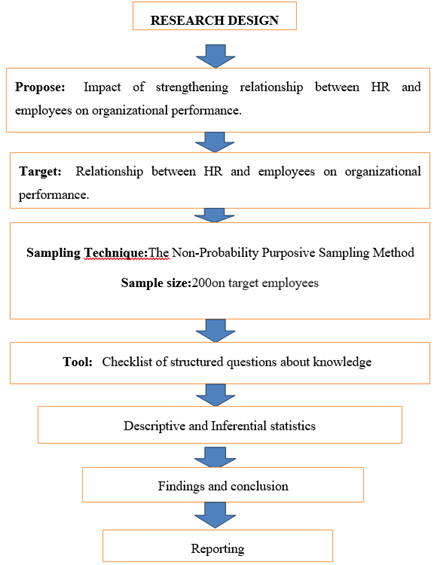
organizational performance. As a visual aid, this image depicts the study
strategy.
|
Figure 1
|
|
Figure 1 Design of a Study
in Schematic Form |
Research Approach
Crucial to the
success of the undertaking is the study's methodology. Finding the most
effective research approach is reliant on the knowledge gained from this study
looks at how impact of strengthening relationship between HR and employees on
organizational performance by using survey research techniques. Data may be
collected by making use of pre-existing surveys. Over the course of the survey,
participants will have the option to choose between multiple-choice and
free-form items.
Research variables
The
characteristics, or variables, of each research subject are distinct from one
another. A suggestion would be to place a number on it. In this context, a
"variable" is anything that may be defined as changing or fluctuating
from one research on the Impact of strengthening relationship between HR and
employees on organizational performance.
Independent
Variable
HR Practices
Dependent
Variable
Organizational
performance
Mediator
Variable
Employee
performance
Sample and sample technique
Researcher
determined howstress affected performance on the job
by selecting a subset of a larger population using a sampling technique. Both
probability and non-probability sampling are widely used in the field of
statistics. This method is referred to as "probability sampling"
since it involves selecting workers at random from a pre-established pool of
possible responses. How stress influenced performance the workplace was
investigated in qualitative research that used a purposive sample technique.
Sources of the sample
This paper's study
relies on a major data collection. The following list provides a concise
overview:
Primary data
An online form
application is required since the only people who can provide primary data are
those working for the firm. The main data for this study came from
questionnaires.”
Secondary data
One definition of
a secondary data set is a data set that is built from a main data set. This
class contains a number of records. Primary sources include things like books
and journals, whereas secondary sources include things like the internet and
official government publications.
Methods and Tools used
Data was collected
by way of an online survey. In corporate settings, surveys are a typical way to
get information from teachers. A comprehensive evaluation was carried out using
a checklist to ascertain on the Impact of strengthening relationship between HR
and employees on organizational performance. We have selected 20 organization
in which 20 HR and 180 employees from various offices.
Statistical analysis
Data Analysis
Data analysis
allows one to derive conclusions from unstructured data. Data entry, editing,
and coding are all part of an initial data analysis that must be finished
before data preparation can begin. Accurate and efficient data analysis tools
are essential for their usefulness. A spreadsheet was used for the examination
of the study data. A numerical score was given to each participant's response
before it was recorded into a spreadsheet. We used SPSS for effective data
analysis and modeling.
In order to
examine the data in this research, the statistical program SPSS 22.0 was used.
Using methods like analysis of variance and percentage-based processes, we
examined the crucial data. The major topics of the research could be better
comprehended with the use of percentage analysis. One easy way to compare and
evaluate statistics is using percentages. This is a foolproof method of getting
your message out to a certain population. Gathering data allows for a more
accurate depiction of the current state of affairs. One way to make percentage
studies more visually appealing is to use graphs.”
Significance
level: There was a
predetermined statistical significance threshold. To begin with, the value of
0.05 is used.
Results
The study aimed to
examine the impact of Human Resource (HR) practices on organizational
performance, with employee performance acting as a mediating factor. A sample
size of 200 respondents was analyzed to test the
proposed hypotheses using various statistical models, with results discussed
below:
|
Table 1 |
|
Table 1 Age Wise
Distribution of Respondents |
||
|
Age |
||
|
Frequency |
Percent |
|
|
20 -
25 years |
60 |
30.0 |
|
26 -
30 years |
75 |
37.5 |
|
31 -
35 years |
30 |
15.0 |
|
36 -
40 years |
24 |
12.0 |
|
Above
40 years |
11 |
5.5 |
|
Total |
200 |
100.0 |
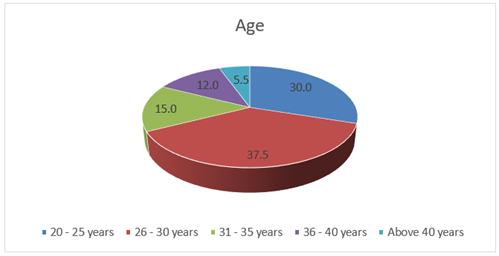
Age wise
distribution of respondents is presented in table above. In 20 – 25 years,
frequency is 60 and percentage is 30%. In 26 – 30 years, frequency is 75 and
percentage is 37.5%. In 31 – 35 years, frequency is 30 and percentage is 15%.
In 36 – 40 years, frequency is 24 and percentage is 12%. In above 40 years,
frequency is 60 and percentage is 30%.
|
Graph 1
|
|
Graph 1 Graphical Representation of Age Wise
Distribution of Respondent |
|
Table 2 |
|
Table 2 Gender Wise
Distribution of Respondents |
||
|
Gender |
||
|
Frequency |
Percent |
|
|
Male |
143 |
71.5 |
|
Female |
57 |
28.5 |
|
Total |
200 |
100.0 |
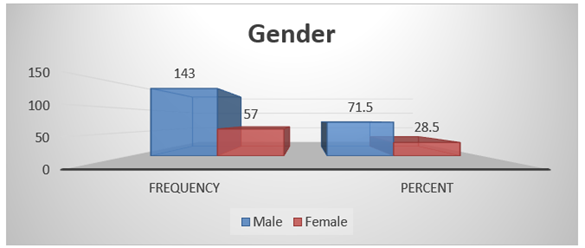
Gender wise
distribution of respondents is presented in table above. There are 143 male and
57 female are participated in this study, whose percentage is 71.5% and 28.5%
respectively.
|
Graph 2
|
|
Graph 2 Graphical
Representation of Gender Wise Distribution of Respondents |
|
Table 3 |
|
Table 3 Years of Experience of Respondents |
||
|
Years
of Experience in the Organization |
||
|
Frequency |
Percent |
|
|
Less
than 1 year |
41 |
20.5 |
|
1-3
years |
96 |
48 |
|
4-6
years |
45 |
22.5 |
|
Above
6 years |
18 |
9 |
|
Total |
200 |
100 |
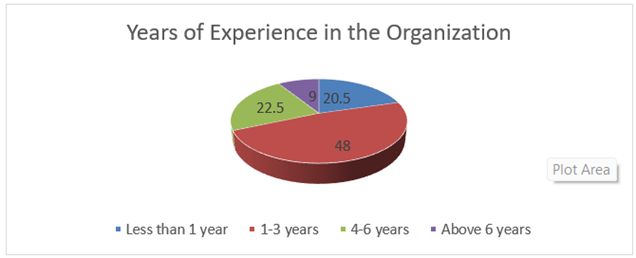
Years of
Experience of respondents is presented in table above. In Less than 1 year,
frequency is 41 and percentage is 20.5%. In 1 -3 years, frequency is 96 and
percentage is 48%. In 4-6 years, frequency is 45 and percentage is 22.5%. In
above 6 years, frequency is 18 and percentage is 9%.
|
Graph 3
|
|
Graph 3 Graphical Representation of Years of
Experience of Respondents |
|
Table 4 |
|
Table 4 Departmentof respondents |
||
|
Department |
||
|
Frequency |
Percent |
|
|
HR |
20 |
10.0 |
|
Marketing |
71 |
35.5 |
|
Finance |
42 |
21.0 |
|
IT |
67 |
33.5 |
|
Total |
200 |
100.0 |
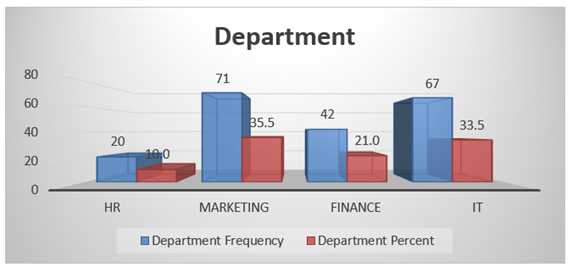
Department of
respondents is presented in table above. There are 20 HR, 71 marketing
executives, 42 executives, 67 IT professionals are incluede
in this study, whose percentage are 10%, 35.5%, 21% and 33.5% respectively.
|
Graph 4
|
|
Graph 4 Graphical
Representation of Department of Respondents |
Hypothesis testing
Hypothesis 1: There is no significant impact of Human
Resource (HR) practices on organizational performance, with a specific focus on
employee performance as a mediating factor.
Model
Y: Organisational performance
X: HR practices
M: Employee performance
SampleSize: 200
|
Table 5 |
|
Table 5 |
|
OUTCOME VARIABLE: |
|
Employee performance |
|
Model Summary |
|
R R-sq MSE F df1 df2 p |
|
.7789 .6067
20.9062 305.3755 1.0000
198.0000 .0000 |
|
Model |
|
coeff
se t p LLCI ULCI |
|
constant 3.6953 1.1807 3.1297 .0020 1.3669 6.0238 |
|
HR practices .6625 .0379
17.4750 .0000 .5877 .7372 |
|
OUTCOME VARIABLE: |
|
Organizational
performance |
|
Model Summary |
|
R R-sq MSE F df1 df2 p |
|
.7153 .5117
26.9285 103.2076 2.0000
197.0000 .0000 |
|
Model |
|
coeff
se t p LLCI ULCI |
|
constant 8.1801 1.3728 5.9588 .0000 5.4729
10.8874 |
|
VAR00016 .4928 .0686 7.1840 .0000 .3576 .6281 |
|
VAR00025 .1781 .0807 2.2078 .0284 .0190 .3371 |
|
DIRECT AND INDIRECT EFFECTS OF X ON Y |
|
Direct effect of X on
Y |
|
Effect se t p LLCI ULCI |
|
.4928 .0686 7.1840 .0000 .3576 .6281 |
|
Indirect effect(s) of
X on Y: |
|
Effect BootSEBootLLCIBootULCI |
|
VAR00025 .1180 .0553 .0052 .2293 |
R-squared =
0.6067: HR practices account for 60.67% of the variance in employee
performance, indicating a substantial impact size.F =
305.3755, p < .001: The model demonstrates statistical significance,
indicating that HR policies have a substantial effect on employee performance.The coefficient of HR practices (X) is 0.6625,
with p < .001: A 1 unit increase in HR practices corresponds to a 0.6625
unit increase in employee performance, indicating a strong and substantial
positive correlation.
R-squared =
0.5117: Human resource practices and employee performance collectively account
for 51.17% of the variance in organizational performance.F
= 103.2076, p < 0.001: This model is statistically significant as well. HR
Practices (X): The coefficient of 0.4928 shows that the HR practices have a
direct, positive impact on organizational performance. Every unit change in the
HR practices increases the organizational performance by 0.4928 units with a
p-value equal to 0.0000, which indicates a very significant impact. Employee
Performance (M): The coefficient is 0.1781. This implies that with an increase
in the performance of employees by 1 unit, the performance of the organization
increases by 0.1781 units. The p-value of 0.0284 signifies that this link is
statistically significant at the 95% confidence level.
Direct Effect of HR Practices on Organizational Performance
The direct effect
is 0.4928 (p <.001) with a 95% confidence interval of 0.3576, 0.6281
indicating that the direct effect of HR practices on organizational performance
is significant.
Indirect Effect of HR Practices on Organizational Performance through Employee Performance:
The indirect
effect is 0.1180, accompanied by a 95% bootstrap confidence range of [0.0052,
0.2293]. This is because there is no zero within the confidence range, which
means that the indirect effect is statistically significant. This indicates
that employee performance somewhat mediates the connection between HR practices
and organizational performance.
The human resource
practices have a significant direct impact on organizational performance. The
large positive value of the correlation between HR practices and organizational
performance (direct effect = 0.4928, p < .001) shows that improvements in HR
practices and policies could directly lead to the success of the organization.
The HR procedures and the organizational performance are mediated by employee
performance. The significant indirect effect (0.1180, 95% CI [0.0052, 0.2293])
shows that employee performance is a partial mediator. The HR strategies
influence organizational success in a segment that is expressed in the form of
employee performance. The null hypothesis (HR practices do not significantly
affect the organizational performance, with performance of the employees as a
mediator) is rejected.
Hypothesis 2: There is no significant relationship between
HR practice, organizational performance and employee performance.
|
Table 6 |
|
Table 6 Correlations |
||||
|
HR
practices |
Employee
performance |
organizational
performance |
||
|
HR
practices |
Pearson
Correlation |
1 |
.779 |
.707 |
|
Sig.
(2-tailed) |
.000 |
.000 |
||
|
N |
200 |
200 |
200 |
|
|
Employee
performance |
Pearson
Correlation |
.779 |
1 |
.619 |
|
Sig.
(2-tailed) |
.000 |
.000 |
||
|
N |
200 |
200 |
200 |
|
|
organizational
performance |
Pearson
Correlation |
.707 |
.619 |
1 |
|
Sig.
(2-tailed) |
.000 |
.000 |
||
|
N |
200 |
200 |
200 |
|
|
.
Correlation is significant at the 0.01 level (2-tailed).” |
||||
The relationship
between the HR practices, employee performance and organizational performance
is discussed in the above table where the sig. value of all variables is 0.00
signifies significant relationship.
Null hypothesis
rejected
Conclusion
This study
explored the role of Human Resource (HR) practices on the performance of an
organization whereby employee performance acted as an intermediate. The primary
results suggest that HR practices have a significant impact on performance of
the employee and the organisation. HR practices have direct and indirect impact
on organizational outcomes by enhancing employee performance. The research
revealed that there is a direct positive positive
impact of HR practices on organizational performance. It means that those firms
that have better HR practices, such as recruiting, training, performance
management, and employee engagement, will more likely have improvements in
their overall performance. The mediating nature of employee performance was confirmed and it implies that the positive impact of HR
strategies on organizational success can be explained by the positive changes
in the job performance of the employees. Companies that focus on workforce
growth and well-being will most likely achieve high performance due to a more
committed and efficient workforce. Great positive correlations were observed
among the HR practices, employee performance, and organizational performance,
which implies that the mentioned factors are interrelated. Improvement of HR
processes is not only directly related to better performance of the employees,
but also directly to the better organizational performance.
Suggestions
·
Organizations
ought to allocate resources towards training and development initiatives that
correspond with workers' professional aspirations and organizational aims.
Ongoing learning opportunities enhance work performance and engagement.
·
Create a
constructive work environment that prioritizes transparent communication,
inclusion, and equilibrium between professional and personal life. An
encouraging workplace fosters employee contentment, hence improving
performance.
·
Ensure
that human resources methods are congruent with overarching organizational
goals. Human Resources policies must be formulated to directly enhance
organizational performance by promoting employee efficiency, satisfaction, and
retention.
·
Organizations
must regularly evaluate the efficacy of their HR strategies via employee
feedback, performance assessments, and key performance indicators (KPIs).
Consistent evaluation will facilitate the identification of improvement areas
and guarantee that HR methods continue to effectively enhance performance.
·
Emphasis
on recruiting individuals whose values and competencies correspond with the
objectives of the firm. Maintaining personnel via competitive remuneration,
professional advancement opportunities, and a nurturing workplace will result
in sustained organizational performance.
ACKNOWLEDGMENTS
None.
REFERENCES
Asfahani, A. (2021). The Impact of Modern Strategic Human Resources Management Models on Promoting Organizational Agility. Academy of Strategic Management Journal.
Bakator, M., Petrović, N., Borić, S., and Đalić, N. (2019). Impact of Human Resource Management on Business Performance: A Review of Literature. Journal of Engineering Management and Competitiveness. https://doi.org/10.5937/jemc1901003b
Bannya, A. R., Bainbridge, H. T. J., and Chan-Serafin, S. (2023). HR Practices and Work Relationships: A 20-Year Review of Relational HRM Research. Human Resource Management. https://doi.org/10.1002/hrm.22151
Brito, R., and Oliveira, L. (2016). The Relationship Between Human Resource Management and Organizational Performance. Brazilian Business Review. https://doi.org/10.15728/bbr.2016.13.3.5
Halid, H., Yusoff, Y. M., and Somu, H. (2020). The Relationship Between Digital Human Resource Management and Organizational Performance. Advances in Economics, Business and Management Research. https://doi.org/10.2991/aebmr.k.200514.022
Hannis Ansah, R., Osei, J., Sorooshian, S., and Aikhuele, D. O. (2018). Importance of Employer–Employee Relationship Towards the Growth of a Business. Quality - Access to Success.
Importance of Employee Relations for the Management of Organization. (2022). Central European Management Journal. https://doi.org/10.57030/23364890.cemj.30.4.265
Kehoe, R. R., and Wright, P. M. (2013). The Impact of High-Performance Human Resource Practices on Employees' Attitudes and Behaviors. Journal of Management. https://doi.org/10.1177/0149206310365901
Kim, Y. (2021). Building Organizational Resilience Through Strategic Internal Communication and Organization–Employee Relationships. Journal of Applied Communication Research. https://doi.org/10.1080/00909882.2021.1910856
Kirpik, G. (2020). The Concept of Employee's Happiness in Human Resources Management: A Systematic Literature Review. Business and Management Studies: An International Journal. https://doi.org/10.15295/bmij.v8i3.1517
Maheshwari, S. K., and Yadav, J. (2019). The Role of HR in Leadership Development. Development and Learning in Organizations. https://doi.org/10.1108/DLO-11-2018-0141
Martins, A., Martins, I., and Pereira, O. (2016). Challenges Enhancing Social and Organizational Performance. In Handbook of Research on Human Resources Strategies for the New Millennial Workforce. https://doi.org/10.4018/978-1-5225-0948-6.ch002
Murugan, B., and Francifca, P. (2019). A Study on Employee Relationship Management in Retail Sector in Trichy. South Asian Journal of Marketing and Management Research. https://doi.org/10.5958/2249-877X.2019.00015.8
Ogbonnaya, C., and Aryee, S. (2022). HRM Practices, Employee Well-Being, and Organizational Performance. In Employee Well-Being and Organizational Performance. https://doi.org/10.1007/978-3-030-29010-8_17
Salman, M., Anwar, I., Ganie, S. A., and Saleem, I. (2024). Impact of Human Resource Management Practices on Organizational Performance: Evidence from the Indian Banking Industry. Management and Labour Studies. https://doi.org/10.1177/0258042X231187224
Shiri, S. (2012). Strategic Role of HR Audit in Organizational Effectiveness. Journal of Management and Public Policy.
Turi, J. A., Khastoori, S., Sorooshian, S., and Campbell, N. (2022). Diversity Impact on Organizational Performance: Moderating and Mediating Role of Diversity Beliefs and Leadership Expertise. PLoS ONE. https://doi.org/10.1371/journal.pone.0270813
Van De Voorde, K., and Beijer, S. (2015). The Role of Employee HR Attributions in the Relationship Between High-Performance Work Systems and Employee Outcomes. Human Resource Management Journal. https://doi.org/10.1111/1748-8583.12062
Widarmanti, T., Prasetio, A. P., and Saragih, R. (2022). The Link Between Effective Human Resource Practices and Employee Engagement with Perceived Organizational Support as Mediation: A Case from Indonesia. Jurnal Manajemen dan Pemasaran Jasa. https://doi.org/10.25105/jmpj.v15i1.10042
|
|
 This work is licensed under a: Creative Commons Attribution 4.0 International License
© IJETMR 2014-2026. All Rights Reserved.