
|
|
|
|
Original Article
Examining the Role of Financial Literacy and Perceived Behavioral Control in Investment Decision-Making: Evidence from Gen Z and Millennials
|
Surbhi 1*, Dr. A.K. Govilla 2 1 Research Scholar, Department
of Economics, Malwanchal University, Indore, India 2 Supervisor, Department of Economics, Malwanchal University, Indore, India |
|
|
|
ABSTRACT |
||
|
Investment decision-making has become increasingly important in contemporary financial environments, particularly among younger and middle-aged individuals who are exposed to expanding investment opportunities, digital financial platforms, and information-rich market environments. In this context, financial literacy and perceived behavioral control have emerged as two important determinants of how individuals evaluate, plan, and execute investment decisions. The present study examined the role of financial literacy and perceived behavioral control in investment decision-making among Gen Z and Millennial respondents. The study also considered the influence of social factors and subjective norms in order to provide a broader behavioral explanation of investment behaviour. Primary data were collected from 480 respondents through a structured questionnaire, and the relationships among the constructs were assessed through structural equation modeling. The findings indicate that financial literacy significantly improves investment decision-making both directly and indirectly through perceived behavioral control. The results further show that perceived behavioral control acts as an important explanatory mechanism, suggesting that financial knowledge alone is not sufficient unless individuals also feel confident in their capacity to make sound investment choices. The generation-wise analysis reveals that these relationships remain meaningful for both Gen Z and Millennials, although the relative influence of confidence and social inputs may vary across age groups. The study contributes to the growing literature on financial behaviour by highlighting that rational investment participation is shaped not only by knowledge but also by perceived capability and behavioural readiness. The findings offer useful implications for policymakers, educators, and financial service providers seeking to improve financial decision-making among emerging and active investor groups. Keywords: Financial Literacy, Perceived
Behavioral Control, Investment Decision-Making, Gen Z, Millennials,
Subjective Norms, Social Factors, Behavioral Finance |
||


INTRODUCTION
In recent years, the financial landscape has undergone
substantial transformation due to the rapid expansion of digital investment
platforms, growing access to financial information, and the increasing
participation of younger individuals in formal investment markets. Investment
is no longer viewed as an activity limited to highly experienced investors or
high-income groups; instead, it has become a more accessible and socially
visible financial behaviour across different demographic categories. Among the
most active and emerging cohorts in this changing environment are Generation Z
and Millennials, who are gradually shaping contemporary investment patterns
through their digital exposure, social connectivity, and evolving financial
aspirations. These generations are more likely to encounter financial products,
market information, and peer-driven investment narratives through online
channels, which makes understanding their investment decision-making process an
important academic and practical concern. Investment decision-making is a
complex process influenced by economic reasoning, psychological readiness,
social environment, and individual capability. Individuals do not make
investment decisions solely on the basis of available income or market
opportunities; rather, such decisions are often guided by knowledge, beliefs,
confidence, and the perceived ability to evaluate risk and return. In this
regard, financial literacy has received considerable scholarly attention as a
foundational determinant of sound financial behaviour. Financial literacy
generally refers to the knowledge, understanding, and skills needed to make
effective financial choices in matters such as saving, borrowing, budgeting,
and investing Atkinson and Messy (2012).
Prior studies have consistently suggested that financially literate individuals
are better equipped to compare alternatives, assess consequences, and make
rational financial decisions Amagir et al. (2020), Suresh (2024). In the context of investment,
financial literacy enables individuals to understand basic financial
instruments, evaluate market information, and reduce the likelihood of
impulsive or uninformed choices.
The present study is also guided by the understanding that
investment behavior is not formed in isolation.
Social surroundings, information channels, and perceived expectations from
important others can influence how individuals think about financial
participation. Social factors such as advice from friends, family discussions,
expert opinions, and digital media content often shape investment awareness and
confidence. Likewise, subjective norms may affect whether individuals perceive
investment as a socially supported or desirable activity. Research has shown
that normative and social influences can affect investment intention,
especially when individuals are uncertain or inexperienced and therefore more
likely to rely on external cues. However, the relative importance of such
influences may differ depending on whether investors rely more heavily on
internal capability or social reinforcement. This makes it important to examine
financial literacy and perceived behavioral control
not as isolated variables, but as part of a broader behavioural framework. The
relevance of this study is strengthened by the continued growth of youth and
middle-aged participation in financial markets, the increasing need for
responsible financial decision-making, and the policy emphasis on improving
financial capability across populations. In many developing and emerging
economies, access to financial services and investment opportunities is
expanding faster than financial understanding. As a result, individuals may
enter investment environments without sufficient literacy or behavioral preparedness. Such conditions can lead to weak
decisions, poor risk assessment, or dependence on unreliable sources of advice.
Existing research has examined the influence of financial literacy on
investment decisions in a variety of contexts, including India, Pakistan, and
other emerging economies Hussain et al. (2022),
Nag and Shah (2022), Arora and Chakraborty (2023). Other studies have explored
behavioural and social determinants, including attitudes, social influence,
risk tolerance, and self-efficacy Che Hassan, et al. (2024), Nepal et
al. (2023), Vaghela
et al. (2023). However,
comparatively fewer studies have focused specifically on the combined role of
financial literacy and perceived behavioral control
in explaining investment decision-making among both Gen Z and Millennials
within a single empirical framework.
The study makes a meaningful contribution in three ways.
First, it extends the literature on financial literacy by demonstrating that
the effect of knowledge on investment decisions should be interpreted alongside
perceived control. Second, it contributes to the behavioral
finance and TPB-based literature by examining how internal capability and
social influences jointly shape decision outcomes. Third, it offers a
generational perspective by focusing on Gen Z and Millennials, two cohorts that
are increasingly influential in the financial marketplace but may differ in
their motivations, confidence, and decision processes. By analyzing
these relationships using primary data collected from 480 respondents, the
study seeks to provide evidence that is both academically relevant and
practically useful.
The remainder of the paper is structured as follows. The
next section reviews the relevant literature on financial literacy, perceived behavioral control, social factors, subjective norms, and
investment decision-making. The subsequent section presents the research
methodology, including sample design, measures, and analytical approach. This
is followed by data analysis and results, including demographic analysis and
generation-wise structural model assessment. The final sections discuss the
findings, draw conclusions, and present practical implications for financial
educators, policymakers, and investment service providers.
Review of Literature
Financial Literacy and Investment
Decision-Making
Financial literacy is widely considered an important
factor in improving investment decision-making because it helps individuals
understand financial concepts, compare alternatives, judge risk and return, and
make more informed choices. A financially literate person is generally more
capable of selecting suitable investment avenues and avoiding impulsive or
poorly informed decisions. Earlier studies have shown that financial literacy
positively influences financial behaviour and investment choices. Atkinson and Messy (2012) explained that financial
literacy is a core requirement for sound financial decisions, while Hussain et al. (2022), Nag
and Shah (2022), Arora and Chakraborty (2023),
and Suresh (2024) also reported that better
financial literacy leads to better investment-related decisions. For Gen Z and
Millennials, this relationship is highly relevant because both groups are
increasingly exposed to market information, online financial platforms, and new
forms of investment participation.
H1: Financial literacy has a significant positive
effect on investment decision-making.
Financial Literacy and Perceived Behavioral Control
Perceived behavioral control
refers to an individual’s belief that he or she is capable of performing a
particular behaviour successfully. In the context of investment, it reflects
the confidence to identify investment opportunities, understand market
situations, and take appropriate financial action. Financial literacy
strengthens this sense of control because knowledge often increases confidence
and reduces uncertainty. Amagir et al. (2020) found that financial
knowledge is linked with financial self-efficacy and behaviour, while Do et al. (2024) showed that financial knowledge significantly improves
perceived behavioral control. This means that when
people know more about financial matters, they are more likely to feel capable
of making investment decisions. This is especially important for younger and
emerging investors, who may have awareness but still lack confidence in actual
market participation.
H2: Financial literacy has a significant positive
effect on perceived behavioral control.
Perceived Behavioral Control and Investment
Decision-Making
Perceived behavioral control
plays a major role in explaining whether individuals turn financial
understanding into real investment action. Even if people have knowledge, they
may not invest unless they feel able to manage risk, evaluate alternatives, and
act with confidence. The Theory of Planned Behavior
suggests that people are more likely to perform a behaviour when they believe
they have control over it. In financial decision-making, this means that
confidence and perceived ability become important drivers of investment
behaviour. Studies such as Do et al. (2024) and Che Hassan, et al. (2024) show that
control-related beliefs significantly influence financial intention and
decision behaviour. Therefore, perceived behavioral
control is expected to directly improve investment decision-making in the
present study.
H3: Perceived behavioral
control has a significant positive effect on investment decision-making.
Social Factors, Subjective Norms, and
Investment Decision-Making
Investment decisions are not shaped by personal knowledge
alone. They are also influenced by social surroundings such as family, friends,
expert opinions, media content, and digital communities. Social factors can
shape how individuals think about investment opportunities and can also affect
their confidence and willingness to participate. Subjective norms refer to the
perceived approval or pressure from important others regarding whether a
behaviour should be performed. Earlier studies have shown that social influence
and subjective norms can affect financial and investment intentions,
particularly among young investors and socially connected groups. Tabassum
et al. (2021) suggest that social
and normative pressures often influence financial behaviour, especially when
individuals depend on external guidance. Thus, social influences are important
in understanding investment decisions among Gen Z and Millennials.
H4: Social factors have a significant positive effect
on investment decision-making.
H5: Social factors have a significant positive effect
on perceived behavioral control.
H6: Social factors have a significant positive effect
on subjective norms.
H7: Subjective norms have a significant positive effect
on investment decision-making.
Mediating Role of Perceived Behavioral Control
The literature also suggests that financial literacy may
not influence investment decisions only in a direct way. It may also improve
investment decision-making indirectly by increasing perceived behavioral control. In other words, people who are
financially literate may develop stronger confidence in their own ability, and
that confidence may further improve their decisions. This mediation logic is
supported by studies that connect knowledge, self-efficacy, control beliefs,
and financial behaviour. Do et al. (2024) and Rangga et al.
indicate that behavioral control is an important
explanatory link between financial understanding and action. Therefore,
perceived behavioral control is expected to mediate
the relationship between financial literacy and investment decision-making in
this study.
H8: Perceived behavioral
control significantly mediates the relationship between financial literacy and
investment decision-making.
Conceptual Model of the Study
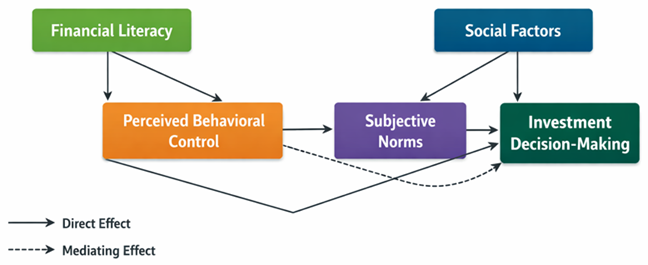
The conceptual model of the study proposes that financial literacy and social factors act as exogenous variables, while perceived behavioral control and subjective norms act as intervening variables, and investment decision-making acts as the final endogenous variable. The model assumes that financial literacy directly affects investment decision-making and also improves it indirectly through perceived behavioral control. At the same time, social factors are expected to influence investment decision-making both directly and indirectly through perceived behavioral control and subjective norms.
Figure 1
|
Figure 1 Conceptual Model of Investment Decision-Making |
Research Methodology
Research Design
The present study adopted a quantitative and descriptive
research design to examine the role of financial literacy and perceived behavioral control in investment decision-making among Gen
Z and Millennial respondents. The study was based on a structured survey
approach because the objective was to measure the relationships among
predefined constructs and test the proposed hypotheses in an empirical manner.
The design was suitable for analyzing how financial
literacy, social factors, perceived behavioral control,
and subjective norms influence investment decision-making.
Population and Sample
The target population of the study comprised individuals
belonging to Generation Z and Millennials. For the purpose of analysis, Gen Z
respondents were classified in the age group of 14–29 years, while Millennials
were classified in the age group of 30–45 years. A total of 480 valid responses
were included in the final analysis. The sample consisted of respondents from
different gender, income, and occupational categories, which helped ensure
diversity in the dataset and improved the suitability of the sample for
examining generational investment behaviour.
Data Collection and Instrument
The study was based on primary data collected through a
structured questionnaire. The questionnaire was designed to measure the major
constructs of the study, namely Financial Literacy (FL), Social Factors (SF),
Perceived Behavioral Control (PBC), Subjective Norms
(SN), and Investment Decision-Making (IDM). All items were measured using
close-ended statements. Most of the construct items were recorded on a
five-point Likert scale, ranging from lower agreement to higher agreement, while
the subjective norm items were measured on a three-point scale. The instrument
was prepared in a simple and understandable format so that respondents from
both generations could provide clear responses.
Variables of the Study
The study included Financial Literacy and Social Factors
as exogenous variables. Perceived Behavioral Control
and Subjective Norms were treated as mediating variables, while Investment
Decision-Making was considered the endogenous variable. Financial literacy
represented the respondents’ level of financial awareness and understanding.
Social factors reflected the influence of media, peers, family, and other
external information sources. Perceived behavioral
control measured the respondents’ confidence in their ability to take
investment-related actions. Subjective norms represented the role of perceived
social approval, while investment decision-making captured the extent to which
respondents made rational and structured investment choices.
Data Analysis Technique
The collected data were coded and analyzed
with the help of SPSS and SmartPLS 4. SPSS was used
for demographic analysis and descriptive statistics, while SmartPLS
4 was used for structural model assessment and hypothesis testing. The analysis
included demographic profiling of respondents, descriptive statistics of
construct items, and structural model analysis for testing direct and indirect
relationships among the variables. In addition, a generation-wise subgroup
analysis was conducted to compare the structural relationships separately for
Gen Z and Millennial respondents. This helped provide deeper insight into the
behavioural differences and similarities between the two cohorts.
Hypothesis Testing
The hypotheses of the study were tested through path
analysis and mediation analysis using SmartPLS 4. The
significance of the proposed relationships was examined through path
coefficients, t-statistics, and p-values. Relationships with significant
p-values were accepted, while statistically insignificant relationships were
rejected. The mediating role of perceived behavioral
control and subjective norms was also assessed to determine whether these
variables transmitted the effects of financial literacy and social factors on
investment decision-making.
Ethical Considerations
The study was conducted on the basis of voluntary
participation. Respondents were approached only for academic purposes, and the
information collected from them was kept confidential. The responses were used
strictly for research analysis, and no personal identity of any respondent was
disclosed in the study.
Data Analysis and Results
Demographic Profile
Table 1
|
Table 1 Demographic Profile of Respondents (N = 480) |
|||
|
Variable |
Category |
Frequency |
Percent |
|
Gender |
Male |
233 |
48.5 |
|
Female |
247 |
51.5 |
|
|
Age Group |
14–29 years (Gen
Z) |
270 |
56.3 |
|
30–45 years
(Millennials) |
210 |
43.8 |
|
|
Income |
Low Income |
186 |
38.8 |
|
Middle
Income |
156 |
32.5 |
|
|
High Income |
138 |
28.7 |
|
|
Occupation |
Student |
114 |
23.8 |
|
Private Job |
129 |
26.9 |
|
|
Self-Employed |
129 |
26.9 |
|
|
Unemployed |
108 |
22.5 |
|
|
Source: Primary
data compiled by the researcher. |
|||
The study is based
on 480 respondents. Female respondents (51.5%) are slightly higher than male
respondents (48.5%). In terms of age, 56.3% belong to Gen Z and 43.8% belong to
the Millennial group. Regarding income, 38.8% fall in the low-income category,
32.5% in the middle-income category, and 28.7% in the high-income category. The
occupational profile shows a balanced spread, with 23.8% students, 26.9%
private employees, 26.9% self-employed respondents, and 22.5% unemployed
respondents. This demographic composition indicates that the sample is
adequately diverse and suitable for studying investment decision-making among
Gen Z and Millennials.
Table 2
|
Table 2 Descriptive
Statistics |
|||||
|
N |
Minimum |
Maximum |
Mean |
Std. Deviation |
|
|
FL1 |
480 |
1.00 |
5.00 |
3.5000 |
.78344 |
|
FL2 |
480 |
1.00 |
5.00 |
3.4833 |
.77523 |
|
FL3 |
480 |
1.00 |
5.00 |
3.4938 |
.78075 |
|
FL4 |
480 |
1.00 |
5.00 |
3.4687 |
.80646 |
|
SF1 |
480 |
1.00 |
5.00 |
3.3021 |
.79034 |
|
SF2 |
480 |
1.00 |
5.00 |
3.3417 |
.78340 |
|
SF3 |
480 |
1.00 |
5.00 |
3.3083 |
.78126 |
|
SF4 |
480 |
1.00 |
5.00 |
3.3063 |
.81987 |
|
PBC1 |
480 |
1.00 |
5.00 |
2.7750 |
.79363 |
|
PBC2 |
480 |
1.00 |
5.00 |
2.7750 |
.75867 |
|
PBC3 |
480 |
1.00 |
5.00 |
2.7688 |
.82918 |
|
SN1 |
480 |
1.00 |
3.00 |
1.4479 |
.54962 |
|
SN2 |
480 |
1.00 |
3.00 |
1.4479 |
.56461 |
|
SN3 |
480 |
1.00 |
3.00 |
1.4750 |
.57741 |
|
IDM1 |
480 |
2.00 |
5.00 |
3.8792 |
.82875 |
|
IDM2 |
480 |
2.00 |
5.00 |
3.8688 |
.82590 |
|
IDM3 |
480 |
2.00 |
5.00 |
3.8854 |
.82333 |
|
IDM4 |
480 |
1.00 |
5.00 |
3.8625 |
.82615 |
|
IDM5 |
480 |
1.00 |
5.00 |
3.9000 |
.83404 |
|
Valid N (listwise) |
480 |
||||
|
Source: SPSS
output based on primary data. |
|||||
Table 2 indicates that the
items measuring Financial Literacy have mean values ranging from 3.4687 to
3.5000, suggesting that respondents generally possess a moderate level of
financial awareness and investment-related understanding. Among these items,
FL1 records the highest mean value of 3.5000, indicating that respondents tend
to believe that they have a reasonably good understanding of investment. The
standard deviations for these items remain below 1.00, which implies a moderate
but acceptable spread of responses. The Social Factors items show mean values
between 3.3021 and 3.3417. These values indicate that respondents moderately
rely on internet sources, media information, family, friends, and experts while
making investment decisions. Among the Social Factors items, SF2 reports the
highest mean, suggesting that internet and media-based financial information
have a relatively strong influence on respondents’ investment thinking. The
findings reflect the growing importance of digital information channels in financial
decision-making among younger and middle-aged investors. The Perceived Behavioral Control items record noticeably lower mean
scores, ranging from 2.7688 to 2.7750. This suggests that although respondents
may have some financial awareness, they are comparatively less confident about
their practical ability to identify profitable investments or act quickly in
stock-market settings. In other words, knowledge and confidence do not appear
to move at the same intensity, which strengthens the importance of including
Perceived Behavioral Control as a mediating construct
in the model. The Subjective Norms items register the lowest mean values,
between 1.4479 and 1.4750, on a three-point response range. These values
suggest that respondents are relatively less driven by social pressure or
social approval when thinking about stock market participation. However, since
the standard deviations remain low, the responses are fairly consistent. In
contrast, the Investment Decision-Making items produce high mean values ranging
from 3.8625 to 3.9000, indicating that respondents tend to compare investment
options, seek advice, set goals, and consider both risk and return in a
systematic manner. This pattern suggests that the sample demonstrates a
relatively rational and deliberate orientation toward investment behavior.
Generation-wise Structural Model Analysis
In order to obtain a deeper understanding of whether the
proposed conceptual model behaves similarly across the two generational
cohorts, the structural relationships were assessed separately for Gen Z and
Millennial respondents. This subgroup analysis is important because the study
is specifically concerned with understanding investment decision-making among
these two generations, which differ in terms of digital exposure, financial
experience, social environment, and life-stage responsibilities. The generation-wise
structural model assessment makes it possible to determine whether the pattern
of direct and indirect effects remains stable across cohorts or whether one
generation displays a meaningfully different investment decision process. Such
analysis adds analytical depth to the study and strengthens the interpretation
of the broader findings.
Structural Model Results for Gen Z
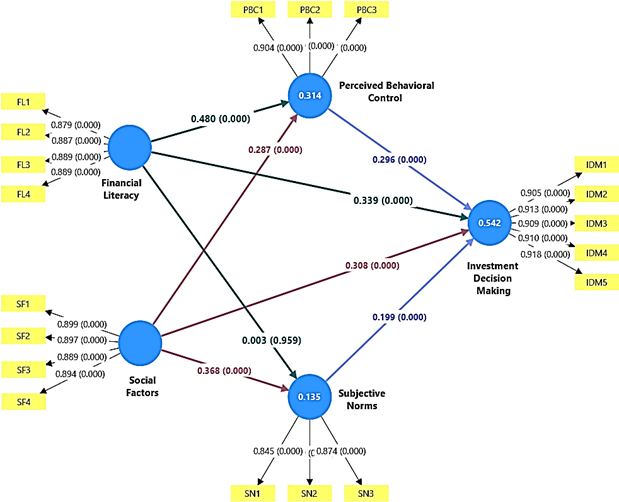
The Gen Z structural model results show a pattern that is largely consistent with the overall sample, while also highlighting the strong relevance of confidence-related mechanisms for younger respondents. Financial Literacy significantly influences both Investment Decision-Making and Perceived Behavioral Control among Gen Z, indicating that knowledge improves both decision quality and the perceived ability to act in financial contexts. However, Financial Literacy does not significantly affect Subjective Norms, which means that financial knowledge among this cohort does not directly translate into feelings of social approval regarding investment. Perceived Behavioral Control significantly affects Investment Decision-Making, confirming that confidence and action capability are particularly important for younger investors who may still be building practical financial experience. Social Factors significantly influence Investment Decision-Making, Perceived Behavioral Control, and Subjective Norms, suggesting that Gen Z respondents are strongly shaped by information environments, peer networks, and social reinforcement. Subjective Norms also significantly affect Investment Decision-Making, indicating that perceived approval from others contributes meaningfully to investment behaviour in this group. Overall, the Gen Z findings show that investment decisions are shaped by a combined influence of financial understanding, social exposure, confidence, and normative signals, though the route from financial literacy to social norms remains non-significant.
|
Figure 2
|
|
Figure 2 Structural Model of Investment Decision Making for Generation Z (Source: Smart PLS 4 software) |
Table 3
|
Table 3 Path Analysis and
Hypothesis Testing GEN Z |
|||||
|
Relationship |
Original Sample (O) |
STDEV |
T Statistics |
P Value |
Decision |
|
Financial Literacy → Investment Decision-Making |
0.339 |
0.048 |
7.124 |
0.000 |
H1a Supported |
|
Financial Literacy → Perceived Behavioral Control |
0.480 |
0.044 |
10.826 |
0.000 |
H2a Supported |
|
Financial Literacy → Subjective Norms |
0.003 |
0.061 |
0.051 |
0.959 |
H3a Not Supported |
|
Perceived Behavioral
Control → Investment Decision-Making |
0.296 |
0.049 |
6.086 |
0.000 |
H4a Supported |
|
Social Factors → Investment Decision-Making |
0.308 |
0.044 |
7.038 |
0.000 |
H5a Supported |
|
Social Factors → Perceived Behavioral Control |
0.287 |
0.048 |
5.972 |
0.000 |
H6a Supported |
|
Social Factors → Subjective Norms |
0.368 |
0.052 |
7.003 |
0.000 |
H7a Supported |
|
Subjective Norms → Investment
Decision-Making |
0.199 |
0.045 |
4.452 |
0.000 |
H8a Supported |
|
Source: SmartPLS
subgroup analysis for Gen Z. |
|||||
The Gen Z results in Table 3 reveal a pattern
largely similar to the overall model. Financial Literacy significantly affects
Investment Decision-Making (β = 0.339, p = 0.000) and Perceived Behavioral Control (β = 0.480, p = 0.000), thereby
supporting H1a and H2a. However, it does not significantly influence Subjective
Norms (β = 0.003, p = 0.959), leading to rejection of H3a. This indicates
that financial knowledge among Gen Z strengthens decision quality and
confidence, but not social-normative pressure. Perceived Behavioral
Control positively affects Investment Decision-Making (β = 0.296, p =
0.000), which supports H4a. Social Factors also significantly affect Investment
Decision-Making, Perceived Behavioral Control, and
Subjective Norms, supporting H5a, H6a, and H7a. Subjective Norms further
contribute positively to Investment Decision-Making (β = 0.199, p =
0.000), supporting H8a. Taken together, these results suggest that Gen Z
investment decisions are shaped by a combination of knowledge, social inputs,
confidence, and normative influence, although knowledge itself does not
directly produce normative pressure.
Table 4
|
Table 4 Mediating |
|||||
|
Relationship |
Original Sample (O) |
STDEV |
T Statistics |
P Value |
Decision |
|
Social Factors → Perceived Behavioral
Control → Investment Decision-Making |
0.085 |
0.021 |
4.125 |
0.000 |
H11a Supported |
|
Financial Literacy → Subjective Norms
→ Investment Decision-Making |
0.001 |
0.012 |
0.050 |
0.960 |
H10a Not Supported |
|
Financial Literacy → Perceived Behavioral Control → Investment Decision-Making |
0.142 |
0.027 |
5.232 |
0.000 |
H9a Supported |
|
Social Factors → Subjective Norms →
Investment Decision-Making |
0.073 |
0.019 |
3.816 |
0.000 |
H12a Supported |
|
Source: SmartPLS subgroup mediation output for Gen
Z. |
|||||
The mediation results for Gen Z indicate that Perceived Behavioral Control mediates the relationship between
Financial Literacy and Investment Decision-Making (β = 0.142, p = 0.000),
supporting H9a. Similarly, Social Factors significantly influence Investment
Decision-Making through Perceived Behavioral Control
(β = 0.085, p = 0.000), supporting H11a, and through Subjective Norms
(β = 0.073, p = 0.000), supporting H12a.
However, Subjective Norms do not mediate the relationship
between Financial Literacy and Investment Decision-Making for Gen Z (β =
0.001, p = 0.960), resulting in rejection of H10a. This means that for Gen Z,
financial knowledge improves investment outcomes primarily through enhanced
personal capability rather than through social expectation channels.
Table 5
|
Table 5 Coefficient of Determination (R²) |
||
|
Construct |
R² |
Adjusted R² |
|
Investment Decision-Making (IDM) |
0.542 |
0.538 |
|
Perceived Behavioral
Control (PBC) |
0.314 |
0.310 |
|
Subjective Norms (SN) |
0.135 |
0.133 |
|
Source: SmartPLS
subgroup analysis for Gen Z. |
||
The R² values for Gen Z show that the model explains 54.2
percent of the variance in Investment Decision-Making, 31.4 percent of the
variance in Perceived Behavioral Control, and 13.5
percent of the variance in Subjective Norms. Compared with the overall model,
the explanatory power for Investment Decision-Making is slightly higher in the
Gen Z subgroup, suggesting that the proposed framework is particularly suitable
for explaining the investment behavior of this
generation.
Discussion
The present study adopted a quantitative, descriptive, and
cross-sectional research design to examine the role of financial literacy and
perceived behavioral control in investment
decision-making among Gen Z and Millennial respondents. A survey-based approach
was considered suitable because the study aimed to empirically test the
relationships among behavioral and financial
constructs through measurable responses collected from a relatively large
number of participants. The focus on financial literacy and investment
behaviour is supported by earlier studies which have shown that financial
knowledge, self-efficacy, control, and behavioral
influences play an important role in shaping financial choices and investment
actions Amagir et al. (2020), Herawati
et al. (2018), Nepal et
al. (2023), Vaghela
et al. (2023). The target population
of the study consisted of individuals from Generation Z (14–29 years) and
Millennials (30–45 years), as these two cohorts represent active and emerging
participants in modern financial environments.
Previous studies have also emphasized that younger
generations are increasingly influenced by financial literacy, behavioral finance factors, and changing investment
attitudes in both traditional and digital contexts Moreno-Herrero
et al. (2018), Sajeev
et al. (2021), Widhiastuti et al. (2024). The study was based
on primary data, and a total of 480 valid responses were included in the final
analysis. The respondents belonged to different categories of gender, income,
and occupation, making the sample sufficiently diverse for analyzing
generational investment behaviour. Data were collected through a structured
questionnaire prepared in a simple and clear format to ensure that respondents
could understand the statements easily and respond accurately. The
questionnaire measured the main constructs of the study, namely Financial
Literacy (FL), Social Factors (SF), Perceived Behavioral
Control (PBC), Subjective Norms (SN), and Investment Decision-Making (IDM).
Most of the items were measured on a five-point Likert scale, while the items
related to subjective norms were measured on a three-point scale. The inclusion
of these constructs was grounded in prior literature which suggests that
financial literacy, social influences, and control-related beliefs are major
determinants of financial and investment behaviour Naiwen et al. (2021), Tabassum
et al. (2021), Che Hassan, et al. (2024), Do et al. (2024). In the conceptual
framework, financial literacy and social factors were treated as exogenous
variables, perceived behavioral control and
subjective norms were treated as mediating variables, and investment
decision-making was taken as the endogenous variable. Financial literacy
represented respondents’ understanding of financial concepts and investment
matters, while social factors represented the influence of peers, family,
media, and other external information channels.
Perceived behavioral control
referred to the level of confidence and perceived capability of respondents to
make and execute investment decisions, an idea supported by earlier research
highlighting the role of control, self-efficacy, and behavioral
readiness in financial action. Subjective norms reflected the social approval
or pressure perceived by respondents regarding investment behaviour, while
investment decision-making referred to the extent to which respondents compared
alternatives, evaluated risk and return, sought advice, and made rational
financial choices. After data collection, the responses were coded and analyzed using SPSS and SmartPLS
4. SPSS was used for demographic analysis and descriptive statistics, including
frequency, percentage, mean, minimum, maximum, and standard deviation values. SmartPLS 4 was used for structural model analysis, path
analysis, mediation analysis, and generation-wise subgroup analysis in order to
test the proposed relationships more comprehensively. The use of such model-testing
procedures is consistent with earlier studies examining financial literacy and
investment-related behavioural relationships. The hypotheses were tested
through path coefficients, t-statistics, p-values, and coefficient of
determination (R²) to assess both direct and indirect effects among the study
variables. In addition, separate structural analysis was conducted for Gen Z
and Millennial respondents to identify whether the relationships among the
constructs differed across the two generations.
The mediation role of perceived behavioral
control and subjective norms was also examined, particularly because prior
research indicates that financial knowledge often influences behavioural
intention and decision-making through control beliefs and internal confidence
rather than only through direct pathways. The study was conducted strictly for
academic purposes, participation was voluntary, and the confidentiality of the
respondents was maintained throughout the research process. Overall, the chosen
methodology was considered appropriate because it combined a structured survey
design, clearly defined constructs, adequate sample size, and suitable
statistical tools to examine the behavioural and financial determinants of
investment decision-making among Gen Z and Millennials in a comprehensive
manner.
Conclusion and Implications
The study concludes that financial literacy and perceived behavioral control are important determinants of investment
decision-making among Gen Z and Millennials. The findings show that respondents
with better financial knowledge are more likely to make rational and informed
investment decisions. However, knowledge alone is not sufficient unless
individuals also feel confident in their ability to understand market
conditions and take appropriate investment actions. In this context, perceived behavioral control plays a significant role by
strengthening the effect of financial literacy on investment decision-making.
The study also finds that social factors and subjective norms contribute to
investment behaviour, especially among younger respondents, but their influence
is weaker than the role of financial literacy and personal control. Overall,
the study establishes that investment decisions are shaped by a combination of
financial understanding, confidence, and social influence, with perceived behavioral control acting as an important link between
knowledge and action.
Implications of the Study
·
For policymakers: Financial awareness programs
should focus not only on knowledge but also on building confidence for
practical investment decisions.
·
For educational institutions: Colleges and
universities should introduce financial literacy and investment education in a
more practical form.
·
For financial service providers: Investment
platforms should be made simple, clear, and user-friendly for Gen Z and
Millennial investors.
·
For young investors: Better financial knowledge
can improve decision quality, but confidence and control are equally important.
·
For researchers: The study provides scope for
further research on behavioral and generational
factors affecting investment decisions.
ACKNOWLEDGMENTS
None.
REFERENCES
Achtziger, A.,
Hubert, M., Kenning, P., Raab, G., and Reisch, L. (2015). Debt Out Of Control: The Links
Between Self-Control, Compulsive Buying, And Real Debts. Journal of Economic
Psychology, 49, 141–149. https://doi.org/10.1016/j.joep.2015.04.003
Alkaraan, F.,
Elmarzouky, M., Hussainey, K., and Venkatesh, V. G. (2023). Sustainable Strategic Investment
Decision-Making Practices In UK Companies: The Influence Of Governance
Mechanisms On Synergy Between Industry 4.0 And Circular Economy. Technological
Forecasting and Social Change, 187, 122187. https://doi.org/10.1016/j.techfore.2022.122187
Amagir, A., Groot,
W., van den Brink, H. M., and Wilschut, A. (2020). Financial Literacy Of High School Students
In The Netherlands: Knowledge, Attitudes, Self-Efficacy, And Behavior.
International Review of Economics Education, 34, 100185. https://doi.org/10.1016/j.iree.2020.100185
Che Hassan, N.,
Abdul-Rahman, A., Ab. Hamid, S. N., and Mohd Amin, S. I. (2024). What Factors Affecting Investment
Decision? The Moderating Role Of Fintech Self-Efficacy. PLOS ONE, 19(4),
e0299004. https://doi.org/10.1371/journal.pone.0299004
Do, H. L., Vu, T. M.
P., Vu, N. M., Nguyen, D. T., and Tran, T. V. (2024). The Mediating Role Of Perceived
Behavioral Control On The Relationship Between Financial Knowledge And Saving
Intention: A Study Of Vietnamese University Students. Human Behavior,
Development and Society, 25(1). https://doi.org/10.62370/hbds.v25i1.270883
Harahap,
N. (2020).
Penelitian Kualitatif.
Herawati, N. T., Candiasa, I. M.,
Yadnyana, I. K., and Suharsono, N. (2018). Factors That Influence Financial Behavior
Among Accounting Students In Bali. International Journal of Business
Administration, 9(3), 30. https://doi.org/10.5430/ijba.v9n3p30
Moreno-Herrero, D.,
Salas-Velasco, M., and Sánchez-Campillo, J. (2018). Factors That Influence The Level Of
Financial Literacy Among Young People: The Role Of Parental Engagement And
Students’ Experiences With Money Matters. Children and Youth Services Review,
95, 334–351. https://doi.org/10.1016/j.childyouth.2018.10.042
Naiwen, L., Wenju,
Z., Mohsin, M., Rehman, M. Z. U., Naseem, S., and Afzal, A. (2021). The Role Of Financial Literacy And
Risk Tolerance: An Analysis Of Gender Differences In The Textile Sector Of
Pakistan. Industria Textila, 72(3), 300–308. https://doi.org/10.35530/IT.072.03.202023
Nasution,
A. F. (2023).
Metode Penelitian Kualitatif.
Nepal, R., Rajopadhyay, P.,
Rajopadhyay, U., and Bhattarai, U. (2023). Interplay Of Investor Cognition, Financial
Literacy, And Neuroplasticity In Investment Decision Making: A Study Of
Nepalese Investors. Journal of Business and Social Sciences Research, 8(2),
51–76. https://doi.org/10.3126/jbssr.v8i2.62133
Sajeev,
K. C., Afjal, M., Spulbar, C., Birau,
R., and Florescu, I. (2021). Evaluating The Linkage Between
Behavioural Finance And Investment Decisions Amongst Indian Gen Z Investors Using Structural
Equation Modeling. Revista de Stiinte
Politice, 72, 41–59.
Strömbäck, C.,
Lind, T., Skagerlund, K., Västfjäll, D., and Tinghög, G. (2017). Does Self-Control Predict Financial
Behavior And Financial Well-Being? Journal of Behavioral and Experimental
Finance, 14, 30–38. https://doi.org/10.1016/j.jbef.2017.04.002
Sulistyowati, A., Rianto, M. R.,
Handayani, M., and Bukhari, E. (2022). Pengaruh Financial Literacy, Return Dan
Resiko Terhadap Keputusan Investasi Generasi Milenial Islam Di Bekasi. Jurnal
Ilmiah Ekonomi Islam, 8(2), 2253. https://doi.org/10.29040/jiei.v8i2.5956
Tabassum,
S., Soomro, I. A., Ahmed, S., Alwi, S. K. K., and Siddiqui, I. H. (2021). Behavioral
Factors Affecting
Investment Decision-Making Behavior
In A Moderating Role Of
Financial Literacy: A Case Study Of Local Investors
Of Pakistan Stock Market. International Journal of Management, 12(2), 321–354.
Twumasi, M. A.,
Jiang, Y., Wang, P., Ding, Z., Frempong, L. N., and Acheampong, M. O. (2022). Does Financial Literacy Inevitably
Lead To Access To Finance Services? Evidence From Rural Ghana. Ciência Rural,
52(3), e20210112. https://doi.org/10.1590/0103-8478cr20210112
Vaghela, P. S.,
Kapadia, J. M., Patel, H. R., and Patil, A. G. (2023). Effect Of Financial Literacy And
Attitude On Financial Behavior Among University Students. Indian Journal of
Finance, 17(8), 43–57. https://doi.org/10.17010/ijf/2023/v17i8/173010
Widhiastuti, R. N., Harianti, A., Suryowati, B., and Suzuda, F. (2024). Penyuluhan Literasi Keuangan Untuk Mencapai Financial Freedom Bagi Gen-Z. Swadimas: Jurnal Pengabdian Kepada Masyarakat, 2(1), 8–12. https://doi.org/10.56486/swadimas.vol2no1.390
|
|
 This work is licensed under a: Creative Commons Attribution 4.0 International License
© IJETMR 2014-2026. All Rights Reserved.