
|
|
|
|
Case Study
Assessing the Impact of Pradhan Mantri Jan Dhan Yojana (PMJDY) on Rural Digital Adoption: A Secondary Data Analysis
|
Mallikarjun
K. Chougala 1, Dr. Arun Babu Angadi 2 1 Assistant Professor, JSPM
University, Pune, Maharashtra, India 2 Assistant Professor, Karnataka Janapada
University, Gotagodi, Shiggaon, Haveri, Karnataka, India |
|
|
|
ABSTRACT |
||
|
Pradhan Mantri Jan Dhan Yojana (PMJDY) is the flagship financial inclusion programme of the Government of India and the foundation of the Jan Dhan–Aadhaar–Mobile (JAM) trinity. Over the last decade, PMJDY has expanded basic savings bank accounts to more than 55 crore beneficiaries, with around two-thirds of accounts located in rural and semi-urban areas. This paper assesses whether the rapid scaling-up of PMJDY has been associated with deeper digital adoption in rural India. Using exclusively secondary data from official sources such as the Ministry of Finance, Reserve Bank of India, Parliament documents, and the National Payments Corporation of India, supplemented by recent survey evidence and academic literature, the study constructs a consolidated data set for the period 2015–2025. Descriptive statistics and trend analysis are used to track the evolution of PMJDY accounts, deposits, RuPay card issuance and rural account shares alongside digital payment indicators such as the RBI Digital Payments Index and aggregate digital transaction volume. A simple correlation analysis for 2020–2025 indicates a very strong positive association between the growth in PMJDY accounts and the RBI-DPI, suggesting that expansion of basic accounts has moved broadly in tandem with the deepening of digital payments infrastructure and usage. However, evidence from rural UPI and AePS usage and from recent survey-based studies shows that gaps in digital literacy, connectivity and trust still constrain active digital use, especially among older and less educated rural account holders. The paper concludes that PMJDY has been a necessary but not sufficient condition for rural digital adoption; complementary investments in digital and financial literacy, cybersecurity safeguards and last-mile infrastructure remain critical for converting access into sustained usage. Keywords: PMJDY, Financial inclusion, Digital
payments, Rural India |
||


INTRODUCTION
Financial
inclusion has emerged as a core pillar of India’s inclusive growth strategy
over the past decade, with digital technology playing an increasingly central
role in extending formal financial services to underserved populations.
Launched in August 2014, Pradhan Mantri Jan Dhan Yojana (PMJDY) sought to
provide at least one basic savings bank account for every household, along with
access to remittances, credit, insurance and pension services at affordable
cost. On inauguration day alone, about 1.8 crore bank accounts were opened, a
feat recognised by the Guinness World Records, and by March 2015 the number of
PMJDY accounts had reached around 14.7 crore. Over time, the scheme has grown
into one of the world’s largest financial inclusion programmes, with more than
50 crore accounts by August 2023 and over 55 crore by
mid-2025, supported by a strong focus on rural and semi-urban geographies and
women beneficiaries.
Parallel to this
expansion in account ownership, India has witnessed a remarkable rise in
digital payments. The Reserve Bank of India’s Digital Payments Index (RBI-DPI),
which uses March 2018 as a base value of 100, rose to 395.57 by March 2023,
445.50 by March 2024 and 493.22 by March 2025, reflecting a more than fourfold
increase in digital payment activity since 2018. Over the same period, total
retail digital transactions expanded from about 2,338 crore
in 2018–19 to more than 16,000 crore transactions in 2023–24, driven
predominantly by the Unified Payments Interface (UPI), Aadhaar-enabled Payment
Systems (AePS) and card-based payments. These developments have positioned
India as a global leader in real-time digital payments and have redefined the
way households and micro-entrepreneurs transact.
Rural India has
been at the heart of both PMJDY and the broader digital payments revolution.
Approximately two-thirds of PMJDY accounts are located in rural and semi-urban
areas, and a substantial proportion of women beneficiaries reside in villages
and small towns. Business Correspondent (BC) networks, micro-ATMs, RuPay debit
cards and mobile-based platforms such as UPI and BHIM have created new
possibilities for accessing cash and conducting digital transactions in
locations that previously lacked brick-and-mortar banking outlets. Yet,
multiple studies and field reports highlight that access to an account does not
necessarily translate into regular, active digital usage. Account dormancy, low
transaction frequencies, patchy connectivity, and persistent gaps in digital
and financial literacy, especially among older and low-income rural households,
continue to constrain the transformative potential of digital finance.
Against this
backdrop, the question of whether PMJDY has primarily opened bank accounts or
whether it has also been a significant enabler of rural digital adoption
assumes policy relevance. While government documents emphasise the role of the
JAM trinity in facilitating Direct Benefit Transfers (DBT) and digital
payments, the empirical linkage between PMJDY expansion and measurable digital
adoption indicators remains under-explored. This paper addresses that gap by
systematically analysing secondary data on PMJDY account growth, deposits and
RuPay card issuance, alongside national and rural-focused metrics of digital
payments, with a particular focus on the period 2015–2025.
Research Problem
Most evaluations
of PMJDY emphasise its success in rapidly expanding basic bank account
ownership, particularly among rural and low-income households. However, far
less attention has been paid to whether these accounts are effectively
leveraged as gateways into the digital financial ecosystem. National-level
statistics on UPI, AePS and card usage show strong growth, but they rarely
disaggregate outcomes by type of account or explicitly link patterns of digital
adoption to PMJDY beneficiaries. At the same time, policy documents and
parliamentary discussions highlight concerns about account dormancy,
cybersecurity risks and uneven digital literacy among Jan Dhan account holders,
especially in rural areas.
The core research
problem addressed in this paper is therefore to assess the extent to which the
expansion of PMJDY has been associated with indicators of rural digital
adoption. Rather than attempting to establish strict causality, the study seeks
to map co-movements between PMJDY account metrics and digital payment
indicators, and to triangulate them with evidence from survey-based and
qualitative studies on rural digital usage. In doing so, it aims to move beyond
a binary view of access versus non-access and to shed light on how far PMJDY
has contributed to meaningful, digitally enabled financial inclusion.
Objectives
The specific
objectives of the study are as follows:
·
To trace
the growth of PMJDY accounts, deposits, RuPay debit cards and rural account
shares between 2015 and 2025 using secondary data.
·
To
analyse the evolution of key digital payment indicators in India—particularly
the RBI Digital Payments Index and aggregate digital transaction volumes—over
the same period.
·
To
examine secondary evidence on digital payment adoption in rural India,
including UPI and AePS usage, and relate these patterns to the PMJDY ecosystem.
·
To
synthesise insights from recent empirical and conceptual studies, including the
work of Dr. Shailesh Kediya and co-authors, on digital platforms, AI-driven
financial services and user behaviour, and draw implications for PMJDY-linked
digital adoption.
Literature Review
The literature on
PMJDY can broadly be grouped into three strands: evaluations of financial
inclusion outcomes, analyses of digital payment systems and rural inclusion,
and studies on technology-enabled financial services.
The first strand
focuses on the extent to which PMJDY has improved access to formal financial
services and altered household behaviour. Gupta
(2023) documents the historical evolution of PMJDY
and concludes that the scheme has been particularly effective in rural areas
because of the deeper penetration of public sector banks and Business
Correspondent networks. Gupta
and Gupta (2026) undertake a micro-level analysis in
Firozabad district and find that PMJDY has increased savings, reduced reliance
on informal moneylenders and facilitated timely receipt of subsidies through
Direct Benefit Transfer, especially for women beneficiaries. Several
commentaries from the Ministry of Finance and policy think tanks highlight that
PMJDY accounts have grown more than threefold since 2015 and that a large
majority of accounts are operative, but these documents typically do not delve
deeply into patterns of digital usage.
A related set of
studies investigates digital payments and financial inclusion in rural India. Vasudev
(2025) and other recent contributions examine how
platforms such as UPI, AePS and mobile wallets are reshaping transactional
behaviour in villages, emphasising the importance of Aadhaar-based
authentication, smartphone penetration and merchant onboarding. Studies
published in journals such as the International Journal of Professional Studies
and IRJMETS report that digital payments have improved account usage, smoothed
delivery of welfare schemes and enabled rural households to reduce travel costs
and time associated with cash-based transactions, although they also underscore
persistent constraints linked to connectivity, digital literacy and cyber risk.
Survey-based work on UPI adoption by rural users finds that perceived
usefulness, ease of use, trust and facilitating conditions significantly
influence behavioural intention to adopt digital payments, but adoption remains
uneven across remote and better-connected villages.
The third strand,
particularly relevant for this paper, explores the intersection of digital
technology, AI and financial services. Kediya and co-authors have contributed
to this emerging body of work in multiple ways. In a study published in the
Journal for ReAttach Therapy and Developmental Diversities, Kediya
et al. (2023) examine how AI and chatbot-based services
shape user psychology in banking and financial services, arguing that
well-designed conversational interfaces can enhance perceived service quality,
reduce friction and extend financial access to underserved segments. In another
paper presented at an international conference on communication, security and
artificial intelligence, Kediya
et al. (2023) propose a blockchain and proxy
re-encryption-based financial data sharing solution, highlighting how secure
data exchange architectures can build trust in digital financial ecosystems.
More recently, Kediya
et al. (2024) compare the performance and customer
satisfaction effects of chatbots in customer service, showing that AI-enabled
conversational tools can significantly improve response times and user
satisfaction when appropriately implemented. Singh et
al. (2023) extend the Technology Acceptance Model (TAM)
to study students’ acceptance of digital platforms across Indian states,
finding that perceived usefulness and perceived ease of use strongly predict
behavioural intention and actual usage.
Together, these
contributions reinforce three themes: first, that the availability of a
transaction account is only the starting point for financial inclusion; second,
that digital payments and AI-enabled service channels are increasingly central
to deepening usage; and third, that user perceptions of usefulness, ease of
use, trust and security critically shape adoption behaviour. However, few of
these studies explicitly connect PMJDY account metrics with national indices of
digital payment penetration or with rural-specific adoption indicators, which
motivates the present study.
Gap Analysis
Existing
scholarship provides rich insights into the functioning of PMJDY and the
broader digital payments ecosystem, but several gaps remain. First, most
PMJDY-focused studies either rely on cross-sectional surveys in specific
districts or summarise headline account and deposit figures; they rarely
integrate these metrics with longitudinal indicators of digital payment
penetration such as the RBI-DPI or aggregate digital transaction volumes.
Second, rural digital adoption studies often treat bank account ownership as a
control variable rather than explicitly distinguishing between PMJDY and
non-PMJDY accounts, even though the former are directly tied to government
initiatives and DBT flows. Third, while the literature on AI, chatbots and
digital platforms—including the work of Kediya and co-authors—highlights the
behavioural factors that drive technology acceptance, these insights have not
yet been systematically applied to the design and evaluation of PMJDY-linked
digital services for rural users.
Finally, there is
a paucity of secondary data-based studies that bring together official
administrative statistics, survey evidence and conceptual literature to
quantitatively and qualitatively assess how the PMJDY ecosystem interacts with
the evolving digital payments landscape. This paper addresses these gaps by
constructing a consolidated time-series data set for PMJDY and digital payment
indicators for 2015–2025, and by synthesising rural adoption evidence and
technology acceptance insights within a unified analytical framework.
Research Methodology
The study adopts a
descriptive and correlational research design based entirely on secondary data.
The primary quantitative variables include: (i) the number of PMJDY accounts
and associated deposit balances at selected time points, (ii) the share of PMJDY
accounts located in rural and semi-urban areas and the share held by women,
(iii) the number of RuPay debit cards issued to PMJDY account holders, (iv) the
RBI Digital Payments Index (RBI-DPI) for March of each year from 2018 to 2025,
and (v) aggregate digital transaction volumes in India between 2018–19 and
2023–24. PMJDY figures are drawn from Ministry of Finance press releases, the
“Nine Years of PMJDY” status document, and parliamentary replies on PMJDY
account statistics. RBI-DPI values and digital transaction volumes are taken
from RBI press releases and derivative reports, while rural digital adoption
indicators are sourced from EY–CII’s 2024 report on financial inclusion through
technology and literacy and from peer-reviewed studies on UPI adoption in rural
India.
Data were collated
into a structured spreadsheet and cross-checked across multiple sources
wherever possible. For PMJDY accounts and deposits, the analysis uses March-end
figures for 2015 and 2021–2025, supplemented by technical reports which
document that PMJDY accounts reached about 38.07 crore by March 2020. For the
RBI-DPI, the study uses March values from 2018 to 2025, treating March 2018 as
the base year (index value = 100). A simple compound annual growth rate (CAGR)
was calculated for PMJDY account growth between 2015 and 2025, and Pearson’s
correlation coefficient was computed for the relationship between PMJDY
accounts and the RBI-DPI over the overlapping period 2020–2025. The resulting
data sets were visualised using line and bar charts to facilitate
interpretation.
In addition to
quantitative analysis, the study conducts a narrative synthesis of qualitative
and survey-based evidence on rural digital payment adoption, drawing on studies
of UPI usage in rural India, AePS transactions through Business Correspondents
and technology acceptance research focusing on digital platforms and AI-enabled
financial services. This mixed secondary-data approach enables the paper to
triangulate statistical trends with user-level insights and to identify
structural and behavioural constraints that may decouple account ownership from
active digital usage. No primary data collection was undertaken, and the
analysis is limited by the granularity and frequency of data published in the
public domain.
Data Presentation and Analysis
Table 1
|
Table 1 Presents the Evolution
of PMJDY Accounts and Deposit Balances at Selected March year-ends Between
2015 and 2025 |
||
|
Year
(March) |
PMJDY
accounts (crore) |
Deposits
(₹ crore) |
|
2015 |
14.72 |
15,670 |
|
2020 |
38.07 |
|
|
2021 |
42.2 |
1,45,551 |
|
2022 |
45.06 |
1,66,459 |
|
2023 |
48.65 |
1,98,844 |
|
2024 |
51.95 |
2,32,502 |
|
2025 |
55.18 |
2,60,387 |
Between March 2015
and March 2025, the number of PMJDY accounts increased from approximately 14.72
crore to 55.18 crore. This implies a compound annual growth rate of roughly
14.1 percent over the decade. Over the same period, reported deposits in PMJDY accounts
rose from about ₹15,670 crore in March 2015 to more than ₹2.60 lakh
crore by March 2025, indicating that many accounts have transitioned from
dormant status to active savings and transaction use. Furthermore,
parliamentary data show a steady increase in the share of women account holders
and sustained dominance of rural and semi-urban locations, where roughly
two-thirds of PMJDY accounts are concentrated.
|
Table 2 |
|
Table 2 Summarises the Co-Movement
of PMJDY Accounts and the RBI Digital Payments Index (RBI-DPI) for the Period
2020–2025 |
||
|
Year
(March) |
PMJDY
accounts (crore) |
RBI-DPI
(index) |
|
2020 |
38.07 |
207.84 |
|
2021 |
42.2 |
270.59 |
|
2022 |
45.06 |
349.3 |
|
2023 |
48.65 |
395.57 |
|
2024 |
51.95 |
445.5 |
|
2025 |
55.18 |
493.22 |
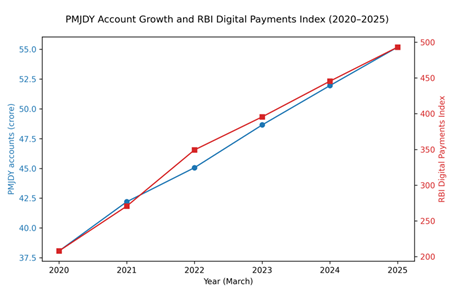
A simple
correlation analysis using these annual March observations yields a Pearson
correlation coefficient of 0.995 between PMJDY account counts and the RBI-DPI
for 2020–2025. While correlation does not imply causation, the near-perfect
positive association suggests that the period of rapid PMJDY expansion has
overlapped closely with the deepening of digital payments infrastructure and
usage captured by the RBI-DPI. This pattern is consistent with the view that a
broad-based base of transaction accounts, combined with the JAM architecture,
has facilitated the scaling up of digital payments, even though other factors
such as smartphone penetration, merchant acceptance infrastructure and policy
nudges also play significant roles.
|
Table 3 |
|
Table 3 Shows the Change
in Aggregate Digital Transaction Volumes in India between 2018–19 and 2023–24 |
|
|
Financial
year |
Digital
transactions (crore) |
|
2018-19 |
2,338 |
|
2023-24 |
16,443 |
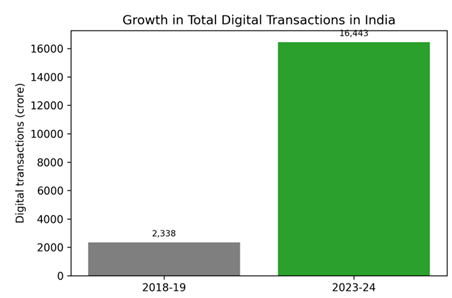
Official data
indicate that total digital transactions in India increased from about 2,338 crore in 2018–19 to approximately 16,443 crore
in 2023–24. This more than sevenfold increase reflects both the rapid adoption
of UPI and the expansion of card, AePS and other digital channels. The period
of steepest growth coincides with sustained increases in PMJDY account balances
and the maturation of the JAM ecosystem, suggesting reinforcing dynamics
between account-based financial inclusion and digital transaction behaviour.
|
Figure 1
|
|
Figure 1 Plots the Joint
Evolution of PMJDY Accounts and the RBI-DPI for the Period 2020–2025 |
|
Figure 2
|
|
Figure 2 Illustrates the
Increase in Aggregate Digital Transaction Volumes Between 2018–19 and 2023–24 |
Beyond national
aggregates, survey and administrative data provide insights into rural digital
adoption. EY and the Confederation of Indian Industry (CII) report that by
2024, the Unified Payments Interface (UPI) had become the most preferred mode
of transaction for nearly 38 percent of respondents in rural and semi-urban
India, even though around 86 percent of account holders in these areas still
expressed a preference for visiting bank branches. Studies on UPI usage in
rural regions find that adoption is higher in semi-rural areas with better
connectivity and market linkages, while remote villages continue to rely
heavily on cash due to network issues and low digital literacy. Administrative
data on AePS transactions show sustained volumes of cash withdrawals and
balance enquiries through BC-operated micro-ATMs in rural areas, underscoring
the importance of biometric, Aadhaar-linked channels for low-literacy users.
Taken together, these patterns suggest that PMJDY has created a broad base of
rural account holders who can, in principle, use digital payment channels, but
that the actual mix of digital and cash usage varies widely across contexts.
Discussion
The empirical
analysis indicates that PMJDY has achieved sustained growth in account
ownership and deposit balances over the last decade, with particularly strong
gains between 2015 and 2025. The CAGR of roughly 14 percent in account numbers
and the manifold increase in balances reflect both continued enrolment and
greater utilisation of accounts for savings and transactions. The high and
persistent share of rural and semi-urban accounts and the over-representation
of women among beneficiaries point to a deliberate targeting of historically
excluded segments. At the same time, the near-linear rise in the RBI-DPI and
the sharp increase in digital transaction volumes suggest that India’s payments
infrastructure and user base have undergone a structural transformation during
the same period.
The very strong
positive correlation between PMJDY account counts and the RBI-DPI over
2020–2025 should be interpreted with caution, but it is nonetheless
informative. It implies that the years in which PMJDY accounts and balances
grew most rapidly were also the years in which digital payment penetration and
performance deepened the most. From a conceptual standpoint, this is consistent
with the idea that transaction accounts, combined with unique digital identity
and mobile phones, form the foundational rails on which digital payment
ecosystems run. PMJDY accounts have served as the primary receptacle for DBT
flows, which in turn may encourage beneficiaries to engage with digital
channels—either directly through UPI and RuPay cards or indirectly through AePS
and BC-assisted transactions.
However, the
rural-focused literature and survey evidence also underscore important
frictions. Many rural PMJDY beneficiaries, particularly older women and
low-literacy users, prefer assisted modes of transaction and cash withdrawals
over independent use of UPI or merchant QR payments. Concerns about fraud, data
privacy and biometric misuse, as discussed in recent work on cybersecurity
risks in PMJDY digital transactions, can dampen willingness to adopt fully
digital usage patterns. The Technology Acceptance Model-based study by Singh et
al. and the AI and chatbot research by Kediya and co-authors highlight the
importance of perceived usefulness, ease of use, trust and service quality in
shaping attitudes towards digital platforms. These findings suggest that
strengthening user-centric design, grievance redressal and cybersecurity, and
embedding financial and digital literacy into PMJDY outreach, are critical for
translating account ownership into meaningful digital inclusion.
Findings
·
PMJDY
accounts expanded from about 14.72 crore in March 2015 to 55.18 crore in March
2025, with a compound annual growth rate of roughly 14.1 percent and a
parallel, multi-fold increase in deposits.
·
Throughout
the period, roughly two-thirds of PMJDY accounts were located in rural and
semi-urban areas and a majority were held by women, confirming the scheme’s
strong rural and gender focus.
·
The RBI
Digital Payments Index rose steadily from 207.84 in March 2020 to 493.22 in
March 2025, and correlation analysis shows a very strong positive association
between PMJDY account growth and the RBI-DPI over this period.
·
Aggregate
digital transaction volumes in India increased more than sevenfold between
2018–19 and 2023–24, driven largely by UPI and supported by RuPay cards and
AePS, indicating rapid mainstreaming of digital payments.
·
Secondary
evidence on rural UPI and AePS usage reveals that while digital adoption has
deepened in many rural and semi-urban areas, significant disparities persist
across villages and user segments due to connectivity constraints, literacy
gaps and trust deficits.
·
Insights
from the work of Dr. Shailesh Kediya and co-authors on AI, chatbots and digital
platform adoption underline that user perceptions of usefulness, ease of use,
security and service quality are crucial determinants of digital financial
adoption, with direct relevance for the design of PMJDY-linked digital
services.
Conclusion
This paper has
assessed the impact of Pradhan Mantri Jan Dhan Yojana on rural digital adoption
using a secondary data-based approach that links PMJDY account and deposit
trends with national indices of digital payment penetration and rural digital
usage evidence. The analysis shows that PMJDY has been instrumental in rapidly
expanding the base of transaction accounts among rural and low-income
households and that this expansion has occurred alongside, and in close
association with, the deepening of India’s digital payments ecosystem. Yet, the
persistence of account dormancy in some segments, the continued reliance on
cash and assisted channels, and reported concerns around cybersecurity and data
privacy indicate that access alone is insufficient for achieving full digital
inclusion.
From a policy
perspective, the findings support a two-pronged strategy. On the one hand,
PMJDY and related schemes should continue to focus on saturating account
coverage, maintaining low-cost access and ensuring that DBT flows are reliably
delivered through formal channels. On the other hand, there is a need to
systematically integrate digital and financial literacy initiatives,
user-centric design of digital interfaces (including AI-driven conversational
tools), and robust cybersecurity safeguards into the PMJDY ecosystem,
particularly in rural and remote areas. Future research could build on this
study by exploiting more granular transaction-level data, conducting
mixed-methods fieldwork to capture user experiences in specific districts, and
applying behavioural frameworks such as TAM and related models to better
understand the determinants of sustained digital usage among PMJDY
beneficiaries. Such work would further illuminate how PMJDY can continue to
evolve from a bank account opening scheme into a cornerstone of inclusive,
secure and trusted digital finance for rural India.
ACKNOWLEDGMENTS
None.
REFERENCES
Das,
A. (2021).
Regulating Basic Savings Bank Deposit Accounts: Do We
Need to Care for these Marginalized Depositors? IIT
Bombay Technical Report.
EY, and Confederation of Indian Industry. (2024). Financial Inclusion Through Technology and Literacy in India: Strategies for Sustainable Growth. EY-CII.
Gupta, K. (2023). Pradhan Mantri Jan Dhan Yojana: History and Present Impact. South Asian Journal of Social Studies and Economics, 19(2), 21–27. https://doi.org/10.9734/sajsse/2023/v19i2674
Gupta,
S., and Gupta, P. (2026). Socio-Economic Impact of Pradhan Mantri Jan Dhan Yojana:
A Micro-Level Analysis in Firozabad. Advances in Consumer Research, 3(2),
1618–1634.
Kediya, S., Dhote, S., Singh, D. K., Bidve, V. S., Pathan, S., and Suchak, A. (2023). Are AI and Chatbots Services Affecting the Psychology of users in Banking Services and Financial Sector. Journal for ReAttach Therapy and Developmental Diversities, 6(9s2), 191–197.
Kediya, S., Chib, S., Chouhan, N., Sharma, A., Vinchurkar, S., and Parekh, K. (2023). Blockchain and Proxy Re-Encryption Technology-Based Financial Data Sharing Solution. In Proceedings of the International Conference on Communication, Security and Artificial Intelligence. https://doi.org/10.1109/ICCSAI59793.2023.10421524
Kediya, S., Mohanty, V., Gurjar, A., Chouhan, N., Sharma, R., and Golar, P. (2024). Chatbots in Customer Service: A Comparative Analysis of Performance and Customer Satisfaction. In Proceedings of the 2nd DMIHER International Conference on Artificial Intelligence in Healthcare. https://doi.org/10.1109/IDICAIEI61867.2024.10842848
Kumari, B., and Singh, A. (2025). Cybersecurity Risks and Data Privacy Concerns in PMJDY Digital Transactions. Electrical and Electronic Engineering and Technology, 15(2), 4725–4745. https://doi.org/10.52783/eel.v15i2.3323
Ministry
of Finance. (2020).
Pradhan Mantri Jan-Dhan Yojana (PMJDY): National
Mission for Financial Inclusion Completes Six Years of Successful
Implementation. Press Information Bureau, Government of India.
Ministry
of Finance. (2021).
Pradhan Mantri Jan-Dhan Yojana (PMJDY): National
Mission for Financial Inclusion Completes Seven Years of Successful
Implementation. Press Information Bureau, Government of India.
Ministry
of Finance. (2023).
Nine Years of Pradhan Mantri Jan-Dhan Yojana (PMJDY). Department of Financial
Services, Government of India.
Ministry
of Finance. (2024).
Pradhan Mantri Jan Dhan Yojana (PMJDY) (Press Release, August 13, 2024). Press
Information Bureau, Government of India.
Ministry
of Finance. (2025).
Eleven Years of PM Jan Dhan Yojana: Banking the
Unbanked. Press Information Bureau, Government of India.
Reserve
Bank of India. (2024). RBI-Digital Payments Index for March 2024 (Press release).
Reserve
Bank of India. (2025). RBI-Digital Payments Index for March 2025 (Press release).
Sharma,
S. V., et al. (2025).
Digital Payments and Financial Inclusion in Rural India. International Journal
of Professional Studies, 5(4), 45–60.
Singh,
D. K., Kediya, S., Band, G., and Shukla, S. (2023). An Insight into Students' Acceptance of
Various Digital Platforms Using TAM Model Across the Indian States During the
Pandemic. Academy of Marketing Studies Journal, 27(5), 1–16.
Vasudev, S. (2025). Digital Payments and Financial Inclusion in Rural India. International Journal of Professional Studies, 5(4), 1–20.
|
|
 This work is licensed under a: Creative Commons Attribution 4.0 International License
© IJETMR 2014-2026. All Rights Reserved.