
|
|
|
|
Original Article
Digital Transformation in Project Management: Evaluating Tools, Techniques, and Professional Perspectives
|
Dr. Malak Al
Dirani* 1 Skema Business School,
France |
|
|
|
ABSTRACT |
||
|
The digital era has profoundly transformed project management practices, creating both opportunities and challenges for professionals across diverse age groups and experience levels. This study investigates how technological advancements, including virtual collaboration tools, real-time data analytics, and artificial intelligence, influence the effectiveness of project management and decision-making. A survey-based methodology was employed, collecting responses from participants representing varied age cohorts and levels of professional experience. Data analysis focused on perceptions of the benefits of digital tools for enhancing collaboration, optimizing resources, improving forecasting accuracy, and improving overall project outcomes. The findings reveal that younger professionals and those with less experience generally perceive greater advantages from digital integration, demonstrating higher satisfaction with the efficacy of contemporary project management methods. In contrast, older and more experienced participants tend to offer more cautious or moderate evaluations, reflecting nuanced insights shaped by extensive professional practice. Overall, the study highlights the positive role of digital technologies in promoting cross-functional collaboration, informed decision-making, and creativity within project teams. These results underscore the importance of adopting hybrid approaches that combine traditional project management principles with digital innovations to optimize outcomes. The research provides practical implications for organizations seeking to implement technology-driven project management strategies while considering the diverse perspectives and adaptability of their workforce. Keywords: Digital Era, Project Management,
Virtual Collaboration, Real Time Data Analytics, Artificial Intelligence |
||


INTRODUCTION
The massive surge in digital
technology and the dynamic nature of current work structures have turned
project management on its head. In the age of digital evolution, modern project
management is no longer limited to physical coordination, linear communication, and local teams. Instead, it is a world of technology-enabled virtual
collaboration, advanced
communication systems, and complex project management software. Guinan et al. (2019). These advances have
brought with them both new opportunities and added complexities, requiring a deeper understanding of how projects are
formulated, implemented, and monitored in contemporary organizational
contexts.
As digital tools permeate more of our organizational lives, how we work
and interact with teams continue to evolve. Collaboration solutions,
synchronous communication, and
team systems are transforming the way project teams plan work, share
information, and make decisions. Meanwhile, with an increase in remote work, cross-functional teams, and spatially
dispersed stakeholders, collaboration has become more complex, requiring new management
capabilities and reflexive organelles. These evolving dynamics are important for organizations seeking to
improve project performance and compete in a digitally interconnected world.
Digital transformation has the potential to add flexibility, efficiency, and responsiveness to project
management processes. However, organizations face challenges aligning
traditional project management methods with today’s digital environment.
Traditional approaches that were considered cornerstone models for project success are also challenged by the
increased complexity and interactivity of virtual communication, the seamless
application of technology, and comprehensive stakeholder engagement Simion
et al. (2018). Face-to-face
practices of coordination and
solidified communication structures are being comprehensively reconfigured as
project management increasingly sedimentates in digitised environments Gunnar
and JokischPavel (2019).
This paradigm shift raises a key issue: we know little about how
traditional project management methodologies work (or fail to) in digital contexts. In particular, the research on how telecommuting, virtual
teaming technologies, and seamless digital interfaces affect project
efficiency, coordination, and outcomes is long overdue. This is a strategic issue
because project management is a key driver of achieving organizational goals,
optimizing resource use, and delivering products or services on time. The consequences are not only purely academic but also directly related to organizational performance,
financial sustainability, and
the company's long-term evolution.
In light of these challenges, the goal of this research is to
investigate whether modern project management is leading into the digital age. In particular, it studies how technological innovation has affected project management
methodologies; whether tools for virtual collaboration (for communication and
coordination) affect project teams' performance; and the relevance of
traditional methods in digitization processes. RQ: How does the digital age influence and affect
the effectiveness of traditional project management approaches?
The goal of this study is not only to understand the impact that
technology has on project management practices, but also how it affects
team-building and problem-solving within the construct
of a virtual environment, as well as share best practices for integrating
traditional tools in a digital era,
while providing practical suggestions that may improve project results in
today’s complex corporate world.
Literature
Review
In the age of digital, there has been a transformation across many industries due to changes in
business processes and behaviour. In project
management, digital transformation has reinvented traditional practices,
leading to technology-based processes that change how projects are conceived,
delivered,
and monitored Sascha
et al. (2021). These shifts have
ushered in new efficiencies, challenges, and collaborative opportunities for today’s project teams.
This has increasingly influenced project management methodologies.
Manual-based,
face-to-face-oriented conventional application processes are being supplemented
or replaced by digital trends Hanna
(2018). For example,
cloud-based project management systems enable cross-country teams to coordinate
efforts in real time, thereby
improving the efficiency of resource utilization and project timetables Gupta et
al. (2022). The importance of
Agile methodologies should also be noted, as they accelerate processes and are extendable and adaptable to
exigent
digital manifestations. Agile methods facilitate a prompt response to
changing technologies and stakeholder needs, leading to better responsiveness
and results Usama et
al. (2022).
The impact of technological
advancements on project management is continually being redefined in terms of
accuracy, appropriateness, and effectiveness. Contemporary project management
software serves as a digital hub
for real-time task assignments, progress monitoring, and resource allocation Gianluca et al. (2021). Real-time analytics
enables managers to obtain
actionable insights from data, adapt strategy, and proactively mitigate risks,
thereby promoting the performance of the entire project Gianluca et al. (2021). The advancement of
AI and ML technologies has
enhanced forecasting by enabling the prediction of bottlenecks, resource
demands, and risk factors Guan et al. (2020).
Virtual collaboration has revolutionized how teams work, transcending physical and spatial boundaries. These platforms
(e.g., Slack, Microsoft Teams,
and Zoom) support live communication, shared document production, and
synchronous interaction for distributed teams Guan et al. (2020). These instruments address challenges stemming from multiple
time zones by fostering team cohesiveness and shared goals in diverse teams Muluken and
Ayenew (2022). Emerging
technologies such as virtual reality (VR) take collaboration a step further by
creating immersive environments for brainstorming and ideation, increasing
creativity and engagement Muluken and
Ayenew (2022). Moreover,
collaborative virtual environment solutions enable cross-functional
collaboration and knowledge sharing,
allowing individuals with different abilities to participate proactively in
problem-solving and decision-making Zegarra
and Sabanovic (2017).
Furthermore, conventional project management approaches are being
modernized by the increasing
influence of technology and the digital age. Hybrid Waterfall and Agile methodologies enable companies to balance structured planning
with the flexibility to adapt to changes in market behaviour Gupta et
al. (2022). It is the
combination of flexibility and structured planning that helps project teams navigate an ever-changing environment while
retaining clear objectives and waypoints Gunnar
and JokischPavel (2019). Furthermore,
developing a digital mindset is viewed as critical to preparing; this involves encouraging
adaptability, lifelong learning, and experimentation so that managers/teams can
utilise technology to overcome management’s and the organisation's inertia and
respond to
opportunities Saif and Kinyó (2020).
On the whole, the
literature points to significant impacts of digital transformation on project
management, and the cases illustrated technological integration, virtual
cooperation, and hybrid methodologies as enabling means (to improve
communication and sharing) in addition to those that contribute to
effectiveness and adaptability. However, there are still some gaps in the
literature about how these practices impact specifically both efficiency and
effectiveness of nowadays’ project management approaches. These are the core
issues that inspire this work.
MATERIALS AND METHODS
The purpose of this research is to investigate the effects of
digital transformation on project management processes. For reproducibility, this section describes the
methods for participant data collection and positional analysis.
Research
Method: Quantitative Approach
Quantitative research is a methodological approach that systematically
collects and analyzes numerical data to determine patterns, relationships, and
trends Creswell
and Creswell (2017). This approach to
quantification provides a measure of phenomena that can be statistically analyzed for significance. Quantitative methods were used
in this study to determine the
influence of digital transformation on project management, focusing on
responses to structured, closed-ended survey questions.
Research
Design: Non-Experimental Design
We chose a non-experimental design to study naturally occurring patterns among variables that were not
manipulated Salvador
(2016). The latter design
is appropriate for understanding
potential causal relations among variables in the digital transformation and
project management research domain, enabling an analysis of the existing situation
and participant experiences without intervening actions.
Sampling
Plan: Non-Probability, Judgmental Sampling
For this research, judgmental or
purposive sampling, which selects expert respondents using non-probabilistic
methods, was utilized Taherdoost
(2016). Twenty-six
experienced project managers with
strong experience in both project management and digital transformation were
deliberately selected to ensure their interpretations aligned with the study's
aim.
This strategy is biasing experts who might have the best and most qualified
answers on how digital transformation affects project management.
Data
Collection: Primary Data Using Closed-Ended Survey .
Closed-ended survey. Closed-ended surveys
can be used to gather original data in a standardised, quantitative form Hox and Boeije (2005). The evaluation
consisted of formal items with fixed-response
options to measure respondents’ views on digital tools, collaboration, and
dynamic project-planning methodologies. For convenience, an online survey was
administered via an online survey platform to reach potential participants, and
e-mails containing survey links with clear instructions on how to complete
them, the study aims, and assurances of confidentiality for study data were sent.
Materials and
Instruments
The questionnaire had been developed to measure perceptions and
practices for digital transformation in project management. The face and
content validity of all items were assessed through expert review, thereby
ensuring the reliability of the gathered data. The
questionnaire also included variables such as technology-enabled project management software/virtual
collaboration tools, adoption of Agile or hybrid methodologies, and perceived project
efficiency outcomes.
Statistical
Analysis
Analyses were conducted using
standard descriptive statistics methods employed in quantitative studies. Participant
characteristics and survey findings were reported using descriptive
statistics. Correlation and regression analyses were conducted as part of
inferential tests to examine the relationships between digital transformation practices and project
management outcomes. Analyses were performed
using SPSS to ensure the validity and reproducibility of results.
RESULTS AND DISCUSSIONS
|
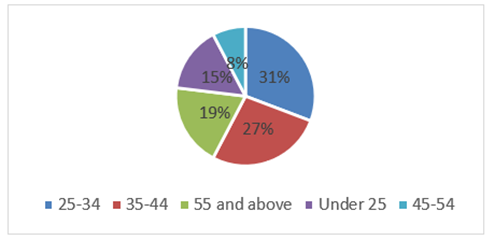
Figure 1 |
|
|
|
Figure 1 Age Group of the Sample |
This figure indicates that, across a broad range
of age groups, the results showed reasonable diversity and robustness among
early-career, mid-career, and experienced workers.
|
Figure 2 |
|
|

|
Figure 2 Gender Distribution of the Sample |
Such an even-handed treatment ensures that both
male and female perspectives are integrated equally, adding to the
inclusiveness of the research. This is for gender equity because it enables a
holistic understanding of digitalisation in project management, making the
findings relevant to industry practitioners globally, regardless of gender.
|
Figure 3 |
|
|
|
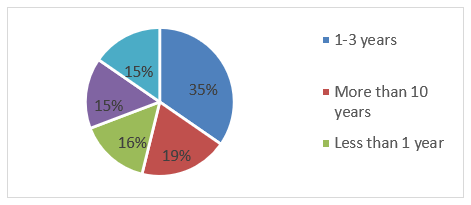
Figure 3 Years of Experience in PM of the Sample |
The surveyed sample demonstrates a diverse range
of professional experience in project management. This balanced distribution
across experience levels ensures the inclusion of perspectives from
early-career to highly experienced professionals, supporting a comprehensive
analysis of the digital era’s impact on project management.
|
Figure 4 |
|
|
|
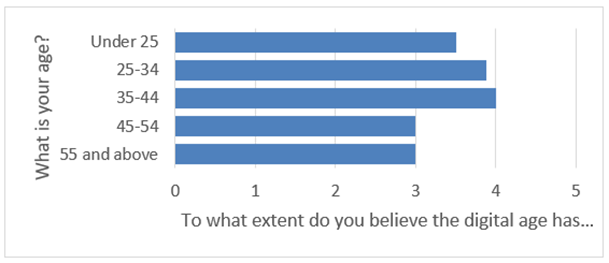
Figure 4 Perceived Influence of the Digital Age on Project
Management Practices Across Different Age Groups |
This study examines age-related perceptions of
the digital era’s influence on project management using a 5-point Likert scale.
In general, the results suggest that younger and mid-career professionals
perceive more positive effects of the digital era on PMWs (the strongest
endorsement came from working professionals in their mid-career). Older age
groups, conversely, are more sceptical of the effect. These variances
imply that experience with computer tools and exposure to the integration of
technology into its practice may affect how different age groups view the
benefits of digital transformation in project management.
|
Figure 5 |
|
|
|
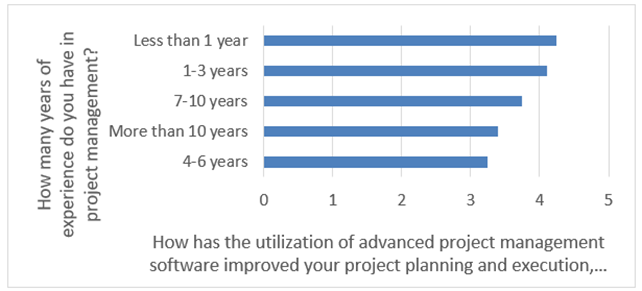
Figure 5 Impact of
Experience on Perceived Benefits of Advanced Project Management Software |
This graph shows the disparity in perceived
importance of advanced project management software by experience level. Younger
professionals place the greatest value on real-time tracking and resource
optimization, suggesting a reliance on digital tools among youth. As experience
increases, perceptions are more tempered, indicating that experienced
professionals use common approaches and develop more mature expectations for
the extra value provided by sophisticated software. This tendency underscores
the influence of professional maturity on attitudes towards the
technological support in project management.
|
Figure 6 |
|
|
|
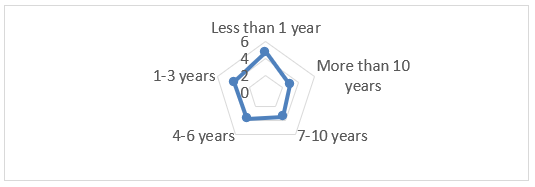
Figure 6 Impact of Experience on Perceived Benefits of
Real-Time Data Analytics in Project Decision-Making |
This shows the disparity in the perceived
importance of advanced project management software by experience level. Younger
professionals place the greatest value on real-time tracking and resource
optimization, suggesting a reliance on digital tools among youth. As experience
increases, perceptions are more tempered, indicating that experienced
professionals use common approaches and develop more mature expectations for
the extra value provided by sophisticated software. This tendency underscores
the influence of professional maturity on attitudes towards the
technological support in project management.
|
Figure 7 |
|
|
|
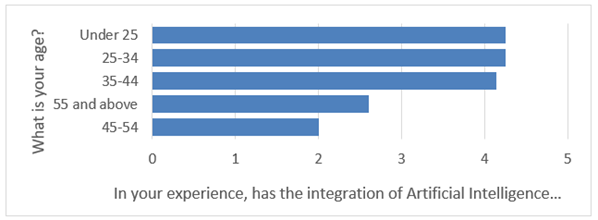
Figure 7 In Their Experience, What
is the Perceived Impact of AI And Machine Learning Integration on Project
Forecasting Accuracy Across Age Groups? |
This shows interesting generational
differences in perceptions of the impact AI and machine learning will have on
project forecasting accuracy. Impression: They just become less and less
interested in these “AI predicting risk” and “AI predicting your resource
demand”. Above all, newbies still feel super confident that those AI-driven
tools know their thing. On the other hand, participants in older age groups are
increasingly tepid or sceptical, indicating a high degree of conservatism over
time in their trust in traditional forecasting methods and in the perceived
additional value that AI and machine learning bring to project management.
|
Table 1 |
|
Table 1 Impact of
Age on Perceived Benefits of Virtual Collaboration Tools in Enhancing Team
Communication and Coordination |
|
|
What is your age? |
Average of to what extent
has the adoption of virtual collaboration tools (such as Slack, Microsoft
Teams, Zoom, etc.) improved team communication and coordination across
geographical boundaries? |
|
25-34 |
4.25 |
|
35-44 |
4.428571429 |
|
45-54 |
2.5 |
|
55 and above |
2.8 |
|
Under 25 |
4.25 |
|
Grand Total |
3.884615385 |
This figure reveals that perceptions of the
advantages of virtual collaboration tools differ across age groups. Younger
workers, the report says, have seen greater benefits in communication and
coordination because they are more accustomed to digital collaboration tools.
Mid-career professionals also place a high value on these tools, especially
regarding geographical dispersion. In contrast, less enthusiasm is observed
among older age groups, indicating disparities in adoption and communication
tendencies. In this sense, the findings support a positive evaluation of VC
tools in general and highlight that age matters when it comes to
perceiving their advantages for project management.
|
Figure 8 |
|
|
|
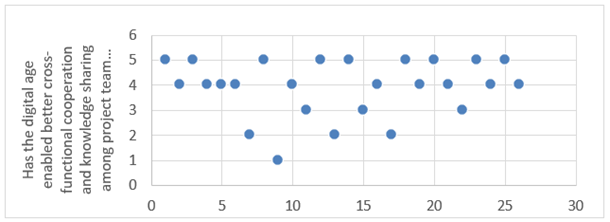
Figure 8 Perceived Impact of the Digital Age on
Cross-Functional Cooperation, Knowledge Sharing, and Innovation Within
Project Teams |
This figure illustrates the distribution of
respondents' ratings for the impact of the digital era on cross-functional
collaboration, knowledge sharing, problem-solving, and creativity within
project teams. In general, the responses are on the higher side of the scale,
suggesting that people generally feel that well about digital
transformation. Even though a minority of people are neutral or give more
negative responses, the dispersion overall indicates a prevailing trend of
agreement that digital tools and practices have improved collaboration and
creativity in innovative project settings.
|
Figure 9 |
|
|
|
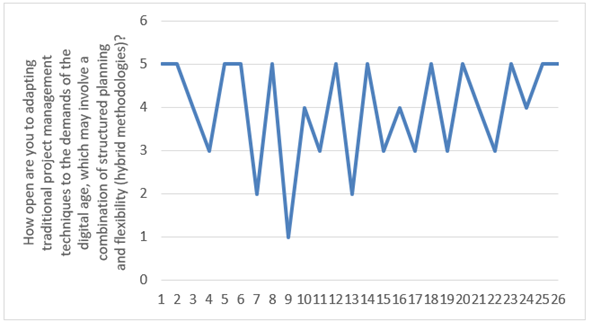
Figure 9 Openness to Adapting Traditional Project Management
Techniques to the Digital Age |
This graph clearly shows participants’
willingness to adapt standard project management processes to the digital age.
Most are receptive (at a strong or moderate level of agreement) to hybrid
models that blend conventional approaches with digital capabilities. At the
same time, a minority holds a neutral attitude or prefers to maintain the
status quo. The collective data exemplifies the trend toward flexibility and
resilience among these individuals.
|
Figure 10 |
|
|
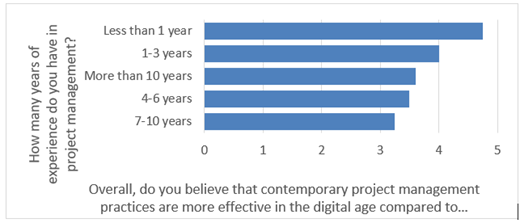
|
Figure 10 Perceived Effectiveness of Contemporary Project
Management Practices in the Digital Age |
This figure shows that less-experienced
professionals tend to rate the effectiveness of modern, digitally enhanced
project management methodologies more positively. At the same time, those with
greater experience provide slightly lower, more measured evaluations. Overall,
the data reflect a pattern in which familiarity with traditional approaches
shapes a more nuanced perspective on the efficacy of contemporary practices.
CONCLUSIONS and RECOMMENDATIONS
Discussion
Project management has evolved significantly
in the digital era. Our results indicate that a range of ages is represented,
with those in the 25-34-year-old cohort showing strong familiarity with digital
technologies. The research also achieves gender balance to support an inclusive
interpretation and to examine the implications of findings from both male and
female participants.
Professional experience is critical in shaping
attitudes. Novice practitioners see great value in advanced project management
tools, especially for real-time visibility and resource constraints. The
perceived benefits diminish with increasing experience, likely due to a more
critical perspective.
Younger professionals have a more positive
attitude toward AI and ML in project management, whereas older participants are
more hesitant toward them. Likewise, tools for virtual collaboration are
considered a means to improve communication and coordination – especially among
younger generations who grew up using such platforms.
Cross-functional collaboration, knowledge
sharing, and innovation in project teams are frequently associated with the era
of digitization. Generally, participants are outspoken in advocating hybrid
methods that integrate older modes with new digital methods. More generally,
modern project management practices are seen as successful even when not
universally adopted, particularly among less experienced staff, underscoring
the need to consider experience- and age-specific perspectives in digital
adoption strategies.
Conclusion and Recommendations
In this study, the influence of the digital era
on project management practice will be discussed through an analysis of
generational and experience levels. This study demonstrates the positive
effects of digital technologies on project management, including improved team
collaboration, more data-driven decision-making, and greater creativity. It is
the newer workers who are most enthusiastic about these developments, in part
because they are more accustomed to digital tools and better at adapting to new technology.
More experienced experts exhibit intermediate enthusiasm, explaining that
refined professional habits and experience influence their nuanced opinions on
what to do.
The findings also underscore the significance of
hybrid methods that combine traditional project management techniques with
digital innovations. Although digital tools can make the process more efficient
and predictable, how effectively they are utilized ultimately depends on
practitioners' experience, preparation, and willingness to change. Younger
professionals found value in virtual collaboration platforms, real-time
analytics, and AI-based forecasting; older groups remained wary or selective in
their use of these tools.
From these observations, several practical implications
follow. They will need to provide focused learning to fill experience-related
gaps, enable cross-functional collaboration, and create experiences that drive
innovation. Digital adoption decision-making needs to be shaped by a range of
age and experience perspectives to ensure inclusion and make meaningful change.
The limitations of the study relate to
representativeness (e.g., generalizing to all project management professionals)
and to a narrow focus on cultural differences, which could affect how someone
views digital transformation. Notwithstanding these limitations, the study
highlights the importance of strategically incorporating digital tools without
detracting from professional experience and existing techniques. This
middle-ground approach can provide lessons for future project management and
let organizations take advantage of new technologies while preserving a level
of flexibility and operational resiliency.
ACKNOWLEDGEMENTS
The author wishes to express her sincere
gratitude to all individuals who contributed to this study but do not meet the
criteria for authorship. Special thanks are extended to the survey participants
for their time and insights, which made this research possible. We also
acknowledge the support and guidance of colleagues and mentors, who provided
valuable feedback throughout the study. Any funding or institutional support
received for this research is gratefully recognized, and all named parties have
provided their consent to be acknowledged.
REFERENCES
Creswell, J., and Creswell, D. (2017). Research Design: Qualitative, Quantitative, and Mixed Methods Approaches. Management Review, 14, 490–495.
Gianluca, E., Alessandro, M., and Secundo, G. (2021). Project Management Canvas: A Systems Thinking Framework to Address Project Complexity. International Journal of Managing Projects in Business, 809–835. https://doi.org/10.1108/IJMPB-04-2020-0128
Guan, C., Mou, J., and Zhiying, J. (2020). Artificial Intelligence Innovation in Education: A Twenty-Year Data-Driven Historical Analysis. International Journal of Innovation Studies, 134–147. https://doi.org/10.1016/j.ijis.2020.09.001
Guinan, P., Parise, S., and Langowitz, N. (2019). Creating an Innovative Digital Project Team: Levers to Enable Digital Transformation. Business Horizons, 717–727. https://doi.org/10.1016/j.bushor.2019.07.005
Gunnar, A., and JokischPavel, O. (2019). Revisiting Automated Project Management in the Digital Age: A Survey of AI Approaches. Online Journal of Applied Knowledge Management, 27–39. https://doi.org/10.36965/OJAKM.2019.7(1)27-39
Gupta, C., Jose, M.-C., and Gupta, V. (2022). Measuring Impact of Cloud Computing and Knowledge Management in Software Development and Innovation. Systems, 151. https://doi.org/10.3390/systems10050151
Hanna, N. (2018). A Role for the State in the Digital Age. Journal of Innovation and Entrepreneurship, 1–16. https://doi.org/10.1186/s13731-018-0086-3
Hox, J., and Boeije, H. (2005). Data Collection, Primary Versus Secondary. In Encyclopedia of Social Measurement (Vol. 1,593–599). https://doi.org/10.1016/B0-12-369398-5/00041-4
Muluken, A., and Ayenew, Z. (2022). Do Paradoxical Virtual Leadership and Emotional Intelligence Have Relationships? In Particular, There are Concerns About Technology Dependence, Geographical Dispersion, and Human Capital Tensions. International Journal of Organizational Leadership, 1–25.
Saif, M., and Kinyó, L. (2020). Constructivist Theory is a Foundation for the use of Digital Technology in Lifelong Learning. Turkish Online Journal of Distance Education, 90–109. https://doi.org/10.17718/tojde.803364
Salvador, J. (2016). Exploring Quantitative and Qualitative Methodologies: A Guide to Novice Nursing Researchers. European Scientific Journal, 12(18). https://doi.org/10.19044/esj.2016.v12n18p107
Sascha, K., Jones, P., Kailer, N., Weinmann, A., Chaparro-Banegas, N., and Roig-Tierno, N. (2021). Digital Transformation: An Overview of the Current State of the Art in Research. SAGE Open, 11. https://doi.org/10.1177/21582440211047576
Simion, C.-P., Popa, S.-C., and Albu, C. (2018). Project Management 4.0: Project Management in the Digital Era. In Proceedings of the 12th International Management Conference (1–2). Bucharest, Romania.
Taherdoost, H. (2016). Sampling Methods in Research Methodology: How to Choose a Sampling Technique for Research. How to Choose a Sampling Technique for Research. https://doi.org/10.2139/ssrn.3205035
Usama, A., Bhatti, S. H., Shamim, S., and Khan, Z. (2022). The Role of Big Data Analytics in Manufacturing Agility and Performance: Moderation-Mediation Analysis of Organizational Creativity and of the Involvement of Customers as Data Analysts. British Journal of Management, 1200–1220. https://doi.org/10.1111/1467-8551.12549
Ustundag, A., and Cevikcan, E. (2017). Industry 4.0: Managing the Digital Transformation. Springer. https://doi.org/10.1007/978-3-319-57870-5
Zegarra, A., and Sabanovic, S. (2017). Cross-Functional Team in a Project with an Agile Management: Effective Strategies and Common Challenges in a Cross-Functional Team While Using Agile Project Management.
|
|
 This work is licensed under a: Creative Commons Attribution 4.0 International License
© IJETMR 2014-2026. All Rights Reserved.