
|
|
|
|
Original Article
EXPLORING EMOTIONAL INTELLIGENCE AND STUDENT WELLBEING IN MULTICULTURAL UNIVERSITY SETTINGS
|
Rokhiya
Tasneem 1*, Dr. Vandana Vashisth 2, Dr. Vimlesh
Tanwar 3 1 Research Scholar, Department of Commerce and Management,
Banasthali Vidyapith, Jaipur, Rajasthan, India 2 Assistant
Professor, Department of Commerce and Management, Banasthali Vidyapith,
Jaipur, Rajasthan,
India 3 Assistant Registrar, Banasthali Vidyapith, Jaipur,
Rajasthan, India |
|
|
|
ABSTRACT |
||
|
The major reason for this research was to find out the perception of college students who take part in multicultural programs regarding the relationship between EI, MA, and PWB. The study aimed at determining the extent to which the relation of EQ to mental health is influenced by intercultural adaptation. The participants in this research numbered 384 and were from very diverse intellectual and cultural backgrounds, while the methodological approach was a quantitative descriptive correlational one. The data was subjected to Structural Equation Modeling (SEM) to verify if our assumption was correct. The researchers utilized standardized scales to evaluate EI, MA, and PWB. The study showed that high EQ had a profound effect on mental health and adaptability to different cultures, thus it would be inferred that through having EQ, students could better regulate their feelings, recover quickly from their failures, and cooperate with people from different cultures. Furthermore, the capacity to blend in with different cultures has a positive effect on the individual’s emotional health through the activity of the most important outer character trait, which is the ability to mix with different cultures. The capacity to adapt to other cultures has a significant bearing on the correlation between EQ and mental health since it moderates the relationship between the two. University and college students can benefit from programs that teach them to be more resilient, accepting, and healthy by increasing their intercultural awareness and emotional intelligence, according to the study's authors. Not only did this study fill a need in our understanding of multicultural university environments, but it also provided evidence that intercultural adaptation is an important process connecting EQ to psychological health. Keywords: Emotional Intelligence, Multicultural
Adaptation, Psychological Wellbeing, University Students, Higher Education |
||


INTRODUCTION
Background of the Study
Globalization
along with the mass internationalization of higher education have sped up the
cultural diversity in university campuses which in turn has increased the
opportunities as well as the psychosocial demands for the students. There is a
lot of research going on which proves that there is a lot of distress among
university populations and international students are the ones who usually
report more depressive symptoms, more perceived stress, and less perceived
social support than their domestic peers Zayed et al. (2025) . This situation emphasizes the necessity of
recognizing the factors affecting student wellbeing that can be modified in a
multicultural environment. The latest evidence after the pandemic shows that
the problem of mental health in students has not gone away and that the
universities need to provide resources for adaptive coping as they are
transitioning to “new normal” learning climates Le Vigouroux et al. (2025).
The capacity to
identify, understand, and control one's own emotions—what is known as emotional
intelligence (EI)—has lately emerged as a robust marker of psychological
well-being among the millennial and college-aged generations (PWB).
Present-day empirical research and reviews always demonstrate the same trend
that high EI correlates with good PWB and lower psychological distress and in
some instances with better academic performance. Shengyao
et al. (2024) For example, a comprehensive study conducted
in 2024 showed that EI had strong positive correlations not only with wellbeing
but also with academic success; meanwhile, a 2025 cross-cultural study in Arab
universities confirmed the role of EI in safeguarding mental health. Ruiz-Ortega et al. (2024) Similarly, reviews point out that EI is
influenced by various educational and contextual factors, leading to the
conclusion that universities can enhance EI by implementing specific teaching
and non-teaching activities. Martínez-Rodríguez
and Ferreira (2025).
In a multicultural
context, the students not only have to deal with the cultural aspects of their
new environment— the norms, ways of communicating and expectations of their new
roles— but also have to be able to do this without any problems, which means
they will need to have good intercultural skills Prado et
al. (2024). The literature on adaptation of
international students indicates that both psychological and sociocultural
factors act together in the course of adjustment; therefore, lack of either one
can result in lowering of the overall satisfaction and decrease of one's
willingness to remain in the academic institution. Gebregergis
and Csukonyi (2025) The most important thing is that the newly
developed research indicates that one of the aspects of EI is intercultural
competence or multicultural adaptation, which may be a way through which EI
leads to positive wellbeing and work-study outcomes— that is, the emotionally
intelligent persons have better skills in regulating their emotions,
empathizing with people from different cultures and establishing supportive
intercultural relationships that help them to cope with stress. This kind of
support for the mentioned pathways has been found in the educational and also
similar professional settings where intercultural competence acts as a partial
mediator between EI and the downstream outcomes (e.g., job satisfaction), which
implies a similar process for student wellbeing Mohamed
et al. (2025).
Simultaneously,
studies that make comparisons reveal that the initial mental-health status of
international students is lower than that of domestic students, thus making
adaptive resources even more essential for international students. Indrayathi
et al. (2025) Therefore, the combination of EI development
and structured intercultural experiences could provide double advantage: it
will be in the direct enhancement of one's emotional self-management and in the
indirect improvement of one's PWB by strengthening one's multicultural
adaptation skills. This integrative viewpoint is consistent with recent higher
education initiatives that recommend the infusion of evidence-based
psychosocial skills and intercultural learning into curricula, advising, and
campus life.
Contemporary
literature suggests a model where EI has a direct impact on student PWB and an
indirect one through multicultural adaptation. When this model is tested in
varying student groups, it can contribute to the development of the theory of
adjustment at internationalized universities and at the same time it will be a
basis for the improvement of institutional policies—like EI training,
intercultural mentoring, and inclusive campus programming—that are meant to
enhance resilience, belonging, and mental health. By positioning an analyzable
mechanism (adaptation) connecting a malleable attribute (EI) to a priority
outcome (wellbeing) at the center, the present study aims at a manageable lever
for bettering student experience and success in multicultural higher education Rodrigo
et al. (2025).
Problem Statement
University
students very often find themselves in multicultural environments which are not
only very rich but also full of emotional and adjustment issues that can have
adverse effects on their health and academics. Emotional intelligence is
believed to promote the use of healthier coping mechanisms and the formation of
better relationships but still, the exact way by which it improves mental
health—especially during cultural adjustment of students—is not clear. The main
problem the present research is addressing is the lack of empirical data that
would demonstrate how emotional intelligence affects the psychological
wellbeing of students in multicultural campuses both directly and indirectly
(through cultural adaptation). The revelation of such a process might help to
create well-targeted interventions that would not only lead to the improvement
of emotional and intercultural skills but also to better student outcomes.
Research Objectives
·
To find out
how well students' emotional intelligence correlates with their mental health
and how well they adapt to different cultures.
·
To
learn more about how intercultural adaptation mediates the connection between
EQ and mental health in multiethnic classrooms.
Research Questions
·
How
successfully do college students in multicultural settings handle emotional
intelligence, adjust to different cultures, and maintain their mental health?
·
Does the
emotional intelligence of college students have any bearing on their
psychological well-being?
·
Does
emotional intelligence significantly affect how well college students can
adjust to different cultural settings?
·
How does a
college student's mental health relate to their capacity to adapt to new
cultural contexts?
·
When
considering the link between EQ and mental health, one must ask: to what extent
does intercultural adaptation play a mediating role?
·
Does
demographic information like age, gender, education level, and academic year
have any bearing on emotional intelligence, multicultural adaption, and mental
health?
Hypotheses of the Study
·
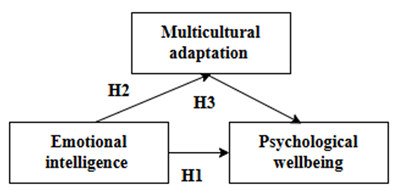
H1: Students' mental health improves when they have high
levels of emotional intelligence.
·
H2: The ability to adapt to other cultures is positively
correlated with emotional intelligence.
·
H3: When it comes to emotional
intelligence and mental health, multicultural adaptation plays a mediating role.
Scope and Delimitations
Examining
the effects of intercultural education on students' emotional intelligence,
capacity to adjust to new cultures, and psychological well-being is the driving
force behind this study. The study also makes an effort to shed light on
emotional intelligence's function as an indirect component in multicultural
adaptation and as a direct component in psychological wellness. All of the
participating universities' students are college freshmen or current students
enrolled in classes at schools that value cultural diversity and
student-teacher dialogue highly. Emotional intelligence, adaptation, and
wellbeing are the only variables that are measured using self-reports based on
psychological scales that have been validated.
The delimitations
of the study bring up the fact that it focuses specifically on university
students and not on other groups of people like school kids or employees. Also,
the study does not take into account other possibilities for mediating or
moderating variables such as personality traits, academic stress, or social
support that might affect the relationships being measured. Moreover, since the
research uses a cross-sectional design, it can only show relationships at one
moment in time, thus limiting the possibility of inferring causality. The
results, therefore, are valid only for the specific context of this research
and may not be applicable to students coming from non-multicultural or
different cultural backgrounds. Yet, the study despite its limitations, sheds
light on the emotional and intercultural factors that are pivotal to student
wellbeing in higher education.
Significance of the Study
This research holds great importance as it sheds light on the combined
effects of emotional intelligence and multicultural adaptation on psychological
wellbeing of students in the universities that are becoming more and more
diverse. Upon the coming of students into contact with others from different
cultures, their emotional understanding and controlling skills opens up a huge
necessity for the positive mental health and moreover, the performance in
studies. The overall well-being effect degree that goes beyond merely the
individual emotional regulation by examining the multicultural adaptation
mediating role is how the emotional intelligence is contributing to the
well-being. The results
of the study stress the need for and the use of various measures, for instance,
counseling services, intercultural competency programs, and emotional
intelligence training, to enhance students' adjustment and resilience. Another,
more comprehensive inclusive education practices that would result in an
emotionally balanced, socially harmonious, and academically successful
multicultural higher education context are laid out by this research through
the formation of a single model, thus paving the way for the theoretical
constructs to be built around the emotional and cultural aspects.
REVIEW OF LITERATURE
Singh et
al. (2022) From its inception to our current knowledge of
emotional intelligence (EI), the article provided a comprehensive literature
analysis that focused on the key theories that influenced its growth. In
addition, it examined several methods of measuring EI, which helped to clarify
the concept even further. Examining the existing EI models, measurement tools,
and the links between them was the primary goal of the article. The models were
compared according to certain characteristics like the emphasis on emotional
components, and the paper pointed out the discrepancies between three
particular models while at the same time marking the demand for uniform EI
scales which are distinguished by the focus on either cognitive parameters or
the use of personality traits.
Ackley
(2016) addressed everyday
inquiries about the usage of EQ in consulting psychology. Initially, it
contrasts three widely accepted models of EQ, after which it critiques
assessment instruments for appraising each model. Ultimately, it demonstrates
the use of EQ tests in executive mentoring and group building, thereby
emphasizing the practical advantages of EQ and the ways of its execution.
Soroka
(2022) The paper
primarily focused on the social adaptation of students in diverse cultural
environments, and particularly on the non-traditional method of distance
learning. It was conducted through the application of questionnaires and the
use of statistical tools to investigate an international students' s resilience
with the help of the obtained results showing an 81.92% resilience index and a
correlation (r = 0.45; p <0.01). The results indicated that the students had
high to medium resilience levels, as they were adjusting well to remote
learning in the midst of the COVID-19 crisis. The research work implies that
the exploration of effective strategies to promote social adaptation in
distance education should be among the priorities of the higher education
professionals, as it would be very much beneficially in the creation of an
adaptive learning environment.
Қожбаева
et al. (2024) The strategies of
the translators have been reflected and profiled concerning their operation in
the paradigmatic relationship of American multicultural literature between the
languages and the cultures. The main task here is nothing less than a systematic
boldness in the presentation and analysis of these strategies with the primary
focus on the preservation of the various cultures involved and the exact
reproduction of the meanings from the original texts. By means of a thorough
analysis of the literary works, the research reveals the existence of a number
of linguistic and cultural adaptation methods that are indispensable for the
genuine representation of the respective cultures. The outcomes significantly
benefit intercultural communication in the very least and offer a language and
culture interplay model in translating of the multicultural literature as well.
This research is not only aimed at the improvement of the translation training
and academic curricula but also at the opening up of cultural diversity and the
establishment of an effective intercultural communication, which is to say that
it will ultimately lead to the production of higher quality translated works
and the breeding of culturally aware translators.
Security is a socio-cultural phenomenon that encompasses various aspects
of social reality and is fundamentally tied to individuals' well-being. Yu (2018) Political,
economic, social, and cultural environments have been shown to impact both the
security of individuals and society at large. Psychological security, thus, is
not static but rather constantly subjected to the emergence of new threats
which require its continuous establishment. The use of an interdisciplinary
approach is pointed out as an advantageous way to comprehend security and
well-being, since the perception of security is primarily psychological and may
differ a lot among individuals and groups. Moreover, modern research is
steadily drawing attention to the interaction between well-being and security,
yet, the traditional tendency of only viewing security in terms of protection
and basic needs' satisfaction persists; hence, the relationship between
psychological well-being and security as complementary concepts remains poorly
explored.
The interest in the concept of well-being has increased remarkably,
bringing to light the two main types of well-being, namely, subjective
well-being (SWB) and eudaimonic well-being (EWB). In the case of SWB, it is
usually evaluated based on the presence of positive emotions and the level of
life satisfaction, whereas EWB does not have a standardized measurement system,
thus leading to the emergence of more than 45 different operationalizations and
63 different constructs, which makes it difficult to make comparisons across
studies. Martela
and Sheldon (2019) Eudaimonic motivations, psychological need
fulfillment, and SWB were the three pillars that made up the tripartite
paradigm of happiness. Grounded in self-determination theory, it postulates that the
satisfaction of the psychological needs for autonomy, competence, and
relatedness not only increases SWB but also contributes to overall health,
thus, it proposes that the inclusion of these needs in the surveys could bring
in very useful information for the policymakers about the cultural and social
factors impacting the well-being question.
Guerra-Bustamante
et al. (2019) The relationship
among emotional intelligence dimensions (attention, clarity, repair) and
adolescent's happiness levels (low, medium, high) has been studied based on a
survey of 646 secondary school students aged 12-17 (47.5% boys, 52.5% girls).
By employing multinomial logistic regression and ROC curve analysis, the
research applied the Trait Meta Mood Scale-24 and the Oxford Happiness
Questionnaire. The results show that emotional intelligence is one of the
factors associated with happiness in adolescence, which in turn makes this
period very important for the development of emotional skills that will benefit
well-being.
Shaheen
and Shaheen (2016) A study was conducted on one hundred children (50 boys
and 50 girls) randomly picked from the Senior Secondary Schools at AMU,
Aligarh, where the average age was fifteen years, to investigate the
correlation between EQ and mental health. The evaluation was done through a
well-being manifestation scale and an emotional intelligence test. The
correlation that was found through Pearson correlation analysis and t-tests was
statistically significant and positive concerning emotional intelligence.
Furthermore, girls had significantly higher scores in emotional intelligence
than boys, but no gender differences were observed in total psychological
well-being or its dimensions.
Kai et al. (2021) Among the several variables that influence an expat's
ability to adjust to a new culture, this study identified cross-cultural
competency as a mediator between the two. Findings highlight emotional
intelligence and cultural adaptability as critical components of cross-cultural
competency development and adaptation. We used structural equation modeling
using the partial least squares approach to evaluate the data gathered from 240
Taiwanese expatriates. The results provide important information on how cultural
adaptability affects performance and adjustment indirectly. This study
emphasizes the importance of cross-cultural competence and hence, it makes a
novel contribution to the existing literature, and it also provides practical
suggestions for HR managers in the areas of expatriate recruitment and
management.
Muhina
et al. (2016) examined the issues arising out of the educational
process structure in connection with the growth of the students' emotional
intelligence. In the current multicultural educational settings, emotional
intelligence is important for the training and professional adaptation of
future teachers. It underlines that the patterns of this formation are very
much connected to a country's particular mentality. The training is aimed at
the development of emotional intelligence as a primary skill for friendly and
efficient interactions, adaptability to educational activities, objective
information reception, and responsive behavior to the changes in the
environment. Besides, it deals with the need to comprehend the actions of the
peers, students, teachers, and parents during the learning and teaching
processes.
Martinet
and Damásio (2021) Among 108 immigrant participants, the research looked
at the relationships between demographics, cultural adaptation, hope, and
several measures of happiness, including GwB, SWB, SoWB, PWB, and meaning in
life.It
turned out that socio-cultural adaptation was the most favorable predicator of
all well-being dimensions but the least when it came to life's meaning. On the
other hand, cultural remoteness harmed SoWB but the same was not true for SWB
as it was just an area where psychological adaptation was positively linked.
There was an inverse relationship between money and the seeking of meaning
while age and type of immigration were the other factors negatively
correlating. The findings provide insights into the lives of Brazilian
immigrants.
Bae (2020) explored the connections between multicultural
teenagers' bicultural identity, acculturative stress, and subjective well-being
using an analysis of data from 1,635 individuals. There was a positive
correlation between psychological well-being and bicultural identification, and
a negative correlation between acculturative stress and psychological
well-being. Bicultural identity also had an indirect impact on mental health by
reducing the severity of acculturative stress. In order to assist multiethnic
adolescents in adjusting, the results highlight the necessity for educational
institutions to foster bicultural acceptance and mitigate the effects of
acculturative stress.
Identified Research Gaps
The phenomenon of emotional intelligence is very well known and the same
applies to multicultural adaptation and psychological well-being. Yet, there
has not been enough research that brings these concepts together and works with
them under a unified theoretical framework. Previous research has focused on isolated aspects,
such as emotional intelligence models and assessment tools, students' social
adaptation in specific settings, or the effect of cultural competency on
adaptation and performance. The present research intends to eliminate the gap
in knowledge by performing an empirical study investigating the direct and
indirect connections between emotional intelligence (EQ), multicultural
adaptation (MA), and psychological health across different educational
settings. Research on multicultural classrooms at the university level is
relatively less compared to adult studies or primary school children.
Therefore, the current research will give a wider view of the adaptation and
mental health of students in the different educational settings.
RESEARCH METHODOLOGY
Research Design
The relationships
between Emotional Intelligence (EI), Multicultural Awareness (MA), and
Psychological Well-Being (PWB) were explored through a quantitative
descriptive-correlational method in this study. The subjects of the research
were university students with different cultural backgrounds. This methodology
was selected because it enables a very thorough statistical examination of the
direct and indirect relationships of the variables. The study applied SEM
(Structural Equation Modeling) to measure the relationships, confirm the
hypotheses, and besides, the cross-sectional data which were obtained from the
subjects during a set time period were used to test the hypotheses. This method
allowed us not only to test the proposed theoretical model but also to develop
a strong analytical framework capable of investigating the mediation effects.
Data Collection Methods
The main
data was a structured questionnaire made up of four parts that contained
together: demographic characteristics, emotional intelligence, multicultural
adaptation, and psychological well-being. The researchers in this context
adapted standardized and verified scales:
·
The Emotional Intelligence Scale (EIS)
measured self-awareness, emotion regulation, and empathy.
·
The Multicultural
Adaptation Scale (MAS)
assessed the ability to interact effectively and adjust to culturally diverse
environments.
·
The Psychological Wellbeing Scale (PWB)
evaluated self-acceptance, life satisfaction, and emotional balance.
Likert
five-point scale was used to evaluate every single item. Prior to general use,
the instrument was tried out on a few people to ensure that it was easy to
understand and operate. A total of 384 students with different ethnicities,
ages, and academic levels were surveyed through both online and offline
methods. The process of obtaining ethical approval and informing participants
about their rights to privacy and autonomy was necessary for the voluntary
participation of the respondents followed by obtaining their consent.
Data Analysis
In order to
support its conclusions and assumptions, the study decided to use a
quantitative methodology that was systematic and orderly for examining the data
gathered. The application of appropriate statistical techniques was the main
reason for the dependability and trustworthiness of the findings. Researchers
used descriptive statistics to take a look at the respondent demographic data
like gender, age, educational level, and participation in cultural activities
and thus provided an overview of the sample's characteristics. After this, the
researchers confirmed the validity and reliability of the assessment scales
which showed that the items measuring EQ, intercultural adaptability, and
psychological wellness were precisely defined.
After
validating the measurement tools' adequacy, we employed inferential analysis to
uncover the correlations among variables. To assess the intensity of the links
between emotional intelligence, multicultural adaptability, and mental health,
the researchers resorted to correlation analysis. Structural Equation Modeling
(SEM) affirmed the anticipated mediation impacts and connections. Within the
scope of the proposed theoretical model, this method allowed for the
examination of both short- and long-term effects. The data had validated the
theoretical model, according to the findings of an evaluation of the overall
model fit using a number of well-known indices.
The analytical
process led to the identification of the way emotional intelligence benefited
psychological wellbeing both directly and indirectly through the mediation of
multicultural adaptation. The findings not only provided empirical proof for
the theoretical assumptions but also showed how emotional and cultural
competencies are interconnected in the process of bringing about psychological
wellbeing among students in div.
RESULTS
Objectives
·
To find out
how well students' emotional intelligence correlates with their mental health
and how well they adapt to different cultures.
·
To learn
more about how intercultural adaptation mediates the connection between EQ and
mental health in multiethnic classrooms.
Conceptual frame work
|
Figure 1
|
|
Figure 1 Conceptual Frame Work |
|
|
Demographic variables
Table 1
|
Table 1 Demographic
Variables |
|||
|
Frequency |
Percentage |
||
|
Gender |
Male |
181 |
47.1 |
|
Female |
203 |
52.9 |
|
|
Total |
384 |
100 |
|
|
Age |
18-20 Years |
94 |
24.5 |
|
21–25 Years |
78 |
20.3 |
|
|
26–30 Years |
117 |
30.5 |
|
|
Above 30
Years |
95 |
24.7 |
|
|
Total |
384 |
100 |
|
|
Level of
study |
Undergraduate |
183 |
47.7 |
|
Postgraduate |
201 |
52.3 |
|
|
Total |
384 |
100 |
|
|
Years of
study |
1st Year |
106 |
27.6 |
|
2nd Year |
83 |
21.6 |
|
|
3rd Year |
94 |
24.5 |
|
|
4th Year |
101 |
26.3 |
|
|
Total |
384 |
100 |
|
|
Cultural
Participation |
Low |
145 |
37.8 |
|
Moderate |
130 |
33.9 |
|
|
High |
109 |
28.4 |
|
|
Total |
384 |
100 |
|
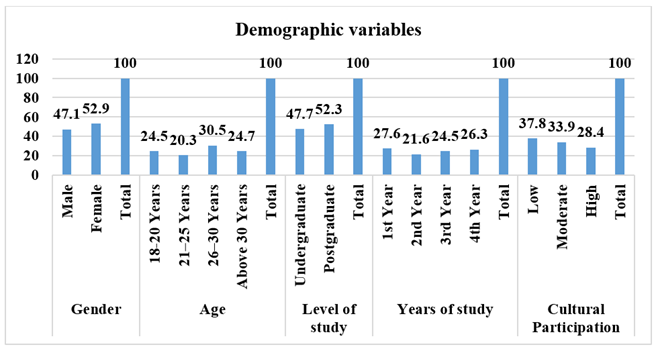
The 384
study participants were fairly evenly dispersed across all of the major
demographic factors. Male students made up 47.1% of the total, while female
students accounted for 52.9%. Among the students that took part, there was a
wide range of ages represented. The youngest was 18–20 years old, the oldest
was 30–something (or 30.5% of the total), and the middle ground was 21–25 years
old (20.3%). While 47.7% of the participants were undergraduates, 52.3% were
postgraduates, suggesting that a slightly larger number of the participants
were involved in advanced coursework.
The distribution of students throughout years of study was very uniform, with
1st-year students constituting 27.6%, 2nd-year 21.6%, 3rd-year 24.5%, and
4th-year 26.3%. Regarding cultural participation, 37.8% of the respondents
declared low involvement, while 33.9% and 28.4% reported moderate and high
involvement in multicultural activities, respectively. This situation means
that a large part of the student population got the opportunity to have
different kinds of contacts with multicultural aspects through their university
life. The sample is well-distributed in terms of gender, age, academic levels,
and intercultural involvement, which together make a strong base for the study
of emotional intelligence, multicultural adaptability, and psychological
well-being to be carried out.
Table 2
|
Table 2 Validity and
Reliability |
|||
|
Variables |
Cronbach’s
Alpha |
Composite
Reliability |
AVE |
|
Psychological
Wellbeing |
0.8940 |
0.85 |
0.665 |
|
Emotional Intelligence |
0.8850 |
0.842 |
0.647 |
|
Multicultural
Adaptation |
0.9140 |
0.853 |
0.745 |
According to
the reliability and validity outcomes table, three variables—cultural
adaptation, emotional intelligence, and mental health—have convergent validity
and strong internal consistency. All of the variables have Cronbach's Alpha
values greater than or equal to 0.70, with ranges from 0.885 to 0.914. This
verifies the dependability and consistency of the objects within each build. A
measurement model is deemed trustworthy if its Composite Dependability (CR)
score falls within the range of 0.842 to 0.853, which exceeds the threshold of
0.70. With AVE values ranging from 0.647 to 0.745, all constructions are also
greater than 0.50; this means that each construct explains more than half of
the variation in its indicators. These results confirm that the measurement
model is reliable and has good convergent validity, so you know the items are
measuring what they claim to be.
Table 3
|
Table 3 Mean and Standard
Deviation |
||
|
Variables |
Mean |
Std. Deviation |
|
Psychological Wellbeing |
3.7014 |
0.78208 |
|
Emotional Intelligence |
3.6706 |
0.75842 |
|
Multicultural Adaptation |
3.7583 |
0.79340 |
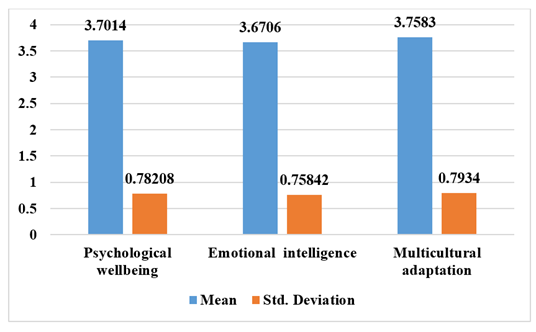
The descriptive statistics
indicate that the three primary variables psychological wellbeing, emotional
intelligence, and intercultural adaptation exhibit comparatively high mean
scores, indicating favourable trends among respondents. Multicultural adaptation
has the highest mean score (M = 3.76, SD = 0.79), indicating that participants
mostly see themselves as well acclimated to multicultural settings.
Psychological wellness (M = 3.70, SD = 0.78) and emotional intelligence (M =
3.67, SD = 0.76) exhibit fairly high mean values, indicating that participants
in the research had a commendable degree of emotional awareness and overall
wellbeing. The standard deviation scores, which were between 0.75 and 0.79,
showed a slight variation in the opinions of the participants. This means that
even if the majority of the people had the same opinion, the differences in
their emotional intelligence, adaptation, and wellbeing would be very small.
The results demonstrate that the sampled individuals in a cross-cultural setting,
on the whole, keep up a healthy and nice mental and emotional state.
Hypothesis
implementation
H1:
Emotional intelligence is positively related to students’ psychological
wellbeing.
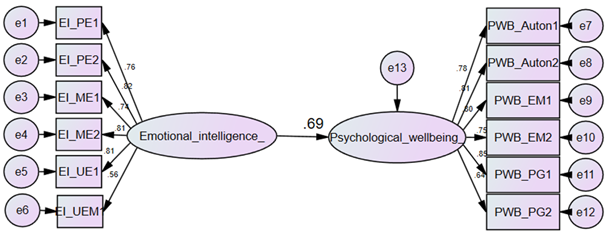
Table 4
|
Table 4 Regression
Weights: (Group Number 1 - Default Model) |
||||
|
Path |
Standard
Estimate |
S.E. |
C.R. |
P |
|
Psychological
wellbeing <--- Emotional intelligence |
0.692 |
0.057 |
11.942 |
*** |
The path
analysis output gives evidence of a solid and statistically significant
relationship between EQ and the mental health of pupils. Pupils scoring higher
in the emotional intelligence test show better overall mental and emotional
health as the standardized estimate (β = 0.692) implies that the one-unit
increase in emotional intelligence results in a very remarkable psychological
wellbeing improvement. The strong relationship is verified by the critical
ratio (C.R. = 11.942), which exceeds the suggested limit of 1.96. On the other
hand, the conclusion is highly significant as the p-value (p < 0.001)
suggests. This research supports the first hypothesis that claims students'
emotional intelligence is a great contributor to their mental health by helping
them understand, regulate, and express their emotions in academic and
intercultural contexts more easily.
Table 5
|
Table 5 Model Fit Summery |
|||||||||
|
CMIN |
DF |
CMIN/DF |
GFI |
NFI |
RFI |
IFI |
CFI |
RMR |
RMSEA |
|
75.826 |
53 |
1.431 |
0.967 |
0.972 |
0.965 |
0.991 |
0.991 |
0.023 |
0.034 |
The
suggested model gives a good match to the data, according to the model fit
indices. A Chi-square value (CMIN) of 75.826 suggests a model fit with 53
degrees of freedom (DF) and a CMIN/DF ratio of 1.431, which is much lower than
the acceptable threshold of 3. This model explains a large portion of the
observed data variation with Goodness-of-Fit Index (GFI) values of 0.967 and
Normed Fit Index (NFI) values of 0.972, both of which are greater than 0.90.
Additionally, the three fit indices (CFI = 0.991, RFI = 0.965, and IFI = 0.991)
are all higher than the suggested cutoff of 0.95, indicating that the model is
extremely well-fitting and that the comparison with the null model was very
effective. It is clear that the model and data are in good agreement, as both
the RMR and RMSEA are well below 0.05 (0.023 and 0.034, respectively). It seems
like a strong bet to use this model because it has low error rates, high
structural validity, and statistically significant goodness-of-fit signals.
H2:
Emotional intelligence is positively related to multicultural
adaptation.
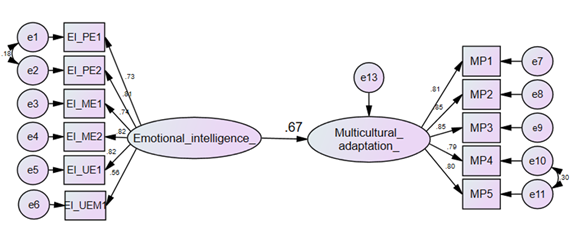
Table 6
|
Table 6 Regression
Weights: (Group Number 1 - Default Model) |
||||
|
Path |
Standard
Estimate |
S.E. |
C.R. |
P |
|
Multicultural
Adaptation <--- Emotional Intelligence |
0.668 |
0.058 |
11.781 |
*** |
Results from
structural equation modeling show that EQ and the ability to adapt to different
cultures go hand in hand. There is a strong association between people'
heightened emotional intelligence and enhanced intercultural adaptability, as
indicated by the standardised value (β = 0.668). This correlation is
statistically significant since the critical ratio (C.R. = 11.781) is much
higher than the cutoff value of 1.96. In addition, the result is very
significant and cannot be attributed to random chance, as shown by the p-value
(***, p < 0.001). Emotional awareness and regulation help individuals
navigate cultural disparities and build positive intercultural relationships;
hence, people with high emotional intelligence are better able to adapt, understand,
and operate effectively in multicultural settings.
Table 7
|
Table 7 Model Fit Summery |
|||||||||
|
CMIN |
DF |
CMIN/DF |
GFI |
NFI |
RFI |
IFI |
CFI |
RMR |
RMSEA |
|
60.07 |
41 |
1.465 |
0.973 |
0.978 |
0.97 |
0.993 |
0.993 |
0.024 |
0.035 |
The model
fits the data well, according to fit indices. With a chi-square value (CMIN) of
60.07 and 41 degrees of freedom (DF), a CMIN/DF ratio of 1.465 indicates a
reasonable model fit, considerably below the necessary 3. The goodness-of-fit
indices (GFI = 0.973, NFI = 0.978, RFI = 0.970, IFI = 0.993, and CFI = 0.993)
supported this finding. These results are all above the 0.90 threshold,
indicating that the suggested model fits the experiment data well. The model
fits the population well with negligible residual error because RMR and RMSEA
are substantially below 0.08. These statistical results show that the proposed
model fits the data well and is stable and dependable.
H3: Multicultural
adaptation mediates the relationship between emotional intelligence and
psychological wellbeing.
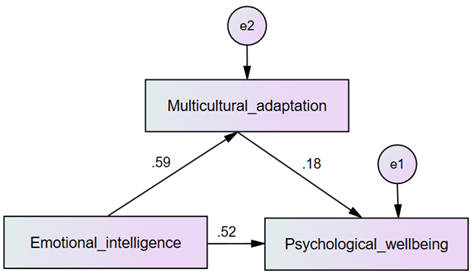
Table 8
|
Table 8 Regression
Weights: (Group Number 1 - Default Model) |
||||||
|
Path |
Standard Estimate |
S.E. |
C.R. |
P |
||
|
Multicultural
adaptation |
<--- |
Emotional intelligence |
0.59 |
0.043 |
14.315 |
*** |
|
Psychological
wellbeing |
<--- |
Multicultural
adaptation |
0.18 |
0.048 |
3.699 |
*** |
|
Psychological
wellbeing |
<--- |
Emotional intelligence |
0.517 |
0.05 |
10.624 |
*** |
Mediating EI
and PWB, the mediation study found multicultural adaptation (MA) essential.
Emotional intelligence (EI) and multicultural adaptability (MA) are positively
and significantly correlated (standardized estimate = 0.59, S.E. = 0.043, C.R.
= 14.315, p < 0.001). This suggests that individuals with higher EI are
better at navigating multicultural settings. MA considerably enhances students'
psychological health, particularly their ability to adapt to multicultural
situations (standardised estimate = 0.18, S.E. = 0.048, C.R. = 3.699, p 0.001).
Strong mediation exists between emotional intelligence (EI) and psychological
well-being (PWB), with a partial estimate of 0.517, a standard error of 0.05, a
coefficient of determination of 10.624, and a p-value less than 0.001.This
provides more evidence that EQ influences mental health both directly and
indirectly through intercultural competence. The results show that EQ has two
main effects: one is a direct improvement to health, and the other is a more
indirect improvement to people's ability to adapt to new cultural environments.
Standardized Indirect Effects (Group number 1 - Default model)
Table 9
|
Table 9 Standardized
Indirect Effects (Group Number 1 - Default Model) |
||
|
Emotional
intelligence |
Multicultural
adaptation |
|
|
Multicultural
adaptation |
0 |
0 |
|
Psychological
wellbeing |
0.106 |
0 |
As shown in
the Standardized Indirect Effects table, the connection between emotional
intelligence (EI) and psychological wellbeing (PWB) is mediated by
multicultural adaptability (MA). Emotional intelligence (EI) indirectly
contributes to psychological wellbeing (PWB) through an individual's capacity
to negotiate intercultural environments. Supporting this, we find that EI has a
standardized indirect effect of 0.106 on PWB via multicultural adaptability
(MA). In conclusion, improved intercultural adaptability is associated with
enhanced emotional intelligence, which has a salutary effect on people's mental
health. According to the positive magnitude of the indirect effect, which
implies that mediation acts positively, a growth in emotional intelligence's positive
influence on well-being is magnified by increased adaption in multicultural
situations. This evidence supports Hypothesis 3 (H3), which states that the
relationship between emotional intelligence and psychological health is
influenced by one's ability to adapt to other cultures.
DISCUSSION
College
students' emotional intelligence, psychological health, and capacity to adjust
to different cultures were positively correlated in various situations,
according to this study. It may be that being in touch with one's emotions and
able to channel them productively leads to more fulfillment in one's life,
since students who scored higher on assessments of emotional intelligence also
reported higher levels of mental health. Emotionally savvy students have a leg
up when it comes to managing academic pressure, making and keeping friends, and
controlling their emotions. Individuals having higher emotional intelligence
levels are likely to attain success in unfamiliar cultural contexts and to get
accustomed to and communicate effectively thereafter, as well. Their capacity
for empathy, self-control, and keeping a receptive mind can be seen as the main
factors for their adaptability which again leads to positive interactions among
the people of different backgrounds. Mediation studies show that the ability to
adapt to different cultures mitigates the relationship between EQ and mental
health to a less degree than the case of IQ. This means that emotional
intelligence is a double-edged sword: it not only enhances a person's mental
health but also helps the person to be more flexible in the different cultural
environments. Besides, the qualities of acceptance, competence, and emotional
stability have boosted students' psychological well-being if they are able, so
to speak, to adapt to different situations easily. The results speak of
emotional intelligence as being the factor, the primary one, that is the most
helpful in people's health, on the one hand, and in their adjustment to
different cultures, on the other hand. It is not only the case that students in
multicultural classrooms will flourish, quickly adjust, and not suffer from
stress when they are trained in these three areas of intercultural skills and
emotional intelligence; it is also the case that universities are strongly
recommended to incorporate such training into their student support services.
CONCLUSION
Data shows
that emotional intelligence plays a major role in not just the well-being but
also in the academic success of university students, especially those taking
mixed-gender classes. The healthiest, in general, are the ones who obtain the
highest scores for emotional intelligence. Higher scores indicate better
emotional intelligence and better regulation of emotions, which in turn help
deal with cultural differences and academic stress. The students that got
higher scores on the emotional intelligence test were more prone to very good
cross-cultural communication skills, adjusting to strange cultural norms, and
making friends with the others from different backgrounds, and all these
features are the signs of successful international adaptation. The ability to
adjust to new cultural environments is one of the factors that mediates the
relationship between emotional intelligence and psychological well-being, as
indicated by the mediation study. The idea that emotional intelligence can
either make or break students' mental and emotional well-being therefore comes
a little nearer to being substantiated as it implies that emotional
intelligence is a student’s ticket to easy entrance and transition through
different classroom types. Along with over-all emotional support and stability,
the students' well-being receives a major boost if they are very good at
adapting to cultural differences since this will lead to more inclusion,
understanding, and emotional stability. Thus, the results point to the fact
that students need to be trained not only in emotion management for themselves
and others but also in the use of the communication and collaboration
techniques with people from different cultural backgrounds. The multicultural
awareness and emotional intelligence programs that are introduced in
conjunction with the school's intention to be more diverse and welcoming will
not only result in a better but also more adaptable student population. The
research not only confirms but also elaborates the interconnectedness of
psychological wellness, global adaptability, and emotional intelligence,
furthermore it suggests that the blend of emotional and cultural skills gives a
considerable edge in different educational contexts.
ACKNOWLEDGMENTS
None.
REFERENCES
Ackley, D. (2016). Emotional Intelligence: A Practical Review Of Models, Measures, and applications. Consulting Psychology Journal: Practice and Research, 68(4), 269–286. https://doi.org/10.1037/cpb0000070
Bae, S. M. (2020). The Relationship Between Bicultural Identity, Acculturative Stress, and Psychological Well‐Being in Multicultural Adolescents: Verification using multivariate latent growth modelling. Stress and Health, 36(1), 51–58. https://doi.org/10.1002/smi.2912
Gebregergis, W. T., and Csukonyi, C. (2025). Unveiling Psychological and Sociocultural Adaptation Patterns of International Students. Journal of International Students, 15(4), 97–117. https://doi.org/10.32674/21yqse06
Guerra-Bustamante, J., León-Del-Barco, B., Yuste-Tosina, R., López-Ramos, V. M., and Mendo-Lázaro, S. (2019). Emotional Intelligence and Psychological Well-Being in Adolescents. International Journal of Environmental Research and Public Health, 16(10), 1720. https://doi.org/10.3390/ijerph16101720
Indrayathi, P. A., Kovács, E., Januraga, P. P., Pradnyani, P. E., Rahyuda, I., and Kolozsvári, L. R. (2025). Exploring Determinants of Well-Being Among International Students: A Basis for Health Policy and Risk Management in Higher Education. Risk Management and Healthcare Policy, 18, 3359–3370. https://doi.org/10.2147/RMHP.S534448
Kai Liao, Y., Wu, W.-Y., Dao, T. C., and Ngoc Luu, T.-M. (2021). The Influence of Emotional Intelligence and Cultural Adaptability on Cross-Cultural Adjustment and Performance with the Mediating Effect of Cross-Cultural Competence: A Study of Expatriates in Taiwan. Sustainability, 13(6), 3374. https://doi.org/10.3390/su13063374
Le Vigouroux, S., Chevrier, B., Montalescot, L., and Charbonnier, E. (2025). Post-Pandemic Student Mental Health and Coping Strategies: A Time Trajectory Study. Journal of Affective Disorders, 376, 260–268. https://doi.org/10.1016/j.jad.2025.02.007
Martela, F., and Sheldon, K. M. (2019). Clarifying the Concept of Well-Being: Psychological Need Satisfaction as the Common Core Connecting Eudaimonic and Subjective Well-Being. Review of General Psychology, 23(4), 458–474. https://doi.org/10.1177/1089268019880886
Martinet, É. H. G., and Damásio, B. F. (2021). Relationships Between Cultural Adaptation and Immigrants’ Well-Being. Psico-USF, 26(3), 467–481. https://doi.org/10.1590/1413-82712021260306
Martínez-Rodríguez, A., and Ferreira, C. (2025). Factors Influencing the Development of Emotional Intelligence in University Students. European Journal of Psychology of Education, 40(2), 60. https://doi.org/10.1007/s10212-025-00956-4
Mohamed Hashim, M. A., Tlemsani, I., Ndrecaj, V., and Cockrill, A. (2025). Modelling the Impact of Emotional Intelligence on Academic Performance: A Conceptual and Empirical Approach in Higher Education. Innovations in Education and Teaching International, 1–18. https://doi.org/10.1080/14703297.2025.2498529
Muhina, T., Aboimova, I., Kulagina, A., Trophimov, V., and Chigarov, E. (2016). Development of Emotional Intelligence of Students as a Condition of Successful Adaptation to Training. International Electronic Journal of Mathematics Education, 11(10), 3463–3467.
Prado, S., Baldofski, S., Kohls, E., Rummel, C., and Id, K. (2024). International and Domestic University Students’ Mental Health Over the Course of the COVID-19 Pandemic in Germany: Comparison Between 2020, 2021, and 2022. PLOS ONE, 19(2), e0299812. https://doi.org/10.1371/journal.pone.0299812
Rodrigo, J., Villar, B. Del, Chunsuwimol, B., Flores, L. A. B., Mando, D. A., Bayoging, B., Pada, W. J. V., Sukmueang, C., and Leephetwongngam, W. (2025). Intercultural Competence as a Mediator Between Emotional Intelligence and Job Satisfaction: Insights from Teaching Professionals in Thailand. Advances in Consumer Research, 5, 1–15.
Ruiz-Ortega, A. M., Sánchez-Álvarez, N., and Berrios-Martos, M. P. (2024). Psychological Well-Being and Emotional Intelligence in Undergraduate Nursing Students as Predictors of Academic Success. Nurse Education Today, 143, 106406. https://doi.org/10.1016/j.nedt.2024.106406
Shaheen, S., and Shaheen, H. (2016). Emotional Intelligence in Relation to Psychological Well-Being Among Students. The International Journal of Indian Psychology, 3(4), 206–213. https://doi.org/10.25215/0304.115
Shengyao, Y., Xuefen, L., Jenatabadi, H. S., Samsudin, N., Chunchun, K., and Ishak, Z. (2024). Emotional Intelligence Impact on Academic Achievement and Psychological Well-Being Among University Students: The Mediating Role of Positive Psychological Characteristics. BMC Psychology, 12(1), 389. https://doi.org/10.1186/s40359-024-01886-4
Singh, A., Prabhakar, R., and Kiran, J. S. (2022). Emotional Intelligence: A Literature Review of Its Concept, Models, and Measures. Journal of Positive School Psychology, 6(10), 1–15.
Soroka, I. A. (2022). Social Adaptation of Students in a Multicultural Environment During Distance Learning. Journal of Curriculum and Teaching, 11(1), 208–217. https://doi.org/10.5430/jct.v11n1p208
Yu, Z. O. (2018). Psychological Security as the Foundation of Personal Psychological Well-Being (Analytical Review). Psychology in Russia: State of the Art, 11(2), 100–113. https://doi.org/10.11621/pir.2018.0208
Zayed, K., Omara, E., Al Kitani, M., Al-Yaaribi, A., Al-Jadidi, K. M., Daroushi, A. R., Al Busafi, M. S., Gaafar, A., Al-Ashkar, H., Al-Hadabi, B., and Mohamed Ali, E. (2025). Structural Relationships Between Emotional Intelligence, Well-Being, and Psychological Distress: A Multi-Group SEM Study Among Undergraduate Physical Education Students in Three Arab Countries. Frontiers in Psychology, 16, 1650030. https://doi.org/10.3389/fpsyg.2025.1650030
Қожбаева, Г., Мизамхан, Б., and Каримова, К. (2024). Translation Adaptation of Linguocultural Components in American Multicultural Literature. Абылай хан атындағы ҚазХҚжәнеӘТУ Хабаршысы. Филология ғылымдары сериясы, 72(1), 1–15. https://doi.org/10.48371/PHILS.2024.72.1.023
|
|
 This work is licensed under a: Creative Commons Attribution 4.0 International License
© IJETMR 2014-2025. All Rights Reserved.