
|
|
|
|
Original Article
PREDICTING MACHINE FAILURES AND SYSTEM SECURITY USING MACHINE LEARNING AND DEEP LEARNING ALGORITHMS
|
Ambreena Muneer 1* 1 Research Scholar, India 2 Research Guide and Professor, Department of Computer Science and Engineering, NIMS Institute of Computer Science and Engineering, NIMS University, Rajasthan, Jaipur, India |
|
|
|
ABSTRACT |
||
|
The term “Internet of Things” (IoT) refers to a system of networked computing devices that may work and communicate with one another without direct human intervention. It is one of the most exciting areas of computing nowadays, with its applications in multiple sectors like cities, homes, wearable equipment, mobile system, critical infrastructure, hospitals, and transportation. The security issues surrounding IoT devices increase as they expand. To address these issues, this study presents a novel model for enhancing the security of IoT systems using machine learning (ML) classifiers. The proposed approach analyzes recent technologies, security, intelligent solutions, and vulnerabilities in ML IoT-based intelligent systems as an essential technology to improve IoT security. The study illustrates the benefits and limitations of applying ML in an IoT environment and provides a security model based on ML that manages autonomously the rising number of security issues related to the IoT domain. The paper proposes an ML-based security model that autonomously handles the growing number of security issues associated with the IoT domain. This research made a significant contribution by developing a cyberattack detection solution for IoT devices using ML. The study used seven ML algorithms to identify the most accurate classifiers for their AI-based reaction agent’s implementation phase, which can identify attack activities and patterns in networks connected to the IoT. The study used seven ML algorithms to identify the most accurate classifiers for their AI-based reaction agent’s implementation phase, which can identify attack activities and patterns in networks connected to the IoT. Compared to previous research, the proposed approach achieved a 99.9% accuracy, a 99.8% detection average, a 99.9 F1 score, and a perfect AUC score of 1. The study highlights that the proposed approach outperforms earlier machine learning-based models in terms of both execution speed and accuracy. The study illustrates that the suggested approach outperforms previous machine learning-based models in both execution time and accuracy. Industry 4.0 emphasizes real-time data analysis for understanding and optimizing physical processes. This study leverages a Predictive Maintenance Dataset from the UCI repository to predict machine failures and categorize them. This study covers two objectives namely, to compare the performance of machine learning algorithms in classifying machine failures, and to assess the effectiveness of deep learning techniques for improved prediction accuracy. The study explores various machine learning algorithms and finds the XG Boost Classifier to be the most effective among them. Long Short-Term Memory (LSTM), a deep learning algorithm, demonstrates its superior accuracy in predicting machine failures compared to both traditional machine learning and Artificial Neural Networks (ANN). The novelty of this study is the application and comparison of machine learning and deep learning models to an unbalanced dataset. Findings of this study hold significant implications for industrial management and research. The study demonstrates the effectiveness of machine learning and deep learning algorithms in predictive maintenance, enabling proactive maintenance interventions and resource optimization. Keywords: Machine, Failures, System, Security,
Deep Learning, Algorithms |
||


INTRODUCTION
In general, ML techniques must be used in
conjunction with other security measures to offer complete security for IoT
systems. ML algorithms and methods have been applied in various tasks,
including machine translation, regression, clustering, transcription,
detection, classification, probability mass function, sampling, and estimation
of probability density. Numerous applications utilize ML techniques and
algorithms, such as spam identification, image and video recognition, customer
segmentation, sentiment analysis, demand forecasting, virtual personal
assistants, detection of fraudulent transactions, automation of customer
service, authentication, malware detection, and speech recognition4.
In addition, IoT and ML integration can
enhance the devices of IoT levels of security, thereby increasing their
reliability and accessibility. ML’s advanced data exploration methods play an
important role in elevating IoT securityfr om only
providing security for communication devices to intelligent systems with a high
level of security5. ML-based models have emerged as a response to cyberattacks
within the IoT ecosystem, and the combination of Deep Learning (DL) and ML
approaches represents a novel and significant development that requires careful
consideration. Numerous uses, including wearable smart gadgets, smart homes,
healthcare, and Vehicular Area Networks (VANET), necessitate the implementation
of robust security measures to safeguard user privacy and personal information.
The successful utilization of IoT is evident across multiple sectors of modern
life6. By 2025, we expect that the IoT will have an economic effect of
$2.70–$6.20 trillion. Research findings indicate that ML and DL techniques are
key drivers of automation in knowledge work, thereby contributing to the
economic impact. There have been many recent technological advancements that
are shaping our world in significant ways. By 2025, we expect an estimated
$5.2–$6.7 trillion in annual economic effects from knowledge labor automation7. This research study addresses the
vulnerabilities in IoT systems by presenting a novel ML- based security model.
The proposed approach aims to address the increasing security concerns
associated with the Internet of Things. The study analyzes
recent technologies, security, intelligent solutions, and vulnerabilities in
IoT-based smart systems that utilize ML as a crucial technology to enhance IoT
security. The paper provides a detailed analysis of using ML technologies to
improve IoT systems’ security and highlights the benefits and limitations of
applying ML in an IoT environment. When compared to current ML-based models,
the proposed approach outperforms them in both accuracy and execution time,
making it an ideal option for improving the security of IoT systems. The
creation of a novel ML-based security model, which can enhance the
effectiveness of cybersecurity systems and IoT infrastructure, is the
contribution of the study. The proposed model can keep threat knowledge
databases up to date, analyze network traffic, and
protect IoT systems from newly detected attacks by drawing on prior knowledge
of cyber threats.
|
Figure 1
|

|
Figure 1 IOT
Applications |
The study comprises five sections: “Related
works” section presents a summary of some previous research. “IoT, security,
and ML” section introduces the Internet of Things’ security and ML aspects.
“The proposed IoT framework architecture” section presents the proposed IoT
framework architecture, providing detailed information and focusing on its
performance evaluation. “Result evaluation and discussion” section provides an
evaluation of the outcomes and compares them with other similar systems. We
achieve this by utilizing appropriate datasets, methodologies, and classifiers.
“Conclusions and upcoming work” section concludes the discussion and outlines
future research directions.
Nowadays, with the rise of the Internet of
Things (IoT), a large number of smart applications are being built, taking
advantage of connecting several types of devices to the internet. These
applications will generate a massive amount of data that need to be processed
promptly to generate valuable and actionable information. Edge intelligence
(EI) refers to the ability to bring about the execution of machine learning
tasks from the remote cloud closer to the IoT/Edge devices, either partially or
entirely. Examples of edge devices are smartphones, access points, gateways,
smart routers and switches, new generation base stations, and micro data centers.
|
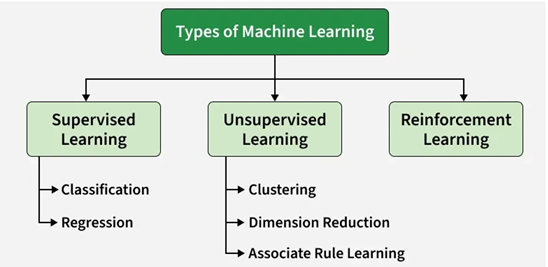
Figure 2 |
|
Figure 2 Types
of Machine Learning |
Some edge devices have considerable computing
capabilities (although always much smaller than cloud processing centers), but most are characterized by very limited
capabilities. Currently, with the increasing development in the area of MEMS
(Micro–Electro– Mechanical Systems) devices, there is a tendency to carry out
part of the processing within the data producing devices themselves (sensors) Kunst et
al. (2019),
Tessoni and Amoretti (2022),
Vollert et al. (2021),
O’Donovan et al. (2019) . There are certainly several
challenges involved in performing processing on resource-limited devices,
including the need to adapt complex algorithms and divide the processing among
several nodes. Therefore, in Edge Intelligence, it is essential to promote
collaboration between devices to compensate for their lower computing capacity.
Some synonyms of this concept found in the literature are: distributed
learning, edge/fog learning, distributed intelligence, edge/fog intelligence
and mobile intelligence Romeo et
al. (2020),
Boyes et al. (2018),
Arena et al. (2022) .
The leverage of edge intelligence reduces some drawbacks of running ML tasks
entirely in the cloud, such as:
High latency Kaushik
and Yadav (2023): offloading
intelligence tasks to the edge enables achievement of faster inference,
decreasing the inherent delay in data transmission through the network backbone;
·
Security and privacy issues Adhikari
et al. (2018),Zhou and Tham (2018): it is
possible to train and infer on sensitive data fully at the edge, preventing
their risky propagation throughout the network, where they are susceptible to
attacks. Moreover, edge intelligence can derive non-sensitive information that
could then be submitted to the cloud without further processing;
·
The need for continuous internet
connection: in locations where connectivity is poor or intermittent, the ML/DL
could still be carried out;
·
Bandwidth degradation: edge computing
can perform part of processing tasks on raw data and transmit the produced data
to the cloud (filtered/aggregated/pre-processed), thus saving network
bandwidth. Transmitting large amounts of data to the cloud burdens the network
and impacts the overall Quality of Service (QoS) Liu et al. (2018).
·
Power waste Carbery
et al. (2018): unnecessary
raw data being transmitted through the internet demands power, decreasing
energy efficiency on a large scale. The steps for data processing in ML vary
according to the specific technique in use, but generally occur in a
well-defined life cycle, which can be represented by a workflow.
Model building is at the heart of any ML
technique, but the complete life cycle of a learning process involves a series
of steps, from data acquisition and preparation to model deployment into a
production environment. When adopting the Edge intelligence paradigm, it is
necessary to carefully analyze which steps in the ML
life cycle can be successfully executed at the edge of the network. Typical
steps that have been investigated for execution at the edge are data
collection, pre-processing, training and inference. Considering the
aforementioned steps in ML and the specific features of edge nodes, we can
identify many challenges to be addressed in the edge intelligence paradigm,
such as (i) running ML/DL on devices with limited
resources, (ii) ensuring energy efficiency without compromising the inference
accuracy; (iii) communication efficiency; (iv) ensuring data privacy and
security in all steps; (v) handling failure in edge devices; and (vi) dealing
with heterogeneity and low quality of data. In this paper, we present the
results of a systematic literature review on current state-of-the-art
techniques and strategies developed for distributed machine learning in edge
computing. We applied a methodological process to compile a series of papers
and discuss how they propose to deal with one or more of the aforementioned
challenges.
To align with Industry 4.0, traditional
industrial automation approaches are evolving with the integration of new
elements. The Internet of Things (IoT) and Cyber-Physical Systems (CPS) play
crucial roles in enabling artificial intelligence and facilitating intelligent
manufacturing, leading to the creation of innovative products and services Kunst et
al. (2019). Companies
embracing this approach face increased competition in a dynamic market
environment, where simply increasing production capacity does not guarantee
success Tessoni and Amoretti (2022). Despite
various interpretations of industrial challenges, incorporating domain
knowledge into understandable and explainable models remains challenging Vollert
et al. (2021). DSS,
leveraging machine learning algorithms, aids in product design iterations and
facilitates effective policymaking, potentially enabling quicker recovery from
failures O’Donovan et al. (2019),Romeo et al. (2020). Furthermore,
leveraging vast amounts of data, particularly in predicting machine failures
and scheduling maintenance, allows industries to enhance performance and
autonomously manage product requirements Boyes et
al. (2018). However, many
manufacturing organizations struggle to embrace data-driven strategies due to
various challenges, particularly during the data preprocessing stage Arena et
al. (2022). As data
generated within Industry 4.0 proliferate, machine learning algorithms play a
vital role in extracting insights for improved understanding Kaushik
and Yadav (2023). Nowadays ML
can not only be used to diagnose problems, but can also be used to diagnose,
prognosticate, and forecast problems Adhikari
et al. (2018),Zhou and Tham (2018). In many
instances, machines exhibit signs of deterioration and symptoms before they
fail. Predictive maintenance (PdM) is a strategy used
by engineers to anticipate failures before they occur, relying on sensor-based
condition monitoring of machinery and equipment. However, implementing PdM requires substantial data and real-time monitoring,
posing challenges such as latency, adaptability, and network bandwidth Liu et al. (2018). Implementing
predictive maintenance at various stages of design offers several benefits but
also presents challenges. Advantages include increased productivity, reduced
system faults Carbery
et al. (2018), decreased
unplanned downtime, and improved resource efficiency Wang and Wang (2017). Predictive
maintenance also enhances maintenance intervention planning optimization Balogh
et al. (2018). However,
managing data from multiple systems and sources within a facility is
challenging, as is obtaining accurate data for predictive modelling Bousdekis et
al. (2019),Ferreira et al. (2017). Additionally,
implementing machine learning models and artificial intelligence faces
challenges such as collecting training data Xu et al. (2018),
LITERATURE REVIEW
Maintenance can be broken down into two
primary categories reactive maintenance and proactive maintenance. These are
the types of maintenance most performed in Industries. After a valued item has
had a breakdown, the purpose of reactive maintenance is to return it to working
order Ding and Kamaruddin (2015). Through the
utilization of preventative and predictive maintenance procedures, the purpose
of proactive maintenance is to forestall the occurrence of expensive repairs
and the early breakdown of assets. Corrective maintenance does not incur any
upfront costs and does not need any prior preparation to be carried out Susto and Beghi (2016). In most
cases, machines will experience some level of deterioration before finally
breaking down. It is possible to monitor the trend of degradation to rectify
any flaws that may exist before they cause any failure or the equipment to
break down. Since machine maintenance is only carried out when it is necessary,
this tactic results in greater levels of efficiency Susto and Beghi (2016). One such
strategy that assists us in predicting failures before they take place is known
as predictive maintenance (PdM). For this strategy to
work, the asset in question needs to undergo condition monitoring, which
employs sensor technologies to look for warning signs of deteriorating
performance or impending breakdown. The PdM allows
for the decision-making process to be examined from two different vantage
points: the diagnosis and the prognosis. According to Jeong et al. Jeong et
al. (2007),diagnosis is
the process of determining the underlying cause of a problem, whereas prognosis
is the process of estimating the likelihood that a failure will occur in the
future Lewis and Edwards (1997). Prognosis
maintenance policy is further divided into statistical-based maintenance and
condition-based maintenance. Industry 4.0 equipped digital model gives
maintenance staff the ability to schedule repairs more effectively because it
provides real-time equipment information. It is evident that predictive
maintenance is gaining more attention due to the recent advancements in data
collection through Industry 4.0technologies and data analysis capabilities
using evolutionary algorithms, cloud technology, data analytics, machine
learning and artificial intelligence. According to U car et al. Ucar et al. (2024) AI is the main
component of PdM for next-step autonomy in machines,
which can improve the autonomy and adaptability of machines in complex and
dynamic working environments. It is comprehensible that predictive maintenance
is getting additional consideration because of recent advancements in data
accessibility and analytics capabilities brought on by expanding research into
ML and AI algorithms. Machine learning is frequently used by researchers to
anticipate failure and improve output. Hesser and Markert Hesser
and Markert (2019) used an
Artificial Neural Network (ANN) model embedded within a CNC-milling machine to
monitor tool wear. Models like this one can be applied to older machinery that
can be used in Industry 4.0, as well as for research purposes. Kamariotis et al. (2024)found testing and validating
AI-based PdM systems face a challenge due to the
absence of standard evaluation metrics. This complicates the comparison of
system performance and assessment of accuracy and reliability. Various
evaluation metrics, including prediction accuracy, mean squared error, and
precision and recall, have been suggested by researchers to address this issue.
Sampaio et al. (2019) created an ANN model
based on vibration measurements for the training dataset. Additionally, they
compare the outcomes of ANN to those of Random Forest and Support Vector
Machine (SVM), two other ML techniques, and discover that ANN is superior.
Binding et al. [29] created Logistic Regression, XG Boost, and Random Forest
models to assess the machine’s operational status. By way of choice criteria,
Random Forest and XG Boost execute far improved as compared to Logistic
Regression, while all algorithms perform better than one another in terms of
Receiver Operating Characteristic (ROC). It was developed by Falamarzi et al. [30] to track forecast data and measure variation.SVM models predict curved segment gauge deviation
better than ANN models do for straight segment gauge deviation. To recognize
various rotary equipment scenarios, Biswal and Sabareesh [31] developed a Deep
Neural Network (hereafter referred to as DNN) and Convolutional Neural Network
(hereafter referred to as CNN). It can be used to monitor bearings in
production lines and enhance the monitoring of online conditions in coastal
turbines for wind energy. Data mining canbe used to
predict system behaviour based on historical data. Amodel-based
approach that heavily relies on analytical models to illustrate how the system
operates has a few benefits. In fields with an abundance of data, like
industrial maintenance, machine learning maybe used [32]. Actual results,
answers based on cloud-based, and new algorithms are all becoming more popular.
Quiroz et al. [33] applied the Random Forest technique for fault identification
and validity and reliability analysis with turned 98 %diagnostic accuracy rate.
Yan and Zhou [34] use TF- IDF (Term Frequency- Inverse Document Frequency) and
RF (Radio Frequency) data from aircraft speed and torque sensors to create ML
models for defect prediction. After extracting the features with TF-IDF from
the unprocessed data after the earlier flights, Random Forest had an accurate
optimistic degree of 66.67 percent and a percentage of false positives of0.13
percent. To predict wear and failures, Lee et al. [35] observed the spindle
motor and cutting machine using data-driven machine learning modelling. It has
been demonstrated that models using SVM and neural networks with artificial intelligence
can forecast system health and longevity with high accuracy. According to Palangi et al. [36], recurrent neural network (RNN) and
long short-term memory networks (LSTM) algorithms perform well with data that
is sequential, time-series data with dependencies that last along
time, and information from IoT flow sensors. LSTM and Naïve Bayes models
combined, according to the study, may effectively identify trends and produce
forecasts. The Naive Bayes anomaly detector was created by the LSTM model. Learning
through deep learning with Cox proportional hazard (CoxPHDL)
was developed in a research study to address the common problems of data
flexibility and filtering that occur when functional maintenance information is
analyzed [37]. The main goal was to develop an
integrated solution based on dependability analysis and deep learning. In
Gensler et al. [38] IoT application that combines solar panel prediction, the
Deep Belief Network (DBN).
The idea of security in IoT devices has been
recently articulated in studies that analyze the
security needs at several layers of architecture, such as the application,
cloud, network, data, and physical layers. Layers have examined potential
vulnerabilities and attacks against IoT devices, classified IoT attacks, and
explained layer-based security requirements8. On the other hand, industrial IoT
(IIoT) networks are vulnerable to cyber attacks.
Developing IDS is important to secure IIoT networks. The authors presented
three DL models, LSTM, CNN, and a hybrid, to identify IIoT network breaches9.
The researchers used the UNSW-NB15 and X-IIoTID
datasets to identify normal and abnormal data, then compared them to other
research using multi-class, and binary classification. The hybrid LSTM + CNN
model has the greatest intrusion detection accuracy in both datasets. The
researchers also assessed the implemented models’ accuracy in detecting attack
types in the datasets9. In Ref.10, the authors introduced the hybrid synchronous-asynchronous
privacy-preserving federated technique. The federated paradigm eliminates
FL-enabled NG-IoT setup issues and protects all its pieces with Two- Trapdoor
Homomorphic Encryption. The server protocol blocks irregular users. The asynchronous
hybrid
LEGATO algorithm reduces user dropout. By
sharing data, they assist data-poor consumers. In the presented model, security
analysis ensures federated correctness, auditing, and PP. Their performance
evaluation showed higher functionality, accuracy, and reduced system overheads
than peer efforts. For medical devices, the authors of Ref.11 developed an
auditable privacy-preserving federated learning (AP2FL) method. By utilizing
Trusted Execution Environments (TEEs), AP2FL reduces issues about data leakage during
training and aggregation activities on both servers and clients. The authors of
this study aggregated user updates and found data similarities for non-IID data
using Active Personalized Federated Learning (ActPerFL)
and Batch Normalization (BN). In Ref.12, the authors addressed two major
consumer IoT threat detection issues. First, the authors addressed FL’s unfixed
issue: stringent client validation. They solved this using quantum-centric
registration and authentication, ensuring strict client validation in FL. FL
client model weight protection is the second problem. They suggested adding
additive homomorphic encryption to their model to protect FL participants’
privacy without sacrificing computational speed. This technique obtained an
average accuracy of 94.93% on the N-baIoT dataset and
91.93% on the Edge- IIoT set dataset, demonstrating consistent and resilient
performance across varied client settings. Utilizing a semi-deep learning
approach, Steel Eye was created in Ref.13 to precisely detect and assign
responsibility for cyber attacks that occur at the
application layer in industrial control systems. The proposed model uses
category boosting and a diverse range of variables to provide precise
cyber-attack detection and attack attribution. Steel Eye demonstrated superior
performance in terms of accuracy, precision, recall, and Fl-score compared to
state-of-the-art cyber-attack detection and attribution systems. In Ref.14,
researchers developed a fuzzy DL model, an enhanced adaptive neuro-fuzzy
inference system (ANFIS), fuzzy matching (FM), and a fuzzy control system to
detect network risks. Our fuzzy DL finds robust nonlinear aggregation using the
fuzzy Choquet integral. Metaheuristics optimized ANFIS attack detection’s error
function. FM verifies transactions to detect block chain fraud and boost
efficiency. The first safe, intelligent fuzzy block chain architecture, which
evaluates IoT security threats and uncertainties, enables block chain layer
decision- making and transaction approval. Tests show that the block chain
layer’s throughput and latency can reveal threats to block chain and IoT.
Recall, accuracy, precision, and F1-score are important for the intelligent
fuzzy layer. In block chain-based IoT networks, the FCS model for threat
detection was also shown to be reliable. In Ref.15, the study examined
Federated Learning (FL) privacy measurement to determine its efficacy in
securing sensitive data during AI and ML model training. While FL promises to
safeguard privacy during model training, its proper implementation is crucial.
Evaluation of FL privacy measurement metrics and methodologies can identify
gaps in existing systems and suggest novel privacy enhancement strategies.
Thus, FL needs full research on “privacy measurement and metrics” to thrive.
The survey critically assessed FL privacy measurement found research gaps, and suggested further study. The research also
included a case study that assessed privacy methods in an FL situation. The
research concluded with a plan to improve FL privacy via quantum computing and
trusted execution environments.
IoT, security, and ML IoT attacks and security vulnerabilities
Critical obstacles standing in the way of
future attempts to see IoT fully accepted in society are security flaws and
vulnerabilities. Everyday IoT operations are successfully managed by security
concerns. In contrast, they have a centralized structure that results in
several vulnerable points that may be attacked. For example, unpatched
vulnerabilities in IoT devices are a security concern due to outdated software
and manual updates. Weak authentication in IoT devices is a significant issue
due to easy-to-identify passwords. Attackers commonly target vulnerable
Application Programming Interfaces (APIs) in IoT devices using code injections,
a man-in-the-middle (MiTM), and Distributed
Denial-of-Service (DDoS)16. Unpatched IoT devices pose risks to users,
including data theft and physical harm. IoT devices store sensitive data,
making them vulnerable to theft. In the medical field, weak security in devices
such as heart monitors and pacemakers can impede medical treatment. Figure 1
illustrates the types of IoT attacks (threats)17. Unsecured IoT devices can be
taken over and used in botnets, leading to cyber attacks
such as DDoS, spam, and phishing. The Mirai software in 2016 encouraged
criminals to develop extensive botnets for IoT devices, leading to
unprecedented attacks. Malware can easily exploit weak security safeguards in
IoT devices18. Because there are so many connected devices, it may be difficult
to ensure IoT device security. Users must follow fundamental security
practices, such as changing default passwords and prohibiting unauthorized
remote access19. Manufacturers and vendors must invest in securing IoT tool
managers by proactively notifying users about outdated software, enforcing
strong password management, disabling remote access for unnecessary functions,
establishing strict API access control, and protecting command-and-control
(C&C) servers from attacks.
IoT applications’ support security issues
Security is a major requirement for almost
all IoT applications. IoT applications are expanding quickly and have impacted
current industries. Even though operators supported some applications with the
current technologies of networks, others required greater security support from
the IoT-based technologies they use20. The IoT has several uses, including home
automation and smart buildings and cities. Security measures can enhance home
security, but unauthorized users may damage the owner’s property. Smart applications
can threaten people’s privacy, even if they are meant to raise their standard
of living. Governments are encouraging the creation of intelligent cities, but
the safety of citizens’ personal information may be at risk21,22. Retail
extensively uses the IoT to improve warehouse restocking and create smart
shopping applications. Augmented reality applications enable offline retailers
to try online shopping. However, security issues have plagued IoT apps
implemented by retail businesses, leading to financial losses for both clients
and companies.
PROPOSED METHODOLOGY
This study employs a quantitative,
experimental, and comparative research design to evaluate the efficiency of
Machine Learning (ML) and Deep Learning (DL) models in predicting machine
failures within an Industry 4.0 environment. The design emphasizes supervised
learning techniques, model benchmarking, hyperparameter optimization, and
rigorous performance validation using real-world industrial data.
|
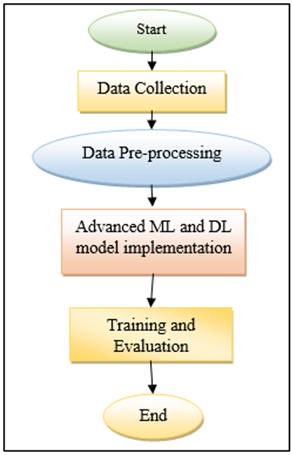
Figure 3 |
|
Figure 3 Proposed
Methodology Flowchart |
Two major analytical components structure the
research: ML-based classification models for machine failure prediction and
LSTM-based deep learning models for time-series behaviour analysis. Both
components are tested on a highly imbalanced predictive maintenance dataset
sourced from the UCI Repository. The experimental design allows systematic
comparison of models under identical conditions, ensuring fairness in
evaluating accuracy, detection capability, and robustness. This approach
supports developing reliable predictive maintenance solutions capable of
offering early warnings and improving industrial decision-making.
Data Source and Description
The study utilizes the Predictive Maintenance
Dataset from the UCI Machine Learning Repository, which contains comprehensive
machine-level operational data, including thermal readings, rotational speed,
torque, voltage levels, tool wear, and system load conditions. The dataset
reflects real industrial behaviour, combining normal operating records with
rare failure occurrences, resulting in a significantly imbalanced class
distribution. It includes several categories of machine failures, such as tool
wear, heat-related issues, overstrain, power failures, and random breakdowns.
Key variables consist of sensor-generated numerical features and operational
parameters, along with binary and multi-class failure labels. This rich,
multi-dimensional dataset provides an ideal testing ground for evaluating
predictive maintenance algorithms, enabling the study to assess how well ML and
DL models capture early deterioration signals and accurately classify impending
failures.
Data Preprocessing
A structured data preprocessing workflow was
implemented to ensure reliability and analytical accuracy. The dataset was
first examined for missing values and noise, though no missing entries were
found due to the dataset’s curated nature. Minor inconsistencies were addressed
through outlier detection and stability checks on sensor readings. Since
machine failures occur infrequently, the dataset suffered from severe class
imbalance, which was corrected using the SMOTE oversampling technique to
synthetically generate minority failure samples. Feature engineering steps
included scaling and normalizing numerical attributes, encoding categorical
variables, and applying a stratified train–test split to preserve class
proportions. These preprocessing techniques enhanced data quality, improved
model learning, and ensured that both ML and DL models were trained on
balanced, representative, and properly formatted inputs.
Machine Learning Models Used
The study implemented and compared seven
machine learning algorithms to identify the most effective model for predicting
machine failures. These included Random Forest, Logistic Regression, Support
Vector Machine, Naïve Bayes, Decision Tree, Gradient Boosting methods, and the XGBoost Classifier, which emerged as the primary performer.
Each algorithm was trained using standardized procedures and evaluated using
identical metrics to ensure fairness. To enhance model performance, Random
Search CV was employed for hyperparameter tuning due to its efficiency and
superior exploration of parameter space compared to Grid Search.
1) Random
Forest (RF)
Random Forest is an ensemble learning method
that builds multiple decision trees and aggregates their predictions to improve
accuracy and reduce overfitting. Each tree is trained on a randomly sampled
subset of data and features, making the model robust against noise and
variance. RF is highly effective for classification tasks, handles nonlinear
relationships well, and performs strongly in predictive maintenance scenarios
where sensor data contain complex patterns.
2) Logistic
Regression (LR)
Logistic Regression is a simple yet powerful
statistical classification model that estimates the probability of a binary
outcome using a logistic function. It is widely used due to its
interpretability and low computational cost. LR works best with linearly
separable data and provides insights into feature importance. Although less
effective for complex nonlinear patterns, it serves as a strong baseline for
machine failure prediction tasks.
3) Support
Vector Machine (SVM)
Support Vector Machine is a supervised
learning model that identifies an optimal hyperplane separating classes with
maximum margin. SVM performs exceptionally well in high-dimensional spaces and
can model nonlinear relationships through kernel functions. Its robustness to
overfitting makes it suitable for predictive maintenance datasets. Although
computationally expensive for large datasets, SVM delivers high accuracy when
distinguishing between normal and failure states in machine data.
4) Naïve
Bayes (NB)
Naïve Bayes is a probabilistic classifier
based on Bayes’ theorem, assuming independence among features. It is efficient,
fast, and performs well even with small datasets or noisy data. NB is
particularly useful in early-stage prediction tasks due to its low training
time. Although the independence assumption may not always hold, it remains
effective for machine failure classification where quick approximations of
failure likelihood are required.
5) Decision
Tree (DT)
Decision Tree is a rule-based classification
model that splits data into branches using feature thresholds, forming an
interpretable tree structure. It models nonlinear patterns and interactions
without requiring complex data preprocessing. DT is easy to visualize and
understand, making it useful for industrial applications. However, it is prone
to overfitting when used alone, which is why it often serves as a base model
for ensemble techniques.
6) Gradient
Boosting Methods
Gradient Boosting builds an ensemble of weak
learners—typically decision trees—in sequential stages, where each new model
corrects the errors of the previous ones. It optimizes predictive performance
by minimizing loss functions using gradient descent. This approach captures
complex relationships and delivers highly accurate results. Gradient boosting
is well-suited for predictive maintenance tasks that require sensitivity to
subtle failure patterns in sensor readings.
7) XGBoost
Classifier (Primary ML Model)
XGBoost
(Extreme Gradient Boosting) is an advanced and optimized boosting algorithm
designed for high speed, scalability, and superior performance. It incorporates
regularization, parallel processing, and optimized tree-building techniques,
making it highly effective for structured industrial datasets. XGBoost handles missing values, nonlinear relationships,
and class imbalance efficiently. Its exceptional accuracy, reliability, and
fast execution make it the leading model for machine failure prediction in this
study.
Deep Learning Framework
The study incorporates a deep learning
framework to capture temporal behavior and sequential
dependencies inherent in machine operating data. The primary model used is Long
Short-Term Memory (LSTM), a recurrent neural network architecture specifically
designed to learn long-term patterns from time-series sensor readings. LSTM effectively
identifies gradual deterioration trends, cyclical fluctuations, and hidden
temporal relationships that traditional ML models may overlook, making it
highly suitable for modeling machine failure
progression. To benchmark its performance, the study also employs a baseline
Artificial Neural Network (ANN) built on a standard multi-layer perceptron
structure. While ANN can learn complex feature interactions, it does not retain
sequential memory, resulting in lower accuracy compared to LSTM. However, the
study notes that ANN performance can improve with deeper architectures and
optimized hyperparameters. Together, these deep learning models provide a
comprehensive evaluation of temporal predictive capabilities in industrial
failure prediction scenarios.
Model Training and Validation
Model training and validation were carried
out using a structured approach to ensure accuracy, fairness, and reliability
in the performance comparison of all machine learning models. After the dataset
underwent preprocessing and balancing through the SMOTE technique, it was
divided into two subsets: 70% for training and 30% for testing. This split was
applied after oversampling to prevent data leakage and maintain the integrity
of model evaluation. The training set was used to fit each model and optimize
parameters, while the testing set served as an independent dataset to assess
generalization performance. This ensured that the models learned from a
balanced dataset but were evaluated on realistic, unseen distributions
representative of actual industrial conditions.
To measure predictive performance, multiple
evaluation metrics were applied, capturing both statistical accuracy and
failure detection capability. Accuracy provided an overall measure of correct
predictions, while Precision, Recall, and F1 Score offered deeper insights into
the model’s sensitivity to rare failure events. ROC-AUC Score evaluated the
models’ ability to distinguish between failure and non-failure classes across
thresholds, and the Confusion Matrix revealed specific misclassification patterns.
Together, these metrics ensured a comprehensive assessment of each algorithm’s
effectiveness in predictive maintenance scenarios.
RESULTS AND DISCUSSION
The primary goal of the classification model
is to predict whether the machine will break down within the allotted time. It
is possible to forecast the residual usable life of the machine by utilizing
the regression model; nevertheless, the value of the prediction shifts with the
deterioration of the asset. They can go down significantly or up significantly.
However, if many assets need to be tracked, it will not be possible to do so on
an individual basis for each asset. As a result, a classification model has
been developed that provides certain early warnings with precision and within a
predetermined time frame. The performance metrics of several machine learning
models are displayed in Table 1. After obtaining the results for the various ML
models, the hyper parameters of these models will be modified to attain a
greater degree of precision and accuracy. As the tuning of hyper parameters was
discussed in the previous section and it is known that the "Random Search
CV" method is superior to the other commonly employed parameter
optimization techniques, we can move on to the next step. The effects of hyper
parameter tuning and optimization on the performance metrics of multiple
machine learning models are displayed in Table 2. Based on the data presented in
Table 2, it can be concluded that the XG Boost classifier is the most effective
of all the algorithms used in the modeling process.
It is primarily because it has the highest AUC score.
Table 1
|
Table 1 Evaluation
Metrics of a Classification Model. |
|||||
|
Model |
Accuracy |
Precision |
Recall |
F1-Score |
AUC-Score |
|
Logistic
Regression |
0.6453 |
0.4419 |
0.9625 |
0.6057 |
0.5331 |
|
KNN |
0.7168 |
0.6709 |
0.6831 |
0.6769 |
0.7007 |
|
SVC |
0.7293 |
0.7809 |
0.8027 |
0.7916 |
0.7138 |
|
Decision
Tree (Gini) |
0.6998 |
0.7713 |
0.7668 |
0.7690 |
0.7237 |
|
Decision
Tree (Entropy) |
0.6998 |
0.7713 |
0.7668 |
0.7690 |
0.7237 |
|
Bagging
Classifier |
0.8239 |
0.8859 |
0.5799 |
0.7010 |
0.7842 |
|
Adaptive
Boosting |
0.7786 |
0.8551 |
0.8657 |
0.8604 |
0.7814 |
|
Adaptive
Boosting |
0.7671 |
0.8520 |
0.8557 |
0.8538 |
0.7817 |
|
Random
Forest Classifier |
0.7964 |
0.9054 |
0.9234 |
0.9143 |
0.8202 |
|
XG
Boost Classifier |
0.8480 |
0.9460 |
0.9466 |
0.9463 |
0.8544 |
Table 2
|
Table 2 Evaluation Metrics
of Classification Model
After Hyper Parameters Tuning
Optimization |
|||||
Model
|
Accuracy
|
Precision
|
Recall
|
F1-Score
|
AUC-Score
|
Logistic Regression
|
0.6692
|
0.4693
|
0.9976
|
0.6383
|
0.5532
|
KNN
|
0.7407
|
0.6983
|
0.7182
|
0.7081
|
0.7208
|
SVC
|
0.7532
|
0.8083
|
0.8378
|
0.8228
|
0.7339
|
Decision Tree
(Gini)
|
0.7237
|
0.7987
|
0.8019
|
0.8003
|
0.7438
|
Decision Tree
(Entropy)
|
0.7237
|
0.7987
|
0.8019
|
0.8003
|
0.7438
|
Bagging
Classifier
|
0.8478
|
0.9133
|
0.6150
|
0.7353
|
0.8043
|
Adaptive Boosting
|
0.8025
|
0.8825
|
0.9008
|
0.8916
|
0.8015
|
Gradient
Boosting
|
0.7910
|
0.8794
|
0.8908
|
0.8850
|
0.8018
|
Random Forest
|
0.8203
|
0.9328
|
0.9585
|
0.9455
|
0.8403
|
XG Boost
Classifier
|
0.8719
|
0.9734
|
0.9817
|
0.9776
|
0.8745
|
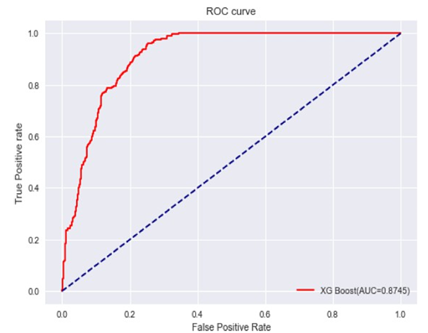
And the highest accuracy among all the
models. The ROC curve for an XG Boost model illustrates its ability to
discriminate between positive and negative classes across various threshold
values, serving as a pivotal tool for evaluating its classification performance.
The ROC-curve corresponding to the XG Boost model is depicted in Fig. 7, and
the confusion matrix for the XG Boost model applied to the validation dataset
is shown in Table 3.
|
Figure 4
|
|
Figure 4 ROC
Curve of XG Boost Model. |
CONCLUSION AND FUTURE WORK
Predictive maintenance appears as an essential method for accomplishing the goals of Industrial Revolution 4.0 in the worldwide industrial sector. The classification models created in this study greatly improve maintenance planning by providing early indications of asset breakdown. Critical tracking of multiple assets at the same time is now possible using these models. However, implementing predictive maintenance presents obstacles, such as addressing dataset imbalance and optimizing hyperparameters for greater performance. The growing applications of machine learning in all domains of science and technology attempts better prediction through applying wellknown models and comparing their performances. Though the models applied in this study are well known machine learning and deep learning models, the focus of this work was on trying to explore the models that ensure accurate prediction with an imbalance dataset. The researchers can apply the same set of algorithms for predicting machine failure in any type of industrial setting. Additionally, this study has developed a data-driven model for predicting machine failure and compared results from different machine learning algorithms. Practitioners and policymakers can take note that these algorithms require availability of large amount of error-free data to predict failure accurately. Many industries do not invest in data collection through IOT and sensor devices and face frequent breakdowns and interruption in their production lines. Analytics of collected manufacturing and operations data can help in saving huge amounts of time and money of manufacturing and service industries. Additionally, while a relevant problem, this paper does not focus on exploring why some algorithms and techniques are individually better than others. Still, the techniques considered represent the most used approaches, and the algorithms used for the meta-learner also provide a decent insight into the performance that can be expected. The SMOTE approach effectively resolved the imbalance in the dataset, allowing for the comparison of different machine-learning methods. The results show that the XG Boost Classifier outperforms other ML algorithms in terms of performance measures, even after hyperparameter adjustment. This emphasizes the significance of balancing datasets and fine- tuning model parameters to ensure accurate predictions. Furthermore, the use of deep learning models, notably Long Short-Term Memory (LSTM), outperforms typical machine learning approaches. Although the accuracy of Artificial Neural Networks (ANN) initially fell short, layer-based optimization has the potential to improve. Despite its efficiency, predictive maintenance remains very expensive due to the use of advanced monitoring technology. Future efforts should focus on creating low-cost sensor technologies to reduce monitoring costs. Furthermore, future work will focus on optimizing hyperparameter tweaking in machine learning models. Furthermore, investigating a range of deep learning algorithms other than LSTM could improve the modelling process and provide more reliable forecasting capabilities. In conclusion, while predictive maintenance provides significant benefits for maintenance planning and efficiency, overcoming problems such as dataset imbalance and cost considerations is critical. Continued R&D efforts will help to advance and widely adopt predictive maintenance solutions in the industry. Predicting machine failures through predictive models, one of the goals of Industry 4.0, provides timely warnings of potential equipment failures and helps organizations to schedule maintenance activities. The results of this study demonstrate the effectiveness of machine learning and deep learning algorithms in predictive maintenance, enabling proactive maintenance interventions and resource optimization. It also contributes to the growing body of research on machine learning applications in industrial settings, advancing theoretical understanding and paving the way for further refinement of predictive maintenance methodologies.
ACKNOWLEDGMENTS
None.
REFERENCES
Adhikari, P., Rao, H. G., and Buderath, M. (2018). Machine Learning-Based Data Driven Diagnostics and Prognostics Framework for Aircraft Predictive Maintenance. In Proceedings of the 10th International Symposium on NDT in Aerospace (24–26). Dresden, Germany.
Arena, S., Florian, E., Zennaro, I., Orrù, P. F., and Sgarbossa, F. (2022). A Novel Decision Support System for Managing Predictive Maintenance Strategies Based on Machine Learning Approaches. Safety Science, 146, 43–54. https://doi.org/10.1016/j.ssci.2021.105529
Balogh, Z., Gatial, E., Barbosa, J., Leitão, P., and Matejka, T. (2018). Reference Architecture for a Collaborative Predictive Platform for Smart Maintenance In Manufacturing. In 22nd International Conference On Intelligent Engineering Systems (Ines) (Pp. 299–304). Ieee. Https://Doi.Org/10.1109/Ines.2018.8523969
Bousdekis, A., Mentzas, G., Hribernik, K., Lewandowski, M., von Stietencron, M., and Thoben, K.-D. (2019). A unified architecture for proactive maintenance in manufacturing enterprises. In Enterprise Interoperability VIII (307–317). Springer. https://doi.org/10.1007/978-3-030-13693-2_26
Boyes, H., Hallaq, B., Cunningham, J., and Watson, T. (2018). The Industrial Internet of Things (IIoT): An Analysis Framework. Computers in Industry, 101, 1–12. https://doi.org/10.1016/j.compind.2018.04.015
Carbery, C. M., Woods, R., and Marshall, A. H. (2018). A Bayesian Network-Based Learning System For Modelling Faults In Large-Scale Manufacturing. In Ieee International Conference On Industrial Technology (Icit) (1357–1362). Ieee. Https://Doi.Org/10.1109/Icit.2018.8352377
Da Cunha Mattos, T., Santoro, F. M., Revoredo, K., and Nunes, V. T. (2014). A Formal Representation for Context-Aware Business Processes. Computers In Industry, 65(8), 1193–1214. Https://Doi.Org/10.1016/J.Compind.2014.07.005
Ding, S. H., and Kamaruddin, S. (2015). Maintenance Policy Optimization—Literature Review and Directions. International Journal of Advanced Manufacturing Technology, 76, 1263–1283. https://doi.org/10.1007/s00170-014-6341-2
Ferreira, L. L., Albano, M., Silva, J., Martinho, D., Marreiros, G., Di Orio, G., and Ferreira, H. (2017). A Pilot for Proactive Maintenance in Industry 4.0. In 2017 IEEE 13th International Workshop on Factory Communication Systems (WFCS) (1–9). IEEE. https://doi.org/10.1109/WFCS.2017.7991952
Hesser, D. F., and Markert, B. (2019).
Jeong, I. J., Leon, V. J., and Villalobos, J. R. (2007). Integrated Decision-Support System for Diagnosis, Maintenance Planning, and Scheduling of Manufacturing Systems. International Journal of Production Research, 45(2), 267–285. https://doi.org/10.1080/00207540600678896
Kaushik, A., and Yadav, D. K. (2023). Analysing Failure Prediction for a Manufacturing Firm Using Machine Learning Algorithms. In Advanced Engineering Optimization Through Intelligent Techniques: Select Proceedings of AEOTIT 2022 (pp. 457–463). Springer Nature Singapore. https://doi.org/10.1007/978-981-19-9285-8_44
Kunst, R., Avila, L., Binotto, A., Pignaton, E., Bampi, S., and Rochol, J. (2019). Improving Devices Communication in Industry 4.0 Wireless Networks. Engineering Applications of Artificial Intelligence, 83, 1–12.
Lewis, S. A., and Edwards, T. G. (1997). Smart Sensors and System Health Management Tools for Avionics and Mechanical Systems. In 16th DASC. AIAA/IEEE Digital Avionics Systems Conference. Reflections to the Future. Proceedings 2 (8-5). IEEE. https://doi.org/10.1109/DASC.1997.637283
Liu, Z., Jin, C., Jin, W., Lee, J., Zhang, Z., Peng, C., and Xu, G. (2018). Industrial AI Enabled Prognostics for High-Speed Railway Systems. In 2018 IEEE International Conference on Prognostics and Health Management (ICPHM) (1–8). IEEE. https://doi.org/10.1109/ICPHM.2018.8448431
O’Donovan, P., Gallagher, C., Leahy, K., and O’Sullivan, D. T. (2019). A Comparison of Fog and Cloud Computing Cyber-Physical Interfaces for Industry 4.0 Real-Time Embedded Machine Learning Engineering Applications. Computers in Industry, 110, 12–35. https://doi.org/10.1016/j.compind.2019.04.016
Romeo, L., Loncarski, J., Paolanti, M., Bocchini, G., Mancini, A., and Frontoni, E. (2020). Machine Learning-Based Design Support System for the Prediction of Heterogeneous Machine Parameters in Industry 4.0. Expert Systems with Applications, 140, 112869. https://doi.org/10.1016/j.eswa.2019.112869
Schmidt, B., and Wang, L. (2018). Cloud-Enhanced Predictive Maintenance. International Journal of Advanced Manufacturing Technology, 99, 5–13. https://doi.org/10.1007/s00170-016-8983-8
Schmidt, B., and Wang, L. (2018). Predictive Maintenance of Machine Tool Linear Axes: A Case from Manufacturing Industry. Procedia Manufacturing, 17, 118–125. https://doi.org/10.1016/j.promfg.2018.10.022
Susto, G. A., and Beghi, A. (2016). Dealing with Time-Series Data in Predictive Maintenance Problems. In 2016 IEEE 21st International Conference on Emerging Technologies and Factory Automation (ETFA) (1–4). IEEE. https://doi.org/10.1109/ETFA.2016.7733659
Tessoni, V., and Amoretti, M. (2022). Advanced Statistical and Machine Learning Methods for Multi-Step Multivariate Time Series Forecasting in Predictive Maintenance. Procedia Computer Science, 200, 748–757. https://doi.org/10.1016/j.procs.2022.01.273
Ucar, A., Karakose, M., and Kırımça, N. (2024). Artificial Intelligence for Predictive Maintenance Applications: Key Components, Trustworthiness, and Future Trends. Applied Sciences, 14(2), 898. https://doi.org/10.3390/app14020898
Vollert, S., Atzmueller, M., and Theissler, A. (2021). Interpretable Machine Learning: A Brief Survey from the Predictive Maintenance Perspective. In 2021 26th IEEE International Conference on Emerging Technologies and Factory Automation (ETFA) (1–8). IEEE. https://doi.org/10.1109/ETFA45728.2021.9613467
Wang, K., and Wang, Y. (2017). How AI Affects the Future Predictive Maintenance: A Primer of Deep Learning. In International Workshop of Advanced Manufacturing and Automation 32 (1–9). Springer. https://doi.org/10.1007/978-981-10-5768-7_1
Xu, Y., Sun, Y., Liu, X., and Zheng, Y. (2018). A Digital-Twin-Assisted Fault Diagnosis Using Deep Transfer Learning. IEEE Access, 7, 990–999. https://doi.org/10.1109/ACCESS.2018.2890566
Zhou, C., and Tham, C. K. (2018). Graphel: A Graph-Based Ensemble Learning Method for Distributed Diagnostics and Prognostics in the Industrial Internet of Things. In 2018 IEEE 24th International Conference on Parallel and Distributed Systems (ICPADS) (903–909). IEEE. https://doi.org/10.1109/PADSW.2018.8644943
|
|
 This work is licensed under a: Creative Commons Attribution 4.0 International License
© IJETMR 2014-2025. All Rights Reserved.