
|
|
|
|
The Role of Customer satisfaction in retaining industrial clients in steel industry
Jiya Mahajan1, Dr. Jyoti Sah2
1 BBA(G),
Amity Business School
2 Assistant
Professor, Amity Business School
|
|
|
ABSTRACT |
|
|
This study examines the role of customer satisfaction in an intensely competitive business-to-business market and its impact on the retention capability of the steel industry regarding its industrial customers. The key factors that influence customer loyalty, namely product quality, regular and appropriate pricing, on-time delivery, technical support, and after-sales service, are identified. The link between satisfaction and long-term retention was studied through primary data from direct interaction with clients and secondary data extracted from business records. The results show that building trust and maintaining relationships require timely responses to client needs, effective communication, and dependability. According to
the study's findings, customer satisfaction and relationship management are
the most important factors influencing client loyalty and company expansion
in the steel industry, even though innovation and technology improve product
performance. |
|||
|
Received 05 January 2025 Accepted 02 February 2025 Published 31 March 2025 DOI 10.29121/ijetmr.v12.i3.2025.1699 Funding: This research
received no specific grant from any funding agency in the public, commercial,
or not-for-profit sectors. Copyright: © 2025 The
Author(s). This work is licensed under a Creative Commons
Attribution 4.0 International License. With the
license CC-BY, authors retain the copyright, allowing anyone to download,
reuse, re-print, modify, distribute, and/or copy their contribution. The work
must be properly attributed to its author.
|
|||
|
Keywords: Customer
Satisfaction, Client Retention, Steel Industry, B2b Marketing, Service
Quality, Relationship Management |
|||



1. INTRODUCTION
The steel sector has traditional been an important driver of the country's economies, playing a crucial role in the supply of raw materials to infrastructure, automotive, engineering, energy, and major construction sectors. Due to its importance in the supply chain, the interfaces between the steel producer and industrial customers go beyond a simple transaction. These relationships rely on ongoing product performance, reliability of supply, responsiveness, and above all, confidence that has been developed over time.
In an increasingly competitive environment - in which there are supply solutions in the marketplace that are frequently technically equivalent - customer satisfaction has emerged as an essential differentiator between one supplier and another. For industrial buyers, determining satisfaction goes beyond simply considering product quality; how well the supplier understands and supports the operational needs of the customer, is the most important determinant of satisfaction. Factors such as timeliness of delivery, specification compliance, responsiveness of the supply solution to customized needs, ability to resolve complaints in a timely manner, digital product service support, and effective post sale product support all play a critical role in influencing the customer's experience.
Companies like ArcelorMittal Nippon Steel India (AMNS) have recognized that industrial customers expect integrated service solutions, not a simply steel service solution. It is important for suppliers and the steel sector's competitiveness to understand how customer satisfaction converts into loyalty. Satisfied customers are more likely to place repeat orders, decrease their propensity to switch suppliers, and even collaborate on new product development. In the long term, loyalty provides stability in demand, increases profits, and assists steel producers in developing a more robust and resilient position in the market.
2. OBJECTIVES
· To research how customer happiness affects industrial clients' loyalty in the steel sector, with a focus on AMNS India.
· To evaluate how customers view AMNS India's goods and services in comparison to those of rivals like POSCO and TATA Steel.
· To look at the connection between long-term customer connections and customer pleasure, with an emphasis on dependability and trust in building brand loyalty.
3. REVIEW OF LITERATURE
Kotler and Keller (2016): Customer satisfaction is achieved when perceived performance meets or exceeds expectation; it can also have a strong influence on repeat orders and preferred suppliers in industrial markets.
Homburg and Rudolph (2001): Service quality, along with regular communication, has a larger influence on customer retention than price in B2B markets.
Oliver (1999): Long-term satisfaction develops into customer commitment, which can be a significant driver of strong and lasting supplier/customer relationships.
Kumar and Rajeev (2018): Ongoing technical support and regular interaction significantly enhance customer loyalty in the steel industry in India.
Chakraborty (2022): Supply chain responsiveness and engagement in relationships were vital for sustainability of business with industrial clients, particularly after the pandemic.
Parasuraman, Zeithaml and Berry (1988): Reliability and responsiveness are two dimensions of service quality that strongly predict satisfaction in technical and industrial services.
Anderson and Narus (1990): Trust and collaborative problem solving can drive engagement in long-term relationship-building and strengthen commitment and loyalty in an industrial context.
Bolton and Drew (1991): Perceived value, or value beyond quality, is important in determining satisfaction among industrial buyers.
4. RESEARCH METHODOLOGY
1) Research
Design
· The research uses both a quantitative and survey-based research design.
· It uses a descriptive approach in an effort to understand the role of customer satisfaction in retaining industrial customers in the steel sector, as well as to explore factors that strengthen long-term loyalty and repeat business.
2) Number
of Participants and Sample Size
· A survey was distributed to a sample of 30 respondents
· Participants were purchase managers, distributors, contractors, and buyers from prominent steel companies such as ArcelorMittal Nippon Steel India (AMNS), TATA Steel, and JSW Steel.
3) Sampling
Technique
· A convenience sampling technique in order to obtain responses from accessible clients in the industry setting.
· The questionnaire was distributed electronically via Google Forms, email, and professional networks.
· A convenience sampling approach permits quick access to collect data, but results may not be broadly generalizable to the entire steel industry.
4) Data
Collection Method
· The data was collected via a structured, online questionnaire.
· Importance of customer satisfaction with respect to client retention.
· Important factors associated with customer satisfaction - product/service quality, timeliness of delivery, and service responsiveness.
· The role of price, brand reputation, and communication on attractiveness and loyalty. Customer's overall satisfaction and their likelihood of repeat business.
5. DATA ANALYSIS AND INTERPRETATIONS:
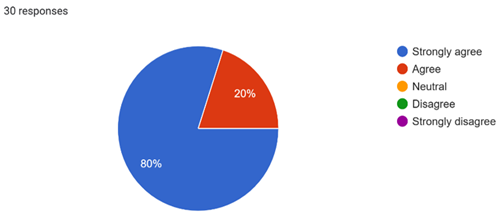
1) Do
you believe customer satisfaction plays a key role in retaining industrial
clients?
• 80% of respondents strongly agree
• 20% of respondents agree
• 0% remained neutral or disagreed
Figure 1
|
Figure
1 Customer
Satisfaction Is Widely Seen as Vital for Client Retention, Emphasizing Its
Direct Impact on Long-Term Loyalty in the Steel Industry. |
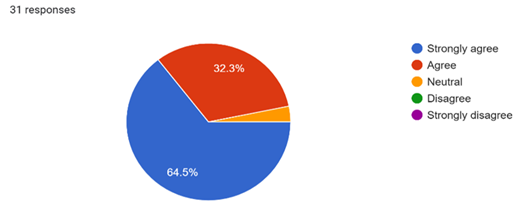
2) Satisfied
customers are more likely to give repeat orders
· 32.3% of respondents strongly agree
· 67.7% of respondents agree
· 0% remained neutral or disagreed
Figure 2
|
Figure
2 Clients
Prefer Reliable Service Quality and Timely Delivery Over Pricing or
Promotional Offers. |
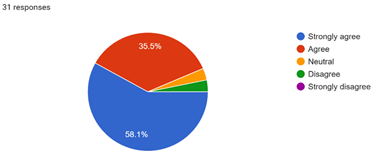
3) Product
quality is the most important factor in customer satisfaction in the steel
industry:
· 58.1% of respondents strongly agree
· 38.7% of respondents agree
· 3.2% remained neutral
Figure 3
|
Figure
3 Industrial
Clients Favor High-Quality And Performance-Tested
Steel Products Over Low-Cost or Generic Alternatives. |
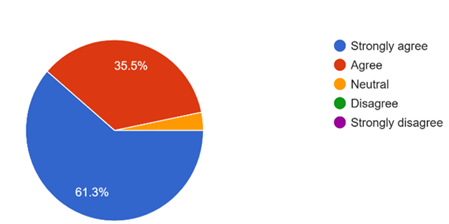
4) Timely
delivery and reliability influence client retention.:
· 35.5% of respondents strongly agree
· 64.5% of respondents agree
· 0% remained neutral or disagreed
Figure 4
|
Figure
4 While Most
Respondents View Timely Delivery as Essential for Client Retention, Some
Emphasize that Reliability and Consistent Communication are Equally Important
In Sustaining Long-Term Partnerships. |
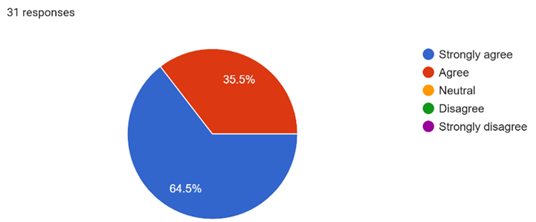
5) Effective
communication and relationship management strengthen long-term
partnerships:
· 35.5% of respondents strongly agree
· 64.5% of respondents agree
· 0% remained neutral or disagreed
Figure 5
|
Figure
5 Strengthening
Communication, Improving Client Engagement, And Maintaining Transparent
Relationships Can Greatly Enhance Satisfaction and Foster Long-Term Loyalty
Among Industrial Clients. |
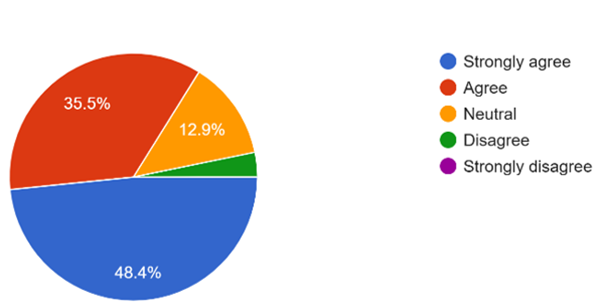
6) Price competitiveness directly affects customer loyalty.
· 12.9% of respondents strongly agree
· 35.5% of respondents agree
· 51.6% remained neutral
Figure 6
|
Figure
6 Competitive
Pricing Helps, But Quality and Service Drive Stronger Client Loyalty. |
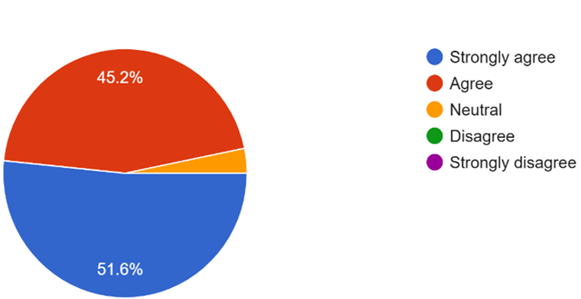
7) Trust
and brand reputation encourage industrial clients to stay loyal:
· 45.2% of respondents strongly agree
· 54.8% of respondents agree
· 0% remained neutral or disagreed
Figure 7
|
Figure
7 Strong Brand
Trust Greatly Enhances Long-Term Client Loyalty. |
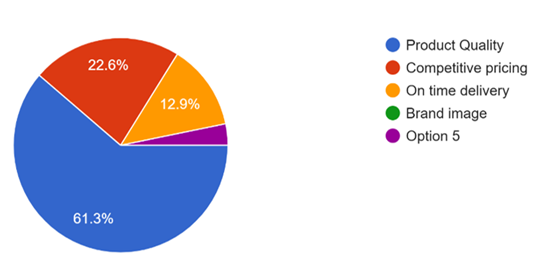
8) What
are the main factors that make you stay loyal to a steel supplier?
· Product Quality – 41.9%
· On-Time Delivery – 22.6%
· Competitive Pricing – 22.6%
· Brand Image – 12.9%
Figure 8
|
Figure
8 Product
Quality Remains the Strongest Reason for Loyalty, Followed by Timely Delivery
and Fair Pricing, Showing that Consistent Performance Matters Most to
Industrial Clients. |
6. ANALYSIS
This study's results strongly demonstrates that customer satisfaction is critical to keeping industrial customers in the steel industry. Because steel is one of the main inputs in such industries as manufacturing, infrastructure, engineering, and construction, buyers seek a supplier that can ensure all three: stability, quality, and reliability. Accordingly, the survey data shows that the vast majority of respondents regard customer satisfaction as directly related to customer retention, illustrating the reality that industrial customers favor the consistent, reliable partner over those suppliers who require a new supplier," which comes with operational risks and costs.
The most important driver of satisfaction for industrial customers was product quality, with the majority of respondents strongly agreeing that high quality steel was the main reason they stayed loyal to a specific supplier. This is in keeping with industry norms that require materials to comply with technical specifications, mechanical properties, and compliance to standards. Any variations to one of the quality attributes would warrant a production disruption for a manufacturing customer making quality consistency vital for retention.
An additional significant area within the findings is the aspect of trust vs. brand reputation. Industrial customers tend to favor suppliers who exhibit reliability, a strong position in the market, and transparent ways of working; that is, brands who in clients' minds have built trust through performance that clients have relied upon for many years. Brands such as AMNS India, TATA Steel, and JSW Steel all benefit from years of reliable service that builds trust and reduces perceived risk allowing a repeat purchase to be made.
In summary, the analysis demonstrates how customer satisfaction in the steel sector is based upon elements interrelated to product quality, delivery quality and punctuality, communication and interaction, technical support, and trust. These elements together play an important role in guides a customer's commitment to stay within a supplier brand. Companies that view satisfaction as an ongoing process driven by value and not an objective will build better more sustainable long-term relationships with their individual industrial customers. By supplying on a commitment that values managing the relationship with customers, strengthening responsiveness in the supply chain and ensuring quality of the products supplied, steel manufacturers can create value that leads to added retention, competitiveness, and sustainable growth in a challenging B2B environment
7. CONCLUSION
This research emphasizes that customer satisfaction is the bedrock of client retention in the steel sector. The survey results indicate that industrial clients show continued loyalty to suppliers who provide a consistent supply of high-quality products, deliver on time, communicate openly, and offer decent after-sales support. Price competitiveness may drive the purchasing decision, yet it is trust, service quality, and reliability over extended periods that underpin the client relationship.
Companies like ArcelorMittal Nippon Steel India, TATA Steel, and JSW Steel, have illustrated that paying attention to customers’ satisfaction not only retains customers, but strengthens brand reputation and market position. However, issues remain that adversely impact satisfaction, such as price volatility, delays in delivery, and providing feedback that is not continuous. If these issues are addressed, such as improving communication systems, investing in enhanced logistics, and better managing customer relationships based on customer needs, then loyalty and stability will remain stronger.
In conclusion, organizations that view customer satisfaction as a continuous process - not just a standard operating procedure - that is driven by quality assurance, responsiveness and improvement processes are going to engender customer is loyalty while also achieving sustainable growth in a competitive steel marketplace.
8. RECOMMENDATIONS
· Improving Consistency and Quality of Product Highest Available: We must enhance our business taking seriously enhancements to steel quality, durability and performance of coatings. Utilising regular audits of quality measures and leveraging feedback in the production process, we can consistently develop our product to meet Client expectations.
· Delivering in Time and Reliably: There is perhaps nothing undermines trust more than a delay in dispatch. It's crucial that firms to build their logistics network to allow them to be radically transparent with Clients about when the product will be delivered.
· Improving Communication and Relationship Management: Offering a dedicated account number and/or a dedicated officer who can manage client relationship is another way to improve the experience for a client, as these dedicated team members can build the relationship with the client.
· Increase Technical Direct and After Sale Support: Enhancing support that is available both during use of the product, and directly post sale, whether that on-site support or technical consultation, will lead to satisfied customers and reduce issues for you and the Client post -delivery of the product.
· Build out Customer Feedback System: Utilising periodic satisfaction reviews or feedback process, where concerns from clients can be documented and addressed, as a systematic approach to engage clients about their experience of your business will help identify client concerns and areas you can improve upon.
· Working Towards Building Long Term Partnerships vs Short Term Engagements: Offering clients preferable benefits, flexible terms of payments, or collaboration in product development help incentivise the client to stay engaged in your business.
9. CHALLENGES
· Delivery Delays and Logistics Issues: Transportation bottlenecks, port congestion, and supply chain disruptions can affect timely deliveries, reducing client confidence and satisfaction.
· Maintaining Consistent Product Quality: With high production volumes, ensuring uniform quality across batches remains challenging and directly impacts client trust and long-term retention.
· Limited Communication and Follow-Up: Many industrial suppliers lack structured client communication systems, leading to delayed responses and weak post-sales engagement.
· Intense Market Competition: The steel market is highly competitive, with major players like AMNS, TATA Steel, and JSW offering similar products. Retaining clients requires strong differentiation through service and value.
· High Client Expectations in B2B Markets: Industrial clients demand reliability, customization, and continuous technical support, which require ongoing investment and process optimization.
· Inadequate Feedback Mechanisms: Companies often collect feedback informally, resulting in missed opportunities to address recurring issues or measure satisfaction systematically.
· Post-Sales Service Gaps: After-sales support, complaint resolution, and technical assistance are not always prioritized, leading to dissatisfaction among industrial buyers.
CONFLICT OF INTERESTS
None.
ACKNOWLEDGMENTS
None.
REFERENCES
Ministry of Steel, Government of India. (2024). Annual report 2023–24. Government of India. Retrieved November 25, 2025, from https://steel.gov.in/node/2034
ArcelorMittal Nippon Steel India. (2024). Annual Report 2023–24: Company Overview and Performance. ArcelorMittal Nippon Steel India. Retrieved November 25, 2025, from the company annual report/investor relations site.
JSW Steel Limited. (2024). Integrated Annual Report 2023–24. JSW Steel. Retrieved November 25, 2025, from https://www.jswsteel.in/investors/jsw-steel-financials-annual-reports
JSW Steel Limited. (2024). Investor Presentations and Customer Strategy Updates JSW Steel. Retrieved November 25, 2025, from https://www.jswsteel.in/investors/jsw-steel-investor-information-investor-presentation
Kotler, P., and Keller, K. L. (2016). Marketing Management (15th ed.). Pearson.
Oliver, R. L. (1999). Whence Consumer Loyalty? Journal of Marketing, 63(Special Issue), 33–44. https://doi.org/10.1177/00222429990634s105
|
|
 This work is licensed under a: Creative Commons Attribution 4.0 International License
© IJETMR 2014-2025. All Rights Reserved.