
|
|
|
|
Review Article
GREEN ENERGY, LITERATURE REVIEW OF RENEWABLE ENERGY SOURCES IN INDIA
|
Dr. Nagaraju
Kaja 1*, Isha Borawake 2 1 Department of Architecture, School of Planning and Architecture,
Vijayawada, India 2 Student,
M. Architecture, Department of Architecture, School of Planning and
Architecture, Vijayawada, India |
|
|
|
ABSTRACT |
||
|
In India, the main goals of the use of renewable energy are to reduce climate change, enhance economic development, and enhance energy security and its accessibility. Utilizing sustainable energy and ensuring that all residents have access to modern, affordable, dependable, and sustainable energy are necessary for sustainable development. India's renewable energy sector has grown tremendously in recent years, due to strong government support and a favourable economic climate. The country has set ambitious targets to increase its renewable energy capacity to 500 GW by 2030. Over a third of India's installed capacity and more than 40% of the country's power generation, including large-scale hydropower, are currently derived from renewable energy sources. People now have better access to electricity as a result of the creation of a unified national power system, and the growth of renewable energy has been crucial to this. However, there are still challenges that need to be addressed, such as the standardization of guidelines, development of stable grid and transmission networks, and steep fluctuations in solar project tariffs. This paper aims to study comprehensive information on the achievements, prospects, projections, and challenges of renewable energy in India. Keywords: Renewable Energy, Solar Energy, Environment, Climate Change |
||


INTRODUCTION
The need for
energy sources is rising along with the population. The amount of energy
required varies throughout nations worldwide. The energy requirements of
established nations are higher than those of emerging nations. Any country
shall have a vision for energy policy which is to meet energy demands by using
clean, sustainable and affordable energy which shall be achieved in a
sustainable way Nagaraju
(2017). Renewable energy sources create less
pollution and are easily available. Renewable energy technology like tidal
energy, biomass energy, geothermal energy, wind energy, solar radiation, etc.
are environment friendly in nature. For the past 20 years, renewable energy
resources have been the main cause of worry for consumers. To achieve
sustainable development, a variety of components are involved. The primary
concern stemming from non-renewable energy sources is climate change. The major
benefits of using renewable energy sources include improved energy for the
environment and human health, increased energy security, social and economic
growth, and a reduction in climate change.
|
Figure 1
|
|
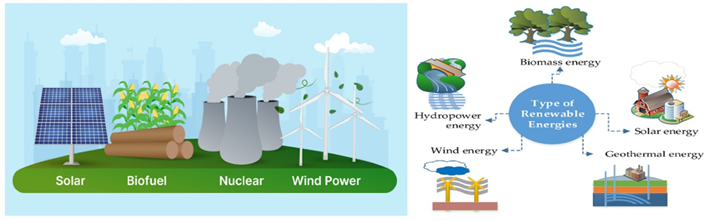
Figure 1 Types of Renewable Energy Source Renewable
Energy Present Status and Future Potentials in India: An Overview |
Need of
the study
Research on renewable energy in India is crucial for understanding its
current status, future potentials, challenges, and the policies and incentives
that can favour its sustainable development. Furthermore, such research can
provide insights into the untapped potential of renewable energy sources, their
role in energy generation, and their contribution to reducing carbon emissions
and addressing climate change. The need to study renewable energy in India is
emphasized by several factors, including the country's significant and
increasing energy consumption, the potential for renewable energy to contribute
to energy security and the environmental benefits associated with its use.
India is the fourth largest energy consumer in the world, and its energy consumption
is projected to increase rapidly, with renewable energy sources expected to
perform a substantial role in meeting this demand. As of December 2022, India
has installed non-fossil fuel capacity, including renewable energy, stands at
more than 176.49 GW, representing about 43% of the country's total capacity.
Renewable
Energy: Perspective of India
India has several major energy-related issues, including low energy
efficiency, hazards to energy security, and energy deficit. The most viable way
to deal with these issues is to increase the amount of power produced using
unconventional energy sources. India’s 38% of installed energy capacity until
2020 is derived from renewable sources, accounting for 136 GW of the country's
total of 373 GW installed energy capacity. India has become the third largest
energy user and renewable energy producer after America and China. According to
Ernst & Young's 2021 Renewable Energy Country Attractiveness Index (RECAI),
India ranked third after America and China. India committed in 2016 to meeting
the Paris Agreement's Intended Nationally Determined Contributions objectives,
which call for obtaining 50% of its total energy output from renewable sources
of energy by 2030. By 2030, the Central Power Authority of India wants to
produce half of the nation's power using sources of renewable energy and by
2022 and 2023, India intends to generate 175 GW and 500 GW of energy
from renewable sources, in succession. India has a robust manufacturing base in wind power with 20 businesses
manufacturing 53 different 3 to 30 MW wind turbines of world excellence. These
turbines are exported to the United States of America, Europe and other
countries. With an additional 25.64 GW of projects in multiple stages of
bidding and 48.21 GW of projects in multiple stages of execution, solar energy
has been operating in India since September 2020. By 2020 India setup three of
the largest solar parks across the globe: the 100 MW Kurnool in Andhra Pradesh,
the 2,000 MW Pavagada Solar Park in Tumkur,
Karnataka, and the 2,255 MW Bhadla Solar Park in
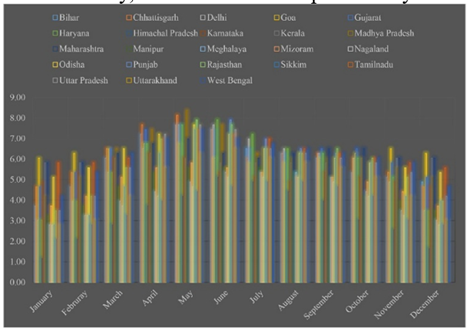
Rajasthan. The states of Chhattisgarh, Punjab, Madhya Pradesh, Rajasthan and
Haryana have been identified as having the highest solar radiation appropriate
for use in the solar energy system to generate power. These states have an
average solar radiation exceeding 6 kWh/m2/day, which makes them particularly
attractive for solar energy.
|
Figure 2
|
|
Figure 2 Month-Wise Average
Solar Radiation Data Set of Different State of India (2020). Source Path Towards Sustainable Energy
Development: Status of Renewable Energy in Indian Subcontinent |
Types of
Renewable Energy in India
The following table presents descriptive information
regarding the capability for renewable energy in different states of India. The
average capacity of India's solar, wind, biomass, hydro, and ocean energy
systems is 1613.07 MW, 1425.75 MW, 375.96 MW, 5399.64 MW, and 1919.82 MW
respectively according to the data. With 7738 MW of solar energy,
Rajasthan has the most solar energy capacity, while Tamil Nadu has 9231.77 MW
of wind energy. At 2632 MW, Maharashtra is the state with the highest biomass energy
capacity; Arunachal Pradesh has the most hydro energy capacity at 52128 MW; and
Gujarat has the highest ocean energy capacity at 14525 MW.
|
Solar |
Wind |
Biomass |
Hydro |
Ocean |
|
|
State |
Tidal + Wave |
||||
|
Andhra Pradesh |
4380 |
4077 |
536 |
2751 |
100 + 6900 |
|
Arunachal Pradesh |
11 |
0 |
1 |
52128 |
0 |
|
Assam |
68 |
0 |
2 |
852 |
0 |
|
Bihar |
190 |
0 |
126 |
567 |
0 |
|
Chhattisgarh |
501 |
0 |
270 |
3300 |
0 |
|
Goa |
11 |
0 |
1 |
60 |
0 |
|
Gujarat |
5709 |
7203 |
100 |
792 |
10425 + 4100 |
|
Haryana |
661 |
0 |
218 |
172 |
0 |
|
Himachal Pradesh |
61 |
0 |
10 |
22000 |
0 |
|
Jharkhand |
80 |
0 |
4 |
809 |
0 |
|
Karnataka |
7469 |
4753.4 |
1902 |
10185 |
100 + 6100 |
|
Kerala |
312 |
62.5 |
3 |
4025 |
100 + 4900 |
|
Madhya Pradesh |
2634 |
2519.89 |
128 |
2790 |
0 |
|
Maharashtra |
2445 |
4794.13 |
2632 |
4100 |
200 + 8100 |
|
Manipur |
12 |
0 |
1 |
1861 |
0 |
|
Meghalaya |
4 |
0 |
14 |
2528 |
0 |
|
Mizoram |
8 |
0 |
1 |
2300 |
0 |
|
Nagaland |
3 |
0 |
1 |
1634 |
0 |
|
Odisha |
428 |
0 |
59 |
3267 |
400 + 600 |
|
Punjab |
1022 |
0 |
492 |
1549 |
0 |
|
Rajasthan |
7738 |
4299.73 |
125 |
534 |
0 |
|
Sikkim |
2 |
0 |
1 |
4514 |
0 |
|
Tamil Nadu |
4675 |
9231.77 |
1040 |
2297 |
230 + 10600 |
|
Telangana |
3992 |
128 |
219 |
2121 |
0 |
|
Tripura |
15 |
0 |
1 |
47 |
0 |
|
Uttar Pradesh |
2020 |
0 |
2180 |
1124 |
0 |
|
Uttarakhand |
552 |
0 |
139 |
19662 |
0 |
|
West Bengal |
163 |
0 |
321 |
3221 |
900 |
|
State-Wise
Renewable Energy Capacity (MW) in India (2020) Source Path Towards Sustainable Energy
Development: Status of Renewable Energy in Indian Subcontinent |
|||||
|
Sources |
Total installed capacity (MW) |
|
Wind power |
22,465.03 |
|
Solar energy |
3063.68 |
|
Small hydro power |
3990.83 |
|
Biomass power |
1365.2 |
|
Bagasse power generation |
2800.35 |
|
Wade to power |
107.58 |
|
Total |
33,791.74 |
|
Total
Installed Renewable Energy Capacity (MW) in India (2020) Source Path Towards Sustainable Energy
Development: Status of Renewable Energy in the Indian Subcontinent |
|
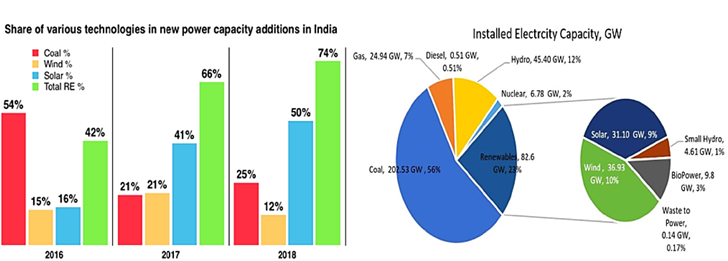
The main sources
of electricity generation in India include power plants that use biomass,
hydropower, and solar energy. In India, just 23% of power is produced by
renewable sources, while 74% of CO2 emissions may be avoided by 2050, based on
the enhanced Renewable Energy Technology scenario. In comparison to the
reference scenario, the percentage of renewable energy in the electrical supply
elevates to 36%, while the reduction of CO2 emissions persists at 74%.
|
Figure
3
|
|
Figure 3 Renewable Energy
Production and Application in India Announced by the Government of India Source Renewable
Energy Present Status and Future Potentials in India: An Overview |
In the figure
shown above, since 2017 India has significantly reduced the dependence on coal
and increased the total generation and utilization of renewable energy. India
also upgraded the efficiency of its transmission system and added additional
energy capacity in order to lower transmission losses in the supply.
|
Figure 4 |
|
|
|
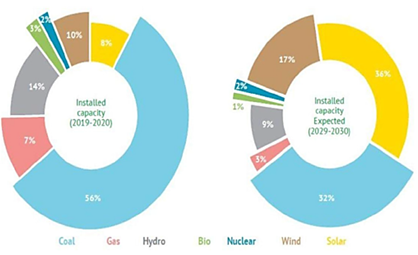
Figure 4 Future Perspective of India’s Conventional and Non-Conventional Energy
Sources Source Renewable
Energy Present Status and Future Potentials in India: An Overview |
By 2030, India's
energy consumption will increase at the swiftest pace of any major economy
since it is the second most populated country. India’s dependence of coal
produced energy is more in 2019-20, hence it is expected to reduce its coal
dependence and fulfil future energy demands with renewable energy sources like
solar and wind energy.
Government
Initiatives and Policies
To speed up the
switch to renewable energy, improve energy security and lower carbon emissions
the Indian government has put in place a comprehensive policy framework and
started a number of programs, these measures are intended to stimulate local
manufacturer, guarantee the integration of renewables into the National Grid
and provide a strong environment for the deployment of renewable energy.
India's ambitious objective of installing 500 GW of non-fossil fuel capacity by
2030 is a pillar of its renewable energy strategy. This goal is supported by
consistent investment, forward thinking policies and international obligations
like net zero promise by 2070. Important government programs include the CCDC
Wind Initiative which has assisted India in reaching 48 GW of wind power and
the National Solar Mission, which has increased solar capacity from slightly
over 9 GW in 2016 to almost 98 GM by 2025. Regulations like mandatory renewable
energy targets for industries which mandate that big businesses source at least
30% of their energy from renewable sources by 2025 has been put in place to
support these flagship missions. Non-compliance will result in penalties, while
over achievement will be rewarded with carbon credits.
A significant step
towards establishing India as a global centre for the production, use and
export of green hydrogen is the National Green Hydrogen Mission which was
authorized in 2023 with a budget of ₹19,744 crore. With pilot projects in
industries including refineries, fertilizers and city gas the mission is being
carried out in stages with an initial emphasis on generating demand and
increasing domestic electrolyser production capability. The later stage seeks
to build a strong regulatory and research and development environment, increase
output and enter new industries like steel and transportation. It is
anticipated that the mission would provide significant job opportunities. The
PM Surya Ghar Muft Bijli Yojna is accelerating rooftop solar adoption by
providing financial assistance and subsidies for residential solar
installations which lowers electricity bills and strengthens energy
self-sufficiency. In the agricultural sector the PM-KUSUM scheme supports
farmers by subsidising solar pumps and decentralised solar power plants
reducing diesel use and empowering rural communities. The government has also
expanded the Solar Park Scheme to further promote solar energy, facilitating
large scale solar installation through efficient land allocation and public-private
partnerships. Grid integration is being strengthened through the Green Energy
Corridor initiative, with ₹60 billion allocated for transmission
infrastructure to ensure the smooth flow of renewable power. The government has
also set Renewable Purchase Obligations (RPOs), mandating power distribution
companies and large consumers to produce a minimum share of renewable energy.
Challenges
of renewable energy production in India
In many regions of
India, the combination of energy generation is starting to include more
renewable energy. The widespread implementation of renewable energy still faces
significant obstacles. Some stem from different renewable energy technologies,
while others are a result of the infrastructure, rules, and contemporary market
conditions.
·
Cost
of production
Among the major difficulties facing
the adoption of renewable energy is the significant cost linked to constructing
and setting up infrastructure, such wind or solar farms. While renewable energy
sources such as solar and wind are generally less expensive to run than
conventional fuels, the upfront costs of installation can make lenders wary and
increase borrowing rates. As a result, investors may find it more challenging
to defend their initial investment.
The expense of
developing and constructing facilities like solar or wind farms is now the
biggest and most well-known barrier to the adoption of renewable energy. When
it comes to renewable energy sources, solar and wind power are far less
expensive to run than "fuels." Installation costs account for the
majority of the cost of using renewable energy. Due to the installation
expenses, lenders are potentially inclined to see renewable energy sources as
high-risk, which could result in higher borrowing rates and make the investment
harder to defend. Interestingly, fossil fuel facilities can pass on growing
fuel expenses to customers, who often take the significant price fluctuations
as a fact.
·
Energy
transmission
In order to
effectively use renewable energy sources, a significant amount of the latest
transmission infrastructure is needed. The transmission infrastructure built
during the 20th century was designed primarily for nuclear power plants and
large fossil fuels. Offshore wind farms are considered one of the most
promising renewable energy sources.
·
Barriers
to entry
The dominance of
non-renewable energy means that the accountable facilities of these
systems have substantial market influence, posing a serious challenge to
renewable energy sources. Renewable energy sources like solar and wind power
have to combat with well-established, well-funded infrastructure, decades of
expertise, and regulations. For start-ups, the barriers to entry are even
greater since they have to compete with major competitors in the industry.
Start-ups need to show that they can grow in order to attract investors. This
is because investors often want enormous amounts of energy output, which can be
difficult to achieve. Levelling the playing field might be aided by increased
government investment in renewable energy through subsidies and other
initiatives.
·
Availability
of power
A major issue
facing the renewable energy industry is the reliance on natural resources that
are beyond human control. Solar power, for instance, can only be generated when
there is adequate sunlight, and wind energy is subject to the availability of
strong winds to turn the turbines. When wind speeds are low, power flow to the
grid may be compromised, resulting in no energy generation.
·
Power
quality issues
For the network to
remain stable and efficient, it is crucial to maintain a consistently
high-power quality. When the power supply is of superior quality, the system
operates with less expense and great authenticity. However, inferior power
quality might have unfortunate impacts on the electrical grid and the
industrial procedures, resulting in equipment failure and increased expenses.
·
Resource
location
Many renewable
energy plants that provide the grid with energy demand plenty of space,
which can be limiting for some users. The location of the renewable energy
sources frequently determines their availability which poses challenges for
adoption. Certain renewable energy sources may not be accessible in certain
regions, and the distance between energy sources and the grid can impact cost
and efficiency. Additionally, renewable energy sources are subject to weather
patterns, climate conditions, and geographical limitations.
·
Information
barrier
Despite
advancements in this area, there is still a lack of information and
comprehension about the significance and benefits of renewable energy.
Fortunately, funding and tax breaks have been provided to support the
integration of renewable energy sources. Government organizations must play a
role in guiding and advising those seeking to obtain these incentives.
·
Politics
Billions-dollar
industries can wield enormous political power and the
non-renewable energy industry is no exception. The conventional electricity
sector gains from tax advantages, incentives, subsidies, and regulatory
loopholes in different countries. While these advantages could have improved
manufacturing, they have also taken funds away from efforts to further develop
renewable energy sources.
·
Oversupply
of renewable energy
In recent years,
the global production of solar panels by governments and private companies has
increased significantly. However, this growth has led to an oversupply
situation where the supply of panels exceeds current demand. Consequently,
businesses are cutting back on their long-term commitments, and some are even
closing their doors, costing millions to investors. Unfortunately, this
oversupply situation could have a negative impact on the future of solar energy
technology, potentially disrupting its long-term adoption.
Discussion
India's combined
problems with energy and the environmental need is to
work toward increasing the proportion of renewable energy in future energy
systems. The commercial state and technology development of renewable energy
technologies differ significantly. Renewable energy is only getting started in
India and before these technologies take off there are still many issues that
need to be tackled by businesses, consumers, industry and the government. With
an extensive array of renewable energy sources like wind, biomass, solar PV,
small scale hydro and solar heating, India is expected to develop and implement
renewable energy projects on a massive scale. From the standpoints of long-term
energy supply security, environmental benefits and climate change mitigation,
India sees the growth of renewable energy as very vital. It is projected that
the proportion of renewable energy in energy production alone might reach
60,000 MW in 2031-2032. Renewable energy will be the main force behind the
poor's social involvement in the development process by 2031-2032. It is
projected that over Rs. 300,000 crores would be invested in the renewable
energy sector over the next 25 years. The Ministry of New and Renewable
Energy's (MNRE) goals include energy security, a growth in the proportion of
clean power, energy available and access, energy affordability and energy
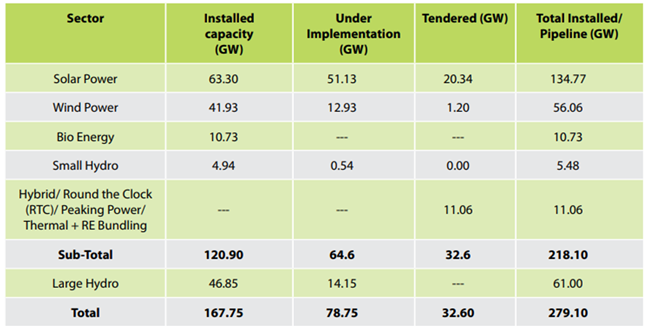
equity. Between March 2014 and December 2022, the installed capacity of
renewable energy which includes large hydro, increased by over 2.2 times from
76.37 GW to 167.75 GW. The entire Solar Power capacity of the country increased
from 2.63 GW in March 2014 to 63.30 GW in December 2022 which is 24.07 times
rise. An array of public and commercial organisations such as MNRE, The Centre
for Wind Energy Technology, Universities, IITs, NITs, Indian Oil Corporation
Limited (IOCL) and The Energy Resource Institute (TERI) conduct research and
development on renewable energy sources. In accordance with the revised
Nationally Determined Contributions (NDC), by 2030 India has
committed to obtain 50% of its installed capacity for electricity from non-fossil
fuel-based energy sources. The nation has installed 167.75 GW of renewable
energy capacity until 31st December 2022. In addition, there are 32.60 GW
of projects in distinct stages of bidding and 78.75 GW of projects in various
levels of implementation. India is ranked fourth in the world for installed
capacity of renewable energy (renewable energy), 4th for wind power, and 4th
for solar energy, according to the REN21 Renewables 2022 Global Status Report.
|
Figure 5
|
|
Figure 5 Sector Wise Cumulative
Achievements (As On 31.12.2022) Source Ministry of New and Renewable Energy
Annual Report 2022-23 |
In addition to the advancements made
through the programs described in Section 2 of Ministry of New and Renewable
Energy Annual Report 2022-23, in key sectors including green hydrogen,
decentralized renewable energy, rooftop solar, wind repowering and offshore
wind, the Ministry introduced regulatory changes and enablers to spur success.
Some notable examples include:
1)
Launch
of National Portal on Rooftop Solar: On 30th July 2022, the Ministry established the National
Portal for Rooftop Solar. Through the platform, homeowners may apply for
rooftop solar power from anywhere in the nation without having to wait for
Discom to complete vendor empanelment and bids. More than 18 MW of projects
have been approved through the platform, which has received proposals totalling
117 MW of solar power since its introduction.
2)
Green
Hydrogen: An initial
expenditure of Rs. 19,744 crores were allocated for the National Green Hydrogen
Mission in January 2023. The main aim of the mission is to establish a green
hydrogen production capacity of over 5 million metric tons per annum, while
simultaneously adding approximately 125 GW of renewable energy capacity in
India by the year 2023.
3)
Energy
Storage: At the Fatehgarh III Substation of the electricity grid, the
tariff-based global competitive bidding (ESS-I) procedure for the creation of
500 MW/1000 MWh standalone BESS experimental projects has been successfully
completed by Solar Energy Corporation of India (SECI).
4)
The
Ministry of New and Renewable Energy under its “Women in RE: Call for Action”: The goal of this
initiative is to encourage a favourable shift in views about women's engagement
across the whole value chain, while also acknowledging the important
contributions that these stakeholders make to the renewable energy sector. An
Inter-Ministerial Multi-Stakeholder Committee has been formed to push policies,
initiatives, and interventions focused on women's empowerment in the renewable
energy sector to accomplish this. This all-inclusive strategy will support the
involvement of producer and self-help groups, along with other community-based
models, to successfully implement DRE schemes, improve women's renewable energy
abilities and skills, and foster fusion of female-focused programs.
5)
India’s
first 24x7 solar-powered village in Gujarat: On 9th October 2022, the Sun Temple in Modhera,
Gujarat, achieved a significant milestone by becoming India's first "Suryagram" to be powered continuously by solar energy
with battery storage. This achievement marks a significant step towards
sustainable energy practices for India, as it demonstrates the feasibility of
implementing solar-powered solutions with reliable energy storage capabilities.
The successful implementation of this project showcases the potential for
renewable energy sources to provide reliable and uninterrupted power supply,
making them a viable alternative to traditional energy sources.
6)
The
National Bioenergy Programme: On
November 2, 2022, a comprehensive launch occurred, consisting of three
sub-themes: the Waste to Energy Programme, which focuses on generating energy
from urban, industrial, and agricultural waste and residues; the Biomass
Programme, which encourages the manufacturing of briquettes and pellets as well
as the development of cogeneration in industries other than bagasse; and the
Biogas Programme.
7)
On 14th February 2022, the Ministry released a framework to help people in remote
and rural areas to access renewable energy sources. This framework aims at
promoting the use of Decentralized Renewable Energy (DRE) for sustainable
livelihoods. This will help people in these areas to improve their quality of
life by providing them with access to clean and reliable energy sources.
8)
Draft
National Repowering Policy for Wind Power Projects: The draft was released in October 2022 for
stakeholder feedback. The aim was to maximize the energy yield (kWh) per sq.
km. of the project area to optimize the exploitation of wind energy resources.
To accomplish this goal, the newest and most advanced onshore wind turbine
technology was used.
9)
Offshore
Wind: The Ministry has
implemented several measures to initiate the development of the nation’s
offshore wind sector. Among these actions are: (i) A
37 GW offshore wind auction trajectory by 2030 was outlined in a strategy study
on offshore wind energy; (ii) The Ministry approached the Ministry of Finance's
Department of Expenditure for clearance regarding the Rs. 15608.65 crore
Viability Gap Funding (VGF) scheme for the first 3 GW of offshore wind energy
projects.
Conclusions
Renewable energy
sources are environment friendly and can help us save energy, have a healthier
environment and replace fossil fuels. Appropriate management of environmental
resources and their consumption can minimize the negative impact on human
health. In India, a total of 167.75 GW of renewable energy capacity has been
installed as of December 31st, 2022. Additionally, projects of 78.75 GW
capacity are being implemented and 32.60 GW capacity are being bid on. However,
some challenges need to be addressed to achieve India's renewable energy
targets, enhance energy security, and reduce carbon emissions. Research and
policy initiatives are essential to overcome these obstacles and facilitate a
successful transition to renewable energy. When it concerns producing renewable
energy, imported equipment is more expensive than locally made equipment. As a
result, production of renewable energy is costly, if not beyond reach. The
nation should get involved in the production of renewable products in order to
lower their costs. Unreliable grid connectivity is a major barrier for the
growth of technology for renewable energy. Many investors start to doubt
renewable energy technology as a result of this uncertainty, which makes them
reluctant to invest. India should focus on creating strategies for the
transmission and evacuation of renewable energy in order to overcome this
obstacle.
ACKNOWLEDGMENTS
None.
REFERENCES
Chaturvedi, P., and Garg, H. P. (2007, July–September). Financing Renewables—Emerging Dimensions. IREDANEWS.
Dey, S., Sreenivasulu, A., Veerendra, G. T. N., Rao, K. V., and Anjaneya Babu, P. S. S. (2022). Renewable Energy Present Status and Future Potentials in India: An overview. Innovation and Green Development, 1(1), 100006. https://doi.org/10.1016/j.igd.2022.100006
Enerdata. (n.d.). India Energy Market. Enerdata.
Invest India. (n.d.). Renewable Energy Sector.
Jangali, S., and Nagesha, N. (2018). A Comparative Study of Energy Consumption Pattern and Environmental Impact in Residential Sector of Indian Cities. IOP Conference Series: Materials Science and Engineering, 376(1), 012138. https://doi.org/10.1088/1757-899X/376/1/012138
Khare, V., Khare, C., Nema, S., and Baredar, P. (2022). Path Towards Sustainable Energy Development: Status of Renewable Energy in Indian subcontinent. Cleaner Energy Systems, 3, 100020. https://doi.org/10.1016/j.cles.2022.100020
MDPI. (2023). Energies, 16(14), 5491. . https://doi.org/10.1109/38.491180
Ministry of New and Renewable Energy (MNRE). (n.d.). Official Website.
Munich Personal RePEc Archive. (2009). MPRA Paper No. 16753.
Nagaraju,
K. (2017). An Overview of Energy Sector in India. International Journal of Science and Research (IJSR), 6(3), 1589–1594.
National Institute of Wind Energy (NIWE). (n.d.). Official Website.
Net Zero India. (n.d.). Official Website.
REN21. (2022). Renewables 2022 Global Status Report. REN21 Secretariat. ISBN 978-3-948393-04-5
ScienceDirect. (2022). Cleaner Energy Systems Article. Sciencedirect.
ScienceDirect. (n.d.). Article on Environmental Science. ScienceDirect.
Singh, R. (2011). Renewable Energy in India: Current Status and Future Potentials. ResearchGate.
Times of India. (2023). India’s Energy Transition: Challenges and Opportunities for a Sustainable Future. Times of India Blogs.
|
|
 This work is licensed under a: Creative Commons Attribution 4.0 International License
© IJETMR 2014-2025. All Rights Reserved.