
|
|
|
|
Original Article
CONSTRUCTIONAL WASTE MANAGEMENT PRACTICES: INSIGHTS FOR LOCAL GOVERNMENT POLICY RECOMMENDATIONS
|
John A.
Liwanag 1, Kenneth Oliver S. Lopez 2* 1 Department of Public Works
and Highways, Pangasinan 4th District Engineering Office, Sta Barbara,
Pangasinan, Philippines 2 Management Engineering Department, School
of Advance Studies, Pangasinan State University, Urdaneta City, Pangasinan,
Philippines |
|
|
|
ABSTRACT |
||
|
This research explores the constructional waste management practices in Pangasinan, aiming to develop a policy brief that addresses key issues in construction-related waste management. The study focuses on profiling the municipalities of Pangasinan’s current construction waste management system, including the adequacy of human resources involved in constructional waste management system, and existing policies, activities, and programs influencing waste management as perceived by selected Civil Engineers in the province of Pangasinan. It also examines how constructional waste management practices are monitored and identifies the types of waste typically generated in construction projects by the local and provincial government, such as concrete debris, scraped asphalt, excavated materials, packaging waste, and fuel waste like oils. Moreover, the research assesses the level of awareness among local government personnel regarding waste management protocols and evaluates the seriousness of challenges faced in implementing effective constructional waste management strategies. The study is limited to constructional wastes and specific materials commonly encountered in road and building projects. Based on the findings, a thorough recommendation will be proposed to improve waste management practices, promote sustainable construction, and enhance policy formulation for the different local government units, including the Department of Public Works and Highways, of Pangasinan. Keywords: Constructional Waste Management
Practices, Local Government Policy Recommendations |
||


INTRODUCTION
The Department of
Public Works and Highways (DPWH) is committed to safeguarding the environment
through proper waste segregation to reduce the solid waste generated in all its
Offices. This shall be done with the four methods of implementation which are source
reduction, reuse of materials, recycling, and purchase of recycled content
materials. Through the guidance of Republic Acts 9003 Official
Gazette (2001), 10964 Department
of Budget and Management (2017), and 11260 Department
of Budget and Management (2019), every employee of the Department has a
personal responsibility for implementing these guidelines. Through the years,
the DPWH has implemented various infrastructure projects under its manifold
programs, with the envisioned organizational outcomes, namely: Reduced Travel
Time through enhanced road network systems; Improved Road Network Quality and
Safety that meets international standards through appropriate engineering
solutions to road network quality and safety; and Lives and Properties
Protected from Natural Disasters by mitigating damages to infrastructures and
building disaster-resilient infrastructures.
The massive
implementation of various infrastructure projects of the DPWH entails
environmental and social risks Philippine
News Agency (2025). These may cause hazards, accident
occurrences, and severe environmental damage [20]. Implementing Field Offices
should therefore be made fully aware of their responsibilities on their
compliance with all the environmental-related requirements before and during
project implementation. Monitoring of compliance of each project specifically
the conditions and provisions set forth in the issued Environmental Compliance
Certificates (ECCs) and other existing environmental laws must be undertaken by
the Implementing Offices Cariaso
(2023).
The Ecological
Solid Waste Management Act or Republic
Act No. 9003 (2001), prescribes that "All government
offices at the national and local levels, within the executive, legislative and
judicial branches, and government-owned and controlled corporations, shall
ensure information, education and actual implementation of waste management
program at the workplaces and work premises, including the pursuit of
environment-friendly purchasing policies for their offices". This type of
legislation typically aims to address environmental concerns related to solid
waste management, such as reducing waste generation, promoting recycling and
composting, regulating disposal methods, and encouraging public participation
in waste management efforts.
Pursuant to the
said Act, the Department issued the D.O. 58 series of 2015 also known as the
Guidelines and Procedures for the Implementation of D.O. 57, series of 2009
"DPWH Solid Waste Management Policy" Department
of Public Works and Highways (2009), Department
of Public Works and Highways (2015). Section VIII of DO 58, specifically states
that DPWH Offices shall evaluate and implement feasible waste reduction
opportunities to the maximum extent possible. The Department's initiatives are
waste reduction, collection, separation, and recovery of solid waste generated
in all its implemented contracts. Contractors, Stakeholders, and Employees of
the Department involved in project contract management and implementation shall
practice waste segregation at source to minimize the production of residual wastes
being collected and brought to a sanitary landfill as final disposal. To
increase the carrying capacity of sanitary landfills, wastes need to be
diverted from entering the facility and further segregation is needed to
capture recyclable materials from wastes as improper waste management will lead
to health and environmental problems and delay the approach to sustainable
waste management and difficulty in several aspects of waste management.
Whereas the
Department has been very responsive towards the implementation of RA 9003 in
its different Bureaus and Field Offices, there is a gap left in its policies
specifically on project-designated construction sites. Often than not, Contractors and even DPWH
project implementers are left to mend disposal of construction-generated wastes
to themselves. Observations revealed
that waste disposal adopted on project sites contradicts the policies and
guidelines outlined in RA 9003 as well as DOs 58 and 57 series of 2015 and
2009, respectively. With this, the researcher exerted his effort to help in
resolving the issues concerning construction waste management practices in the
DPWH-Pangasinan.
This study will
show the current status of waste disposal management of DPWH. The result of
this study will catalyze to the creation of waste
disposal operations policy. The findings will encourage the support for the
continuous improvement and implementation of project construction wastes of the
DPWH. The study limits itself to the assessment of the existing practices in
the project construction waste management of DPWH-Pangasinan. The indicators
used in the assessment are explanatory and might not have been purely the
result of the existing practices. The proxy indicator’s validity and
reliability are added limitations.
Most information
gathered was based primarily on survey instruments and interviews, which posed
certain limitations in terms of the accuracy of information. Furthermore, due
to the lack of awareness of some of the respondents on the existing project
construction waste management practices, the time considered in data gathering,
the data gathering technique, the respondents considered, the scope of the
research area, and the results are also taken in high considered in the scope
and limitation of this study may pose as another variable in the limitations of
the research and the researcher.
This study focused on all four (4)
District Engineering Offices (DEOs) in Pangasinan namely: Pangasinan 1st DEO
located in Alaminos City, Pangasinan headed by District Engineer, Engr. Marieta
B. Mendoza Cariaso
(2023), Pangasinan 2nd DEO located in Lingayen
Pangasinan headed by District Engineer, Engr. Edita L. Manuel Department
of Public Works and Highways (n.d.), Pangasinan 3rd DEO located in Rosales
Pangasinan headed by District Engineer, Engr. Maria Venus S. Torio; and
Pangasinan 4th DEO located in Sta Barbara Pangasinan headed by District
Engineer, Engr. Mel Harvey A. Gonzalez.
The total
population is also an added limitation. Not all of the employees have been
covered due to the researcher’s supervisory limitation, and also due to the
fact that not all employees have a direct connection to project construction
waste management. The study will only focus on infrastructural wastes such as
concrete debris, scraped asphalt pavements, excavated unsuitable materials,
used forms and metal products, etc. Waste disposal is also limited to the
following materials namely: construction products and materials packaging,
topsoil, Biodegradable materials such as grass leaves, etc., old concrete
pavement, old asphalt, and fuel waste such as oils.
|
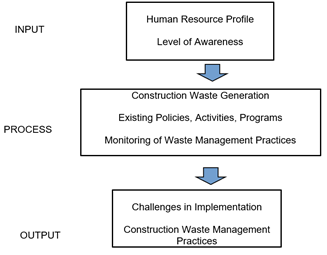
Figure 1
|
|
Figure 1 Conceptual
Framework |
MATERIALS AND METHODS
The descriptive
case study research design will be used in this study. A case study was done
individually on every participating district engineering offices
identifying every input, output, and effect. This will be done province-wide
later on. Respondents came from all participants of participating construction
and maintenance operation employees who belong to the supervisory jurisdiction
of the researcher. Number of expected respondents in every area of the
supervisory jurisdiction of the researcher is listed in Table 1.
Table 1
|
Table 1 List of Actual Respondents |
|||||
|
District Engineering
Offices |
Rank-in-File |
Middle |
Senior |
Policy Maker |
Total |
|
1.
Pangasinan 1 |
9 |
0 |
0 |
0 |
9 |
|
2.
Pangasinan 2 |
12 |
0 |
0 |
0 |
12 |
|
3.
Pangasinan 3 |
8 |
1 |
0 |
0 |
9 |
|
4.
Pangasinan 4 |
10 |
1 |
1 |
0 |
12 |
|
Total |
39 |
2 |
1 |
0 |
42 |
Since the
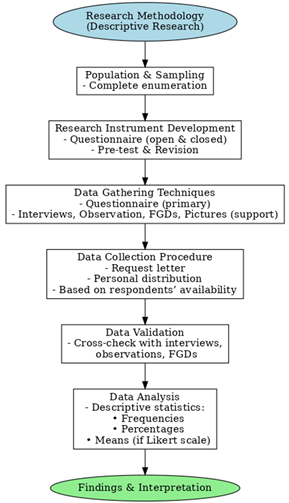
population is so small, the researcher considered all respondents, hence, a
complete enumeration was done. Part of the questionnaire will consist of open
and closed-ended questions. The questions will be designed to gather data on
training inputs and outputs. The research instrument will be pre-tested to
selected employees of DPWH. Revisions will be made based on the result of the
pre-test before the instrument will be used for final data collection.
Semi-structured interviews will be conducted personally with the employees and
supervisors.
The questionnaire
will be floated personally by the researcher to ensure that the necessary
instructions and clarification were given to the respondents and to guarantee
that the necessary data were gathered as planned. Observation, ocular
inspection, pictures, interviews, and focused group discussions are considered
as other data-gathering tools to materially support and supplement the data
that were gathered. A request letter to conduct of research will be prepared by
the researcher and will be given to the interviewee personally. The schedule of
floating questionnaires will be set based on the availability and convenience
of the respondents. Please see Figure 2 for the Visual Flow-Chart Diagram of
Methodology
|
Figure 2
|
|
Figure 2 Visual Flow-Chart Diagram of Methodology |
RESULTS AND DISCUSSIONS
DPWH PANGASINAN PROFILE
1)
Number
of Municipalities Covered per District Office
Each District
Engineering Office (DEO) of DPWH in Pangasinan is responsible for overseeing
infrastructure projects, including waste management, within specific
municipalities. Understanding the coverage area for each district office
provides insight into the geographical scope and the extent of
responsibilities.
Pangasinan 1st
DEO: 1st Congressional
District of Pangasinan office is located in Poblacion,
Alaminos City, Pangasinan. There are 10 municipalities/cities under its
jurisdiction namely Agno, Alaminos, Anda, Bani, Bolinao,
Burgos, Dasol, Infanta, Mabini, and Sual.
Pangasinan 2nd
DEO: 2nd Congressional
District of Pangasinan office is located in Alvear E, Maniboc,
Lingayen Pangasinan. There are eight (8) municipalities/cities under its
jurisdiction namely Aguilar, Basista, Binmaley,
Bugallon, Labrador, Lingayen, Mangatarem, Urbiztondo,
Dagupan, Manaoag, Mangaldan,
San Fabian, San Jacinto.
Pangasinan 3rd
DEO: 5th and 6th
Congressional District of Pangasinan office is located in Tumana,
Rosales, Pangasinan. There are 20 municipalities/cities under its jurisdiction
namely Alcala, Bautista, Binalonan, Laoac, Pozorrubio, Santo Tomas,
Sison, Urdaneta City, Villasis, Asingan Balungao,
Natividad, Rosales, San Manuel, San Nicolas, San Quintin, Santa Maria, Tayug, and Umingan.
Pangasinan 4th
DEO: 3rd Congressional
District of Pangasinan office is located in Santa Barbara, Pangasinan, formerly
known as Pangasinan Sub-DEO. There are six (6) municipalities/cities under its
jurisdiction namely Bayambang, Calasiao,
Malasiqui, Mapandan, San
Carlos, Santa Barbara.
Table 2
|
Table 2 Number of
Municipalities Covered Per District |
||
|
District |
Frequency |
Percent (%) |
|
Pang 1 (District 1) |
10 |
23 |
|
Pang 2 (District 2) |
8 |
18 |
|
Pang 3 (District 3) |
20 |
45 |
|
Pang 4 (District 4) |
6 |
14 |
|
Total |
44 |
100% |
2)
Human
Resource Personnel Involved in Waste Management
The human resource
personnel dedicated to waste management within DPWH Pangasinan include various
professionals and workers. These personnel are responsible for planning,
implementing, and maintaining waste management systems. Analyzing
the composition and qualifications of this team is crucial to understanding the
department's capacity to manage waste effectively.
Table 3
|
Table 3 Summary of the Respondents |
||||||
|
District Engineering
Office |
Total |
|||||
|
Position/ Designation |
Pang 1 |
Pang 2 |
Pang 3 |
Pang 4 |
Frequency |
Percentage |
|
Engineer I |
1 |
6 |
0 |
2 |
9 |
20 |
|
Engineer II |
4 |
4 |
8 |
8 |
24 |
53.33 |
|
Engineer II/CS |
1 |
0 |
0 |
0 |
1 |
2.22 |
|
Engineer II/PE - II |
1 |
0 |
0 |
0 |
1 |
2.22 |
|
Engineer III |
1 |
0 |
1 |
0 |
2 |
4.44 |
|
Engineer Assistant |
0 |
2 |
0 |
2 |
4 |
8.89 |
|
District Engineer |
1 |
1 |
1 |
1 |
4 |
8.89 |
|
Total |
9 |
13 |
10 |
13 |
45 |
100 |
Table 3 shows that the majority of employees
involved in the construction waste management practices of DPWH Pangasinan are
Engineers I and II, with 20.00% and 53.33% respectively. It was expected that
only a handful of 8.89% involved in waste management are in administrative
positions, which are the District Engineers or every DEO. Though some DEOs
(Pang 2 and Pang 4) have Engineering Assistants, this does not affect the
output of the research. Pang 1 has the only DEO with manpower(s) with multiple
designations.
3)
Different
Construction Waste Handled Per DEO
This section
examines the types of wastes generated during construction projects,
categorizing them into biodegradable, non-biodegradable, recyclable, and other
types. By identifying and classifying these wastes, the section aims to provide
a clear understanding of their composition and the implications for effective
waste management strategies. The data in Table 4 presents a detailed breakdown of the types
of wastes generated on construction projects across four district engineering
offices (DEOs) in Pangasinan.
Table 4
|
Table 4 Types of Waste Generated on the Projects
of DEO Districts 1-4 |
|||||
|
DEO/Type of Waste |
Pang 1 |
Pang 2 |
Pang 3 |
Pang 4 |
Average % |
|
BIODEGRADABLE |
0% |
9% |
10% |
15% |
8.5 |
|
- Organic/Vegetables |
|
|
|
|
|
|
- Garden Waste |
|
|
|
|
|
|
- Wood/Trees/Branches |
|
|
|
|
|
|
NON-BIODEGRADABLE |
80% |
68% |
35% |
75% |
64.5 |
|
- Cement |
|
|
|
|
|
|
- Asphalt |
|
|
|
|
|
|
- Building Materials |
|
|
|
|
|
|
- Glass |
|
|
|
|
|
|
RECYCLABLES |
20% |
20% |
40% |
10% |
22.5 |
|
- Paper |
|
|
|
|
|
|
- Metals |
|
|
|
|
|
|
- Plastics/Rubber |
|
|
|
|
|
|
Others |
0% |
3% |
15% |
0 |
4.5 |
|
Total |
100% |
100% |
100% |
100% |
100% |
The data shows the
need for enhanced waste management strategies, particularly focusing on
reducing non-biodegradable waste. Implementing more robust biodegradable waste
management and exploring innovative recycling methods could further improve
sustainability in construction projects within the DEO districts.
AWARENESS OF DPWH PANGASINAN PERSONNEL ON EXISTING POLICIES, AND
ACTIVITIES AND PROGRAMS IN WASTE MANAGEMENT SYSTEM
Table 5
|
Table 5 Summary of Awareness of DPWH Pangasinan
Personnel on Existing Policies (DO No. 58 s.2015), and Activities and
Programs in Waste Management System |
|||||||||
|
DEO |
Existing Policies |
Activities and Programs |
|||||||
|
Aware |
Unaware |
Aware |
Unaware |
||||||
|
Freq. |
Percent |
Freq. |
Percent |
Freq. |
Percent |
Freq. |
Percent |
||
|
Pang 1 |
9 |
6 |
66.67 |
3 |
33.33 |
2 |
22.22 |
7 |
77.78 |
|
Pang 2 |
13 |
1 |
7.69 |
12 |
92.31 |
3 |
23.08 |
10 |
76.92 |
|
Pang 3 |
10 |
1 |
10 |
9 |
90 |
3 |
30 |
7 |
70 |
|
Pang 4 |
13 |
5 |
38.46 |
8 |
61.54 |
7 |
53.85 |
6 |
46.15 |
|
Total |
45 |
13 |
28.89 |
32 |
71.11 |
15 |
33.33 |
30 |
66.67 |
The awareness of
DPWH Pangasinan personnel regarding existing waste management policies and
their participation in related activities and programs is crucial for effective
implementation and compliance. Table 5 provides a summary of the awareness across four districts (Pang 1-4),
highlighting significant variations and areas needing improvement.
Across all four
districts, only 28.89% (13 out of 45) of personnel are aware of the existing
policies, while 71.11% (32 out of 45) are not. This indicates a significant gap
in policy awareness that needs to be addressed to ensure effective waste
management practices.
For activities and
programs, leveraging various engagement strategies such as interactive
workshops, hands-on training, and regular updates can foster greater
participation and awareness among personnel. Implementing monitoring and
evaluation mechanisms to regularly assess awareness levels and the
effectiveness of communication strategies can help identify gaps and areas for
improvement.
While some
districts show moderate to high levels of awareness, the overall low awareness
across all four districts indicates a pressing need for more effective
communication, training, and engagement strategies to ensure comprehensive
understanding and implementation of waste management policies and programs
among DPWH Pangasinan personnel.
1)
Awareness
of Responsibility for Waste Management Practices in DPWH Pangasinan.
Awareness of who
is responsible for executing various waste management practices is essential
for the efficient functioning of DPWH Pangasinan's operations. Understanding
these responsibilities ensures accountability and enhances the effectiveness of
waste management efforts across the region. Table 6 shows the level of awareness (%) regarding
who is responsible for carrying out various waste management practices of the
different personnel in Pang 1-4 assessed across different waste management
functions.
The awareness in
Pangasinan 1 among personnel regarding responsibilities for waste management
practices varies significantly across different functions. For solid waste
management services to domestic premises, 2 out of 8 personnel (25%) are aware
of who is responsible, with the majority, 6 personnel (75%), lacking clarity on
these roles. Similarly, for solid waste management services to commercial/trade
premises and industrial premises, only 2 personnel (25%) in each category are
aware, while 6 personnel (75%) in each category are not aware.
In DPWH Pang 2 the
awareness among personnel regarding responsibilities for waste management
practices shows notable variations across different functions. For solid waste
management services to domestic premises, 3 out of 12 personnel (25%) are aware
of who is responsible, while 9 personnel (75%) are not aware. Similarly, for
solid waste management services to commercial/trade premises and industrial
premises, only 2 personnel (17%) in each category are aware, with 10 personnel
(83%) in each category lacking clarity on these roles.
Table 6
|
Table 6 Awareness of Responsibility for Waste
Management Practices of DPWH Pang 1-4 |
||||
|
Pangasinan |
||||
|
|
1 (n=8) |
2 (n=12) |
3 (n=10) |
4 (n=13) |
|
Solid waste management
service to domestic premises |
25 |
25 |
30 |
61.54 |
|
Solid waste management
service to commercial/trade premises |
25 |
16.67 |
30 |
61.54 |
|
Solid waste management
service to industrial premises |
25 |
16.67 |
30 |
53.85 |
|
Street sweeping |
50 |
75 |
100 |
84.62 |
|
Tree/grass cutting |
50 |
75 |
100 |
100 |
|
Drainage cleansing |
50 |
75 |
80 |
92.31 |
|
Removal of dead animals |
37.5 |
41.67 |
60 |
69.23 |
|
Removal of garden waste |
25 |
16.67 |
70 |
69.23 |
|
Removal of bulky waste
e.g. huge rock, lumber, etc. |
62.5 |
41.67 |
60 |
92.31 |
|
Removal of abandoned
vehicles |
25 |
16.67 |
80 |
76.92 |
|
Procurement of
vehicles/equipment involved in waste management |
50 |
16.67 |
60 |
69.23 |
|
Maintenance of vehicles
and equipment involved in waste management |
50 |
16.67 |
70 |
84.62 |
|
Recruitment of project
construction waste management staff |
37.5 |
16.67 |
60 |
69.23 |
|
Training of project
construction waste management staff |
25 |
16.67 |
60 |
76.92 |
In DPWH Pang 3,
the awareness among personnel regarding responsibilities for waste management
practices varies across different functions, reflecting a mix of understanding
and areas for improvement. For solid waste management services to domestic,
commercial/trade, and industrial premises, approximately 3 out of 10 personnel
(30%) are aware of who is responsible, while 7 personnel (70%) in each category
lack awareness of these roles.
In DPWH Pang 4,
the awareness among personnel regarding responsibilities for waste management
practices reflects varying levels of understanding across different functions.
Solid waste management services to domestic, commercial/trade, and industrial
premises show relatively high awareness, with 8 out of 13 personnel (62%) aware
of who is responsible, while 5 personnel (38%) in each category are not fully
aware of these roles as shown.
LEVEL OF SERIOUSNESS OF THE CHALLENGES DPWH FACES IN IMPLEMENTING AN
EFFECTIVE WASTE MANAGEMENT SYSTEM FOR CONSTRUCTION PROJECTS
Table 7
|
Table 7 Level of Seriousness of DPWH Pang 1 Waste
Management Implementation Challenges |
||
|
Problem |
Weighted Mean |
Description |
|
Inadequate service
coverage (some people not given service) |
4.33 |
Very Serious Problem |
|
Lack service quality (not
frequent enough, spill, etc.) |
4 |
Serious |
|
Lack of authority to make
financial and administrative decision |
4.33 |
Very Serious Problem |
|
Lack of financial
resources |
4 |
Serious |
|
Lack of trained personnel |
4 |
Serious |
|
Lack of vehicles |
3.5 |
Serious |
|
Lack of equipment |
3.5 |
Serious |
|
Old vehicle/ equipment frequent |
4.33 |
Very Serious Problem |
|
breakdown |
|
|
|
Difficult to obtain spare
parts |
3.5 |
Serious |
|
Lack of capability to
maintain/ repair vehicle/ equipment |
3.5 |
Serious |
|
No standardization of
vehicle/ equipment |
4 |
Serious |
|
No proper institutional
set-up for solid waste management service |
4.25 |
Very Serious Problem |
|
Lack of legislation |
5 |
Very Serious Problem |
|
Lack of enforcement
measure and capability |
4.67 |
Very Serious Problem |
|
Lack of planning (short, medium and long term plan) |
4.25 |
Very Serious Problem |
|
Rapid urbanization
outstripping service capacity |
4 |
Serious |
|
Uncontrolled
proliferation of squatter settlements |
4 |
Serious |
|
Difficult to locate and
acquire landfill site |
4 |
Serious |
|
Difficult to obtain cover
material |
3.75 |
Serious |
|
Poor cooperation by
Government agencies |
3.75 |
Serious |
|
Poor public cooperation |
4.67 |
Very Serious Problem |
|
Uncontrolled use of
packing material |
4.33 |
Very Serious Problem |
|
Poor response to waste
minimization (reuse/ recycling) |
4.33 |
Very Serious Problem |
|
Lack of qualified private
contractors |
4 |
Serious |
|
Difficult to control
contractual service |
4.33 |
Very Serious Problem |
|
Lack of control on
hazardous waste |
4.25 |
Very Serious Problem |
Table 7 shows that DPWH Pangasinan 1 faces numerous
challenges in implementing an effective waste management system for
construction projects, each with varying levels of seriousness as indicated by
the weighted mean scores. Inadequate service coverage, the lack of authority to
make financial and administrative decisions, frequent breakdowns of old
vehicles and equipment, uncontrolled use of packing material, and difficulty in
controlling contractual services all received a weighted mean of 4.33,
categorizing them as very serious problems. Similarly, the absence of proper
institutional set-up for solid waste management services, lack of planning, and
lack of control over hazardous waste are also very serious, with weighted means
of 4.25 each.
As shown in Table
8, DPWH Pangasinan 2 faces several challenges
in implementing an effective waste management system for construction projects,
with varying degrees of seriousness. The challenge of uncontrolled use of
packing material stands out as very serious, with a weighted mean of 4.25.
Closely following are issues like the lack of authority to make financial and
administrative decisions, lack of financial resources, and poor public
cooperation, each with a weighted mean of 4.08, indicating they are serious
problems. The frequent breakdown of old vehicles and equipment also poses a
significant challenge, with a weighted mean of 4.00.
DPWH Pangasinan 3
faces a range of challenges in implementing an effective waste management
system for construction projects, with varying levels of seriousness. The most
pressing issues include the lack of equipment, with a weighted mean of 4.33,
and the inadequate institutional set-up for solid waste management services and
the difficulty in locating and acquiring landfill sites, both with weighted
means of 4.25. These are classified as very serious problems, indicating
critical areas that need immediate attention. Please see Table 9.
DPWH Pangasinan 4,
as shown in Table 10, faces numerous challenges in implementing
an effective waste management system for construction projects, each with
varying degrees of seriousness. The most critical issues include the lack of
trained personnel, rapid urbanization outstripping service capacity, and lack
of control on hazardous waste, each with a weighted mean of 4.08. These are
categorized as serious problems, reflecting significant obstacles that require
immediate and focused interventions.
Table 8
|
Table 8
Level of Seriousness of DPWH Pang 2 Waste Management Implementation
Challenges |
||
|
Problem |
Weighted Mean |
Description |
|
Inadequate service coverage (some people not
given service) |
3.67 |
Serious |
|
Lack service quality (not frequent enough, spill,
etc.) |
3.67 |
Serious |
|
Lack of authority to make financial and
administrative decision |
4.08 |
Serious |
|
Lack of financial resources |
4.08 |
Serious |
|
Lack of trained personnel |
3.67 |
Serious |
|
Lack of vehicles |
3.67 |
Serious |
|
Lack of equipment |
3.45 |
Serious |
|
Old vehicle/ equipment frequent breakdown |
4 |
Serious |
|
Difficult to obtain spare parts |
2.83 |
Mildly Serious |
|
Lack of capability to maintain/ repair vehicle/
equipment |
3.08 |
Mildly Serious |
|
No standardization of vehicle/ equipment |
3.58 |
Serious |
|
No proper institutional set-up for solid waste
management service |
3.92 |
Serious |
|
Lack of legislation |
3.67 |
Serious |
|
Lack of enforcement measure and capability |
3.67 |
Serious |
|
Lack of planning (short, medium
and long term plan) |
2.92 |
Mildly Serious |
|
Rapid urbanization outstripping service capacity |
3.42 |
Serious |
|
Uncontrolled proliferation of squatter
settlements |
3.33 |
Mildly Serious |
|
Difficult to locate and acquire landfill site |
3.55 |
Serious |
|
Difficult to obtain cover material |
3.8 |
Serious |
|
Poor cooperation by Government agencies |
3.67 |
Serious |
|
Poor public cooperation |
4.08 |
Serious |
|
Uncontrolled use of packing material |
4.25 |
Very Serious |
|
Poor response to waste minimization (reuse/
recycling) |
4.17 |
Serious |
|
Lack of qualified private contractors |
3.08 |
Mildly Serious |
|
Difficult to control contractual service |
2.92 |
Mildly Serious |
|
Lack of control on hazardous waste |
3.92 |
Serious |
Table 9
|
Table 9 Level of Seriousness of DPWH Pang 3 Waste
Management Implementation Challenges |
||
|
Problem |
Weighted Mean |
Description |
|
Inadequate service
coverage (some people not given service) |
3.5 |
Serious |
|
Lack service quality (not
frequent enough, spill, etc.) |
3.25 |
Mildly Serious |
|
Lack of authority to make
financial and administrative decision |
3.5 |
Serious |
|
Lack of financial
resources |
3.75 |
Serious |
|
Lack of trained personnel |
3.75 |
Serious |
|
Lack of vehicles |
3.75 |
Serious |
|
Lack of equipment |
4.33 |
Very Serious |
|
Old vehicle/ equipment
frequent breakdown |
4 |
Serious |
|
Difficult to obtain spare
parts |
3.75 |
Serious |
|
Lack of capability to
maintain/ repair vehicle/ equipment |
3.75 |
Serious |
|
No standardization of
vehicle/ equipment |
3.75 |
Serious |
|
No proper institutional
set-up for solid waste management service |
4.25 |
Very Serious |
|
Lack of legislation |
3.75 |
Serious |
|
Lack of enforcement
measure and capability |
3.5 |
Serious |
|
Lack of planning (short, medium and long term plan) |
3.75 |
Serious |
|
Rapid urbanization
outstripping service capacity |
3.75 |
Serious |
|
Uncontrolled
proliferation of squatter settlements |
4 |
Serious |
|
Difficult to locate and
acquire landfill site |
4.25 |
Very Serious |
|
Difficult to obtain cover
material |
3.5 |
Serious |
|
Poor cooperation by
Government agencies |
3.67 |
Serious |
|
Poor public cooperation |
3.67 |
Serious |
|
Uncontrolled use of
packing material |
3.5 |
Serious |
|
Poor response to waste
minimization (reuse/ recycling) |
3.75 |
Serious |
|
Lack of qualified private
contractors |
3.75 |
Serious |
|
Difficult to control
contractual service |
3.75 |
Serious |
|
Lack of control on
hazardous waste |
3.75 |
Serious |
Table 10
|
Table 10 Level of Seriousness of DPWH Pang 4 Waste
Management Implementation Challenges |
||
|
Problem |
Weighted Mean |
Description |
|
Inadequate service
coverage (some people not given service) |
3.58 |
Serious |
|
Lack service quality (not
frequent enough, spill, etc.) |
3.42 |
Serious |
|
Lack of authority to make
financial and administrative decision |
3.67 |
Serious |
|
Lack of financial
resources |
3.83 |
Serious |
|
Lack of trained personnel |
4.08 |
Serious |
|
Lack of vehicles |
3.73 |
Serious |
|
Lack of equipment |
3.92 |
Serious |
|
Old vehicle/ equipment
frequent breakdown |
3.83 |
Serious |
|
Difficult to obtain spare
parts |
3.42 |
Serious |
|
Lack of capability to
maintain/ repair vehicle/ equipment |
3.58 |
Serious |
|
No standardization of
vehicle/ equipment |
3.83 |
Serious |
|
No proper institutional
set-up for solid waste management service |
3.92 |
Serious |
|
Lack of legislation |
3.67 |
Serious |
|
Lack of enforcement
measure and capability |
3.83 |
Serious |
|
Lack of planning (short, medium and long term plan) |
4 |
Serious |
|
Rapid urbanization
outstripping service capacity |
4.08 |
Serious |
|
Uncontrolled
proliferation of squatter settlements |
3.92 |
Serious |
|
Difficult to locate and
acquire landfill site |
3.83 |
Serious |
|
Difficult to obtain cover
material |
3.83 |
Serious |
|
Poor cooperation by
Government agencies |
3.91 |
Serious |
|
Poor public cooperation |
3.83 |
Serious |
|
Uncontrolled use of
packing material |
3.91 |
Serious |
|
Poor response to waste
minimization (reuse/ recycling) |
3.92 |
Serious |
|
Lack of qualified private
contractors |
3.45 |
Serious |
|
Difficult to control
contractual service |
3.5 |
Serious |
|
Lack of control on
hazardous waste |
4.08 |
Serious |
CONCLUSIONS AND RECOMMENDATIONS
CONCLUSION
The lack of availability of most of the respondents were the main reason for not achieving 100% of data being gathered form the respondents. In addition, their lack of time due to administrative designations/jobs, administrative intervention, training, schooling are some of the main reasons for their lack of fundamental understanding on the construction waste management system of the DPWH. In addition, the absence of designated personnel who has a close monitoring job description in terms of construction waste management system is a clear indication that these claims were justified. The expected bloat on the problem on the level of seriousness was produced by the chemistry of these above-mentioned variables including the internal and external dynamics of contracts and politics in the basis of the Local Government Unit jurisdictional powers in the areas of implementation of every DPWH projects.
RECOMMENDATION
It is highly
recommended that policy for construction waste management system be implemented
in accordance to the variables found out in the results and finding. Detailed
brief policy is highly recommended to the administration of the DPWH Province
of Pangasinan to improve the current construction waste management system. The
policy brief includes the following but not limited to:
1)
The DPWH
may involve all employees to enhance the level of awareness on how the
construction waste materials of the agency conform with the Republic Act No. 9003.
2)
The
generated construction materials which are subject to disposal may consider the
system management attributed to REDUCE, REUSE, and RECYCLE.
3)
Collaboration
with LGU’s may look into an established waste management may be adapted by the
DPWH to maximize its waste management utilization.
4)
The DPWH
may include a position to the organizational structure who will manage the
generated waste data by contractors and the agency.
5)
Possible
landfill for the District Engineering Offices (DEOs) may be established, and
Manual of Operations may be crafted to address waste management concerns; and
6)
A follow
up study may be considered wider in scope to include all District Engineering
Offices in Region 1.
ACKNOWLEDGMENTS
JOHN ABELLA
LIWANAG
My Spouse
Josephine and children Melissa Joy, Jericho, and Jhona
Belle; My Parents Tatay Francisco and Nanay Imelda; My DPWH Pangasinan IV
District Engineering Office Construction Section Staff; My DPWH Pangasinan IV
District Engineering Office Planning and Design Section colleagues; Pangasinan
IV DEO Assistant District Engineer Eldred M. Mislang.
Pangasinan IV DEO
District Engineer Mel Harvey A. Gonzales; District Engineers and Construction
Section Chiefs of DPWH Pangasinan 1st, 2nd, and 3rd District Engineering
Offices; and The Pangasinan State University. Thank you so much for your
unwavering support and guidance!
KENNETH OLIVER
S. LOPEZ
Bismillah
Ar-Rahman Ar-Raheem Al-hamdu
lillahi Rabb il-'alamin.
REFERENCES
Alwadhenani, A. (n.d.). Potential Benefits from Practices in Construction Waste Material Controls. Graduate Theses, Dissertations, and Problem Reports, 2020.
Bao, Z., Lee, W. M. W., and Lu, W. (2020). Implementing On-Site Construction Waste Recycling in Hong Kong: Barriers and Facilitators. Science of the Total Environment, 747. https://doi.org/10.1016/j.scitotenv.2020.141091
Bokarde, K. (2021). Sustainable Management of Construction and Demolition Waste. International Journal for Research in Applied Science and Engineering Technology, 9(12), 250–257. https://doi.org/10.22214/ijraset.2021.39247
Cariaso, B. (2023, June 25). 200 Siargao Establishments Issued ECC Violation Notices. Philstar.com.
Department of Budget and Management. (2017, December 29). General Appropriations Act, FY 2018.
Department of Budget and Management. (2019, April 29). Republic Act No. 11260 General Appropriations Act, Volume 1-B, Fiscal Year 2019.
Department of Public Works and Highways. (2009). DPWH Solid Waste Management Policy DO 57 s. 2009.
Department of Public Works and Highways. (2015). Guidelines and Procedures for the Implementation of DO 57 Series of 2009 “DPWH Solid Waste Management Policy.”
Department of Public Works and Highways. (n.d.). Pangasinan 1st District Engineering Office.
Department of Public Works and Highways. (n.d.). Pangasinan 2nd District Engineering Office.
Dimaculangan, E. (2023). Current Construction and Demolition Waste Management Strategies for Philippine Construction Sector – A Systematic Literature Review. Journal of Sustainable Construction Materials and Technologies.
Fikri Hasmori, M., Faizul Md Zin, A., Nagapan, S., Deraman, R., Abas, N., Yunus, R., and Klufallah, M. (2020). The On-Site Waste Minimization Practices for Construction Waste. IOP Conference Series: Materials Science and Engineering, 713. https://doi.org/10.1088/1757-899x/713/1/012038
Kabirifar, K., Mojtahedi, M., Wang, C., and Tam, V. W. Y. (2020). Construction and Demolition Waste Management Contributing Factors Coupled with Reduce, Reuse, and Recycle Strategies for Effective Waste Management: A Review. Journal of Cleaner Production, 263, 121265. https://doi.org/10.1016/j.jclepro.2020.121265
Morillo, C. C., and Silva, D. L. (2023). Sustainable Construction Waste Management Model: A Framework Anchored with the Triple Bottom Line Approach in Design and Build Projects Utilizing Fuzzy Analytic Hierarchy Process Method. https://doi.orgk/10.1109/icaibd57115.2023.10206074
Nzima, L., and Koranteng, E. (2022). Construction Waste Management Practices in the Construction Industry. Journal of Natural and Applied Sciences. https://doi.org/10.53974/unza.jonas.5.1.713
Official Gazette. (2001, January 26). Republic of the Philippines.
Ostyakova, A. V., and Mazurin, D. M. (2021). Management of the Waste of Construction and Demolition. IOP Conference Series: Materials Science and Engineering, 1030(1), 012103. https://doi.org/10.1088/1757-899x/1030/1/012103
Patty, R., Bera, D. K., and Rath, A. K. (2020). Strategies for Construction and Destruction (CandD) Waste Management. In Recent Developments in Sustainable Infrastructure (pp. 879–889). Springer. https://doi.org/10.1007/978-981-15-4577-1_74
Philippine News Agency. (2025, July 23). Infra Damage from Inclement Weather Now at P3.75B – DPWH.
Republic Act No. 9003. (2001, January 26). Official Gazette.
Thornton, S., and Thornton, S. (2025, July 16). Philippines Faces Growing Hazardous Waste Crisis amid Infrastructure Shortfalls. Broadsheet Asia.
|
|
 This work is licensed under a: Creative Commons Attribution 4.0 International License
© IJETMR 2014-2025. All Rights Reserved.