ShodhKosh: Journal of Visual and Performing ArtsISSN (Online): 2582-7472
|
|
Influence of Green Entrepreneurial Orientation and Supply Chain Learning on Green Innovation in Pharmaceutical Industry of Thailand
Chayanan Kerdpitak 1
 ,
Witthaya Mekhum 2,
Phutthiwat Waiyawuththan 3,
Napassorn Kerdpitak 4
,
Witthaya Mekhum 2,
Phutthiwat Waiyawuththan 3,
Napassorn Kerdpitak 4 ,
Pimploi Tirastittam 5
,
Pimploi Tirastittam 5
1 Suan
Sunandha Rajabhat University, Thailand
2 Suan Sunandha Rajabhat University, Thailand
3 Suan Sunandha Rajabhat University, Thailand
4 Suan Sunandha Rajabhat University, Thailand
5 Suan Sunandha Rajabhat University, Thailand
|
|
|
ABSTRACT |
|
|
Practicing
innovation as a combination with the concepts of environmental development,
the concept of green innovation is great importance play a significant role
in the sustainable development of the sector. The main purpose of this
research paper is to examine the green product innovation practices through
the use of green entrepreneurial orientation. This research paper takes
social continuity learning as a mediating role to identify the impacts of
green entrepreneurial orientation, both direct and indirect, on green product
innovation and green radical innovation. Another main objective of this paper
is to evaluate green incremental innovation through the role of green
entrepreneurial orientation. This research paper develops a model for the
green radical innovation, green incremental innovation, and green
entrepreneurial orientation, and mainly uses experimental data and
information 440 respondents that belong to different pharmaceutical firms of
Thailand. The findings of this research paper indicate that the analysis of
influence of green entrepreneurial orientation on green product innovation
has been significant. Besides, the mediating role of social continuity
learning also positively intervenes the association between green
entrepreneurial orientation and green product innovation. The findings of
this research have significant contributions to enhance the theory of
entrepreneurial orientation and green innovation. |
|||
|
Received 28 February 2024 Accepted 05 April 2024 Published 07 May 2024 Corresponding Author Chayanan
Kerdpitak, chayanan.ke@ssru.ac.th DOI 10.29121/shodhkosh.v7.i1.2026.7869 Funding: This research
received no specific grant from any funding agency in the public, commercial,
or not-for-profit sectors. Copyright: © 2026 The
Author(s). This work is licensed under a Creative Commons
Attribution 4.0 International License. With the
license CC-BY, authors retain the copyright, allowing anyone to download,
reuse, re-print, modify, distribute, and/or copy their contribution. The work
must be properly attributed to its author.
|
|||
|
Keywords: GEO, Green Innovation, Green Radical Innovation,
Green Product Innovation, Supply Chain Learning, Green Incremental Innovation |
|||



1. INTRODUCTION
Escalation of the global crisis related to the environment has raised concern among the community as well as in the organizations Bouncken et al. (2016), Guo et al. (2020). Therefore, a number of necessary actions have been taken to deal with the environmental risks associated with the manufacturing processes that takes place at the manufacturing industries and the supply chain network. Green entrepreneurial orientation helps the organizations to cope up with the requirements of the environmental markets through the use of proper and effective strategic business opportunities Chu (2019), Jiang et al. (2018). Moreover, through the use of green orientation, the negative effects of the economic activities on the natural environment could be reduced. This is done with the use of innovation in the development of products, processes of the organizations and the change in the organizational structure and institutions that also include the improvements in the supply chain business Chen et al. (2017).
Although the use of supply chain learning for the enhancement of green entrepreneurial orientation has not been studied widely, there are still some studies that have provided the evidence of use of supply chain learning for introducing and increasing green entrepreneurial orientation Chu (2019), Jiang et al. (2018). Achieving green innovation is not easy for the organizations and especially if they work on it on their own. That is why, the companies need to have a learning network that is also inter-organizational and enable them to know about the changes that could be made in the organizational structure Arshad (2018). This can be achieved through learning the supply chain network which is known as supply chain learning Bouncken et al. (2016), Guo et al. (2020).
THE RESEARCH OBJECTIVES FOR THE
STUDY
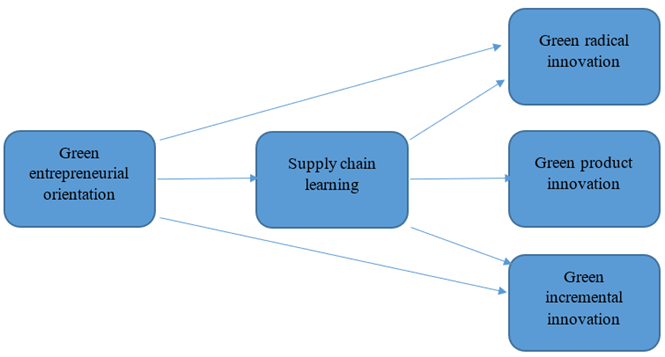
1) To determine the impact of green entrepreneurial orientation on the green radical innovation.
2) To determine the impact of green entrepreneurial orientation on the supply chain learning.
3) To determine the impact of green entrepreneurial orientation on the green incremental innovation.
4) To determine the impact of SCL supply chain learning on the green radical innovation.
5) To determine the impact of SCL supply chain learning on the green product innovation.
6) To determine the impact of SCL supply chain learning on the green incremental innovation.
The need to change the innovativeness in the industries has increased with the rising environmental concerns of the general public. That is why the firms need to work upon the change of its manufacturing processes and also on their innovation performance. They need to move towards a more sustainable and environment friendly approach. The focus of this study is to provide evidence to support the role of supply chain learning in bringing green innovativeness and green entrepreneurial orientation in the industrial sector.
2. Review of literature
2.1. Theoretical background
The theory of green entrepreneurial orientation helps in understanding the importance of green innovation in the business sector. According to the research studies Habib and Bao (2019), Wang et al. (2018), the green entrepreneurial orientation research started from the introduction of the green innovative theory. Research studies also show that having high green entrepreneurial orientation does not necessarily mean that the industry is having environmental protection Bouncken et al. (2016), Jiang et al. (2018). Therefore, it is why it is necessary for the industries to learn about the different means that can be used to improve the environmental protection in an organization which can be achieved through learning of the supply chain network.
2.2. The impact of green entrepreneurial orientation on the green radical innovation
According to the research studies Bouncken et al. (2016), Jiang et al. (2018), the enterprises that are entrepreneurially oriented, must have the capability of risk taking and bringing innovative initiatives Chu (2019). Through the entrepreneurial mindset, the organizations move towards new entry behavior and shows competitive aggressiveness. Taking initiatives regarding the environmental orientation and the green radical initiatives are included in this. Thus, the following hypothesis is being supported form the studies literature:
H1: There is a significant relationship between
the green entrepreneurial orientations on the green radical innovation of the
firms.
2.3. The impact of green entrepreneurial orientation on the supply chain learning
Green orientation in the business sector is an important factor mechanism for the high levels of learning at the organizational level, by the researchers. According to the research studies Habib and Bao (2019), Wang et al. (2018), the organizational learning has been found to be positively related to the entrepreneurial orientation. As the entrepreneurial orientation encourages the learning behavior and atmosphere by providing effective directions for the corporate learning Gosling et al. (2016), Wei et al. (2018), Wickramaratne et al. (2017). Thus, the following hypothesis is being supported form the studies literature:
H2: There is a significant relationship between
the green entrepreneurial orientations on the supply chain learning of the
firms.
2.4. The impact of green entrepreneurial orientation on the green incremental innovation
According to the literature studies Habib and Bao (2019), Wei et al. (2018), Wickramaratne et al. (2017), the entrepreneurial orientation results in shortening the knowledge resources of the corporates and therefore, the need to seek external sources from the other organizations increases Chu (2019). Thus, to deal with the other organizations, the enterprise itself must be aware of the green entrepreneurial orientation of the others. This will enhance the innovative performance of the organizations that are interconnected with each other Wang et al. (2018). Thus, the following hypothesis is being supported form the studies literature:
H3: There is a significant relationship between
the green entrepreneurial orientations on the green incremental innovation of
the firms.
2.5. The impact of supply chain learning on the green radical innovation
According to the research studies Gosling et al. (2016), Song et al. (2017), Trong Tuan (2017), Wach et al. (2018), the supply chain learning enables the organizations to learn about the green resources of technology and master them. Therefore, through this mutual collaboration between the supply chain partners, the development of better knowledge system takes place Habib and Bao (2019), Wei et al. (2018), Wickramaratne et al. (2017)which encourages the generation of new innovative ideas and also green radical innovations. Thus, the following hypothesis is being supported form the studies literature:
H4: There is a significant relationship between
the supply chain learning of the firms and their green radical innovation.
2.6. The impact of supply chain learning on the green product innovation
The supply chain learning enables the organizations to create collective knowledge pool and make the best use out of it Mandal and Saravanan (2019), Wątróbski (2019). Through the knowledge flow form the organizations and in between the interconnected organizations, the innovative performance of the enterprises also gets improved and their efficiency also increases Gosling et al. (2016), Song et al. (2017), Trong Tuan (2017), Wach et al. (2018). Thus, the following hypothesis is being supported form the studies literature:
H5: There is a significant relationship between
the supply chain learning of the firms and their green product innovation.
2.7. The impact of supply chain learning on the green incremental innovation
Literature studies Song et al. (2017), Trong Tuan (2017), Wach et al. (2018) shows that the diversity on the resources available for green technology increases the opportunities for the organizations to interact with each other. Therefore, the use of knowledge pool of the supply chain learning, the enterprises becomes able to positively influence the relationship innovation which then encourages the green incremental innovation practices in the organizations Gosling et al. (2016), Wei et al. (2018), Wickramaratne et al. (2017). Thus, the following hypothesis is being supported form the studies literature:
H6: There is a significant relationship between
the supply chain learning of the firms and their green
incremental
innovation.
2.8. Theoretical model
3. Methods
3.1. Sample Characteristics
The research utilized a questionnaire to fulfill the objectives of this study. Questionnaires were distributed among senior and middle level managers belonging to the pharmaceutical organizations of Thailand. A total of 440 questionnaires were distributed and self-administration was used to generate the data. The respondents were given a brief overview of the requirements and context of the study before they were asked to enter their responses. Out of the 440 distributed questionnaires 10 were excluded due to missing values and nine were misplaced, the remaining 421 were used for data analysis.
3.2. Measures
The construct items were selected after extensive literature review was conducted by the researcher. The directions of Brislin (1970) were followed to implement the forward and back translation method, the questionnaire designed for the study was in English and afterwards for the sake of people who were involved in the study, it was translated into Thai so that the respondents could clearly understand the questions and statements. Then it was again converted into English so that fellow non-Thai researchers could also benefit from the study. The questionnaire was pretested on MBA students and minor modifications were made according to their feedback. A five points Likert scale was used to record responses.
3.2.1. Green Entrepreneurial Orientation
Five items were developed for measuring green entrepreneurial orientation. These items were adopted from the studies of Li et al. (2010), Jiang et al. (2018), and Zhao et al. (2011). These items were later modified to fit the requirements of the present study. A sample item is “Our firm has a tendency to be a market leader, always first in introducing green products, services, or technologies”.
3.2.2. Supply Chain Learning
The five items for measuring supply chain learning were adapted from the studies of Flint et al. (2008). A sample item is that from the knowledge gained from the important supply chain partners will help the managers and employees of the firm to change their attitude towards the changing situation of the market (e.g., to be aware of the market potential of environmentally friendly packaging materials by gaining information from the suppliers)”.
3.2.3. Green Incremental Innovation
The total items used for measuring green incremental innovation were four and were adapted from the study of Dai et al. (2015). A sample item is “the existing technologies are often exploited so that the processes could be made environmental friendly (e.g., to reduce pollutant emissions by using existing pollution control technologies or existing waste management technology)”.
3.2.4. Green Radical Innovation
The items for measuring green radical innovation were used from Dai et al. (2015), and Li et al. (2008). Four items were used to measure GRI. A sample item is “We often introduce radically new concept innovations to make products more environmentally friendly (e.g., introduce radically new environmental concepts in the process of product research and development”.
3.2.5. Green Product Innovation
GPI has been measured on the basis of the scale adapted from the studies of Chiou et al. (2011), and Chen et al. (2006). Four items were used to measure GPI, a sample item is “Improving and designing environmentally friendly packaging (e.g.: less paper and plastic material used) for existing and new products”.
4. Results
4.1. Demographics
The sample consists of 421 individuals who serve as the managerial staff in the pharmaceutical sector of Thailand. Out of these 55.5 percent are male and 44.5 are female respondents. The disparity in male and female employees is due to the presence of patriarchy in Thailand. 74 percent of the sample is aged between 20 and 35 and 74.3 percent has working experience ranging from 2 to 8 years. The managers and middle managers were the constituents of the sample therefore a maturity in age and experience is observed.
4.2. Descriptive Analysis
The descriptive analysis of the data has been demonstrated in Table 1. The minimum and maximum values are observed in order to check the data for the presence of outliers. The minimum and maximum values follow the stream of the limits of the Likert scale (1-5), therefore outliers were found to be present in the data as the maximum values represent some altercation from 5. The data followed a normal distribution as skewness coefficients were less than -1. The mean values of all items are approaching 4, demonstrating that the respondents agreed with the statements of the scale items
Table 1
|
Table 1 Descriptive Statistics |
|||||||
|
N |
Minimum |
Maximum |
Mean |
Std. Deviation |
Skewness |
||
|
Statistic |
Statistic |
Statistic |
Statistic |
Statistic |
Statistic |
Std. Error |
|
|
GreEntOri |
421 |
1.00 |
5.00 |
3.2196 |
0.845 |
-.193 |
.116 |
|
SCLear |
421 |
1.00 |
5.00 |
3.3749 |
0.703 |
-.372 |
.116 |
|
GreRedInno |
421 |
1.00 |
5.00 |
3.5230 |
0.769 |
-0.552 |
.116 |
|
GreProdInno |
421 |
1.00 |
5.28 |
3.4380 |
0.725 |
-.506 |
.116 |
|
GreIncInno |
421 |
1.00 |
5.00 |
3.5561 |
0.843 |
-.565 |
.116 |
|
Valid N (listwise) |
421 |
||||||
4.3. KMO
KMO test is used to determine whether or not the sample
data is adequate and can be used for factor analysis. As the KMO and Bartlett’s
sphericity values are significant therefore the sample data can be used for
further testing. Table 2
|
Table 2 KMO and Bartlett's Test |
||
|
Kaiser-Meyer-Olkin
Measure of Sampling Adequacy. |
0.927 |
|
|
Bartlett's Test of
Sphericity |
Approx. Chi-Square |
8665.267 |
|
df |
231 |
|
|
Sig. |
.000 |
|
4.4. Factor Analysis
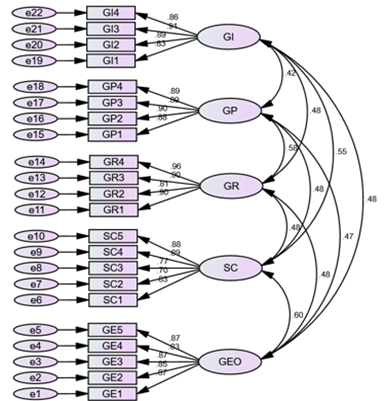
The individual component loadings of all scale items are depicted in Table 3. The loadings of each scale item represents its contribution in the overall variance of the construct. A loading greater than 0.7 showcases significant contribution. Thus all factors are significant as they are more than 0.7.
Table 3
|
Table 3 Rotated Component Matrixa |
|
|
|
|
|
|
Component |
|||||
|
1 |
2 |
3 |
4 |
5 |
|
|
GE1 |
.808 |
||||
|
GE2 |
.868 |
||||
|
GE3 |
.826 |
||||
|
GE4 |
.793 |
||||
|
GE5 |
.799 |
||||
|
SC1 |
.737 |
||||
|
SC2 |
.731 |
||||
|
SC3 |
.779 |
||||
|
SC4 |
.841 |
||||
|
SC5 |
.804 |
||||
|
GR1 |
.821 |
||||
|
GR2 |
.839 |
||||
|
GR3 |
.843 |
||||
|
GR4 |
.864 |
||||
|
GP1 |
.845 |
||||
|
GP2 |
.859 |
||||
|
GP3 |
.849 |
||||
|
GP4 |
.851 |
||||
|
GI1 |
.811 |
||||
|
GI2 |
.833 |
||||
|
GI3 |
.863 |
||||
|
GI4 |
.854 |
4.5. Convergent and Discriminant validity
A CR value greater than 0.7 verifies the internal consistency, as demonstrated in Table 4 all of the CR values are greater than 0.7 and the AVE values of scale items are above the threshold value, ensuring the convergent validity of scale items. As Table 4 represents, all items have high self-correlation values and low MSV values therefore the overall construct has discriminant validity.
Table 4
|
Table 4 Convergent and Discriminant Validity |
||||||||
|
CR |
AVE |
MSV |
GEO |
GP |
GI |
GR |
SC |
|
|
GEO |
0.933 |
0.737 |
0.360 |
0.858 |
||||
|
GP |
0.940 |
0.796 |
0.331 |
0.472 |
0.892 |
|||
|
GI |
0.927 |
0.761 |
0.305 |
0.478 |
0.418 |
0.873 |
||
|
GR |
0.941 |
0.800 |
0.331 |
0.481 |
0.575 |
0.483 |
0.895 |
|
|
SC |
0.909 |
0.669 |
0.360 |
0.600 |
0.477 |
0.552 |
0.480 |
0.818 |
4.6. Model Fitness
The CFA test is
conducted to ensure the fitness of the model, the model is fit as the CMIN CFI
IFI GFI RMSEA values are according to the threshold limits.
Table 5
|
Table 5 Confirmatory Factors Analysis |
||
|
Indicators |
Threshold range |
Current values |
|
CMIN/DF |
Less or equal 3 |
2.620 |
|
GFI |
Equal or greater .80 |
.998 |
|
CFI |
Equal or greater .90 |
.967 |
|
IFI |
Equal or greater .90 |
.977 |
|
RMSEA |
Less or equal .08 |
.061 |
Figure 1 CFA
4.7. SEM
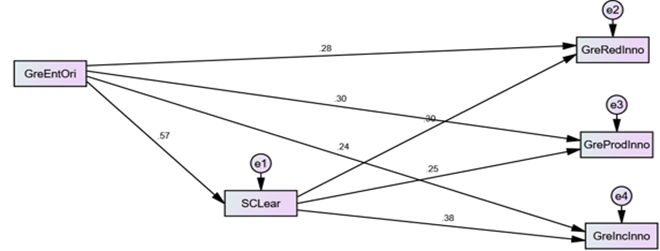
A unit change in GreEntOri
produces an effect of 24.5 percent in GreIncInno, 29.7 percent in GreProdinno
and 28.4 percent in GreRedInno. All three relationships and variances are
significant therefore the hypotheses are accepted. The mediation of SClear produces
similar significant effects. A change of 37.6 percent in GreIncInno is
observed, 25.2 percent variation in GreProdInno occurs and 30 percent change is
concurrent in GreRedInno. The relationships are significant therefore the
hypotheses are accepted.
Table 6
|
Table 6: Structural Equation Modeling |
||
|
Total Effect |
GreEntOri |
SCLear |
|
SCLear |
.573 |
.000 |
|
GreIncInno |
.460 |
.376 |
|
GreProdInno |
.442 |
.252 |
|
GreRedInno |
.456 |
.300 |
|
Direct Effect |
GreEntOri |
SCLear |
|
SCLear |
.573 |
.000 |
|
GreIncInno |
.245 |
.376 |
|
GreProdInno |
.297 |
.252 |
|
GreRedInno |
.284 |
.300 |
|
Indirect Effect |
GreEntOri |
SCLear |
|
SCLear |
.000 |
.000 |
|
GreIncInno |
.215 |
.000 |
|
GreProdInno |
.145 |
.000 |
|
GreRedInno |
.172 |
.000 |
Figure 2 SEM
5. Discussion
Research by Jiang et al. (2018) manifests that GEO sometimes closely related to the concept of green innovation because it deals with all the aspects of green innovations and enables organizations to successfully achieve all the green innovation goals with a competitive advantage. In context to the pharmaceutical market of Thailand, this research study developed a model (conceptual) that consists of the impact of GEO on the green innovation products of the sector. Initial results and findings of this study revealed that the impact of GEO on green product innovation has been significant and positive and the hypothesis has been accepted. This is because research by Fatoki (2019) revealed that GEO consciously deals with environmental issues mainly through focusing on entrepreneurial ideas and concepts with a level of accuracy. Further findings of this research exhibit that the effects of the GEO on the green radical innovation GRI has also been positive and significant. Also, supply chain learning can significantly effects the relation of GEO with the green product innovations. SCL can be referred to as an important source and tool related to CSB and might play a significant role in enhancing the association between the variable GEO and the green product innovation.
6. Conclusion
The purpose of the given theory is to detail how green Entrepreneurial orientation reveals the various ways of the successful industry can be by adopting such innovations in the internal structure of the industry but also the individuals can be benefited. Such innovations not only are essential but provide a path to industry to grow more successfully in the future. The Research paper shows that the data is taken by 421 employees of the various firms of the industry to analyze the impacts of the effects.
6.1. Implications and Limitations
The research paper has a broad coverage of the different areas of the pharmaceutical sector in Thailand and this provides a further study to the researchers to find more ways and means to enhance the progress of the industry. The Findings of this research study makes significant contributions to the literature and theory of EO, supply chain learning and green innovation products.
This research study subject to some limitations and restrictions that provide crucial opportunities for future studies and analysts. Primarily, this research has considered the supplier and consumer learning CL together to construct the supply chain learning scale, thus, it is significant for future analysts that should know the contribution of individual type and dimension. Secondly, the research study only evaluates the mediating role of SCL between green product innovation and GEO; therefore, future analysts should add some other mediating variables for accurate results.
CONFLICT OF INTERESTS
None.
ACKNOWLEDGMENTS
None.
REFERENCES
Arshad, M. H. (2018). Effect of Market Orientation, Learning Orientation and Entrepreneurial Orientation on SME’s Performance in the Pakistan Context [Doctoral Dissertation, Universiti Utara Malaysia].
Bouncken, R. B., Plüschke, B. D., Pesch, R., and Kraus, S. (2016). Entrepreneurial Orientation in Vertical Alliances: Joint Product Innovation and Learning from Allies. Review of Managerial Science, 10(2), 381–409. https://doi.org/10.1007/s11846-014-0150-8
Brislin, R. W. (1970). Back-Translation for Cross-Cultural Research. Journal of Cross-Cultural Psychology, 1(3), 185–216. https://doi.org/10.1177/135910457000100301
Chen, C.-Y., Huang, H.-H., and Wey, S.-C. (2017). The Mediating Roles of Differentiation Strategy and Learning Orientation in the Relationship Between Entrepreneurial Orientation and Firm Performance. Chiao Da Management Review, 37(1), 1–40.
Chen, Y.-S., Lai, S.-B., and Wen, C.-T. (2006). The Influence of Green Innovation Performance on Corporate Advantage in Taiwan. Journal of Business Ethics, 67(4), 331–339. https://doi.org/10.1007/s10551-006-9025-5
Chiou, T.-Y., Chan, H. K., Lettice, F., and Chung, S. H. (2011). The Influence of Greening the Suppliers and Green Innovation on Environmental Performance and Competitive Advantage in Taiwan. Transportation Research Part E: Logistics and Transportation Review, 47(6), 822–836. https://doi.org/10.1016/j.tre.2011.05.016
Chu, K.-M. (2019). Coevolution of Environmental Sustainability Orientation and Strategic Alliance Learning in Green Supply Chain Management. International Journal of Management and Economics, 55(1), 3–12. https://doi.org/10.2478/ijme-2019-0001
Dai, J., Cantor, D. E., and Montabon, F. L. (2015). How Environmental Management Competitive Pressure Affects a Focal Firm’s Environmental Innovation Activities: A Green Supply Chain Perspective. Journal of Business Logistics, 36(3), 242–259. https://doi.org/10.1111/jbl.12094
Fatoki, O. (2019). Green Entrepreneurial Orientation and Firm Performance in South Africa. Entrepreneurship and Sustainability Issues, 7(1), 247–262. https://doi.org/10.9770/jesi.2019.7.1(19)
Flint, D. J., Larsson, E., and Gammelgaard, B. (2008). Exploring Processes for Customer Value Insights, Supply Chain Learning, and Innovation: An International Study. Journal of Business Logistics, 29(1), 257–281. https://doi.org/10.1002/j.2158-1592.2008.tb00078.x
Gosling, J., Jia, F., Gong, Y., and Brown, S. (2016). The Role of Supply Chain Leadership in the Learning of Sustainable Practice: Toward an Integrated Framework. Journal of Cleaner Production, 137, 1458–1469. https://doi.org/10.1016/j.jclepro.2014.10.029
Guo, Y., Wang, L., and Chen, Y. (2020). Green Entrepreneurial Orientation and Green Innovation: The Mediating Effect of Supply Chain Learning. SAGE Open, 10(1), 2158244019898798. https://doi.org/10.1177/2158244019898798
Habib, A., and Bao, Y. (2019). Impact of Knowledge Management Capability and Green Supply Chain Management Practices on Firm Performance. International Journal of Research in Business and Social Science, 8(6), 240–255. https://doi.org/10.20525/ijrbs.v8i5.548
Jiang, W., Chai, H., Shao, J., and Feng, T. (2018). Green Entrepreneurial Orientation for Enhancing Firm Performance: A Dynamic Capability Perspective. Journal of Cleaner Production, 198, 1311–1323. https://doi.org/10.1016/j.jclepro.2018.07.104
Li, Y., Liu, Y., Li, M., and Wu, H. (2008). Transformational Offshore Outsourcing: Empirical Evidence from Alliances in China. Journal of Operations Management, 26(2), 257–274. https://doi.org/10.1016/j.jom.2007.02.011
Li, Y., Wei, Z., and Liu, Y. (2010). Strategic Orientations, Knowledge Acquisition, and firm Performance: The Perspective of the Vendor in Cross-Border Outsourcing. Journal of Management Studies, 47(8), 1457–1482. https://doi.org/10.1111/j.1467-6486.2010.00949.x
Mandal, S., and Saravanan, D. (2019). Exploring the Influence of Strategic Orientations on Tourism Supply Chain Agility and Resilience: An Empirical Investigation. Tourism Planning and Development, 16(6), 612–636. https://doi.org/10.1080/21568316.2018.1561506
Song, Y., Cai, J., and Feng, T. (2017). The Influence of Green Supply Chain Integration on Firm Performance: A Contingency and Configuration Perspective. Sustainability, 9(5), Article 763. https://doi.org/10.3390/su9050763
Trong Tuan, L. (2017). Organizational Social Capital as a Moderator for the Effect of Entrepreneurial Orientation on Competitive Intelligence. Journal of Strategic Marketing, 25(4), 301–315. https://doi.org/10.1080/0965254X.2015.1076884
Wach, K., Głodowska, A., and Maciejewski, M. (2018). Entrepreneurial Orientation, Knowledge Utilization, and Internationalization of Firms. Sustainability, 10(12), Article 4711. https://doi.org/10.3390/su10124711
Wang, Z., Wang, Q., Zhang, S., and Zhao, X. (2018). Effects of Customer and Cost Drivers on Green Supply Chain Management Practices and Environmental Performance. Journal of Cleaner Production, 189, 673–682. https://doi.org/10.1016/j.jclepro.2018.04.071
Wątróbski, J. (2019). Ontology Supporting Green Supplier Selection Process. Procedia Computer Science, 159, 1602–1613. https://doi.org/10.1016/j.procs.2019.09.331
Wei, F., Wang, C.-Y., and Xiong, Q.-C. (2018). Linking Proactive Environmental Strategy to Green Supply Chain Management: Commentary and Future Directions. In Proceedings of the 4th Annual International Conference on Management, Economics and Social Development (ICMESD 2018). https://doi.org/10.2991/icmesd-18.2018.31
Wickramaratne, A., Kiminami, A., and Yagi, H. (2017). External Relationships and Entrepreneurial Orientation of Tea Manufacturing Firms in Sri Lanka. International Food and Agribusiness Management Review, 20, 293–306. https://doi.org/10.22434/IFAMR2015.0070
Zhao, Y., Li, Y., Lee, S. H., and Chen, L. B. (2011). Entrepreneurial Orientation, Organizational Learning, and Performance: Evidence from China. Entrepreneurship Theory and Practice, 35(2), 293–317. https://doi.org/10.1111/j.1540-6520.2009.00359.x
|
|
 This work is licensed under a: Creative Commons Attribution 4.0 International License
© ShodhKosh 2026. All Rights Reserved.