ShodhKosh: Journal of Visual and Performing ArtsISSN (Online): 2582-7472
|
|
A Framework for an Interactive Public Art Platform: Revitalizing Graphic Heritage of Luoyang City Gates
Hanli Liu 1 , Chanoknart Mayusoh 2
 , Akapong Inkuer 3
 , Permsak Suwannatat 4
1 Doctoral
Student of Philosophy Program in Visual Arts and Design, Faculty of Fine and
Applied Arts, Suan Sunandha Rajabhat University, Thailand
2 Advisor
in Visual Arts and Design, Faculty of Fine and Applied Arts, Suan Sunandha
Rajabhat University, Thailand
3 Visual Arts and Design, Faculty of Fine and Applied Arts, Suan
Sunandha Rajabhat University, Thailand
4 Program in Creative Arts Department, Faculty of Fine and Applied Arts
Chulalongkorn University, Thailand
|
|
|
ABSTRACT |
|
|
This study
proposes a three-stage framework "symbolic decoding - digital
translation - public co-creation" to revitalize graphic heritage through
an interactive public art platform. Using the graphic heritage of Luoyang's
ancient city gate as a case study, the research was conducted through
literature review, expert interviews, platform prototype development, and
initial user validation. Results demonstrate that the TUMEN (Cultural Memory
Gate Generator) platform effectively transforms historical architectural
symbols into interactive cultural experiences. Data from 157 valid responses
demonstrates the platform's positive impact on aesthetic perception,
understanding of cultural symbolism, and interactive engagement. The study
validates the theoretical and practical applicability of the framework and
provides a replicable strategy for cultural communication in both digital and
physical public spaces. This research establishes a new bridge between the
preservation of cultural heritage authenticity and its creative
reinterpretation, offering important implications for public art, cultural
education, and the construction of urban memory. |
|||
|
Received 28 February 2026 Accepted 10 April 2026 Published 07 May 2026 Corresponding Author Hanli Liu,
s65584948015@ssru.ac.th DOI 10.29121/shodhkosh.v7.i1.2026.7857 Funding: This research
received no specific grant from any funding agency in the public, commercial,
or not-for-profit sectors. Copyright: © 2026 The
Author(s). This work is licensed under a Creative Commons
Attribution 4.0 International License. With the
license CC-BY, authors retain the copyright, allowing anyone to download,
reuse, re-print, modify, distribute, and/or copy their contribution. The work
must be properly attributed to its author.
|
|||
|
Keywords: Public Art, Graphic Heritage, Interactive Platform,
Co-Creation, Cultural Heritage Communication, Urban Memory, Visual Narratives |
|||



1. INTRODUCTION
Against the backdrop of rapid globalization and digitalization, public art has gradually become a crucial medium for cultural dissemination and the construction of urban identity Della Lucia and Trunfio (2018). Contemporary cities face the dual challenges of cultural homogenization and the gradual loss of local cultural values. Preserving and revitalizing local cultural assets has become a crucial issue that demands urgent attention UNESCO (2001). Among various forms of cultural heritage, "graphic heritage" (the visual, symbolic, and stylistic elements embedded in historical architecture, decoration, and design) plays an irreplaceable role in the construction of collective memory and the strengthening of cultural identity Harland et al. (2019), Gombrich (1984).
However, despite its significance, graphic heritage is often confined to archives, static exhibitions, or specialized academic fields, limiting its accessibility and interactivity to the contemporary public. In contrast, public art, with its openness, interactivity, and site-specific nature, can transform heritage into a participatory cultural experience Cartier and Willis (2008). Furthermore, the rapid development of digital platforms, particularly online interactive systems for public co-creation, has opened up new possibilities for the dissemination of heritage, transforming the public from passive recipients to participants and reconstructors of cultural content Giaccardi (2012).
Against this backdrop, the question of how to integrate graphic heritage, public art, and interactive digital platforms to enhance the engagement and impact of heritage communication has become a pressing issue. To address this challenge, this article proposes a three-stage public art framework model. Using the graphic heritage of Luoyang's ancient city gates as an example, this paper constructs and initially validates the platform, aiming to explore pathways for reinterpreting cultural symbols in digital environments.
2. Research Objectives
This study aims to construct and verify an interactive public art platform model based on the logic of graphic heritage symbol translation, emphasizing the integration of the entire process from visual element extraction to public co-creation, and enhancing the depth of cultural heritage dissemination and public participation.
Specific objectives include:
Framework construction: To formulate a visual-encoding and re-interpretation framework applicable to multiple types of cultural heritage;
Prototype development: To develop an interactive platform prototype centered on the graphic repertoire of Luoyang’s city gates and verify modes of public participation in digital co-creation;
Exploring communication paths: To explore deployable design pathways for both virtual and physical spaces, thereby expanding the boundaries of cultural-heritage dissemination.
3. Literature Review
3.1. Public Art as Cultural Engagement and Urban Memory
The role of public art in contemporary cities has transcended aesthetic decoration, becoming a crucial medium for inspiring collective identity and fostering cultural interaction Mersmann et al. (2024). Highly interactive art forms, in particular, emphasize the public's right to recreate within specific spaces, shifting art spaces from a "display" perspective to a "participatory" one Giaccardi (2012). This shift provides a theoretical foundation for transforming the way cultural heritage is disseminated.
Related research has shown that public art, through its community-building and participatory processes, can enhance a sense of place and encourage public reflection on historical elements that have been overlooked or lost in urban development Lossau and Stevens (2014). This suggests that, within the dual context of urban renewal and cultural heritage, public art is not only an aesthetic practice but also a crucial channel for cultural reproduction. This study applies this theoretical perspective to the practice of interpreting the graphic heritage of Luoyang's ancient city gates, aiming to explore how public participation can promote the regeneration of historical and cultural symbols.
3.2. Graphic Heritage: The Intersection of Architectural Symbolism and Visual Culture
"Graphic heritage" refers to the collection of elements that carry historical and cultural values in visual forms, such as architecture, patterns, and decorative symbols Harland and Xu (2021). In social memory theory, cultural memory is continuously constructed at the collective level through visual symbols, images, and rituals Halbwachs (1992). Therefore, graphic heritage is not only a carrier of historical information but also a "visual language" of cultural identity.
In ancient Chinese architecture, the proportions of city gates, roof forms, and color schemes all carry specific political and cultural symbolism. For example, the hipped roof and gabled roof are not only structural features but also implicitly convey hierarchy and status. The stability and recognizability of these visual symbols make them crucial vehicles for the public to quickly identify cultural information.
Visual culture theory further argues that the meaning of an image derives not only from its appearance but also from its function and context within social cognition and cultural production Mirzoeff (2015). This theoretical framework provides the foundation for this study, making graphic heritage not only an object of study but also a dynamic participant in the process of cultural dissemination.
3.3. Digital Platforms and Mechanisms for Heritage Co-Creation
Driven by information technology, digital platforms have become a crucial channel for disseminating cultural heritage. Katifori et al. (2020) emphasize that the interactivity and customizability of digital environments provide unprecedented opportunities for public participation in heritage interpretation. Mantzou et al. (2023) note that the introduction of co-creation mechanisms can enhance public participation and a sense of belonging, bringing cultural expression closer to individual experience.
In the context of public art, digital platforms provide flexible and open experimental venues for the contemporary reinterpretation of heritage. They not only transcend the limitations of physical space but also enable the display of virtually generated cultural works in physical public spaces, fostering a model of interactive and complementary online and offline communication. This study explores the feasibility of this "digital - physical" dual-track communication approach using the case study of the Luoyang Ancient City Gate graphic heritage.
3.4. Research Gap and Potential for Integration
While existing research has explored the roles of public art, graphic heritage, and digital platforms in cultural communication, theoretical models that systematically integrate these three remain relatively scarce. In the context of Chinese culture, research on how to effectively transform visual cultural symbols into interactive artistic experiences is particularly weak. Most studies focus on single-domain or single-media applications, lacking comprehensive methodological support across disciplines and media.
This study aims to fill this gap by proposing and validating an interactive framework centered on the pathway of "symbolic decoding - digital translation - public co-creation." This framework not only focuses on the authenticity and recognizability of heritage but also emphasizes the public's creative participation and emotional connection in the cultural regeneration process, thereby exploring strategies for revitalizing traditional visual heritage in the digital age.
4. Research Methodology
This study adopts a qualitative-led exploratory research strategy, combining the development of a platform prototype with user feedback verification to implement the feasibility of the three-stage interactive model of "graphic heritage + public art + digital platform" in practice.
4.1. Literature Summarization and Visual Variable Extraction
This study first, through a systematic literature review and collation of historical image archives, identified key visual variables that influence the cultural cognition and aesthetic perception of city gates. These include roof form, the ratio of width to column height, the shape and number of doorways, and the color scheme. These variables, which have clear hierarchical symbolic meanings in architectural history and visual culture research, were encoded as interactive components of the platform.
In city gate architecture, roofs serve both structural and social functions; hip-roofed and gable and hip-roofed are the most representative forms, and the number of eaves (single-eaved vs. double-eaved) also visually conveys corresponding social status. Accordingly, the platform maps roofs into four optional components: single-eaved hip-roofed, double-eaved hip-roofed, single-eaved gable and hip-roofed, and double-eaved gable and hip-roofed. These are coded A1–A4 for easy access and recording on the platform.
Table 1
|
Table 1 Roof form Variable Definition and Platform Mapping |
||||
|
Variable |
Reference Images |
Platform Mapping |
Visible parameters |
Coding |
|
Hip-roofed (single-eaved) |
|
|
Shape: Hip-roofed, Number of eaves: 1 |
A1=Single-eaved Hip-roofed |
|
Hip-roofed (double-eaved) |
|
|
Shape: Hip-roofed, number of eaves: 2 |
A2=Double-eaved Hip-roofed |
|
Gable and hip-roofed (single-eave) |
|
|
Shape: Gable and hip-roofed, number of eaves: 1 |
A3 = Single eaves Gable and hip-roofed |
|
Gable and hip-roofed (double-eaved) |
|
|
Shape: Gable and hip-roofed, number of eaves: 2 |
A4=Double eaves Gable and hip-roofed |
|
Source: Author (2025) |
||||

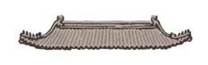

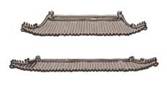


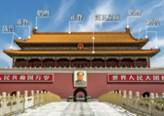

The ratio of frontage (number of bays) to column height jointly determines the vertical and horizontal tension of the city gate's facade, providing a crucial clue to the sense of hierarchy and visual order. Standards such as the "Yingzaofashi" clearly define the relationship between the two, with variations observed over time: the Tang Dynasty saw a tendency toward horizontal expansion and low proportions, while the Song and Yuan dynasties saw a trend toward vertical expansion and increased column height. Within the platform, proportion is achieved through the number of bays and levels of the building's components.
Table 2
|
Table 2 Variable Definition and Platform Mapping for Width-to-Column-Height Ratio |
|||||
|
Variable |
Reference Images |
Platform Mapping (House Components) |
Visible parameters |
Coding |
|
|
Tang Dynasty city gate |
|
|
Number of bays: 9; Number of floors: 1 |
B9F1 |
|
|
|
Number of bays: 9; Number of floors: 2 |
B9F2 |
|||
|
Northern Song Dynasty city gate |
|
|
Number of bays: 7; Number of floors: 1 |
B7F1 |
|
|
|
Number of bays: 7; Number of floors: 2 |
B7F2 |
|||
|
Yuan Dynasty city gate |
|
|
Number of bays: 5; Number of floors: 1 |
B5F1 |
|
|
|
Number of bays: 5; Number of floors: 2 |
B5F2 |
|||
|
Note: B represents the number of
bays, and F represents the number of floors. These numbers are specific
values. This study considers bays and floors as core parameters for roof
components, used for platform component selection and user combination
recording. Source: Author (2025) |
|||||
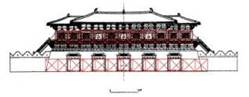
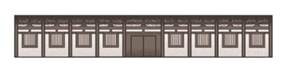

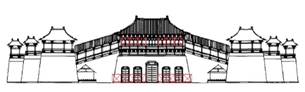
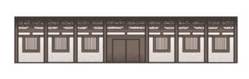
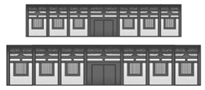

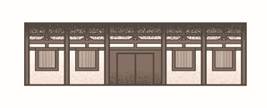

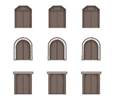
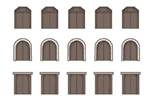
The layout of gate opening and gate passages embodies ritual and traffic order: structural forms gradually evolve from lintels to arches; the number of one, three, or five passages clearly reflects allocation of use and hierarchy (the central gate was reserved for the emperor, the side gates for officials and civilians). The platform uses C-codes for doorways (trapezoidal, arched, or square) and D-codes for passages (1, 3, or 5), allowing for free combination to convey ritualistic meaning.
Table 3
|
Table 3 Doorway and Passage Variable Definitions and Platform Mapping |
||||
|
Variable |
Reference Images |
Platform Mapping |
Visible parameters |
Coding |
|
Gate opening shape |
|
|
Trapezoid |
C1=trapezoidal |
|
|
|
Arch |
C2=Arch |
|
|
|
|
Square |
C3=Square |
|
|
Number of gate passages |
|
|
Number of gate passages: 1 |
D1 = one |
|
|
|
Number of gate passages: 3 |
D3=three |
|
|
|
|
Number of gate passages: 5 |
D5=Five |
|
|
Source: Author (2025) |
||||
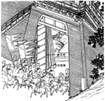

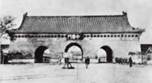


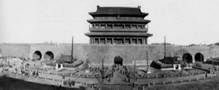

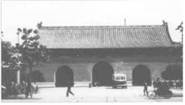
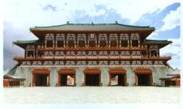
Color is the most intuitive way to encode hierarchy: Tang and Song dynasty imperial architecture often featured a "red pillars, red doors, and yellow glazed tiles" pattern, with walls often constructed of gray brick or white. Based on this, the platform constructs combinations of primary colors (pillars, walls, and doors), roof colors (yellow glazed tiles, black tiles), and city wall colors (white, gray, and brown) to support the visual selection of cultural symbols.
Table 4
|
Table 4 Color System Variable Definition and Platform Mapping |
||||
|
Variable |
Reference Images |
Platform Mapping |
Visible parameters |
Coding |
|
Main color |
|
|
Column color, wall color, door color |
M=Red columns/white walls/red doors combination |
|
Roof color |
|
|
Roof tile and ridge color |
RY = Yellow Glaze; RG #NAME? |
|
Wall color |
|
|
Wall color |
CW=white; CG=gray; CB=brown |
|
Source: Author (2025) |
||||

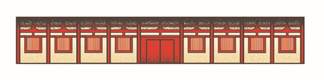

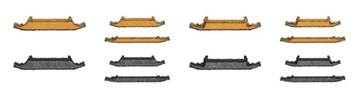
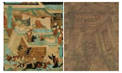

These four variables do not exist in isolation; rather, they interact within historical architecture, collectively shaping the city gate's sense of hierarchy and cultural identity. To this end, this study integrates them into a component library and embeds them into an interactive platform, allowing users to freely combine them to digitally recreate cultural imagery.
4.2. Expert Interviews and Thematic Analysis
Based on the variable extraction process, this study conducted purposive sampling and invited eight experts in the fields of architectural history, urban heritage preservation, visual communication, color systems, and public art curation to participate in semi-structured interviews to gain professional insights into the cultural value and transformation paths of city gates Table 5. The interviews covered core topics such as "cultural memory recall," "form and symbol recognition," and "public participation variables." The data collection process included audio recording, verbatim transcription, and cross-verification.
Table 5
|
Table 5 Expert Interview Sample Overview |
|||||
|
No. |
Field |
Job title/position |
Representative organizations/units |
Years of experience |
Interview method |
|
E01 |
Public Art Design |
Senior Art Curator |
Urban Art Promotion Center |
15 years |
Offline |
|
E02 |
Architecture and Urban Renewal Design |
Partner of an architectural firm |
An architectural firm |
18 years |
On-line |
|
E03 |
Urban Landscape and Visual Communication |
Professor/ Urban Landscape Consultant |
Urban Space Vision Research Institute |
25 years |
Offline |
|
E04 |
Interpretation of Historical Architectural
Culture |
Researchers |
Dingdingmen Ruins Museum |
12 years |
On-line |
|
E05 |
Research on Color and Modeling Language |
Color system expert |
Art and Color Research Association |
20 years |
On-line |
|
E06 |
Urban public space art |
Design Director |
Cultural and Creative Companies |
14 years |
Offline |
|
E07 |
Research on the history of Chinese and Western
aesthetics and aesthetic principles, research on art philosophy and art
theory |
Doctoral Supervisor/ |
Chinese Society of Aesthetics/Shanghai Society of
Aesthetics |
22 years |
Offline |
|
Expert Consultant |
|||||
|
E08 |
Urban heritage protection |
Professor/Doctoral Supervisor |
School of Urban Planning of a comprehensive
university |
20 years |
On-line |
|
Note: To protect the privacy of
the respondents, the professional titles and affiliations in the table has
been desensitized, but their professional identity labels are still retained. Source: Author (2025) |
|||||
To ensure a systematic qualitative analysis, the research team used NVivo 12 Plus to conduct a three-level coding process, completing open, axial, and selective coding. During the open coding phase, the interview texts were annotated sentence by sentence, resulting in 78 initial tags. These tags were then clustered and contextualized into 16 mid-level categories Table 7. Ultimately, four core themes were identified, explaining the transformation mechanism from "graphic heritage to cultural cognition to public expression" Table 8.
Table 6
|
Table 6 Open Coding Example |
||
|
Excerpt from the original statement |
Encoded Label |
Frequency |
|
"The overlapping eaves of the double-eaved
hip roof make the roof appear even larger, creating a sense of oppression at
first glance. This is the architectural embodiment of power" (E02) |
Roof volume + symbol of power |
23 |
|
“Using parametric design to
transform the proportions of bracket sets into modern devices, preserving the
DNA while breaking through the formal boundaries” (E06) |
Component parameterization + form regeneration |
27 |
|
"The gradual changes in the height-to-width
ratio of the city gate piers not only reflect the evolution of technical
skills, but also reflect carefully calculated political considerations"
(E08) |
Proportional changes + political expression |
41 |
|
“Yellow glazed tiles are an
absolute symbol of imperial status; this is an institutionalized color
privilege” (E05) |
Color Specificity + Hierarchy |
38 |
|
“The material division
system of bracket sets can be completely transformed into parametric design
units” (E03) |
Construction logic + digital translation |
22 |
|
“Young people think of city
gates as arched, semicircular gates on top, but they don’t realize that
during their heyday, city gates wer |
Graphic symbol failure + cultural disconnection |
35 |
|
“Directly replicating city
gate components in a commercial plaza is essentially symbolic appropriation”
(E06) |
Mechanical reproduction + field disembedding |
22 |
|
"[E04 repeatedly used hand gestures to
simulate the warping curve of the roof during the demonstration]"
(recording notes) |
Gesture simulation + spatial memory evoked |
27 |
|
"Allowing viewers to use AR to adjust the
number of door nails and the color of the building allows them to better
understand the impact of the architectural system on class at the time than a
static exhibition would." (E03) |
Immersive interaction + Enhanced system awareness |
19 |
|
“The change in the number of
doorways is a developmental need for urban expansion, and more importantly,
it is physical evidence of the identity system” (E04) |
Doorway changes + identity system mapping |
17 |
|
Source: Author (2025) |
||
Table 7
|
Table 7 Axial Categories Summary |
||||
|
Category Name |
Contains concepts (keywords) |
Typical relationship path |
Experts involved |
Remark |
|
Reappearance of ritual space |
Axial symmetry / Number of gates / Level of city
walls |
Structural Features → Spatial Rituals
→ Power Representation |
E02, E08 |
Closely linked to the planning of the city’s
central axis |
|
Color symbology |
Red Pillars and Red Walls / Glaze Level / Golden
Despotism |
Color Combination → Visual Hierarchy
→ Identity |
E05, E07 |
High integration of structure and decoration |
|
Graphic Cognitive Gap |
Graphic symbol failure / Chiwen meaning / Young
people's poor cognition |
Graphic style → Cultural suspension →
Cultural distance |
E03, E04 |
It is the premise of the phenomenon of
"context stripping in design" |
|
Translation technology path |
Parametric design / Material classification
system / Digital imitation |
Traditional form → Digital language → Modular adaptation |
E03, E06 |
A collection of opinions from public art
designers |
|
Module expression potential |
Graphic Reconstruction/ Proportional Unit/
Rhythmic Structure |
Component deconstruction → Visual unit
→ Contemporary design language |
E01, E06 |
Forming a technical bond with "parametric
architecture" |
|
Field disembedding risk |
Graphic collage / Positional disjunction /
Display symbolism |
Spatial stripping → Emotional rupture
→ Meaning dissolution |
E04, E08 |
Frequently observed in negative cases |
|
Non-verbal memory channels |
Gesture reproduction / Graphic imitation / Spatial
immersion |
Body movement → Memory anchor → Spatial
identity |
E01, E06 |
Combined with immersive display |
|
Proportional Power Rhetoric |
Pier height-to-width ratio / Strict proportions /
Gradual enclosure on three sides |
Mathematical form → Volumetric oppression
→ Visual sense of power |
E08, E03 |
It represents a core expression of political
architectural aesthetics |
|
Material symbolism |
Glazed Tile / Chiwen Ridge Beast / Craft
Difficulty |
Material Grade → Technological Development
→ Gazing up at Majesty |
E05, E07 |
Often intersects with color categories |
|
Graphics system closed |
Roof shape / Gate shape / Door and window / Decoration patterns |
High knowledge threshold → Difficulty in
memory → Symbolic barrier |
E02, E04 |
One of the obstacles to public participation |
|
Visual power axis |
City gate → Main building → Central
axis → Distant view composition |
Deep Space → Emotional Progression →
Ritual Symbolism |
E03, E08 |
Overlapping with "Ritual Space
Reproduction" |
|
Dynamic participation mechanism |
AR control / Simulation comparison / Immersive
experience |
Modern methods → Participatory interaction
→ Improved understanding |
E01, E06 |
It is the experience factor that young users pay
attention to |
|
Graphic aesthetics are detached from reality |
Decorative stacking / Graphic collage / Simulated
texture |
Rough transplant → Visual retro →
Floating meaning |
E04, E06 |
Joint review with "field disembedding"
forms an anti-category |
|
Institutional semantic lag |
Roof shape / Number of brackets / Ceremonial
structure |
Complex norms → Lack of institutional
translation → Cognitive gap |
E05, E02 |
There is a causal relationship with cognitive
dissonance |
|
Environmental Visual-Emotional Resonance |
Symmetrical Space / Repetitive Structure |
Spatial environment → Mind shock → Emotional
arousal |
E06, E03 |
Interdisciplinary (Psychology/Arts) Focus |
|
Media technology convergence |
Light Mapping / Material Updates |
Media Update → Cultural Reproduction
→ Expression Upgrade |
E01, E07 |
Forming a technical intersection with the
"translation path" |
|
Source: Author (2025) |
||||
Table 8
|
Table 8 Selective Coding Framework |
||||
|
No. |
Core Themes |
Concept aggregation source (axis category) |
Conceptual Inductive Logic |
Functional Positioning |
|
1 |
Graphical Coding of Ritual Space |
Reproduction of ritual space / axis power field /
institutional semantic lag |
The graphic structure of the city gate →
the spatial expression of ritual hierarchy → visualization of the
system |
Core meaning: Institutional expression
materialized through space |
|
2 |
Hierarchical expression of color and form |
Color symbolism / proportional power rhetoric /
material symbolism / emotional-proportional resonance |
Proportion and color as visual rules →
stimulate psychological oppression → convey power hierarchy |
Perceptual Mechanisms: Symbolization from
Aesthetics to Symbolism |
|
3 |
Technical translation mechanism of graphics |
Modular expression / parametric path / media
convergence / non-verbal memory channel |
Deconstruct traditional components into modules
→ digital media translation → reconstruct urban public expression |
Operational mechanism: A conversion model from
translation to experience |
|
4 |
Field context and public connectivity |
Graphic cognitive gap / Field disembedding risk /
Graphic system closedness / Dynamic participation mechanism |
Graphics out of context are risky →
difficult for the public to understand → need to be re-embedded through
participatory interaction |
Reception mechanism: The process of constructing
recognition and memory |
|
Source: Author (2025) |
||||
To facilitate intuitive understanding of the relationships between the themes, the framework table was visually simplified, retaining the core themes and their key subcategories, and a thematic map was created. This map clearly illustrates the logical path from "graphic heritage elements" to "public connection mechanisms," providing a comprehensive reference for subsequent platform design and strategy formulation.
Figure 1

Figure 1 Theme Map
Source: Author
(2025)
4.3. Prototype platform development and function design
Based on literature review and expert interviews, this study developed an interactive prototype platform, TUMEN: Cultural Memory Gate Generator. This platform implements the digital translation of cultural symbols through a logical process of "component selection → real-time preview → naming and exporting → data recording." Users can freely combine components from the component library and receive instant visual presentation and cultural cues. The system also records their operation paths and selection preferences.
4.4. Initial Platform Verification and Subsequent User Feedback Plan
To assess the platform's suitability for public interaction and cultural communication, this study introduced a brief questionnaire during the image generation phase, collecting feedback on three key areas: aesthetic perception, cultural symbolism, and interactive experience. User behavior data was also recorded simultaneously. Because validation is an exploratory phase, this chapter only describes the validation framework and process; detailed results will be presented in the Research Results section.
5. Research Results
5.1. Objective 1: Framework Construction Results
Through preliminary expert interviews and coding analysis, four key themes have been clearly identified: ritual space, hierarchical color, graphic translation, and public connection mechanisms. These themes not only summarize the cultural characteristics of Luoyang's ancient city gates but also serve as a design basis for platform components, systematically embodying them in aspects such as interface interaction, modular composition, and cultural cues. For example, visual variables such as roof form, structural proportions, doorway layout, and color schemes are incorporated . These elements not only reflect the cultural meaning of traditional architecture but also provide clear structural guidance and meaningful feedback to users when constructing graphics.
To more intuitively illustrate the application path of the framework in platform design, the study further developed a "Graphic Heritage Regeneration Model" Figure 2, summarizing the platform's operational processes and data flows within the three-phase logic of "symbolic decoding - digital translation - public co-creation." This model clearly illustrates the translation path from traditional component knowledge to interactive experience, providing theoretical support for the systematic construction of heritage dissemination mechanisms.
Figure 2

Figure 2 Graphic Heritage Regeneration Model
Source: Author
(2025)
5.2. Objective 2: Prototype platform implementation and interaction mechanism construction
After constructing a framework and refining core themes, this study translated the theoretical findings into actionable digital tools, developing an interactive prototype platform—TUMEN: Cultural Memory Gate Generator. This platform aims to facilitate the public re-creation of Luoyang's ancient city gate graphic heritage through modular component assembly.
Figure 3
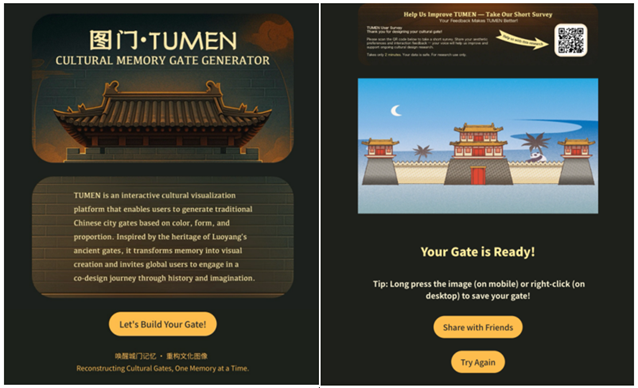
Figure 3 Platform Operation Interface Home Page and User-Generated Results Page
Source: Author
(2025)
The TUMEN platform utilizes a top-down, partitioned interface, allowing users to freely select and replace components from a library of components (Roof of the Gatehouse, Facade and Structure of the Gatehouse, Gate Podium, Gate Opening, Gate Base, Que-Gate Towers, hereafter referred to as Que). The system uses layer-based stitching to provide instant previews, allowing users to return to modify and export results at any time. The operation path is "Component Selection → Instant Preview → Name and Export → Data Recording." The backend simultaneously records the selection sequence and duration of the selected component, providing data support for subsequent preference analysis and platform optimization Figure 4, Figure 5 and Figure 6.
Figure 4
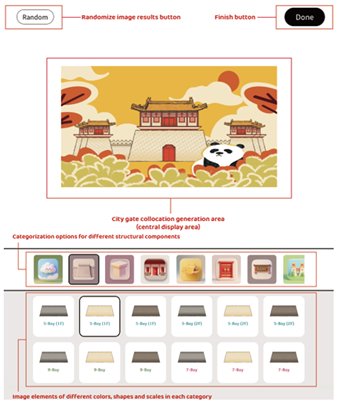
Figure 4 Platform Interface Layout and Functional Divisions
Source: Author
(2025)
Figure 5
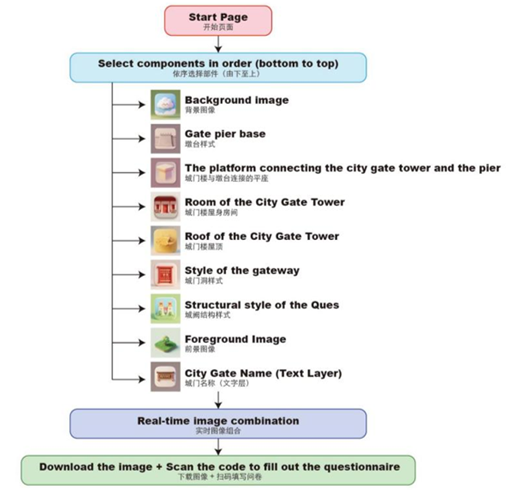
Figure 5 Schematic Diagram of the Platform Image Generation Process
Source: Author
(2025)
Figure 6

Figure 6 Image Stitching Structure and Layer Order
Source: Author
(2025)
To enhance component identification and cultural understanding, the platform adds naming labels to roof components (such as "Hip-roofed" and "Gable and hip-roofed") and uses icons for image comparison to help distinguish between forms. Users can customize names for complete works, and the system will display the names above the gate opening, enhancing personalized expression and a sense of belonging Figure 7.
Figure 7

Figure 7 Roof Component Naming Example
Source: Author
(2025)
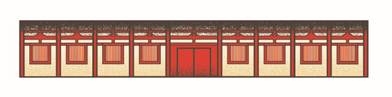
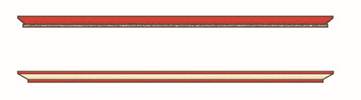
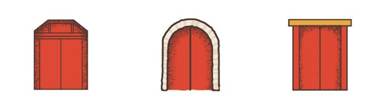
The gate podium's component library covers three categories: shape, proportion, and color. These are derived from historical imagery of Luoyang's Dingding Gate and Yingtian Gate and expert interviews Table 9, Table 10 and Table 11. This library not only ensures the cultural authenticity of the shapes but also provides users with visual creative resources.
Table 9
|
Table 9 Shape Component Library |
||||
|
Roof of the Gatehouse |
|
|
|
|
|
Facade and Structure of the Gatehouse |
|
|||
|
Gate Podium |
|
|
||
|
Gate Base |
|
|||
|
Gate Opening |
|
|
|
|
|
Que |
|
|
|
|
|
Source: Author (2025) |
||||



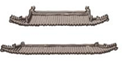
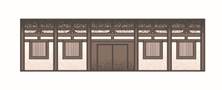


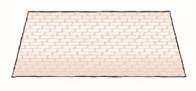

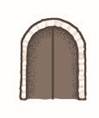

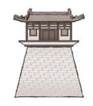
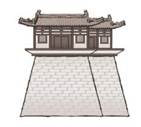
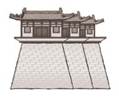
Table 10
|
Table 10 Scale Parameter Library |
|||
|
Roof of the Gatehouse |
|
|
|
|
Facade and Structure of the Gatehouse |
|
|
|
|
Gate Podium |
|
|
|
|
Gate Base |
|
|
|
|
Gate Opening |
|
|
|
|
Source: Author (2025) |
|||
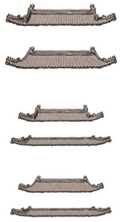
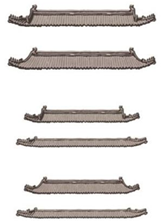
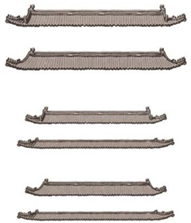
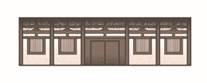
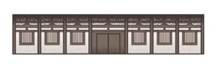
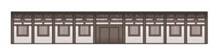
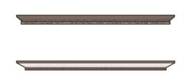
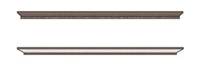
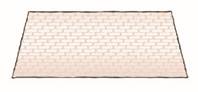
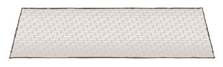


Table 11
|
Table 11 Color Combination Library |
|
|
Roof of the Gatehouse |
|
|
Facade and Structure of the Gatehouse |
|
|
Gate Podium |
|
|
Gate Base |
|
|
Gate Opening |
|
|
Que |
|
|
Source: Author (2025) |
|



In terms of presentation, the platform has brought together a diverse range of user-generated works Table 12 . These works not only demonstrate the creativity of free combination but also visually retain the symbolic characteristics of traditional architecture. To further demonstrate the relationship between platform functionality and user experience, this study compiled a table corresponding to the platform's main functions and user experience dimensions Table 13 . This table clearly demonstrates how functional design enhances public engagement in terms of operational freedom, visual feedback, cultural cognition, and social communication, providing a context for subsequent verification of the results.
Table 12
|
Table 12 User-Generated Works Samples |
|||||
|
Gate Base |
Facade and Structure of the Gatehouse |
Roof of the Gatehouse |
Gate Passages and Gate Opening |
Que |
Result image |
|
Ivory white base |
Nine-bay, two-storey |
Gable and hip-roofed (double-eaved) |
Five-passaged Gate, Trapezoidal Gate Opening |
Triple Que |
|
|
Gray base |
Five-bay, two-storey |
Gable and hip-roofed (double-eaved) |
Three-passaged Gate, Arched Gate Opening |
Single Que |
|
|
Brown base |
Five-bay, single-storey |
Hip-roofed (single-eave) |
Single-passaged Gate, Arched Gate Opening |
Double Que |
|
|
Gray base |
Five-bay, two-storey |
Gable and hip-roofed (double-eaved) |
Three-passaged Gate, Arched Gate Opening |
Single Que |
|
|
Source: Author (2025) |
|||||




Table 13
|
Table 13 Comparison of the Platform's Main Functions and User Experience Dimensions |
|||
|
Platform Features |
Specific description |
User experience dimension |
Corresponding value |
|
Modular component selection |
Provide free selection and combination of roof of
Gatehouse, Facade and Structure of Gatehouse, Gate Podium, Gate Opening, Gate
Base, Que and other components |
Operational freedom |
Enhance the diversity and personalization of
creation |
|
Live Preview |
Instantly display the combination effect, support
zoom and viewing angle adjustment |
Visual feedback |
Enhance the intuitiveness and immersion of
operation |
|
Cultural knowledge |
Learn about cultural heritage through component
selection |
Knowledge accessibility |
Enhance cultural learning and cognition |
|
Personalized naming |
Users can name their works based on creativity or
cultural associations |
Create a sense of participation |
Strengthening personal engagement and cultural
expression |
|
Export and share your work |
Generate image files and support sharing on
social platforms |
Social Contagion |
Expand cultural influence and public
participation |
|
User behavior records |
Backstage records the order of component
selection, duration of stay, and structure of the work |
Data analyzability |
Support follow-up research and platform
optimization |
|
Source: Author (2025) |
|||
5.3. Objective 3: Exploration and preliminary verification of transmission paths
During the initial testing phase, the platform collected 157 valid responses, primarily evaluating users across three dimensions: aesthetic perception, understanding of cultural symbolism, and interactive experience. The results showed that 82.5% of users found the platform's images visually appealing, 87.1% said the platform helped them more easily identify city gate cultural symbols, and 79.4% found the platform easy to use and the feedback effective Table 14.
Table 14
|
Table 14 Key Indicators from Preliminary User Feedback |
|||
|
Evaluation Dimensions |
Core Issues |
Recognition rate (%) |
Illustrate |
|
Aesthetic perception |
The images generated by the platform are visually
appealing |
82.5 |
Users generally recognize the design quality of
the platform's visual presentation |
|
Cultural symbolic understanding |
The platform helps me more easily identify the
main cultural symbols of Luoyang's ancient city gates |
87.1 |
In line with the goal of research to enhance
public cultural awareness |
|
Interactive experience |
The platform is easy to operate and provides
effective instant feedback |
79.4 |
The interaction process is smooth, which enhances
users' willingness to continue using the product. |
|
Source: Author (2025) |
|||
The system's backend behavioral data also reflects public preferences in component selection: double-eaved hipped roofs and double-eaved gable roofs are the most popular, the combination of vermilion columns and yellow glazed tiles is the most popular, and trapezoidal and "Three-passaged Gate" gate openings are the most popular Table 15. These preferences reflect that the public's aesthetic preferences still retain a strong visual memory of traditional hierarchical structures and provide data support for subsequent personalized recommendation functions.
Table 15
|
Table 15 Top Five User Component Selection Rates and Their Cultural Significance |
||||
|
Ranking |
Component Type |
Coding Example |
Selection rate (%) |
Summary of Cultural Significance |
|
1 |
Roof: Double-eaved hip-roofed |
A2 |
34.8 |
Commonly used in royal ritual buildings,
symbolizing dignity and authority |
|
2 |
Roof: Double-eaved gable and hip-roofed |
A4 |
28.6 |
Commonly found in high-level palaces and city
gates, it is delicate and flexible. |
|
3 |
Color combination: Vermilion columns + yellow
glazed tiles |
M+RY |
25.4 |
It symbolizes authority and joy, and has a strong
visual impact. |
|
4 |
Gate Opening: Trapezoidal Gate Opening |
C1 |
21.7 |
It embodies calmness and simplicity, and has a
strong cultural connotation |
|
5 |
Number of Gate passages: Three-passaged Gate |
D3 |
19.5 |
Combines defense and ceremonial functions to
enhance solemnity |
|
Source: Author (2025) |
||||
In summary, the platform validation results demonstrate that the interactive framework proposed in this study can stimulate public enthusiasm for creation and cultural expression while maintaining cultural authenticity. Both questionnaire feedback and behavioral data demonstrate the platform's strong cognitive guidance and dissemination potential, laying the foundation for subsequent application on a larger scale and in cross-cultural contexts.
6. Conclusions
Compared to existing research that has focused on site-specific technology applications or contextualized engagement mechanisms Ng et al. (2024), Mantzou et al. (2023), this study proposes an interactive framework centered on structured visual encoding, systematically integrating cultural semantics, interactive logic, and public expression pathways, expanding the theoretical depth and practical breadth of cultural heritage digital platforms. The TUMEN platform's design, including component selection, naming mechanisms, and feedback logic, achieves a "cultural content-driven interactive pathway construction." This not only echoes Maietti (2023) principle of "technology serving cultural semantics" but also explores the dynamic balance between cultural identity generation and personalized design. While the platform has yet to be fully deployed in physical public spaces, its "graphic re-creation" logic and co-creation philosophy are already transferable, providing a viable path for the future integration of offline public art and digital platforms.
The three-stage framework constructed in this study establishes a close connection between the structuring of graphic elements and mechanisms for public engagement, transforming visual symbols from cultural abstractions into operational objects for interactive experiences. The platform's embedded "free combination + naming + real-time feedback" mechanism not only enhances user immersion and expressiveness, but also provides a new paradigm for the dissemination of traditional heritage. This process not only recreates the form of historical buildings but also reconstructs cultural semantics, enabling the dynamic updating of symbolic systems within a digital context. This shift from "redesign" to "reinterpretation" reflects the structural reshaping of digital platforms within the cultural dissemination model. The platform's instant generation and export capabilities also enable the rapid dissemination of creative outputs through social media or virtual exhibitions, stimulating cross-regional cultural interaction and resonance among the public.
On a theoretical level, the greatest contribution of this interactive framework lies in its proposed methodological logic of "structured encoding - cultural semantic binding - co-creation and generation," which demonstrates strong cross-media and cross-cultural adaptability. By breaking down cultural graphic elements into combinable building blocks, the platform not only lowers the cognitive threshold but also expands the scope of participation in heritage digital creation. Preliminary validation results indicate that users generally appreciate the visual aesthetics and cultural identity of the platform's components, and their naming and collage behaviors demonstrate an aesthetic preference for traditional hierarchies and construction logic. While the current data sample is primarily preliminary and requires further validation with a wider population, the platform's construction logic already possesses strong universality. This achievement not only provides a replicable tool for cultural institutions, designers, and educators, but also provides both theoretical and operational support for urban renewal, public art dissemination, and cultural education practices.
7. Discussions
This study focuses on the graphic heritage of Luoyang's ancient city gates and constructs a three-stage path of "symbolic decoding - digital translation - public co-creation". Through the prototype design and verification of the TUMEN platform, it verifies the operability and interactive value of this model in cultural communication.
Research results demonstrate that the platform is able to enhance public recognition of the visual symbols of the ancient city gates while maintaining historical authenticity and promoting engagement in their creation. User behavioral data reveals a preference for high-grade architectural components and specific color combinations, while questionnaire responses indicate high recognition of the platform in terms of aesthetic perception, cultural symbolism, and interactive experience. These findings demonstrate the potential of digital interactive design in promoting cultural identity and communication.
The framework proposed in this study demonstrates methodological transferability, particularly in its dual aspects of structured encoding and cultural meaning-making, providing a scalable model for the digital translation of cultural heritage. While this study is based on the graphic heritage of Luoyang's ancient city gates, future research will require validation of its applicability across multiple heritage types and within broader cultural contexts. The findings can provide sustainable theoretical and technical support for research in digital humanities, urban image reconstruction, and cultural participation mechanisms.
CONFLICT OF INTERESTS
None.
ACKNOWLEDGMENTS
Researcher would like to express her sincere to the thesis advisor, Asst. Prof. Dr. Chanoknart Mayusoh for her invaluable help and constant encouragement throughout the course of this research. In addition, the researcher has to give thanks to all lecturers for their assistance: Asst. Prof. Dr. Akapong Inkuer and Asst. Prof. Dr. Pisit Puntien. At the same time, the researcher gratefully thanks to Miss Sasanant Rattanapornpisit, Mr. Chat Sukarin, Miss Vistha Chintaladdha, Miss Kanyanee Phangsua, etc. for their strong support.
Finally, the researcher would like to express her gratitude to Suan Sunandha Rajabhat University School of Fine and Applied Arts for their support in all aspects.
REFERENCES
Braun, V., and Clarke, V. (2006). Using Thematic Analysis in Psychology. Qualitative Research in Psychology, 3(2), 77–101. https://doi.org/10.1191/1478088706qp063oa
Cartiere, C., and Willis, S. (2008). The Practice of Public Art. Routledge. https://doi.org/10.4324/9780203926673
Cartiere, C., and Zebracki, M. (2015). The Everyday Practice of Public Art: Art, Space, and Social Inclusion. Routledge. https://doi.org/10.4324/9781315737881
Corbin, J., and Strauss, A. (2014). Basics of Qualitative Research: Techniques and Procedures for Developing Grounded Theory (4th ed.). Sage Publications.
Della Lucia, M., and Trunfio, M. (2018). The Role of the Private Actor in Cultural Regeneration: Hybridizing Cultural Heritage with Creativity in the City. Cities, 82, 35–44. https://doi.org/10.1016/j.cities.2018.05.003
Fu, X. N. (1977). Restoration Study of Xuánwǔ Gate and Zhòngxuán Gate in the Daming Palace of Tang Chang'an [Research on the Restoration of Xuanwu Gate and Chongxuan Gate in Daming Palace of Chang'an in the Tang Dynasty]. Acta Archaeologica Sinica, (2), 131–158.
Giaccardi, E. (2012). Heritage and Social Media: Understanding Heritage in a Participatory Culture. Routledge. https://doi.org/10.4324/9780203116595
Gombrich, E. H. (1984). The Sense of Order: A Study in the Psychology of Decorative Art. Phaidon Press.
Halbwachs, M. (1992). On Collective Memory. University of Chicago Press. https://doi.org/10.7208/chicago/9780226774497.001.0001
Harland, R. G., and Xu, J. (2021). Repositioning Graphic Heritage. Loughborough University. https://doi.org/10.17028/rd.lboro.14273105.v1
Harland, R. G., Du, Q., Selby, A., Wells, P., Xu, J., Yongqi, L., and Zhang, X. (2019, September). Defining Urban Graphic Heritage for Economic Development in the UK and China. In Design revolutions: International Association of Societies of Design Research Conference (1–14).
Katifori, A., Tsitou, F., Pichou, M., Kourtis, V., Papoulias, E., Ioannidis, Y., and Roussou, M. (2020). Exploring the Potential of Visually-Rich Animated Digital Storytelling for Cultural Heritage: The Mobile Experience of the Athens University History Museum. In Visual Computing for Cultural Heritage (325–345). Springer. https://doi.org/10.1007/978-3-030-37191-3_13
Lossau, J., and Stevens, Q. (2015). The Uses of Art in Public S pace. Routledge. https://doi.org/10.4324/9781315757018
Maietti, F. (2023). Heritage Enhancement Through Digital Tools for Sustainable Fruition: A Conceptual Framework. Sustainability, 15(15), Article 11799. https://doi.org/10.3390/su151511799
Mantzou, P., Bitsikas, X., and Floros, A. (2023). Enriching Cultural Heritage Through the Integration of Art and Digital Technologies. Social Sciences, 12(11), Article 594. https://doi.org/10.3390/socsci12110594
Mersmann, B., Kruse, C., and Bartetzky, A. (2024). Image Controversies: Contemporary Iconoclasm in Art, Media, and Cultural Heritage. OAPEN Library. https://doi.org/10.1515/9783110773576
Ng, W. K., Chen, C. L., and Huang, Y. H. (2024). Revitalization of Cultural Heritage in the Digital Era: A Case Study in Taiwan. Urban Resilience and Sustainability, 2(3), 215–235. https://doi.org/10.3934/urs.2024011
Nofal, E. (2023). Participatory Design Workshops: Interdisciplinary Approaches in Digital Heritage. Heritage, 6(3), Article 146. https://doi.org/10.3390/heritage6030146
Patton, M. Q. (2015). Qualitative Research and Evaluation Methods: Integrating Theory and Practice (4th ed.). Sage Publications.
UNESCO. (2001). Universal Declaration on Cultural Diversity. UNESCO.
Xu, L. G. (2015). Study on the Gateways of Ancient Chinese Capitals [Research on Gateways of Ancient Chinese Capitals]. Acta Archaeologica Sinica, (4), 425–450.
Yu, D. Y. (1989). Beijing Historical City Wards, Palaces, and Imperial Gardens [Beijing's Historical City Blocks, Palaces, and Gardens]. Capital Normal University Press.
|
|
 This work is licensed under a: Creative Commons Attribution 4.0 International License
© ShodhKosh 2026. All Rights Reserved.