ShodhKosh: Journal of Visual and Performing ArtsISSN (Online): 2582-7472
|
|
From Pagodas to Products: Consumer Preferences for Architectural Heritage - Based Goods in China
Tianyi Qu 1 , Akapong Inkuer
2
, Akapong Inkuer
2 , Chanoknart Mayusoh
3
, Chanoknart Mayusoh
3 , Permsak Suwannatat
4
, Permsak Suwannatat
4
1 Doctoral
Student of Philosophy Program in Visual Arts and Design, Faculty of Fine and
Applied Arts, Suan Sunandha Rajabhat University, Thailand
2 Advisor
in Visual Arts and Design, Faculty of Fine and Applied Arts, Suan Sunandha
Rajabhat University, Thailand
3 Visual Arts and Design, Faculty of Fine and Applied Arts, Suan
Sunandha Rajabhat University, Thailand
4 Program in Creative Arts Department, Faculty of Fine and Applied Arts
Chulalongkorn University, Thailand
|
|
|
ABSTRACT |
|
|
This study
investigates how regional architectural heritage - specifically the Four
Pagodas of Zhengding Ancient City - can be
translated into contemporary cultural and creative products (CCPs) to
strengthen consumer engagement and promote cultural sustainability. Amid
rising consumer interest in authenticity, symbolism, and localized identity,
this research presents the quantitative phase of a broader mixed-methods
project. A total of 386 valid responses were collected and analyzed using
descriptive statistics, Pearson correlation, and multiple regression analysis
to explore the influence of architectural heritage awareness, cultural
attitudes, and design perception on product preference, product evaluation,
and user experience. The findings reveal that interactivity is the most
significant predictor of product evaluation, while cultural attitude has a
strong positive impact on purchase intention. These results inform the
development of a three-stage consumer engagement model - comprising
cognitive, affective, and behavioral dimensions - that illustrates how users
respond to and interact with heritage-integrated CCPs. The model provides a
theoretical framework for understanding consumer behavior in heritage-based
product design and supports the integration of intangible cultural values
into modern design practices. This study contributes practical implications
for designers, entrepreneurs, and cultural policymakers seeking to align
heritage preservation with consumer-centered innovation, offering pathways toward
more sustainable, market-responsive cultural product development grounded in
regional identity. |
|||
|
Received 28 February 2026 Accepted 29 March 2026 Published 07 May 2026 Corresponding Author Tianyi Qu,
s64584948048@ssru.ac.th DOI 10.29121/shodhkosh.v7.i1.2026.7853 Funding: This research
received no specific grant from any funding agency in the public, commercial,
or not-for-profit sectors. Copyright: © 2026 The
Author(s). This work is licensed under a Creative Commons
Attribution 4.0 International License. With the
license CC-BY, authors retain the copyright, allowing anyone to download,
reuse, re-print, modify, distribute, and/or copy their contribution. The work
must be properly attributed to its author.
|
|||
|
Keywords: Architectural Heritage, Cultural and Creative
Products (CCPS), Consumer Behavior, Interactive Design, Heritage
Revitalization, Zhengding Four Pagodas |
|||



1. INTRODUCTION
Architectural heritage plays a pivotal role in safeguarding regional identity, transmitting cultural values, and enriching aesthetic traditions. In the context of globalization and rapid urbanization, the creative transformation of heritage resources has emerged as a strategic approach to achieving cultural sustainability - defined as the capacity to preserve and reinterpret cultural meanings within dynamic social, economic, and design environments Throsby (2017). As cultural consumption increasingly emphasizes authenticity, symbolism, and localized narratives, architectural elements are regaining prominence as a source of inspiration for cultural and creative products (CCPs). These heritage-driven designs facilitate the integration of tradition and innovation, offering market-responsive solutions that convey both cultural depth and visual appeal.
However, while previous studies have explored the preservation and symbolic interpretation of built heritage, there remains a lack of empirical research examining how consumers engage with CCPs rooted in architectural traditions. Specifically, the emotional, cognitive, and behavioral mechanisms underlying such engagement are insufficiently understood.
This study addresses this gap by focusing on the Four Pagodas of Zhengding Ancient City - Lingxiao Pagoda, Chengling Pagoda, Xumi Pagoda, and Hua Pagoda - which collectively exemplify the vertical elegance of Tang architecture and the intricate masonry techniques of the Liao Dynasty. Beyond their material forms, these pagodas serve as enduring cultural symbols, embodying religious meaning, spiritual continuity, and regional identity. Their reinterpretation in contemporary design contexts offers a compelling opportunity to bridge historical narratives with present-day consumer aesthetics, transforming static architectural heritage into dynamic expressions of cultural relevance.
The primary objective of this study is to investigate consumer preferences, attitudes, and the key factors influencing engagement with CCPs that incorporate architectural features from the Four Pagodas. Drawing on data from 386 respondents, the research applies descriptive statistics, Pearson correlation, and multiple regression analysis to examine the roles of architectural awareness, cultural orientation, and user experience in shaping consumer behavior. The findings aim to provide actionable insights for designers, cultural industries, and policymakers seeking to revitalize traditional heritage through user-centered and narrative-driven design innovation.
2. Research Objectives
This study aims to investigate consumer acceptance and demand trends related to the integration of architectural elements from the Four Pagodas of Zhengding Ancient City into cultural and creative products (CCPs). Consumer responses are evaluated across key dimensions, including design functionality, aesthetic perception, and cultural identity resonance. Furthermore, the study explores the pathways through which regional architectural heritage can be effectively transformed within contemporary CCP design. The research seeks to offer both a theoretical foundation and practical guidance for the development of culturally embedded products and the strategic integration of architectural heritage into modern cultural industries.
3. Literature Review
3.1. Architectural Heritage and Creative Product Design
The integration of architectural heritage into cultural and creative products (CCPs) has become a growing academic focus, as cultural industries seek to reconcile commercial functionality with cultural authenticity. Architectural heritage, as a tangible cultural asset, represents not only construction aesthetics and craftsmanship but also deeper symbolic narratives and regional identity Zhou and Han (2024). Heritage-based design enhances cultural identity and adds emotional value to products, increasing their symbolic meaning and user resonance. These theoretical perspectives provide a foundation for examining how design rooted in heritage can influence consumer perception and behavior.
3.2. International Practices and Symbolic Interpretation
In global contexts particularly in Europe and East Asia architectural heritage is often incorporated into tourism and creative industries as both a preservation method and a design inspiration. Scholars highlight that structural forms, decorative motifs, and traditional materials can be effectively transformed into emotionally engaging designs when interpreted through modern aesthetics Chen and Zhang (2024), Liu and Wang (2022). However, successful integration depends not merely on visual replication, but on a nuanced understanding of symbolic meaning and user expectations across cultural contexts.
3.3. Consumer Perception and Cultural Behavior
From a consumer behavior perspective, heritage based CCPs tend to resonate with younger, educated demographics who seek symbolic richness, uniqueness, and cultural authenticity Huang et al. (2023). Factors such as perceived cultural identity, emotional connection, and aesthetic appreciation play central roles in shaping purchase decisions. Furthermore, the authenticity of heritage symbols mediates emotional attachment and influences consumer satisfaction Zhang and Li (2023). These behavioral drivers offer a conceptual foundation for examining user responses to architectural CCPs in this study. Recent studies on China’s “Guochao” (national trend) phenomenon reveal that nostalgic sentiment and cultural pride significantly enhance consumer engagement with products incorporating traditional symbols. These findings support the need for a more data-driven analysis of consumer behavior, which this study aims to address.
3.4. Empirical Gaps and Research Contribution
Although scholarly interest in cultural and creative design is expanding, existing studies remain largely conceptual or qualitative, with limited quantitative validation of consumer-related variables. Specifically, few studies focus on how localized architectural heritage is received when embedded in consumer products, especially within the Chinese context. Addressing this gap, the present study applies a data-driven approach to examine consumer attitudes, cultural orientation, and interaction experiences related to Cultural and Creative Products that incorporate elements from the Four Pagodas of Zhengding.
4. Research Methodology
This study constitutes the quantitative phase of a broader mixed-methods research project that examines how regional architectural heritage can be effectively integrated into the design of cultural and creative products (CCPs). Centered on the Four Pagodas of Zhengding Ancient City in China, the project adopts a sequential design that combines qualitative and quantitative approaches to ensure both contextual depth and analytical generalizability.
The initial qualitative phase involved a comprehensive literature review, expert interviews, and architectural case analyses. This phase identified key symbolic elements of the pagodas - such as spatial configuration, decorative motifs, and historical significance - which informed the construction of survey instruments and provided a conceptual foundation for understanding consumer engagement.
This article focuses specifically on the subsequent quantitative phase, which aims to empirically investigate how consumers perceive, evaluate, and engage with CCPs that incorporate architectural heritage. In particular, the study examines the influence of heritage awareness, cultural attitudes, design perception, and interactive experience on product preference and purchase intention.
To achieve this, a structured questionnaire was developed and distributed both online and offline to a diverse sample of domestic tourists, local residents, and culturally engaged consumers aged 18 to 40. A total of 386 valid responses were collected and analyzed using descriptive statistics, Pearson correlation, and multiple regression analysis to explore the relationships among key variables. This quantitative phase offers robust empirical support for heritage-informed design strategies and contributes to a deeper understanding of user-centered innovation in the cultural and creative sectors.
4.1. Quantitative Research Methods
1) Questionnaire
Survey
A structured questionnaire was developed and administered both online and offline to collect data on consumer preferences, heritage awareness, purchasing behavior, and perceived cultural value related to cultural and creative products (CCPs). The target population included local residents, domestic tourists, and, in particular, younger consumers aged 18 to 40—demographic segments widely recognized as key participants in contemporary cultural consumption in China. The sampling strategy was designed to ensure diversity across geographic regions and professional backgrounds relevant to the cultural and creative industries.
2) Statistical
Analysis
The collected data were analyzed using descriptive statistics, Pearson correlation coefficients, and multiple linear regression models. These statistical methods were employed to examine the relationships among key variables, including architectural heritage awareness, cultural attitudes, product design perception, interaction experience, and purchase intention. Standard statistical software was utilized to ensure the reliability of computations and the rigor of analytical procedures.
This quantitative phase provides a robust empirical foundation for understanding consumer behavior in the context of heritage-integrated cultural and creative products (CCPs). Moreover, it offers a basis for future qualitative inquiry and supports the development of culturally grounded, evidence-based design strategies.
5. Research Results
This study explores the architectural heritage of the Four Pagodas in Zhengding Ancient City as a foundation for cultural and creative product (CCP) development. A total of 390 questionnaires were distributed, yielding 386 valid responses. A multi-dimensional analytical approach was employed to investigate consumer demand patterns and identify key factors influencing engagement with heritage-inspired CCPs. The main findings are presented as follows.
1) Findings:
Cultural and Symbolic Interpretation of the Four Pagodas
To complement the quantitative findings, this section presents qualitative insights derived from an extensive literature review and a case-based analysis of the Four Pagodas in Zhengding. These insights elucidate the ways in which architectural features influence consumer perception and deepen the cultural resonance of heritage-inspired products.
Table 1
|
Table 1 Symbolic Value and Product Implication of Four Pagodas |
||
|
Pagoda |
Symbolic Meaning |
Product Design Implications |
|
Lingxiao |
Spiritual elevation, purity, tranquility |
Ideal for spiritual, vertical, or
meditation-themed designs (e.g., bookmarks, incense holders) |
|
Chengling |
Stability, strength, historical continuity |
Suitable for commemorative or heritage-themed
items (e.g., souvenirs, seals) |
|
Huayan |
Refinement, scholarly tradition, harmony |
Best for elegant and educational products (e.g.,
journals, stationery, calligraphy sets) |
|
Xumi
(Sumeru) |
Modesty, introspection, philosophical depth |
Fitting for minimalist and balanced styles (e.g.,
notebooks, modern accessories) |
|
Source: Author |
||
Collectively, these symbolic features deepen the understanding of consumer preferences and provide strategic guidance for design differentiation. They emphasize that architectural heritage functions not merely as a visual motif but also as a carrier of cultural narratives within the process of product development.
2) Demographic
Characteristics
Figure 1
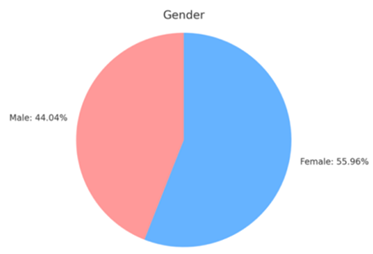
Figure 1
Gender Distribution
of Respondents
Source: Author
The sample comprised a higher proportion of female respondents (55.96%), suggesting a relatively stronger interest in cultural and creative product (CCP) design among women. Regarding age distribution, the majority of participants (43.01%) were between 18 and 30 years old, indicating that younger consumers constitute the primary target demographic for CCPs. This trend may be attributed to their relatively greater purchasing power and increased receptiveness to cultural and creative products.
Table 2
|
Table 2 Age Distribution of the Sample |
|||
|
Category |
Frequency |
Percentage |
Cumulative
Percentage |
|
A.
Under 18 |
15 |
3.89% |
3.89% |
|
B.
18–30 years old |
166 |
43.01% |
46.89% |
|
C.
31–45 years old |
103 |
26.68% |
73.58% |
|
D.
46–60 years old |
76 |
19.69% |
93.26% |
|
E.
Over 60 |
26 |
6.74% |
100.00% |
|
Total |
386 |
100.0% |
100.0% |
|
Source: Author |
|||
According to the age distribution of survey participants, individuals aged 18 to 30 constituted the largest proportion of the sample (43.01%), reflecting a pronounced interest in cultural and creative product (CCP) design among younger consumers. This trend may be attributed to their relatively higher purchasing power, enhanced cultural awareness, and greater receptiveness to creative innovation. Respondents aged 31 to 45 accounted for 26.68% of the sample and are generally characterized by advanced cultural literacy and substantial consumption capacity. In contrast, participants aged 46 and above collectively represented only 26.43%, suggesting a comparatively lower level of interest in CCPs among older individuals - possibly due to differing lifestyle preferences or reduced engagement with contemporary design trends. Overall, consumers aged 18 to 45 - particularly those in younger cohorts - emerge as the most responsive demographic to the integration of Zhengding’s Four Pagodas into CCP design. These findings highlight the considerable market potential of heritage-integrated products among younger and middle-aged segments.
Figure2
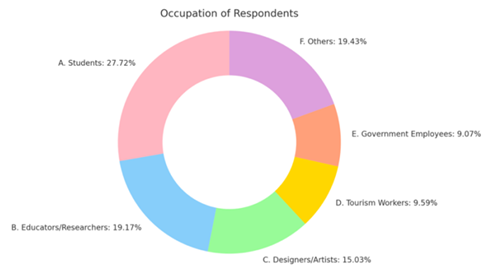
Figure 2 Occupation of Respondents
Source: Author
In terms of professional background, the sample was primarily composed of students (27.72%), educators and researchers (19.17%), and designers or artists (15.03%), reflecting a pronounced interest among individuals engaged in creative and academic professions. Moreover, a significant majority of respondents (82.62%) held at least a bachelor’s degree, indicating that higher educational attainment is positively correlated with both awareness of and receptiveness to cultural heritage–inspired cultural and creative products (CCPs).
3) Descriptive
Analysis of Variables
Table 3
|
Table 3 Descriptive Statistics of Variables |
||||||
|
Variable |
N |
Min |
Max |
Mean |
SD |
Median |
|
Architectural Heritage Awareness |
386 |
1.167 |
5.000 |
3.270 |
0.859 |
3.333 |
|
Attitude Toward Architectural Elements |
386 |
1.000 |
5.000 |
3.264 |
0.929 |
3.333 |
|
Cultural Attitude |
386 |
1.167 |
5.000 |
3.279 |
0.816 |
3.417 |
|
Product Preference and Purchase Intention |
386 |
1.000 |
5.000 |
3.340 |
0.884 |
3.500 |
|
Product Evaluation Factors |
386 |
1.000 |
5.000 |
3.301 |
0.966 |
3.500 |
|
Interaction and User Experience |
386 |
1.000 |
5.000 |
3.301 |
0.964 |
3.500 |
|
Source: Author |
||||||
Descriptive statistical analysis confirms that all variables were measured using a consistent sample size of 386 respondents, thereby ensuring the reliability and comparability of the data. The mean score for Architectural Heritage Awareness (M = 3.270, SD = 0.859) reflects a moderate level of familiarity with the Four Pagodas among participants. Respondents exhibited a generally neutral attitude toward the incorporation of architectural elements into CCP design (M = 3.264, SD = 0.929), while the mean score for Cultural Attitude (M = 3.279, SD = 0.816) indicates broader support for the integration of cultural preservation with creative innovation.
The results for Product Preference and Purchase Intention (M = 3.340, SD = 0.884) suggest a moderately positive consumer disposition toward heritage-inspired products. Similarly, the scores for Product Evaluation Factors (M = 3.301, SD = 0.966) and Interaction and User Experience (M = 3.301, SD = 0.964) underscore the significance of authenticity, design quality, and interactive engagement in shaping consumer perceptions.
Overall, the clustering of mean values around the midpoint of the Likert scale suggests a moderate degree of acceptance regarding the integration of architectural heritage into CCPs, while also revealing variability in individual attitudes and preferences.
4) Reliability
and Validity Analysis
Table 4
|
Table 4 Cronbach’s α Reliability Analysis |
|||
|
Dimension |
Number of Items |
Sample Size |
Cronbach's α |
|
Architectural Heritage Awareness |
6 |
386 |
0.803 |
|
Attitude Toward Application of Architectural
Elements |
6 |
386 |
0.838 |
|
Cultural Attitude |
6 |
386 |
0.771 |
|
Product Preference and Purchase Intention |
8 |
386 |
0.864 |
|
Product Evaluation Factors |
8 |
386 |
0.888 |
|
Interaction and User Experience |
6 |
386 |
0.858 |
|
Source: Author |
|||
Based on 386 valid responses, a descriptive statistical analysis was conducted using a five-point Likert scale (1 = strongly disagree to 5 = strongly agree). The six measured constructs yielded mean values ranging from 3.264 to 3.382, indicating a moderately positive overall attitude toward the integration of architectural elements from the Four Pagodas into the design of cultural and creative products (CCPs).
Respondents demonstrated slightly above-average awareness of architectural heritage (M = 3.270, SD = 0.859), although some appeared to lack comprehensive knowledge of the historical and stylistic features of the Four Pagodas. Both the Attitude Toward Architectural Elements (M = 3.315, SD = 0.910) and Cultural Attitude (M = 3.315, SD = 0.802) suggest a general preference for combining cultural preservation with creative adaptation. Notably, the minimum score observed for Cultural Attitude (1.167) reflects the presence of a small subset of dissenting views.
Product Preference and Purchase Intention (M = 3.340, SD = 0.884), together with Product Evaluation Factors (M = 3.301, SD = 0.966), indicate that consumers place significant value on cultural authenticity, design quality, and functional usability. The dimension of Interaction and User Experience (M = 3.301, SD = 0.964) was also rated positively, though individual responses varied depending on familiarity with interactive technologies.
Reliability analysis using Cronbach’s alpha confirmed high internal consistency across all six constructs, with coefficients ranging from 0.771 (Cultural Attitude) to 0.888 (Product Evaluation Factors). All values exceeded the commonly accepted threshold of 0.70, indicating strong reliability of the measurement scale and supporting its appropriateness for further empirical analysis.
Table 5
|
Table 5 KMO and Bartlett's Test |
||
|
KMO value |
0.894 |
|
|
Bartlett sphericity test |
Approximate chi-square |
6123.567 |
|
Degrees of Freedom (df) |
780 |
|
|
Significance (p-value) |
0.000 |
|
|
Source: Author |
||
The validity analysis yielded a Kaiser–Meyer–Olkin (KMO) value of 0.894, indicating excellent sampling adequacy for factor analysis. Additionally, Bartlett’s test of sphericity was statistically significant (χ² = 6123.567, df = 780, p < 0.001), confirming sufficient intercorrelations among the measured variables and supporting the appropriateness of the dataset for subsequent multivariate analysis.
Collectively, these results provide strong empirical support for the construct validity of the questionnaire. Respondents generally demonstrated favorable attitudes toward the integration of architectural elements from the Four Pagodas into cultural and creative product (CCP) design, particularly in terms of balancing cultural preservation with contemporary innovation.
Furthermore, Cronbach’s alpha coefficients for all measured dimensions exceeded 0.77, indicating a high level of internal consistency and affirming the overall reliability of the measurement instrument.
5) Correlation
Analysis
Table 6
|
Table 6 Pearson Correlation Analysis |
||||||
|
Interaction and
User Experience |
Architectural
Heritage Awareness |
Attitude Toward
Architectural Elements |
Cultural
Attitude |
Product
Preference and Purchase Intention |
Product
Evaluation Factors |
|
|
Interaction
and User Experience |
1 |
|||||
|
Architectural
Heritage Awareness |
0.347** |
1 |
||||
|
Attitude
Toward Architectural Elements |
0.309** |
0.319** |
1 |
|||
|
Cultural
Attitude |
0.279** |
0.276** |
0.311** |
1 |
||
|
Product
Preference and Purchase Intention |
0.317** |
0.220** |
0.237** |
0.219** |
1 |
|
|
Product
Evaluation Factors |
0.460** |
0.233** |
0.246** |
0.283** |
0.380** |
1 |
|
Note:
p<0.05 p<0.01 Source: Author |
||||||
The correlation analysis revealed statistically significant positive relationships among all measured variables. Among them, Interaction and User Experience demonstrated the strongest correlation with Product Evaluation Factors (r = 0.460, p < 0.01), indicating that interactivity plays a critical role in shaping consumers’ assessments of cultural and creative products (CCPs). In addition, Interaction and User Experience was positively associated with Architectural Heritage Awareness (r = 0.347), Attitude Toward Architectural Elements (r = 0.309), Cultural Attitude (r = 0.279), and Product Preference and Purchase Intention (r = 0.317), underscoring its central role in facilitating user engagement and acceptance.
Architectural Heritage Awareness was positively correlated with both Attitude Toward Architectural Elements (r = 0.319) and Cultural Attitude (r = 0.276), suggesting that a higher level of heritage awareness is associated with greater support for the integration of architectural features and the preservation of cultural values. Furthermore, Attitude Toward Architectural Elements was significantly related to Cultural Attitude (r = 0.311) and Product Preference and Purchase Intention (r = 0.237), highlighting the mediating influence of cultural perception on consumer behavior.
Product Preference and Purchase Intention also demonstrated positive associations with both Architectural Heritage Awareness (r = 0.220) and Product Evaluation Factors (r = 0.380), reflecting the joint impact of cultural cognition and product quality perception on consumer decision-making.
In sum, heritage awareness, cultural attitudes, and user interaction constitute an interrelated network, with interactivity functioning as a key bridging variable that enhances both engagement and evaluative judgment. These findings provide a theoretical foundation for market segmentation and the development of culturally informed product design strategies.
6) Regression
Analysis
To further examine the influence of key explanatory variables on consumer behavior, three multiple linear regression models were constructed. The dependent variables included Product Preference and Purchase Intention, Product Evaluation Factors, and Interaction and User Experience. The independent variables comprised Architectural Heritage Awareness, Attitude Toward Architectural Elements, and Cultural Attitude. The results of the regression analysis are presented as follows:
Table 7
|
Table 7 Regression Model 1: Dependent Variable = Product Preference and Consumption Intention |
|||||||
|
Linear regression analysis results (n=386) |
|||||||
|
Unstandardized Coefficients |
Standardized Coefficients |
t |
p |
Multicollinearity Diagnosis |
|||
|
B |
Std. Error |
Beta |
VIF |
Standard error |
|||
|
Constant |
1.939 |
0.228 |
- |
8.52 |
0.000 |
- |
- |
|
Architectural Heritage Awareness |
0.138 |
0.054 |
0.134 |
2.563 |
0.011 |
1.158 |
0.864 |
|
Attitude Toward Architectural Elements |
0.145 |
0.050 |
0.152 |
2.869 |
0.004 |
1.184 |
0.844 |
|
Cultural Attitude |
0.146 |
0.057 |
0.134 |
2.572 |
0.010 |
1.152 |
0.868 |
|
R² |
0.095 |
||||||
|
Adjust R² |
0.088 |
||||||
|
F |
F (3,382) = 13.345, p = 0.000 |
||||||
|
D-W values |
1.888 |
||||||
|
Note: Dependent variable = product preference vs.
willingness to spend |
|||||||
|
p<0.05 p<0.01 |
|||||||
|
Source: Author |
|||||||
R² = 0.095, Adjusted R² = 0.088, F(3,382) = 13.345, p = 0.000, D-W = 1.888.
The regression model is statistically significant, and all three independent variables exert a significant positive influence on product preference and purchase intention. Among these predictors, Attitude Toward the Application of Architectural Elements demonstrates the strongest effect (β = 0.152), indicating its pivotal role in shaping consumer purchasing behavior.
Table 8
|
Table 8 Regression Model 2: Dependent Variable = Product Evaluation Factor |
|||||||
|
Linear regression analysis results (n=386) |
|||||||
|
Unstandardized Coefficients |
Standardized Coefficients |
t |
p |
Multicollinearity Diagnosis |
|||
|
B |
Std. Error |
Beta |
VIF |
Standard error |
|||
|
Constant |
1.550 |
0.245 |
- |
6.330 |
0.000 |
- |
- |
|
Architectural Heritage Awareness |
0.149 |
0.058 |
0.133 |
2.570 |
0.011 |
1.158 |
0.864 |
|
Attitude Toward Architectural Elements |
0.146 |
0.054 |
0.140 |
2.689 |
0.007 |
1.184 |
0.844 |
|
Cultural Attitude |
0.240 |
0.061 |
0.203 |
3.944 |
0.000 |
1.152 |
0.868 |
|
R² |
0.123 |
||||||
|
Adjust R² |
0.116 |
||||||
|
F |
F (3,382) = 17.819, p=0.000 |
||||||
|
D-W values |
1.955 |
||||||
|
Note: Dependent variable = product preference vs.
willingness to spend |
|||||||
|
p<0.05 p<0.01 |
|||||||
|
Source: Author |
|||||||
R² = 0.123, Adjusted R² = 0.116, F(3,382) = 17.819, p = 0.000, D-W = 1.955.
Cultural Attitude emerged as the most influential predictor of product evaluation (β = 0.203), suggesting that consumers’ prioritization of cultural values significantly enhances their assessments of product quality and relevance.
Table 9
|
Table 9 Regression Model 3: Dependent Variable = Interaction and User Experience |
|||||||
|
Linear regression analysis results (n=386) |
|||||||
|
Unstandardized Coefficients |
Standardized Coefficients |
t |
p |
Multicollinearity Diagnosis |
|||
|
B |
Std. Error |
Beta |
VIF |
Standard error |
|||
|
Constant |
1.182 |
0.236 |
- |
5.017 |
0.000 |
- |
- |
|
Architectural Heritage Awareness |
0.276 |
0.056 |
0.246 |
4.951 |
0.000 |
1.158 |
0.864 |
|
Attitude Toward Architectural Elements |
0.19 |
0.052 |
0.183 |
3.635 |
0.000 |
1.184 |
0.844 |
|
Cultural Attitude |
0.182 |
0.059 |
0.154 |
3.106 |
0.002 |
1.152 |
0.868 |
|
R² |
0.185 |
||||||
|
Adjust R² |
0.178 |
||||||
|
F |
F (3,382)=28.861,p=0.000 |
||||||
|
D-W values |
1.991 |
||||||
|
Note: Dependent variable = product preference vs.
willingness to spend |
|||||||
|
p<0.05 p<0.01 |
|||||||
|
Source: Author |
|||||||
R² = 0.185, Adjusted R² = 0.178, F(3,382) = 28.861, p = 0.000, D-W = 1.991.
This model exhibits comparatively strong explanatory power. Among the predictors, Architectural Heritage Awareness exerts the most significant effect on Interaction and User Experience (β = 0.246), highlighting the critical role of cultural cognition in fostering user engagement.
Collectively, the results from all three regression models are statistically significant, confirming that architectural awareness, design-related attitudes, and cultural orientation serve as positive predictors of consumer behavior. These findings offer a robust theoretical foundation for enhancing both the design and market positioning of cultural and creative products (CCPs).
To explore these relationships in greater depth, the study constructed three regression models to assess the influence of architectural awareness, attitudinal factors, and cultural variables on product preference, product evaluation, and interaction-based user experience.
·
Model 1: Predicting Product Preference and
Purchase Intention
All independent variables had significant positive effects, with attitude toward architectural elements exerting the greatest impact (β = 0.152, p < 0.01).
·
Model 2: Predicting Product Evaluation
Factors
Cultural attitude had the strongest influence (β = 0.203, p < 0.001), indicating that consumers place high importance on cultural value and design innovation.
·
Model 3: Predicting Interaction and User
Experience
Architectural heritage awareness was the most significant predictor (β = 0.246, p < 0.001), followed by attitude toward architectural elements and cultural attitude.
Although the explanatory power of each regression model is moderate (R² = 0.095 to 0.185), all models yielded statistically significant outcomes. These findings highlight the pivotal role of cultural and cognitive factors in influencing consumer acceptance of Cultural and Creative Products (CCPs), affirming their relevance as key determinants in heritage-driven design and marketing strategies.
6. Conclusions
This study explores the cultural significance and design potential of the Four Pagodas in Zhengding Ancient City within the context of Cultural and Creative Products (CCPs). Survey results indicate that young consumers - especially students and professionals in creative and academic fields -exhibit a strong interest in heritage-based CCPs. This interest is largely attributed to their heightened cultural awareness, refined aesthetic sensibilities, and openness to design innovation.
Both descriptive and inferential analyses confirm significant positive relationships among architectural heritage awareness, cultural attitudes, and consumer behavior. Notably, interactivity exerts the greatest influence on product evaluation, underscoring the critical role of immersive and experience-oriented design in shaping consumer perceptions. The regression analysis further substantiates the importance of cognitive and cultural variables - especially attitudes toward architectural elements and cultural identity - in influencing purchase intentions.
In conclusion, aligning the design of CCPs with the cultural values and experiential preferences of younger audiences presents a promising strategy for transforming regional heritage into emotionally engaging and market-responsive products. These findings offer valuable insights for designers, cultural industry practitioners, and policymakers seeking to revitalize traditional architecture through contemporary creative expression.
7. Discussions
The findings of this study demonstrate that consumers aged 18 to 45 - particularly students, designers, and professionals in the education and cultural sectors - exhibit heightened sensitivity toward Cultural and Creative Products (CCPs) inspired by architectural heritage. This demographic demonstrates elevated cultural awareness and a pronounced preference for symbolic reinterpretation. These results are consistent with Huang et al. (2023), who emphasized the pivotal role of younger, educated consumers in driving demand for culturally embedded design. Similarly, Zhang and Li (2023) underscored the importance of symbolic recognition in enhancing consumer acceptance of heritage-derived products.
Beyond heritage awareness, consumer preferences are significantly shaped by emotional resonance and interactive experience. Among the predictive variables, the interaction and user experience dimension emerged as the most influential factor in product evaluation. This finding supports Zhang and Li (2023) assertion that immersive engagement and co-creation mechanisms enhance user connection with culturally meaningful content. Furthermore, regression analysis confirmed that cultural attitude and design perception are key antecedents of both purchase intention and product evaluation. These findings align with the multidimensional consumer behavior model proposed by Huang et al. (2023), which integrates affective and cognitive dimensions of decision-making.
Although the explanatory power of the regression models remains moderate (R² = 0.095–0.185), such outcomes reflect the complex, multi-layered nature of consumer behavior in heritage-related contexts. As noted by Liu and Wang (2022), the integration of intangible cultural elements into product design requires both emotional resonance and cultural sensitivity. The consistent influence of symbolic meaning, emotional engagement, and perceptual evaluation in this study further supports their utility as strategic levers in heritage-based innovation and branding.
Synthesizing these insights, the study introduces a Three-Stage Consumer Journey Model, which conceptualizes consumer engagement with architectural heritage in CCPs across cognitive, affective, and behavioral stages. This model echoes the perspective of Chen and Zhang (2024), who argued that heritage interpretation, when integrated into narrative and emotional design, deepens consumer experience and enhances behavioral intention. It also reinforces Zhou and Han (2024) position on the relevance of cultural identity in contemporary CCP development.
Table 10
|
Table 10 Three-Stage Consumer Journey Model |
||
|
Stage |
Process |
Key
Influence |
|
Cognitive |
Heritage
Awareness → Recognition |
Awareness
of symbolic and historical significance |
|
Affective |
Cultural
Attitude and Design Perception → Evaluation |
Emotional
resonance and aesthetic connection |
|
Behavioral |
Interactivity
→ Purchase Intention |
Engagement
through immersive experience and authenticity |
|
Source: Author |
||
This model demonstrates that regional architectural heritage, when strategically integrated into product narratives and interactive design, has the potential to significantly enhance consumer engagement and improve market competitiveness. For designers and policymakers, the co-creation of cultural value through participatory and emotionally resonant experiences represents a compelling approach to revitalizing heritage within the framework of contemporary consumer culture.
CONFLICT OF INTERESTS
None.
ACKNOWLEDGMENTS
Researcher would like to express her sincere to the thesis advisor, Asst. Prof. Dr. Akapong Inkuer for his invaluable help and constant encouragement throughout the course of this research. In addition, the researcher has to give thanks to all lecturers for their assistance: Asst. Prof. Dr. Chanoknart Mayusoh, Asst. Prof. Dr. Pisit Puntien, and Asst. Prof. Dr. Pibool Waijittragum. At the same time, the researcher gratefully thanks to Miss Sasanant Rattanapornpisit, Mr. Chat Sukarin, Miss Kanyanee Phangsua, Miss Vistha Chintaladdha, etc. for their strong support.
Finally, the researcher would like to express her gratitude to Suan Sunandha Rajabhat University School of Fine and Applied Arts for their support in all aspects.
REFERENCES
Chen, L., and Zhang, M. (2024). The Influence of Architectural Heritage and Tourists’ Positive Emotions on Behavioral Intentions: A Study in the Historic Centre of Macau. Scientific Reports, 14, 85009.
Huang, H., Chen, H., and Zhan, Y. (2023). A Study on Consumers’ Perceptions of Museum Cultural and Creative Products Through Online Textual Reviews: An Example from Palace Museum’s Cultural and Creative Flagship Store. Behavioral Sciences, 13(4), 318. https://doi.org/10.3390/bs13040318
Liu, Y., and Wang, J. (2022). A Review of Research on the Development of Cultural and Creative Products from the Perspective of Intangible Cultural Heritage Inheritance. Advances in Social Science, Education and Humanities Research, 655, 1234–1240.
Throsby, D. (2017). Culturally Sustainable Development: Theoretical Concept or Practical Policy Instrument? International Journal of Cultural Policy, 23(2), 133–147. https://doi.org/10.1080/10286632.2017.1280788
Zhang, Y., and Li, X. (2023). Research on Consumers’ Purchase Intention of Cultural and Creative Products: Metaphor Design Based on Traditional Cultural Symbols. PLOS ONE, 18(5), e0301678. https://doi.org/10.1371/journal.pone.0301678
Zhou, C., and Han, Z. (2024). Research on the Design of Museum Cultural and Creative Products Under the Background of New Cultural and Creative Culture. SHS Web of Conferences, 189, 01001. https://doi.org/10.1051/shsconf/202418301001
|
|
 This work is licensed under a: Creative Commons Attribution 4.0 International License
© ShodhKosh 2026. All Rights Reserved.