ShodhKosh: Journal of Visual and Performing ArtsISSN (Online): 2582-7472
|
|
Influence of Visualization-Based Online Learning Environments on Student Learning Outcomes in Online Physical Education
Wei qi Cheng 1
 ,
Ooi Boon Keat 2
,
Ooi Boon Keat 2 , Norhisham
Binti Mohamad 3
, Norhisham
Binti Mohamad 3
1 Management
and Science University, Malaysia
2 Management
and Science University, Malaysia
3 Management and Science University, Malaysia
|
|
|
ABSTRACT |
|
|
The rapid expansion of digital technologies has significantly increased the use of online learning in higher education, including in physical education courses. However, the effectiveness of online physical education largely depends on the quality of the online learning environment that supports teaching and learning activities. This study examines the influence of visualization-based online learning environments on student learning outcomes in online physical education. A quantitative cross-sectional survey design was employed. Data were collected from undergraduate students who had participated in online physical education courses at two Double First-Class universities in China. A total of 680 questionnaires were distributed, and 614 valid responses were retained after data screening. Structural equation modelling (SEM) was used to analyse the relationship between the online learning environment and student learning outcomes. The results indicate that the online learning environment has a significant positive effect on student learning outcomes (β = 0.323, p < 0.001). The measurement model demonstrated satisfactory reliability and validity, and the structural model showed a good overall fit. The findings suggest that stable digital platforms, reliable network conditions, and accessible online course tools play an important role in supporting effective learning in online physical education. These results
highlight the importance of improving digital learning environments to
enhance students’ learning experiences and learning outcomes in online
physical education contexts. |
|||
|
Received 29 January 2026 Accepted 12 March
2026 Published 17 April 2026 Corresponding Author Norhisham Binti Mohamad, norhisham_mohamad@msu.edu.my
DOI 10.29121/shodhkosh.v7.i5s.2026.7663 Funding: This research
received no specific grant from any funding agency in the public, commercial,
or not-for-profit sectors. Copyright: © 2026 The
Author(s). This work is licensed under a Creative Commons
Attribution 4.0 International License. With the
license CC-BY, authors retain the copyright, allowing anyone to download,
reuse, re-print, modify, distribute, and/or copy their contribution. The work
must be properly attributed to its author.
|
|||
|
Keywords: Digital Learning, Higher Education,
Visualization-Based Learning, Online Learning Environment, Structural
Equation Modelling, Student Learning Outcomes |
|||



1. INTRODUCTION
Digital technologies have increasingly reshaped teaching and learning practices in higher education. Universities increasingly rely on online learning platforms to deliver course content, facilitate communication, and support student engagement. The expansion of digital learning environments has created new opportunities for flexible learning but has also introduced challenges related to technological infrastructure, platform usability, and students’ ability to participate effectively in online learning activities.
In recent years, online learning environments have become an important component of higher education systems worldwide. These environments typically involve digital learning platforms, internet connectivity, multimedia instructional resources, and communication tools that facilitate interaction between instructors and students. When designed effectively, online learning environments can provide flexible access to learning resources and enable students to participate in learning activities regardless of time and location. However, the effectiveness of online learning largely depends on the stability and accessibility of the technological infrastructure supporting these activities.
Online physical education presents additional complexities compared with traditional classroom-based subjects. Physical education courses require movement demonstration, physical practice, and performance feedback, which are traditionally conducted through face-to-face instruction. When these activities are transferred to online environments, students must rely heavily on digital platforms to observe demonstrations, follow instructions, and complete physical practice independently. Under such conditions, the quality of the online learning environment becomes particularly important in shaping students’ learning experiences and outcomes.
Previous studies have suggested that favourable online learning environments can positively influence student engagement, motivation, and academic performance. Stable digital platforms, reliable network connections, and accessible learning tools may facilitate smoother learning processes and enable students to participate more actively in learning activities. Conversely, technological barriers such as unstable internet connections, complicated platform interfaces, or limited access to instructional resources may hinder students’ participation and negatively affect learning outcomes.
Despite the growing attention to online learning in higher education, empirical research examining the influence of online learning environments in the context of online physical education remains relatively limited. Compared with theoretical subjects, physical education requires students to perform and practice physical movements, which may make the learning process more sensitive to technological conditions. Understanding how the online learning environment influences student learning outcomes in online physical education is therefore important for improving the design and delivery of such courses.
Based on these considerations, the present study investigates the relationship between the online learning environment and student learning outcomes in online physical education courses. By analysing survey data collected from undergraduate students who participated in online physical education courses, this study aims to provide empirical evidence regarding the role of digital learning environments in shaping students’ learning experiences and performance.
This study contributes to the existing literature in two ways.
First, it provides empirical evidence on the relationship between online learning environment and student learning outcomes in online physical education.
Second, it highlights the importance of digital infrastructure in supporting effective learning in online PE contexts.
Hypothesis 1 (H1):
The online learning environment has a significant positive effect on student learning outcomes in online physical education.
2. Literature Review
Online learning environments have become an essential component of contemporary higher education. With the rapid development of digital technology, universities increasingly rely on online platforms to support teaching and learning activities. An online learning environment typically includes technological infrastructure, digital learning platforms, internet connectivity, and the availability of learning tools that facilitate interaction between teachers and students Sun and Chen (2016), Martin and Bolliger (2018). Previous research has shown that well-designed online learning environments can improve students’ access to learning resources, support flexible learning arrangements, and enhance overall learning experiences Moore and Kearsley (2012).
In higher education contexts, the online learning environment is often viewed as a key factor influencing students’ engagement and academic performance. Digital learning platforms provide opportunities for interactive learning, asynchronous communication, and access to multimedia instructional materials. However, the effectiveness of these environments depends largely on the stability of the technological infrastructure and the usability of the platforms Al-Fraihat et al. (2020). Studies have indicated that poor network conditions, complicated platform interfaces, and limited access to digital tools may hinder students’ participation and reduce learning effectiveness Dhawan (2020).
Online physical education presents additional challenges compared with traditional classroom-based learning. Physical education courses involve movement demonstration, physical practice, and performance feedback, which are typically easier to conduct in face-to-face settings. When these activities are transferred to an online environment, the quality of digital infrastructure becomes particularly important. Students rely on video demonstrations, instructional recordings, and online guidance to understand and perform physical activities Daum and Buschner (2012). Therefore, the online learning environment plays a crucial role in determining whether students can effectively participate in physical education learning activities.
Student learning outcomes are widely used as indicators of the effectiveness of educational processes. In the context of online learning, learning outcomes often refer to students’ perceived improvement in knowledge, skills, and performance after participating in learning activities. Previous research has shown that favourable learning environments can positively influence learning outcomes by supporting students’ engagement, motivation, and participation Richardson et al. (2017). When students are able to access instructional materials easily and participate in learning activities without technological barriers, they are more likely to achieve better learning results.
Several studies have suggested that the quality of the online learning environment is positively associated with student learning outcomes. Stable digital platforms, reliable network connections, and accessible learning tools can facilitate smoother learning processes and support students in completing learning tasks effectively Al-Fraihat et al. (2020), Martin and Bolliger (2018). Conversely, technical problems or poorly designed platforms may interrupt learning activities and negatively affect students’ learning experiences Dhawan (2020). Based on these theoretical considerations, the present study examines the influence of the online learning environment on student learning outcomes in the context of online physical education.
However, empirical studies examining the role of the online learning environment in online physical education remain limited, particularly in higher education contexts.
Figure 1
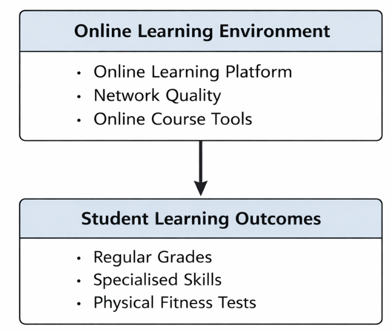
Figure 1
Conceptual Framework
of the Study
Based on the literature reviewed, this study proposes a conceptual framework in which the online learning environment is expected to influence student learning outcomes in online physical education courses.
3. Sampling Design and Participants
The participants of this study were undergraduate students from Xinjiang University and Shihezi University, two Double First-Class universities located in the Xinjiang Uyghur Autonomous Region of China. These universities were selected because they represent the highest level of higher education institutions in the region and have widely implemented online physical education courses.
The target population consisted of undergraduate students who had prior experience participating in online physical education courses. Most participants were between 18 and 24 years old and were enrolled in different academic majors.
A systematic sampling method was adopted to ensure the representativeness of the sample. Questionnaires were distributed to undergraduate students who had experienced online physical education courses. In total, 680 questionnaires were distributed, and 614 valid responses were retained after data screening and quality checks.
Table 1 presents the distribution of the sample across the selected universities. Participation in the survey was voluntary, and all respondents were informed about the purpose of the study and the confidentiality of their responses.
Table 1
|
Table 1 Population and Sample Distribution of the Selected Universities |
||
|
University |
Sample distributed |
Valid responses |
|
Xinjiang University |
340 |
307 |
|
Shihezi University |
340 |
307 |
|
Total |
680 |
614 |
Table 1 presents the distribution of the valid sample across the selected universities.
3.1. Instrument Development
The questionnaire used in this study was developed based on existing validated measurement scales reported in previous research on online learning and physical education. The instrument was designed to measure two key constructs in this study: the online learning environment and student learning outcomes.
Measurement items were adapted from established studies to ensure conceptual consistency with the research framework. Minor wording adjustments were made to reflect the context of online physical education courses.
Before the main survey, the questionnaire was reviewed and pilot tested to evaluate clarity and reliability. Based on the pilot results, redundant or unclear items were revised or removed to improve the readability and feasibility of the instrument.
The final questionnaire was used for the main data collection.
Table 2
|
Table 2 Presents the Operationalization of the Study Variables and their Measurement Dimensions |
||
|
Variable |
Dimension |
Source |
|
Online
Learning Environment |
E-learning
platform Network
signal stability Online
course tools |
Yang (2010), Sun (2019) Cui (2020) Sun (2019) |
|
Learning
Outcomes |
Student
regular performance Institutional
test scores Sports
skill performance |
Zhu (2020) Su (2020) Zhu (2020) |
3.2. Data Collection
Data was collected using paper-based questionnaires administered during scheduled physical education classes. After obtaining institutional permission and coordinating with course instructors, questionnaires were distributed and completed individually by the students. To minimise potential social influence, respondents were asked not to discuss their answers while completing the survey.
The data collection period lasted several weeks, during which completed questionnaires were checked on-site for completeness. Responses with substantial missing data or obvious response patterns were removed prior to data entry.
3.3. Data Analysis
After questionnaire collection, responses were coded and entered into SPSS for statistical analysis. Demographic variables and measurement items were coded numerically to facilitate data processing. Descriptive statistics and Pearson correlation analyses were first conducted to examine the basic characteristics of the data and the relationships between variables. Reliability analysis (Cronbach’s alpha) and confirmatory factor analysis (CFA) were then performed to evaluate the measurement properties of the constructs. Finally, structural equation modelling (SEM) using AMOS was applied to test the hypothesised relationship between the online learning environment and student learning outcomes.
3.4. Ethical Considerations
Participation in the study was voluntary, and respondents were informed about the purpose of the research and the confidentiality of their responses. No personally identifiable information was collected, and all data were used solely for academic research purposes.
4. Results
4.1. Sample Characteristics
A total of 680 questionnaires were collected during the formal survey stage. After data screening, including the removal of responses with extremely short completion times, identical response patterns across items, and logical inconsistencies, 66 invalid questionnaires were excluded. Finally, 614 valid responses were retained for analysis, resulting in an effective response rate of 90.3%. This response rate suggests that the dataset was sufficient for subsequent multivariate statistical analysis and structural equation modelling.
In terms of gender distribution, the sample included 318 male students (51.8%) and 296 female students (48.2%), showing a relatively balanced structure. Respondents also represented a wide range of academic disciplines, including engineering, agriculture, literature, science, medicine, arts, and other fields. Such disciplinary diversity improves the representativeness of the sample and supports the generalisability of the findings. Overall, the sample size, gender balance, and disciplinary coverage provided a solid empirical basis for the subsequent statistical analysis.
Table 3
|
Table 3 Demographic Profile of Respondents |
|||
|
Variable |
Option |
Frequency |
Percentage |
|
Gender |
Male Female |
318 296 |
51.8 48.2 |
|
Discipline |
Engineering Agriculture Literature/Arts Science Medicine Arts Others |
98 84 95 100 103 107 27 |
16 13.7 15.5 16.3 16.8 17.4 4.4 |
4.2. Reliability Analysis
Reliability analysis was conducted to assess the internal consistency of the two constructs examined in this study: online learning environment and student learning outcomes. Cronbach’s alpha coefficients were used as the main indicator of internal consistency reliability. In general, values above 0.70 indicate acceptable reliability, while values above 0.80 indicate good reliability.
The results showed that the overall Cronbach’s alpha coefficient for the Online Learning Environment scale was 0.886, indicating good reliability. At the dimensional level, the reliability coefficients were 0.790 for Online Learning Platform, 0.879 for Network Quality, and 0.890 for Online Course Tools. For the Student Learning Outcomes scale, the overall Cronbach’s alpha coefficient was 0.869, which also indicates good reliability. The alpha coefficients for its dimensions were 0.835 for Regular Grades, 0.804 for Specialized Skills Achievement, and 0.810 for Physical Fitness Test Results. These findings confirm that both constructs demonstrated satisfactory internal consistency and were suitable for further validity testing and structural modelling.
Table 4
|
Table 4 Reliability Analysis of the Measurement Scales |
||||
|
Scale |
Dimension |
Items |
Cronbach’s α (Dimension) |
Cronbach’s α (Scale) |
|
Online Learning Environment |
Online Learning Platform Network Quality Online Course Tools |
3 3 3 |
0.79 0.879 0.89 |
0.886 |
|
Student Learning Outcomes |
Regular Grades Specialized Skills Achievement Physical Fitness Test Results |
3 3 3 |
0.835 0.804 0.81 |
0.869 |
4.3. Validity Analysis
4.3.1. Exploratory Factor Analysis
Exploratory factor analysis was conducted to examine the structural validity of the Online Learning Environment and Student Learning Outcomes scales. The Kaiser-Meyer-Olkin (KMO) measure and Bartlett’s test of sphericity were first used to assess the suitability of the data for factor analysis. The results indicated that both scales met the recommended standards for factor extraction.
For the Online Learning Environment scale, the KMO value was 0.857, exceeding the recommended threshold of 0.70. Bartlett’s test of sphericity was statistically significant (χ² = 3168.014, p < 0.001), indicating that the data were appropriate for factor analysis. Three factors were extracted, corresponding to Online Learning Platform, Network Quality, and Online Course Tools. The cumulative variance explained by these three factors was 78.201%, indicating good structural validity.
All factor loadings exceeded 0.50, and no serious cross-loading was observed. For the Student Learning Outcomes scale, the KMO value was 0.863, which also exceeded the recommended threshold. Bartlett’s test of sphericity was significant (χ² = 2452.309, p < 0.001), confirming the suitability of the data for factor analysis. Three factors were extracted, representing Regular Grades, Specialized Skills Achievement, and Physical Fitness Test Results. The cumulative variance explained reached 73.808%, suggesting satisfactory structural validity. All factor loadings were above 0.50, with no substantial cross-loadings.
Table 5
|
Table 5 KMO and Bartlett’s Test Results |
||||
|
Scale |
KMO |
Bartlett’s Chi-Square |
df |
Sig. |
|
Online Learning Environment |
0.857 |
3168.014 |
36 |
0 |
|
Student Learning Outcomes |
0.863 |
2452.309 |
36 |
0 |
Table 6
|
Table 6 Exploratory Factor Analysis Results |
||
|
Scale |
Number of Factors Extracted |
Cumulative Variance Explained (%) |
|
Online Learning Environment |
3 |
78.201 |
|
Student Learning Outcomes |
3 |
73.808 |
4.3.2. Confirmatory Factor Analysis
Confirmatory factor analysis (CFA) was conducted using AMOS 24.0 to further assess the measurement model. The model fit indices showed a satisfactory fit between the data and the proposed measurement model. Specifically, the chi-square to degrees of freedom ratio (χ²/df) was 1.733, which was below the recommended threshold of 3. The RMSEA value was 0.035, which was below 0.08. In addition, the IFI, TLI, CFI, GFI, and AGFI values were 0.970, 0.963, 0.969, 0.948, and 0.933, respectively, all exceeding the recommended threshold of 0.90. These results indicate that the measurement model had a desirable overall fit.
Table 7
|
Table 7 Model Fit Indices for Confirmatory Factor Analysis |
||
|
Index |
Criterion |
Result |
|
χ²/df |
< 3 |
1.733 |
|
RMSEA |
< 0.08 |
0.035 |
|
IFI |
> 0.90 |
0.97 |
|
TLI |
> 0.90 |
0.963 |
|
CFI |
> 0.90 |
0.969 |
|
GFI |
> 0.90 |
0.948 |
|
AGFI |
> 0.90 |
0.933 |
4.3.3. Convergent Validity
Convergent validity was assessed using standardised factor loadings, composite reliability (CR), and average variance extracted (AVE). The CR value for Online Learning Environment was 0.755, and its AVE value was 0.508. For Student Learning Outcomes, the CR value was 0.753 and the AVE value was 0.506. Since both CR values exceeded 0.70 and both AVE values were above 0.50, the convergent validity of the two constructs was considered acceptable.
Table 8
|
Table 8 Convergent Validity of the Measurement Model |
|||
|
Construct |
Standardised Factor Loading |
CR |
AVE |
|
Online Learning Environment |
0.673–0.732 |
0.755 |
0.508 |
|
Student Learning Outcomes |
0.625–0.766 |
0.753 |
0.506 |
4.3.4. Discriminant Validity
Discriminant validity was evaluated by comparing the correlation coefficient between the constructs with the square roots of their AVE values. The square root of AVE for Online Learning Environment was 0.713, and the square root of AVE for Student Learning Outcomes was 0.711. The correlation between the two constructs was 0.654, which was lower than the square root of AVE for both variables. This result indicates that the two constructs were empirically distinct and that the measurement model demonstrated adequate discriminant validity.
Table 9
|
Table 9 Discriminant Validity of the Constructs |
||
|
Construct |
Online Learning Environment |
Student Learning Outcomes |
|
Online Learning Environment |
0.713 |
|
|
Student Learning Outcomes |
0.654 |
0.711 |
4.4. Descriptive Statistics
Descriptive statistical analysis was conducted to examine the distribution characteristics of the two main constructs in this study: online learning environment and student learning outcomes. The results showed that the mean values of both variables were above the theoretical midpoint of the scale, indicating that respondents generally reported moderate to relatively high levels of online learning environment quality and learning outcomes in online physical education courses.
For the Online Learning Environment construct, the mean value was 3.197 (SD = 0.724). Among its dimensions, the mean values were 3.236 (SD = 0.791) for Online Learning Platform, 3.152 (SD = 0.857) for Network Quality, and 3.204 (SD = 0.992) for Online Course Tools. For Student Learning Outcomes, the overall mean value was 3.424 (SD = 0.556). Its dimensions showed mean values of 3.360 (SD = 0.661) for General Achievement, 3.476 (SD = 0.690) for Specialised Skills, and 3.437 (SD = 0.687) for Physical Fitness Test Results.
Skewness and kurtosis values were also examined to assess normality. The absolute values of skewness were below 3 and those of kurtosis were below 10, indicating that the variables approximately followed a normal distribution. These results support the use of parametric statistical techniques in the subsequent analysis.
Table 10
|
Table 10 Descriptive Statistics of the Main Study Variables |
|||||||
|
Variable |
N |
Min |
Max |
Mean |
SD |
Skewness |
Kurtosis |
|
Online Learning Environment |
614 |
1 |
5 |
3.197 |
0.724 |
0.075 |
0.355 |
|
Online Learning Platform |
614 |
1 |
5 |
3.236 |
0.791 |
0.126 |
0.201 |
|
Network Quality |
614 |
1 |
5 |
3.152 |
0.857 |
0.152 |
-0.394 |
|
Online Course Tools |
614 |
1 |
5 |
3.204 |
0.992 |
0.264 |
-0.574 |
|
Student Learning Outcomes |
614 |
1 |
5 |
3.424 |
0.556 |
-0.715 |
1.553 |
|
General Achievement |
614 |
1 |
5 |
3.36 |
0.661 |
-0.246 |
0.929 |
|
Specialised Skills |
614 |
1 |
5 |
3.476 |
0.69 |
-0.37 |
0.73 |
|
Physical Fitness Test Results |
614 |
1 |
5 |
3.437 |
0.687 |
-0.284 |
0.228 |
4.5. Correlation Analysis
Pearson correlation analysis was conducted to examine the relationship between online learning environment and student learning outcomes. The results showed that online learning environment was significantly and positively correlated with student learning outcomes (r = 0.476, p < 0.01). This indicates that more favourable perceptions of the online learning environment were associated with better reported learning outcomes in online physical education courses.
The positive correlation provided preliminary statistical support for the hypothesised relationship between the two variables. Although correlation analysis does not establish causality, it confirms that the two constructs were meaningfully associated and thus suitable for further structural analysis.
Table 11
|
Table 11 Pearson Correlation between Online Learning Environment and Student Learning Outcomes |
||
|
Variable |
1 |
2 |
|
1. Online Learning Environment |
1 |
|
|
2. Student Learning Outcomes |
0.476** |
1 |
|
Note: ** p < 0.01. |
||
4.6. Structural Equation Modelling
Structural equation modelling was conducted to test the hypothesised effect of online learning environment on student learning outcomes. The results showed that online learning environment exerted a significant positive effect on student learning outcomes (B = 0.271, β = 0.323, S.E. = 0.054, C.R. = 5.008, p < 0.001). This indicates that improvements in the online learning environment were associated with higher levels of student learning outcomes in online physical education.
Among the structural paths examined in this study,the path from online learning environment to student learning outcomes showed one of the strongest standardised coefficients. This finding suggests that digital learning conditions, including platform usability, network quality, and access to online course tools, play a substantial role in supporting students’ learning performance in online physical education contexts.
The result confirms the hypothesised relationship and highlights the importance of technological and environmental support in online PE learning. A more stable, accessible, and user-friendly online learning environment may facilitate better student participation, smoother learning processes, and improved performance outcomes.
Table 12
|
Table 12 Structural Path from Online Learning Environment to Student Learning |
|||||
|
Path |
B |
β |
S.E. |
C.R. |
p |
|
Student Learning Outcomes ← Online Learning
Environment |
0.271 |
0.323 |
0.054 |
5.008 |
*** |
|
Note: ***
p < 0.001. |
|||||
4.7. Key Findings
The empirical results consistently support the proposed relationship between online learning environment and student learning outcomes. The descriptive statistics showed that both constructs were reported at moderate to relatively high levels. Reliability and validity analyses confirmed that the measurement model was psychometrically sound. Pearson correlation analysis revealed a significant positive association between the two variables, and structural equation modelling further demonstrated that online learning environment had a significant positive effect on student learning outcomes. Together, these findings suggest that the quality of the online learning environment is an important determinant of student learning outcomes in online physical education.
5. Discussion
5.1. Online Learning Environment and Learning Outcomes
The findings indicate that the online learning environment is positively associated with student learning outcomes in online physical education courses. The statistical results showed a significant positive relationship between the online learning environment and learning outcomes, suggesting that students who perceived their digital learning conditions more positively also tended to report better learning performance. Although this relationship might appear theoretically expected, the empirical evidence provides an important confirmation within the specific context of online physical education. These findings are consistent with previous studies suggesting that digital learning environments play an important role in supporting student engagement and learning performance Martin and Bolliger (2018), Richardson et al. (2017).
Online learning environments function not merely as technical platforms but as the operational space through which teaching activities are delivered and experienced. In online physical education, this role becomes even more visible. Unlike theoretical subjects that rely primarily on reading and discussion, physical education requires students to observe movement demonstrations, practice exercises independently, and often repeat physical actions guided by digital instructions. If the platform is unstable, the network connection unreliable, or instructional materials difficult to access, the continuity of these activities is easily interrupted. Under such conditions, even well-designed instructional materials may not translate into effective learning outcomes.
The results also suggest that the technological and organisational elements of online learning environments can shape students’ engagement with learning tasks. When digital platforms are stable and easy to navigate, students tend to experience fewer interruptions and can focus more fully on completing learning activities. Conversely, when technical difficulties occur frequently, students may lose patience or motivation, which can gradually affect their learning outcomes. In other words, the online learning environment operates as a form of structural support for learning processes rather than as a neutral background condition.
Another aspect worth noting is that the influence of the online learning environment appears to extend beyond simple access to technology. Students’ perceptions of the learning environment include their experiences with platform usability, the clarity of instructional resources, and the ease of participating in learning activities. These elements together create a learning atmosphere that can either encourage or discourage sustained participation. The positive relationship observed in this study therefore reflects not only technological conditions but also the broader learning experience created by the online environment.
Taken together, the results indicate that improving online learning environments may contribute directly to improving student learning outcomes in online physical education. This finding highlights the importance of viewing digital infrastructure as an integral component of the teaching process rather than as a purely technical support system.
5.2. Implications for Online Physical Education Teaching
The results of this study carry several implications for the design and delivery of online physical education courses. First, the findings suggest that the effectiveness of online physical education is closely linked to the quality of the digital learning environment in which teaching activities take place. For instructors and course designers, this means that attention should be given not only to the content of instruction but also to the conditions under which learning occurs.
In practical terms, the organisation of online physical education courses should prioritise clarity and accessibility. Instructional videos, demonstration materials, and practice guidelines need to be presented in a way that allows students to easily follow and repeat the required movements. If learning materials are difficult to access or poorly organised within the platform, students may struggle to understand the sequence of activities or lose interest in continuing the exercises.
Another implication concerns the importance of maintaining stable and reliable technological support during online instruction. Physical education activities often require continuous observation of movement demonstrations. When video playback is interrupted or the network connection becomes unstable, students may miss key details of the instruction. Ensuring stable platform performance therefore becomes a prerequisite for effective teaching rather than a secondary technical issue.
The findings also suggest that online physical education should encourage active participation rather than passive viewing. Digital platforms should ideally allow students to interact with instructional materials, revisit demonstrations when necessary, and track their learning progress. When students feel that the learning environment supports their participation and improvement, they are more likely to remain engaged with the course.
Finally, the study highlights the need for instructors to consider the diversity of students’ technological conditions. Not all students have access to the same quality of internet connection or digital devices. Designing course activities that remain accessible under different technological conditions may help reduce disparities in learning experiences and ensure that more students can benefit from online physical education.
5.3. Practical Implications
Beyond its implications for teaching practice, the findings of this study also have practical relevance for institutions and administrators responsible for organising online physical education programmes. Universities seeking to expand online physical education programmes should recognise that their success depends not only on curriculum design but also on the technological infrastructure that supports learning.
One practical implication is the need for institutions to invest in stable digital platforms capable of supporting video-based instruction and interactive learning activities. Since physical education relies heavily on visual demonstration, platform performance directly affects students’ ability to observe and imitate movements. Even small improvements in video quality, loading speed, and interface design can make a noticeable difference in students’ learning experiences.
Another consideration concerns the development of digital teaching resources tailored specifically to physical education. Online learning environments often originate from systems designed for lecture-based courses. As a result, they may not always support the practical nature of physical education activities. Institutions may therefore need to develop specialised teaching materials, such as structured exercise demonstrations, multi-angle movement recordings, and guided practice sessions that allow students to engage with physical tasks more effectively.
Administrative support also plays an important role in maintaining the quality of online learning environments. Technical support teams should be prepared to assist both instructors and students when technological issues arise. Timely technical assistance can prevent minor technical difficulties from becoming major disruptions to the learning process.
Overall, the results suggest that improving the online learning environment requires coordinated efforts from instructors, administrators, and technical staff. When these elements work together effectively, the online learning environment can provide meaningful support for students’ physical education learning.
5.4. Limitations and Future Research
Although this study provides useful insights into the relationship between the online learning environment and student learning outcomes, several limitations should be acknowledged. First, the data were collected from two universities within a specific regional context. While these institutions represent major universities within the region, the findings may not fully reflect the experiences of students in other educational environments or countries.
Second, the study relied on self-reported data to measure students’ perceptions of their learning environment and learning outcomes. Self-reported measures are widely used in educational research, but they may be influenced by individual interpretation and subjective judgement. Future research could combine survey data with objective indicators of learning performance or physical activity outcomes.
Another limitation concerns the cross-sectional nature of the research design. The data capture students’ perceptions at a single point in time, which makes it difficult to examine how the relationship between the learning environment and learning outcomes may evolve over longer periods. Longitudinal research designs could provide deeper insight into how students adapt to online physical education environments and how learning outcomes develop across multiple semesters.
Future studies may also explore additional factors that could influence learning outcomes in online physical education. For example, variables such as student motivation, instructor feedback, and instructional design strategies may interact with the online learning environment in shaping students’ learning experiences. Investigating these relationships may help develop a more comprehensive understanding of how online physical education can be improved.
Despite these limitations, the present study contributes empirical evidence on the role of the online learning environment in shaping learning outcomes within online physical education contexts. The findings highlight the importance of technological and organisational support in facilitating effective learning and provide a foundation for future research on digital physical education environments.
6. Conclusion
This study examined the influence of the online learning environment on student learning outcomes in online physical education courses. The results of the structural equation modelling indicated that the online learning environment has a significant positive effect on student learning outcomes. The findings suggest that stable digital platforms, reliable network conditions, and accessible online learning tools play an important role in supporting effective learning in online physical education contexts. Improving the quality of digital learning environments may therefore contribute to enhancing students’ participation and learning performance in online physical education.
This study therefore contributes empirical evidence to the growing literature on digital learning environments and online physical education in higher education contexts.
CONFLICT OF INTERESTS
None.
ACKNOWLEDGMENTS
None.
REFERENCES
Al-Fraihat, D., Joy, M., Masa'deh, R., and Sinclair, J. (2020). Evaluating E-Learning Systems Success: An Empirical Study. Computers in Human Behavior, 102, 67–86. https://doi.org/10.1016/j.chb.2019.08.004
Castañeda, L., and Selwyn, N. (2018). More than Tools? Making Sense of the Ongoing Digitization of Higher Education. International Journal of Educational Technology in Higher Education, 15(1), 22. https://doi.org/10.1186/s41239-018-0109-y
Daum, D. N., and Buschner, C. (2012). The Status of High School Online Physical Education in the United States. Journal of Teaching in Physical Education, 31(1), 86–100. https://doi.org/10.1123/jtpe.31.1.86
Dhawan, S. (2020). Online learning: A Panacea in the Time of COVID-19 Crisis. Journal of Educational Technology Systems, 49(1), 5–22. https://doi.org/10.1177/0047239520934018
Garrison, D. R., Anderson, T., and Archer, W. (2000). Critical Inquiry in a Text-Based Environment: Computer Conferencing in Higher Education. The Internet and Higher Education, 2(2–3), 87–105. https://doi.org/10.1016/S1096-7516(00)00016-6
Hodges, C., Moore, S., Lockee,
B., Trust, T., and Bond, A. (2020). The Difference Between Emergency Remote Teaching and Online
Learning. EDUCAUSE Review.
Hrastinski, S. (2008). Asynchronous and Synchronous E-Learning. Educause Quarterly, 31(4), 51–55.
Kuo, Y. C., Walker, A. E., Belland, B. R., Schroder, K. E., and Kuo, Y. T. (2014). A Case Study of Integrating Interactivity in Online Learning Environments. International Review of Research in Open and Distributed Learning, 15(1), 126–146. https://doi.org/10.19173/irrodl.v15i1.1664
Martin, F., and Bolliger, D. U. (2018). Engagement Matters: Student Perceptions on the Importance of Engagement Strategies in the Online Learning Environment. Online Learning Journal, 22(1), 205–222. https://doi.org/10.24059/olj.v22i1.1092
Means, B., Toyama, Y., Murphy, R.,
Bakia, M., and Jones, K. (2010). Evaluation of Evidence-Based Practices in Online Learning:
A Meta-Analysis and Review
of Online Learning Studies. U.S. Department
of Education.
Moore, M. G., and Kearsley, G. (2012). Distance Education: A Systems View of Online Learning (3rd ed.). Cengage Learning.
Richardson, J. C., Maeda, Y., Lv, J., and Caskurlu, S. (2017). Social Presence in Relation to Students' Satisfaction and Learning in the Online Environment: A Meta-Analysis. Computers in Human Behavior, 71, 402–417. https://doi.org/10.1016/j.chb.2017.02.001
Sun, A., and Chen, X. (2016). Online Education and its Effective Practice: A Research Review. Journal of Information Technology Education: Research, 15, 157–190. https://doi.org/10.28945/3502
Tucker, B. (2012). The Flipped Classroom. Education Next, 12(1), 82–83.
|
|
 This work is licensed under a: Creative Commons Attribution 4.0 International License
© ShodhKosh 2026. All Rights Reserved.