ShodhKosh: Journal of Visual and Performing ArtsISSN (Online): 2582-7472
|
|
Integrating Performing Arts into Humanistic Tourism for Destination Development in Chengdu City, Sichuan Province, China
Jia Wei 1
 ,
Qinghua Mao 2
,
Qinghua Mao 2
1 Gingko College of
Hospitality Management, Chengdu 611743, China
2 Gingko College of Hospitality
Management, Chengdu 611743, China
|
|
|
ABSTRACT |
|
|
This study
explores how performing arts influence destination development through
humanistic tourism. It examines four aspects of the performing arts
availability, accessibility, diversity, and visibility using sustainable
development theory and presents a conceptual framework for destination
growth. The research used a quantitative approach, gathering cross-sectional
data from participants through purposive sampling Development in Chengdu
City, Sichuan Province, China. A total of 349 valid responses were analyzed
with SPSS. Results show that all four dimensions have a significant positive
effect on destination development. Humanistic tourism also has a moderate
positive impact. The model accounts for a significant amount of variance,
supporting the strength of the proposed framework. This research adds to both
theory and practice by integrating humanistic tourism and cultural elements
into destination development, offering a new perspective grounded in
sustainable tourism theory. Integrating culture and humanistic values into
tourism planning gives policymakers practical ways to use performing arts for
inclusive and sustainable destination development. |
|||
|
Received 28 January 2026 Accepted 25 February 2026 Published 16 April 2026 Corresponding Author Jia Wei, jia.wei@gingkoc.edu.cn DOI 10.29121/shodhkosh.v7.i1.2026.7642 Funding: This research
received no specific grant from any funding agency in the public, commercial,
or not-for-profit sectors. Copyright: © 2026 The
Author(s). This work is licensed under a Creative Commons
Attribution 4.0 International License. With the
license CC-BY, authors retain the copyright, allowing anyone to download,
reuse, re-print, modify, distribute, and/or copy their contribution. The work
must be properly attributed to its author.
|
|||
|
Keywords: Integrating Performing Arts, Humanistic Tourism,
Destination Development, China |
|||



1. INTRODUCTION
Tourism context and processes are transforming from traditional mass-oriented to more meaningful and value-added around the globe. Tourists seek culturally authentic, immersive and enriching experiences at the destinations Scheyvens (1999), Moscardo (1996), Ali et al. (2025). They emphasise personal and social growth, cultural authenticity, local empowerment, engagement and meaningful interaction among visitors, operators and the local community for holistic destination development. This paradigm shift integrates the social, cultural, and economic development of the destination and brings unique experiential values to the tourism development Oh et al. (2007), Kim et al. (2010); Richards (2018), Burgelman and Grove (1996).
Among these cultural resources, the performing arts are a foundational element, which include but are not limited to music, dance, theatre, and other live artistic symbols and expression which showcases the cultural identity, values, traditions, norms and heritage Woo and Mun (2020), Chen et al. (2013). Moreover, performing arts is the sum of the interactive and socially and emotionally engaging experiences, and becomes a strategic tool for connecting visitors and local communities Comunian and England (2020), Duxbury et al. (2021). Likewise, it contains rhythms, stories, narratives, which are most of the time experiential, participatory, and engaging; therefore, it has become an integral part of tourism and destination development Duxbury and Bakas (2021), Zenker and Kock (2020).
During the literature review, it was found that much of the literature on tourism and destination development is available from a tangible perspective, such as infrastructural development, destination beautification, and economic benefits Duxbury et al. (2021), Boo and Busser (2018), Richards (2018). However, despite the performing arts' potential to portray culture and their role in destination development, they have rarely been investigated in depth. Therefore, the current study focused on the gap and explored the construct in more detail, exploring its four critical dimensions, i.e. availability, accessibility, diversity and visibility of the performing arts and its impact on cultural engagement and destination development.
At the same time, humanistic tourism serves as a bridge between performing arts and destination development Lucia et al. (2021), Duxbury et al. (2021). It shifts focus from transactional to transformative processes and experiences, moving beyond traditional and superficial engagement and fosters cultural authenticity, sensitivity, local appreciation, empowerment and engagement, which help to align tourism with broader humanistic values, adding to inclusive and sustainable development Lucia et al. (2021), Gohary et al. (2022). However, empirical investigation on the moderating role of humanistic tourism is missing between performing arts and destination development.
2. Literature Review
Tourism is expanding. It is evolving from mass and traditional tourism and taking different forms and shapes. Based on the purpose and objectives, destinations are planned and developed. In culture tourism, tradition, history, and heritage are planned and developed Zenker and Kock (2020), Duxbury et al. (2021). Similarly, Medical tourism focuses on health care development, and ecotourism promotes responsible tourism by visiting natural areas, promoting environmental and biodiversity conservation Reed (2008), Connell (2013), Ali et al. (2025). In the same way, many other forms like religious tourism, leisure tourism, sport tourism, etc., are being focused on and developed Rashid (2018), Choe (2025), Gibson (1998), Min et al. (2016).
So, keeping the objectives, goals, context, setting, and destinations are development, maintained, sustained and promoted Boo and Busser (2018), Zhang and Zhang (2002), Ritchie et al. 2019). Plans are managed strategically to improve destination location, to make them more attractive, accessible, and sustainable for the visitors. Infrastructure, transportation, and accommodation plans are developed and implemented to provide basic facilities to the visitors Mazlan et al. (2025); Carr (2002). Moreover, marketing and branding should be planned in the best possible way to promote cultural values besides leisure and relaxation. Research admits that besides developing these facilities, plans should also be developed to maintain cultural authenticity, promote cultural harmony, and avoid cultural commodification, for which all the stakeholders, which include, but are not limited to, locals, government, operators, should be involved to enhance tourist experiences and for sustainable destination development Cohen (1988), Amorim et al. (2020). At destinations, social, economic, cultural, and environmental aspects are developed in a balanced way. In destination planning, eco-friendly practices should be added to boost tourism Boo and Busser (2018), Woo and Mun (2020), Burgelman and Grove (1996).
2.1. Theoretical Support for the Study
The study is based on sustainable tourism development (STD) theory, which provides social and economic long-term viability and socio-cultural integration to the tourism destination development Khan et al. (2021), Dabphet et al. (2012). STD focuses on the social and cultural aspects, cultural resources, destination competitiveness, community empowerment, inclusive social and economic benefits, biodiversity preservation, besides minimizing the negative aspects of the tourism like overcrowding, resource exploitation and depletion, culture and heritage commodification Wickens et al. (2015) , Sitepu (2019).
from the STD perspective, performing arts availability serves as a foundation to beautify and strengthen tourism destination, develop its capacity and sustain tourism flow. The arrangement of festivals, live performance improve destination capacity Zhang and Zhang (2002), Boukas and Ziakas (2014), Byrd (2007). Moreover, these arrangements not only become a source of relaxation and leisure, but also boosts social and economic status of locals, and contribute to the circular economy Ali et al. (2025), Byrd (2007). Similarly, the accessibility of these resources from the STD perspectives promotes local and visitors’ engagement, and tourism becomes more inclusive and sustainable, which strengthens local identity. The availability, accessibility and affordability also reduce inequalities and provide opportunities to the marginalised people to participate Sharpley (2000), Hua and Wondirad (2021), Jamal and Camargo, (2014).
Likewise, STD theory advocates the diversification of the performing arts to foster intercultural exchange to create meaningful interaction among visitors and the communities, which enhances visitors’ satisfaction and experiences Wang (1999), Pratt (2015). Furthermore, STD also recommends the visibility, branding, promotion and communication of all processes and practices through responsible sources to develop intercultural tolerance Amorim et al. (2020). According to the STD, all these processes of destination development should be authentic, ethical, respectful, and meaningful to expand the socio-cultural benefits of tourism Tan et al. (2013). In simple words, tourism should be humanistic, and all possible ethical protocols need to be developed and followed to ensure the availability, accessibility, visibility, and diversity of the performing arts. Responsible tourism practices need to be supported to create dynamic benefits for all stakeholders Font et al. (2017), Bramwell and Lane (2011).
2.2. Research Hypothesis for the study
The availability of the performing arts’ tools and equipment, which includes, but is not limited to, music, theatre, dance, and cultural festival celebrations, has a significant impact on tourism processes and practices and destination development Amorim et al. (2020), Io, (2019). Visitors prefer to visit destinations where immersive, rich cultural and artistic experiences are available. Performing arts provide cultural identity, strengthen destination branding, improve tourists' experiences and inflows, and contribute to social, emotional and economic development Chen et al. (2013). Local artists perform and get financial and economic benefits, which help in preserving cultural heritage Jaeni (2023), Song (2016), Zieba (2016). Based on these arguments, the study proposes that
H1: Performing Arts availability positively
contributes to the destination development.
The accessibility of the performing arts refers to how easily the local and the tourists can approach, access, locate and participate in cultural performances Zairil (2024), Mazlan et al. (2024). The availability of the facilities for accessing these facilities, like location, transportation, and, in the same way, the affordability, timing, scheduling, availability and dissemination of the authentic information play a critical role in the tourism and destination development Richards (2018), Darcy and Dickson (2009). In many cases, even if the high-level performing arts facilities and tools are available, if there is no accessibility, or limited access, high cost, poor transportation and other limitations, these can restrict locals and tourists from participation, and reduce overall destination development Comunian and England (2020), Bramwell and Lane (2011). From a practical perspective, accessibility to the performing arts enhances inclusivity, competitiveness, and attractiveness of the tourism industry, which leaves a positive and significant impact on the destination development Dabphet et al. (2012). Therefore, policymakers and the tourism authorities should facilitate and develop tools and infrastructure for accessing performing arts facilities, to improve visitors’ experiences, conservation of the cultural sights and resources, contribute to the local social and financial development, and encourage cultural exchange and social cohesion Salem et al. (2026); Zheng et al. (2020). These arguments lead to the hypothesis that
H2: Performing Arts accessibility positively
contributes to the destination development.
Diversification to performing arts means that there should be a range and variety of tools and artistic expression in the destination to amuse the locals and visitors Choudhury et al. (2024). Different types of performing tools, generic dance, theatrical performance and multi-cultural festival celebration at the destination improve visitors' interests, experiences, satisfaction, and they extend their stay at the destination, which enhances social, financial, and economic conditions and processes, which leads to sustainable destination development Luo et al. (2023), Han et al. (2026). Research admits that diversification in the performing arts offerings enhances overall visitors' experiences, destination image, making it vibrant, inclusive and rich from social and cultural perspectives Byrd (2007). Moreover, diversity of the performing arts makes the destination unique, differentiated, contemporary, leading to sustainable practices, creativity, innovation, and cultural exchange. Additionally, it fosters community participation, ensures cultural identities and preserves cultural authenticity besides tourism and destination development Ngerndang et al. (2025). So, the study proposes that
H3: Performing Arts diversity positively contributes to the destination development.
Visibility of the performing arts refers to the showcasing, promotion, recognition, branding, and marketing of the tools, models, techniques, and methods associated with the cultural arts Kabanda (2014), Salem et al. (2026). There can be various methods for performing arts visibility, which include but are not limited to social media, electronic models, blogs and other digital platforms, and even tourism companies, and on-site promotion, however, the for the destination development, the best possible, feasible, viable and suitable need to be selected, keeping in view the social, financial and economic conditions to make it optimal from all aspects Mazlan et al. (2025), Salem et al. (2026). According to the research, visibility play pivotal role in shaping destination development, making it more attractive and sustainable. Literature admits that the availability of the performing arts tools and techniques is fundamental to tourism and destination development; however, their visibility to the targeted audience enhances awareness among locals and visitors, develops cultural identity and positively influences destination development Luo et al. (2023). Additionally, it enables destinations to enhance the value of the cultural resources by reaching the maximum targeted population. Strategic marketing and branding strategies like arranging and celebrating festivals, creating linkages with the local, regional, national and even internal organisations, working in the same domain, promote visibility of the performing arts and help in destination development Ngerndang et al. (2025). In a digitally mediated era, social media can be a better tool for promotion and visibility, which can bring a positive impact to destination development Mazlan et al. (2024). Based on these arguments, the study hypothesises that
H4: Performing Arts visibility positively contributes to the destination development.
Humanistic tourism believes in promoting meaningful engagement, authentic tourism practices and processes, aligning with cultural identity, empathy and understanding. locals and tourists are supposed to deeply believe in these sustainable practices, connect themselves deeply with these cultural experiences, to encourage and promote local traditions Rashid (2018), Smith and Diekmann (2017). According to the research, higher humanistic values encourage artistic production and make the experiences memorable. Similarly, humanistic tourism provides facilities and opportunities for accessibility and meaningful engagement, to understand, connect and develop inclusivity, empathy, and experiential depth, by accessing and using performing arts tools and facilities Higgins-Desbiolles (2006), Kim et al. (2010). Additionally, from a stakeholder perspective, making the performing art activities more diversified makes them more attractive and visible for the customers. Guided cultural tours and workshops develop more opportunities for performing arts tools accessibility and help in destination development Pung et al. (2020), Gerritsen et al. (2015).
Furthermore, humanistic tourism believes in intercultural dialogue for cultural plurality, and engagement can harness performing arts diversity, encourage cultural narratives, and foster inclusivity, which becomes a source of sustainable destination development Wang (1999), Amorim et al. (2020). In the same way, the visibility of the performing art promotes tourism awareness, deeper appreciation, and stronger emotional connection, which leads to destination efficiency and effectiveness Hansen (2020), Higgins-Desbiolles (2018). These findings, relationship and arguments lead to
H5: Humanistic tourism moderates the relation between performing Arts availability and destination development.
H6: Humanistic tourism moderates the relation between performing arts accessibility and destination development.
H7: Humanistic tourism moderates the relation between performing Arts diversity and destination development.
H8: Humanistic tourism moderates the relation between performing Arts visibility and destination development.
Based on the above-cited literature, findings, and relations, the study proposes the conceptual study model given in Figure 1.
Figure 1
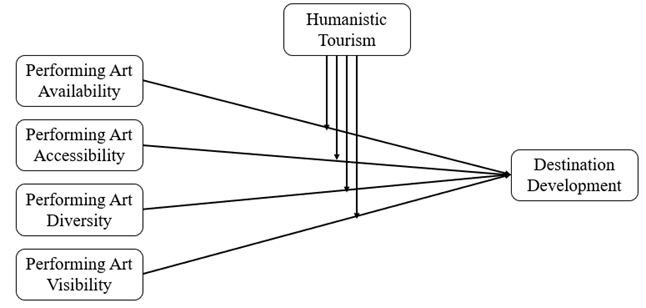
Figure 1 Research Model for the Study
3. Methodology
3.1. Research Design
This study adopted a quantitative research design to examine the research problem in Chengdu City, Sichuan Province, China. The data were collected from respondents through a structured questionnaire. The study focused on individuals involved in performing arts and tourism development, ensuring that all respondents had at least three years of relevant experience.
3.2. Sampling Technique and Respondents
The study employed a purposive sampling technique. This technique was considered suitable because only respondents directly engaged in performing arts and tourism development were selected. In addition, respondents were required to have at least three years of experience, which helped ensure the relevance and quality of the data collected.
3.3. Instrument Development and Adaptation
The questionnaire was adopted from previous studies and then adapted to fit the specific context and setting of the present study. After adaptation, the instrument went through several refinement stages to improve clarity, relevance, and comprehensibility for the target respondents.
3.4. Validity and Pilot Testing
To ensure the quality of the instrument, the adapted questionnaire was first examined for face and content validity by faculty members from the language department to identify and remove language deficiencies, redundancies, and anomalies. Subsequently, three professionals from the social work department were consulted for further face and content validation. The questionnaire was then tested in a pilot phase at a public university in Chengdu, involving both male and female students. Based on this process, some items were removed and others were added to make the instrument more respondent-friendly and contextually appropriate.
3.5. Data Collection Procedure
After the scale maturation process, the questionnaire was operationalized for data collection. The survey was distributed online, considering the time and demographic characteristics of the respondents. Online distribution was chosen because it was more convenient in a digitized environment than printed questionnaires. The questionnaire was shared through personal and professional networks, including WhatsApp, LinkedIn, and email.
3.6. Response Rate and Data Screening
A total of 400 questionnaires were distributed, of which 371 were returned. The high completion rate was supported by personal follow-up. No missing data were recorded because Google Forms settings required respondents to complete each page before proceeding. During data screening, 13 questionnaires were removed due to consistent response patterns, and 9 more were excluded as outliers. As a result, 349 valid responses remained for the final analysis.
3.7. Data Analysis
After data collection and screening, the data were entered into SPSS for analysis. SPSS was selected because it is a robust and user-friendly statistical tool with comprehensive functions for data handling and hypothesis testing. It also supports both simple and advanced analyses, including direct and indirect relationships. Therefore, based on the proposed model and relationships, SPSS was used to analyze the data.
4. Findings and Analysis
4.1. Demographics of the Study
Table 1 contains the demographic information and statistics, which indicate that all the respondents had the required skills, experiences and qualifications. Both the male and female participated in the study, which indicates that the study was diversified. Similarly, the data was collected from public, private and non-profit organization, working for the promotion of the sustainable tourism development and maintaining cultural heritage, thereby contributing to the performing arts in the region. In the same way, the respondents were well qualified, most of them had Bachelor's degrees, followed by Master's and higher diploma and certificate holders. Likewise, the experience statistic proclaims that all the respondents had reasonable experiences to participate in the study.
Table 1
|
Table 1 Demographics of the Study (N= 349) |
|||
|
Items |
Frequency |
Percentage (%) |
|
|
Gender |
Male |
198 |
57 |
|
Female |
151 |
43 |
|
|
Type of organization |
Public |
127 |
36 |
|
Private |
144 |
41 |
|
|
Non-profit |
78 |
23 |
|
|
Qualification |
Bachelors |
176 |
50 |
|
Masters |
105 |
30 |
|
|
Higher Diploma |
68 |
20 |
|
|
Job Experience |
1-10 years |
48 |
14 |
|
10-20 years |
166 |
48 |
|
|
20-30 years |
135 |
38 |
|
4.2. Descriptive Statistics
Table 2 contains the descriptive statistics. According to the data, the mean values for all the constructs are bigger than their corresponding standard deviation values, which proclaims that the respondents that there is a high level of agreement among the respondents and the lower values of the standard deviation mean low level of variability, which means that the data is consistent and reliable for further analysis.
Table 2
|
Table 2 Descriptive Statistics |
|||||
|
Variables |
N |
Min |
Max |
S.D |
Mean |
|
Performing
Arts Availability |
349 |
1 |
5 |
0.384 |
3.738 |
|
Performing
Arts Accessibility |
349 |
1 |
5 |
0.738 |
3.293 |
|
Performing
Arts Diversity |
349 |
1 |
5 |
0.627 |
3.748 |
|
Performing
Arts Visibility |
349 |
1 |
5 |
0.829 |
3.711 |
|
Humanistic
Tourism |
349 |
1 |
5 |
0.738 |
3.739 |
|
Destination
Development |
349 |
1 |
5 |
0.327 |
3.91 |
4.3. Reliability Analysis
Table 3 showcases values for the reliability analysis. Reliability analysis assesses the internal consistency of the scale items. According to the research and practice, the threshold value for the reliability, which is shown by the Cronbach's Alpha, should be more than 0.7. Statistics in Table 3 indicate that all the values have higher values then its accepting values, which means that scale items are consistent and reliable for further processing.
Table 3
|
Table 3 Reliability Analysis |
||
|
Construct |
No
of items |
Cronbach
Alpha |
|
Performing
Arts Availability |
3 |
0.783 |
|
Performing
Arts Accessibility |
4 |
0.831 |
|
Performing
Arts Diversity |
5 |
0.738 |
|
Performing
Arts Visibility |
4 |
0.792 |
|
Humanistic
Tourism |
4 |
0.801 |
|
Destination
Development |
5 |
0.79 |
4.4. Correlation Analysis
Correlation analysis was conducted to assess the relationship among the variables. According to the values, all the variables are positively related (correlated) with each other. There are no signs of multicollinearity among the variables, and they contributed significantly to one another. Moreover, the results revealed the significant contribution at 0.01 significance level. The co-efficient values of the correlation were found positive and significant (0.52-0.72), which indicate moderate positive relation among the study variables and admits that all the aspects of the performing arts significantly contribute to the tourism and destination development. The statistics for the correlation analysis are listed in Table 4.
Table 4
|
Table 4 Correlation Analysis |
||||||
|
Construct |
Performing
Arts Availability |
Performing
Arts Accessibility |
Performing
Arts visibility |
Performing
Arts diversity |
Humanistic
Tourism |
Destination
Development |
|
Performing
Arts Availability |
1 |
|||||
|
Performing
Arts Accessibility |
0.567** |
1 |
||||
|
Performing
Arts Diversity |
0.573** |
0.690** |
1 |
|||
|
Performing
Arts Visibility |
0.620** |
0.582** |
0.737** |
1 |
||
|
Humanistic
Tourism |
0.592** |
0.583** |
0.670** |
0.693** |
1 |
|
|
Destination
Development |
0.539** |
0.672** |
0.683** |
0.637** |
0.537** |
1 |
4.5. Regression Analysis
For the regression analysis, both direct and moderating impact of the variables was tested in the hierarchical multiple regression testing. In model 1, the first direct impact was assessed for the variables, and it was confirmed that all the constructs have positive and significant contributions to tourism and destination development. All the beta values are where positive and the P-values were in the threshold level i.e. P < 0.001. Similarly, for the moderator (humanistic tourism) statistics (β = 0.158, p < 0.001) also revealed positive contribution on the destination development. This slight improvement of the impact portrays the importance of the humanistic tourism processes and procedures in the destination development. Moreover, in model 4, the moderation was assessed through the interaction terms, where again, the co-efficient of all variables were improved. Furthermore, the statistics for the explained variables and the total variance was attained 71%. The significant F-changes further confirm the meaningful moderating impact in the study. In sum, the finding confirms the moderating impact of the humanistic tourism and its impact on the relation between the performing arts and the destination development. The statistics for the regression analysis can be seen in Table 5.
Table 5
|
Table 5 Regression Analysis |
|||
|
Variables |
Model
1 (IVs) |
Model
2 (Moderator) |
Model
3 (Interactions) |
|
Performing
Arts Availability (PAA) |
0.197*** |
0.184*** |
0.161*** |
|
Performing
Arts Accessibility (PAC) |
0.255*** |
0.245*** |
0.222*** |
|
Performing
Arts Diversity (PAD) |
0.224*** |
0.211*** |
0.197*** |
|
Performing
Arts Visibility (PAV) |
0.288*** |
0.267*** |
0.242*** |
|
Humanistic
Tourism (HT) |
— |
0.157*** |
0.142*** |
|
PAA
× HT |
— |
— |
0.105** |
|
PAC
× HT |
— |
— |
0.117*** |
|
PAD
× HT |
— |
— |
0.109*** |
|
PAV
× HT |
— |
— |
0.123*** |
|
R² |
0.63 |
0.66 |
0.72 |
|
ΔR² |
— |
0.04 |
0.039 |
|
F |
122.44*** |
118.22*** |
125.66*** |
5. Discussion
The study empirically assessed the impact of the performing arts on tourism and destination development. Moreover, the study explored alignment with the principles of sustainable tourism development theory and integrated sustainable tourism and destination development. The results demonstrate that the performing arts element significantly contributes to destination development through integrating immersive social and cultural experiences, leading to visitors satisfaction and socio-economic development Byrd (2007), Zheng et al. (2020), Bramwell and Lane (2011).
Additionally, the study explored that all four dimensions play a foundational role in destination development. First, the tourism authorities should work on the availability of the tools and facilities for the destination development, making them accessible to the local communities and visitors Ngerndang et al. (2025). Furthermore, performing arts facilities should be diversified, robust and unique, so that the culture can be branded or showcased in a holistic form, not in bits and bytes. Diversification will add to cultural enrichment and visitor satisfaction, which may lead to their long stay at the destination, which eventually contributes to the cultural harmonisation, intercultural dialogues, innovations, and socio-economic benefits Jamal and Camargo (2014), Higgins-Desbiolles (2018).
Likewise, the visibility of the performing arts showed the strongest impact, advocating for the marketing, branding and promotion of the performing arts tools and facilities. In this digital era, social and electronic media can be the best feasible sources for destination promotion and sustainable tourism development, to shape the destination image for the global audience Comunian and England (2020). Additionally, the study confirmed that humanistic tourism provides a deeper understanding of the cultural experiences and their translation and transformation into meaningful insights. Cultural experiences become a source of emotional bonding, cultural development, and ethical engagement, and pave a road for human-centred tourism and destination development Darcy and Dickson (2009), Zhang and Zhang (2002).
6. Conclusion and Recommendations
The study concludes that performing arts are an enabler, driver and a transformative tool for destination development. Its dimensions promote cultural experiences and engagement, leading to visitors’ satisfaction, local empowerment, and eventually inclusive sustainable tourism and destination development. The study also concludes that humanistic values are crucial for ensuring long-term sustainability and socio-cultural enrichment. The study extended the sustainable tourism development theory by integrating the intangible element of cultural authenticity and empathy for destination development. Additionally, the study provides insights to policymakers that although tangible infrastructure development is instrumental for tourism and destination development, they also focus on the development of the soft aspects of destination development.
Like other studies, the current study also carries certain limitation, which needs to be considered in future studies. First, the study is confined to a certain geographical area, which may not be generalised, so the same study can be extended to a multi-cultural context. Similarly, a longitudinal study is recommended to assess the impact of the performing arts facilities on the destination development. Furthermore, the current study is based on self-reporting data; observational data can be assessed in a future study, which is expected to come up with new insights and directions.
CONFLICT OF INTERESTS
None.
ACKNOWLEDGMENTS
None.
REFERENCES
Ali, J. (2025). Impact of Sustainable Sourcing on Ecotourism Resilience. Sustainable Development, 33(6), 8586-8598. https://doi.org/10.1002/sd.70121
Ali, J., Khwaja, M. G., Alsolamy, M., Aljehani, S., Alblowi, K., and Alotaibi, M. G. (2025). Assessing Dynamics of Ecotourism Using Multi-Methods Analysis. Journal of Ecotourism, 24(3), 307-327. https://doi.org/10.1080/14724049.2024.2414822
Amorim, D., Jiménez-Caballero, J. L., and AlmeIda, P. (2020). The Impact Of Performing Arts Festivals on Tourism Development: Analysis of participants' motivation, quality, satisfaction and Loyalty. Tourism and Management Studies, 16(4), 45-57. https://doi.org/10.18089/tms.2020.160404
Boo, S., and Busser, J. A. (2018). Meeting Planners' Online Reviews of Destination Hotels: A Twofold Content Analysis Approach. Tourism Management, 66, 287-301. https://doi.org/10.1016/j.tourman.2017.11.014
Boukas, N., and Ziakas, V. (2014). A Chaos Theory Perspective of Destination Crisis and Sustainable Tourism Development in Islands: The case of Cyprus. Tourism Planning and Development, 11(2), 191-209. https://doi.org/10.1080/21568316.2013.864995
Bramwell, B., and Lane, B. (2011). Critical Research on the Governance of Tourism and Sustainability. Journal of Sustainable Tourism, 19(4-5), 411-421. https://doi.org/10.1080/09669582.2011.580586
Bramwell, B., and Sharman, A. (1999). Collaboration in Local Tourism Policymaking. Annals of Tourism Research, 26(2), 392-415. https://doi.org/10.1016/S0160-7383(98)00105-4
Burgelman, R. A., and Grove, A. S. (1996). Strategic Dissonance. California Management Review, 38(2), 8-28. https://doi.org/10.2307/41165830
Byrd, E. T. (2007). Stakeholders in Sustainable Tourism Development and their Roles: Applying stakeholder Theory. Tourism Review, 62(2), 6-13. https://doi.org/10.1108/16605370780000309
Carr, N. (2002). The Tourism-Leisure Behavioural Continuum. Annals of Tourism Research, 29(4), 972-986. https://doi.org/10.1016/S0160-7383(02)00002-6
Chen, Y., Lehto, X. Y., and Cai, L. (2013). Vacation and Well-Being: A Study of Chinese Tourists. Annals of Tourism Research, 42, 284-310. https://doi.org/10.1016/j.annals.2013.02.003
Choe, J. (2025). Religious tourism. Tourism Geographies, 27, 830-839. https://doi.org/10.1080/14616688.2024.2423168
Choudhury, D., Chaudhuri, D., and Goel, M. (2024). The Role of Performing Arts in the Advancement of Sustainable Development Goals (SDGs). International Journal for Multidisciplinary Research, 1-19.
Cohen, E. (1988). Authenticity and Commoditization in Tourism. Annals of Tourism Research, 15(3), 371-386. https://doi.org/10.1016/0160-7383(88)90028-X
Comunian, R., and England, L. (2020). Creative and Cultural Work Without Filters: COVID‑19 and Exposed Precarity in the Creative Economy. Cultural Trends, 29(2), 112-128. https://doi.org/10.1080/09548963.2020.1770577
Connell, J. (2013). Contemporary Medical Tourism: Conceptualisation, Culture and Commodification. Tourism Management, 34, 1-13. https://doi.org/10.1016/j.tourman.2012.05.009
Dabphet, S., Scott, N., and Ruhanen, L. (2012). Applying Diffusion Theory to Destination Stakeholder Understanding of Sustainable Tourism Development: A Case from Thailand. Journal of Sustainable Tourism, 20(8), 1107-1124. https://doi.org/10.1080/09669582.2012.673618
Darcy, S., and Dickson, T. J. (2009). A whole-of-Life Approach to Tourism: The Case for Accessible Tourism Experiences. Journal of Hospitality and Tourism Management, 16(1), 32-44. https://doi.org/10.1375/jhtm.16.1.32
Duxbury, N., Bakas, F. E., Castro, T. V., and Silva, S. (2021). Creative Tourism Development Models Towards Sustainable and Regenerative Tourism. Sustainability, 13(1), 1-21. https://doi.org/10.3390/su13010002
Duxbury, N., and Bakas, F. E. (2021). Creative Tourism: A Humanistic Paradigm in Practice. In Humanistic Management and Sustainable Tourism (1021). Routledge. https://doi.org/10.4324/9781003108955-9
Font, X., and McCabe, S. (2017). Sustainability and marketing in tourism: Contexts, paradoxes, approaches, challenges and potential. Journal of Sustainable Tourism, 25(7), 869-883. https://doi.org/10.1080/09669582.2017.1301721
Gerritsen, D. F., Rigtering, J. C., Bouw, S. R., and Vonk, S. (2015). Travelers' Conversion Behavior at Foreign Cash Withdrawals: An Experimental Study. Annals of Tourism Research, 50, 162-165. https://doi.org/10.1016/j.annals.2014.10.005
Gibson, H. J. (1998). Sport Tourism: A Critical Analysis of Research. Sport Management Review, 1(1), 45-76. https://doi.org/10.1016/S1441-3523(98)70099-3
Gohary, A., Shah, A., Hosseini, S. R., Chan, E. Y., and Madani, F. (2022). God Salience and Tourists' Pro-Environmental Behavior. Annals of Tourism Research, 93. https://doi.org/10.1016/j.annals.2021.103318
Han, C., Yuan, H., and Kim, Y. (2026). From Diversified Development to Sustainable Destination Management: Mechanisms Linking Tourist Psychological Identity and cultural tourism sustainability. Sustainability, 18, 473. https://doi.org/10.3390/su18010473
Hansen, T. (2020). Media Framing of Copenhagen Tourism: A New Approach to Public Opinion About Tourists. Annals of Tourism Research, 84. https://doi.org/10.1016/j.annals.2020.102975
Higgins-Desbiolles, F. (2006). More than an "industry": The Forgotten Power of Tourism as a Social Force. Tourism Management, 27(6), 1192-1208. https://doi.org/10.1016/j.tourman.2005.05.020
Higgins-Desbiolles, F. (2018). Sustainable Tourism: Sustaining Tourism or Something More? Tourism Management Perspectives, 25, 157-160. https://doi.org/10.1016/j.tmp.2017.11.017
Hua, H., and Wondirad, A. (2021). Tourism Network in Urban Agglomerated Destinations: Implications for Sustainable Tourism Destination Development. Sustainability, 13(1), 285. https://doi.org/10.3390/su13010285
Io, M.-U. (2019). Understanding the Core Attractiveness of Performing Arts Heritage to International Tourists. Tourism Geographies, 21(4), 687-705. https://doi.org/10.1080/14616688.2019.1571096
Jaeni, J. (2023). Arts Communication Model: The Development of Performing Arts Through Empowering Cultural Art-Based Tourism. Harmonia Journal of Arts Research and Education, 23(2), 1-19. https://doi.org/10.15294/harmonia.v23i2.41463
Jamal, T., and Camargo, B. A. (2014). Sustainable Tourism, Justice and an Ethic of Care: Toward the just destination. Journal of Sustainable Tourism, 22(1), 11-30. https://doi.org/10.1080/09669582.2013.786084
Kabanda, P. (2014). The Creative Wealth of Nations: How the Performing Arts can Advance Development and Human Progress. Policy Research Working Paper No. 7118. https://doi.org/10.1596/1813-9450-7118
Khan, M. R., Khan, H. U., Lim, C. K., Tan, K. L., and Ahmed, M. F. (2021). Sustainable Tourism Policy, Destination Management and Sustainable Tourism Development: A moderated-mediation model. Sustainability, 13(21), 12156. https://doi.org/10.3390/su132112156
Kim, J.-H., Ritchie, J. R., and McCormick, B. (2010). Development of a Scale to Measure Memorable Tourism Experiences. Journal of Travel Research, 51(1), 1-18. https://doi.org/10.1177/0047287510385467
Liu, Y., Wang, Y., Dupre, K., and McIlwaine, C. (2022). The Impacts of World Cultural Heritage Site Designation and Heritage Tourism on Community Livelihoods: A Chinese Case Study. Tourism Management Perspectives, 43. https://doi.org/10.1016/j.tmp.2022.100994
Lucia, M. D., Dimanche, F., Giudici, E., Camargo, B. A., and Winchenbach, A. (2021). Enhancing Tourism Education: The contribution of humanistic management. Journal of Digital Management, 6, 429-449. https://doi.org/10.1007/s41463-021-00111-3
Luo, C., Tsai, C. S., and Chen, M.-H. (2023). From Stage to a Sense of Place: The Power of Tourism Performing Arts Storytelling for Sustainable Tourism Growth. Journal of Travel and Tourism Marketing. https://doi.org/10.1080/10548408.2023.2293012
Luo, H. C.-Y., Tsai, C.-H., Su, C.-H., and Chen, M.-H. (2023). From Stage to a Sense of Place: The Power of Tourism Performing Arts Storytelling for Sustainable Tourism Growth. Journal of Travel and Tourism Marketing, 40(8), 728-743. https://doi.org/10.1080/10548408.2023.2293012
Mazlan, C. A., Abdullah, M. H., Hashim, N. S., Wahid, N. A., Nor, N. M., Attan, M. N., and Hidayatullah, R. (2024). Performing arts in the Landscape of cultural tourism: A Mini-Review. International Journal of Religion, 5(10), 1009-1018. https://doi.org/10.61707/22x9mf60
Mazlan, C. A., Abdullah, M. H., Hashim, N. S., Wahid, N. A., Pisali, A., Uyub, A. I., … Hidayatullah, R. (2025). Discovering the Intersection of Performing Arts in Cultural Tourism: A Scoping Review. Discover Sustainability, 6, Article 14. https://doi.org/10.1007/s43621-025-00805-w
Min, C.-K., Roh, T.-S., and Bak, S. (2016). Growth Effects of Leisure Tourism and the Level of Economic Development. Applied Economics, 48(1), 7-17. https://doi.org/10.1080/00036846.2015.1073838
Moscardo, G. (1996). Mindful Visitors: Heritage and Tourism. Annals of Tourism Research, 23(2), 376-397. https://doi.org/10.1016/0160-7383(95)00068-2
Ngerndang, A., Rittibul, P., Inthachote, S., and Boonsong, P. (2025). The Development of Performing Arts to Promote Local Identity in Supporting Tourists in Pathum Thani Province. Journal of Ecohumanism, 4(1), 3735-3745. https://doi.org/10.62754/joe.v4i1.6222
Oh, H., Fiore, A. M., and Jeoung, M. (2007). Measuring Experience Economy Concepts: Tourism Applications. Journal of Travel Research, 46(2), 119-132. https://doi.org/10.1177/0047287507304039
Pratt, S. (2015). The Economic Impact of Tourism in SIDS. Annals of Tourism Research, 52, 148-160. https://doi.org/10.1016/j.annals.2015.03.005
Pung, J. M., Gnoth, J., and Chiappa, G. D. (2020). Tourist Transformation: Toward a conceptual model. Annals of Tourism Research, 81. https://doi.org/10.1016/j.annals.2020.102885
Rashid, A. G. (2018). Religious Tourism: A Review of the Literature. Journal of Hospitality and Tourism Insights, 1(2), 150-167.
Reed, C. M. (2008). Medical
Tourism. Medical Clinics of North America, 92(6), 1433-1446. https://doi.org/10.1016/j.mcna.2008.08.001
Richards, G. (2018). Cultural Tourism: A Review of Recent Research and Trends. Journal of Hospitality and Tourism Management, 36, 12-21. https://doi.org/10.1016/j.jhtm.2018.03.005
Salem, I. E., Sulaiman, M. A., Bella, E. D., Preti, S., Abdien, M. K., and Magdy, A. (2026). Beyond the Stage: How performing arts Tourism Shapes Tourist Perceptions and Destination image. Journal of Hospitality and Tourism Insights, 9(1), 375-396. https://doi.org/10.1108/JHTI-04-2025-0467
Scheyvens, R. (1999). Ecotourism and the Empowerment of Local Communities. Tourism Management, 20(2), 245-249. https://doi.org/10.1016/S0261-5177(98)00069-7
Sharpley, R. (2000). Tourism and Sustainable Development: Exploring the Theoretical Divide. Journal of Sustainable Tourism, 8(1), 1-19. https://doi.org/10.1080/09669580008667346
Sitepu, E. S. (2019). Improving Destination Management Through Sustainable Tourism Development Model: A Case Study of Taman Simalem Resort. International Journal of Applied Sciences in Tourism and Events, 3(1), 1-16. https://doi.org/10.24922/eot.v6i2.45746
Smith, M. K., and Diekmann, A. (2017). Tourism and wellbeing. Annals of Tourism Research, 66, 1-13. https://doi.org/10.1016/j.annals.2017.05.006
Song, H. (2016). Theatrical Performance in the Tourism Industry: An Importance-Satisfaction Analysis. Journal of Vacation Marketing, 22(2), 129-141. https://doi.org/10.1177/1356766715604664
Tan, S.-K., Kung, S.-F., and Luh, D.-B. (2013). A Model of Creative Experience in Creative Tourism. Annals of Tourism Research, 41, 153-174. https://doi.org/10.1016/j.annals.2012.12.002
Wang, N. (1999). Rethinking Authenticity in Tourism Experience. Annals of Tourism Research, 26(2), 349-370. https://doi.org/10.1016/S0160-7383(98)00103-0
Wickens, E., Bakir, A., and Alvarez, M. D. (2015). Sustainable Destination Development: Issues and Challenges. Tourism Planning and Development, 12(1), 1-5. https://doi.org/10.1080/21568316.2014.960597
Woo, L., and Mun, S. G. (2020). Types of Agglomeration Effects and Location Choices of International Hotels in an Emerging Market. Tourism Management, 77, 1-19. https://doi.org/10.1016/j.tourman.2019.104034
Zairil, Z. (2024). Rural Tourism Development: Assessing the Role of accessibility in enhancing Sumber Bulu Village's appeal. Jurnal Manajemen Pelayanan Hotel. https://doi.org/10.37484/jmph.080208
Zenker, S., and Kock, F. (2020). The Coronavirus Pandemic: A Critical Discussion of a Tourism Research Agenda. Tourism Management, 81. https://doi.org/10.1016/j.tourman.2020.104164
Zhang, L., and Zhang, J. (2002). A Systematic Review on Tourism Energy Consumption, Sustainable Tourism, and Destination Development: A Behavioral Perspective. In Transport and Energy Research: A Behavioral Perspective (295-313). https://doi.org/10.1016/B978-0-12-815965-1.00013-2
Zheng, D., Ritchie, B. W., Benckendorff, P. J., and Bao, J. (2019). Emotional Responses toward Tourism Performing Arts Development: A Comparison of Urban and Rural Residents in China. Tourism Management, 70, 238-249. https://doi.org/10.1016/j.tourman.2018.08.019
Zheng, D., Ritchie, B. W., and Benckendorff, P. (2020). Tourism Performing Arts Development in China. In Handbook on Tourism and China (250-265). https://doi.org/10.4337/9781788117531.00024
Zieba, M. (2016). Tourism Flows and the Demand for Regional and City Theatres in Austria. Journal of Cultural Economics, 40, 191-221. https://doi.org/10.1007/s10824-015-9250-9
|
|
 This work is licensed under a: Creative Commons Attribution 4.0 International License
© ShodhKosh 2026. All Rights Reserved.