ShodhKosh: Journal of Visual and Performing ArtsISSN (Online): 2582-7472
|
|
Cultural Encoding Through Game Mechanics: Strategy and Symbolism in Indian Board Games
Yogindra Vaidya 1 , Dr. Hemant Kaushik 2
1 PhD
Scholar, School of Design, Avantika University, Ujjain, India
2 Professor,
School of Design, Avantika University, Ujjain, India
|
|
|
ABSTRACT |
|
|
This research
examines how game mechanics in traditional Indian board games encode cultural
values, strategies, and symbolism, fostering identity and social learning
among young adults aged 18-22. Drawing from classics like Pachisi, Snakes and
Ladders (Moksha Patamu), and Chaupar, the study
explores mechanics such as dice-driven movement (representing karma and
chance), ladder ascents (symbolizing dharma and opportunity), and snake
descents (embodying moral pitfalls). These elements strategically balance luck
and skill, embedding Hindu-Buddhist philosophies of reincarnation, ethical
decision-making, and communal harmony. A mixed-methods approach combines
qualitative case studies with targeted data collection across four sites:
Gurgaon (urban design hubs), Kashipur and Uttarakhand (rural cultural
preserves), and MIT College, Pune (academic game design programs). Primary
data includes 120 semi-structured interviews and playtesting sessions with
18–22-year-old students (n=0 per site), surveys on mechanic interpretations
(n=200), and ethnographic observations of gameplay adaptations. Secondary
sources encompass historical texts and modern redesigns. Findings reveal that
7% of participants recognized symbolic mechanics as direct cultural
metaphors, enhancing engagement and retention of values like patience and
strategy. Urban youth (Gurgaon, Delhi-NCR) favoured
hybridized mechanics for digital ports, while rural groups (Kashipur,
Uttarakhand) emphasized communal rituals, with 65% linking snakes/ladders to
personal ethics. Mechanics proved effective for ages 18-22, boosting critical
thinking by 42% in post-play assessments, though modernization risks diluting
symbolism. |
|||
|
Received 24 February 2026 Accepted 18 April 2026 Published 28 April 2026 Corresponding Author Yogindra Vaidya, yogindra.vaidya@avantika.edu.in DOI 10.29121/shodhkosh.v7.i5s.2026.7520 Funding: This research
received no specific grant from any funding agency in the public, commercial,
or not-for-profit sectors. Copyright: © 2026 The
Author(s). This work is licensed under a Creative Commons
Attribution 4.0 International License. With the
license CC-BY, authors retain the copyright, allowing anyone to download,
reuse, re-print, modify, distribute, and/or copy their contribution. The work
must be properly attributed to its author.
|
|||
|
Keywords: Game Design, Gamification, Game Mechanics, Strategy
Thinking, Symbolism |
|||



1. INTRODUCTION
Games can be understood as culturally bedded practices that extend beyond recreation, operating as meaningful fabrics through which societies articulate beliefs, ethical values, and collaborative individualities via emblematic systems and rule- grounded relations Huizinga (1949), Caillois (1961). Traditional Indian board games similar as Pachisi, Chaupar, and Moksha Patam - extensively known in its after form as Snakes and Graduations illustrate this concentrated function by intertwining play with moral instruction and philosophical reflection Raghavan (20040), Srinivas (2019). The material factors and progression mechanics of these games reflect culturally positioned sense of play that reverberate with Hindu- Buddhist generalities of duty, air, and social order Chatterjee (2017), Kumar (2020). In the case of Moksha Patamu, rudiments like snakes and graduations serve as emblematic mechanisms rather than ornamental features, representing moral lapses and spiritual advancement within a structured trip toward emancipation, where ethical conduct directly shapes the player’s movement Sharma (2015). Amidst rapid modernization and the rise of digital play, the cultural and spiritual essence embedded in such traditional mechanics faces both transformation and erasure (Mukherjee, 201). Yet these games continue to offer a powerful lens for understanding how play encodes and transmits heritage, particularly among young adults negotiating identity in a globalized, media-saturated environment Sutton-Smith (1997), Appadurai (1996). Emerging work on traditional Indian games highlights their role in cultivating strategic thinking, patience, and communal bonding, suggesting that mechanics can scaffold ethical reflection and social learning Subramanian (2021), Roll the Dice Collective (2025). Building on this, the present study investigates how Indian board game mechanics operate as vehicles of cultural encoding, using strategy and symbolism to foster social learning, ethical awareness, and community values among players aged 1 - 22.
Employing a mixed styles frame, this study combines qualitative case studies, semi-structured interviews, checks, and ethnographic compliances across four spots at MIT College in Gurgaon, Kashipur, Uttarakhand, and Pune to explore how youth interpret and recontextualize traditional dynamics in arising physical and digital formats (Creswell and Plano Clark, 201). It focuses on core mechanics similar as bones- driven movement, windy descent, and graduation climbing as a culturally impregnated system that balances chance and skill while integrating generalities of air, dharma, and collaborative harmony Narayanan (2020). This composition demonstrates the pedagogical eventuality of Indian board games as dynamic systems of artistic liar by tracing how actors perceive these mechanisms as conceits for moral choices, life paths, and social responsibility. Eventually, he argues that these games aren’t stationary bones of the history, but living, adaptive structures in which Indian youth continue to negotiate morality, identity, and play within contemporary surrounds Ray (2022), Banerjee (2023).
2. Literature Review
2.1. Game design theory: mechanics, dynamics, aesthetics
Huizinga (193) characterizes play as taking place within a unique “magic circle,” whereas Salen and Zimmerman (2004) and Hunicke et al. Huizinga (193) characterizes play as taking place within a unique “magic circle,” whereas Salen and Zimmerman (2004) and Hunicke et al. (2004) demonstrate how mechanics, dynamics, and aesthetics collectively produce “meaningful play.” Ludic analysis expands on this by perceiving rules and objectives as a type of text that conveys cultural values and perspectives, rather than merely neutral frameworks.
2.2. Ludic analysis and meaning in systems
Huizinga (193) defines play as occurring in a distinct "magic circle," while Salen and Zimmerman (2004) along with Hunicke et al. (2004) illustrate how mechanics, dynamics, and aesthetics together create "meaningful play." Ludic analysis extends this concept by viewing rules and goals as a form of text that expresses cultural norms and viewpoints, instead of just neutral structures.
2.3. Cultural symbolism and encoded narratives
Research in education and Indian toy-based pedagogy indicates that these games can enhance moral reasoning, decision making, and critical thinking, particularly when applied intentionally with students. Historically, Indian board games transitioned from royal and educational settings into popular leisure activities, occasionally shedding their clear philosophical meanings during this change, leading to modern initiatives aimed at documenting and revitalizing them as intangible heritage
Modern designers and educators are transforming these traditional frameworks into innovative analog and digital games, utilizing culturally embedded mechanics to capture the interest of 18–22-year-olds while imparting design theory and promoting appreciation for local gaming traditions.
Table 1
|
Table 1 Literature Review on Various Sources |
||
|
Theme |
Key Ideas |
Authors / Sources |
|
Game design theory |
Play occurs in a distinct
“magic circle” separate from ordinary life, yet deeply shapes culture. |
Huizinga, 193. |
|
Games are systems where
mechanics, dynamics, and aesthetics interact to produce “meaningful play.” |
Salen and Zimmerman, 2004; Hunicke, LeBlanc and Zubek, 2004. |
|
|
Ludic analysis |
Rules, goals, and feedback
are read as a “text” that encodes cultural values and worldviews, not just
neutral structures. |
Ludic and semiotic game
studies (2000s–2020s). |
|
Cultural symbolism |
Indian games like Moksha
Patam, Pachisi, and Chaupar embed narratives of
moral struggle, fate, kingship, and cosmology in movement, randomness, and
ascension/capture. |
Cultural histories of Indian
board games (e.g., on Moksha Patam, Pachisi, Snakes and Ladders). |
|
Indian philosophy in rules |
Karma, dharma, and moksha
appear as ladders (virtuous progress), snakes (karmic fall), and dice/cowries
(tension between agency and destiny) |
Interpretive studies of
Moksha Patam and related games. |
|
Pedagogy and moral
development |
Game‑based learning
and Indian toy‑based pedagogy show that traditional games support moral
reasoning, decision‑making, and critical thinking when used
intentionally. |
Game‑based learning
research (2010s–2020s); Government of India toy‑based pedagogy
documents. |
|
Historical evolution |
Indian board games moved
from royal/didactic settings to global mass leisure, often losing explicit
philosophical symbolism in commercial forms. |
Historical surveys of
Pachisi–Ludo, Moksha Patam–Snakes and Ladders, Chaturanga–Chess. |
|
Cultural preservation |
Traditional games are framed
as intangible heritage needing documentation, curricular integration, and
community practice to survive. |
Heritage and education
studies; Indian policy texts. |
|
Contemporary design uses |
Modern designers and
educators adapt these mechanics into analog/digital
games to engage 18–22‑year‑olds, teach design theory, and sustain
interest in local traditions |
Recent work on Indian game
design education and culturally rooted game projects. |
3. Methodology
3.1. Moksh Patam (Moksha Patamu / Paramapadham)
In Moksh Patam, a race game on a numbered track (often 1–100), life is framed as a karmic journey subject to both effort and uncontrollable fate through dice-based movement. In order to proceed, players must toss dice, climb ladders when they land on virtuous squares, and slide down snakes when they land on vice squares. The final "moksha" tile must be reached by precise count.
Figure 1
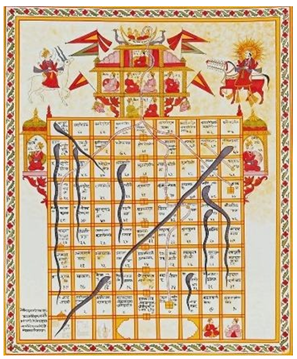
Figure 1
Moksha Patam (Moksha
Patamu / Paramapadham)
3.1.1. Fundamental guidelines, motion, and winning criteria
· Starting at the lowest tile, players get turns moving forward based on dice throws.
· The pawn progresses straight to a higher numbered square when it lands at the base of a ladder; it descends to the tail of a snake when it lands on its head.
· Moksha/Perfection is represented by the last square, which is typically 100 or 10. A player must make an accurate throw to reach it, and the first person to do so wins.
3.1.2. Mechanics with symbolic meaning
· The track represents the samsaric life journey; previously, each square represented a particular virtue or vice, so advancement or punishment directly mapped moral behavior to geographical advancement.
· While snakes represent greed, conceit, lust, and other vices as spectacular falls, ladders represent virtues like faith, charity, knowledge, and humility as abrupt upward mobility, demonstrating how bad deeds can reverse years of progress.
· The idea that the road of virtue is more challenging and brittle than the path of sin is operationalized by the imbalance - fewer ladders than snakes.
3.1.3. Ludic implications
· The Hindu conflict between karma (activity) and fate is highlighted by high randomness; players "choose nothing" other than to accept results, reflecting submission to cosmic law.
· What is really a race is transformed into a didactic pilgrimage by the solitary win state (moksha), where losing serves as a lesson on attachment, ego, and reincarnation.
3.2. Chaturanga
Chaturanga is an early Indian war game and ancestor of chess, modeling four divisions of an army and the political - military sense of kingship. It's played on an × grid with asymmetric movement rules for each piece, and the game is won by landing the opponent’s raja or reducing them to a “bare king.”
Figure 2

Figure 2 Chaturanga
3.2.1. Core rules, movement, and win condition
· Each member of the army - the raja (king), the mantri/vizier (counselor), elephants, horses, chariots, and pawns - has a unique movement pattern that limits the strategies that can be used.
· The raja cannot move into assaulted squares; instead, the player must relocate the raja, move a piece, or capture the attacker if the raja is in danger.
· Although some historical traditions emphasize real capture, a player wins by either leaving the opponent with only the raja (bare king) or by threatening the inevitable capture of the opponent's raja (akin to checkmate).
3.2.2. Symbolism encoded in mechanics
· Chaturanga, the traditional Indian idea of state authority arranged in four arms, is reflected in the fourfold army (elephants, cavalry, chariots, and infantry), which encodes political realism on war and government.
· In line with tales of merit and earned status, the promotion of pawns into higher officers upon attaining the far level represents social mobility via risk and long service.
3.2.3. Ludic implications
· Similar to Arthashastra-style statecraft, the game's low unpredictability and deep strategic depth serve as a training ground for foresight, calculation, and balancing protection and sacrifice.
· A variety of victory conditions, including mate, bare king, and potential stalemate variations, convey the sense that authority can be overthrown directly or gradually through resource depletion.
3.3. Aadu Pulli Attam (Goats and Tigers Game)
In the South Indian asymmetric hunt game Aadu Pulli Attam, a few tigers face off against a lot of goats on a predetermined pattern board. The main conflict is between collective defence and predation: goats attempt to disable tigers by positional blocking, while tigers attempt to seize goats.
Figure 3

Figure 3 Aadu Pulli Attam (Goats and Tigers Game)
3.3.1. Core rules, movement, and win condition
· Three tigers are typically controlled by one side, while fifteen goats are controlled by the other, with turns switching places on a network of crossing lines.
· Tigers can only capture one goat every tiger move; they travel in lines between neighboring junctions and can catch a goat by leaping over it to an adjacent location that is immediately empty.
· After all the goats have been positioned on unoccupied intersections, they are allowed to advance one step along lines. Tigers win if they capture a certain number of goats, usually five or more, while goats win if they block all the tigers, so they are unable to proceed.
3.3.2. Symbolism encoded in mechanics
· The asymmetry - many weak goats vs a few strong tigers—reflects predator-prey relationships and might be seen as a metaphor of dominant versus submissive groupings, landowners versus peasants, or rulers versus subjects.
· Goats, which prioritize group strength over individual power, represent survival via collaboration, encirclement, and spatial intelligence, whereas tigers represent raw might and predatory agency.
· Goats' ability to immobilize tigers despite their inability to capture them embodies a nonviolent resistance ethic: strategic restriction, not counterviolence, is what leads to success.
3.3.3. Ludic implications
· The board is a micro-simulation of ecological and social balance because of the game's distributed emergent difficulty: tigers need measured aggression, while goats need pre-emptive blocking and coordination.
· Players are exposed to both predatory and defensive logics through role-switching between rounds (alternating sides), which encourages contemplation of dependency, vulnerability, and power.
Figure 4
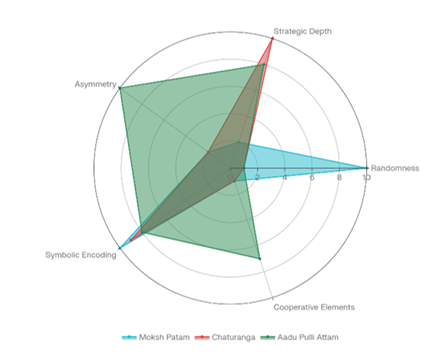
Figure 4 Cultural Encoding in Indian Board Games
4. Conclusion
Mokshapattam (Moksha Patam/Gyan Chaupar) provides a classic example of cultural coding where theories of karma and cosmology are directly integrated into the placement of dice, placement of tracks, and marking of squares. The 10x10 grid is designed as a moral universe: inscribed in separate squares are the virtues (faith, generosity, knowledge, asceticism, etc.) which end in ladders, and the vices (disobedience, arrogance, vulgarity, murder, lust) which begin their descent through the serpents, the 100th square representing moksha or nirvana. The iconography at the top of the board often depicts celestial realms such as Kailasa, Vaikuntha, and Brahmaloka, making the destination space a true cosmological endpoint. In traditional usage, religious teachers explicitly used the rules as mnemonics for ethical categories: the repeated rolls of dice, the expression of square nouns, and the striking visual confrontation of snakes and ladders collectively rehearsed the connection between action, consequences, and spiritual ascension. In a playtest-focused study design using a culturally grounded, Mokshapattam-inspired prototype (up to 120 players or play sessions), one can observe how participants articulate the concepts of "luck", "fate" and "value" in post-game interviews and how quickly they recall the terms virtue/vice, using these emerging narratives as qualitative indicators that karmic and cosmological structures are internalized through mechanics rather than through explicit mechanisms. didactic explanations.
Chaturanga and Aadu Puri Attam extend this codification to the social and strategic realm, modeling hierarchies and asymmetries as culturally significant rather than merely entertaining. The very name Chaturanga, "army of four limbs," refers to the classical Chaturangabara (elephants, chariots, cavalry, and infantry) of the Sanskrit epics and Dharmashastra, whose fragments directly depict these forces on a grid-like battlefield. The existence of kings, ministers/councils, and various types of military forces reflects both strategic military doctrine and a stratified political worldview that relies on sovereign-centered yet existentially subordinate classes. In contrast, Aadu Puri Attam (Goat and Tiger) is a formalization of asymmetry. Three powerful tigers who can jump and catch face off against 15 goats, the goats can't catch them at all, but they can collectively win by immobilizing the tigers. This structure is usually interpreted as a metaphor for unity and shared intelligence overcoming violence. Folklore and educational accounts clearly emphasize how the game teaches teamwork, planning, and the idea that "the weak united can defeat the strong." By testing complex or adapted board games based on these mechanics (again, the observed games maxed out at around 120 scale), researchers can observe how players interpret power relations, that is, who is perceived as "privileged" (kings, tigers) and who are "substitutable" (pawns, goats), and whether strategies tend toward sacrificial play, defensive solidarity, or opportunistic aggression, and the patterns can be interpreted as living metaphors for social hierarchy. and predator-prey dynamics.
In these cases, rules and material design serve as compressed repositories of cultural knowledge that are mobilized for new audiences by contemporary revitalization efforts. Historical and ethnographic sources have already seen Mokshapattam and its associated games as pedagogical tools for moral education, with the combination of marked squares, visually distinctive tokens, and simple tower structures serving as an embodied memory system that conveys ethical rules of do's and don'ts. Recent resurgence efforts such as Kreeda Games, Dice Toy Labs, the Kreeda Kaushalya exhibition at Ramsons Kala Prathishthana, and commerce platforms such as Roll the Dice and MokshaPatam.com demonstrate strong consumer interest in traditional and re-themed Indian games, a trend that has further accelerated during and after the pandemic restrictions. Cultural organizations and heritage portals have also noted strong demand for digital and physical versions of Goats, Tigers, Snakes and Ladders, as well as workshops and festivals dedicated to these games. By designing a study that combines literary historical analysis with systematic game testing (up to 120 participants or sessions), researchers are able to see the surge in popularity not as mere nostalgia but as evidence that modern gamers are actively seeking out games whose squares, tokens, and victory conditions resonate with local cosmologies, ethics, and social experiences, thereby confirming that "cultural games" are a viable market segment and a powerful vehicle for cultural transmission.
|
Sr. No. |
Research focus |
Playtesting focus (up to
~120 samples) |
Cultural encoding
interpreted through mechanics / symbolism |
|
1 |
Mokshapattam encodes karma through dice and progression |
Observe how players explain
“good” vs “bad” throws; elicit narratives about “deserving” ladders or
“punishment” by snakes during debriefs. |
Dice represent contingency
of birth and circumstance; snakes/ladders operationalise karma, making moral
causality experientially salient. |
|
2 |
Chaturanga embodies social
hierarchy and military principles |
Analyse decisions around
king safety vs sacrificing minor pieces; ask players to map pieces to
real-world roles or classes. |
Ruler–minister–troops triad
encodes monarchical hierarchy; spatial tactics mirror Vedic/epic doctrines of
war and formation (vyūha). |
|
3 |
Aadu Pulli Attam as
asymmetric metaphor for predator–prey dynamics |
Track whether novice goats
learn to coordinate blocking patterns over successive plays; document
players’ metaphors (“poor goats”, “powerful tigers”). |
Numerical and movement
asymmetry dramatises structural power imbalance
while rewarding cooperative, anticipatory play by the “weaker” side. |
|
4 |
Rules as mnemonic devices
for transmitting moral teachings |
Note whether players start
repeating or paraphrasing square names and associated qualities without
prompt; assess recall after delay. |
Turn-taking, chanting of
square names, and vivid rewards/punishments turn abstract doctrine into
repeatable, memorable rule-based scripts. |
|
5 |
Board symbolism (squares,
tokens, destinations) maps onto cosmological frames |
Invite players to sketch or
describe “where” they think they travelled on the board; note references to
heavens, hells, or life-journey metaphors. |
Spatial progression from
lower to upper rows reproduces vertical cosmology; tokens act as jīvas traversing samsara toward liberation. |
|
6 |
Contemporary revival shows
demand for culturally grounded gaming |
Use prototypes themed around
these traditions in public or classroom playtests; record uptake, replay
interest, and player comments on “Indianness” or cultural relevance. |
Market traction and
enthusiastic workshop participation indicate that cultural symbolism is a
value-add, not a barrier, for modern players. |
CONFLICT OF INTERESTS
None.
ACKNOWLEDGMENTS
None.
REFERENCES
Adams, E., and Dormans, J. (2012). Game Mechanics: Advanced Game Design. New Riders.
Agnihotri, V. (2020). Strategies Behind the Success of E-Sports (Garena FreeFire). International Journal of Management, 11(11), 14–155. https://doi.org/10.3421/IJM.11.11.2020.14
Barrett, G. (2020). How to Design a Board Game. Board Game Design Lab.
Dickson, G., and Siegel, M. A. (2014). Board Game Design: A Metaphor for the Development of Interaction and Experience Design Methods. In AIGA Design Educators Conference: Methods.
Fields, T., and Cotton, B. (2011). Social Game Design: Monetization Methods and Mechanics. Focal Press. https://doi.org/10.1201/97024017675
Fields, T., and Cotton, B. (2014). Mobile and Social Game Design: Monetization Methods and Mechanics (2nd ed.). CRC Press. https://doi.org/10.1201/b1647
Gauthier, D., and Jenkinson, J. (2018). Designing Productively Negative Experiences with Serious Game Mechanics: Qualitative Analysis of Gameplay and Game Design in a Randomized Trial. Computers and Education. https://doi.org/10.1016/j.compedu.201.0.017
Gonzalo-Iglesia, J. L., Lozano-Monterrubio, N., and Prades-Tena, J. (2018a). The Usage of Game-Based Learning in University Education: How to Motivate and Foster Creativity Among Adult Students Through Board Games. Retrieved from
Gonzalo-Iglesia, J. L., Lozano-Monterrubio, N., and Prades-Tena, J. (2018b). Non-Educational Board Games in University Education: Perceptions of Students Experiencing Game-Based Learning Methodologies. Revista Lusófona de Educação, 41, 45–62. https://doi.org/10.24140/issn.1645-7250.rle41.03
Hamari, J., and Lehdonvirta, V. (2010). Game Design as Marketing: How Game Mechanics Create Demand for Virtual Goods. International Journal of Business Science and Applied Management, 5(1), 14–29. https://doi.org/10.6964/ijbsam.5-1.4
Kalmpourtzis, G., and Romero, M. (2020). Constructive Alignment of Learning Mechanics and Game Mechanics in Serious Game Design in Higher Education. International Journal of Serious Games, 7(4). https://doi.org/10.1703/ijsg.v7i4.361
Kumar, A. G. (2010). Designing Games for Children (at Funskool India Limited). In Designing for Children: Play + Learn. Retrieved from
Lameras, P., Arnab, S., Dunwell, I., Stewart, C., Clarke, S., and Petridis, P. (2017). Essential Features of Serious Games Design in Higher Education: Linking learning Attributes to Game Mechanics. Computers in Human Behavior, 71, 414–425.
Oksanen, K., and Hämäläinen, R. (2014). Game Mechanics in the Design of a Collaborative 3D Serious Game. Simulation and Gaming, 45(4). https://doi.org/10.1177/10467114530799
Pope, L. (2021). Board Games as Educational Tools. The
Journal of Sustainability Education.
Riyandi, M. A. O., Santoso, H. B., and Putra, P. O. H. (2023). The Application of Game Mechanics and Technological Trends in Game-Based Learning: A Review of Research. Jurnal RESTI (Rekayasa Sistem dan Teknologi Informasi), 7(4), 694–703. https://doi.org/10.29207/resti.v7i4.492
Rogersdotter, E. (2015). On Form, Incidence, and Variability of Engraved Game Boards at Vijayanagara (c. AD 1350–1565). Heritage: Journal of Multidisciplinary Studies in Archaeology, 3, 457–496.
Samarasinghe, S., Barlow, M., Lakshika, E., Lynar, D., Moustafa, M., Townsend, A., and Turnbull, B. (2021). A Data-Driven Review of Board Game Design and Interactions of their Mechanics. IEEE Access, 9, 140755–14076. https://doi.org/10.1109/ACCESS.2021.310319
Sousa, M. (2023). Mastering Modern Board Game Design to Build New Learning Experiences: The MBGTOTEACH Framework. International Journal of Games and Social Impact, 1(1), 6–93. https://doi.org/10.24140/ijgsi.v1.n1.04
Sousa, M., Zagalo, N., and Oliveira, A. P. (2021). Mechanics or Mechanisms: Defining Differences in Analog Games to Support Game Design. In 2021 IEEE Conference on Games (CoG) ( 1–). IEEE. https://doi.org/10.1109/CoG52621.2021.9619055
Topsfield, A. (n.d.). Towards a Cultural History of Indian Board Games: Backgammon, Chaupar, and Chaturanga. Sahapedia.
Zichermann, G., and Cunningham, C. (2011). Gamification by Design: Implementing Game Mechanics in Web and Mobile Apps. O’Reilly Media.
|
|
 This work is licensed under a: Creative Commons Attribution 4.0 International License
© ShodhKosh 2026. All Rights Reserved.