ShodhKosh: Journal of Visual and Performing ArtsISSN (Online): 2582-7472
|
|
Political Image Building in Digital and Visual Media: Examining Economic Impacts of Social Media Campaigns on Voter Decision-Making
Anshul Garg 1 ,
Dr. Chanchal Sachdeva Suri 2
,
Dr. Chanchal Sachdeva Suri 2 ,
Surbhi Rawal 3
,
Surbhi Rawal 3
1 Research
Scholar, University Institute of Media Studies, Chandigarh University, Punjab,
India
2 Professor,
University Institute of Media Studies, Chandigarh University, Punjab, India
3 Research Scholar, Department of Economics, Malwanchal
University, India
|
|
|
ABSTRACT |
|
|
With the
growth of the internet‚ social media platforms and image-centric platforms
have emerged such as Facebook‚ Instagram‚ and X (formerly Twitter)‚ that
allow political actors‚ candidates‚ and parties to create and share an
impression management narrative to the public that seeks to construct
perceptions and influence voter behavior․ This text examines the role
of social media campaigns in shaping political brands and influencing voters'
choices․ It also explores the economics of these campaigns‚ including
the impact of advertising spends‚ content creation‚ and targeted messaging on
the perception of political brands and electoral outcomes․ The study
uses behavioral economics concepts to investigate the interaction of economic
circumstances (income‚ employment status‚ and economic outlook) with digital
political campaign communications in order to assess their impact on voter
preferences․ The research seeks to provide insights into the
effectiveness and ROI of social media political campaigns through a mixed-method
approach‚ combining survey data and content analysis․ The results are
expected to shed light on how digital political communication is both a means
of persuasion and an economic activity shaping electoral outcomes‚ resource
distribution and democratic practices․ |
|||
|
Received 21 January 2026 Accepted 16 March
2026 Published 11 April 2026 Corresponding Author Dr.
Chanchal Sachdeva Suri, chanchalssuri@gmail.com DOI 10.29121/shodhkosh.v7.i4s.2026.7513 Funding: This research
received no specific grant from any funding agency in the public, commercial,
or not-for-profit sectors. Copyright: © 2026 The
Author(s). This work is licensed under a Creative Commons
Attribution 4.0 International License. With the
license CC-BY, authors retain the copyright, allowing anyone to download,
reuse, re-print, modify, distribute, and/or copy their contribution. The work
must be properly attributed to its author.
|
|||
|
Keywords: Political Image Building, Social Media, Visual
Messaging, Voter Engagement, Algorithmic Amplification, Authenticity,
Emotional Resonance, Political Communication |
|||



1. INTRODUCTION
Digitization of political communication is one of the biggest paradigm changes in the modern democratic process. The social media mediums have essentially re-organized the flow of communication between political figures, candidates and parties with their constituencies and have moved out of traditional broadcast media into interactive, personalized and visual form of engagement strategy. The emergence of image-based products and services like Instagram, Tik Tok, and Facebook feeds with a substantium amount of visual information has provided a political space to create and manage personal image through a well-pruned visual narrative Farkas and Bene (2021).
The currency of politics, i.e., political image building, the creation of positive publicity, which has long been the key to an electoral victory, have always been the foundation of political legitimacy. The rise of social media, however, has democratized the creation and use of political images by making it a complicated space in which the traditional gatekeeper roles are avoided, authenticity challenged, and the visual framing (as opposed to textual) takes center stage Schill (2012). Modern studies show that content containing visual elements acquires exponentially more engagement rates than text-based content on social media sites, and studies record up to 400% more engagements in reach indicators whenever a visual post was included Kulachai et al. (2024). This shift requires a critical insight into how politicking cultivates visual messages theatrically on various platforms to build, sustain and modify political images in tandem to expectations of the populace and in response to electoral politics.
The academic focus on visual political communication has surged to a higher degree, especially after the spread of high-follower political profiles on visually-based platforms. One of the most remarkable signals of this trend is the number of people that have subscribed to Instagram politicians on the one hand and grew by a factor of three between 2019 and 2021, which is a significant indicator of the centrality of the platform in the current political communication strategies Navarro et al. (2023). This trend in growth indicates that the process of visual image creation has ceased to be an addition to the campaign activity and become a part of the strategy of political involvement. Its implications are not that superficial: visual messages inform the political discourse, and their utilization can impact voters, excite them, and transform the election results Aiello and Parry (2019).
1.1. Research Significance and Scope
This is because the explanation of political image building at the social media level has important implications on various stakeholder groups. To people in the fields of political science and communication scholars, it offers a clue into the processes that make the construction of political legitimacy in digital space possible. To the politicians and their campaign managers, there is a strategic direction provided to them on how to maximize visual communication. To the voters and citizens, it sheds light on the sleek methods of image management that mould their political views and judgments. As a platform designer or a policy maker, it provides information to inform the debate concerning content moderation, algorithmic amplification, and the democratic value of social media Srikandi et al. (2024).
This study is a multifaceted analysis of the multidimensional aspects of image construction in social media, in terms of: (1) the typologies and the features of visual messages used by political actors, (2) strategic processes through which image types and visual styles serve, (3), the connection between the nature of visual communication and audience activity indicators, (4), individual differences between image performance on each platform, and (5) the even larger implications of visual image communication and democratic communication. The detailed review is the synthesis of available empirical studies and recent case studies based on recent election campaigns in different geographic settings.
2. Theoretical Frameworks and Conceptual Foundations
2.1. Visual Communication Theory in Political Contexts
Visual political communication is also the phenomenon that is studied based on a number of developed theoretical traditions. According to the visual framing theory, which was advanced by researchers who studies the media representations, the visual options formed in the framing of the image such as angle, color palette, elements in the background and the placing of the subject, frame political messages in a way that shapes the interpretation and emotional response of the audience Grabe and Bucy (2009). Visual framing does not work the same as textual framing, and involves the processing systems of the viewers that deal with emotions and intuition before analytical processing sets in Khatib (2012).
According to the theory of political personalization, modern political communication is partial to focusing on individual political leaders and is less concerned with parties, ideologies, and policies. This personalization strategy is effectively led by visual communication mechanisms since images in themselves detail the focus on personal faces, bodies, and the surrounding situations. Studies show that the self-personalization strategies applied in the visual media, especially images that highlight politicians in non-political personal environments and portray emotional reactions and facial expressions are strongly associated with the enhanced viewer involvement Navarro et al. (2023). This process makes Instagram and other platforms like it virtual spaces to develop perceived closeness between political leaders and their electorate.
Figure 1
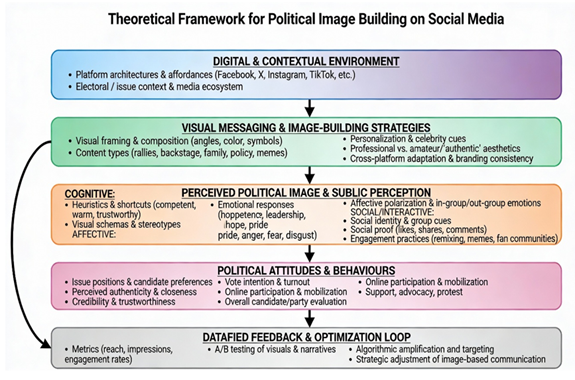
Figure 1
Theoretical
Framework for Political Image Building on Social Media
2.2. Image as Identity Construction
Another important theory that can be useful in analyzing political image building on social media is the identity construction theory. Visual cues such as clothes, setting and activities are used strategically by politicians to convey information about themselves including their political personality and character Dan and Arendt (2025). These visual identity cues can be thought of as visual shorthand, giving the viewer quick access to the attributes of authenticity, competence, trustworthiness and aligned ideology in political personnel, using such dimensions as authenticity, competence, trustworthiness and ideological alignment. A study of the application of visual identity markers by conservative and liberal politicians finds that the applicability of the visual cues varies greatly, with the visual cues giving rise to identity related effects in liberal politicians and not conservative ones indicating that the visual messaging interacts with the pre-existing political orientations Dan and Arendt (2025).
The concept of visual habitus, which concerns a specific visual presentation pattern realized during habituation and repeated performance, can be used to explain the reason why individual politicians acquire a set of visual styles and image types that turn out to be recognizable and memorable to viewers. Such habits of visuality explored specifically via Instagram are semi-conscious collections of aesthetic decisions that assert political identification making a unique personal brand Raynauld and Lalancette (2023).
2.3. Digital Affordances and Platform-Specific Dynamics
The modern political communication research is becoming more cognizant of the fact that platforms are not impersonal conduit mechanisms but active spaces with specific affordances, algorithmic rationalities, and end user characteristics affecting communication activity Bossetta (2018). Each of Facebook, Instagram, Twitter, Tik Tok, and Snapchat offers various visual capacities, audience demands, time dynamics (ephemeral and persistent materials), and interaction. These platform disparity give rise to significant differences in the way in which politicians are using visual communication, and which image features can cause an audience response Bossetta (2018).
This scene is further complicated by the commodification of social media, with platforms now relying on algorithmic curation and sponsored content systems to dictate the visibility of content, providing policies to encourage the politician to craft visual messages tailored to how they can be amplified by algorithms instead of actually being of personal interest to the user Strand and Schill (2019). This process brings about conflict of authenticity and strategic calculation because politicians have to trade authenticity with strategic management of their image.
3. Visual Content Typologies in Political Communication
Political actors deploy diverse categories of visual content on social media, each serving distinct strategic functions and generating different audience responses.
Table 1
|
Table 1 Visual Content Typologies in Political Communication on Social Media |
|||
|
Visual
Content Category |
Defining
Characteristics |
Strategic
Function |
Engagement
Effectiveness |
|
Portrait/Headshot
Images |
Close-up
photographs of political figure's face; formal or semi-formal attire; neutral
or positive facial expression |
Establish
personal brand identity; facilitate facial recognition and memorability;
express professional competence |
High
engagement; creates perceived intimacy and connection |
|
Informal/Lifestyle
Imagery |
Politicians
in casual settings; non-political activities; family contexts; candid
expressions; everyday environments |
Humanize
political figure; demonstrate relatable personality; build authentic persona;
personal connection cultivation |
Moderate
to high engagement; particularly effective on Instagram for privatization
personalization |
|
Rally
and Event Photography |
Crowd
scenes with politician prominently featured; mass gatherings; campaign
events; supporter interaction |
Demonstrate
political support and popularity; create momentum perception; show grassroots
engagement; validate legitimacy through mass assembly |
Moderate
engagement; effectiveness varies by context; crowd size communicates
political viability |
|
Policy
and Substantive Imagery |
Visual
representations of policy proposals; charts and data visualizations;
construction projects; infrastructure development; demonstrable
accomplishments |
Communicate
competence and programmatic substance; provide tangible evidence of policy
delivery; address substantive political concerns |
Lower
engagement on visual-primary platforms; more effective for detailed policy
communication on secondary platforms |
|
Text-Based/Quote
Graphics |
Inspirational
or political quotes; values statements; key campaign messages; branded text
overlays on visual backgrounds |
Communicate
ideological positioning; convey values-based messaging; maximize textual
reach within visual format; easy content sharing |
Moderate
engagement; highly shareable; enables rapid message dissemination |
|
Celebrity
and Influencer Endorsement |
Images
featuring politicians with celebrities, influencers, or prominent figures;
social capital demonstration; association imagery |
Transfer
social status and cultural capital; reach celebrity followers; leverage
influencer credibility; expand audience reach |
High
engagement; leverages celebrity follower bases; effectiveness depends on
endorser relevance and audience alignment |
|
Lifestyle
and Personal Interest Imagery |
Politicians
engaged in hobbies, sports, cultural activities, family moments; humanizing
contexts |
Communicate
relatability and personal interests; build parasocial relationships;
demonstrate emotional dimensions; cultural alignment signals |
Moderate
to high engagement; particularly effective for younger audiences;
platform-dependent effectiveness |
|
Dramatic/Theatrical
Imagery |
High-contrast
visuals; artistic photography; emotionally evocative imagery; saturated
colors; dramatic lighting; professional photography composition |
Generate
emotional resonance; create memorable visual impressions; differentiate from
competitor messaging; maximize emotional engagement |
Variable
engagement; highly context-dependent; effectiveness increases during
electoral periods |
3.1. Platform-Specific Image Deployment Patterns
A study comparing political visual communication on various platforms demonstrates the existence of considerable variations in the deployment on the platforms. Politics-related, candidate-focused images on Facebook are overused by political organizations and politicians and included more policy content and formal political situations. The audience of Facebook users leans more towards older age groups that already have political interests, thus setting them expectations of engaging content. Therefore, Facebook politicians focus on visual branding of policy platforms and the political success Stieglitz and Dang (2013).
Instagram is an opposite platform, which serves as a means of personal brand development and communication of the life styles. Instagram users show more interest in informal, privatized posts with politicians that do not involve political images, relaxed environments, and personal experiences Lalancette and Raynauld (2019). The preference of aesthetic visual composition and narrative construction in the sequences of images developed in the platform forms the incentive structures based on the motivation to curate personal images rather than to communicate in a formal way. The Instagram profiles of politicians, in turn, include much greater shares of lifestyle and informal pictures than Facebook Stieglitz and Dang (2013).
New types of short-form content such as Tik Tok and Instagram Reels give virality to visual content, which is often humorous and immensely shareable and not as time-intensive. The visuals used by the political actors on these platforms are theatrical, emotionally loaded and culturally appealing visual images in conjunction with dynamic visual presentation methods such as rapid cuts, transitions and overlay text. This type of platform shows the best interaction rates and at the same time has difficulties with message control and even toning of the message Kulachai et al. (2024).
4. Audience Engagement and Effectiveness Analysis
4.1. Engagement Metrics and Visual Content Relationship
Empirical study of political posts on the social media shows that there are homogeneous correlations between the visual post content features and the audience activity. The initial conclusion proves the hypothesis that the rate of engagement with visual-dominant posts actually is much more pronounced among both all the significant platforms. A meta-analysis of political material on Instagram that has been analyzed by Peng (2021) with the assistance of computer vision identification also revealed specific visual features that were associated with increased engagement values Peng (2021).
Table 2
|
Table 2 Visual Characteristics and Audience Engagement Effects |
|||
|
Visual
Characteristic |
Average
Engagement Increase |
Primary
Platforms |
Effect
Mechanism |
|
Presence
of Recognizable Face |
+34-55% |
Instagram,
Facebook, TikTok |
Facial
recognition triggers attention; face-based processing prioritizes humans;
emotional signal transmission |
|
Smiling
Expression |
+27-62% |
All
platforms |
Positive
emotion communication; approachability perception; reduced threat perception |
|
Close-Up
Framing |
+21-68% |
Instagram,
TikTok |
Intimacy
perception; emotional intensity; reduced spatial distance communication |
|
Crowd/Large
Group Presence |
+14-75% |
All
platforms |
Social
proof; popularity demonstration; perceived support validation |
|
Warm
Color Palette (Red, Orange, Yellow) |
+17-72% |
Visual-primary
platforms |
Emotional
arousal; positive affect association; visual salience enhancement |
|
Professional
Photography Quality |
+11-8% |
All
platforms |
Competence
signaling; legitimacy communication; aesthetic appeal |
|
Diverse
or Minority Representation |
+19-7% |
All
platforms |
Inclusivity
communication; identity alignment for represented groups; representation
validation |
|
Outdoor/Natural
Settings |
+9-.82% |
Instagram,
TikTok |
Authenticity
perception; accessibility communication; environmental stewardship signaling |
4.2. Emotional Resonance and Persuasive Effectiveness
In addition to the indicators of mechanical engagement (likes, comments, shares), the political image building also operates based on the emotional appeal and message appeals. Neuroscience studies of visual political communication indicate that politics in the form of images interacts with one of the emotional processing centres such as emotion centres before a conscious analytical processing happens. Emotional facial expressions and, especially, positive emotions enhance quicker and stronger emotional reactions in comparison with written messages or graphs and charts Grabe and Bucy (2009).
Manipulation of emotive value becomes a potent instrument in the modern day political image construction. By comparing and contrasting 2024 European Parliament elections, it is possible to see that in pre-election periods, negative images generated by populist political parties with an emotional subtext are strategically used to recruit supporters and develop emotional states such as anger, fear, disgust Aiello and Parry (2019). By comparison, positive emotional images of hope, unity, and progress are more prevalent by establishment political parties. These affective appeals are compounded with previous voter orientations and ideological devotion, which indicates that emotional visual advertising is the most convincing messages to the voters who were already inclined toward accepting the emotional appeal Dan and Arendt (2025).
4.3. Credibility and Authenticity Perception
Visual cues convey credibility and authenticity signals that determine the voter trust and candidate evaluation. The studies analyzing the aspects of credibility in visual storytelling in politics single out several visual qualities of increased perceived credibility: professional quality of photographic work, visual branding, temporal consistency, contextual relevance, the correspondence of visual display with communicated information Page and Duffy (2018).
Ironically over-visual professionalization may destroy the impression of authenticity, especially in the domain where personal interaction and close experiences are in the spotlight. The dichotomy between the polished and professional imagery, and the unfiltered and seemingly unfiltered documentation poses strategic challenges to the political communicators Lukyanova and Kalashnikova (2025). Applicants are forced to consider visual chic to the point of appearing competent and visual honesty. This balance differs significantly between platforms and demographic audiences as younger voters often care more about apparent authenticity than professional polish, whereas older voters express the opposite preferences Stieglitz and Dang (2013).
5. Digital Platforms and Algorithmic Architecture in Political Image Distribution
5.1. Platform-Specific Algorithmic Dynamics
These environments are algorithmic in their nature as now in the contemporary generation of building political images platforms are being designed to dictate the content that is visible, the audience accessibility, and the results of engagement. A range of platforms use radically different algorithmic logics to establish disparate incentive structure to political communicators Bossetta (2018).
The algorithmic structure of Facebook gives importance not only to engagement: comments, shares, and time-consuming interaction but also to emotionally-resonant content. This produces incentive systems that encourage imagery that is highly emotional or divisive, or potentially controversy generating. Therefore, politicians who use Facebook apply more inflammatory or emotionally charged visual content than on other platforms. Being interest-based and thus valence-blind, the algorithm promotes negative political content, inflammatory content, and divisive content at a considerable level of amplification Aiello and Parry (2019).
The algorithm of Instagram places emphasis on visual quality and aesthetics, moving the traffic to visual appealing content, professionally written content, and aesthetically balanced content. This site design encourages professional photography of high quality and integrated visual branding. Investing in professional photographers and visual designers, politicians therefore get better amplification through algorithms in Instagram than high-quality content created at fast speeds Peng (2021).
The algorithm of TikTok is focused on swift attention capture and completion of the watch-time, putting an emphasis on the short and catchy videos having interesting hooks and emotional appeal. The algorithm does not consider the number of followers or even the account status but gives precedence to all content during the first distribution. Political communication has become democratized through this type of architecture, allowing oppressed political voices to gain tremendous reach, at the same time spreading false information and false imagery virally Kulachai et al. (2024).
5.2. Strategic Algorithmic Optimization and Image Selection
Data analytics are becoming increasingly popular in sophisticated political campaigns that ensure improved visual messaging to be optimally amplified through algorithms. Campaigns can monitor a performance measurement based on visual traits, and trial variants of the test images on sub-scale sizes and, based on the performance responses, permittively refine the visual objectives Peng (2021). Such data-driven methodology can be seen as a break of the intuitive or creative image selection processes towards the image optimization based on algorithms.
Analysis of political images using computer vision allows performance analysis and qualification of images in large volumes. A study that examined Instagram posts made by political advertisers who use a visual image analysis tool found that there were strong relationships between particular visual content and the results of engagement, allowing the exploitation of successful visual capabilities Peng (2021). Such technical capability of systematically analyzing and maximizing image qualities is a strong addition to the old-fashioned regime of image selection in campaign images.
6. Comparative Analysis: Visual Political Communication Across Geographic Contexts
6.1. Electoral Campaign Case Studies and Geographic Variations
Comparative analysis of political image building across diverse geographic and electoral contexts reveals significant variations in visual communication strategies, cultural aesthetics, and audience response patterns.
Table 3
|
Table 3 Comparative Visual Political Communication Strategies Across Electoral Contexts |
|||
|
Electoral
Context |
Dominant
Visual Strategy |
Key
Visual Themes |
Notable
Characteristics |
|
2024
European Parliament Elections |
Emotionally-charged
populist imagery; nationalist symbolism; crisis framing |
Nationalist
identity; anti-immigration; economic crisis; national sovereignty |
High
prevalence of negative emotion cultivation; anger and fear prominent;
attack-focused messaging; divisive content emphasis |
|
2024
Brazilian Presidential Elections |
Polarized
visual messaging; dramatic theatrical imagery; personality-focused
communication |
Opposing
candidate attacks; personal character emphasis; partisan identity; emotional
mobilization |
Extreme
visual polarization between competing campaigns; substantive policy imagery
minimal; personality conflict emphasis |
|
Spain
and India Comparative Study |
Visual
personalization and celebrity politics integration; lifestyle imagery
prominence |
Individual
leader glorification; personal achievements; lifestyle moments; cultural
identity signaling |
Distinct
cultural aesthetic variations; different visual norms across contexts;
varying reliance on formal versus informal imagery |
|
2024
Indonesian Presidential Election |
Visual
commodification and influencer integration; mass event imagery; personalized
emotional framing |
Personality-based
image building; influencer endorsements; crowd demonstrations; emotional
storytelling |
Strategic
influencer partnerships; Instagram-central communication; lifestyle
personalization prominence; audience commodification |
|
United
States Political Communication |
Platform-diversified
visual strategies; demographic-targeted imagery; rapid-response visual
content; AI-generated imagery emergence |
Multi-platform
consistency; demographic personalization; rapid response to events; emerging
AI-generated content |
Sophisticated
data analytics integration; demographic microtargeting; video-primary
orientation; synthetic media emergence |
6.2. Cultural Specificity and Aesthetic Variation
Visual communication works within culturally-specialized aesthetic standards and anticipations of visual culture that construct both production and reception of visual politics. Comparative examination of how politicians in Spain and India communicate using Instagram shows that there is a great deal of cultural divergence in the interpretation of visual appealing images and focus on strategies Navarro et al. (2023). The Instagram accounts of Spanish political leaders are more focused on formal images that are written in a professional manner and represent European aesthetics with their preference to visual sophistication and aesthetic elegance. The profiles of Indian political leaders are marked by a higher level of using color-saturated and emotionally dramatic images with regard to particular aesthetic preferences and the culture of visual communication.
Such aesthetic differences do not just concern a selective taste but generally cultural values on what are considered public/private boundaries, presentation of authority, emotional expression, and acceptable expression of politics. Compared to Spanish political communication, which values a high level of restraint in expression of emotions and reserved use of emotive aspects, Indian political communication shows a greater risk of emotionally inflated imagery, drama styles, and glamorized celebrity-ness Hermawan (2025). Such cultural differences prove that building and sustaining a political image cannot be explained by some universal principles but should be analyzed culturally and taken into consideration how the meaning of vision is formed within the frames of cultural-specific interpretative systems Navarro et al. (2023).
7. Strategic Implications and Political Effects
7.1. Image-Based Political Communication and Voter Influence
Voter behaviour and the implications of visual messaging, whilst showing predictable but subtle relationships, are studied empirically through the image effects in politics. The strongest result shows that the influence of visual materials on the affective reactions, including emotional reactions, feeling thermometer ratings among the voters, is more desirable than the cognitive appraisals of policy positions. The emotional impressions created by visual imagery of politicians in turn form issues assessment and preference of candidates Grabe and Bucy (2009).
Nonetheless, there seems to be more involved in the interaction between visual impression and real electoral action. Effects on the visual images play significantly with the preexisting attitudes, affiliation with the party, and ideological adherences among the voter. Prejudiced yourself voters often see unclear visual signals as affirming their preconceived judgments, which is known as confirmatory bias, whereas disbelievers often see the same image negatively Dan and Arendt (2025). This bias interpretation means that the image of seeing is the best method of the persuasion of the voters with moderate or undecided votes and less effective with the hard political opinions.
Image effect dynamics also make evaluation difficult due to the temporal effects. Visual impressions produce short-term affective reactions and often quickly fade away when voters are exposed to conflicting information and go through electoral cycles. The image effect is necessitated by repetition of exposure and being strengthened by other visual messages and this is why sustained image campaign is more effective in comparison to isolated visual intervention Grabe and Bucy (2009).
7.2. Authenticity, Manipulation, and Democratic Implications
The growing sophistication of politics image creation is an issue that of great concern in terms of integrity on the authenticity, manipulation and democratic communication integrity. The visual representation brings certain challenges to both genuine cherishing and strategic efficiency of self-expressiveness. In any case, all political imagery is selection, curation and presentation- what to capture at what angle, which background to choose and how to configure visual information. These choices produce visual discourse, which constitutes and shapes political identity Raynauld and Lalancette (2023).
New technologies such as AI-generated imagery and advanced photo editing bring about a further layer of intricacy since they generate some visual image that is no longer directly documented in any event. The art of AI-generated images allows one to make photorealistic images of the events that never took place, claims that were never said, and settings that have never been encountered. Although nowadays the legal and regulatory consequences of such appearances seldom allow considering synthetic imagery generated by politicians misleading, often voters that have been exposed to such an image are unable to understand who captured a photograph and who created it, which leaves a significant risk of being manipulated Kulachai et al. (2024).
Individual deceit is not the only area where the ethics of the matter are at risk but also the larger issue of democracy. Political image construction is increasingly done according to mechanisms that cannot be subjected to examination or to any form of public discourse. The fact that the mechanisms of the algorithms that decide which imagery gets to which audiences are highly immersive in places that are not easily observed by the masses. The algorithmic amplification of visual content through data driven optimization of visual content avoids turning politics into a process of democratic deliberation and rather turned politics into an engineered process of persuasion. These systems provoke some basic questions about the independence of voters, the reasonable consent, and the circumstances needed to make an authentic choice in democracy Bossetta (2018).
7.3. Platform Power and Political Gatekeeping
The social media political image building activity takes place in the settings where the platform companies enjoy a significant degree of the gatekeeping power in terms of content visibility, reach of the audiences, and communication opportunities. Platform algorithms dictate what politicians images go where, with the results of electoral viability/political impact. Polarization, amplification of misinformation, and the breakdown of democracy are common outcomes of the algorithmically-determined search of the engagement-maximizing content Bossetta (2018).
The ability of platforms to alter algorithmic rules, limit specific content categories or downprank certain political actors makes dependencies in which the electoral viability of politicians is in some manner dependent on decisions made regarding platform architecture that they cannot control. Platforms have the power to gatekeep political communication through recent examples of platforms removing, deprioritizing, or restricting the reach of content by certain politicians, based on the argument over misinformation or breach of community standards, which can be viewed as evidence of the gatekeeping of political communication Bossetta (2018).
8. Economic Dimensions of Social Media Campaigns in Political Image Building
Another example of the economization of politics is how the digitalization of political campaigning has made it increasingly contingent on finance․ Different aspects of the political campaign on social media require a substantial amount of investment․ Hiring influencers‚ buying data analytics tools‚ and funding target political advertisements contributes to the financialization of the political brand․ Political parties and candidates have budgeted to maximize political reach and interaction through algorithmic advertising that targets based on demographic‚ economic‚ or location-based characteristics of potential voters․
From the economic point of view‚ political campaigns via social media have been described as the attention economy where attention is the commodity and voter engagement is the product․ Compared to paid advertising via television and newspapers‚ it is relatively cheap for political actors to promote their message via paid advertising‚ sponsored content and micro-targeting on social media․ They can also provide measurable returns in terms of the click-through rate‚ engagement and conversion into voting support․
Economic conditions also affect voters' responses to political messages․ Those facing unemployment‚ inflation‚ and other economic problems tend to be more responsive to targeted political messaging․ Behavioral economic theories of judgment and decision-making assume that reasoning is not the only element of decisions: emotions and economic incentives towards economic stimuli also play a role․ From this perspective‚ the social media campaigns can include an economic dimension besides the political one․ This dimension shapes the production and reception of political content․
9. Conclusion
The study on Political Image Building in Digital and Visual Media: Examining Economic Impacts of Social Media Campaigns on Voter Decision-Making points out that contemporary political communication is heavily mediatised by economic processes and digital technologies․ Politicians configure their social media as economic resources and spend financial capital to develop‚ establish‚ manage and increase their digital identities on these platforms․ Beyond saving campaign funds‚ data-driven‚ targeted communications can increase the efficiency by which messages are communicated to specific segments of voters when compared to customary political campaigning․
Economic models of political stage building on online platforms see it as a marketplace for attention‚ engagement‚ and voter perceptions․ Its market value is reflected in campaign budgets for advertising‚ audience analysis and research‚ and content generation‚ which increasingly focus on return on investment․ The online environment has supported the transformation of political campaigning into goal-oriented endeavors․ And voters' economic self-interests‚ as expressed by their reported income level‚ unemployment status‚ or perceptions of the economy‚ affect their responses to online messages․
The study illustrates the relevance of behavioral economics for the study of voting behavior‚ specifically the importance of non-cognitive influences through social media and images․ Furthermore‚ the study has shown that political image management is no longer an exercise in political communication․ Rather‚ it is now an economic endeavor with far-reaching implications for voting‚ election outcomes and trust in democracy․
In summary‚ economic factors influence social media use among voters‚ politics and elections․ In studying digital political communication‚ economics provides understanding into ethics‚ transparency‚ resource allocation and a host of other issues․ Economics suggests a path to improving how campaigns use technology and how technology is improving‚ rather than weakening‚ democracy․
CONFLICT OF INTERESTS
None.
ACKNOWLEDGMENTS
None.
REFERENCES
Aiello, G., and Parry, K. (2019). Visual Communication: Understanding Images in Media Culture. https://doi.org/10.4135/9781529721522
Bossetta, M. (2018). The Digital Architectures of Social Media: Comparing Political Campaigning on Facebook, Twitter, Instagram, and Snapchat in the 2016 US election. Journalism and Mass Communication Quarterly, 95(2), 471–496. https://doi.org/10.1177/1077699018763307
Dan, V., and Arendt, F. (2025). Visuals as Identity Markers in Political Communication on Social Media: Evidence for Effects of Visual Cues in Liberals, but Not in Conservatives. Mass Communication and Society, 28(4), 605–631. https://doi.org/10.1080/15205436.2024.2333404
Farkas, X., and Bene, M. (2021). Images, Politicians, and Social Media: Patterns and Effects of Politicians' Image-Based Political Communication Strategies on Social Media. The International Journal of Press/Politics, 26(1), 119–142. https://doi.org/10.1177/1940161220959553
Grabe, M. E., and Bucy, E. P. (2009). Image Bite Politics: News and the Visual Framing of Elections. Oxford University Press. https://doi.org/10.1093/acprof:oso/9780195372076.001.0001
Green, J. M. (2014). Visual Imagery on Social Media: Increasing Power Through the Use of Photographs on Social Media.
Hermawan, V. (2025). Political Communication in the Digital Era: The Role of Social Media in Shaping Public Opinion in the 2024 Election. Jurnal Ilmiah Multidisiplin Indonesia (JIM-ID), 4(5), 160–169.
Hoffmann, M., and Neumayer, C. (2025). Images of protest in movement parties' social media communication. New Media and Society, 27(8), 4929–4952. https://doi.org/10.1177/14614448241243352
Khatib, L. (2012). Image Politics in the Middle East: The Role of the Visual in Political Struggle. Bloomsbury Publishing. https://doi.org/10.5040/9780755610785
Kulachai, W., Chayanon, S., and Srisorn, W. (2024). Political Communication and Political Success: The Art of Effective Messaging. Kasetsart Journal of Social Sciences, 45(2), 681–694. https://doi.org/10.34044/j.kjss.2024.45.2.35
Lalancette, M., and Raynauld, V. (2019). The Power of Political Image: Justin Trudeau, Instagram, and Celebrity Politics. American Behavioral Scientist, 63(7), 888–924. https://doi.org/10.1177/0002764217744838
Lukyanova, G. V., and Kalashnikova, E. A. (2025). Visual Storytelling as a Strategy for Online Political Communication. In 2025 Communication Strategies in Digital Society Seminar (ComSDS) (125–128). IEEE. https://doi.org/10.1109/ComSDS65569.2025.10971298
Navarro, C., Ganapathy, D., and Raynauld, V. (2023). Visual Culture, Personalization, and Politics: A Comparative Analysis of Political Leaders' Instagram-Based Image-Making and Communication in Spain and India. International Journal of Strategic Communication, 17(4), 381–397. https://doi.org/10.1080/1553118X.2023.2209572
Page, J. T., and Duffy, M. E. (2018). What Does Credibility Look Like? Tweets and Walls in US Presidential Candidates' Visual Storytelling. Journal of Political Marketing, 17(1), 3–31. https://doi.org/10.1080/15377857.2016.1171819
Peng, Y. (2021). What Makes Politicians' Instagram Posts Popular? Analyzing Social Media Strategies of Candidates and Office Holders with Computer Vision. The International Journal of Press/Politics, 26(1), 143–166. https://doi.org/10.1177/1940161220964769
Raynauld, V., and Lalancette, M. (2023). Social Media, Visuals, and Politics: A Look at Politicians' Digital Visual Habitus on Instagram. In Research Handbook on Visual politics (167–180). Edward Elgar Publishing. https://doi.org/10.4337/9781800376939.00021
Schill, D. (2012). The Visual Image and the Political Image: A Review of Visual Communication Research in the Field of Political Communication. Review of Communication, 12(2), 118–142. https://doi.org/10.1080/15358593.2011.653504
Srikandi, M. B., Latupeirissa, J. J. P., Ramadiansyah, S. A., Dewi, N. L. Y., Pramana, I. B. G. A. Y., and Prayana, I. K. R. (2024). Social Media Politics: Analysis of Political Elite Image Construction in Multiple Country Elections. Multidisciplinary Reviews, 7(11), 2024278. https://doi.org/10.31893/multirev.2024278
Stieglitz, S., and Dang-Xuan, L. (2013). Social Media and Political Communication: A Social Media Analytics Framework. Social Network Analysis and Mining, 3(4), 1277–1291. https://doi.org/10.1007/s13278-012-0079-3
Strand, R. T., and Schill, D. (2019). The Visual Presidency of Donald Trump's First Hundred Days: Political Image-Making and Digital Media. In Visual political communication (167–186). Springer International Publishing. https://doi.org/10.1007/978-3-030-18729-3_9
|
|
 This work is licensed under a: Creative Commons Attribution 4.0 International License
© ShodhKosh 2026. All Rights Reserved.